When the Word
Fell Silent
The spirit behind Tatpada
There is a beautiful account preserved in the tradition of Jagadguru Sri Chandrasekhara Bharati Mahaswamigal, the 34th Acharya of the Sringeri Sharada Peetham.
In him, immense scriptural learning and profound inner realisation met naturally. The scriptures were not merely texts he had mastered. Their truth had become the life he lived.
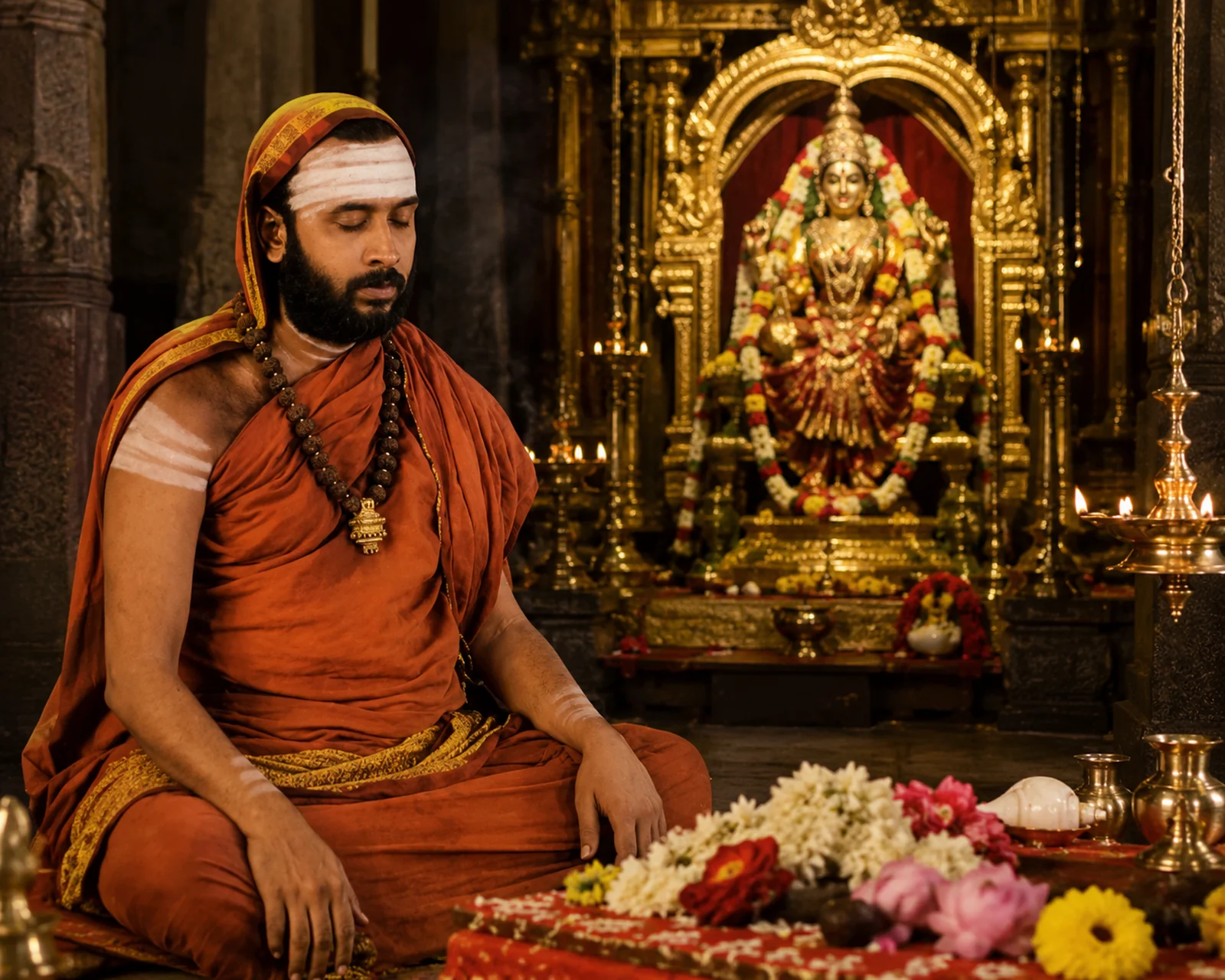
One day the Acharya was performing archana before Sri Sharadamba, offering worship through the sacred names of the Lalitā Sahasranāma. Name followed name until he came to:
ॐ तत्पदलक्ष्यार्थायै नमः
oṁ tatpadalakṣyārthāyai namaḥ
She who is the Reality indicated by the word Tat — “That”.
And there, the worship paused.
Not because he had forgotten the next name, or because anything had interrupted the pūjā. The meaning itself had drawn him inward.
For one who had lived with the Upaniṣads, Tat carried immeasurable depth. In Tat Tvam Asi — “That Thou Art” — it points beyond every name, form and limitation to the one Reality that is not distant from us or separate from us.
And here the Divine Mother is called Tatpadalakṣyārthā. She is not merely one who leads us towards that Reality. She is Herself what the word ultimately points to.
There is a subtle beauty in this name. A sacred word may first offer a meaning the mind can approach: Brahman as the source and sustainer of the world. Yet it can also point beyond that immediate meaning to Brahman free of every limiting attribute. This is the force of lakṣya: that which is indicated. The Reality spoken of and the Reality ultimately indicated are not two.
For the Acharya, this was no longer an idea awaiting explanation. The sacred word had fulfilled its purpose.
Recitation gave way to contemplation.
Contemplation deepened into silence.
He became absorbed in samādhi. The heart of the story is not how long that absorption lasted, but what it reveals: he had heard a sacred word so completely that it opened into the Reality it had been pointing to all along.
Why this story sits behind Tatpada
Sacred texts were never meant merely to become information.
We can learn a verse, understand its grammar and read pages of commentary, yet still leave its truth outside our lives. These things are precious. They preserve the teaching, remove confusion and prepare us to listen more deeply. But scripture invites us further: to contemplate what we have heard, absorb its essence and live by it.
Our Gurudeva reminds us that reading alone is not enough. A teaching must become something we can turn to when life brings its challenges and tests. Those moments invite us to delve deeper, allowing what we have contemplated in quiet to guide how we respond.
We may meet what comes as the unfolding of our karma, cultivating vairāgya: fulfilling our responsibilities with inner detachment, without letting each outcome disturb our peace. Through bhakti, we may surrender our lives to God, seeking only to love and please Him, and rest in that surrender rather than in changing circumstances. Through jñāna, we may recognise that we are the Ātman, the Self, untouched by all that passes through body and mind, and abide in that unshaken peace.
The invitation is not to become indifferent to life. It is to meet it fully, with love and care, while remaining inwardly free.
This is where contemplation becomes lived understanding: the teaching no longer remains on the page. It accompanies us into life.
What Tatpada can offer
No interface can confer samādhi. No commentary can replace sādhana. And no collection of words can substitute for the living guidance and grace of the Guru.
What Tatpada can offer is a quiet space to dwell with the words of the great ṛṣis, ācāryas and saints: to read slowly, reflect deeply and return to a teaching until its meaning begins to take root within us.
The grace that makes the teaching living
Contemplation is not merely an exercise of thought. Understanding ripens through śraddhā, through sādhana and through the grace of the Guru.
A sentence we have read a hundred times may open through a word of guidance, a gentle correction or the silent presence of one who has realised its truth. The Guru does not simply give us more information about scripture. The Guru helps scripture become living truth.
What we try to do
We begin with the text. We honour its original language, listen to its sound and unfold its meaning with care. We turn to the tradition and its great commentators, allowing one text to illuminate another.
We seek language that remains faithful without making a living teaching feel distant or clinical. Then we make room for silence, and for the patient work of living what we have understood.
The purpose is not simply to know more about the Truth. It is that, through contemplation, sādhana and the grace of the Guru, what first appeared as words on a page may become something we recognise within ourselves — and live from.
That possibility is why Tatpada exists.
The word is precious because of what it points to.
And what it ultimately points to is not somewhere beyond us.
It points to the Source — our very Self.
Tatpada
The word, and what it points to.