Direct Inquiry
Writings of Ramaṇa Maharṣi, and companion works of contemplation on the Self.
Bhagavan Sri Ramana Maharshi: his worksAppaḷappāṭṭu, Aruṇācala Aṣṭakam, Aruṇācala Navamaṇimālai…
- AppaḷappāṭṭuA kitchen song made for his mother while she rolled appaḷam, the crisp lentil wafer. Each ingredient and utensil becomes a step of self-inquiry: the grain is the "I" conceit, the grinding stone is the question "who am I?"
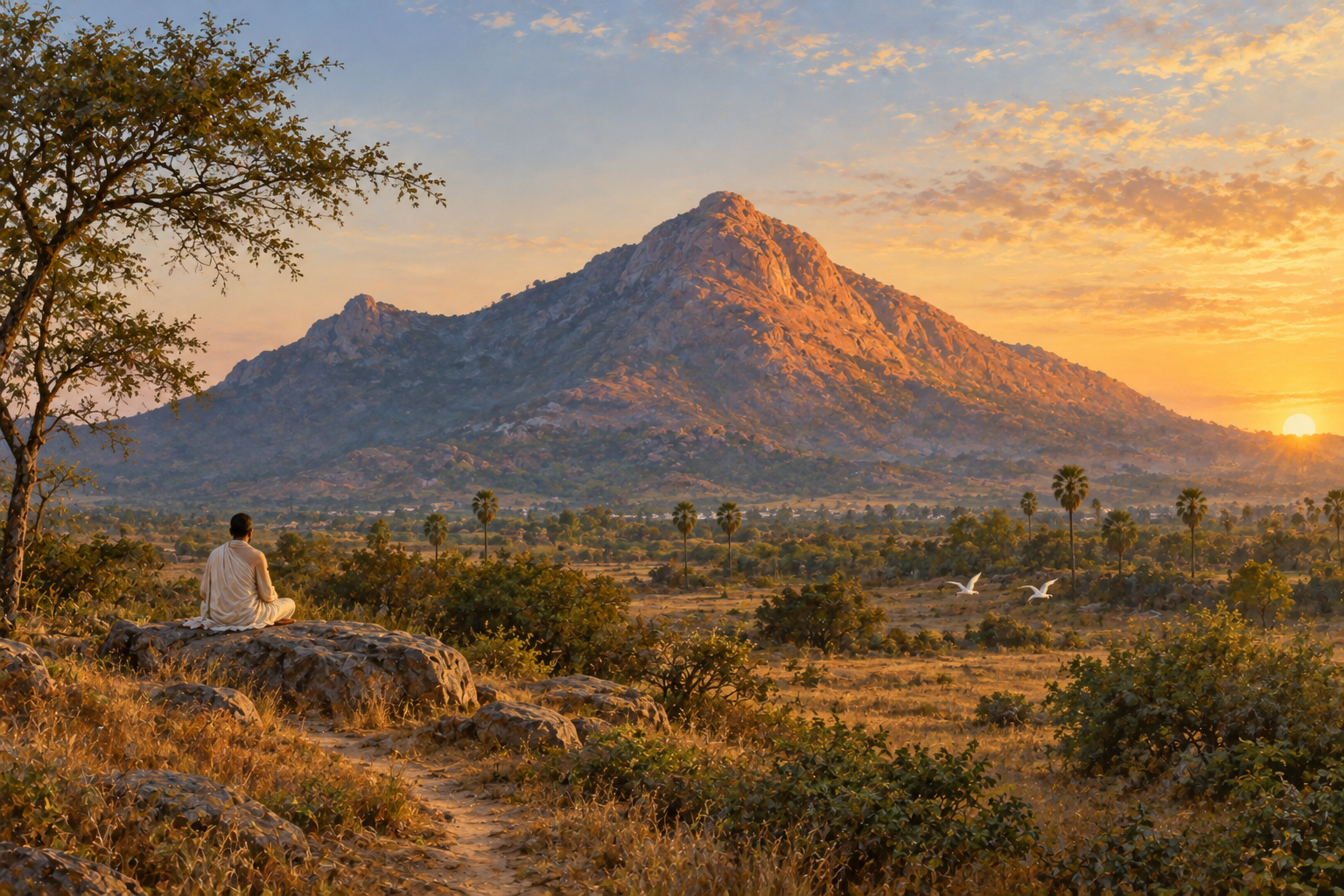
- Aruṇācala AṣṭakamEight verses on the hill itself: how the name Aruṇācala filled his mind from childhood before he knew it was a place, and how, looking for the one who saw it, he found the seer gone and the hill standing. Spoken as they came, unasked.
- Aruṇācala NavamaṇimālaiNine verses to Aruṇācala in varied metres, a garland of nine gems: Śiva's dance at Chidambaram stilled into this hill, "you are That" set down as red rock and light, and the plea to be kept as his own.
- Aruṇācala PadikamEleven verses of a lover's complaint to Aruṇācala, the mountain that draws lives to itself like a magnet: you took me by grace when I never once thought of you, and now you hide your face — finish what you began.
- Aruṇācala PañcaratnamFive verses on Aruṇācala as the Heart itself, first written in Sanskrit and then in his own Tamil: all that is seen is a painting on you; in the Heart something dances saying "I, I"; ask where that "I" rises.
All 12 textsThe first 5 only
- Ātma VidyāA song on how easy Self-knowledge is — "a berry lying in the open palm", says the refrain, which Muruganar wrote. Ramaṇa's five verses say how: let the thought "I am this body" sink, and what remains is the Self.
- Ēkātma PañcakamBhagavān's last composition: five short verses on the one Self. Forgetting it is a dream of wandering, asking where it is is the drunkard's question, the body is in it as a picture on its cloth, and the First Guru taught it in silence.His last composition, February 1947: five veṇbās written first in Telugu and rendered into Tamil by Bhagavān himself.
- Nāṉ Ār?"Who am I?" — Ramaṇa's answers to Sivaprakāśam Piḷḷai's questions, later rewritten by him as one essay of twenty paragraphs: not the body, senses or mind; the thought "I" is the root of every thought; ask where it rises.Bhagavān's answers to Sivaprakāśam Piḷḷai, which he later rewrote himself as one continuous essay of twenty-one paragraphs.
- Uḷḷadu NāṟpaduForty verses on "what is", his fullest statement of the teaching: the world and the one who sees it rise together; find where the "I" comes from and both fall away. Written when Muruganar asked for the nature of reality and the way to it.
- Upadeśa SāramThirty Tamil verses framed as Śiva's counsel to forest sages who trusted in ritual action alone: from action done without desire, through devotion and breath, to abiding as the Self. Written at Muruganar's request to finish his poem.
- Vicāra Saṅgraham"Self-Inquiry": the replies Ramaṇa wrote out for Gambhīram Seshayya in his years of silence, set down as forty questions and answers on how to find what one really is, and how that differs from yoga and other paths.The replies Bhagavān wrote out for Gambhīram Seshayya while keeping silence, set down as forty questions and their answers.
- VicāramaṇimālaiThe essentials of the Tamil Vicāra Sāgaram, which Bhagavān drew out himself for a devotee who found the book too long: a disciple asks and the Guru answers, from why bliss seems to come from objects to what liberation in the body is.The essentials of the Tamil Vicāra Sāgaram, drawn out by Bhagavān himself in 1909 and set as a dialogue between a disciple and the Guru, after a maṅgala verse and its meaning.
Bhagavan Sri Ramana Maharshi: his Tamil renderingsĀtma Sākṣātkāra, Ātmabodha, Śrī Dakṣiṇāmūrti Stotram…
- Ātma SākṣātkāraŚiva's instruction to his son Guha on the direct realisation of the Self, from the jñāna-pāda of the Sarvajñānottara Āgama: the Self bears none of the marks laid on it, and the contemplation by which that mistake falls away.Translated into sixty-two Tamil veṇbās by Bhagavān in 1933, with an opening benediction verse of his own.
- ĀtmabodhaŚaṅkara's sixty-eight verses on the knowledge of the Self: why knowing ends bondage where doing cannot, told through the rope and the snake, the water and the salt — and closing in the Self as Brahman, one's own.All sixty-eight stanzas rendered into Tamil veṇbās by Bhagavān in 1948, keeping the treatise's own order.
- Śrī Dakṣiṇāmūrti StotramŚaṅkara's hymn to Dakṣiṇāmūrti, Śiva teaching in silence: the world seen the way a city is seen in a mirror, a lamp shining out through the openings of a pot — one awareness present through every changing state.Rendered into Tamil viruttam by Bhagavān, the printed sequence opening with a meditation on the silent teaching.
- Śrī DevīkālottaramThe knowledge chapter of the Devīkālottara, an Āgama spoken by Śiva to Devī, in eighty-five Tamil veṇbās: what a seeker holds to and what he lets go of, and the conduct that keeps him steady in it.Rendered into eighty-five Tamil veṇbās by Bhagavān, keeping the Āgama's own order of knowledge and conduct.
- Śrī Bhagavad Gītā SāramForty-two verses of the Bhagavad Gītā, chosen and set into Tamil veṇbā: Kṛṣṇa answering Arjuna's grief — the Self is never slain, act without seizing the fruit, and turn the whole of it over to Him.Selected and arranged by Bhagavān at G. V. Subbaramayya's request, and rendered into four-line Tamil veṇbās.
All 8 textsThe first 5 only
- Guru StotramEight verses recalling the guru to what 'That thou art' declares — sung, in the story the collection prints beside them, by Śaṅkara's own disciples to bring him back to himself while he wears a king's body.Rendered into Tamil by Bhagavān with the narrative that frames it; the printed collection titles it Gurustuti.
- Hastāmalaka StotramThe boy Hastāmalaka's answer to Śaṅkara's question 'Who are you?': not the body, not a name, not a station — ever-present awareness, appearing through many minds as the sun appears in many waters and divided by none.Bhagavān's Tamil verse rendering keeps the question, the boy's reply, and the explanation of his name.
- Vivekacūḍāmaṇi — Tamil proseŚaṅkara's crest-jewel of discrimination, in Bhagavān's own Tamil prose: what the Self is and what has only been taken for it — from the qualifications a seeker needs, through enquiry, to the freedom of one established in it.Bhagavān's free Tamil prose rendering, first published in 1908, distinct from Ulakanātha Swāmi's Tamil verses.
Bhagavan’s teaching, through his disciplesGuru Vācaka Kōvai, The Path of Sri Ramana, Śrī Ramaṇa Catvāriṃśat…
- Guru Vācaka KōvaiThe Tamil verses in which Sri Muruganar recorded Bhagavān Śrī Ramaṇa Maharṣi's sayings, with the verses Bhagavān himself wrote into the work, in three parts and their prefatory verses, each with an English translation.
- The Path of Sri RamanaSri Sadhu Om's account of Bhagavān Śrī Ramaṇa's teaching and its practice: why happiness lies in attending to ourself, what ātma-vicāra is and is not, and in Part Two, God, the world, bhakti and karma.
- Śrī Ramaṇa CatvāriṃśatForty Sanskrit verses in which Gaṇapati Muni praises his guru, Bhagavān Śrī Ramaṇa Maharṣi, with an invocation and a closing verse: the teacher seen at close hand, his silence, gaze and compassion, and Skanda come to earth as a man.Gaṇapati Muni's forty verses in praise of Bhagavān Śrī Ramaṇa Maharṣi, with an invocation and a closing verse.
- Talks with Sri Ramana MaharshiQuestions asked in the hall at Tiruvannamalai between 1935 and 1939, and how Sri Bhagavan answered them.
Classic texts of inquiryAmṛtānubhava, Aṣṭāvakra Gītā, Avadhūta Gītā…
- AmṛtānubhavaJñāneśvar's Marathi poem on "the nectar of experience": non-duality known directly, not argued. Ten chapters that begin from Śiva and Śakti as one lover in two bodies, and take apart knowledge and ignorance alike.
- Aṣṭāvakra GītāKing Janaka asks the sage Aṣṭāvakra how knowledge, freedom and detachment come; the answer is that they are already the case. Twenty chapters of terse verses on the Self as untouched witness, and Janaka's own awakening.
- Avadhūta GītāA song of one who has shaken everything off: the Self is never bound and never freed, untouched by body, mind, practice or path. Eight chapters spoken by Dattātreya, the wandering sage, in the voice of the free.
- Bṛhat YogavāsiṣṭhaThe full, unabridged Yogavāsiṣṭha: Vasiṣṭha teaches the young Rāma, entire, across six books and near thirty thousand verses — the same source Laghu Yoga Vāsiṣṭha condenses, told here without abridgment.
- Kaivalya Navaneetham"The cream of liberation": Tamil Advaita in 288 verses. First a plain exposition of what is real; then a disciple brings his doubts one by one — the world, karma, the guru, the Self — and the guru clears each.
Sri Sathya Sai Baba: the VāhinīsJñāna Vāhini, Praśānti Vāhini, Praśnottara Vāhini…
- Jñāna VāhiniHis Telugu discourse on Self-knowledge in twelve chapters: its four obstacles and the four kinds of jñānī, the mind as the cause of bondage and freedom, devotion as the lamp of jñāna, and the fourfold sādhana behind self-inquiry.
- Praśānti VāhiniHis Telugu discourse on peace in twelve chapters: its place as the foundation of every sādhana, the obstacles that dissolve it, and dispassion and devotion as the paths that restore it.
- Praśnottara VāhiniHis Telugu Q&A in fifteen chapters on liberation and its obstacles: the fourteen worlds, the four āśramas, the five sheaths, yoga and jñāna, and women's standing in brahma-vidyā.
- Sandeha NivāriṇīHis Telugu dialogues between a devotee and Swāmi in eighteen Prabodhas, clearing doubts on the spiritual path: the Bhārata and Rāmāyaṇa within each person, gurus and disciples, dhyāna and the forms seen in it, the Manas and the tattvas.