Sri Vidyaranya
12.1380 - 1386Dakshinamnaya Sri Sharada Peetham, Sringeri
4 chapters
Sri Vidyaranya
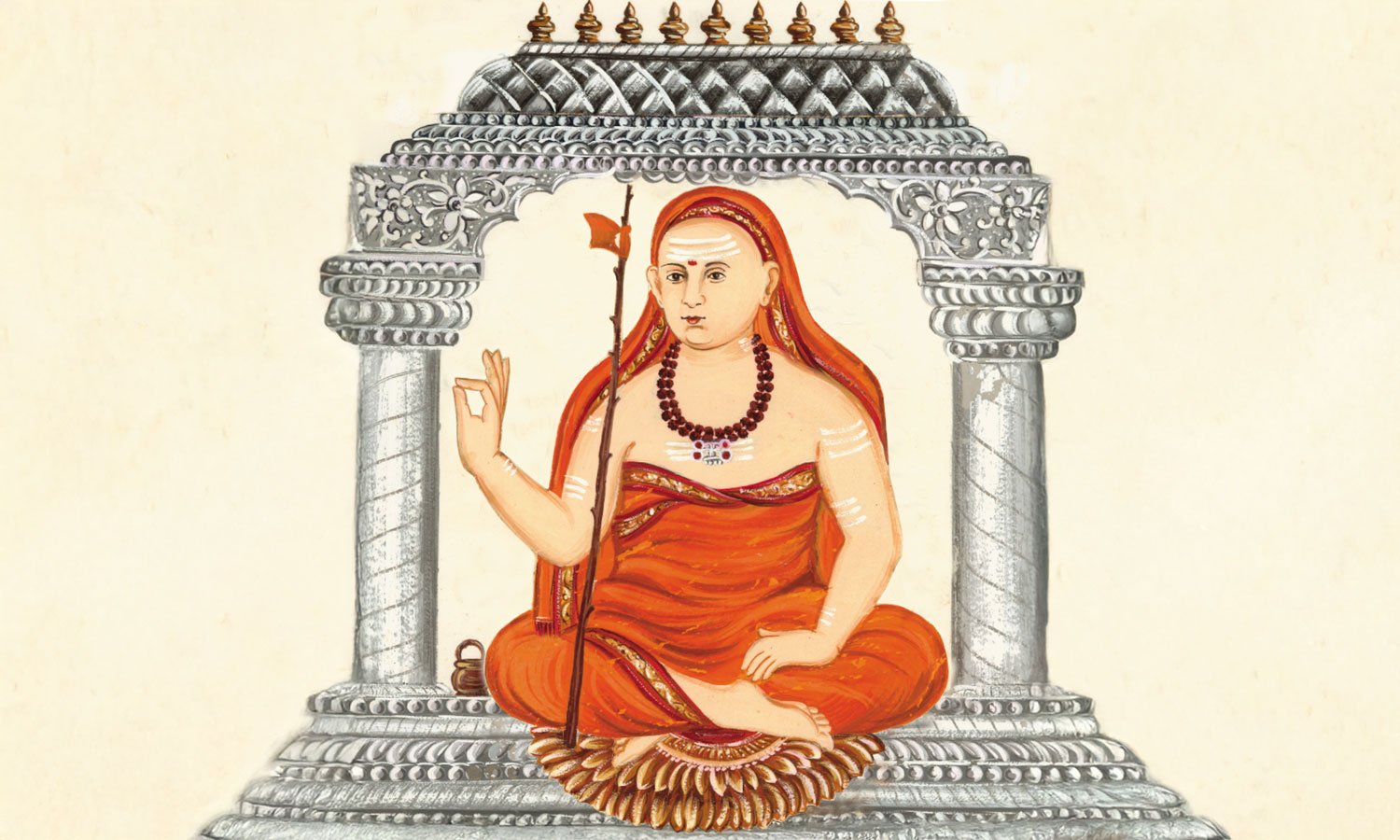
अविद्यारण्यकान्तारे भ्रमतां प्राणिनां सदा ।
विद्यामार्गोपदेष्टारं विद्यारण्यगुरुं श्रये ॥
To souls that wander in utter dismay in the dense woods of mental ignorance,
He shows the path of true wisdom; Homage to the great Saint Vidyaranya!
The Illustrious Twelfth Acharya
Five centuries after the divine advent of Sri Shankara Bhagavatpada, Sri Vidyaranya ascended the sacred Sringeri Sharada Peetham as its twelfth Jagadguru Shankaracharya. Though He graced the Vyakhyana Simhasana for a relatively brief period from 1380 to 1386 A.D., His visionary leadership and incomparable contributions to Vedantic philosophy brought unparalleled glory to the Math and transformed the spiritual landscape of India.
Transformation of Sringeri
Under Sri Vidyaranya's extraordinary guidance, Sringeri underwent a remarkable metamorphosis while simultaneously witnessing the birth of a great empire. What had been a peaceful collection of hermitages blossomed into a magnificent spiritual empire vested with both religious and temporal authority. The Vyakhyana Simhasana—the Throne of Transcendental Wisdom—at the Sharada Peetham became the seat of administrative governance over the newly established Samsthanam, while His visionary counsel gave rise to the Vijayanagar Empire itself.
This unique synthesis of the sacred and the secular, manifested both at Sringeri and in the founding of Hampi as the empire's capital, ignited a powerful renaissance of cultural pride and spiritual unity throughout southern India. His strategic genius in establishing Vijayanagar as a bulwark against invasive forces while nurturing it as a center of learning and devotion awakened a renewed sense of dharmic identity that would resonate for centuries.
Founder of Vijayangar Empire and Sacred City of Hampi
Jagadguru Sri Sri Vidyaranya Mahaswamiji stands as the supreme architect of both spiritual renaissance and political resurgence in medieval India. His visionary genius gave birth to the mighty Vijayanagar Empire—a Hindu kingdom that would stand as Dharma's shield against foreign invasions for over three centuries. As the spiritual mentor and guiding force behind the empire's founders, Harihara and Bukka, He transformed a strategic vision into historical reality.
At Hampi, on the banks of the sacred Tungabhadra, Sri Vidyaranya established what would become the jewel of the Vijayanagar Empire. This was no mere act of city planning but a profound spiritual undertaking—the creation of a sacred metropolis where temporal power would serve eternal dharma. The magnificent temples He constructed at both Sringeri and Hampi stand as enduring testimony to His architectural vision, while the numerous Maths He founded across the subcontinent created an extensive network for disseminating Vedanta's eternal wisdom.
His role transcended that of a spiritual advisor; He was the empire's true architect, weaving together political strategy, economic prosperity, and cultural flowering into a unified vision of dharmic governance. Under His guidance, Vijayanagar became not merely a kingdom but a civilization—a beacon of Hindu renaissance that attracted scholars, artists, and devotees from across the known world.
Yet His greatness transcended even these monumental achievements. He embodied a rare combination of spiritual realization, political acumen, and scholarly excellence. As a writer and philosopher, His works occupy an exalted position in the treasury of post-Shankara Advaitic literature. His profound interpretative genius enabled Him to resolve apparent contradictions across various philosophical texts, revealing the underlying unity that pervades all authentic Vedantic teachings.
Unparalleled Literary Contributions
While Sri Adi Shankaracharya remains unsurpassed in establishing and disseminating the fundamental truths of Advaita Vedanta, Sri Vidyaranya distinguishes Himself among subsequent Acharyas through the remarkable depth, breadth, and accessibility of His scholarly works. His writings demonstrate an extraordinary ability to make the most profound philosophical insights comprehensible to sincere seekers while maintaining rigorous intellectual precision.
Among His numerous invaluable contributions to Vedantic literature, two masterworks shine with particular brilliance—the Panchadasi and the Jivanmukti Viveka. These luminous treatises, crafted respectively for spiritual aspirants and accomplished renunciates, have earned universal acclaim for their crystalline clarity of exposition and their rich treasury of authoritative scriptural quotations. Through these works, the most subtle truths of Advaita become accessible to dedicated students while offering profound insights for advanced practitioners on the path of liberation.
The enduring influence of these texts continues to guide countless seekers across the centuries, transforming the bewildering forest of spiritual ignorance into a clear pathway illuminated by the radiant light of self-knowledge.
Biography of Sri Vidyaranya
The Early Journey of Two Brothers
Tradition holds that Madhava was the elder of two brahmachari brothers, born into a poor yet profoundly learned Brahmin family of Ekasila Nagari (present-day Warangal, Telangana). While Madhava remained immersed in his studies, His younger brother embarked on a sacred journey southward in pursuit of ultimate knowledge. Destiny guided His footsteps to Sringeri during the illustrious reign of Jagadguru Sri Vidyatirtha.
Recognizing the innate spiritual magnificence radiating from this young seeker, the Acharya bestowed upon Him sannyasa diksha in 1328 A.D., conferring the sacred name Sri Bharati Tirtha. Meanwhile, Madhava had set forth in search of His beloved younger brother. After extensive wandering, He too arrived at the hallowed precincts of Sringeri, discovering His brother now serving as the junior pontiff, Sri Bharati Tirtha Mahaswamiji.
At Sri Bharati Tirtha's heartfelt request, Jagadguru Sri Vidyatirtha Mahaswamiji graciously initiated Madhava into sannyasa in 1331 A.D., bestowing upon Him the prophetic name Sri Vidyaranya—truly signifying "a forest of knowledge." Though younger in chronological age, Sri Bharati Tirtha was honored as the senior among the two by virtue of His earlier initiation into the sannyasa ashrama, becoming known as the senior Sripada, while Sri Vidyaranya was lovingly referred to as the junior.
The Mystic's Pilgrimage and Divine Initiation
Sri Vidyaranya Mahaswamiji then embarked upon a transformative sacred pilgrimage, arriving first at the eternal city of Kashi. Under the direct guidance of Sri Veda Vyasa Himself, He proceeded to the sublime heights of Badrikashrama, where the immortal sage personally initiated Sri Vidyaranya into the profound mysteries of Sri Vidya. This divine initiation would prove foundational to His later spiritual accomplishments and the empire-building that would follow.
Upon returning to the South, Sri Vidyaranya withdrew to the sacred solitude of Matanga Hill near Hampi, where He became absorbed in the deepest states of meditation. It was during this period of intense sadhana that two scholarly brothers, Madhava and Sayana—sons of Mayana of the Bharadwaja Gotra—approached the great sage seeking His divine blessings.
With characteristic magnanimity, Sri Vidyaranya entrusted them with His unfinished commentaries on the Vedas and other scholarly works, blessing them to complete and publish these monumental texts under their own names as the renowned Madhaviyam and Sayaniyam respectively. These brothers would later serve with distinction as ministers in the Vijayanagar Empire under the successive reigns of Bukkaraya and Harihara I and II, demonstrating how spiritual grace translated into worldly competence.
The Founding of the Mighty Vijayanagar Empire
While Sri Vidyaranya remained immersed in profound meditation on Matanga Hill, destiny approached in the form of two warrior brothers, Harihara and Bukka, sons of Sangama. This divine encounter would lead to the establishment of the great Vijayanagar Empire—one of the most powerful and enduring Hindu kingdoms in Indian history. Guided by divine dreams, these future emperors sought the sage's blessings and counsel for what would become the founding of an empire that would stand as dharma's mighty fortress for over three centuries.
Their extraordinary journey from captivity in Delhi—where they had been reportedly compelled to embrace Islam—to becoming the founders of India's greatest Hindu empire exemplifies the transformative power of Sri Vidyaranya's guidance. The Sultan, recognizing their exceptional valor, had eventually dispatched them southward at the head of an army tasked with suppressing the revolts erupting across the Deccan.
Seizing this providential opportunity, the brothers instead asserted their independence under Sri Vidyaranya's divine direction, launching the historic founding of the Vijayanagar Empire. With His blessings, they established this sovereign kingdom initially on the left bank of the Tungabhadra River, later shifting to the right bank according to the sage's strategic counsel.
In profound reverence, they named their imperial capital Vidyanagara—"City of Knowledge"—honoring their guru whom they regarded as protector, guide, and divine manifestation. This city, destined to become the legendary Vijayanagara or "City of Victory" and the heart of their vast empire, was laid out under Sri Vidyaranya's personal supervision in the sacred form of a Sri Chakra, with the ancient Virupaksha temple at its cosmic center and nine gates surrounding it like the petals of a divine lotus.
Karnataka Simhasana Pratishtapanacharya
The empire's foundation in 1336 A.D. was not merely a political event but a sacred act of dharmic restoration. As recorded in a copper plate bearing the royal signature Virupaksha: "Harihara was seated on the throne as directed by Vidyaranya. He made the sixteen great gifts resplendent in the city called Vidya, of vast dimensions."
In an unprecedented gesture of spiritual submission, Emperor Harihara placed all His imperial insignia at the feet of Sri Vidyaranya, receiving in return initiation into Atmavidya and the exalted titles Srimad Rajadhiraja Parameshwara, Aparimita Pratapavira, and Narapatin. This momentous event earned Sri Vidyaranya the eternal title "Karnataka Simhasana Pratishtapanacharya"—the Establisher of the Lion Throne of Karnataka—an honor that remains an integral part of every Sringeri Jagadguru's Birudavali to this day.
The Illustrious Tenure at Sringeri
Meanwhile, the spiritual life at Sringeri continued to flourish under profound guidance. Jagadguru Sri Vidyatirtha Mahaswamiji attained mahasamadhi through lambika yoga, and was succeeded by Sri Bharati Tirtha Mahaswamiji, who became the 11th Jagadguru of the Sringeri Sharada Peetham, adorning the Vyakhyana Simhasana from 1333 to 1380 A.D.
During this period, Sri Vidyaranya continued His pilgrimage to Varanasi while Sri Bharati Tirtha commenced construction of the magnificent Vidyashankara Temple over the sacred chamber where His guru had entered lambika yoga samadhi. When Bukkaraya and Harihara, advancing from victory to victory in their imperial conquests, visited Sringeri in 1346 to receive Sri Bharati Tirtha's blessings, they commemorated the occasion with generous land grants to the Peetham.
Bukkaraya, ever devoted to the Peetham, conveyed these developments to Sri Vidyaranya in Kashi, forwarding Sri Bharati Tirtha's srimukha inviting His earliest return to Sringeri. Complying with this noble summons, Sri Vidyaranya journeyed southward, pausing at Hampi where He had earlier established a Math near the sanctified precincts of the Virupaksha Temple, before proceeding to Sringeri accompanied by Bukkaraya Himself.
The Twelfth Jagadguru's Glorious Reign
Upon Sri Bharati Tirtha Mahaswamiji's mahasamadhi, Sri Vidyaranya ascended the Vyakhyana Simhasana as the twelfth Jagadguru of the Sharada Peetham. Though His direct reign spanned merely six luminous years from 1380 to 1386 A.D., He governed the Math with unmatched wisdom and transformative vision. It was during this sacred period that He initiated the emperor into the sacred path of Atmavidya (self-realization), completing the spiritual education of His royal disciple.
In 1386, the Acharya Himself attained videha mukti, leaving behind a legacy of unparalleled brilliance that would illuminate centuries. Shortly thereafter, Harihara visited Sringeri and established the Agrahara of Vidyaranyapura—an enduring tribute to His guru, the sage who had illumined an empire and transformed a civilization.
Champion of Dharmic Renaissance: Srirangam, Madurai & Beyond
Sri Vidyaranya's empire-building was inseparable from His broader mission of dharmic restoration. Under His guidance, Vedic Dharma—which had suffered devastating setbacks under foreign rule in northern India—found its strongest bastion in the South. This revival manifested across multiple dimensions: politically through the establishment of the resurgent Vijayanagar Empire, and socio-religiously through the restoration of temple worship at sacred sites including the renowned temples of Srirangam and Madurai, where devotional practices had been suspended.
His visionary leadership transformed not only the physical landscape but the spiritual consciousness of an entire civilization. During His era, temples in and around Sringeri were refurbished and expanded. The Vidyashankara temple emerged as the most architecturally distinguished of the new constructions, while Sri Bharati Tirtha replaced the original sandalwood image of Sri Sharada—consecrated by Sri Adi Shankaracharya over a Sri Chakra on a sacred rock—with the present golden image, also significantly enlarging the temple.
Other important shrines were established: the Bharati Ramanatha temple was constructed over the adhishtanam of Sri Bharati Tirtha Mahaswamiji, while the Vidyavishweswara temple was built in honor of Sri Vidyaranya Mahaswamiji. Sri Vidyaranya also made grants for the worship of Gopinatha at Paschimavahini—a few furlongs from Sringeri on the westward bend of the Tunga—and consecrated lingas and Sri Chakras at various sacred sites.
Under His direction, the Vijayanagar emperors and their feudatories undertook extensive renovations and grand expansions of hundreds of temples, as recorded in Mysore inscriptions that mention grants made specifically under His guidance or in His honor. Most significantly, Sri Vidyaranya expanded the very mission of the Sringeri Sharada Peetham itself. While previous Jagadgurus had focused primarily on imparting Brahmavidya to dedicated spiritual aspirants, from His era onwards the Peetham took on the additional responsibility of prescribing proper modes of temple worship and guiding the socio-religious activities of millions of disciples, instilling in them both dharmic discipline and the paths to moksha.
Network of Spiritual Institutions
Under Sri Vidyaranya's guidance, the emperors of Vijayanagar made generous endowments to several Maths founded either by Him or by His illustrious predecessor, Sri Bharati Tirtha, across various parts of southern India. Some of these institutions rose to prominence as branches of the Sringeri Sharada Peetham, while others functioned as affiliated monastic establishments furthering the cause of Advaita.
Notable examples include the grant made by Prince Chikka Raya—later known as Virupaksha I—to Sri Satyatirtha of the Muniyur Math, marking the genesis of the Sakatapuram or Bandigade Math. Hariharapura, an agrahara situated approximately six miles from Sringeri, was established by Harihara II, with Sri Ramachandra Saraswati installed as the first Acharya of the Math founded there.
The Tirthamuttur Math in present-day Tirthahalli taluk and the Kudali Math were also founded in subsequent centuries under the continued patronage of the Sringeri Jagadguru Shankaracharyas and the emperors. Additionally, the Agraharas of Sringapura and Vidyaranyapura were laid out by Harihara II as enduring tributes to the spiritual renaissance spearheaded by the Peetham.
Unparalleled Literary and Philosophical Genius
Beyond His monumental achievements as empire-founder and spiritual guide, Sri Vidyaranya embodied a rare combination of mystical realization, political wisdom, and scholarly brilliance. As a writer and philosopher, His works occupy an exalted position in the treasury of post-Shankara Advaitic literature. His profound interpretative genius enabled Him to harmonize seeming divergences across philosophical texts, illuminating the essential unity that pervades all authentic Vedantic teachings.
While Sri Adi Shankaracharya remains unsurpassed in establishing and disseminating the fundamental truths of Advaita Vedanta, Sri Vidyaranya distinguishes Himself among subsequent Acharyas through the remarkable depth, breadth, and accessibility of His scholarly works. His writings demonstrate an extraordinary ability to make the most profound philosophical insights comprehensible to sincere seekers while maintaining rigorous intellectual precision.
Among His numerous invaluable contributions to Vedantic literature, two masterworks shine with particular brilliance—the Panchadasi and the Jivanmukti Viveka. These luminous treatises, crafted respectively for spiritual aspirants and accomplished renunciates, have earned universal acclaim for their crystalline clarity of exposition and their rich treasury of authoritative scriptural quotations.
Imperial Recognition of Divine Nature
The imperial recognition of His divine nature is captured magnificently in the copper plate inscriptions of His royal disciples. As recorded in May 1384: "Sri Vidyaranya's powers of exposition are more wonderful than those of Brahma; He can make (by His dialectics) the eloquent mute and (by His teaching) the mute eloquent."
Even more remarkably, in the Sringeri Plate of Harihara II dated May 1386, they declared: "Can He be Brahma? We do not see four faces; can He be Vishnu? He does not have four hands; can He be Shiva? No oddness of the eyes is observed. Having thus argued for a long time, the learned have concluded that Vidyaranya is verily the Supreme Light Incarnate."
A Resplendent Jewel Among Jagadgurus
Although Sri Vidyaranya headed the Sringeri Math for only six years, His association with the Peetham during the illustrious leadership of Jagadguru Sri Bharati Tirtha Mahaswamiji spanned over five decades, leaving an indelible mark on the spiritual life of the age. The Vidyatirtha–Bharati Tirtha–Vidyaranya epoch heralded the rise of the Sharada Peetham to unparalleled eminence and firmly established it as a beacon in the preservation and propagation of Sanatana Dharma.
Sri Vidyaranya stands out as a singular figure among the scholars and sages of the post-Shankara era, rightly revered as a profound thinker and visionary whose influence shaped the course of Advaitic thought and Indian civilization itself. He is truly regarded as one of the brightest jewels in the glorious lineage of the Sringeri Guru Parampara.
विद्याविद्याविवेकेन पारं संसारवारिधेः ।
प्रापयत्यनिशं भक्तान् तं विद्यारण्यमाश्रये ॥
Homage to this serene Vidyaranya who holds aloft the torch of discrimination
Between knowledge of the Real and the unreal,
And helps the devoted cross the vast ocean of worldly existence!
The Vijayanagara Empire
Birth of Vijayanagara
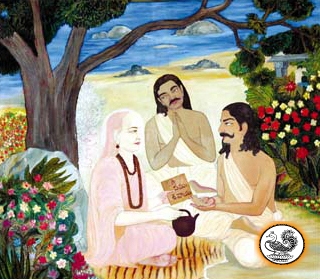
It was while Sri Vidyaranya was doing tapas at Matanga hill that the two warrior brothers, Harihara and Bukka, sons of Sangama, approached him. Directed by a dream, they sought his blessings and guidance. Earlier, these two brothers had been taken prisoner and led to Delhi. It is believed they were under compulsion to embrace Islam. But the Delhi ruler recognising their valour sent them back to the south. They were sent back as the heads of an army to contain the rebellions brewing in the Deccan.
Seizing this opportunity, the two brothers asserted their independence. With the guidance and blessings of Sri Vidyaranya, they established their own independent kingdom with its capital on the left bank of Tungabhadra river. Following the sage’s counsel, they shifted their capital to the right bank, naming it Vidyanagara, as a mark of respect and gratitude to the sage, whom they regarded as their Guru, God and saviour. The city, which came to be popularly known as Vijayanagara or City of Victory was planned in accordance with the directions of sage Vidyaranya in the form of a Sri Chakra, with the Virupaksha temple in the middle and nine gates all around.
Karnataka Simhasana Pratishtapanacharya
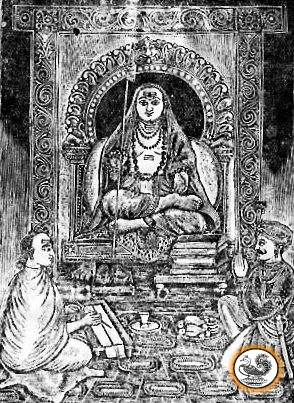
A copper plate grant of 1336 A.D bearing the sign manual ‘Virupaksha’ recounts, ‘Harihara was seated on the throne as directed by Vidyaranya. He made the 16 great gifts resplendent in the city called Vidya, of vast dimensions” The emperor placed at the feet of his master Sri Vidyaranya, all his imperial insignia. Sri Vidyaranya initiated him into Atmavidya and conferred on him the titles, Srimad Rajadhiraja Parameshwara, Aparimita Pratapavira and Narapatin. From then on, the Sringeri Jagadguru came to be addressed as ‘Karnataka Simhasana Pratishtapanacharya’ which is part of their birudavali even to this day.
Works of Sri Vidyaranya
A Renaissance Scholar of Universal Genius
Sri Vidyaranya's extraordinary literary corpus demonstrates the breadth of a truly universal scholar, spanning disciplines that encompass the entire spectrum of sacred and secular knowledge. His mastery extended across Vyakarana (grammar), Mimamsa (scriptural interpretation), Smriti (legal texts), Purana (mythological literature), astronomy and astrology, Mantra Shastra (science of sacred formulas), music, Darshana (philosophical systems), and above all, Advaita Vedanta. This remarkable range reflects not merely scholarly erudition but the integrated wisdom of a realized sage who could illuminate truth from every angle of inquiry.
Among His most significant works stand towering contributions including Jaiminiya Nyayamala, Parashara-smriti Vyakhyana, Smriti Sangraha, Vyavahara-Madhava, Sri Vidyatirtha-Dipika, Vivaranaprameya Sangraha, Panchadasi, Jivanmukti Viveka, Drik-drishya-viveka, Aparokshanubhuti-Tika, and six illuminating Upanishad-Dipikas. Each work represents a masterpiece in its respective field, demonstrating His ability to synthesize complex philosophical insights with practical wisdom.
The Crown Jewel: Panchadasi
Among this illustrious collection, the Panchadasi stands as Sri Vidyaranya's crowning achievement in Advaita Vedanta. Named for its elegant division into fifteen chapters (pancha-dashi), this monumental work explores the deepest metaphysical and spiritual truths with unprecedented clarity and systematic precision. The treatise serves as both a comprehensive introduction for sincere seekers and a profound reference for advanced practitioners, demonstrating Sri Vidyaranya's unique gift for making the most sublime truths accessible without sacrificing their depth.
The Panchadasi's enduring popularity across centuries testifies to its exceptional quality—it remains one of the most studied and revered works in Vedantic literature, offering a complete roadmap for understanding the non-dual nature of reality and the practical path to self-realization.
Scholarly Syntheses and Commentaries
In the Brihadaranyavartikasara, Sri Vidyaranya presents a masterful condensation of Sri Sureshwaracharya's comprehensive Vartika, distilling its essential insights while maintaining the original's scholarly rigor. This work exemplifies His remarkable ability to synthesize vast bodies of knowledge into accessible formats without losing their essential meaning.
His Dipikas (illuminating commentaries) on the Aitareya and Taittiriya Upanishads, as well as His exposition of Sri Adi Shankaracharya's summary of the twelve principal Upanishads, demonstrate His role as a bridge between the foundational texts and contemporary understanding. These works continue to serve as standard references for students seeking to comprehend the Upanishadic teachings in their full depth.
The Sacred Biography: Madhaviya Shankara Vijaya
The Madhaviya Shankara Vijaya represents Sri Vidyaranya's excellence in devotional literature, combining historical accuracy with sublime poetic expression. This biographical work on Sri Adi Shankaracharya is universally esteemed for its literary beauty and objective narration, striking the perfect balance between reverent devotion and scholarly precision. Its melodious verses and inspiring content have made it the preferred text for recitation during Shankara Jayanti celebrations, ensuring that Sri Vidyaranya's poetic genius continues to inspire devotees across generations.
Collaborative Wisdom: Drik-Drishya-Viveka
The Drik-Drishya-Viveka (Discrimination between Seer and Seen) represents a unique collaborative masterpiece, with portions attributed to Sri Bharati Tirtha and others to Sri Vidyaranya. This work on the fundamental discrimination between the observer and the observed serves as a crucial text for understanding the practical methodology of Vedantic inquiry. The collaboration between these two luminous Jagadgurus produced a work of extraordinary depth and clarity, demonstrating how spiritual wisdom can transcend individual authorship to create timeless teachings.
A Living Legacy
The combined literary contributions of Sri Bharati Tirtha and Sri Vidyaranya rank among the most important developments in post-Shankara Advaita literature. Their works continue to serve as essential texts in traditional gurukulas and modern academic institutions alike, bridging the gap between ancient wisdom and contemporary understanding.
Both Acharyas hold a singular place in the history of Sanatana Dharma, not merely as preservers of tradition but as creative interpreters who made eternal truths relevant for their age and all subsequent generations. Their literary legacy ensures that the profound insights of Advaita Vedanta remain accessible to sincere seekers, regardless of their background or level of preparation.
Through these immortal works, Sri Vidyaranya continues to guide spiritual aspirants across the ocean of ignorance toward the shore of self-realization, fulfilling His eternal role as the compassionate teacher who illuminates the path from darkness to light.
The official text
Sri Vidyaranya
Read the official text