Meetings with Sages and Saints
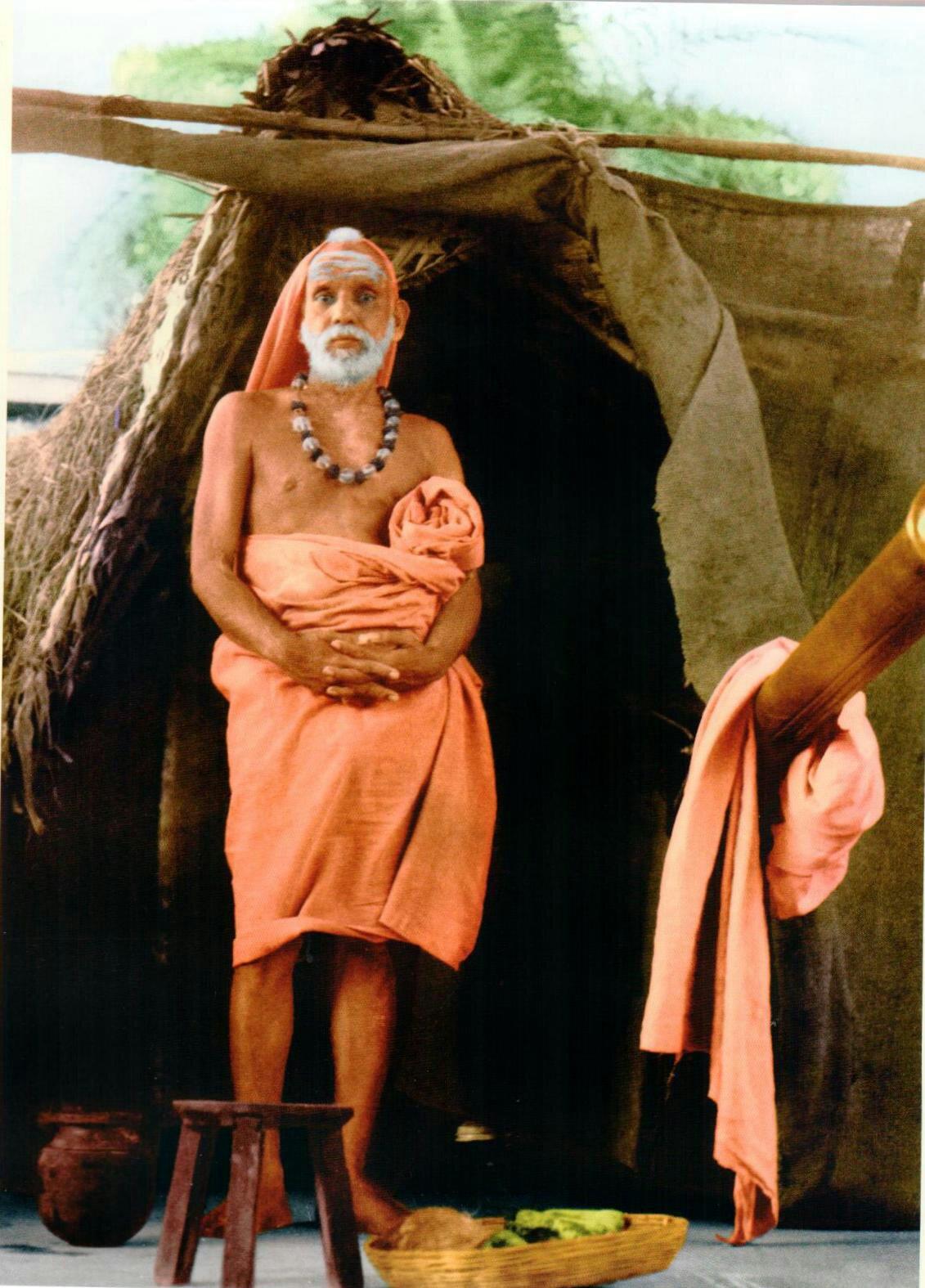
KANCHI PARAMACHARYA
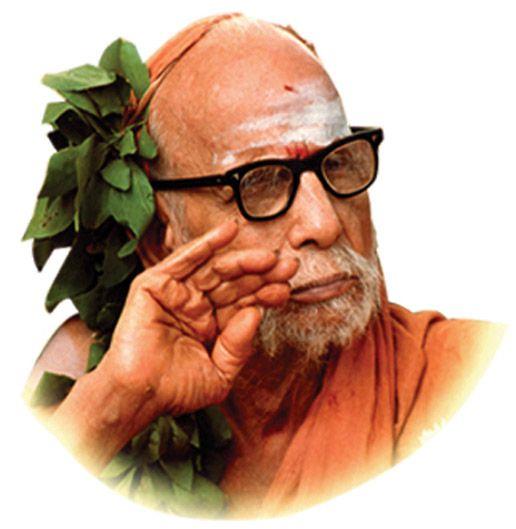
Life
Chandrashekarendra Saraswati Swami (popularly known as ‘Kanchi Paramacharya’) was born as Swaminathan, on 20th, May 1894 in the town of Viluppuram, Tamil Nadu. He was born to a devout Brahmin couple, Subramania Shastri and Mahalakshmi Ammal, as their second son.
Swaminathan’s brilliance prompted Shastri to home school him until the age of eight. He also trained the boy in music at a very young age. Swaminathan was capable of grasping and remembering anything that he saw or heard just once. When his father was stationed at Tindivanam, he was enrolled into second form at Arcot American Mission High School. Swaminathan excelled in studies, coming first in the class, first in all exams in every grade, won all trophies in every annual day celebrations. He even got the first prize in learning the Bible.
In 1906, Swaminathan’s father, took his family with him to obtain the darshan of the then Shankaracharya, the 66th Peetadhipathi of the Kanchi Kamakoti Peetam. The family stayed on for two days to get the benefit of Swami’s continued darshan. During this occasion, the Acharya interacted closely with young Swaminathan and asked him many questions. Pleased with the young boy’s brilliance and attractive personality, the Acharya was heard commenting: “He will turn out to be a Maha Purusha.” Hearing this, his father’s joy knew no bounds. He took leave from the Acharya and returned to Tindivanam where he was stationed for work. The Acharya had, meanwhile, requested Subramania Shastri to bring Swaminathan frequently to the Mutt. Shastri accordingly took his son several times to the Mutt. During frequent meetings, the abundant Grace of the Guru flowed over young Swaminathan.
One day, Swaminathan was found missing from his house in Tindivanam. His parents were very anxious and searched everywhere. But he was nowhere to be found. Two days later, a messenger arrived from the Acharya’s camp which was five miles away. He conveyed the news that Swaminathan had come there for Acharya’s darshan on his own, and he was safe. He added that the Acharya had sent him to convey this message to the parents.
In the first week of February in 1907, Subramania Shastri’s house received a telegram from the Mutt camp asking Shastri to come to the Mutt immediately with Swaminathan. At the time that the telegram was sent to Tindivanam, the Acharya’s health was in decline. Believing that his time was limited, the Acharya had sent the summons to Tindivanam with the intention of installing Swaminathan as the next Acharya.
An excerpt of how he became the 68th pontiff was best told by Acharya himself and published in ‘Bhavan’s Journal’, Bombay: “In the beginning of the year 1907, when I was studying in a Christian Mission School at Tindivanam, I heard one day that the Shankaracharya of Kanchi Kamakoti Peetam who was amidst us in our town in the previous year, attained siddhi at Kalavai, a village about ten miles from Arcot and 25 miles from Kanchipuram. Information was received that a maternal cousin of mine who, after some study of Rig Veda, had joined the camp of the Acharya offering his services to him, was installed on the Peetam.
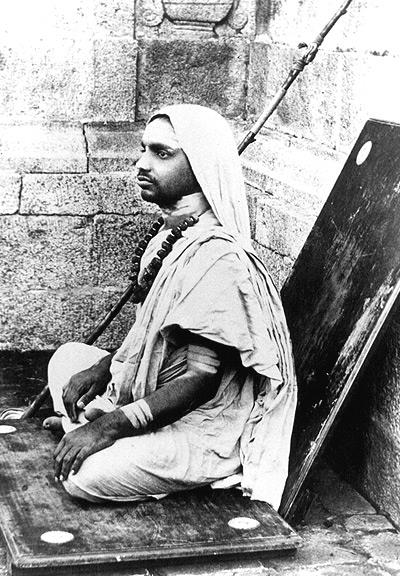
The young ascetic Paramacharya
“He was the only son of the widowed and destitute sister of my mother and there was not a soul in the camp to console her. My mother with myself and other children, started to Kalavai to console her sister on her son assuming sannyas ashram. We travelled by rail to Kanchipuram, and halted at the Shankaracharya Mutt there. I had my ablutions at the Kumara-koshta Tirtha. A carriage of the Mutt had arrived there from Kalavai with persons to buy articles for the Maha Pooja on the 10th day after the passing away of the late Acharya. But one of them, a hereditary maistri (mason) of the Mutt, asked me to accompany him. A separate cart was engaged for the rest of the family to follow me.
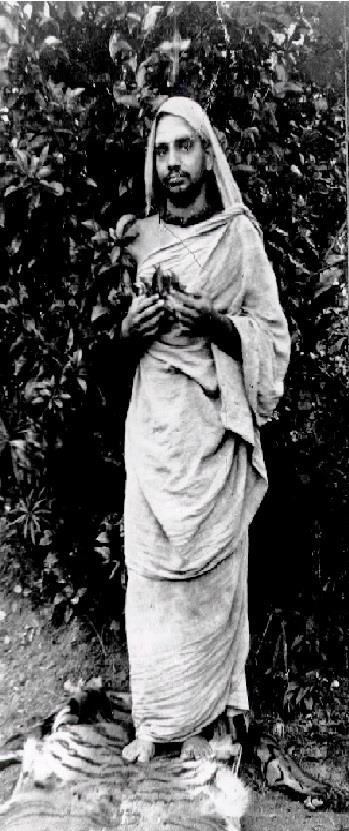
… the ‘young’ Swami in the process of ‘learning’ …
“During our journey, the maistri hinted to me that I might not return home and that the rest of my life might have to be spent in the Mutt itself. At first I thought that my elder cousin having become the head of the Mutt, it might have been his wish that I was to live with him. I was then only 13 years of age and so I wondered as to what use I might be to him in the institution.
“But the maistri gradually began to clarify as miles rolled on, that the Acharya, my cousin in the poorvashram had fever which developed into delirium and that was why I was being separated from the family to be quickly taken to Kalavai. He told me that he was commissioned to go to Tindivanam and fetch me, but he was able to meet me at Kanchipuram itself. I was stunned by this unexpected turn of events. I lay in a kneeling posture in the cart itself, shocked as I was, repeating ‘Rama Rama’ - the only spiritual prayer I knew - during the rest of the journey.
“My mother and the other children came some time later only to find that instead of her mission of consoling her sister, she herself was placed in the state of having to be consoled by someone else.
“My robes of sannyas were not the result of any renunciation on my part, nor had I the advantage of living under a Guru for any length of time. I was surrounded from the very first day of sannyas by all the comforts and responsibilities of a gorgeous court.”
In the years 1909 and 1910, the Mutt appointed scholars who were engaged to teach and train Swami in Sanskrit and Vedic studies. The scholars and the academicians of the day were surprised at the brilliance and sharpness of Swamiji’s intellect.
The method of schooling given to the Swami was very unique. Ordinarily, students treat their teachers with respect and devotion and learn from them. However, the scholars who taught Swami would pay their respects and devotion to him before and after their lessons! Some of the subjects learnt by Swami included arts, vyakaranam, tharka shastra, vedantha, meemamsa, etc.
Swami also learnt languages like Marathi and French. During what little free time he had, he got Tamil scholars to train him in Tamil grammar and literature. He made a deep study of Thevaram, Thiruvachakam, Periya Puranam, Thiruvilaiyadal Puranam and Thirukural.
Swami used to take walks in the sand dunes in the middle of Kaveri and enjoy the natural beauty, and sometimes get absorbed in meditation in the beautiful surroundings. Swami liked to take photographs of picturesque landscapes. In those days, there used to be a person who would follow Swami with a camera. Swami would order him randomly to take pictures of certain scenes. As he was familiar with the intricacies of photography, he would give suggestions and tips to photographers while taking pictures. Swami also became well versed in mathematics, astrology and astronomy. He also made himself familiar with Vaishnavite scriptures including Thiruvaimozhi.
The young Shankaracharya strode this earth as an authentic Jagadguru, making his devotees at home and abroad, from Kailash and Kasi in the North to Kanyakumari in the South marvel at the mastery, the self-assurance, the humility, the dedication and self-discipline of the young sannyasin. He journeyed rapidly across the country as Adi Shankara had done, mostly on foot, practising rigorous personal tapas and in a spirit of brooding meditativeness.
A unique episode stands out in his life of Himalayan achievement in the field of the spirit:
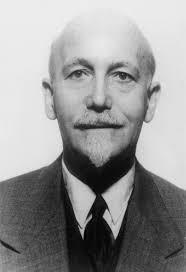
Paul Brunton
When the author of A Search in Secret India met Paramacharya first at Chinglepet and sought help in his explorations of the mind and heart of the real India, he was asked to go to Tiruvannamalai and meet Bhagavan Sri Ramana who was a shining example of Self-Realization. In this account, Paul Brunton relates how the sage guided the seeker to the "Maharishee":
Paul Brunton: “I look at him in silence. This short man is clad in the ochre coloured robe of a monk and leans his weight on a friar's staff. I have been told that he is on the right side of forty, hence I am surprised to find his hair quite grey.
“His noble face, pictured in grey and brown, takes an honoured place in the long portrait gallery of my memory. That elusive element which the French aptly term spiritual is present in this face. His expression is modest and mild, the large dark eyes being extraordinarily tranquil and beautiful. The nose is short, straight and classically regular. There is a rugged little beard on his chin, and the gravity of his mouth is most noticeable. Such a face might have belonged to one of the saints who graced the Christian Church during the Middle Ages, except that this one possesses the added quality of intellectuality. I suppose we of the practical West would say that he has the eyes of a dreamer. Somehow, I feel in an inexplicable way that there is something more than mere dreams behind those heavy lids.
“I broach the matter of my quest and His Holiness questions me about the different yogis or holy men I have so far met. After that, I frankly tell him: ‘I would like to meet someone who has high attainments in yoga and can give some sort of proof or demonstration of them. There are many of your holy men who can only give one more talk when they are asked for this proof. Am I asking too much.?’
“The tranquil eyes meet mine. There is a pause for a whole minute. His Holiness fingers his beard. ‘If you are seeking initiation into real yoga of the higher kind, then you are not seeking too much. Your earnestness will help you, while I can perceive the strength of your determination; but a light is beginning to awaken within you which will guide you to what you want, without doubt.’
“I am not sure whether I correctly understand him. ‘So far I have depended on myself for guidance. Even some of your ancient sages say that there is no other god than that which is within ourselves,’ I hazard.
“And the answer swiftly comes: ‘God is everywhere. How can one limit Him to one's own self? He supports the entire universe.’
“I feel that I am getting out of my depth and immediately turn the talk away from this semi-theological strain. ‘What is the most practical course for me to take?’
“Go on with your travels. When you have finished them, think of the various Yogis and holy men you have met; then pick out the one who makes most appeal to you. Return to him, and he will surely bestow the initiation upon you.
“I look at his calm profile and admire its singular serenity. ‘But suppose, Your Holiness, that none of them makes sufficient appeal to me. What then?’
“In that case you will have to go on alone until God Himself initiates you. Practise meditation regularly; contemplate the higher things with love in your heart; think often of soul and that will help to bring you to it. The best time to practise is the hour of waking; the next best time is the hour of twilight. The world is calmer at those times and will disturb your meditations less.
“He gazes benevolently at me. I begin to envy the saintly peace which dwells on his bearded face. Surely, his heart has never known the devastating upheavals which have scarred mine? I am stirred to ask him impulsively: ‘If I fail, may I then turn to you for assistance?’
“Shankaracharya gently shakes his head. ‘I am at the head of a public institution, a man whose time no longer belongs to himself. My activities demand almost all my time. For years, I have spent only three hours in sleep each night. How can I take personal pupils? You must find a master who devotes his time to them.’
“ ‘But I am told that real masters are rare, and that a European is unlikely to find them.’ He nods his assent to my statement, but adds: ‘Truth exists. It can be found.’
“ ‘Can you not direct me to such a master, one who you know is competent to give me proofs of the reality of higher Yoga?’ His Holiness does not reply till after an interval of protracted silence. ‘Yes. I know of only two masters in India who could give you what you wish. One of them lives in Benares, hidden away in a large house, which is itself hidden among spacious grounds. Few people are permitted to obtain access to him; certainly, no European has yet been able to intrude upon his seclusion. I could send you to him, but I fear that he may refuse to admit a European.’
“ ‘And the other?’ My interest is strangely stirred. ‘The other man lives in the interior, farther south. I visited him once and know him to be a high master. I recommend that you go to him.’
“ ‘Who is he?’
“ ‘He is called the ‘Maharishee’. I have not met him, but know him to be a high Master. Shall I provide you with full instructions, so that you may discover him?’
A picture flashes suddenly before my mind's eye. I see the yellow-robed friar, who has vainly persuaded me to accompany him to his teacher. I hear him murmuring the name of a hill. It is: ‘The Hill of the Holy Beacon.’
“ ‘Many thanks, Your Holiness,’ I rejoin, ‘but I have a guide who comes from the place.’
“ ‘Then you will go there?’
I hesitate. “All arrangements have been made for my departure from the South, tomorrow," I mutter uncertainly.
“ ‘In that case I have a request to make. ’
“ ‘With pleasure. ’
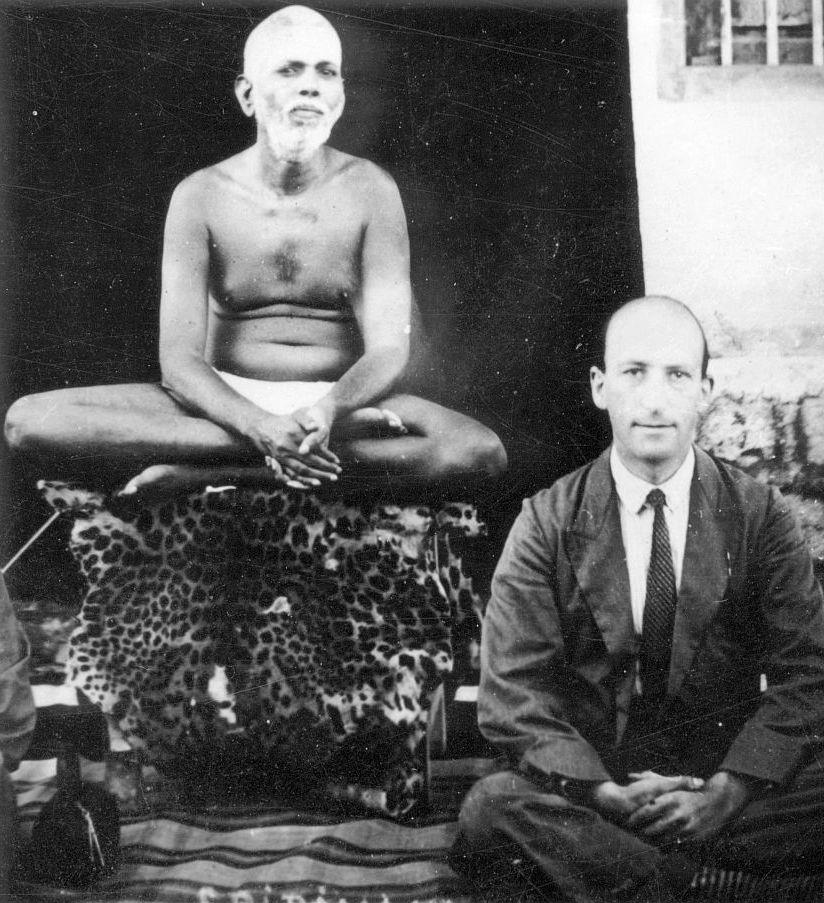
Paul Brunton with the ‘Maharishee’
“ ‘Promise me that you will not leave South India before you have met the Maharishee ” I read in his eyes a sincere desire to help me. The promise is given. A benignant smile crosses his face. ‘Do not be anxious. You shall discover that which you seek.’ ”
The Jagadguru, Shankaracharya of Kanchi Kamakoti Peetha, was a multifaceted genius. He was indeed a World Teacher. He had devotees from all walks of life. From the downtrodden to the affluent, from Hindus to Muslims, from Asians to Europeans, there were many who found solace from this man who lived in a small thatched hut in Kanchipuram. He was known throughout the world as a great saint, in whose presence everyone found great peace and tranquility.
We speak of time throwing up the Man of the Age. But often it was not a single man. When people are in need of exemplars of more than one path, time (or, was it the timeless Spirit?) brings forth these Men of the Age. To quote, Sadhu Arunachala (Major A.W. Chadwick): "The classic examples of the four Yogas in modern times are: Jnana, Sri Ramana Maharshi; Bhakti, Sri Ramakrishna Paramahamsa; Yoga, Sri Aurobindo of Pondicherry; and Karma, Sri Shankaracharya of Kanchi Peetam.”
His long tenure as Peetadhipathi is considered by many to have been the Golden Era of the Kanchi Kamakoti Peetam. He attained Mahasamadhi on 8, January, 1994, at the age of 100. A never ending stream of people filed past the same dais where they had been having his darshan all these years. The saint's appeal cutting across religion, caste and creed was eloquently attested by numerous Muslims in traditional headgear and several Christian nuns in the 3-mile long queue. Roads jammed as crowds of people descended on Kanchi. The then Prime Minister of India, P.V.Narasimha Rao, cancelled all his programs to attend the interment ceremony. A shrine was erected on the spot of his samadhi. Not surprisingly, the Sage of Kanchi continues to draw hordes of the needy and the faithful to his eternal presence to this day.
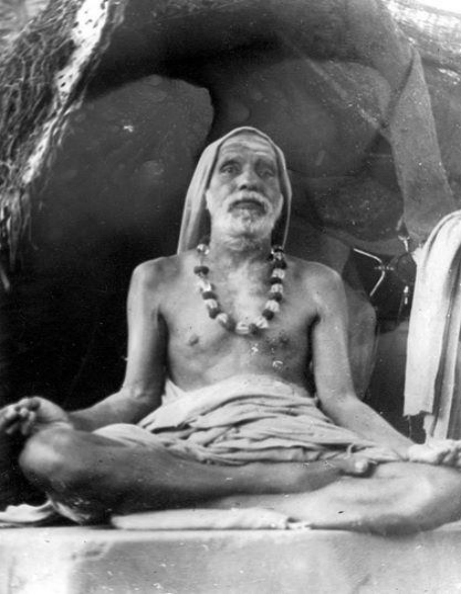
PARAMACHARYA AND ME
In 1940-41, His Holiness Kanchi Mahaperiyava, came to camp in Tiruvannamalai. The reception committee had arranged for a grand, traditional reception which included taking him in a palanquin around the four main streets encircling the Temple, one night.
Our family was staying in a house on Big Street at that time. When the procession reached our house, it was past midnight. His Holiness stopped the procession in front of our house and accepted the honour extended to him by my parents. I was only five years old at that time and was fast asleep. My parents gathered those who were awake, reached the palanquin and introduced them to His Holiness. Maha Periyava specifically asked for the ‘second son’ and my father reported that I, the ‘second son’ was adamant on his deep sleep not being disturbed and coming out. His Holiness insisted that I be lifted up and brought to his presence. When I was brought, I am told by my mother, His Holiness intently looked at me with a gracious smile, plucked a jasmine flower from the garland he was wearing on his neck and flipped it towards me as a sign of blessing. My mother added that the flower came and hit the right side of my chest, which she felt was a great blessing poured on me by His Holiness.
* * * * *
All my life, I have been totally devoted to Sri Bhagavan and for propagation of his Teaching. At the same time, I have moved very closely with staunch devotees of Paramacharya and have had tremendous admiration for and adoration to him. Since I could not observe ‘Karma Marga’, I could not move closely with the inimitable Sage of Kanchi.
* * * * *
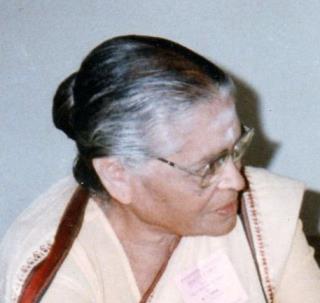
Kanakkamma
Kanakamma, an Old Devotee of Bhagavan Ramana recalls an unforgettable encounter with the sage of Kanchi: “It was an evening in the year 1958. The Kanchi Acharya was camping in West Mambalam in Madras. When I went to the camp, there was nobody else except a couple of Mutt workers with the Acharya. It was indeed a rare opportunity for me to have a quiet, leisurely darshan. I bowed before him and stood up with palms joined. The Acharya smiled very graciously and asked me, ‘Are you here (in Madras) these days?’ I said ‘Yes’. He made very kind enquiries about my mother and other family members and then asked, ‘Are you not still at Sri Ramanasramam in Tiruvannamalai?’ I said, ‘I am there ever since I moved to that place.’ What the Acharya said on hearing my reply thrilled me. He said, ‘Oh, you live in solitude (Ekaanta vaasamo?)’. I was overwhelmed by his apt, kind words that I could hardly articulate the word ‘Yes’. I just nodded in assent. The Acharya then said, ‘And you listen to Vedanta (Vedanta sravanamo?)’. I again nodded. Acharya continued, ‘And, of course, you cook your own food (Swayampaakamo?)’ The three questions of the Acharya, which were more affirmative than interrogative in tone, plunged me in pure joy! I said ‘Please bless me that I may continue like this.’ ‘Yes, yes!’, said the Acharya giving me a gracious look and moving his right hand up in a benedictory gesture.
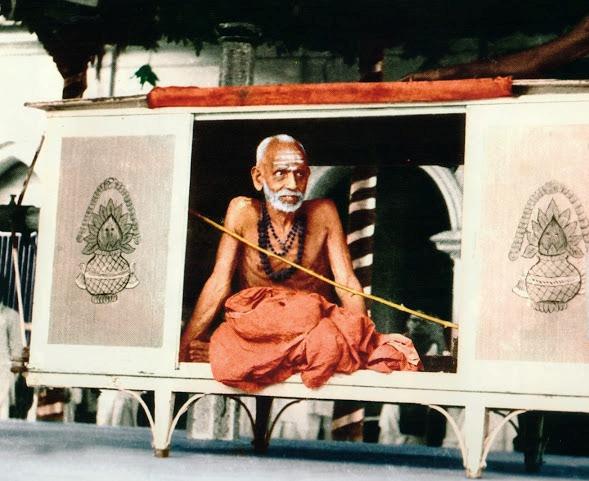
Paramacharya seated inside the Mena (“cramped wooden box”)
I was, then as now, living alone in an apartment near Sri Ramanasramam. Muruganar was daily giving me lessons on Sri Bhagavan's Nool Tirattu (Collected Works of Ramana Maharshi, in Tamil). I cooked my own food! It was astounding the way the Acharya in three terse Tamil phrases not only summed up my daily life but in a tone which implied his approval of it and blessing for it! So powerful are his look and words and so overwhelming his compassion!”
* * * * *
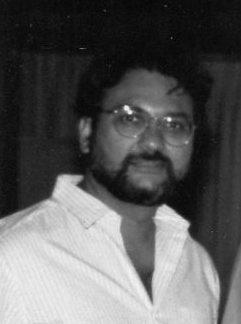
A.Haji (Riaz Padamsee)
Spiritually advanced friends of Paul Brunton used to request him to advise as to how they could further progress in their sadhana. Brunton used to advise them to go to India and have darshan of His Holiness at Kanchi. To a few of them, he would tell that they should, after having the darshan of His Holiness, go to Arunachala and stay at Sri Ramanasramam as it would help them spiritually enormously. Some of them have met me and revealed this to me.
One such close admirer of Paul Brunton was a young Muslim businessman - A. Haji. He used to live in the USA. Whenever he visited India, he would visit Kanchi without fail and have darshan of His Holiness. Since he was an intellectual, he was drawn to Sri Bhagavan’s Direct Teaching of Self-Enquiry. At a particular stage, he was in a dilemma of choosing between Ramana Maharshi and His Holiness as his Satguru. He also wanted guidance on the form of meditation he should adopt, though he was doing some form of spiritual practice.
He narrated to me the experience he had once in the presence of Kanchi Shankaracharya :
“A frail old man sitting in a cramped wooden box, draped in a thin orange cloth and crowned with a wreath of tender green leaves: my first impression of the Shankaracharya! The box is his palanquin, with the carrying poles on two sides detached. He spends much of his time inside this tiny room, no larger than a big refrigerator. Yet he seems quite comfortable in it, sitting crossed-legged, gazing out of the open door at his visitors. He even has a bookshelf inside the palanquin. I can only see one eye and a part of his face, steadily looking at me. Not a word is said. In a few minutes he draws shut the sliding doors of the palanquin. He has effectively retired, even though the palanquin is in full view.”
“I quickly carry my precious foreign friends' letters to the Mutt’s manager. He is cordial and reassuring: ‘I will read the letters to him at eight.’ I glance at my watch and it is 7 a.m. I return to the audience chamber. There are about twenty people standing behind the bamboo barricades, gazing at the Shankaracharya, who is peering back at them from his palanquin.”
“A Tamil matron standing in front of me is pleading with the Shankaracharya. I do not understand Tamil, but I pick up a key Sanskrit word. She is pleading for moksha - liberation from the endless round of birth and death. With hands prayerfully folded, she becomes more and more impassioned, finally breaking into tears. The Shankaracharya gazes at her compassionately, wordlessly, all through her performance, and is moved to raise his right hand in the abhayamudra - the gesture of ‘fear-not’. The woman leaves, apparently reassured.”
“The Shankaracharya talks softly in almost a hoarse whisper, and mostly to his attendants. He asks questions in sign language punctuated with a few words. The attendant then repeats the question and relays the answer back to the Shankaracharya.”
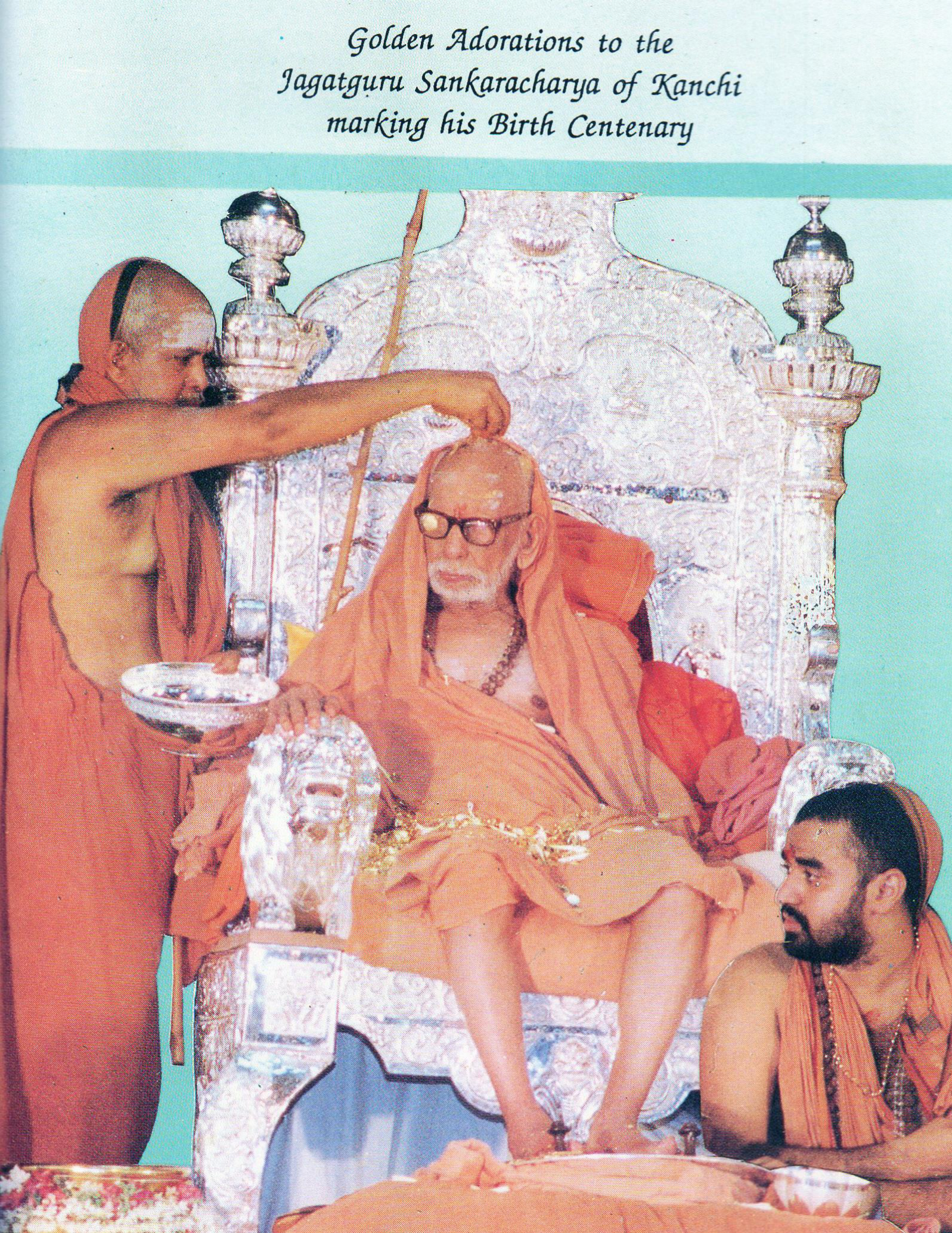
Golden Adorations to the Jagatguru Sankaracharya of Kanchi marking his Birth Centenary
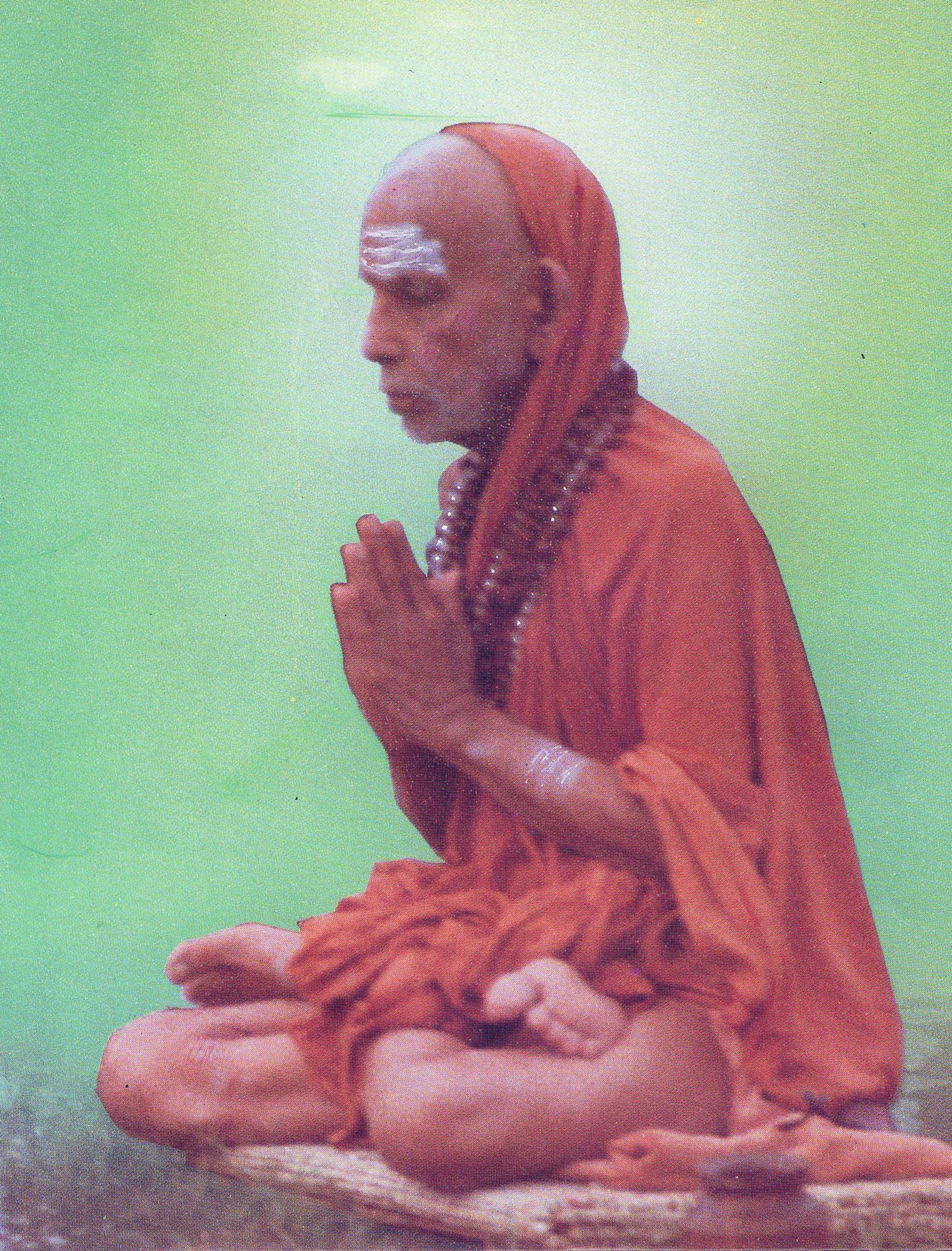
Our Prayers are offered to the One Who ever prays for the welfare of the entire humanity
“I lean against a bamboo pole for support. Many devotees walk by. They bring their problems, victories and sorrows to the Shankaracharya. He listens intently to his attendant, voicing these messages of humankind. Often, he asks questions. He is hard of hearing and the attendant must shout loudly. A young boy, hardly twelve, folds his hands in prayer in front of the Shankaracharya, and at the urging of his mother, rattles off a longish prayer. The Shankaracharya asks a question. On hearing the reply, a smile suddenly appears on the Shankaracharya's face. He seems more than happy.”
“I grow weak in the knees. I cannot stand there any longer. I look at my watch. It's, only 7:20 a.m. I go to the back of the crowd and find a seat from where I can see the Shankaracharya. My tiredness refuses to go away. I find that if I lean my head against the wall, I am quite comfortable.”
“I open my eyes. It is already ten minutes past 8. I have been asleep for almost an hour! I stand up to stretch, silhouetted against the bright sky. The Shankaracharya immediately points a finger at me: ‘Where do you come from?’ The question is shot at me through the attendant. ‘I come from America,’ I answer, surprised by this sudden turn of attention. ‘When did you land in India?’ he asks. ‘I arrived on the 24th of last month,’ I quickly guess. Then a short silence. ‘Do you have a question for the Shankaracharya?’ ”
“I decide to first seek advice about my meditation, postponing that crucial question I had decided to test him with, namely, ‘Who is my Guru?’ As if echoing this, the attendant queries back, ‘Who is your Guru? Who do you think of in your meditation?’ I find myself answering, ‘Ramana Maharshi’. This is a strange turn of events. I have just answered my own unasked question without the least hesitation, almost as if, at some deeper level, I already knew the answer. Then my question on meditation is answered. I am advised to discontinue my current practice and concentrate on focussing my love and attention on my Guru.”
“The Shankaracharya ends the discussion with a very Indian shaking of his head from side to side, which seems to say: ‘All is understood and will be taken care of.’ With his right hand raised in blessing, he gently motions me out of the audience chamber.”