Meetings with Sages and Saints
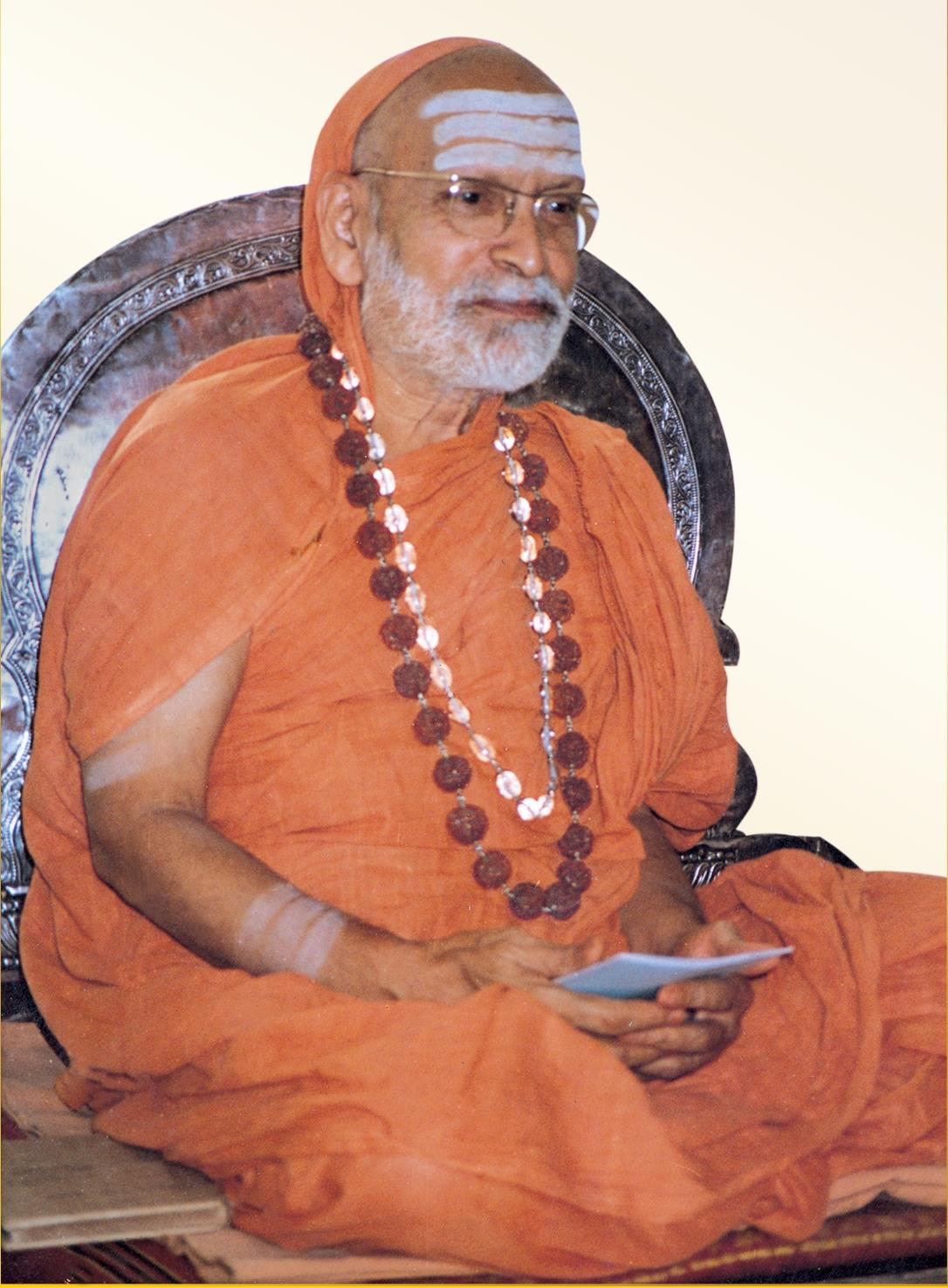
ABHINAVA VIDYATHIRTHA SWAMI
Life
Abhinava Vidyathirtha Swami was born on November 13, 1917, as the eldest son of a virtuous couple, Kaipu Rama Sastry and Venkatalakshmi, and was named ‘Srinivasa’. He was endowed from childhood with devotion to God, detachment to sensory objects, fondness for noble people and good conduct, and became the recipient of the unlimited kindness of the then pontiff of the Sringeri Sarada Peetham, the renowned Jivanmukta, Chandrasekhara Bharathi Mahaswami.
Srinivasa proved to be a living testimony to the scriptural declarations regarding a perfect Sage. He had all the personal qualities that a Mahatma ( a great Sage) should have – compassion for all, forbearance, purity, auspiciousness, absence of stinginess, freedom from jealousy, laziness and attachment.
One day Chandrasekhara Bharathi Mahaswami took Srinivasa with him on his evening walk to the Kālabhairava temple, situated atop a hill in Narasimhavana. On the way, his holiness spoke very strongly about the greatness of vairagya (dispassion) and sannyasa (renunciation) to Srinivasa.
He blessed him with the same words with which his Guru blessed and guided him.
“O Child! If you have the desire to cross the ocean of ‘suffering’ then listen to my words which is in consonance with the Upanishads and is beneficial to you. Having shaven your head, together with the tuft and having broken the sacred thread donned for performing sacrifices, take up the vow of paramahamsa-sannyāsa (total renunciation). Very firmly cultivate the four indispensable spiritual means. Listen to the teachings of the Upanishads through the nectarine words of the Satguru. With faith and devotion, enquire for long, deeply on the Truth about the Atman”.
The divine words of the great Sage had the necessary impact on the youth’s mind.
When Srinivasa was just thirteen and a half years old, the Mahaswami gave him sannyāsa and, named him as “Abhinava Vidyathirtha” and nominated him as his successor to the Sarada Peetham.
The power of initiation from the Guru had an immediate impact on the disciple. Starting with the day he was initiated into sannyasa, Lord Śiva appeared in his dream and instructed the young Swami on ‘Hatha Yoga’ practices, through seven successive nights. Each dream was a continuation of the preceding one, which included the various kinds of restraint of prāna like sūryabhedana, ujjāyī, sītkārī, śītalī and bhastrikā in such a way that the young Swami could clearly understand, grasp and practice them.
Chandrasekhara Bharathi Mahaswami spared time to personally familiarize the new Swami with the daily rituals and other duties of a sannyasi. He also initiated him into mantras such as the Śrīvidyā and Narasimha mantra.
Let us listen to Abhinava Vidyathirtha’s own words, narrating as how his Guru taught him:
“When staying in Narasimhavana with my Guru, I used to go every evening to behold Goddess Śāradāmbā and remain there for up to an hour. On my return, he once asked me, “You have crossed the river and come. What thought arose in your mind?”
“What thought?” I wondered and replied, “There were various objects which I saw.”
“What was new?”
“Nothing. I saw what was visible.”
“Must you see whatever is in the range of your vision?”
“If the eyes are kept closed, it is not possible to walk.”
“You must see and yet not see.”
“How is that possible?” To this, he said, “This is how we should ever conduct ourselves. When we walk, the feeling should be, ‘In the big Ocean of Pure Awareness - the Ātman - a wave has arisen’. There is no difference between the wave and the Ocean. Contemplation must be done in this manner. ‘I am a wave in the Ocean of Bliss, in the Ocean of Ātman. In the thread of Pure Awareness, I am a gem. Through me runs the thread of unbreakable Consciousness’. Whenever some object is seen, one must hold on to the ‘Witness Awareness.’ When lying down for sleep, contemplate, ‘I am now immersed in an Ocean of Bliss’ and, with this feeling, begin to sleep. Let the wave merge back in the Ocean. Even when you talk to someone - repeat this idea in the mind. With practice, one uninterruptedly gets established in this experience”.
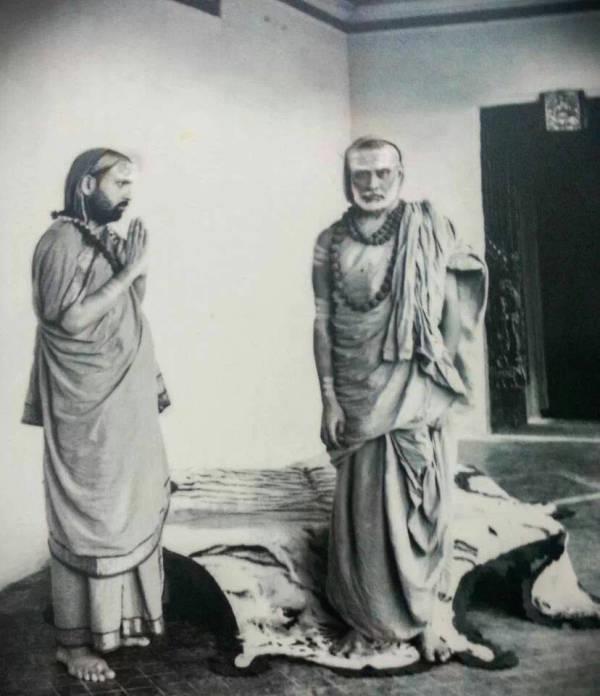
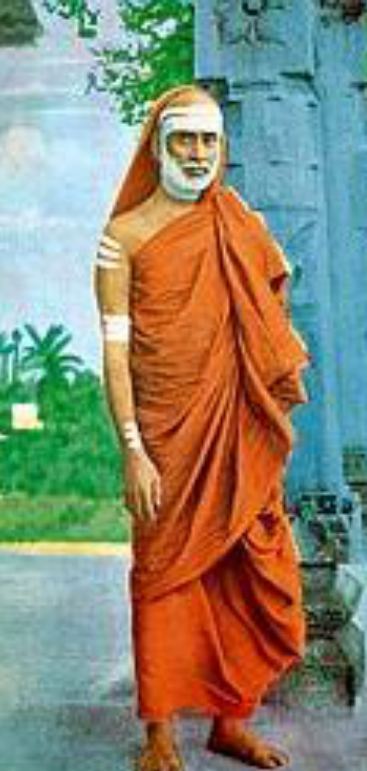
Abinava Vidyathirtha Swami paying respects to his Guru Chandrasekara Bharati Mahaswami
“When walking, sitting, standing and even when lying down, this is how you must conduct your life. He who spends his daily life in this fashion gets firmly established in the Atman.”
His Holiness – the young Swami - was enjoying dhyāna and samādhi on several forms of Īśvara (God), and then, switched from meditation on ‘forms’ to that of on the ‘Formless’ and quickly attained Nirvikalpa-Samādhi. Recognizing the profound realization of his disciple, Chandrasekhara Bharathi Mahaswami suddenly came to his room and said, “I knew that your mind was becoming more and more absorbed in Nirvikalpa-Samādhi. Last night, however, the Lord made it clear to me that your samādhi had become so intense that you would not emerge from it on your own. Unless aroused from samādhi, you would remain in it until physical death. As impelled by the Lord, I came to your room before the night ended and with great difficulty, I succeeded in awakening you. Regulate your samādhi and the introversion of the mind. Else, today itself, your Nirvikalpa-samādhi will become such that you cannot be aroused from it at all, by anybody. Do not leave me by entering irreversible samādhi and discarding your human form. There is so much to be done by you for me, for others and for the Mutt.
“While you can now manage to perform your routine activities, your mind is still too introverted to engage in the serious study of the Tarka and other śāstras. Only tranquility and happiness can be seen in your face. Even if I, to whom you are deeply devoted, were to cast off my body right now, your facial expression would not change. No matter how much you be provoked, not a trace of anger would be visible. Nothing of the world interests you at all. On you, however, rests the future of this great Sarada Peetham.
“Accordingly, though unswervingly established in Brahman, you should study diligently and master the śāstras. Further, you should learn to show interest, appreciation, concern, anger, curiosity and the like in your dealings with devotees, Mutt staff and others.”
Even though established in the Atman, His Holiness accepted the instructions of his Satguru to work for the welfare of the world. Slowly he came down from the stupendous height of his Realization and did tremendous work establishing various branch Mutts, Dharmaśālās and Pāthaśālās; and, shone forth as one of the greatest Madathipathis of the Sringeri Sarada Peetham.
Every work of His Holiness was an illustration and a reflection of his foresight and benevolence. He was a good administrator and was not upset when the government handed back the administration of the Mutt to him, stripping off all the jagirs ( landed property) earlier in its possession.
Simple living and high thinking characterized his life. He insisted on doing his personal work by himself. He would take his attendant’s assistance only if it related to pontifical duties.
However his great contribution is in selecting and handing over the light to the next Jagadguru, “Bharathi Thirtha Swami” on Nov 11, 1974.
From the second week of September 1989, he was not well. In the early hours of September 21,1989 he experienced chest pain and uttering ‘Narayana’, Abhinava Vidyathirtha Swami merged with the Absolute !
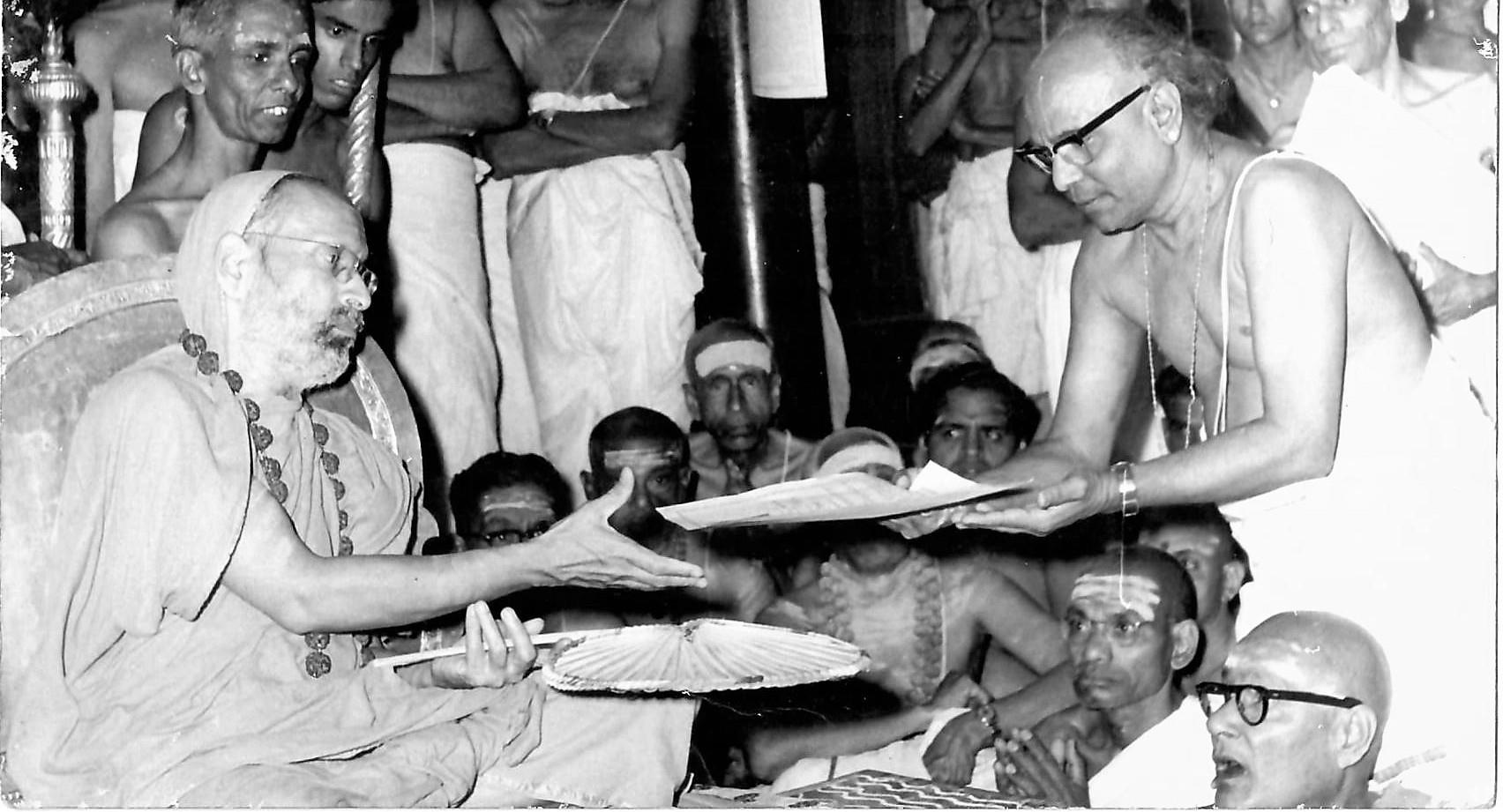
Embar Vijayaraghavachariar being honoured by his Holiness for his performing harikatha [exposition ] on “Ramana Vijayam” [ Life and Teachings]
SRINGERI ACHARYA AND ME
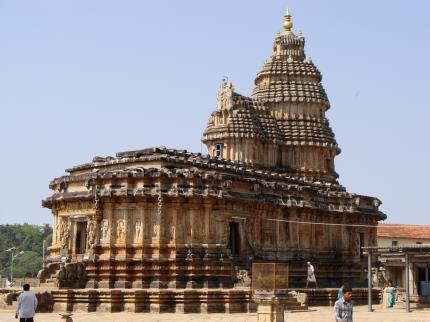
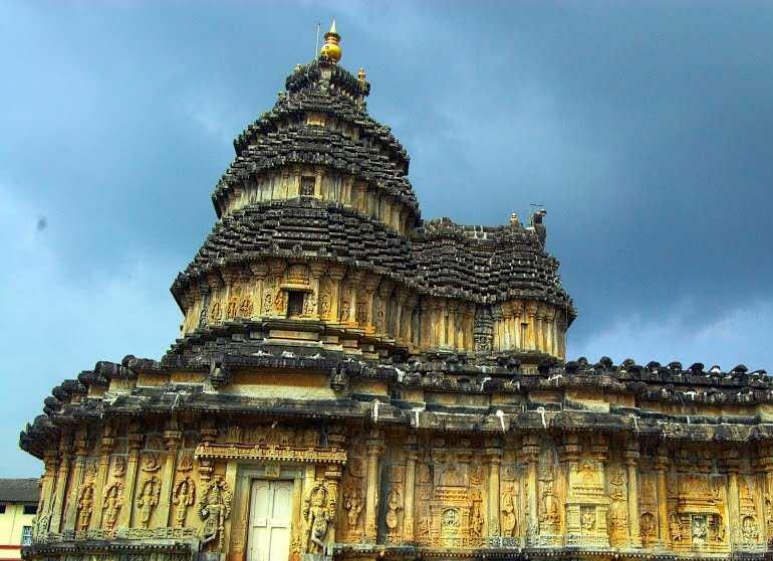
Sringeri Saradamba Temple
The Sringeri Sarada Peetham was founded by Adi Shankara with Sureshvaracharya as the first Pontiff. A lineage of illustrious Sages has adorned this sacred seat, spiritually guiding humanity through the centuries. Abhinava Vidyatirtha Swami was its 35th Pontiff.
When I had the opportunity to meet with him, in the company of A.R. Natarajan and family, I found His Holiness’s simplicity exemplary and his graciousness limitless. I feel that the best way I could pay homage to this illustrious and ever-gracious Mahasannidhanam – as he is addressed - is to recount what happened while we were with His Holiness.
The Mahasannidhanam, had a severe heart attack and hence was under the constant and immediate care of doctors. He was advised to avoid the strain involved in talking, walking and similar other exertions.
That was the first time I was in his presence and that too very close, as well. When we went in, the Acharya was seated. Natarajan introduced me to His Holiness and I fully prostrated to him. When I was lifting up my head, my face was very close to his and I saw him as a 'person'. Then, I was pleasantly surprised to see and observe the glittering ‘golden colour’ of the skin of his body !
Instantly, I remembered what my teacher Pundit T.K. Sundaresa Iyer once told me about the ‘golden colour’ of the skin on Sri Bhagavan's body : "When Sri Bhagavan was staying at Virupaksha Cave, I used to go and stay with him, almost every day. The very first day, I saw him standing on a rock outside the Cave when the Sun was shining on him. His whole body shone brilliantly with a ‘molten gold colour’. It was an ecstatically stunning experience, for, I have never ever seen the skin of any human being in 'molten gold colour’ ! After that, every time I was near his body -- throughout my life with him -- my heart would jump with joy to witness the same splendour of the 'molten gold colour’ in him ! It was truly a spiritual ecstasy ! ".
In those days, I could not figure out how a human skin can shine like ‘molten gold’; for, I had seen in life fair-skinned people, beautiful and attractive – but, that was only physical beauty; nothing spiritual about it !
Hence, I felt blessed that for the first time, I had the good fortune of seeing the ‘spiritual colour’ of ‘molten gold’ in His Holiness ! A true spiritual experience, indeed !
The purpose of the group's visit to Sringeri and meeting with His Holiness was with a specific important mission - very personal and private, indeed ! After such a long gap of many years, I feel, I can share it without any motive, for the exclusive cause of revealing how great the Sages are in alleviating the deep suffering of the seekers!
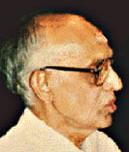
A.R.Natarajan
A.R. Natarajan was then a senior member of the Revenue Board. It was the ripe time that he was promoted as the Chairman of the Revenue Board. At the neck of the moment, a petition was sent to the finance ministry picking up complaints that he should not only not be made the chairman but should also be dismissed on the basis of ‘corruption charges’. Basic enquiries were conducted and the charges on him that he “misused his official power and gathered enormous money to help Sri Ramakrishna Mission and Sri Ramanasramam”.
A.R. Natarajan was the most uncorrupted Government Official applauded by every one around him – both in the office and in the day-to-day world of activities. He once declared to me, “ I have studied law and hence know the law, thoroughly. Hence, I am fully aware of the ‘power’ entrusted to me as a high Government officer – the ‘use’ and ‘misuse’ of the power. I will NEVER misuse the powers!”. After that I started noticing in him that he would use the office car, ONLY for executing office work; and, for all other purposes, he would use his privately owned car! He, thus, had close friends who were actually his admirers in Delhi, who had informed him of the danger awaiting him.
He came to the Ashram and confided with me, very privately, his fear of being unjustly dismissed from the high office. He sought my help. I took him to Sastri Mama and explained to him Natarajan’s difficult position and helpless pains. Mama went into his usual ‘Prasna’ method of getting guidance from the Divine within, through watching the breathing. After some time of quiet absorption, with closed eyes, he said : ”Yes ! The dark forces have exerted their highest power; and the danger seems like unavoidable and imminent. Yet, I see the Divine Hand of Sri Bhagavan putting an end by cutting down all forms of danger. Natarajan will definitely be saved. Don’t have any fear !” Both Natarajan and myself felt relieved.
With Sastri Mama’s assured prediction in our hearts, that day we approached His Holiness’s presence and sought his blessings. Natarajan said, “ I have fear….” Before he could complete the sentence, His Holiness smilingly said, “How is it you say you have fear? You’re a big Income Tax Officer and as such only people around you are afraid of you, they say….!” Yet, His Holiness asked Natarajan to explain matters to him, which he did in minute details.
His Holiness solemnly closed his eyes and went into inner silence. After some time, he opened his eyes and said amidst his unique smile, “Yes ! The matter had taken a very bad and serious turn and had reached the top level decision-making which should have been very adverse towards you. See ! Mother Saradamba’s karuna (Compassion) on you. At the last moment She made the top authority to cancel all forms of accusations. Have no fear !”
Later, Natarajan got it officially confirmed what exactly took place, since the accusation was dropped. The then Prime Minister, Smt. Indira Gandhi whose signature of approval for the dismissal of such a high official was necessary – called the Finance Secretary and enquired whether there was any remission on Natarajan’s part in the discharge of his official duty. The whole record did not portray any blame on him as an officer from the day of his direct recruitment into the Income-Tax Department. Then the Prime Minister ‘dismissed’ the entire procedure against Natarajan as ‘false accusation’ and re-confirmed his official position!
Sri Bhagavan and Goddess Saradamba profusely had blessed Natarajan. The unseen Grace and Blessings of Sri Bhagavan and Mother Saradamba were channelised with words through the ‘human voices’ of Sastri Mama and Mahasannidhanam! What a blessing from Sages and Saints !
* * * * *
In the Mahasannidhanam’s presence was seated, a very old couple. The old man was sickly and bent even in the sitting posture. His wife was narrating to His Holiness how her husband was suffering from so many diseases, how it was difficult for her to look after him and that Mahasannidhanam should bless them both and save them from hardship. Mahasannidhanam’s response was magnificent: “Oh! He has these problems! It is really painful and difficult to undergo such suffering. Take this mantra akshada [sanctified rice soaked in turmeric-juice). Don’t worry; everything will be all right!”.
The old lady took the prasad and sat at a distance. Again, she came up to him and repeated the same words of woe. His Holiness also responded with the same intensity, repeating the above words and also giving the mantra akshada. This happened nearly five times, continuously, without interval.
For an onlooker like me it was irritating. But there was not a trace of irritation, monotony, boredom or dimunition of concern on the face of His Holiness. It was amazing to witness his capacity to be tolerant and yet gracious! I remembered the saying that Mahatmas are like mirrors and reflect the same intensity of approach that is shown towards them! A demonstration of purity, tolerance, grace, compassion and intense spiritual relationship, indeed!
* * * * *
Next, the Mahasannidhanam referred to the shrine of the ‘Papanasana Linga’ in a cave on a hillock near Mysore and narrated the following:
“Some thirty years back we were going on a yatra (journey). When we were close to that hill I felt like going there and so we deviated and walked a few miles to reach the hill. Climbing up a particular place in the cave, the passage is so narrow you will have to bend and crawl to go in. Once you are through you reach a vast space where a Linga is placed. Behind the Linga there is a raised ground from where water sprung up and fell on the Linga, like a small waterfall, forming a natural abhisheka (giving a bath).
“I had heard about it long back and hence wanted to do my sandhya (offering evening oblutions) there. But when we reached the interior of the cave we found that water was not flowing, though the moisture of water was visible on the surface of the earth. How to do the worship? For a moment there was hesitation. Then, spontaneously, I started chanting ‘Purusha Sooktam’ (A hymn in Praise of God). By the time the chanting was concluded, water gushed forth from the raised ground and poured over the Lingam to our great delight, I had never before heard or read anywhere that ‘Purusha Sooktam’ had such tremendous power!
“Next time, some years ago, we were passing that side. Coming to know about the above details from me, people numbering 30 or 40, following me, wanted to go into the cave. We all went in. Again, it was dry! Now, I kept quiet; but the bhaktas in one voice, as it were, chanted ‘Purusha Sooktam’ with great fervour. Lo! Again the miracle happened! Water simply poured forth and fell as a small waterfall on the Holy Siva Linga. We all peformed puja and returned. For the second time, the uniqueness of ‘Purusha Sooktam’ was demonstrated on that day too. The Lord’s Grace is Supreme!”
The words of His Holiness narrating the whole episode in his lilting Tamil is still lingering in my ears. The facial expression of the Mahasannidhanam was that of an innocent child, filled with wonder and awe! How simple and gracious His Holiness looked!
* * * * *
Crowning the above anecdotes, occurred a most remarkable incident. A middle-aged man, perhaps some junior official touring that area for inspection, suddenly burst in and stood in front of His Holiness. He reported that he was going to perform the sacred-thread ceremony of his son on a particular day. He did not even - if I remember aright - have the courtesy to reverentially seek the blessings of the Mahasannidhanam; he gave the information in a casual way.
His Holiness was happy to hear that. With a gracious smile he gave him mantra akshada and blessed him and the vatu (boy). I was, again, amazed to see the Acharya’s magnanimity, which looked million times magnified in front of the pettiness and callousness arrogantly demonstrated by the ‘bhakta'!
It was not all!
This man did not leave; and kept standing in front of His Holiness. Suddenly, again, in a casual tone, he asked the Mahasannidhanam who his Guru was. Such a question is not permitted in our tradition to be put to a sannyasin, not to speak of the head of such an eminent Spiritual Centre! I felt how impertinent that question was and feared that it might annoy His Holiness. But I was surprised by the reaction of His Holiness!
Mahasannidhanam as I previously said, was under strict medical advice not to get up, thereby straining himself. No sooner did the word ‘Guru’ strike his ears, his face became “glowingly mellow, filled with devotional fervour”; and like a rubber ball he jumped from the seat and approached the wall where huge oil paintings of the previous Acharyas were hung. He reverentially went in front of the painting of Chandrasekhara Bharati Mahaswami and raised both his hands above his head in salutation. In a voice choked with Guru-bhakti, he said: “This is my Guru and Acharya Sri Sri Chandrasekhara Bharati Mahaswami”. He then moved and stood in front of the next picture; and again in a mood and tone full of devotional ecstasy, said: “This is my Paramacharya, Sri Sri Nrisimha Bharati Mahaswami.” After standing a few minutes like that he came back, face glowing with spiritual ecstasy, as if he had met them in flesh and blood!
That day, I realised what was meant by Guru-bhakti (surrendered devotion to one’s Guru) ! Intensity of devotion, total dedication and steadfast surrender are the marks of Guru-bhakti. Henceforth, I will never be casual in referring to my Guru; my whole being will be involved!
Great Mahatmas teach through practice, not by precept alone! And how marvellously they teach!
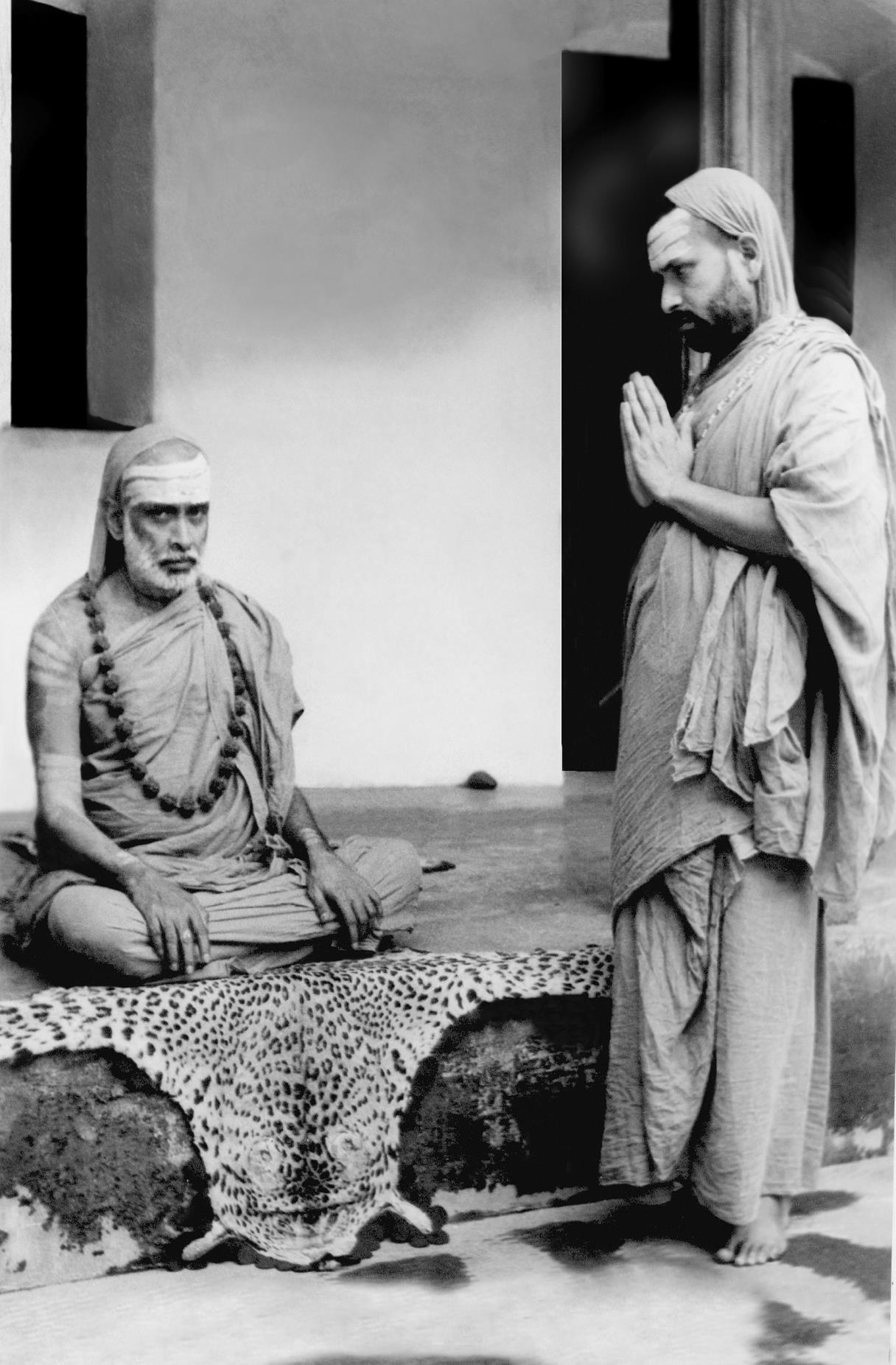
Abinava Vidyathirtha Swami paying respects to his Guru Chandrasekara Bharati Mahaswami