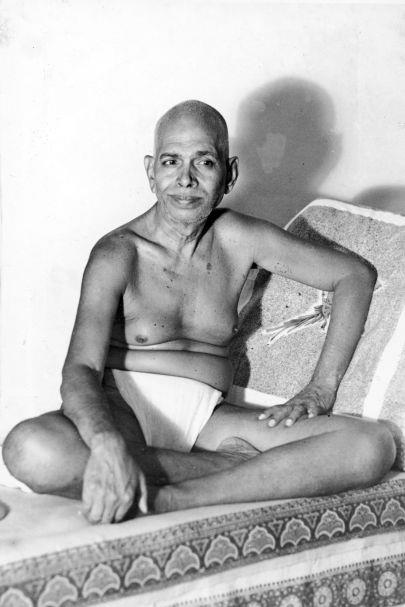
Prof. N. R. Krishnamurthy Iyer
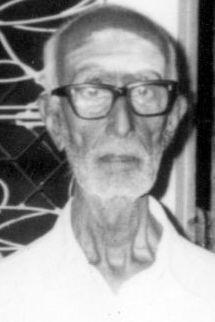
N. R. Krishnamurthy Iyer was a scientist who believed only in the intellect and doubted everything else. Bhagavan enabled this doubting Thomas to experience inner felicity, directly and tangibly.
N. R. Krishnamurthy Iyer was a brilliant professor of physics. He had studied under Dr. C. V. Raman, the Nobel laureate of international repute. Known as NRK, he would pick a fight with anyone who ignoring the practicalities of life focused only on God and the spiritual side. He had to have a scientific explanation for anything before accepting it. Though a Hindu, he felt that not only was it superstition to prostrate before anyone, it was also degrading oneself. In 1922, NRK came to Tiruvannamalai to meet his sister who stayed there. NRK’s brother-in-law Kuppuswamy and his friend T. K. Sunderesa Iyer, who were just leaving to see Bhagavan, told him, “We are both going to Ramana Maharshi. Krishnamurthy, you also come along with us.” NRK agreed but on the condition, “Do not expect me to prostrate before the one whom you call the Maharshi.” The friends smiled - they knew beyond doubt what was in store.
At that time, Ramanasramam was just a thatched shed built over the Mother’s samadhi. The three entered the thatched shed and then something strange happened. Without even being aware of it, the professor found himself flat on the ground, prostrating before the Maharshi. The two friends smiled broadly when they witnessed this, because this was exactly what they had anticipated. For, there is no need to persuade a skeptic to do something; spiritual power itself is potent enough. Bhagavan was totally focusing on NRK. After a few minutes, NRK got up, taken aback by what he had done. He then decided to have a debate with Bhagavan so that he could make amends for his spontaneous act.
NRK narrated to me what happened next: “I asked Bhagavan, ‘Seated like this, what is your next state?’ My idea was to elicit the reply that the soul survives the dissolution of the body and later gets united with the Self or God. I wanted to have a verbal war with him in order to disprove him. But, it was not to be. Several minutes passed after I raised my question. There was no reply. There was absolute silence as our eyes interlocked in a steady gaze. A thought arose within me: ‘Is this man taking shelter in silence to avoid answering an inconvenient question?’ At that very moment, Bhagavan’s resounding voice rang out, ‘You said ‘sthiti’ (state); what do you mean by ‘sthiti’ ?’ This sudden counter question made me feel that I had to answer him. So, I began to think. I did not ask him about the body that will be buried or burned; what I was thinking about was the thinking apparatus inside the body called the mind. It is about this that I had asked. Now, if I said that the question was about the state of the mind then he would ask me to define the mind. I had to have a ready answer to this question. Therefore, within myself, I raised the enquiry, and this of course was because of the power of his look. I could, however, find no answer to the question. My mind was paralyzed; the thinking power was dead. I became helplessly mute. I noticed the fierce glow in Bhagavan’s eyes. They locked mine in a tight grip. Then, a radiant smile of triumph spread over the Maharshi’s face. I lost all awareness of both the body and the world as the insignificant ‘I’ in me was swallowed up in the pure awareness of being, in which all names, forms, time and action were utterly lost. It was a state of immense silence, without a beginning or an end, but aglow with the self-effulgent ‘I AM’. When I recovered consciousness of my body and its surroundings, with the inner glow still effulgent, there were no more questions to be asked or answered. Revelling in the joy of that defeat, I quickly prostrated and ran out.”
“That was the beginning of the end of the ‘me’. After having given the experience of spiritual explosion within myself, Bhagavan invited me. He said, ‘Come in and have lunch.’ It was just a thatched shed, so everything - darshan, food, and sleep - took place there.” NRK continued, “Ganesan, I will tell you the secret behind the offering of food. To sustain the spiritual experience, Bhagavan always nourished the body, which had been so very strongly and deeply jolted, with food. Many do not understand this mother principle or the compassion of Bhagavan.
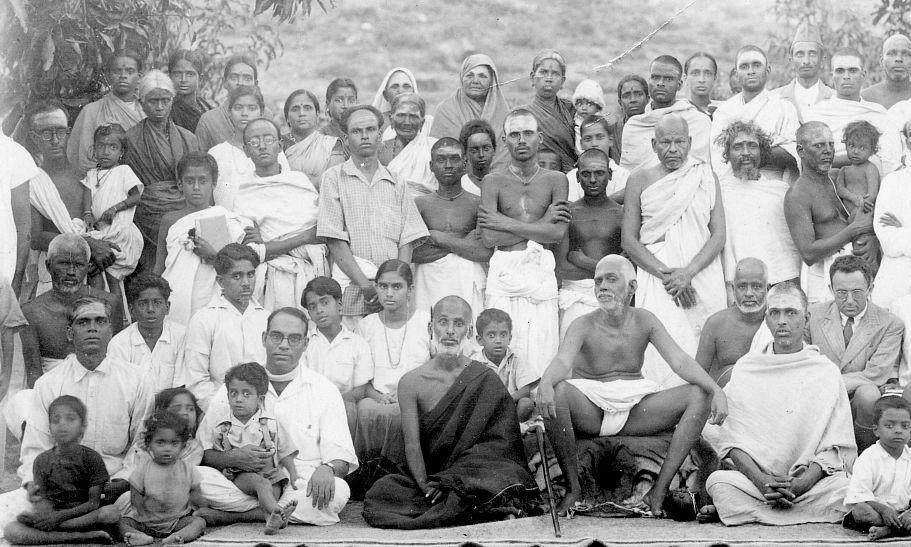
Sri Bhagavan and Prof. NRK with his family members (NRK standing extreme left holding baby daughter)
Granting the spiritual experience is the father principle; to sustain it in one’s self, Bhagavan compassionately extended the mother principle of feeding the body with food. That day, when I was thoroughly shaken up by Bhagavan spiritually, physically too he showered his grace on me through food. A leaf plate was placed on the bare ground. Two courses of rice with sambar and buttermilk were served. Though simple, it was the food of the gods. This Prasad solidly bound me to the sacred feet of my satguru, Bhagavan Ramana.”
Professor N. R. Krishnamurthy Iyer was born in 1898 in a village near Trichy. His father Ranganatha Iyer was a reputed lawyer in the city. His uncle Appachi Iyer would often visit their house and talk about Bhagavan. NRK did not understand much at the time as he was only fifteen years old. Fortunately for him, the entire family of twenty members went on a pilgrimage to Tirupati. Tiruvannamalai happens to be one of the stations on the way. Since NRK’s eldest sister who was married lived in Tiruvannamalai, they halted there. This happened around 1914 or 1915, when Bhagavan was in Virupaksha cave. All of them went to Virupaksha cave with the fifteen year old NRK and the other boys and girls. When they prostrated before Bhagavan, Bhagavan’s attention was on this boy of fifteen. NRK, however, did not pay any heed to the focused attention of Bhagavan because he was too interested in running around the cave. He told me there was a big, white conch that the children blew into; he was elated that the children were allowed to play around so freely.
In 1919, NRK visited his sister again. He paid a causal visit to Skandashram to have the darshan of Bhagavan. From 1915 to 1922, when he was in school and later in college, he had many, many experiences, sending him into silence. However, he was not able to attribute these to that first look of Bhagavan. He had no answer to what was happening to him. When the professor of his college asked the students to write an essay or an article in English, everyone else would write endlessly, but NRK was not able to write even a single word because his mind was blank. In those days, he never attributed these unexplainable spells of inner silence to that glorious look of Bhagavan. But, when he shared the experience with me later on, he said, “I recollected that the entire route of my inward spiritual journey began from that single look of Bhagavan.”
In 1930, he had a tonsils operation. The doctor made a mistake and removed more flesh than necessary, resulting in incessant bouts of coughing which lead to acute asthma. He took allopathic medicines, but these did not provide any relief. He then tried ayurveda, unani and other such systems of treatment which forbade him from consuming tamarind and chilly. During this time, he visited Bhagavan with his uncle Appachi Iyer and his brother-in-law. Bhagavan again invited them for lunch. They all sat down and food was served. It was the same rice, sambar, rasam and buttermilk that are served in Ramanasramam even today. NRK hesitated when he saw the sambar being poured on the mound of rice because of his diet restrictions. Bhagavan, who had been looking at him all the while, said, “Having come here to be rid of all your illnesses, why are you hesitant? Eat!” This was a divine commandment. He hoped that the commandment would cure him and it did. It was not a miracle that happened immediately; it took a few months, but he was completely cured.
In addition to this, another beautiful incident took place on the same day. Bhagavan’s brother, Chinna Swami, called him and presented him with a big picture of Bhagavan at the age of twenty one. He also gave him two Tamil books - Sri Arunachala Stuti Panchakam (five hymns in praise of Arunachala written by Bhagavan) and Sri Ramana Stuti Panchakam (five hymns in praise of Bhagavan written by a mystical devotee of his). An elated NRK took these to Bhagavan and placed them on his lap. Bhagavan picked up the books, corrected the printing mistakes in them and returned them to him with the photo. NRK prostrated before Bhagavan and received these as prasad. He preserved and treasured these all his life.
It did not stop here. A beautiful dialogue between the guru and the skeptic disciple had already taken place. It happened again in 1922 when the skeptic scientist had become the disciple of Ramana Maharshi. NRK said, “I prostrated before him and said, “Bhagavan, I am doing Rama japa; I chant, ‘Rama, Rama, Rama’. Is not chanting, ‘Arunachala Siva , Arunachala Siva ,’ superior to that?” ‘No! No! No!’ said Bhagavan vehemently. ‘Both are the same. Ra means ‘that which is’ and ma means ‘you’. In ‘Arunachala’, A means ‘that’, ru means ‘you’ and na means ‘are’. Thus, both mean ‘That thou art’ - you are that. Using your mind as the mouth, let the name Rama revolve continuously like Lord Vishnu’s chakra (a discus like weapon). Nobody needs to know that you are doing japa.’” NRK, who was a professor of physics, interrupted, “If I spend all my time like that, what will happen to my teaching job? Will not my job be in jeopardy?” Bhagavan looked at him graciously and replied, “The one whose name you repeat will take full charge of that. You need not be concerned about it. Keep repeating the Rama mantra.” This assurance from his guru inspired him to chant the Rama mantra eighty million times in the course of five years.
In 1934, NRK visited Ramanasramam with his wife and three children. Two of Bhagavan’s classmates, Venkataramiah and Narayana Iyer, also accompanied them. NRK was in touch with the classmates and playmates of Bhagavan. (It was NRK who later interviewed them at my request.) Even during this trip, he had a series of experiences in Bhagavan’s presence. One day after dinner, they were seated in front of Bhagavan when Ramachandra Rao, a gentleman from Bangalore, started reading the Ribhu Gita aloud. Bhagavan advocated it to all serious spiritual seekers. Each verse ends with ‘Aham Brahmam’, meaning ‘I am Brahmam’, or as God in the Bible says to Moses, “I AM THAT I AM.” When this was being recited by Ramachandra Rao, NRK became ecstatic. Vibrations of pure consciousness shook him up. He lost body consciousness. He was aware that all else looked like shadowy objects. In this state, he decided that he would renounce his family and the world. In those days, Arunachala was like a forest, so he decided that he would disappear into the forest. Bhagavan looked at him and only him - this was the guru’s grace - and said, “Krishnamurthy! Go back to Madurai with your family. The salvation that you want to gain as a sannyasin in the forest is what you will get even as a householder in your profession. I say, return home!”
NRK told me, “Just like the repetition of ‘Aham Brahmam’ took me to the heights of ecstasy this specific command of Bhagavan woke me up.” He prostrated and obeyed his master. He only asked, “Would you please give me a copy of the Ribhu Gita?” With the book in hand, he took his family home. He became a very serious sadhaka. He kept aside time for his professional work and his duties towards his family. Other than that, he was always chanting the Rama mantra or reading the five hymns in praise of Arunachala and the five hymns in praise of Ramana. He also memorized most of the Ribhu Gita. This is how we have to apply our master’s teaching to our daily routine. And when we do so, the guru leads us step by step in the journey inwards as Bhagavan did with NRK.
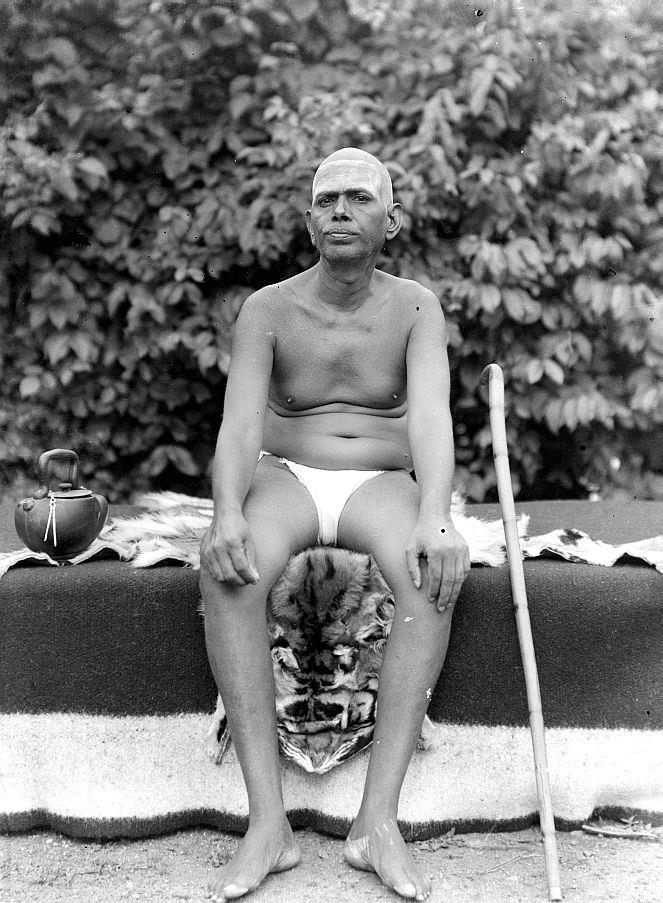
In 1941, NRK, who was a professor at Madurai, received an invitation from Ramanasramam for the Navaratri festival. The Mother Goddess is worshipped and celebrated for nine nights during this period. I was five years old then and my aksharabhyasam was going to be conducted according to tradition on Vijayadasami, the tenth day. (Aksharabhyasam is the ceremonial initiation of the child into the practice of writing. Akshara means the letters of the alphabet and abhyasam means practice.) My grandfather, Chinna Swami, invited NRK to attend this function. When NRK received this invitation, he felt that since he too was the child of Bhagavan, he should also have his aksharabhyasam done. In Sanskrit, the word aksharabhyasam can also mean ‘the silent practice of the eternal Self’. He felt that since he would be in the presence of Bhagavan at that time, he would also get silent initiation into the Self. He left for Ramanasramam immediately. (Around 1962 or 1963 he told me, “We two are brothers. Remember your aksharabhyasam when you were inducted into formal education in the presence of Bhagavan? I picked up the practice of Self attention in the presence of Bhagavan at the same time. So, we are brothers. We are always together and will always be together. That is how Bhagavan has meant it to be.”)
For nine days, he participated in the Navarathri celebrations holding on to the Ribhu Gita. The other two books were already committed to memory and so there was no need to carry them around. He held on to the book and looked at his master. Bhagavan asked, “Why are you holding on to that book?” NRK explained how he had given the book to Bhagavan and Bhagavan himself had given it back to him. He became very emotional at Bhagavan paying such attention on him. Gathering courage, he asked Bhagavan, “Please choose for me the most important lines to recite every day.” Bhagavan indicated chapter twenty six, saying, “The recital of these lines is itself samadhi.”
This is a teaching for all seekers. A book is not something that is just to be read and kept aside. It has to become a part of us. It has to become an integral part of us like any other limb of the body. This is an instruction that we have to take our master’s directions seriously. NRK always carried these books with him. He recited the verses tens of thousands of times and the Ribhu Gita became as much a part of him as his breathing. When I once asked him why he had read these books so many times, he replied, “These are not just books; they are not just verses. They are mantras - the sacred and holy words of the master.” When I appeared a little hesitant or disbelieving, he said, “I once asked my guru to explain the five hymns of Arunachala. He replied, ‘Repeatedly reading it is the meaning.’ That is why I have read them so many times.” Just look at this skeptical scientist. He would have probably read it many more times after that meeting. The guru transmuted him into gold. A scientist reading verses thousands of times even though the meaning is simple! He also recited the Rama mantra. Though a brilliant scientist, he could go beyond his brain.
In 1944, NRK came to Bhagavan for his final initiation. During the interval, he was in a state of total sadhana, because he had received the special grace of Bhagavan. On that day, Bhagavan was coming down the hill and NRK prostrated before him. Gathering courage, he asked Bhagavan, “With your grace, how can I experience the Self? Please let me know how I can be in a state of kevala nirvikalpa samadhi (a temporary trance-like state of the Self in which outer awareness is lost) even in a state of sleep. How can I at other times be in a state of sahaja nirvikalpa samadhi (the state of complete enlightenment in which one can function normally and naturally)? I would like it to be there even when I sleep. When I get up, the state should continue.” Bhagavan replied, “Sleep is a God given state. You cannot do anything while you are asleep. But, at other times you must practice the enquiry ‘Who am I?’ The ripe fruit that you so desire will come to you automatically and of its own accord.” NRK told me, “I got my final upadesa from the blessed lips of my beloved lord and master, satguru Ramana. I had nothing more to ask from him. I knew that I had to work hard to achieve my objective and there was nothing else for me to do.”
NRK dedicated himself totally to sadhana and after retirement in 1955, became a regular visitor to the ashram. I was amazed to find that he was constantly in the state of deep inwardness and yet he never claimed that he was a realized person. That was a revelation to me. As a matter of fact, none of the old devotees claimed that they were realized. I was close to NRK because he used to come frequently to the ashram. Since I stayed permanently at the ashram from 1960, I would incessantly ask him to narrate some of the reminiscences.
From 1960 onwards, whenever he came, he would stay for long periods of time. It was he who gave information about the classmates of Bhagavan. When Bhagavan’s family was at Tiruchuzhi, they stayed next to a family where there was a small girl called Lakshmi. Lakshmi narrated the following to NRK: “When Bhagavan was in the womb, Azhagammal experienced an incessant and unbearable burning. Hence, a paste of neem leaf and vilva leaf was applied on her stomach every day to provide some kind of relief.” We get this information only from Lakshmi, who was supposed to be close to Bhagavan’s mother. She has also said that when she was two, Bhagavan and she would suckle from Azhagammal at the same time. As a matter of fact, Bhagavan had mother’s milk till the age of six and Lakshmi attributed his strong physique to this!
Bhagavan’s classmates have also disclosed that though it is stated in the biographies that on September 1, 1896, when Bhagavan got down from the train, he went straight to the temple, this is not how it happened. The train arrived at six in the morning. Bhagavan was in a state of sheer ecstasy. He did not go straight to the temple. He wandered in the streets of Tiruvannamalai and only around twelve at noon did he enter the temple. The doors of the temple were locked, but when Bhagavan entered, every door opened. When he went inside, he found no one. Bhagavan embraced the lingam and declared, “Father, I have come at thy bidding. Thy will be done.” Everything was Arunchala’s will; it was not Bhagavan’s plan.
I asked NRK about the personal habits of Bhagavan. NRK replied, “Not only have I observed them, but I have tried to follow his example all my life. One noticed in Bhagavan’s daily life, personal cleanliness, tidiness of dress, the equal sharing of all food with those around him and a strict adherence to a time schedule. He did useful work however ‘low’ it may be. He never left a work unfinished, never asked another to do something which could be done by him and never considered himself as superior to others. He always spoke the truth or kept a strict silence if his expressing a truth would hurt or lower the reputation of others. Finally, he never worried about the future. Bhagavan taught us devotees by example. We should follow his example in body, spirit and mind.
Once, in 1980, I lamented to NRK, “You have been doing sadhana. Even now you are continuing your sadhana, Professor. I am burdened with ashram work. I have no time to do sadhana. I feel miserable when I look at you.” He replied, “Why worry? It is immaterial whether you do sadhana or service. Fully recognize that you are a part of Arunachala. That is enough.” Puzzled, I asked, “What do you mean that I am part of Arunachala?” NRK took me from my office to the foot of the holy mountain. He reverently pointed the mountain out to me and said, “Arunachala is the pure Self, the ‘I AM’, the nature of Tat Tvam Asi - That Thou Art - you are that. The Vedas also declare this truth. Humanity has forgotten that Arunachala is the same ‘I AM’ in each one of us, that Arunachala is the essence of Vedas. In order to make humanity recognize and re-establish the truth of ‘I AM’, Arunachala itself has taken the human form of Ramana Bhagavan. When Arunachala took the human form to spread the truth of ‘I AM’, all the rocks and boulders from the hill also took birth as devotees. So, be assured Ganesan, you and I are also rocks and boulders of Arunachala. Just as Bhagavan went back to Arunachala in the form of a meteor like light which we all saw, we too, when we drop our bodies, will go back to the holy mountain. Keep this truth deeply embedded in your heart. Share and announce the greatness of these rocks and boulders. Be happy, Ganesan; you have this work to do. I feel Bhagavan wants you to do this.”
I was very fortunate to have been able to persuade NRK and his wife to stay in Ramanasramam for a long time. This gave me the great opportunity of receiving his blessings. Once, around 1981 or 1982, I requested him to grant me the state of ecstasy that he and other old devotees experienced in the presence of Bhagavan. He was overjoyed at this request of mine. He said, “Yes, not only you Ganesan, but anyone who listens to this incident will melt into Ramana’s silence inwardly and shed tears of ecstasy outwardly. Listen to this. One day, Bhagavan was seated cross legged on a bench close to the thatched mud hut that had been built over the Mother’s samadhi. Bhagavan’s classmate Rangan, Ramaswamy Pillai, and other old devotees were sitting on the floor before Bhagavan. They all started singing the five hymns in praise of Ramana called Ramana Stuti Panchakam in Tamil. Rangan was on the floor close to Bhagavan. His head was only a couple of inches away from the bench. The verses concluded with ‘Pray! Place your soft, holy feet on my head.’ As this line was being sung, one of Bhagavan’s feet descended, came into contact with Rangan’s head and stayed there for quite some time. The whole group, including Rangan, was hypnotized at this remarkable spiritual experience and continued repeating the same stanza again and again.”
NRK later moved to Madras and passed away there. His sons told me that even though the doctors declared he was unconscious and in coma, his lips were moving as if reciting something. It must have most certainly been the five hymns to Arunachala, the five hymns to Ramana and the twenty sixth chapter of the Ribhu Gita.
The head bowing to the Heart is the final physical act of our losing our ego in the Self. It has to merge with the Self. This is the symbol of taking the guru’s holy feet on one’s head. Prostrating before someone or placing the head on someone’s feet - all these have a spiritual significance. Please understand and experience it. I have put my head on the holy feet of thirty masters. I was also a skeptic like many. But, believe me, when you put your head at the holy feet of the master, something else transpires. What is that something else? Your ego bows down to the all pervading Self. There is no other way. Mere reading and undergoing training will not help. The touch of the master’s holy feet is enough. Bhagavan said, “The holy feet of the satguru is in one’s Heart. Any time you bow your head to the Heart, you are being blessed by the satguru’s holy feet.”
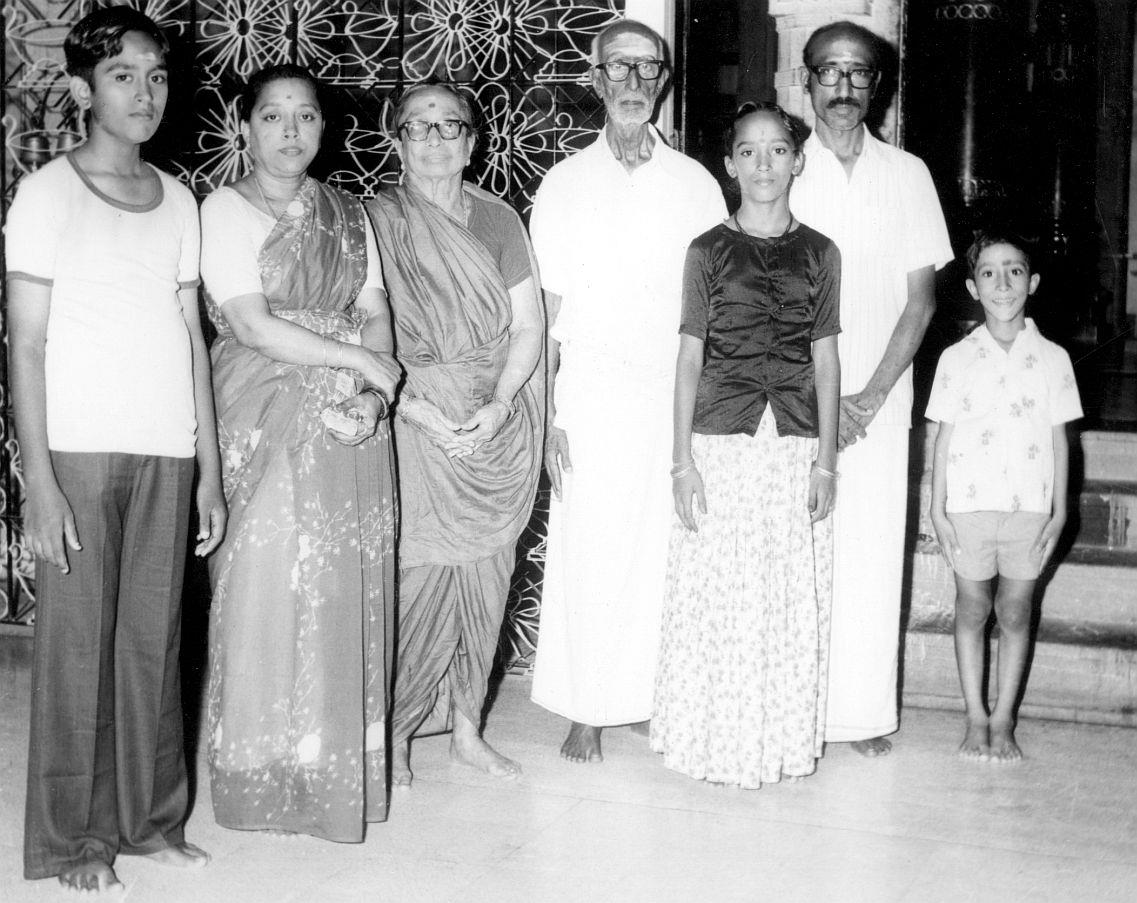
Prof. NRK and family in front of Sri Bhagavan’s Samadhi Shrine