Sivananda: Biography of a Modern SageHis life, by Swami Venkatesananda
UNCONVENTIONAL METHODS
The ashram, the Divine Life Society and all that Swamiji worked for and built up during his life time were not only for the welfare of mankind but were also fields of sadhana for seekers after Truth. Once this idea is clearly grasped, the sincere seeker will understand the numerous paradoxes noticed in the life and conduct of Swamiji, the conflicts experienced now and then and the indiscipline that sometimes crept into the institution. Yoga is not a ‘subject for discussion at a club table’, as Swamiji so wisely said, but is to be practised in the daily battle of life.
Service and charity were always the basic virtues to Swamiji. It was impossible for him to imagine that a human being could live and yet not possess these qualities. Swami Paramananda recalls: “On one occasion he told me that I should always look for opportunities to serve others in any capacity. He would insist on our keeping a small handkerchief in our pockets so that we might clean the shoes of the mahatmas and pilgrims while they were at satsang, without their knowledge — such was his zeal and enthusiasm for serving the Lord in all. If anyone missed any opportunity to manifest these qualities he did not hesitate to ‘rub it in’.”
At the same time, Swamiji never encouraged mere work alone. The attitude or spirit is the all-important factor in yoga. He never failed to give the young workers wholesome advice on how to keep up the right spirit.
Swami Paramanandaji had been sent by Swamiji to a printer and publisher, to get one of his early books printed. Paramanandaji was urgently required at Madras. Those were the days when Swamiji was living on alms, so the printers themselves paid the travelling expenses of the person sent by Swamiji to do the proof-reading, etc. What happened is evident from the following letter written to the printer by Swamiji on the 29th January, 1936:
Immortal Self, write Hari Om at the top of each letter 12 times. This is the easy sadhana for Self-realisation: remembering God during activities.
How is it you have not sent me money order for railway fare? When a little money question comes, heart contracts and recedes. Every man is very, very generous for himself, for his wife and children. Others, he ignores, he thinks that they are different from him. This is maya (illusion). This is ignorance. This brings death and misery.
Kindly send Swami Paramanandaji to Madras. He has got some urgent work there. I shall send you another swami, within a month. If you approve of my suggestion you can send me third class railway fare for him. Kindly give interclass fare for Swami Paramanandaji, PLUS any small amount he may be spending during his stay there. You must be a generous man like Sri P.K. Vinayagam of Madras. Kindly supply Paramanandaji with plenty of coffee in thermos flask unasked. This is his food for energetic work.
Have devotion for sannyasins. Take care of their bodies with faith and divine love. Here is a field for thy growth, evolution and emancipation.
May the divine flame grow brighter in you:
Thy own Self Sivananda
A much greater degree of service and charity was expected of the sannyasin-disciple, as we see from the following letter dated the 23rd February, 1936, addressed to Paramanandaji who was at Madras at that time:
Kindly send money to Vivek... He wants to purchase some books... Kindly send immediately Rs.8 to Swami Nirmalananda Saraswati as he wants to go to Benares to pursue his studies. Kindly send him Rs. 20 whenever convenient for his books within 2 or 3 months. If you send him some money within a month, he can purchase some books for his immediate use. All this can go into my account. I am giving you a lot of trouble. Kindly, pray, pardon me. People press me. I have to turn towards thee. What is to be done? We should have mercy and should serve others at the sacrifice of our wants. Sri Sadhu K.C. wants all my books free. Too much pressure on Mr. P.K.V. for free gifts will be a nuisance. But, as he is charitable, he won’t feel. The above can be done. Sri Sadhu K.C. is leaning upon me for the growth of his ashram. He is an old man. Let us serve.
This is ‘Sivananda style’. Apology is followed by a command; prayer is followed by an admonition; concession is immediately followed by its cancellation.
Sometimes Swamiji would adopt the ‘appeal’ method for extracting work from his own disciples. They would be made to feel superior, important and responsible. Thus, the charitable nature was developed:
Amritiji is wonderfully improving. He is the senior acharya of the kitchen nowadays. He is the senior typist also. Supply him one fountain pen on my account. 1 copy of Gita Sankara Bashya for Nijabodhji, 1 set Upanishads translation for Swarupanandaji and Atmanandaji. (1935)
Although Swamiji was the author of the books, the guru and the master who could command, yet there was humility in his approach and he had the great quality of treating his own disciples and servants as people equal to him in status and importance, whose obedience should be won by persuasion and understanding, not by mere directives and authoratitive commands. The following letters illustrate this:
Sri Swami Nityananda Saraswati — a new initiate. He is a great man, very learned in Tamil, a poet; one who has great influence, who stays in Tinelvely for the last 20 years, who now does lectures and builds kshetras for southerners at Benares. He is a Jaffna man. I have given him my only full set of books. He wanted them for his lectures; his disciples will translate and read. Kindly send me one full set of books at once. (23rd June, 1936).
Your friend, that young boy of Swarg Ashram, who never speaks, who was with a towel only without kowpeen, has asked me to request you to send him 1 lb. of snuff! This is also a kind of vairagya (dispassion). The nose has become like a machine gun through repeated usage. He brings in ingenious argument for his using. You can send the small tin as usual. Let this be your charity towards a virakta mahatma. (10th July, 1936).
Another interesting revelation about this kind of charity: Swamiji said that it will result in some punya (merit) and some papa (demerit) also: “Punya for relieving a bit of their suffering, papa for making them sufferers. Had we not supplied them the habit would have been killed. But the ‘Aham Brahmasmi’ (I am Brahman) people are above merit and demerit.” Swamiji’s charity knew no limitations, no codes other than the code of compassion: where there is suffering, relieve it. Offer it to God later.
Swamiji did not treat all people alike: he did not give the same pill to all patients. For instance, he actually encouraged smokers. There was one swami in the ashram who was a heavy smoker. One day he did not have cigarettes. His brain did not function! Swamiji noticed this, so he at once gave four annas to another ashramite to purchase a packet of cigarettes. When this was brought he instructed that the packet should be kept underneath the swami’s pillow in his absence.
Some felt that Swami Sivananda was encouraging this swami against his own principles. That was not so, because when the man came to know how Swamiji went out of the way to fulfil his cravings he felt ashamed and automatically gave it up. But that did not mean that Swamiji was unaware of the great and urgent need for a spiritual aspirant to practise self-control. Another letter expresses this feeling clearly:
V. has sent me a postcard asking me to remind you for money order and expressing his difficulty. He bores me and you also. Why are sannyasins keen to get back a small sum? Where is the spirit of sannyas? Let the body rot. What harm is there? A little suffering young people are not able to bear.” (6th May, 1936).
Swamiji combined wit and wisdom in instructing his disciples. The following extract is an instance in point:
You will have to add the enclosed article to Yoga in Daily Life quietly, without murmuring or grumbling. This is called yoga in daily life! (26th June, 1936).
Paramanandaji used to relate how once when a disciple staying with Swamiji in Swarg Ashram adopted an attitude of rebellion and refused to copy an article to be sent to a journal, Swamiji silently slipped out of the disciple’s kutir. Then, after a day or two when the young man had obviously cooled down a bit, Swamiji approached him again. After telling him a significant Tamil proverb which says: “However much a pregnant woman may cry, she alone will have to deliver the baby”, he narrated the following story of a kowpeen both to humour him and to instruct him: “Once a kowpeen (underwear) became disgusted with the duty allotted to it, and so flew away from the clothesline. It fell at some distance, and was greeted by a man who was then in need of some underwear. He promptly put it on and went away. Thus the underwear realised that there was no way out but to do one’s duty in a spirit of cheerful surrender.”
This humorous instruction had a magical effect on the aspirant who, without a word, took the article from Swamiji’s hand and made a copy.
Freedom and Discipline
Swamiji’s teaching was a synthesis of freedom and discipline. He was able to combine these two very beautifully and very subtly, though it involved a tremendous lot of work on his part. In freedom he allowed the disciple to grow and as he grew Swamiji pruned. Self-surrender was not demanded, but he created situations in which it became obvious that he was the master, and that there was nothing that he did not know. The disciples would observe how things went on, compare what they would have done with what he did, and see that he was infinitely wiser and infinitely more efficient. When the disciple saw this, surrender would happen.
Usually the guru prescribes the sadhana that the disciple should undertake, but Swamiji never did, except in the case of disciples who were perfectly in tune with him. Even when it came to mantra diksha (initiation into a mantra), he would ask what the devotee’s ishta devata (favourite deity) was, and give a mantra suited to that. He would also ask what name was preferred when he initiated a disciple into sannyas.
He allowed total freedom, but waited for opportunities to plant his seeds, to prune, guide, to train — in the sense of turning the direction. For instance, if after doing meditation for six months at the rate of three hours every morning a disciple went to him and said that nothing was happening, he would say: “You should do some Hari Rama kirtan in the Bhajan Hall along with it, then the meditation will be deeper.” Then it appealed! If he had said that right in the beginning, probably that suggestion would not have been received so favourably. If that also seemed to be making the mind dull, Swamiji might have said, “Go and work in the kitchen for a couple of hours a day, cutting vegetables.” He made it seem as if the disciple was not doing it to serve the ashram, but to get rid of his lethargy. Then he would say: “Why don’t you exercise yourself a little bit? Do some pranayama or yoga asanas.” By then the disciple was practising what Swamiji loved most — integral yoga. He merely provided incentive and guidance now and then. He gave the disciple the privilege of freely choosing to do what he wanted the disciple to do!
Thus, Swamiji never forced his will upon his disciples. (Of course, the ashram had to have its own rules and regulations, that was a different story!) Between him and the disciples there was total freedom, but it was freedom that was guided and trained and allowed the student to grow. And growth there was. The freedom was not so free as to allow the disciple to wither away.
If necessary Swamiji would gently give him a prick and wake him up. The prick may have come in a hundred different ways, but it was always gentle. It woke one up but it didn’t hurt. This was his supreme grace, not only in the sense of divine grace flowing to all, but it was gracefully done. That supreme grace of Swamiji is perhaps impossible to find elsewhere. He was all things rolled into one — father, mother, teacher, stern master and an extremely loving friend. In all things he was a synthesiser, there was no division. He was always combining all sorts of contradictions — this was his speciality.
Times without number Swamiji insisted that along with selfless service the aspirant should study sacred texts, and meditate. Six hours study, six hours meditation and six hours service was his ideal routine for a seeker. One day he said:
I grieve to find that many a time my own students fail to catch my meaning when I urge them to dedicate their very lives in the cause of selfless service. In no way do I mean them to neglect their personal sadhana in the name of other work. Systematic sadhana at a set time daily in the early morning and at evening twilight is not at all incompatible with active work during the rest of the day. The point I stress is that even the work should become spiritual sadhana by the adoption of the attitude of non-doer, with the feeling ‘I am not the enjoyer’; or the attitude of offering everything that one does unto God, and the feeling ‘I am an instrument in the hands of God.’ Then your entire daily activity will form worship. Your lives will brighten up into an effulgent light offered daily to the manifest cosmic Being. You will slowly but surely be transformed. How many pious householders are even now diligently practising systematic sadhana together with their social duties! If you rational youths do not see the logic and psychology of the powerful influence that our mental attitude and suggestion exert on all our actions, how then do you expect the masses and the laymen to understand the theory or philosophy of karma yoga? Leave off queer preconceived notions of what sadhana is and what it is not. All selfless activity, reverentially done, constitutes the highest sadhana. If you practise doing all work in the spirit of worship, there cannot be any feeling of despondency at all.
Swami Venkatesananda related:
Sometimes we would be asked to work in the kitchen, peeling potatoes and cutting vegetables, and Swamiji used to insist that during all this we repeat God’s name. Sometimes we would all sing:
Hare Rama Hare Rama Rama Rama Hare Hare, Hare Krishna Hare Krishna Krishna Krishna Hare Hare’
as we went on doing the job. The chant would keep reminding us that it is God that does it and unto God it is done. The subject is God and the object is also God, and therefore the action in itself becomes divine.
One day we were all working in the office right in front of Swamiji. Some of us were typing, some writing, some doing the accounts. He had a very lovely way of indicating when he wanted to say something funny. He would put his spectacles up onto his forehead and close one eye and look at us with his elbow on the table. There was a radiant and mischievous smile when he said: “Were you not doing this kind of work in Delhi?”
“Yes, Swamiji.”
“So what is the purpose of coming here? You go to an ashram, a holy place, looking for moksha (liberation), and there you do exactly the same thing that you did before in government service. Why did you have to come here at all? Isn’t it possible for each one, remaining in his own station in life, to practise karma yoga?”
All of us were silent. Then he himself provided the answer: “It is here that the spirit is awakened. It is very difficult while you are still engaged in the battle of life, when you are confused, to cultivate the right spirit. Only if you live at the feet of a master can you discover this spirit. When you return to the world it is the same world, but you are not the same, and therefore the world is not the same either. You have a new vision. To train you in this is the role of the ashram.”
Laziness
Swami Sivananda was extremely patient with sloppy work, mistakes and inefficiency. There was virtually nothing he would not put up with— except laziness.
How do you make another person work? The first answer is that you must set an example. Swamiji was himself the best example. Once he said: “Not only do I work hard, but I know how to extract work from others.” He did this in a delightful fashion. Sometimes he would lean back in his chair and look; sometimes he would close one eye and just look... and then he would smile. In that look and in that smile there was something that was bewitching. He conquered by love.
If the disciple was lazy and did not respond to this, first he would get some fruit, milk and biscuits from Swamiji and perhaps some other gifts. Whenever he went near, Swamiji would greet him and praise his good qualities. This was an indirect way of suggesting: “You are a wonderful man, why don’t you do something about it?” Some times a disciple would take the hint and at others perhaps would say: “I am meditating six hours a day.” Then Swamiji would respond eagerly: “Very good. You must meditate and do some kirtan and bhajan.” If the disciple were to think that Swamiji was encouraging him to do only that, he would become more lazy. Even the fruits and milk would not inspire him. Then, in his presence, Swamiji would start talking about somebody else: “What a dynamic man So-and-so is. Everybody ought to be like that.” If the disciple did not heed this, Swamiji might say: “For a change, get up and do something!” He could come down like a thunderbolt for a few minutes, and then be all milk and honey again. If even that failed and the disciple remained lazy, he would be the first person asked to leave when there was a financial crisis.
One dreamy aspirant had acquired a sort of deceptive indolence, imagining it to be a way of expressing inner spiritual tranquillity. One day it happened that Swamiji was conversing with some visitors on the verandah outside the Bhajan Hall. This young man came ambling up the pathway in a leisurely stateliness which immediately caught Swamiji’s eye. “Come here,” he called out. When the young man came he asked: “What is the matter with all of you? Are you being underfed? Is there nothing in the kitchen? Or is it that you don’t get time to eat? Your hair is not grey yet. Why then this deportment of a half-starved being? Where is your energy, your youth? Why can’t you step about with a bound and a jump? Let me see you sprint. Come, take a run around the Bhajan Hall.”
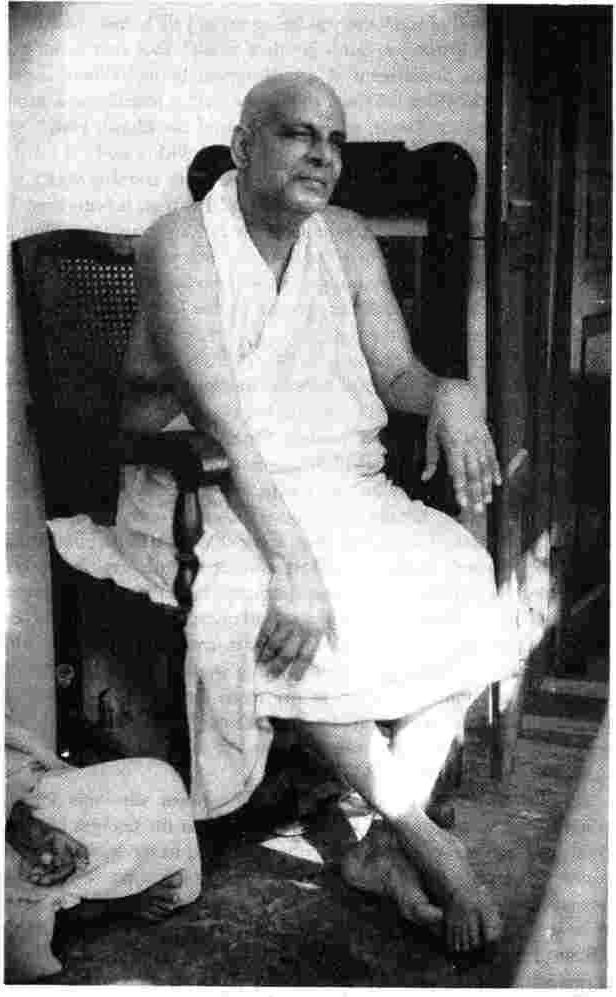
Sometimes he would close one eye and just look...
The youth started to run. Swamiji then said with a nod, “I want to send this boy to a military camp. It is only a military training which will instil pep into these entranced hermits. I think this man is born lazy. He seems to think that a life of renunciation is synonymous with physical quiescence and inactivity. Where they obtain such ideas, the Lord alone knows!” Then turning to the young man — who had completed the run and who stood with a sheepish expression on his face — he said: “You should learn a lesson from the busy man of the city or the young medical students. How briskly from block to block, from ward to ward, along verandahs and through corridors does the medico step about in his daily work in the hospital. Why can’t you take his example? A world renouncer should be the most dynamic of workers because he has the advantage of being wholly free from the multifarious vexing activities and distractions that beset a man in worldly life. Be energetic from tomorrow. Let me see you run and not walk. Let me see you everywhere at once. Sloth does not constitute sainthood. If it were so, then every chair, table and pillar would have to be canonised. Shake yourself up and turn into a versatile worker.”
During the Yoga Vedanta Forest Academy classes Swamiji frequently used to pull up any slumbering aspirant and question him: “Do you keep notes of the important points that you hear during these classes?” Most often the aspirant would not. Then Swamiji would continue, “After the class is over, as soon as I return to my room I reflect over the ideas I gathered during the lectures at the class. Deeply meditating over them gives rise to other related sublime thoughts. All these I incorporate in an article and present to the world.”
There was a diligent aspirant in the ashram who was fond of meditation; he would be seen sitting on a rock on the Ganges bank for two or three hours every morning without moving in the least. Everyone thought that he was enjoying not only meditation but super-consciousness. One morning, however, Swamiji questioned him about why he was not attending the morning class. He said, “Swamiji, I love to meditate. I am in meditation for three hours in the morning.” Swamiji was in a jovial mood that day: “Be careful,” he said, “lest you should get drowned in the Ganges. You might go into a superconscious state at any time and be washed away!”
After a pause, he added: “Do you know the quickest way to enter into that blissful state? I will tell you: take good cold rice, and curd prepared out of buffalo’s milk. Spread a nice bed with good soft pillows. Stretch yourself on it. Breathe deeply with a little noise. Relax. You will instantly enter into that state! This assumed superconscious state, sitting on a block of stone, like a block of stone, is nothing better than that.” The aspirant was puzzled. Swamiji explained: “Meditation means to ‘touch the Infinite’. It is communion with the omnipotent God. Do you know what a tremendous amount of power will surge within you if you really meditate even for five minutes? You can transform the world, you can roll up space like a piece of leather! You can work wonders if you even meditate for a few minutes. What have you acquired by the three-hour meditation that you have been practising all these months? Nothing. Better carry water from the Ganges to the ashram kitchen. Your lethargy will go away. Be active. Serve. Then you will know what purity is. Only when your mind is filled with purity will you be able to meditate.”
When a disciple’s misdemeanour was reported to Swamiji, unless he saw it with his own eyes he refused to believe the complaint. If it was pointed out that So-and-so had some evil qualities, he had a counter-list of that person’s good qualities. For a few days he would shower his love and affection on this person. If the complaint still persisted, it meant there was some truth in it. He would send a great beam of love flowing to the errant disciple and only when he was sure that he had him in his grip, that his heart had been completely conquered, would he gently drop a hint. Even this hint was not allowed to hurt, because if criticism hurts it is counter-productive, and one will rebel against it and turn away. He would never allow that to happen. For the sake of the good that surely everyone has in him, Swamiji would give a long rope to the evil, thus gaining one more brother to the spiritual family.
To him, there was no wicked man on this earth who did not have his own good points — no one was incorrigible. In his vision the eternal sinner did not exist. He saw God and godliness everywhere, and this, coupled with the supreme dynamism in him, transmitted his own soul-force. This instantly awakened the dormant good in all and strengthened virtue where it already existed. Even the beneficiary was often unaware of this. It was in his attitude towards the spiritual aspirants that Swamiji manifested the highest degree of adaptability. No sacrifice was too great in this work of moulding men into saints.
If the seeker had a mere surface defect, like a bad eating habit, he would soon get over it in the spiritual atmosphere. Lest the aspirant should be tempted away by other minor weaknesses or love of luxury, Swamiji would himself provide these, thus immediately preventing a downfall. He had the conviction that sooner or later the aspirant would overcome the weakness and abandon the luxury. Even if it was deep-seated enough to prevent him from rising very high in spiritual practice, he would work as an instrument in Swamiji’s divine hands, and that work would elevate thousands of others. This was his magic. The very person whom the world scoffed at, was taken up by him and transformed into a very useful citizen. To spurn a man for the evil that you may see in him was a terrible loss. Swamiji never did that. He would get very good work out of even the devil.
He often illustrated the need for patience and forbearance by the following example: “If you are walking near a thorny bush and suddenly there is a gust of wind and the shawl you are wearing round your shoulders gets caught in the bush, you can’t just drag it. If you do, your shawl will be torn. You have to stop your movement, and very gently disengage each one of those thorns. Such patience is necessary if one is to deal with one’s own evil nature.” Swamiji gave us wonderful, actual and almost daily demonstration of this attitude.
His forbearance was often severely tested. An aspirant might yield to the sage’s sculpturing of his personality; indeed he was then truly blessed. Or, he might manifest his weakness and even rebel against his own benefactor. Falsely imagining that he was a saint even at birth, a foolish aspirant would resent the chisel with which Swamiji tried to create a form out of the ungainly mass that the aspirant was. A beloved son might anger his father by such behaviour, but Swamiji would merely suspend the chiselling and shower his love upon the ignorant man, allowing him time to come to his senses. The young man might even go away from the protective shelter of the master and, strangely enough, Swamiji would then look on apparently unconcerned as the misguided aspirant, yielding to egoism, anger or greed, shattered in a moment the beautiful edifice which had been constructed with years of patient and persevering labour. Swamiji seemed to immediately forget all about it — but no, it was then that he performed the greatest miracle. Before he coolly gave the aspirant leave to go, he would unobtrusively spread over him the invisible armour of his blessings that one day surely would bring him back. When such an aspirant returned to the ashram Swamiji would treat him as though he had always been part of it and had never left.
However impossible the disciples were and however rudely they may have reacted to his training, Swamiji didn’t lose his temper or give up hope, but just went on. If the disciple was not able to see what he was trying to do, he gently created a situation in which the disciple may be able to see it. That is how he worked ceaselessly for forty years.
It used to be a standing joke in the late 40’s that if someone took a complaint to Swamiji against someone else he would refuse to believe it. Obviously no one would fight with someone else in Swamiji’s presence — that happens only when the master is not there! So whatever mischief went on happened behind his back. If an ashramite took a complaint against some one he would say: “Ah, is that so?” but he didn’t really believe it because he had not seen it with his own eyes. However, if there was a complaint, for instance, that So-and-so was smoking — and Swamiji felt that there was a germ of truth in it — he would write an article on the dangers of smoking. If the man against whom the complaint had been laid was a good typist, Swamiji would ask him to type the article.
There was no confrontation, but it was possible that while typing the article this message might sneak into the heart. If he was not a typist Swamiji would have the article typed by someone else and ask for it to be brought to the evening satsang. In the evening satsangs in those days there used to be lots of reading from the scriptures and occasionally from Swamiji’s own writings. That day he would say, for instance “Mukunda, have you typed the article? Please give it to him to read,” as if at random and as if he was not very particular who read it. So it was given to the man against whom the smoking complaint was lodged. There in the satsang in front of all the people he had to read aloud, “Don’t smoke. Smoking is deadly, it poisons your lungs, etc. Therefore stop smoking immediately.” It is possible that the smoker got the message!
Often he would ask an aspirant to give a talk. If he were a man of bad temper for example, he might be called on to give a talk on anger to some group. He could not say that anger was good, but that a spiritual aspirant must be absolutely calm and patient and so on. As he went on saying this, inevitably he himself would listen to it.
To many perhaps, Swamiji was only a teacher who taught them, or just a good man who looked after them. Many went to the ashram as destitutes, he looked after them; many went in despair, he gave them some hope; many didn’t know what to do with themselves, he gave them some work. He was several things to several people. He often came down to the common level to help people — not because he loved their company, but in order to lift them up. If they refused to be lifted up he left them where they were spiritually. Then he treated them as destitutes by providing the necessities of life — that is what they wanted!
An incident on the 8th March, 1949, gives us a glimpse of the superhuman workings of Swamiji’s mind and his divine way of looking at men and problems. Someone had had a misunderstanding with another. Swamiji patiently heard both sides. The verdict proved to be a most strange one — strange in the sense that no court of law in the world has this simple commonsense way of seeking the good in both the accuser and the accused, and then striking at the very root of the problem and eradicating the root there itself, instead of simply cutting off the branches.
To the accused, Swamiji said:
In the field of active work alone, man comes face to face with his own inner contents. The inner nature is dormant while one is away from the battle-field. When favourable opportunities offer themselves, then the inner hidden traits have a chance of manifesting themselves.
There must be some truth in what the other man says. This is the attitude that every sadhak must adopt. Then sit, reflect, analyse your own self and find out what hidden trait he has pointed out.
Some people’s nature is sensitive. Their sensitivity is too highly strung, but we should not consider that a defect in them and prick it. We should mind what we do. We should, on our part, understand and respect that sensitiveness.
His sensitiveness has felt that something that you said was offensive. At once you should feel thankful to him. Thank him who points out your defects. This is the basic virtue that every sadhak should cultivate and develop. Then only is there a chance for one’s own improvement.
To the accuser, Swamiji said:
If every one aspires to be a sadhak, there will never be any complaint, a rub or a quarrel. A sadhak’s attitude should always be to work selflessly, to aspire to be a good, perfect sadhu. Then there will be no need to revolt. God has given us all comforts. You have never felt the pinch of hunger: you have never suffered insecurity, nor exposed yourselves to the mercy of nature. You have found a prosperous institution to care for you like a loving mother. I have known what it is to run to a kshetra to take alms. I have known what it is to sleep on the roadside. These should always be held before the mental eye of a sadhaka. These are the principles of a sadhu’s life. We should compare our status with that of the Rishikesh-sadhus. We are a thousand times more comfortable than they. We should be thankful to God for that. This complaining-mentality should go.
To both he said:
This incident reveals the fact that there is somewhere a disharmony of hearts. A quarrel arises only when there is this disharmony. Otherwise, the accuser refuses to accuse, and the accused readily admits the accusation. Then there would be no need for courts of law. All people should develop this ‘one-family spirit’. Then only quarrels will cease. There should be harmony of hearts. Your heart should beat in unison with all hearts: you should love all. Once there is rupture it is very difficult to patch it up. But this is quite possible; what is required is a continued, uniform and prolonged love approach, so that the other party will have time enough —first to get over the grudge, then to get over the suspicion of your inner motives of love, and ultimately to understand your true nature.
Sannyas
Swamiji welcomed everyone to his ashram, and gave mantra diksha to anyone who asked for it. As time went on he gave sannyas initiation almost indiscriminately to young and old. He gave it in person and through the mail, to men and women, Indians and foreigners.
In a talk on sannyas he said:
The Upanishads emphatically declare that immortality cannot be attained either through the performance of selfish actions — even though they may be good and virtuous — or by any other means other than renunciation. Only by renouncing the feeling ‘I am So-and-so, or Such-and-such’, only by annihilating egoism and mine-ness, can man attain immortality.
No doubt the path of renunciation is a thorny one; it is the razor’s edge. But there will always be brave heroic men of discrimination who will be fired with the zeal to renounce the world and lead the life of nivritti and attain Self-realisation. You will always find in the world such supermen of higher wisdom who are fired with intense dispassion and yearning for liberation. They will renounce the world and embrace sannyas. There will always be sannyasins in the world. No political or social doctrine or system can put a stop to people renouncing the world and leading the life of sannyasa. Without spiritual men of renunciation and spiritual leaders there can be no peace or happiness in the world. They are the suns that dispel the darkness of ignorance and vice. They are the very foundation of a nation and the world at large.
It is the duty of enlightened society to support such men of renunciation and to help them in every possible way in their search for truth. They, in their turn, should serve society and give men and women the priceless spiritual food.
Some people ask me why I admit young men into the ashram and give them sannyasa. They are most fit for sannyasa. Only young people can practise intense sadhana and tapas (austerities). What can an old man do? Just when he is about to die, someone will utter the mahavakyas (great sentences e.g. ‘Thou art That’, etc.) in his ears which have already gone stone-deaf! Of what use is such sannyasa?
I want fiery young men, brave, dispassionate and wise, with iron will and ferro-concrete body and nerves, who can pulverise the Himalayas, who can sip the waters of the ocean, who can devour death like a pickle, who can swim across the Pacific, who can uproot Mount Everest, who can swallow a ball of fire! Glory to young sannyasins who have dared to defy the worldly temptations and embrace sannyas...
These aspirants appear to be young only to your superficial vision. They appear to be young only so far as their body is concerned, but they are not young in their mind. Their heart is mature. Discrimination and dispassion have arisen in their minds due to their sadhana done in previous births. It may look as though they neglect their families or leave their parents and wife and children in the lurch. This is not the case. These young men have all renounced the world in search of God. By this act of renunciation they entrust their families to the care of the Lord. The Lord will look after them. Indeed, it is God who protects everyone; it is only due to illusion and attachment that you think that you look after your children or parents. No, no, it is He and He alone that protects you all. When the son renounces the world, the parents and other members of the family should at once feel that he has done the noblest act; and from that moment they too should regain their faith in God, and they too should aspire in their own station to reach Him.
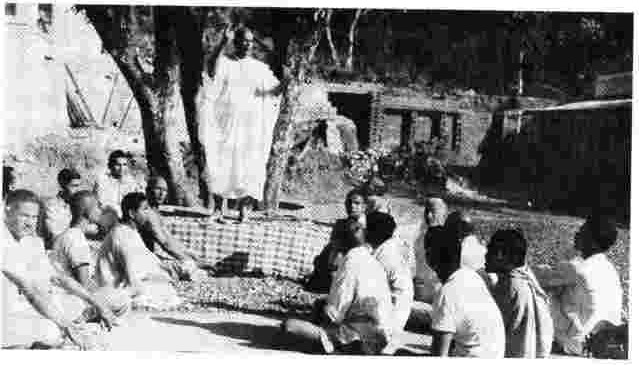
Not all the sannyasins initiated by Swamiji stuck to their vows. Some behaved in such a way that they brought disgrace to the Order, while others left to become householders. When Swamiji was criticised over these incidents he said:
Yes, there are many instances of swamis doing things that are not what is expected of a sannyasin, and many have thrown away the gerua cloth and have married. Yet, they are worthy of your veneration. For, at least one day they were sannyasins. They had the courage to throw up their hands and say “I renounce the pleasures of the three worlds.” They had the boldness and daring to stand up against the greatest forces of nature, the forces that maintain this samsara — those of self-preservation and procreation. They were taken unawares when they were a little heedless. Because one man had failed to live up to sannyas you should not think that the Order itself is unsuitable for the youth. What about the names of great sannyasins like Swami Vivekananda, Swami Rama Tirtha, Swami Dayananda? As a matter of fact you will find that most of the noteworthy sannyasins renounced the world while they were youthful. What can an old man achieve? It is mock-sannyas if he embraces the holy order.