GOSPEL OF SRI RÂMAKRISHNA
INTRODUCTORY.
SRI RÂMAKRISHNA—A Short Sketch of His Life.
Birth of Sri Râmakrishna—his father Khudirâm and mother Chandrâmani—the primary school—his daily worship of Raghubir, his household God—mixing with holy men—listening to the recital of the Sacred Books—beholds a miraculous Light or Glory—comes down to Calcutta—sees God at the temple of the Universal Mother at Dakshineswar—'Like one mad'—thrown into the company of holy men in the Temple—listens to the recital of the Vedanta by Totâ Puri—practises austerities according to the Sacred Books—talking with the Mother of the Universe—his 'members near and dear to him'—his devotees—Râmakrishna and the Brahmo Samaj—reconciliation of all Religions—his female devotees—the Communion of Devotees.
Sri Râmakrishna was born in a village called Kamarpukur in the district of Hughli (Bengal) on Wednesday the 20th of February 1834, or the 10th of Fâlgun 1756 Saka, the second lunar day of the light fortnight. He came of a highly respected, though poor, Brahmin family. The village of Kamarpukur is about eight miles west of the sub-division Arambag, formerly called Jehanabad, and about 26 miles south of Burdwan.
Sri Râmakrishna's father, Khudirâm Chatterjee, was a great devotee. His mother Chandrâmani Debi was the impersonation of kindness. In her there was no guile. The family used formerly to live in a neighbouring village called Deray, three miles from Kamarpukur. Khudirâm with the independence of a cultured Brahmin declined to appear before a law-court and give evidence in favour of the local magnate, the landlord of the village. This man made the place too hot for Khudirâm and he left Deray with his family and settled in Kamarpukur.
Sri Râmakrishna was called Gadâdhar in his childhood. He received some lessons in reading, writing and arithmetic at the village primary school. Subhankar, the well-known mathematician whose arithmetic is widely read in Bengal, only, as he used to say, threw his head into confusion.
After leaving the village school, the boy was not allowed to sit idle at home. His next duty was to attend to the daily worship of his household God Raghubir. Every morning he chanted the name of the Lord, put on a holy garment, and gathered flowers. After ablutions, prayers1 and meditation on the Supreme Being,2 the One and Indivisible God, he worshipped Raghubir, also called Râma, one of the Incarnations of the Supreme Being, and the Hero of the well-known Epic, Râmâyana. He could sing divinely. The songs that he heard during theatrical performances,3 he could recite from beginning to end. From a boy he was always happy. Men, women and children—everybody loved him.
1 Gâyatri.
2 Brahma.
3 Jâtrâs.
Holy men used to visit at the guest-house of his neighbours, the Lahas of Kamarpukur. Gadâdhar, as Sri Râmakrishna was then called, would go amongst these holy men and try his best to minister to them with the devotion of a disciple.
Brahmin scholars were often, as is the practice amongst Hindus, engaged to read from the Sacred Books about the Life and Teachings of the various Incarnations of God,and sing and narrate the incidents in the vernacular. Sri Râmakrishna would listen to these men with rapt attention. In this way he mastered the Râmâyana, the Mahâbhârat, and the Bhâgabat—all religious epics relating to Râma and Krishna who are both regarded by the Hindus as Incarnations of God.
When eleven years old, Sri Râmakrishna was one day going through the corn-fields to Anur, a village near Kamarpukur. As he told his disciples afterwards, he suddenly saw a Vision of Glory and lost all sense-consciousness. People said, it was a fainting fit; but it was really that calm and serene mood, that super-conscious state, called Samâdhi, brought on by God-vision.
After the death of his father, Sri Râmakrishna, then seventeen or eighteen years old, went with his elder brother to Calcutta. The brothers came down to Calcutta with an intention of seeking their fortune. They spent some days at Nathair Bagan; thence they removed their lodgings to Gobinda Chatterjee's house at Jhamapukur. Sri Râmakrishna was employed by Gobinda to officiate as an assistant priest under him. In this capacity he came in contact with the Mitras and other respectable families of Jhamapukur who entrusted to him the daily worship of their household Gods.
Râni Râshmani, a rich and pious Bengali lady, built the well-known temple at Dakshineswar, a village about four miles from Calcutta, in the summer of the Bengali year 1262, Thursday, 31st May 1855 A.D., on the day of the full-moon, the 18th of Jaistha. The eldest brother of Sri Râmakrishna, Pandit Râm Kumâr, was appointed the chief priest of the temple.
Sri Râmakrishna used often to come to the temple to see his brother. Within a few days he was himself employed as an assistant priest. His second brother, Rameswar, also officiated as a priest from time to time. He has left two sons, Ramlal and Sivaram, and one daughter, Lakshmi Devi.
In the course of a few days a change came over Sri Râmakrishna. He was found sitting alone for long hours before the Image of the Mother1. Evidently his mind was drawn away from things of this world. It was in quest of some Object not sought by men of the world.
His people shortly arranged his marriage. They hoped that marriage would turn his mind away from his Ideal World. His newly married bride Sri Sri Sâradâmani Devi was the daughter of Ram Kamal Mukhopadhyaya of Joyrambati,a village only four miles from Kamarpukur. She was only six years old at the time of her marriage (1859) while her husband was twenty-five.
1 Kâli or Consort of the Lord of Eternity.
After his marriage Sri Râmakrishna returned to the Temple garden at Dakshineswar. This was the turning point of his godly life. In a few days, while worshipping the mother, he saw strange Visions of Divine Forms. During evening service his duty amongst other things was to wave1 the lights, holy water, flowers, etc., before the Sacred Image. But filled with the Divine Idea as he was, he would begin the ceremony but very often forget to bring it to a close! Indeed, he did not stop until his attention was drawn by the Temple people to the strangeness of his conduct. On other occasions too, he would sit down to worship the Mother; but very often it was noticed that he was not going to stop at all! Stranger still, he would place on his own head the flowers intended as offerings to the Mother of the Universe!
It was soon found by the temple authorities that Sri Râmakrishna was in the present state of his religious feelings, incapable of doing the duty of a priest any longer. Indeed, in the present state of those feelings, he went about like a man who was not in the right state of mind. Râni Râshmani's son-in-law Mathoor however, looked upon him in a different light. He called him a Prophet sent by God for the salvation of mankind. As for the daily worship of the Mother, Mathoor had another priest appointed to do the duty.
1 Âratrika.
Thus it came about that Sri Râmakrishna could not go on with his work as a priest. Nor could he go on doing his duties as a householder.
The marriage had been only in name. He said 'Mother, O Mother!' night and day. Now he was like a stock or stone, or a figure made of wood! Now he was found behaving like a person of unsound mind. At another time he behaved like a child! He hid himself from the sight of worldly-minded men! He did not like those who did not love the Lord, nor did he listen to any words except those of God! He cried without ceasing, 'Mother, O my Divine Mother!'
There was a guest-house in the Temple-garden. Holy men who had given up the world used to come there as guests. Totâ Puri, a holy man, stayed there as a guest for eleven months. He it was who expounded to Sri Râmakrishna, the Vedanta Philosophy. During the exposition Totâ observed that his disciple was no ordinary man, and that he used frequently to be put into a state of Divine Ecstasy1 in which the finite ego goes out of sight and becomes one with God, the Universal Ego!
A Brahmani lady who had also given up the world came as a guest to the temple a little before Totâ Puri. She it was who helped Sri Râmakrishna to go through the practices enjoined by the Scriptures called the Tantras. She looked upon him as the incarnation1 of Chaitanya, the God-Man of Nadia and read before him the Sacred Books2 relating to his life and teachings.
1 Samâdhi,
Vaishnab Charan, a well-known Pandit amongst the Vaishnabas of the time, used often to come and see Sri Râmakrishna. Once he took him to Colootola, a district in Calcutta, to witness the proceedings of a religious assembly3. The people there were a little shocked at the sight of Sri Râmakrishna, then in a state of God-consciousness, stepping up to take the seat set apart for Chaitanya, the Divine Incarnation whom they all worshipped. Vaishnab Charan was the president of this religious assembly.
Vaishnab Charan once said to Mathoor, son-in-law of Râshmani, then manager of the Temple,—'The madness of this young man is not of the ordinary kind. He is mad after the Lord!' Both Vaishnab Charan and the Brahmani Lady found out that Sri Râmakrishna was filled with the 'Great Idea'—the Divine Idea. Like Chaitanya he used to pass through three different states of religious consciousness, viz., the purely Internal or Super-conscious State,—in which there can be no outward consciousness; the Half-conscious State in which outward perception is not entirely lost; and the Conscious State in which it is possible for one to chant the holy name of the Lord. With 'Mother, O Mother!' ever on his lips, he would talk to the Divine Mother without cessation. He would ask Her to teach him. He would often say, 'O Mother, I know not the Sacred Books1; nor have I anything to do with the pandits well versed in them. It is Thou alone whose words I shall hear. Teach Thou and let me learn.'
1 Avatâr.
2 Charitâmrita, etc.
3 Chaitanya Sabhâ.
The sweet name of Mother, Sri Râmakrishna applied to the Supreme Being, God the Absolute, who transcends all thought, all time and space. The Divine Mother once said to him, 'Thou and I are One. Let the end of thy life in this world be deep devotion2 to Me. Do thou pass some days in this world for the good of mankind. And there shall come to thee many worshippers. Then thou shalt be pleased to see that there are in the world not only the worldly-minded but also those that are pure and free from worldly desires, loving Me alone, their Divine Mother.'
In the evening at the time of divine service3 Sri Râmakrishna would, amidst the sounds of bells, cymbals and drums, cry out from the terrace of the Kuthi, saying, Come ye that love God and tarry not; O, how I long to see you all! Come, my own; or else my life shall quit my body!
Keshab (Sen) saw Sri Râmakrishna about the year 1875. Keshab was then staying with his disciples in a garden at Belgharia about three miles from the Temple-garden at Dakshineswar. With Sri Râmakrishna was his nephew Hridoy.
1 Shâstrâs.
2 Bhakti
3 Âratrika.
Biswanath Upadhyaya, usually known as the Captain, visited Sri Râmakrishna about this time. He was the representative of the Nepal Government at Calcutta. Mahimacharan met him shortly after.
His disciples, some of those that were near and dear to him, first met him between 1879 and 1882. He had then passed the stage of 'madness for the Lord.' He was like a child, gentle and full of joy and gladness. Only he was, as a rule, in a state1 of intense God-consciousness. Coming down from this plane he used to move about in his Ideal World. Verily he behaved himself like a child five years old,—with 'Mother! O Mother' always on his lips!
About the end of 1879 came Ram and Manamohun. Kedar, Surendra came next; Chuni, Latoo, Nritya Gopal, Tarak also came about that time. Towards the end of 1881 and the beginning of 1882 came Narendra (Vivekânanda),Rakhal, Bhabanath, Baburam, Balaram, Niranjan, M., Jogin. In 1883, 1884, the following disciples came and met Sri Râmakrishna:—Kishori, Adhar, Nitai, Gopal of Sinthi, Gopal (junior), Tarak of Belgharia, Sarat, Sasi, Subodh, Sanyal, Gangadhar, Kali; Girish, Debendra, Sarada, Kalipada (Ghosh), Upendra, Dwija, Hari; Narendra (junior), Paltu (Pramatha), Purna, Narayan, Tej Chandra, Hari pada; Haramohan, Joggeswar, Khirode, Hajra, Jogin and Kishori of Krishnagar, Manindra (Khoka); Bhupati, Akshoy, Nabagopal, Gobinda of Belgharia, Ashu, Girindra, Atul, Durgacharan, Suresh, Prankrishna, Nabai Chaitanya, Hariprasanna, Mahendra (Mukerjee), Preo (Mukerjee), the saint Manmatha, Binode, Tulsi, Daksha; Haris (Mustafi), Basak,Kathak Thakur, Sasi Brahmachari of Balli, Nritya Gopal Goswami, Bepin of Konnagar, Dhiren, Rakhal (Haldar), and others.
1 Samâdhi
The following also saw Sri Râmakrishna—many of them men of light and leading:—Pandit Iswar Chandra Vidyasagar, Pandit Sasadhar, Doctor Rajendra, Doctor Sirkar, Doctor Bhaduri, Bankim (Chatterjee), Mr. Cook of the United States, Mr. Williams, Mr. Missir, Michael Madhu Sudan (the poet), Krishna Das Pal, Pandit Dinabandhu, Pandit Syamapada, Doctor Ram Narayan, Doctor Durga Charan; Nilkantha; Trailanga Swami, the great Saint of Benares. Mother Ganga of Brindaban also met him when he was with Mathoor during his pilgrimage to Brindaban. Mother Ganga regarded him as Râdhâ, the Incarnation1 of Divine Love. She was therefore unwilling to part from him.
Before his immediate disciples ever met him, other well-known devotees had been to the Temple-garden to see Sri Râmakrishna. Thus he came to know Krishnakishore the venerable old Brahmin of Ariada, Mathoor, Sambhu Mallik, an English-educated wealthy citizen of Calcutta, Narain Sastri (a Sanskrit Scholar who read logic2 at one of the colleges at Nadia), Gouri Pandit of Indesha near Hughly, Achalananda, Chandra, Padma Lochan, the court Pandit of a former Maharaja of Burdwan, Dayananda, the founder of Arya Samaj, and many others. It is needless to add that the inhabitants of Kamarpukur, his native village, and those of Seore and Syambazar, etc., many of them intensely devoted to God, were amongst those who used often to meet him.
1 Avatâr.
2 Nyâya.
The leaders of the Brahmo Samaj with their disciples often came in contact with him. Keshab Sen, Bijoy, Kaly Bose, Pratap, Sivanath, Amrita, Trailokya, Krishna Bihary, Manilal, Umesh, amongst the older members; Hirananda, Bhawani, Nandalal, Benoy, Pramatha, Mahit, and many others amongst the younger members of the Brahmo Samaj, often met him. He too would often come amongst them. During the lifetime of Mathoor, Sri Râmakrishna saw Debendra Tagore, leader of the Adi Brahmo Samaj; and he once paid a visit to that Samaj during Divine service. He paid a similar visit to Keshab's church when Divine service was being conducted by Keshab; and to the church of the Sadharan Samaj, one of the many sects into which the Society1 of the Brahmos has been split up.
Sri Râmakrishna often visited Keshab at his house and rejoiced in his company and that of his followers. Keshab also, sometimes alone and sometimes with his disciples, often came to the Temple-garden at Dakshineswar to see him. At these meetings Sri Râmakrishna spoke for long hours about the Lord, and his audience listened as he spoke with rapt attention to the words of wisdom that fell from his lips. Like an inspired prophet he spoke, and very often he was thrown into a state of Divine Ecstasy! His corporeal frame would become motionless; his respiration stop; his eyes moved not! All sense-consciousness would leave him, and he became filled with God-consciousness instead.
1 Brâhmo Samâj.
At Kalna near Burdwan he met Bhagabandas Babaji, a Vaishnab saint. The Babaji observed his unique state of Divine Ecstasy and said, 'Verily Thou art an Incarnation of God, eminently fit to take the seat set apart for Chaitanya.'
Besides teaching the fact that God may be seen, his great object was to point out the harmony amongst all religions. He realised, on the one hand, the Ideal set up by each of the various sects of the Hindu religion, on the other, the Ideal of Islâm and that of Christianity. He recited in solitude the name of Allah and meditated upon Jesus Christ. In a vision he saw Jesus in his glory. In his chamber he made room for the pictures not only of Hindu Gods and Goddesses including Buddha, but also for that of Jesus. In that picture Jesus is represented as delivering Peter who is about to be drowned, and as stilling the storm that is raised. The picture of Jesus is still to be seen in his chamber. English and American men and women may be found to-day squatting on the bare floor of that room, meditating upon God and upon Sri Râmakrishna.
One day he said to the Divine Mother, 'O Mother, I long to see how Thy Christian devotees pray to Thee. May it please Thee to take me to a place where they come together for Divine service.' Some days after, he was found standing at the entrance of a Christian church in Calcutta, looking in and watching the Divine service held within. Upon his return to the Temple-garden, he said to his disciples, 'I went to the church but did not get in, lest the steward of the Temple should not suffer me to enter the Sanctuary and worship the Mother.'
Sri Râmakrishna had devotees also amongst women. He would give joy to Gopal's Mother by calling her by the sweet name 'Ma.' He looked upon all women as Incarnations of the Divine Mother and he worshipped them as such. Only he would warn men not to come in contact with women until they had realised them as such Incarnations, and until they had learnt to have a pure love for God. Indeed, he enforced this rule even in connection with women well-known for their purity, piety, and deep devotion to God. To the Divine Mother he once said, 'O Mother, I will put a knife across my throat if any impure lustful thought arises in my mind!'
The number of his followers is large. Some of them are known and some unknown. It is impossible to name all. In this Gospel the names of many will be found mentioned. The following names may be added, of those who visited him during their boyhood; Ramakrista, Putto, Tulsi, Sasi, Bepin, Nagendra, Upendra, Surendra (Gupta), Suren, Santi, etc. Many girls also saw him. All these are at present his devoted followers.
Many are those who have become and are becoming his followers to-day. Madras, Ceylon, the United Provinces; Kumaun, Nepal; Bombay, Rajputana, the Punjab; Japan; all contain men and women who aspire to follow in his footsteps. Nay, the family of his disciples lies scattered to-day not only in Asia but also in America and Europe, and notably in the United States and in England.
THE TEMPLE-GARDEN.
The Master teaching in the Temple:—It is Sunday. The devotees are free from work, and they have come in numbers to the Temple-garden to see Sri Râmakrishna. His door is open to everybody. The Master freely talks with all men regardless of creed or colour, sect or age. Holy men, be they novices or those who have attained the highest stages of spirituality; orthodox Hindus, Christians and members of the Brahmo Samaj; Hindus who worship God as the Primal Divine Energy1 as well as those2 who worship Him as the Preserver (Vishnu); men and women; all alike are coming to see the Master. Blessed art thou, Oh Râni Râshmani, for it is thy religious merit that has caused this beautiful Temple to be raised up! To thee also is due that we are able to meet and worship this Prince amongst men, this Holy image of the Divinity, which unlike marble or clay does move about to the delight of all who love the Lord.
1 Shakti.
2 Vaishnaba.
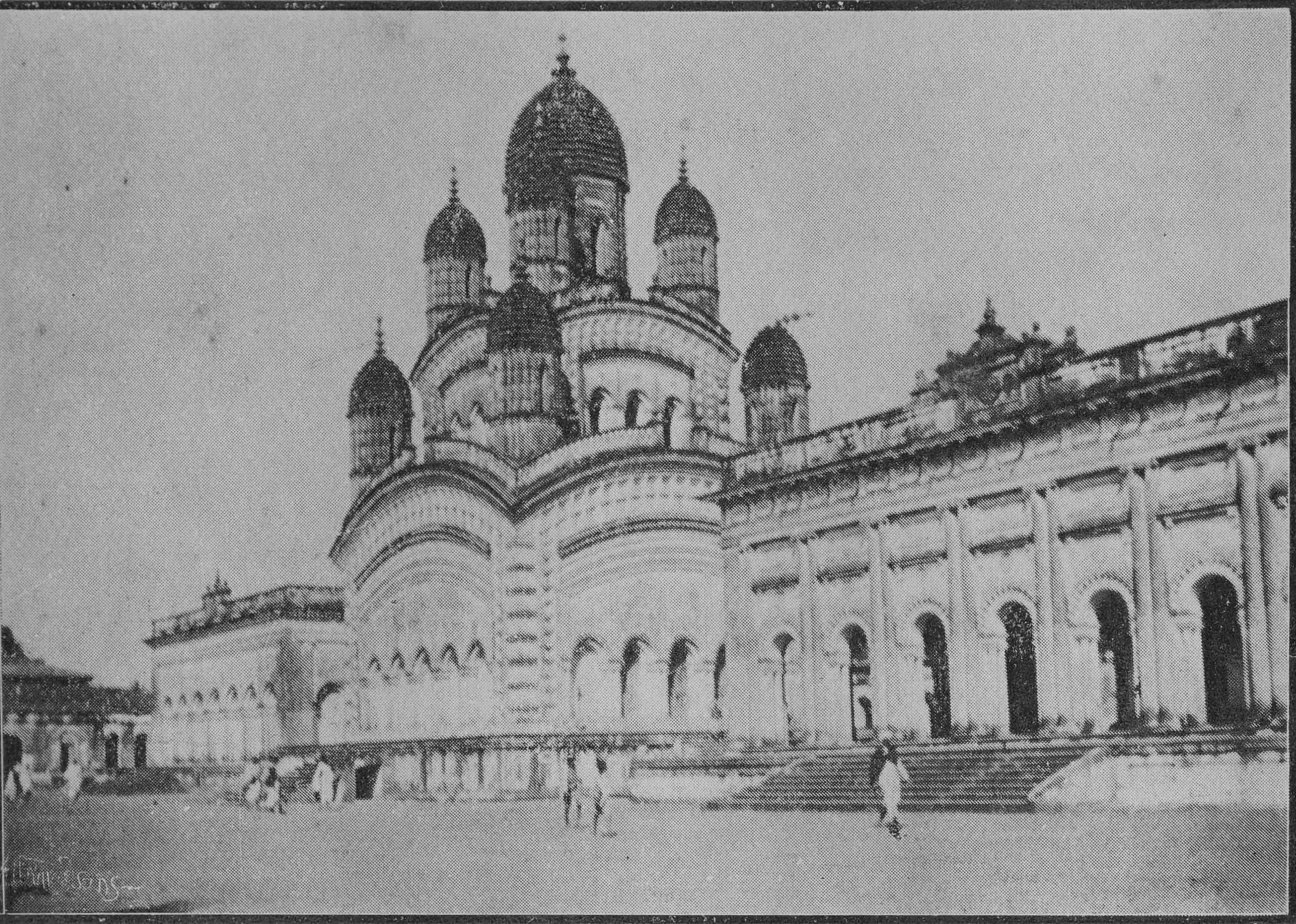
The Temple of Dakshineswar (Interior).
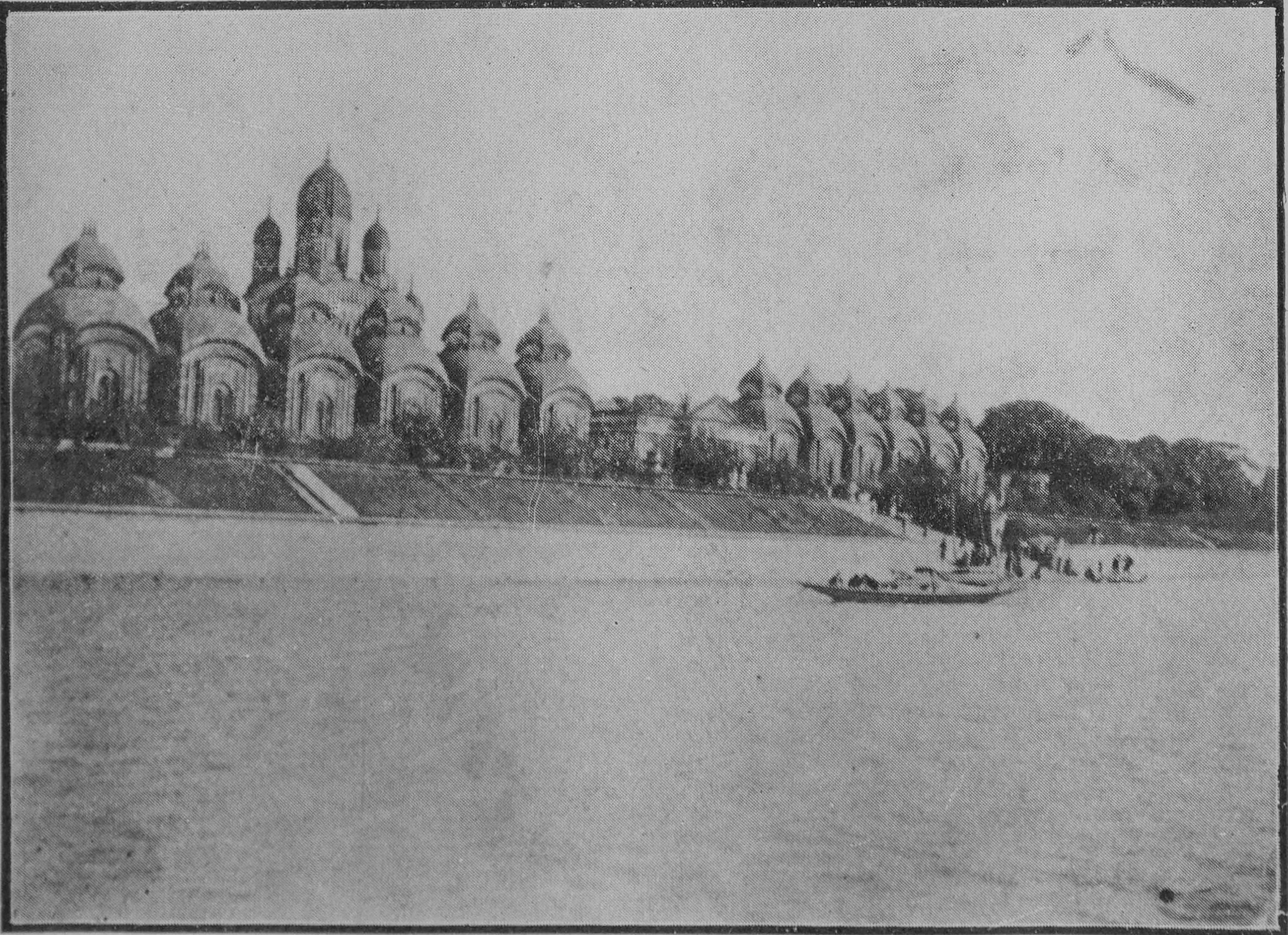
The Temple of Dakshineswar (view from the Ganges).
2. The Porch and the Twelve Temples of God the Father:—The Temple-garden is situated about four miles north of Calcutta on the banks of the holy river Ganges. Going there by boat one lands on the broad brick-built steps of the ghat leading to the temple. Sri Râmakrishna used to bathe at this ghat. East of the landing is the Chandni or the Porch. Its roof resembles an awning supported on pillars. The Chandni is especially used at night by the Temple watchmen on duty. Their chests of mango-wood and one or two water vessels or lotas, made of brass, are often found there lying about. The gentlemen of the neighbourhood often come here and take their seats before stepping down to bathe in the Holy Waters. They amuse themselves with gossip as they rub themselves with oil. Many holy men and women belonging to various sects of the Hindus come into the Temple and wait here until the hour is over for morning offerings to the Gods and they have partaken of the accepted offerings—the consecrated food1. Not unfrequently a woman worshipper2 of the Mother will be found sitting here. She has given up the world, is dressed in ocher-coloured clothes and holds in her hands the trident, the symbol of her order. She, too, will come into the guest-house and wait until the morning offerings have been presented.
The chandni is exactly in the middle of a long row of Temples, dedicated to Siva who symbolizes God the Father. These Temples are twelve in number, six of them being to the north of the porch and the remaining six to the south. People passing in boats on the river point out to one another the Twelve Temples, saying 'Look! yonder is the Temple-garden of Râni Râshmani!'
1 Prasâd.
2 Bhairavi.
3. The Temple of God as Love Incarnate:—Eastwards within this row of Temples and the Chandni is the courtyard. The yard is paved with tiles set in concrete. In the middle are two Temples, one facing west and the other south.
The first is situated northwards and is dedicated to Râdhâ and Krishna, God manifesting Himself as the Incarnation of Divine Love. The two Images stand with their faces to the west. Steps lead from the courtyard into the Sanctuary. Its floor is paved with marble. Chandeliers hang from the ceiling of the verandah, they are protected by red linen, except when uncovered on festive occasions. In front of the verandah is a row of columns. At the entrance to the passage between two of these columns is seated a solitary porter keeping watch. In the afternoon the direct rays of the setting sun would find their way into the Sanctuary, and for this reason canvas screens have been provided to place between the columns. They are intended for the passages left open between the columns. In the south-east corner of the verandah is a great jar containing holy water from the Ganges. Close to the threshold of the door leading into the Sanctuary is a small brass vessel containing the 'Nectar of the Feet of the Lord.' The devotees come, bow down before the Images of the Gods, receive some drops of this sacred water on the palm of their right hand and drink it with the greatest reverence.
Inside the sanctuary are the Holy Images of Râdhâ and Krishna.
4. The Temple of God the Mother:—In the southern temple is the beautiful image of the Divine Mother. She is called here the Saviour1 of the world. The floor of the temple is paved with marble. The Image stands on a dais of stone with steps to the south. The stone platform has upon it a silver 'lotus of a thousand petals.' On this lotus lies Siva, the Symbol of the Absolute, with His head to the south and His feet to the north. This Image is made of white marble. Upon Him stands the Mother of the Universe with one foot on His breast and the other on His thigh. She is apparelled in a gorgeous Benares Sari and Her Person is decorated with jewels of many kinds. On the lotus of Her feet are, amongst others, the tinkling anklets called nupur and the scarlet jaba with fresh leaves of the Bael tree fragrant with sandal paste. One of these anklets is the panjeb used by our up-country women. This ornament was procured by Mathoor, son-in-law of the foundress Râni Râshmani at the special desire of Sri Râmakrishna. The Mother's arms are adorned with various ornaments made of gold set with jewels; the lower arm, with the bracelets known as the 'cocoanut flower,' paincha, bauti, and bala; the upper with the armlets called tarr, tabiz, baju; the last with a pendant attached to it. Round Her neck She wears the golden cheke, a pearl necklace of seven strings, a golden necklace of thirty two strings, a 'chain of stars' (tara har) and—the garland made of human skulls. On Her head She wears a crown of gold and Her ears are adorned with kanbala add kanpash; and with golden ear-rings that look like flowers; and chaudani and the 'golden fish.'
1 Bhabatârinî.
The beauty of Her aquiline nose is set off by a golden nose-ring with a pearl-drop attached to it. She has three eyes, the third being the Eye of Divine Vision. She has four arms. In one of the two left hands She holds a freshly severed human head and in the other a sword. With one of Her right hands She offers boons to Her devotees, and with the other—the uplifted one—She says 'Fear not.' The head and the sword symbolize Death and the terrible side of the Divinity, even as Her offer of boons and Her assurance of help to Her devotees bring out the loving side and put them in mind of Her boundless Love and Mercy.
Round Her waist She wears a terrible garland made of human arms and also golden waist-chains called neem fruit and komarpata.
In the north-east corner of the shrine is a bed on which the Mother takes Her rest. Near this hangs on the wall a chamar made of the white hairs from the tail of the cow called chamari used for fanning the Mother. Many a time has Sri Râmakrishna himself fanned Her with this chamar. On the steps stand vessels which hold Her drinking water. On the silver lotus is a small image of a lion made of the eight metals, an image of the guana and a trident. At the south-western corner of the dais stands the image of a female fox. To the south is that of a black bull and to the north-east that of a goose. On one of the steps of the dais the image of Nârâyan or God the Preserver is installed on a small silver throne. By His side is the Image of Râmlâlâ or Râmchandra, God Incarnate, obtained by Sri Râmakrishna from a holy man. Close to Râmalâlâ on the same step is a small emblem of Siva called Bâneswar and also the images of various other manifestations of God. The Divine Mother stands with Her face to the south.
Within the shrine and close to the northern wall is the sacred pitcher made of copper, filled with the Holy Water of the Ganges for the Mother to wash Her face. Above the Holy Image is a beautiful canopy, and the background is a piece of Benares silk embroidered with flowers of many colours. The canopy adds greatly to the beauty of the Image. Twelve columns, inner and outer, made apparently of silver, stand at the corners of the dais round about the Holy Image.
The entrance to this shrine is by a pillared verandah and is protected by strong doors. The guard sits near one of the passages. Close to the threshold again, as in the case of the other shrine is a small cylindrical brass vessel containing the Nectar of the Mother's Feet. The top of the temple is adorned with nine pinnacles.
5. The Theatre-hall1:—In front of the temple and exactly to the south of it is the spacious Theatre-hall1. It is rectangular and the splendid terrace is supported by both inner and outer rows of columns. Theatrical performances2 etc. take place here on special occasions, especially on the day of the festival3 held in honour of the Mother.
6. The Guest-house4.—To the west of the courtyard is the row of twelve temples of the Father already mentioned. On the three other sides are sets of rooms with corridors leading to them. The rooms to the east are the store-room; the room5 for keeping noochis and sweetmeats; the room for cooking the food offerings for Vishnu who does not accept any fish or meat offerings; the room for getting ready fruits and other offerings; the room for cooking the offerings for the Divine Mother. Lastly, there are the corridors used for feeding the guests including holy men, Brahmins, beggars, etc. These, if they do not sit at meals in the Guest-house must proceed to the office of the steward of the Temple-garden and apply for their doles of rice and dal and other necessaries. The steward bids the officer in charge of the stores give what they want.
7. To the south of the Theatre-hall is the place of sacrifice.
8. No fish or meat may be offered to Vishnu, God the Preserver, who is worshipped here under the name of Râdhâkânta or the Lord of Râdhâ. The food-offerings for the Mother include fish and meat. On days of lunar conjunction,—on1 the dark night of the month—goats are offered. The worship at the temples is completed before 12 o'clock noon, by which time rice and the various dishes that are prepared in the kitchen are offered. In the meantime the Guest-house is filled with holy men, poor men, women and other guests.
1 Nâta-Mandir.
2 Jâtras.
3 Kâli-pujâ.
4 Atithi-sâlâ.
5 Noochi-ghar.
The Brahmins have a separate corner allotted to them during dinner. The officers of the Temple who happen to be Brahmins dine with the other Brahmins.
The steward has his food2 carried to him into his own room. The Babus of Janbazar, the descendants of the foundress Râni Râshmani, pay occasional visits to the Temple, when they put up in the two-storied building outside the temple court-yard called the kuthi. They too have their food2 carried to them at the kuthi.
9. The Steward3 and the office-rooms:—In the rooms lying south of the court-yard are the quarters set apart for the officers of the Temple and also the office-rooms.4 Here the steward and the clerk are always present; the store-keeper, the maid-servants, men-servants, priests, Brahmin-cooks, and porters are always found walking in and out. Some of these rooms are kept under lock and key. They contain the sacred utensils, the furniture of the Temple-garden, carpets, awnings for the courtyard, etc. Some of these rooms were used as store-rooms on occasions of the great Birthday Festival formerly held here in honour of Sri Râmakrishna. The cooking for this great festival used to be done on the adjoining grounds lying south of this set of rooms.
1 Amâbasyâ.
2 Prasâda.
3 Khâjânchi.
4 Daftarkhânâ.
There is a gate north of the court-yard and leading into it. Porters are stationed here as well as in the Chandni. The votaries who desire to worship God in the temples must leave their shoes behind at the gate.
10. The Master's Chamber:—In the north-west corner of the court-yard and immediately to the north of the row of twelve temples dedicated to Siva is the well-known Chamberin which Sri Râmakrishna used to pass his days in communion with God. Next to it and situated west is a semi-circular verandah with a roof also semi-circular, supported partially by columns. It looks out on the Ganges as she flows past the terrace of the Temple-garden running along her bank. Sri Râmakrishna often watched from this place the sacred waters with his face to the west, looking upon the holy river all the time as a manifestation of the Deity. To the west of the balcony is a narrow garden-path running north and south. To the west of this path is a flower garden. Next to the garden is the terrace along the side of which flows Ganga with sweet melodious murmurs.
11. The Concert-room1:—The Master's chamber is bounded by a rectangular verandah on the north. Next to this room and the verandah is another garden-
1 Nahabutkhânâ.
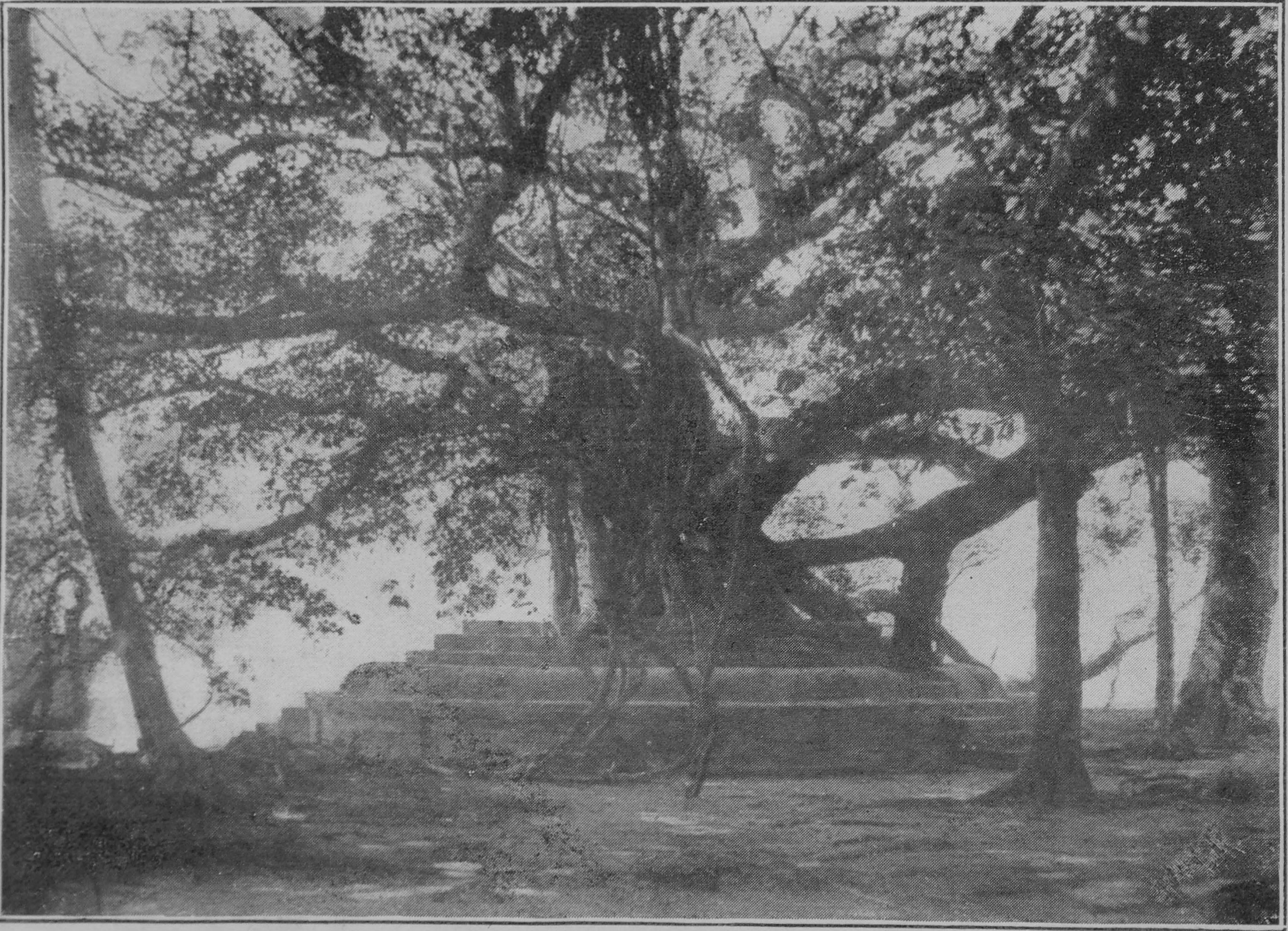
Panchavati.path going west to east. This path again has a flower-garden next to it lying north. North of the flower-garden is the Concert-room1. The revered Mother of the Master now in Heaven used to pass her last days in a small chamber just under the concert-room.
Next to this building is the Bakultala or the 'Foot of the Bakul' trees and the river-ghat which leads to it. The women folk of the neighbourhood bathe at this ghat. A pious and devout Brahmin lady as she was, the dying mother of Sri Râmakrishna was removed to this ghat, and she breathed her last in the presence of her weeping son—with the lower half of her body immersed, after the manner of the Hindus, in the holy waters of the Ganges.
There is a second concert-room in the south-west corner of the Temple-garden, close to the Office-rooms.
12. Panchabati:—Panchabati is situated a little north of the Bakul trees. Panchabati is a 'collection of five trees,' viz., Bata, the Indian fig, the Peepul, the Neem, the Amlaki and the Bæl tree. They were planted at the desire of Sri Râmakrishna. It was at the foot of the Panchabati that he went through various religious practices.1 Latterly he used often to walk about this place, sometimes alone, sometimes with his disciples. Coming back from Brindaban he caused to be scattered about on this place, the holy dust that had been brought from that place of pilgrimage.
1 Sâdhan.
Close to Panchabati and situated east was a thatched hut (now turned into a brick-built room) in which Sri Râmakrishna practised many religious austerities and with a single-minded devotion meditated upon God.
In this place there is a second Banyan1 tree built round at its foot with a terraced seat. It is an ancient tree and joined with it grows another, viz., a peepul2 tree. This ancient tree has many hollows within. It has become the home of birds and of other animals.
The terraced seat is circular in form. It is provided with steps at two different points—the south and the north. It is used by people who visit the Temple-garden and specially by those who wish to retire into solitude and meditate upon God, with the Holy Ganges flowing past before them. Seated here with his face to the west, many a day did Sri Râmakrishna pass in the midst of his devotional exercises. In those days he would call to the Mother of the Universe with a yearning which only equalled that of the cow crying for her calf! Across that hallowed Seat to-day there has fallen a branch of the peepul tree, the comrade of the Banyan. This branch has not been completely severed from the parent tree, but continues partially to adhere to it. It seems as though the God-man who is worthy to take that seat where God has been realised, has not come into the world yet.
13. Jhautala and Baeltala:—Going a little north of Panchabati one reaches a railing made of iron wire. On the other side of the railing is the Jhautala, a collection of five trees known as the Bengali pine or singing tree (casuarina). Devout worshippers of God rejoice to see them from the bank of the Ganges at Bagbazar, Calcutta, where they may have come for purposes of ablution.
1 Bata.
2 Aswatha.
Going a little east from the Jhautala is Baeltala or the 'Foot of the Bael tree.' Sitting at the foot of this tree Sri Râmakrishna went through various religious austerities.
Beyond the Jhautala and the Baeltala is the wall that separates the Temple-garden from the Government Magazine.
14. The Kuthi:—Getting out of the northern passage at the entrance of the courtyard one comes across a two-storied house called the Kuthi. Whenever Râni Râshmani or her son-in-law Mathoor visited the Temple they used to put up at the kuthi. During their life-time the Master used to pass his days in a chamber there on the ground-floor, facing the Ganges. There is a splendid view of the holy river from this room. A straight path from the kuthi running from east to west leads to the river ghat at the foot of the Bakul tree.
5. Gazitala, the Main Gate, and the Back Gate:—Going on due east from the northern entrance of the courtyard in the direction of the eastern gate we have on our right a fine tank called Gazi-pukur, having two pucca ghats one to the north and the other to the west of the tank. The western ghat is used for the purpose of washing the sacred utensils and is called the Plate-washing Ghat. A little to the north-east of the ghat is an old tree and the foot of this tree is called Gazitala. This is the place where an old Mahomedan Saint used to live long ago and pass his days in the contemplation of God. His departed Spirit is worshipped even to-day by the poor people, both Hindu and Mahomedan, who live in the vicinity of the Temple.
The eastern gate of the Temple-garden or the Main Gate is a little to the east of Gazitala. People who come from Alambazar or Calcutta enter into the Temple through this gate. The people of Dakshineswara come in through the back gate or the north-eastern gate. When the Master used to come back from Calcutta into the Temple, sometimes at midnight, the cab which brought him stopped at the main gate. The porter was then waked up and asked to unlock the gate. Sri Râmakrishna would ask him to come with him to his chamber in the Temple and he would see him rewarded with sweetmeats, which the Temple people would send him every evening out of the sanctified offerings made to the Deity,
16. The Goose tank1 : the Cow-house:—There is another tank called the Goose-tank to the east of Panchabati. To the north-east of this tank are the stables and the Cow-house. To the east of these is the back gate or north-eastern gate. Through this gate the people of Dakshineswar come into the Temple. This gate is also used by the officers of the Temple who live in this village with their families. Those without families have their rooms within the Temple.
1 Hangspukur.
There is a straight narrow path-way running from the southern extremity of the Temple-garden to Panchabati. This path runs from south to north along the bank of the Ganges and is lined with flower plants on both sides. Passing on its way between the chandni and the southern ghat of the river it comes to the 'Foot of the Bakul trees,' just leaving the northern ghat on its left, and at last comes up to Panchabati.
The garden path which runs from west to east and is situated to the south of the Concert-room1 and the kuthi goes past the Gazitala as far as the eastern gate. This too has flower-plants on both sides. In the same way the path leading from south to north on the eastern side of the kuthi runs past the Goose-tank until it reaches the Cow-house. The garden to the east of this path contains many flower plants and fruit plants and also a tank.
17. The Flower-garden:—Just before the break of day the sweet sound of bells comes from the Temple to the ear of the devotee. They make known abroad the morning service with the Waving2 of Lights, which brings the tidings of Love and Joy to all God's creatures; for the Mother of the Universe is up again and will continue to bless Her own, Her beloved children. The morning tunes are played on the flageolet3 to the accompaniment of drums and cymbals and come to the ear from the Concert-room. It is not as yet red in the east—for the day-star is not up yet to give light and life to this world of ours. At such an early hour they are plucking the flowers in the Temple-garden to be offered during morning service to God.
1 Nahabutkhânâ.
2 Âratrika.
3 Rasunchouki.
On the bank of the Holy River and just to the west of Panchabati are the bael tree and the sweet-scented milk-white gulchi flower. Close to them is the mango-creeper.1 Sri Râmakrishna had a great liking for the flower-plant mallika (the tulip), the mango-creeper so dear to Sri Râdhikâ, and for the gulchi flower. He had the mango-creeper brought down with him from Brindaban whither he had gone with Mathoor on pilgrimage, and planted it at Panchabati.
The part of the Temple-garden to the east of the path running towards the cow-house above-mentioned contains many flower plants. Amongst others there are the fragrant champak, the five-faced jaba, the jaba pendant like ear-rings, the rose and the gold-flower.2 On the hedges grows the creeper amaranth, called aparajita or the 'unvanquished', with blue flowers used for the worship of the Divine Mother. Very close to these are the jui jasmine and the shefalika flowers.
Alongside the long line of the twelve temples of Siva and situated just to the west of them are also many flower-plants—the white oleander1, the red oleander, the rose, the jasmine2, the large double jasmine3. There is also the thorn apple4, especially used for the worship of Siva. At intervals there is the sacred basil5 plant growing on brickbuilt platforms.
1 Mâdhabi.
2 Kânchan.
To the south of the Concert-room are the double jasmine, the single jasmine, 'the king of scents' and the rose—all sweet scented flowers. Within a short distance of the southern river-ghat are two flower-plants with beautiful fragrant flowers,—one called the lotus oleander and the other the cuckoo-eyed. The colour of the latter resembles that of the eyes of the cuckoo.
Near the Master's room and growing west of it are a couple of plants with flowers called the Krishna-crest (the cox-comb flower) resembling the crest adorning the head of Krishna, the Incarnation of Divine Love; also the double jasmine, the jasmine, the king of scents, the rose, the tulip, the jaba, the white oleander, the red oleander; the five-faced jaba, the china-rose, &c.
Sri Râmakrishna too used formerly to gather flowers for Divine worship. On one occasion he was plucking the leaves of the bael tree near Panchabati, when a portion of the bark came off. It seemed to him as if the Divinity that was within him and manifest in all things without had received a severe wound. He felt this in his very soul, and thenceforward ceased plucking the leaves of the bael tree. On another occasion he was walking about, gathering flowers for the worship of the Mother. Suddenly it flashed on his soul that the various flower-plants before him were but so many nose-gays—things of beauty decorating the macrocosm,—bouquets adorning the outward manifested form of the Absolute. Sri Râmakrishna perceived in his soul that the worship of God was thus being celebrated night and day without cessation. Henceforward he ceased to pluck flowers any more for the purpose of worship.
1 Karavi.
2 Jui.
3 Bel.
4 Dhutura.
5 Tulasi.
18. The Lobbies and the Balcony:—There is a lobby running east to west leading to the Master's room. It is two-winged; one wing facing the courtyard to the south, the other facing north and commanding a view of the kuthi and the garden paths round about. The Master used often to be seated in the southern lobby with his disciples, talking about God or singing with them the Name of the Lord. In the northern wing there used sometimes to be celebrated the festival in honour of his birthday. There with disciples and other devotees he would sit at meals and partake of the accepted offerings1 amidst the joy and excitement of the festive occasion. Very often at the head of his disciples Keshab Sen would come to see Sri Râmakrishna and meet him in this very verandah, listen to the words of wisdom that proceeded out of his mouth and watch the state of Divine Ecstasy into which he was frequently thrown. Here it was that Keshab and his disciples were entertained with popped1 rice, cocoanut, luchi, and sweets. It was here again that the Master was once put in a state of Samadhi at the sight of Narendra (Vivekananda.)
1 Prasâd.
19. The Abode of Joy and Gladness:—The Temple garden has become an abode of joy and gladness. The Deity is worshipped night and day in His various aspects as Father2; as the Incarnation3 of Divine Love; and again as the Mother4 of the Universe, Saviour of the world. The offerings regularly made during Divine worship every day are many and various. The Guest house which accords welcome to holy men and mendicants is an institution connected with the Temple, highly valued by those that resort to it. The view of the sacred river flowing past the Temple-garden calls up thoughts that appeal to the highest nature of man. No less inspiring is the garden within the Temple compound, with flowers of variegated hues which charm the devout lovers of God with their fragrance, beauty and sanctity. What gives the finishing touch to this fascinating picture of the Temple-garden is the saintly figure of the God-man intoxicated night and day with the joy of the Lord.
Verily here goes on a perennial festival in honour of the Ever-joyful Mother. The music from the Concert-room celebrates this never-ending festival, pouring out melodies that send a thrill of joy through the soul of the lover of God and very often put him in a state of ecstasy. The sacred music never tires of proclaiming night and day to the world the glad tidings of joy, that our Mother has not only created us but always looks after us, Her own children. It begins the song at early dawn, repeats it at about nine in the morning at the time of Divine worship, and again at about noon when the Deity retires to rest. The song is again taken up at about four in the afternoon when the Mother rises once more, sits in state, and is ready to receive the worship offered by Her devotees. The festive song is yet once more, repeated at candle-light when it calls upon the world to be ready for evening worship. The closing strains of this soul-stirring music reach the ear at about 9 o'clock at night, when the Mother retires to rest:—music sweet in the solemn stillness that reigns in the Temple-garden at that solemn hour—in the midst of the gathering Darkness,—the garment which the Mother now puts on to remind her children of the Eternity when nothing was,—neither Man nor Woman, neither the Sun nor the Moon, the Earth or the Starry Firmament!
1 Muri.
2 Siva.
3 Krishna,
4 Kâli.