Treasure Trove of Sri Bhagavan’s Grace
Prof. K. Swaminathan
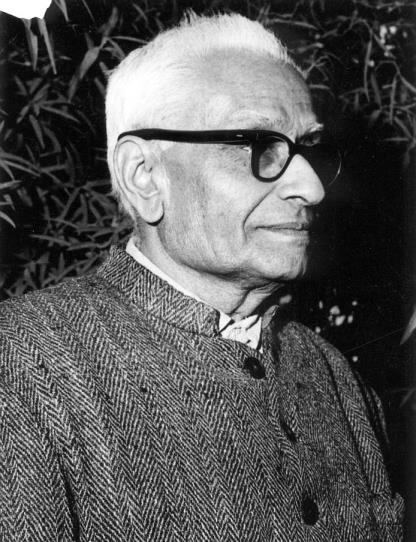
Professor K. Swaminathan, Chief Editor of “The Collected Works of Mahatma Gandhi” (Delhi), was a well-known devotee of Sri Bhagavan. He was also familiar to readers of The Mountain Path through his translations of Muruganar’s Guru Vachaka Kovai, (Garland of Guru's Sayings) voluminous books of Tamil poems like Ramana Sannidhi Murai and book reviews. He was decorated with ‘Padma Bhushan’, by the Government of India.
A distinguished scholar and writer, he had held important positions in the Educational World. His appointment to the Principalship of the Government Mohammaden College (now Government Arts College), Madras, was an event which was noted by Sri Bhagavan Himself as He made it a point to read out the news report to all present in the Old Hall.
He and his wife had their first darshan of Sri Bhagavan along with a few friends in 1940. Their experience was unique on that occasion. They entered the Ashram premises and were making their exploratory enquiries, when surprisingly, they saw Sri Bhagavan Himself standing at the entrance to the Old Hall after His daily walk on the Hill and graciously looking at them. Thus, Sri Bhagavan took them by surprise, denying them, as it were, the chance of mental preparation for such a significant event as the first darshan of him. Later, when they sat before Him in the hall, in silence, they felt overwhelmed. The impact of Sri Bhagavan's mere Presence was so powerful that it gave the experience of “Awareness with only Peace for its content”!
The association with Sri Bhagavan became closer and the Professor frequently spent his vacations at the Ashram. In Sri Devaraja Mudaliar and others, he found kindred souls. He took an active part in the ‘Golden Jubilee Celebrations’ in 1946 (commemorating Sri Bhagavan's arrival at Arunachala in 1896) and was also an editor for the Ashram, for instance, in bringing out the Ramana Pictorial Souvenir (1967) and Ramana Jyothi Souvenir (1970).
Prof. Swaminathan, besides being a Master of English Literature, was at home in Tamil literature as well, particularly the devotional poetry of the Singer-Saints of the South. Sri Muruganar's poems, devoted to Sri Bhagavan and His Teachings, moved him greatly and he translated many of these into English.
Particular mention deserves to be made of the Professor's services in the general interest of Sri Bhagavan's devotees. One is that since the Maha Nirvana of Sri Bhagavan, he made his residence in Madras available for conducting the programmes of the ‘Ramana Bhakta Sabha’. His wife, Smt. Visalakshi Swaminathan was an equally great devotee, combining simplicity with greatness of Heart.
Prof. Swaminathan’s great satisfaction was holding the responsibility of being the Editor of The Mountain Path after Arthur Osborne had passed away.
How the Professor was drawn by Sri Bhagavan whom he described as ‘the Mightier Magnet’ is best told in his own words:
“Sixty years ago, M.G. Shanmugam, (son of Police Inspector Gopala Pillai), then my student of Sri Minakshi College, Chidambaram, spoke to me enthusiastically about Sri Bhagavan. I was not interested then in some one sitting still and doing nothing when so much needed to be done to change this mad, bad World and Mahatma Gandhi strode the land doing so many things "socially relevant”.
“Many things happened between 1927 and 1940 which drew me to the ‘Mightier Magnet’ of the ‘Movementless Mountain’. Long talks in Madras with Douglas Ainslie and Swami Siddheswarananda and a casual perusal of Muruganar's Sannidhi Murai (1939 edition) convinced the obstinate camel that the oasis he badly needed was near and easy to reach.
“In 1910, my good father had appointed, and I had meekly accepted, Sir P.S. Sivaswami Iyer as my infallible guide and mentor. In the summer of 1940, I had many baffling problems and mental conflicts and, as advised by Sir P.S. Sivaswami Iyer, took a series of lessons on the Brahma Sutras, sitting at the feet of a learned Pundit in Bangalore. An English scholar, a Swami from Paris and this Narayana Sastriar agreed that an actual person in the Brahmic state was present there in Tiruvannamalai, offering rest and shade to tired travellers in the desert of samsara.
“Cautious Sir P. S. S., who was my sole pater familias after my father's death in 1935, permitted my visit to the Ashram but added this advice: ‘You are a young man with many responsibilities. When I look down at the abyss from the edge of Dodabetta, I have four strong men holding me safe with a rope round my hip. By all means, go to the Ashram. But don't go alone. Take some friends with you.’
“And so, I took with me my wife, my former student, K. Subrahmanyam and my then student M. M. Ismail. The Maharshi deprived me of none of the persons or pleasures that were dear to me. He left them all with me enriched and sanctified. Shakespeare, Keats, Wordsworth and the Bible meant much more for me when illumined by the Light He shed on all He saw. His Grace it was that gave me length of life, strength of body and ample room to render humble service to Rajaji, Vinoba and Gandhi, all reflections in our own time of the “Eternal Goodness” of which he was the Full Embodiment.”
* * *
“Sri BHAGAVAN was a perfect Impersonality, like the Sun in the sky or like unnoticed daylight in an inner chamber. People spoke to one another freely and frankly in His Presence, as if the figure on the couch were a statue, not a listener. It was natural to refer to him as ‘It’ instead of ‘You’ or ‘He’. Thus, every conversation in the Old Hall turned out to be a truly Socratic dialogue; every statement was tentative and therefore poetic; no statement was dogmatic, eristic or polemical. This Impersonal Being would suddenly become a ‘Person’ full of Sattvic Power, highly human, charming, mother-like, who could communicate with sharp precision His own Awareness-Bliss to other persons according to their needs and moods. The Sun now came down and played with us as the Light of the Moon to illumine the ‘mind’, or as the ‘fire’ in the home to cook our food.
“In 1944 when the proofs of the third edition of Ulladu Narpadu were being corrected in his Presence, some of us (scrupulous scholars) found fault with the introductory note of ‘Who’ (Lakshmana Sarma): "To the question how the sadhaka (aspirant) is to behave in the World till he succeeds in attaining Jnana, the answer is given in the two following verses taken from the Yoga Vasishta."
The two verses may be summed up thus: "Holding firmly at Heart to the Truth of your Being, play like a hero, your part in the World-stage, inwardly calm and detached, but assuming zeal and joy, excitement and aversion, initiative and effort, and performing outward actions, appropriate to your particular role in various situations." Now we (fine fellows and fully qualified College Teachers!) pointed out the obvious absurdity of the Pudukottai Lawyer's suggestion that Sri Rama, avatar of Lord Vishnu and a Nitya Mukta, needed this teaching. ‘Who has these doubts?’ enquired Sri Bhagavan. Someone mentioned my name and then the cool bright beam of His Glance pierced my eyes as he said smiling. ‘Look! It is for you. (Paar, unakkuttaan.)’ This teaching was for me!
“This one moment solved for me a whole multitude of problems, personal, philosophical and social.
My father's chosen God was Sri Rama and my mother's Hanuman. They had both died years before, and the old familiar World of Dharma (with no mention of Moksha) was half-forgotten and I had been feeling rather rootless in this strange new ‘milieu of meditation’, ‘self-inquiry’ and all that. And now while at the hum-drum job of proof-correction, Sri Bhagavan planted me back firmly in my ancestral soil. I was told gently. but clearly, ‘The oasis is a nice place to rest in, but not your permanent home. Also remember, there is a way of taking the oasis into the desert, of making more and more of the desert a garden green. What's wrong with poetry? Does it not work in the World and transform all life in earth into a poem? Why not speak and listen to the “Heart” rather than the ‘head’?’
“Sri Rama, the Mukta, enacts the poem of his earthly life, playing his heroic roles as son, brother, husband, ruler. Poetry can not only be written and read; it can also be lived and enjoyed. The line that divides the aesthetic and the practical is (like the equator) ‘imaginary’. What after all is a poem? An expression of disinterested joy, an experience of someone else's agony or ecstasy as if it were one's own; a momentary manifestation in ‘word’ or ‘deed’ of our eternal Being.”
* * *
“In the early forties Professor Madan Gopal (of Jubbulpore) was a frequent visitor to the Ashram. He knew German and would translate into English articles in German. In one such article, the famous psychologist Carl Jung had contrasted Sri Ramakrishna and Sri Bhagavan and saw in this succession the progressive advance from Bhakti to Jnana. On hearing this, Sri Bhagavan promptly sat erect and protested against the comparison, saying: ‘When one has reached the mountain-top, no matter from what side or by what path, one knows and understands all other paths. What is there that Sri Ramakrishna did not know?’
The eye that sees and the hand that works are alike organs of one and the same Eternal Goodness. He saw only one Adhyatma Sakti working everywhere. Different persons perform different functions. Arranging them in an order of merit is ‘the mischief’ of the ‘ego’.
“Another thrilling incident is worth recalling. One afternoon in 1949, two highly esteemed senior devotees, Dr. V. Srinivasa Rao and Mr. T. P. Ramachandra Iyer, stepped into my house, Dharmalayam, formally ‘prostrated’ before me and presented to me two copies (fresh from the press) of Anma Bodham, Sri Bhagavan's Tamil rendering of Adi Sankara's Sanskrit work. Speaking with unusual respect they said, ‘Bhagavan wanted us to go and give these copies to you. They contain some corrections in His own hand.’
“How did I deserve this shower of grace? A few weeks earlier, my friend Minna Nuruddin (a good Tamil and Sanskrit scholar) had gone to the Ashram and given to Sri Bhagavan a copy of M. N.' s Tamil translation in eight-line stanzas of Atma Bodha. Sri Bhagavan had done many years earlier a translation in terse venbas of most of the 68 verses of the Sanskrit treatise. He now had the old note-book dug up from the Ashram archives, revised and completed the translation and had it printed and brought out as His last little booklet. And He now sends me these two copies, one for me and the other for Minna!”