Treasure Trove of Sri Bhagavan’s Grace
Kanakamma
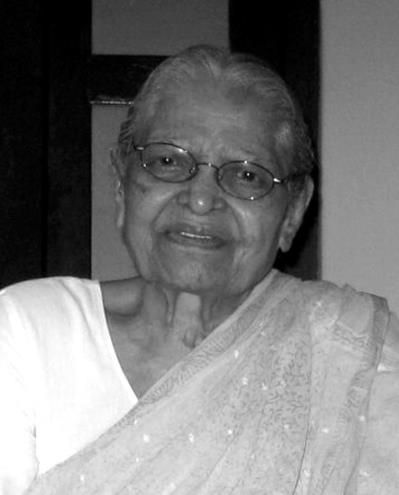
Kanakamma was a precocious child. The precocity lay in her sad Socratic discontent — her constant companion for many years. The discontent was like an inner sphurana. Born with the proverbial silver spoon in her mouth — in an affluent Tamil Brahmin family — settled in Andhra, Kanakamma evinced from her early girlhood a natural indifference to things mundane and materialistic, and later a distaste for married life. She did get married to give satisfaction to her dying grandfather whom she was very fond of from her childhood. Soon, she left her husband and came away to Arunachala.
Kanakamma had all the makings of a true spiritual seeker. There was search for a Master but no groping from guru to guru. There was discontent but no desire; aspiration but no ambition; a gentle sadness but no grief; righteousness but no self-righteousness; tears of love but no sobs of self-pity. Her sights were being set for her and when they were set, she saw the Jnani Supreme! Thanks to her father who understood her noble aspirations, she finally came away in 1946 to Tiruvannamalai and settled down in an apartment near Sri Ramanasramam. There were no residential facilities then for women in the Ashram.
In Sri Bhagavan's Presence, Kanakamma's sadness diminished gradually and then vanished. A joy she never knew before was now hers. When one day in 1949 she was sitting in front of Sri Bhagavan with lots of other devotees in the New Hall, His gaze focussed on her. She closed her eyes and then opened them after a while. The luminous gaze was still on her and the “Penetrating Gracious Glance” of the Master took her mind to the innermost depths to be dissolved at the Source. This rare benediction was repeated for a longer time later, a few months before Sri Bhagavan's Brahma nirvana. She was immersed in peace and bliss. Kanakamma rarely talks about this event. While she avoids talking about herself, she is always willing to talk on Sri Bhagavan.
Kanakamma used to come to the Ashram every morning and evening around Puja time and kept herself as an open house for serious students of Sri Ramana's Teaching. Eager groups of devotees listen in rapt attention to her informal talks on Sri Ramana's “Collected Works” (Nool Thirattu). Her Tamil commentary on Sri Bhagavan's “Collected Works” was published by the Ashram. Even now it is a great boon to Tamil-speaking devotees. Characteristically, she disowned any credit for it and passed it to Sri Muruganar who explained the entire "Nool Thirattu" to her during the years when she served this devotee extraordinary and poet par excellence. Kanakamma was conversant with every one of the nearly forty thousand exquisite verses that Sri Muruganar composed on Sri Bhagavan and His teaching everyday early in the morning she would narrate one poem from Bhagavan’s Collected Works and Muruganar’s Sannidhi Murai.
Still waters run deep. Kanakamma, who came to Sri Bhagavan in the 1940's, was like a mill pond but much deeper. The slight frown on her forehead, almost constant, seemed to put off strangers, but devotees of Sri Ramana knew the depth of her Ramana-scholarship.
On our request Kanakamma agreed to share the following scintillating anecdotes :
It was in the New Hall — now adorned by the granite statue of Sri Bhagavan. The Power of the Presence of Sri Bhagavan surcharged the atmosphere. Kanakamma, who always preferred to sit at the back-most corner and meditate, was urged by another lady-devotee to go to the front and enjoy the ‘luxury’ of nearness of Sri Bhagavan! With hesitation she acceded to it and took seat in the front row, not knowing that she had thereby blocked the passage for Sri Bhagavan to come out of the enclosure around His couch. Sri Bhagavan gave a Gracious Look which sent quivers of joy through Kanakamma and she closed her eyes. Something made her open her eyes again and she saw Sri Bhagavan’s Grace-filled eyes piercing through her! She was filled with ecstasy and she remained in that state for a long time unaware of the external environment. Time arrived for Sri Bhagavan to move out. The attendants were visibly annoyed that Kanakamma was seated right in the way; the lady-devotee too became restless and wanted to wake her up. Sri Bhagavan gave a look of disapproval to the attendants and made a gesture to the lady-devotee not to disturb the meditating Kanaka. Everybody had left the Hall; Kanakamma continued to be totally absorbed! On account of His rheumatism Sri Bhagavan moved with great difficulty to the side and managed to have the side enclosure readjusted so that He could squeeze out. All this He did without making any noise lest it should disturb the meditating aspirant. The lady-devotee later reported to Kanakamma her great good fortune. Till He got up for His walk Sri Bhagavan had been directing His Glance of Grace on Kanakamma. What a great spiritual boon!
* * *
“When Sri Bhagavan came to the New Hall, in front of the Matrubhuteswara Shrine a few rigid restrictions had been imposed that darshan could be had only between fixed periods, that no one should sleep in the Hall except the attendants, and that even such attendants should go to sleep in the night at certain hours etc. So, Kodur Venkatratnam, Sub-Registrar Narayana Iyer and T.P. Ramachandra Iyer used to offer to be the attendants at night so that they could be in the company of Sri Bhagavan. In those days Sri Bhagavan also talked a lot, irrespective of whether it was day or night. Particularly if He was narrating a story Sri Bhagavan would enact the entire drama with lively gesticulations. Sri Niranjanananda Swami, the Sarvadhikari was very particular that the attendants did not engage Sri Bhagavan in conversation and that they lay down quietly. So, he would go round the Hall at regular intervals, peeping through the window in between to check. Venkatratnam and Narayana Iyer would sit erect and gape at Sri Bhagavan while He dramatised a story. They would entirely forget the environment. Sri Bhagavan would know the incoming danger(!). So, suddenly He would stop telling the story or talking and make signs to them with His hands to lie down; they would obey. After some time when the Sarvadhikari had left, Sri Bhagavan would again make signs without a whisper of a sound and the avid listeners would get up! How childlike Sri Bhagavan was!
“During one such night session Sri Bhagavan was telling the story of a Saint very graphically. Venkatratnam was massaging Sri Bhagavan’s leg. Since, Sri Bhagavan was having pain in the legs, it was customary to massage His legs from thigh to toe, every night. That day, it was the good fortune of Venkatratnam to do it. He was transfixed in listening to Sri Bhagavan; yet he kept massaging His leg. After sometime Sri Bhagavan stopped the narration and looked at him. Thinking that Sri Bhagavan wanted more strength to be used, he massaged with added force. After some time Sri Bhagavan looked again at him, again he pressed the leg very hard. This happened again. Then suddenly Sri Bhagavan told Venkatratnam: ‘What are you doing? You want to massage something, do you? Go and massage that stone pillar.’ Venkatratnam was flabbergasted! Then only he realised his mistake. Instead of massaging the whole leg, absorbed in listening to Sri Bhagavan’s storytelling, he was massaging the same place again and again! Each time Sri Bhagavan looked at him to make him understand his mistake, he only pressed with greater vehemence, so much so the spot had swollen. How much Sri Bhagavan must have felt the pain! Next morning he could not face Sri Bhagavan. He avoided coming into the presence of Sri Bhagavan as he felt guilty and ashamed. Then Sri Bhagavan went out of the way and called him in and said: ‘Why are you avoiding me? Anyone else in your position would have also committed the same mistake. You were so absorbed in the story. It is alright !’ These, soothing words of Sri Bhagavan relieved Venkatratnam. Here, one should notice not only the forgiving nature of Sri Bhagavan but His rushing to rescue a devotee from mental suffering.”
Kanakamma continued:
“Once it happened in the Jubilee Hall — this was a beautiful thatched extension to the Old Hall to its North. It was raised so that more people could be accommodated and Sri Bhagavan could have fresh air, particularly, in summer.
“It was Sri Bhagavan’s Jayanti day. Sri Bhagavan had gone behind the Goshala and was returning to the Jubilee Hall. At the entrance to the men’s guest room (next to the stores) a lady had drawn kolam (design with flour on the ground) of a peacock. The peacock design had come out so well and life-like that the White Peacock who happened to be there, was stunned looking at the design as he took it to be a fellow-white peacock. Sri Bhagavan reached there and stood observing this unique scene. Cereals were brought, and were placed in an open tin next to the White Peacock. The Peacock who would otherwise have rushed to eat it did not even look at it; he continued to stare at his ‘image’ on the floor!
“Sri Bhagavan said: ‘What (Yennada)! Are you feeling that a competitor has come to confront you?’ After Sri Bhagavan said this, the White Peacock, as if understanding His retort, gave up his staring and started eating the cereals. Sri Bhagavan was kind enough to comment: ‘The greatness of a piece of art lies in another artist of the same calibre appreciating it wholeheartedly. If a cobbler really appreciated the shoe made by a non-professional then it has real worth. If you stitch a cloth and if a tailor appreciates it then it must be really first rate. Likewise, if a peacock is lost in admiration of a drawing taking it to be a real peacock it proves the excellence of the art work. The artist is to be very much appreciated!’
After a pause Sri Bhagavan continued: ‘For such exceedingly gifted artists, Brahma Vidya (Highest Spiritual Attainment) is very easy. But, they will not pursue Spiritual Perfection. Their mind will go only after further fame!’
These words of Sri Bhagavan apply to all talented people.
* * *
“I came to the Ashram in 1946. In those days Veda Parayana was being done in the Presence of Sri Bhagavan at 5 a.m. During the month of Margazhi (December-January) Tamil Parayana would begin at 4 a.m. itself, before the Veda Parayana. ‘Margazhi’ is the coldest month. The Tamil Parayana contained sections from Muruganar’s Sri Ramana Sannidhi Murai, like Tiruppalliyezhuchi, Tiruvembhavai, Tiruvammanai and Tiruppallandu and from Saint Manickavachakar’s Tiruvachakam-Tiruvembhavai. Sri Bhagavan would, as usual, be ready seated by 3.30 a.m. itself.
“Then Sri Bhagavan was sitting in the Jubilee Hall. Since it was open on all sides, the cold was really biting. Yet, Sri Bhagavan would wear only a shawl, which covered his head also. Dasangam (incense) was burnt and when sprinkled on the live charcoal, the smoke would spread, freshening the entire atmosphere.
“The urn with burning charcoal stood on a stool near Sri Bhagavan. Occasionally, He would spread out His palm and fingers over this fire and warm them. It was a beautiful sight! Once, when an over-enthusiastic attendant showered a lot of incense, waves of thick, heavy smoke gushed out and smothered His face and He could hardly breathe. Sri Bhagavan laughed and said:
“போடுங்கோ ஒய் போடுங்கோ, சாமி தானே! புகையை நன்றாக போடுங்கோ! கோவிலில் இருக்கும் சாமிக்கு தூபம் போடுவதில்லையா? அதை போல் தானே இந்த சாமிக்கும் போடணும்! அப்போது தானே த்ருப்தி!”
“Add incense as you please, Sir! After all this is also ‘Swami’! Raise a cloud of smoke! Don’t they do so for the ‘Swami’ in Temples? So, you won’t be content unless you do likewise for this ‘Swami’! Perhaps that is why in Temples the ‘Swami’ is always made of stone! Otherwise, how troublesome would all this worship become for Him! I am troubled only once in a way. Guess the predicament of the Temple ‘Swami’! For Him it is six times a day; sometimes even more!”
* * *
Kanakamma narrated the following as told by Sri Muruganar:
“A disciple of a reputed Swami of South India came to Sri Bhagavan to have His darshan. With some hesitation he started telling Sri Bhagavan about his guru’s strict injuction that each one of his devotees should do so many thousands of japa daily and surrender the phala to the guru as their offering and that they were following it without fail.”
“Sri Bhagavan smiled and observed: “Is it so? It is to be appreciated. So much gain for the guru with no strain on his part!” While Sri Bhagavan was saying this, Muruganar entered the Old Hall. Turning to him Sri Bhagavan said: ‘Do you know? His guru commands each one of his disciples to perform so many thousands of nama-japa and surrender the phala to him, as guru kanikkai (offering). After that will there be any balance for the disciples? It looks like one keeping the principal and surrendering the interest to the guru as offering. How do you appreciate this?”
“Muruganar with tears in his eyes replied: “Sri Bhagavan! Their guru is far better. He at least leaves the principal and demands only the interest. But this Guru here (pointing to Sri Bhagavan) is worse. He takes away the principal itself; then where is room for interest? He demands the devotees’ moolam (principal) and vaddi (interest) all at once!” Sri Bhagavan gave a benign smile enjoying the poet’s joke with deep meaning.
* * *
It happened during Sri Bhagavan’s serious illness when He was laid up in the Nirvana Room. Sri Bhagavan’s sister, Alamelu Ammal, very hesitantly went near Him and pleaded with Him, thus: “Bhagavan! Once when you were in Virupaksha Cave, while trying to move a big rock from one place to another your hand was suddenly caught under it and when the hand was taken out one of the fingers was dislocated and found hanging down limp. Vasudeva Sastri, who noticed it, was alarmed and started crying aloud. You calmed him saying: ‘Why do you cry? Nothing has happened!’ Then, with the other hand, you placed the drooping finger back in its place and it regained its proper position. No trace of any mishap could be noticed! Likewise, why don’t you now touch this painful cancer on your left shoulder-arm with your ‘golden’ right hand, Bhagavan? It will be cured if you will do it. All our anxieties will be at an end. Just as you relieved the anguish of Vasudeva Sastri, please bless us now by turning your mind to the arm and curing it”.
Sri Bhagavan looked at His sister intently with love and compassion. After some time He replied:
“ஆமாங்! எனக்கு உடம்புன்னு ஒண்ணு இருக்கு. அதுலே என்னோட கைன்னு ஒண்ணு இருக்கு. அதுக்கு வியாதின்னு ஒண்ணு இருக்கு. அது எந்த வைத்தியத்துக்கும் கட்டுப்படாம இருக்கு. அதெ நான் மனசு வச்சி சரிபடுத்திக்கணும். இத்தனைக்கும் எனக்கு மனசு எங்க வச்சு வாழறது?!”
“Yes, Yes! I have a body; and that has a hand; the hand has a disease that defies any treatment and so I must apply my mind to it to cure it. But, where is a ‘mind’ to do all this?”
* * *
“Krishna Prem (Britisher) was in the Ashram. He would always carry a shoulder bag in which he kept in a glass-case the images of Radha and Krishna. Only when going to bed would he remove it from his shoulder. After his first darshan of Sri Bhagavan he said he wanted to see the places hallowed by the Presence of Sri Bhagavan. Viswanatha Swami was asked to act as his guide. Early in the morning the two left for Skandashram. They went to various places and finally returned to Skandashram. Overwhelmed by the serene atmosphere, Krishna Prem sat down and started meditating. He was lost in it, Viswanatha Swami, with his practical wisdom, noticed the passage of time, and whispered into his ears: ‘We are now in Gokulam (Birthplace of Lord Krishna). Sri Krishna has gone to Brindavan; we should also go there; so, please get up!’ Krishna Prem meekly followed the Swami back to the Ashram.
Viswanatha Swami recounted the story of the journey in detail to Sri Bhagavan, the places visited and the ruse which he employed to bring Krishna Prem out of his meditation. Sri Bhagavan gave a broad smile and said, “பலே பலே! ரொம்ப பொருத்தமாயிருக்கே பிருந்தாவனம்!” “Very good, very good! calling this ‘Brindavan’ is quite apt!”
Krishna Prem was a staunch Vaishnavite, who saw only Lord Vasudeva in all the Worlds perceived. ‘Sarvam Vasudevamayam jagat,’ ‘Everything is pervaded by Lord Vasudeva.’ Quoting this, he asked Sri Bhagavan: “Is not this the highest ideal?”
Sri Bhagavan nodded His head in agreement and said: “Yes, yes! It is an exalted State of Consciousness. The Vaishnava cult is based on this. Yet, who is it that thinks ‘All that is perceived is Vasudeva’? Is it not ‘you’, yourself? Do any of the things perceived come forward announcing themselves as ‘Vasudeva’? While seeing the Earth, trees and plants as Vasudeva, don’t you wish to see ‘yourself’ as He? If you who see everything as Vasudeva learn to see yourself as Vasudeva, you will become Lord Vasudeva Himself. After that there will be no need to specially perceive each and every other thing as His Form. If he who sees is transformed into Vasudeva, then that which is seen automatically becomes Vasudeva! Acharya Sankara’s Drishtim Jnanamayeem Kritva’ (Making perception permeated by Jnana) is simply this.”
The Vaishnava-experience is that God is both our Master and the Inner Self (யானும் நீ, அதன்றி, எம்பிரானும் நீ, இராமனே) How wonderfully has Sri Bhagavan explained this!
* * *
In front of the Ashram, there is a small but very old Temple for “Manakkula Vinayakar”. During Sri Bhagavan’s last days, Dr. T. N. Krishnaswami bought a plot of land and built a house behind that powerful shrine. After Sri Bhagavan’s Brahma Nirvana, Muruganar was requested to occupy the main building, while Smt. Kanakamma and Smt. Padma Amma who used to serve Muruganar then, stayed in an attached room beside it. Ashram was sending his lunch; and Padma and Kanakamma were helping him with coffee and hot water to drink, bathe etc. (Some years later, Dr. TNK gifted the house to me. In the 1990s, I transferred the ownership of this land and building to Sri Ramanasramam.)
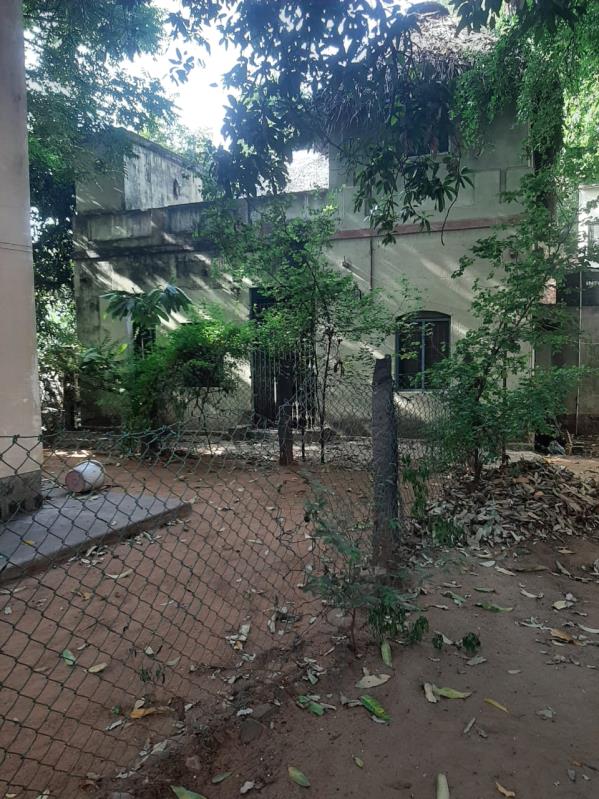
Dr.T.N.K Building: Muruganar and Kanakamma gave their expositions on ‘Collected Works’ in Tamil
Since devotees like Kanakammal, Anandammal, Abhurvathammal, Nombammal and some other ladies could not bear the absence of the physical Presence of Sri Bhagavan, Muruganar started holding sessions in this building, explaining the intricacies of Sri Bhagavan’s Nool Thirattu — “Collected Works” — verse by verse. As Muruganar revealed, “Just as Sri Bhagavan did the same verse by verse explanation of the entire text to me!”
* * *
Kanakamma, who worshipped Sri Bhagavan and basked in His Presence, was further fortunate in her close acquaintance with Sri Muruganar. This association greatly helped her; particularly after Sri Bhagavan shed His body. Muruganar, through austere living, high thinking and vast learning, preserved and radiated a bright ray of Sri Bhagavan’s Sun-like Presence for those who felt orphaned after 1950. Kanakamma, Padma, Anandamma and others, thus benefitted from their proximity to Muruganar. His daily exposition of Sri Bhagavan’s Nool Thirattu (“Collected Works of Sri Ramana Maharshi”) for many months transported them into Sri Ramana’s “World of Pure Awareness”.
I once asked Kanakamma to tell me about Anandamma. She narrated: “Anandammal had been coming to Sri Bhagavan from His Virupaksha days. She belonged to Tiruvannamalai itself and lived here with her parents. She was attached to Sri Bhagavan from her childhood and used to meditate in front of Him at Virupaksha Cave.”
“Though her aspiration was purely spiritual, her parents forced her into marriage. Even after marriage, her regular visits to Sri Bhagavan at Virupaksha Cave did not cease. In course of time, she had a son. All her thoughts were about Sri Bhagavan; and, the son and other family members remained neglected. Leaving the child at home, she would still go up the hill for meditation. Nothing — not even the pleading persuasions of her parents and relatives — could wean her from this practice. After a few years, her husband passed away. Sri Bhagavan also had come down from the Hill to the present Sri Ramanasramam.
“Anandammal, leaving her son with her brother, shifted her residence from Tiruvannamalai town to ‘Ramana Nagar’, opposite to the Ashram. She erected a thatched hut with mud walls. She led a strictly disciplined life, eating very little, speaking only on matters spiritual and going to Sri Bhagavan every day without fail. The purity of her appearance would inspire reverence - the ochre dress, rudraksha mala around her neck, and clean-shaven head. Her needs were few. One Dhanammal, who was a great admirer of Anandammal, used to help by cooking for her. If Dhanammal had to go out of town, she would cook rice for a few days and put it in a pot and pour water into it. This was all: when hungry, Anandammal would eat a portion of the cold rice, with salt for taste!”
“Though she could not read and write, she could explain any passage from spiritual texts. She would be very happy if friends who were visiting, recited Sri Bhagavan’s Nool Thirattu and Ribhu Gita in her presence. Her happiest moments, however, were those when she could sit meditating in Sri Bhagavan’s Presence. She also dearly loved to go round the Holy Hill, Arunachala.”
“A school teacher, Madurammal, well-versed in Vedanta, often visited the Ashram. She hailed from Madurai. Seeing the greatness of Anandammal, she used to spend some time with her and read out Tamil religious books. Difficult passages which baffled her would be explained by Anandammal in the light of Sri Bhagavan’s Teachings. Thus, what erudition could not reveal, her direct experience could.”
“In those days, many earnest sadhus were living at Palakottu - Muruganar, Munagala Venkataramaiah, Annamalai Swami, Kunju Swami and others. It was customary for devotees to give these sadhus some special eatables prepared at their houses. Once, I prepared ‘pakodas’ and distributed them to the sadhus in Palakottu. That day, I took a packet of pakodas and went to her hut. She was in meditation. But, she welcomed me with her usual affection. I offered the packet. Without touching it, she asked what it was. I said: ‘Pakodas. I prepared them specially to offer to the sadhus. I had a thought that I should also give some eatables to the sadhus at Palakottu. I have given the rest. This last packet is for you’.
“She ate it and then turned a stern face towards me and said: ‘Do you think sadhus really need these varieties? Look at that corner. Dhanammal has left cold rice there in the pot for me for a few days. That is all I need. Time is very precious for seekers. We should abide ‘as we are’ — to remain ‘as we are’ is all that we have to do. Not waste time in making special eatables for sadhus. This is all due to distracting, disturbing ‘thoughts’. Remain where ‘thoughts’ do not rise’. Saying this, she resumed her meditative state. After some time, she opened her eyes and said: “Why do you waste your time like this? What does Sri Bhagavan say? Close your eyes and be still. Simply be!” She said these words with such power that after all these years, I remember and cherish them. Yes, why should one waste even that much time to do a so-called good act, when our Master wanted us to spend all the time in reposing in the Self. Even today, I feel greatly grateful to Anandammal for saving me from unnecessary entanglements and directing me powerfully to spend all the time in diving within, withdrawing the mind from going outward.
“Anandammal did spend most of her time in the Presence of Sri Bhagavan. When she returned to her hut, she would remain in meditation or if people arrived, she would ask them to read out to her some passages from books. She was quite fond of me. She told me: ‘You have come to Sri Bhagavan at this tender age; it is very good. It is a rare opportunity, indeed! Utilise every moment in sadhana. Attaining the “Fullness of Self” should be your aim; all the rest are only the traps of the ‘mind’. Be ever vigilant. Attain the “Self” which is ever yours. Be true to yourself; Sri Bhagavan’s Blessings will always be with you!’ Young aspirants have much to learn from the Wisdom and Pure Life of Anandammal.”
“Once when I went to her hut, a young woman was lamenting over her hardship in life and Anandammal’s consoling words even now linger in my ears: ‘Your thinking about such troubles is what makes your will power weaker and weaker. Break the whole chain of these ‘thoughts’. Go and sit in the presence of Sri Bhagavan. He will solve your problems and bestow Well-Being on you’. She added: ‘For women who wish to do sadhana, Arunachala is the best “Kshetra”: Did not Mother Goddess, Parvati, Herself do tapas here to gain the Left Half of Lord Shiva's Body? It means that at Arunachala, women will surely gain Atma Siddhi. Look at Sri Bhagavan’s Mother. Are there temples over the samadhis of the mothers of Rama or Krishna? For Alagammal, Sri Bhagavan saw to it that a Temple was built. What better proof is there for the Greatness of Womanhood?’
“After Sri Bhagavan’s Brahma Nirvana, devotees scattered out of Tiruvannamalai. However, after some time, they discovered that they could not find peace of mind anywhere else! So, they slowly came back to the shrine of Sri Bhagavan’s samadhi. They approached Muruganar and requested him to expound Sri Bhagavan’s written works (Nool Thirattu). Muruganar’s explanations, interspersed with reminiscences of the Master, delighted us, like showers of Ramana-ambrosia. Fortunate indeed were those who listened to Muruganar’s talks! Anandammal and myself were among those who have had this rare privilege!”
“After completing the Collected Works of Sri Ramana Maharshi, Muruganar expounded other spiritual treatises like Atma Purana. One day, Anandammal wanted Muruganar to explain a passage about Saint Vamadeva in Atma Purana. She asked: ‘Vamadeva had some residual prarabdha and had to experience garbha vaasa (stay in womb, i.e. rebirth). Immediately after coming out of the womb, he realised the “Self”, didn’t he?’ After uttering these words, Anandammal suddenly fell forward and collapsed. It looked as if she was prostrating. But after a few minutes, when she did not get up from her ‘prostration’ I lifted her and made her sit up. She was not conscious. We sprinkled water on her face, yet there was no improvement. Then, she was taken to her relative’s house in the town. She never opened her eyes again. This happened at evening 6 and by 9 p.m. she was pronounced dead. Her last thought was on the Release of Vamadeva! Her body was laid to rest near the Ashram, by her son and her brother. Anandammal was an ideal devotee worthy of emulation!”
This scene must have caused a deep impression in Kanakamma that her life also ended at the very Shrine of Sri Bhagavan — on Sri Bhagavan’s Jayanthi day – She was wearing a new saree and prostrated to the Sacred Shrine and never got up — her life having merged in the Huge Flame of her Sat-Guru.
* * *
Sri Yogi Ramsuratkumar was instrumental in reviving the Tamil Parayanam at the Ashram, which had captivated him in the days when Sri Ramaswamy Pillai, Sri Somasundaram Pillai, Sri Kunju Swami and others did daily Tamil Parayanam in the Presence of Sri Bhagavan.
I lost contact with him after that point as I was immersed in Ashram work — being actively involved with The Mountain Path. Still, I sometimes caught sight of him near the Bus Terminus during my trips to Chennai. He would suddenly appear, hand me a flower and then demand, “Ganesa! Give me a Rupee.” It was only in 1980, after a gap of several years, that I came into contact with him again. The Birth Centenary of Sri Bhagavan’s Jayanthi was being organized at the Ashram on a grand scale, with lots of celebrations and poojas.
One day, Yogi Ramsuratkumar met me and said, “Ganesa, the local people of Tiruvannamalai are not in favour of what is happening at Sri Ramanasramam. They are saying that it is a Brahmin institution and only Sanskrit is chanted there. During Sri Bhagavan’s lifetime, Tamil Parayanam from the “Collected Works of Sri Bhagavan” was being sung. Start that again.” I tried, but except for two or three Old Devotees, there was nobody who knew Sri Bhagavan’s entire “Collected Works”. I avoided meeting him again as he was very persistent with this demand.
He solved this dilemma of starting the Tamil Parayanam in his own inimitable style. My friend Anuradha had settled in Arunachala in 1983. My brother Mani had also resigned his job and moved permanently to Tiruvannamalai to help with Ashram work. Together, they were helping me manage the Ashram as its activities had grown significantly. During the Karthikai festival in 1983, Anuradha, Kanakamma and I were near the Temple witnessing the procession of the Huge Wooden Car. Suddenly, out of nowhere, Yogi Ramsuratkumar came and caught my hand and said, “Ganesa, this beggar has been sending word to you to meet you and ask you to start the Tamil Parayanam. But you have been avoiding me.” He was in his garb of several shawls, carrying a coconut shell bowl, sticks and a large fan. Anuradha was quite frightened with this vision of a ‘madman’ suddenly accosting me — this was her first darshan of Yogi Ramsuratkumar! I admitted that I was avoiding him as I was unable to find someone to take on the heavy task of learning all the ”Collected Works of Sri Bhagavan” in Tamil and teaching these to others to do Parayanam. He instantaneously turned towards Anuradha and said, “She will take up this task!” He then disappeared into the crowd as abruptly as he had appeared. Anuradha, still quite stunned by his dishevelled appearance and the familiarity with which he addressed me, asked, “Who is this ‘madman’ who accosts you and gives orders to you? What is this Tamil Parayanam he is referring to?”
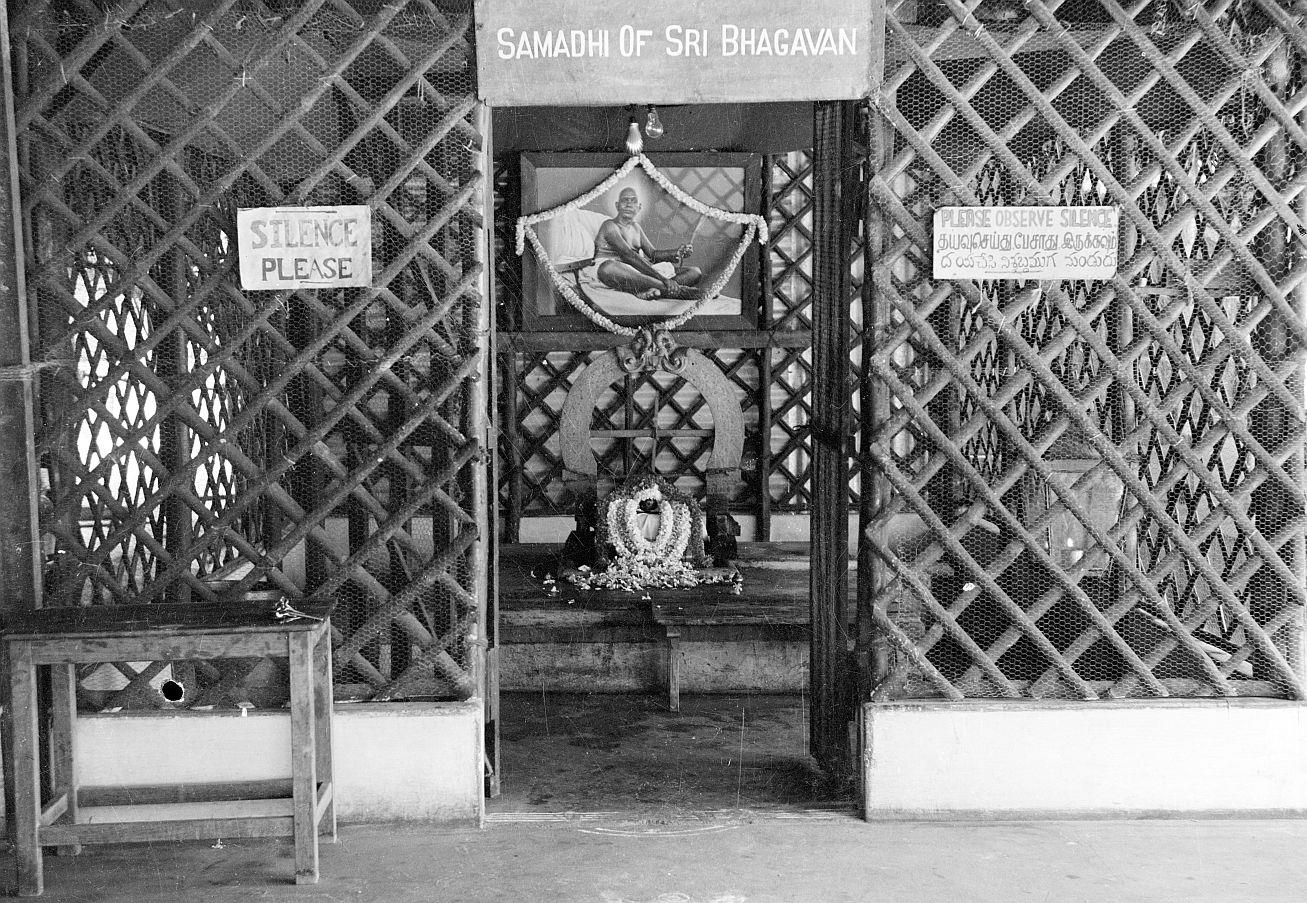
Sri Bhagavan’s Sacred Samadhi Shrine
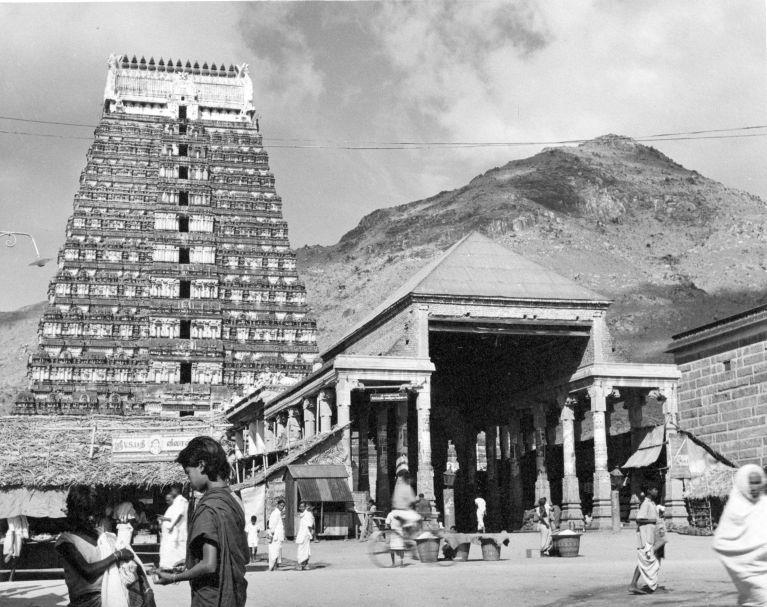
Yogi Ramsuratkumar’s ‘Spiritual Haven’ ARUNACHALA : Hill and Temple
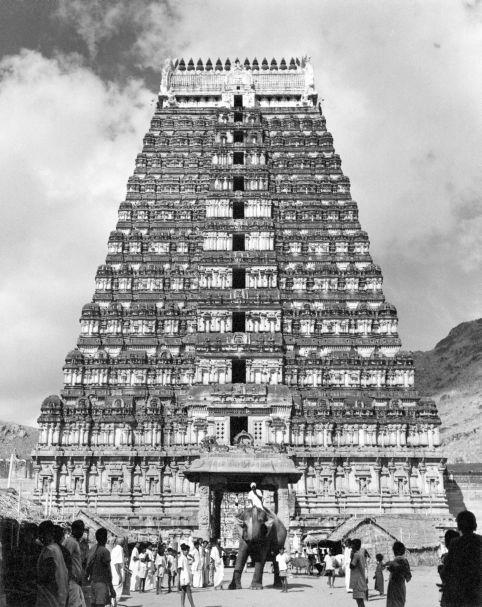
Eastern entrance to Sri Arunachaleswara Temple
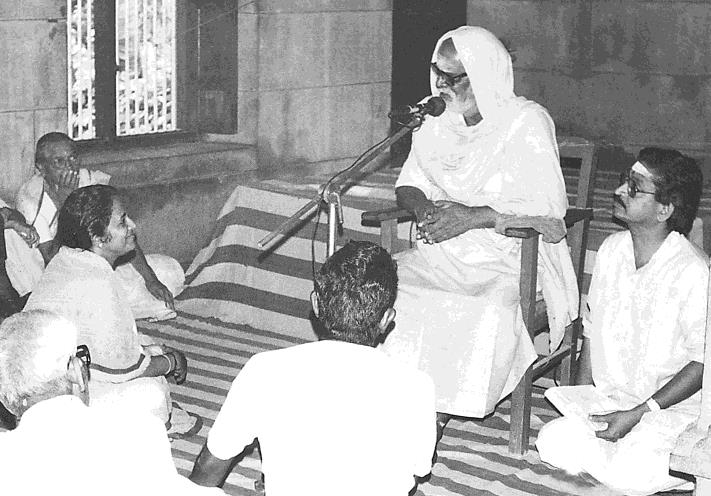
Kunju Swami expounding Sri Bhagavan’s Teaching (Kanakamma, Anuradha, Ganesan seated among audience)
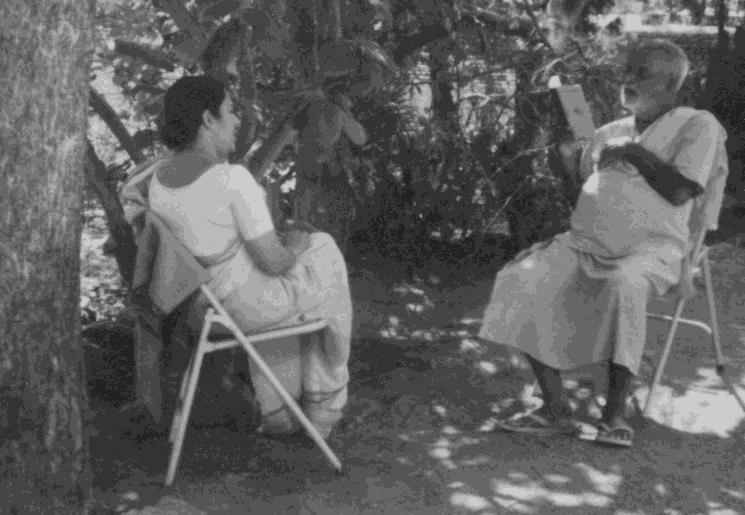
Kunju Swami teaching Tamil Parayanam – ‘Nool Thirattu’ to Anuradha
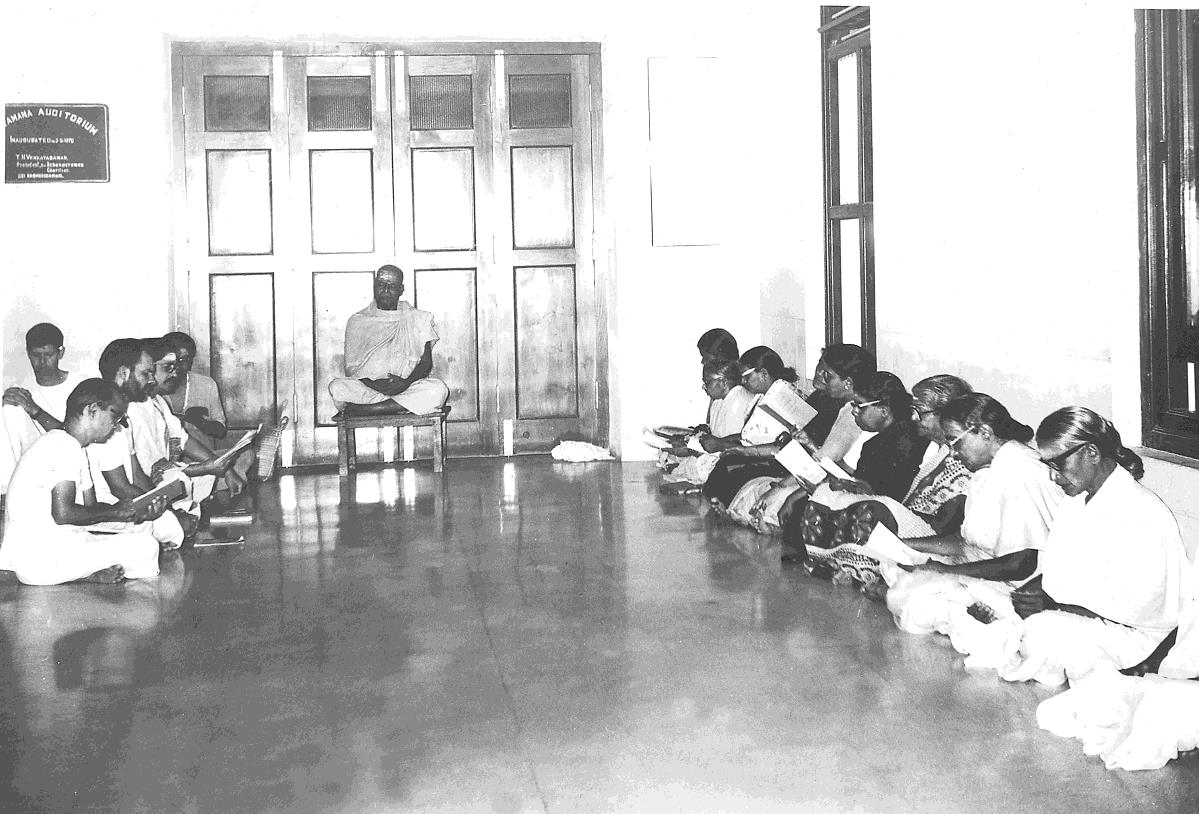
Tamil Parayanam with Kunju Swami (seated in the centre)
Some power must have been transferred from “Yogi” to Anuradha, because she started learning the “Collected Works of Sri Bhagavan” from Kanakamma and Kunju Swami and started singing whatever she had learnt in Sri Bhagavan’s shrine. Many ladies were attracted to her singing because they had never heard Sri Bhagavan’s “Collected Works” being sung in the recent past. Whenever Kunju Swami taught Anuradha, he used to say, “You have to learn it by heart. Otherwise, I will not teach you.” She soon learned every poem in the “Collected Works” by heart and taught all the ladies who were interested. Ramani, my brother’s wife, was especially keen on learning them. Dr. TNK building was the place wherein this Parayana training was being conducted. The same place wherein Sri Muruganar taught the meaning of “Nool Thirattu” to the ladies after Sri Bhagavan’s Brahma Nirvana. Significantly, Kanakamma was expounding the “Nool Thirattu” within the same place, in the same building. More joyously, Anuradha too was teaching the 15 ladies Parayanam within this Dr. TNK Building!
In the beginning, devotees did Parayanam only on Mondays and Thursdays, between 6.45 and 7.30 p.m. On Monday, they sang Five hymns to Sri Arunachala (Arunachala Stuti Panchakam), and on Thursdays, Forty Verses on Reality (Ulladu Narpadu), Supplement to Forty Verses on Reality (Ulladu Narpadu Anubhandam) and Essence of Instruction in Thirty Verses (Upadesa Undhiar). This was increased to three days in a week under the immediate presence of Kunju Swami, and Anuradha, its organiser and conductor. Now, the schedule that was followed was: on Monday, Arunachala Stuti Panchakam, on Thursday, Ramana Stuti Panchakam (Five hymns to Sri Ramana), on Saturday, Ulladu Narpadu , Ulladu Narpadu Anubhandham and Upadesa Undhiar.
Yogi Ramsuratkumar kept himself informed of the progress of the Parayanam.
A few years later, when Anuradha had completed and prepared six days of Parayanam, Yogiji asked her, “How many days of Parayanam are ready?” When she replied that six days of it were ready, Yogiji asked her, “What about Sunday?” Anuradha, who is very bold and quick witted, retorted, “Sunday is Sabbath!” Yogi Ramsuratkumar burst into peals of laughter and said, “Oh, then Sunday will be a rest day.”
The presence and participation of Old Devotees — Kunju Swami and Kanakamma — in the Tamil Parayanam, devotees felt the Presence of Sri Bhagavan! More so, since the Parayanam is taking place in front of the Sacred Samadhi Shrine of Sat-Guru Bhagavan Sri Ramana Maharshi.
Even today, the very singing of the Holy Hymns composed by Sri Bhagavan and on Sri Bhagavan in the Tamil Parayanam, is divinely and enthralling to all !
* * *