Sri Shankara Bhagavatpada
1.820 (videha-mukti)Dakshinamnaya Sri Sharada Peetham, Sringeri
5 chapters
Introduction: Sri Adi Shankaracharya
The Divine Purpose of Avatara
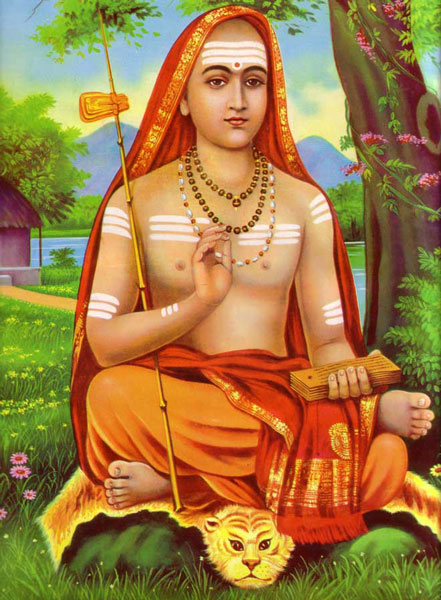
When spiritual darkness engulfs humanity and eternal principles of Dharma face extinction, the Supreme Consciousness manifests in human form to restore cosmic order. These divine incarnations—Avataras—emerge with specific forms and purposes uniquely suited to address the spiritual crises of their time. Sri Adi Shankaracharya stands among these luminaries as an Avatara of Lord Shiva Himself, whose appearance twelve centuries ago transformed the spiritual landscape of India, revitalized the profound wisdom of Vedanta, and forged national integration across diverse regions. It is universally acknowledged that if Sanatana Dharma thrives today, allowing us to partake in its spiritual treasures, it is primarily due to Sri Shankaracharya's divine intervention and tireless work. His legacy continues to illuminate the path for seekers worldwide, serving as the foundation upon which the living tradition of eternal wisdom stands.
A Timely Manifestation
In an era when the pristine wisdom of Sanatana Dharma faced unprecedented peril, when the Vedic path to liberation lay obscured beneath divisive sectarianism and materialistic philosophies, Sri Shankaracharya emerged as the divine response to humanity's spiritual crisis. The Hindu society of His time had fractured into countless competing sects, each advancing contradictory interpretations and engaging in endless disputations that served only to weaken the unified spiritual foundation of the culture.
Into this intellectual chaos, Sri Bhagavatpada brought the crystalline clarity of Advaita Vedanta—the non-dual wisdom of the Upanishads. With matchless eloquence and penetrating insight, He revitalized the eternal truths that had become clouded by misinterpretation and neglect. His accomplishment becomes even more remarkable considering the absence of modern communication technologies and transportation systems, as He traveled the length and breadth of India on foot, igniting a spiritual renaissance.
The Multifaceted Brilliance of a Perfect Master
Though established in the sublime state of Self-realization, where He could have remained in solitary bliss, Sri Shankaracharya chose instead to embrace humanity with boundless compassion. Recognizing the diverse spiritual capacities of seekers, He communicated transcendent wisdom at multiple levels, meeting souls precisely where they stood on the spiritual journey.
His extraordinary talents included:
- Intellectual brilliance that could distill the most profound metaphysical truths into accessible understanding
- Spiritual realization that transcended mere scholarship to embody the truth He taught
- Poetic genius that flowed effortlessly from rigorous philosophical treatises to soul-stirring devotional hymns
- Organizational vision that established enduring institutions to preserve and transmit wisdom
- Compassionate leadership that reformed religious practices while honoring authentic tradition
Within the remarkably brief span of His manifest life—completing His earthly mission by age 32—Sri Shankaracharya accomplished what would seem impossible for many lifetimes. His commentaries on the principal Upanishads, the Brahma Sutras, and the Bhagavad Gita (collectively known as the Prasthanatraya) remain definitive expositions that have guided generations of seekers to the highest truth.
The Essence of His Teaching
The heart of Sri Shankaracharya's philosophy reveals that:
- Brahman—the eternal, impersonal, conscious Absolute—is the only reality
- The universe, with all its names and forms, appears within this reality through the power of Maya
- The individual soul (jiva) is fundamentally non-different from Brahman, appearing separate only due to limiting adjuncts (upadhis)
- Liberation (Moksha) is the direct recognition of this eternal oneness, as proclaimed in the Mahavakyas of the Upanishads
- Karma (action) and Bhakti (devotion), when performed with proper understanding, purify the mind and prepare it for this supreme knowledge
- Many forms, one Bhagavan – all divine forms are manifestations of the same Supreme and there is no difference in the essence
While maintaining that Brahman alone is the Absolute Truth (Paramarthika), Sri Shankaracharya acknowledged the practical reality (Vyavaharika) of the world for purposes of spiritual practice and daily living. This balanced approach allowed Him to integrate diverse spiritual practices within a coherent framework, leading ultimately to non-dual realization.
Compassion in Action
Though His philosophical achievements alone would secure His place among humanity's greatest teachers, Sri Shankaracharya's compassion extended beyond the intellectual realm to address practical human suffering. Numerous accounts attest to His willingness to employ yogic powers for the welfare of others—from blessing a destitute woman with prosperity through the Kanakadhara Stotram to revealing the greatness of His disciple Padmapadacharya through the miracle of lotus flowers manifesting upon the waters of the Ganga.
A Visionary Legacy for Millennia
Perhaps the most enduring testament to Sri Shankaracharya's visionary leadership lies in the establishment of the four Chaturamnaya Peethams (monastic centers) at the cardinal points of India. With remarkable foresight, He created a network of spiritual epicenters that would preserve and propagate Sanatana Dharma through the centuries:
- Dakshinamnaya Sri Sharada Peetham at Sringeri in the South
- Poorvamnaya Sri Govardhana Peetham at Puri in the East
- Paschimamnaya Sri Kalika Peetham at Dwarka in the West
- Uttaramnaya Sri Jyotir Peetham at Badrinath in the North
In structuring these institutions, Sri Bhagavatpada demonstrated profound wisdom about human nature and national integration. Sri Sureshwaracharya, hailing from the North, was placed in charge of the Sringeri Peetham in the South, while Totakacharya from the South was assigned to the Jyotir Peetham in the North. He ordained that the Nampoothris from Kerala should perform Puja at the Badrinath temple in Badri, while the Brahmins from Karnataka were assigned to perform Puja at the Pashupatinath temple Nepal. Similarly, He entrusted Maharashtra Brahmins with the Pujas at the Sri Ramanathaswamy temple in Rameshwaram. Thus, by strategically assigning Acharyas from different regions to lead Maths in distant quarters of the country, He established cross-regional ritual practices that fostered cultural exchange.
Among these four pillars of Vedic tradition, the Dakshinamnaya Sringeri Sharada Peetham holds the distinction of maintaining an unbroken succession of enlightened Jagadgurus who continue to embody Sri Shankaracharya's divine qualities, from profound Self-realization to comprehensive mastery of the scriptural tradition.
For over twelve centuries, this living stream of realized masters has preserved not merely the letter but the very spirit of Sri Adi Shankaracharya's teachings, offering seekers in every generation direct access to the transformative wisdom He bestowed upon humanity. Through their presence, the light kindled by the Master continues to illuminate the path to ultimate truth for all who yearn for liberation.
Biography of Jagadguru Sri Adi Shankaracharya
https://sringeri.net/history/sri-adi-shankaracharya/biography/abridged-madhaviya-shankara-digvijayam
Pictorial Biography and Teachings (Kannada E-book)
Biography of Sri Adi Shankaracharya
To those who are fortunate to study his valuable works, devotion and gratitude swell up spontaneously in their hearts. His flowing language, his lucid style, his stern logic, his balanced expression, his fearless exposition, his unshakable faith in the Vedas, and other manifold qualities of his works convey an idea of his greatness that no story can adequately convey. To those who are denied the immeasurable happiness of tasting the sweetness of his works, the stories of his earthly life do convey a glimpse of his many-sided personality.
Sri Shankara Digvijayam
The Madhaviya is the the most authentic and widely known among the different Sankaravijayas today. It is certainly the most popular such text in the Advaita tradition, and is also known as the Samkshepa Sankarajaya. The popularity of this work derives from the fame of its author, Madhava, who is actually Jagadguru Sri Vidyaranya, the 12th Acharya of the Sringeri Sharada Peetham.
Works of Sri Adi Shankaracharya
Introduction
Sri Adi Shankaracharya stands as the preeminent philosopher in the Advaita Vedanta tradition. His profound interpretations of Vedantic texts established the foundation for classical Advaita philosophy, which teaches the essential oneness of all reality. Through His teachings, He achieved three important goals that revived Sanatana Dharma during one of its darkest hours: He taught the universality of the Vedic religion, dispelled the seeming contradictions in the understanding of the Upanishads caused by partisan adherents of different schools, and integrated the three spiritual paths of action (Karma), devotion (Bhakti), and knowledge (Jnana) into a unified approach to liberation from suffering.
The heart of Sri Shankaracharya's contribution lies in His elucidation of Advaita (non-dualism) as the central truth of the three foundational texts of Indian philosophy—the Upanishads, the Brahmasutras, and the Bhagavad Gita—collectively known as the Prasthanatraya. His commentaries on these texts exemplify both clarity and depth in a language characterized as “prasanna-gambhira” (lucid and profound). The enduring influence of His teachings across centuries, countries, cultures and people of different faiths, testifies to their profound truth and vitality.
Major Works
Sri Shankaracharya's literary legacy can be organized into three primary categories: The Prasthanatrya Bhashyam, Prakarna Granthas and Stotras.
1. Prasthanatraya Bhashyam
Prasthanatraya means the three sources of authority. It is the collective name given to the Upanishads, Brahma Sutra, and Srimad Bhagavad Gita, which are accepted as the three primary sources from which different schools of Vedanta derive their authority.
a. The Upanishads Commentary
The Upanishads generally form the end of the Aranyakas of the Vedas and therefore the philosophy enshrined in them is called as Vedanta meaning `end of the Vedas’. They contain the essence of Vedic teachings, and are the foundations on which most of the later philosophies and religions of India rest.
There is no important form of the Hindu thought which is not rooted in the Upanishads. Sri Shankaracharya's interpretation of these texts remains the most influential in Indian thought.
In His commentaries, Sri Shankaracharya explains that the Upanishads present teachings at two levels:
- For advanced seekers who either possess the necessary mental preparation in this life or have developed an introspective mind through disciplines in past lives. These seekers either need only a reminder of their true nature through an experienced teacher or require guidance through contemplative practices.
- For others, the Upanishads offer methods to meditate on Apara "lower Brahman" (a concept of God with attributes), which leads to the heavenly realm called Brahma Loka.
Sri Shankaracharya resolves the apparent contradiction between a formless and form-based Supreme Reality by explaining that Brahman is formless in its essential nature, beyond all sensory perception and mental concepts, yet can be approached through forms when understood as the Creator, Sustainer, and In-dweller of the universe.
b. The Brahma Sutra Commentary
The Brahma Sutra consists of 555 aphorisms composed by Bhagavan Veda Vyasa, presenting the entire Upanishadic philosophy in condensed form. Considered advanced study material for Vedanta students, these aphorisms guide inquiry into the Supreme Reality, the relationship between individual souls and this Reality, and the ultimate purpose of human existence. These concise formulations serve as memory aids for deep contemplation and, when properly understood, can open the door to supreme bliss.
c. The Bhagavad Gita Commentary
The Bhagavad Gita stands as Sanskrit literature's most beloved philosophical poem. This unique text offers profound teachings on religion, philosophy, ethics, and the art of living with the right attitude towards life's challenges.
2. Prakarana Granthas (Introductory Vedantic Treatises)
Traditionally, spiritual knowledge in the form of granthas (texts) can be classified into two kinds: The texts of the Science (of the Supreme Reality or Brahman), which explain the theory and technique, are called the Shastras, while the books that explain the terms used in the Shastra texts are called Prakarana Granthas. Following are some examples of Prakarana Granthas:
- Vivekachudamani
- Upadesha-Sahasri
- Atma-Bodha
- Aparokshanubhuti
- Dasha-Shloki
- Shata-Shloki
- Vakya-Vritti
- Panchikarana
- Prabodhasudhakara
- Tattva-Bodha
3. Stotras (Devotional Hymns)
Sri Shankaracharya composed numerous devotional hymns, from the widely known Bhaja Govindam to the profound Dakshinamurti Stotram. These compositions reflect His conviction that Brahman (the Absolute) manifests as Ishvara (the personal Bhagavan) through the power of maya (divine creative energy) to bless devotees.
Sri Shankaracharya sanctified worship practices for six divine forms, the Shanmata —Shiva, Devi, Vishnu, Surya, Ganapati, and Kumara—composing devotional hymns for each. He taught that these forms are manifestations of the same Supreme Reality, and that sincere devotion to any of these forms leads to divine grace, spiritual knowledge, and ultimate liberation. For instituting these six modes of worship, He earned the title "Shanmata Sthapaka" (founder of the six traditions of worship).
Despite God's all-pervasiveness, His presence and sanctity can also be localised to specific forms and places. It is akin to the ruler of an entire country who can also be addressed as "the King of Ayodhya" (i.e., a specific city). We do this to help focus our meditation. Sri Shankaracharya instructs to meditate on God as being present in the heart, similar to how devotees might focus on Lord Hari within a sacred Saligrama stone. When the mind is concentrated this way, one is blessed with a glimpse of the divine. Although God exists everywhere, God becomes especially responsive when worshipped in these specific places. It's comparable to how space itself is everywhere, but we still talk about the tiny space inside a needle's eye as being a specific, limited space.
This teaching helps make the abstract concept of an omnipresent God more approachable for spiritual practice.
His hymns, metaphorically harvested from the garden of Upanishadic wisdom and woven with poetic threads, express his profound love for the Divine while embodying profound philosophical insights through evocative similes.
Additional Works
Beyond these major categories, Sri Shankaracharya authored several other significant texts:
- Yogasutra Vivarana Bhashya (Commentary on Patanjali's Yoga Sutras)
- Commentary on the Adhyatma Patala of the Apastamba Dharmasutra
- Commentaries on the Vishnu Sahasranama and Lalita Trishati
- Jayamangala (a work on Sankhya philosophy)
- Sthirasiddhi (a treatise on Nyaya logic)
Philosophical Approach
Sri Shankaracharya's approach to spiritual teaching shows remarkable psychological insight. He recognized that abstract philosophical concepts can be difficult to grasp, particularly the notion of a formless Absolute Reality. Therefore, He endorsed the practice of contemplating on the Divine through forms and images as stepping stones to higher understanding.
He compared the relationship between a teacher and disciple to that between a father and child, but with an important distinction: while a father gives physical life, a true spiritual teacher (Guru) saves one from the cycle of rebirth by removing ignorance (avidya). The debt to such a teacher can never be fully repaid, though passing this knowledge to other qualified seekers represents a partial repayment.
The study of Sri Shankaracharya's commentaries requires deep knowledge of Sanskrit, expertise in grammar (Vyakarana), logic (Nyaya), ritual exegesis (Mimamsa), and Vedic recitation (Veda-adhyayana). This tradition of study continues today throughout India through the Guru-Shishya (teacher-student) relationship that is the hallmark of Indian spiritual traditions.
Legacy
Sri Shankaracharya's comprehensive philosophical system transformed India's religious landscape by reconciling diverse spiritual approaches within a coherent framework. His commentaries not only preserved ancient wisdom but also made it accessible and relevant across generations. His devotional compositions demonstrate that profound philosophical understanding and heartfelt devotion are complementary rather than contradictory. Together, His works provide a complete spiritual path that addresses both intellectual understanding and emotional fulfillment.
Primary Disciples
The Chosen Four
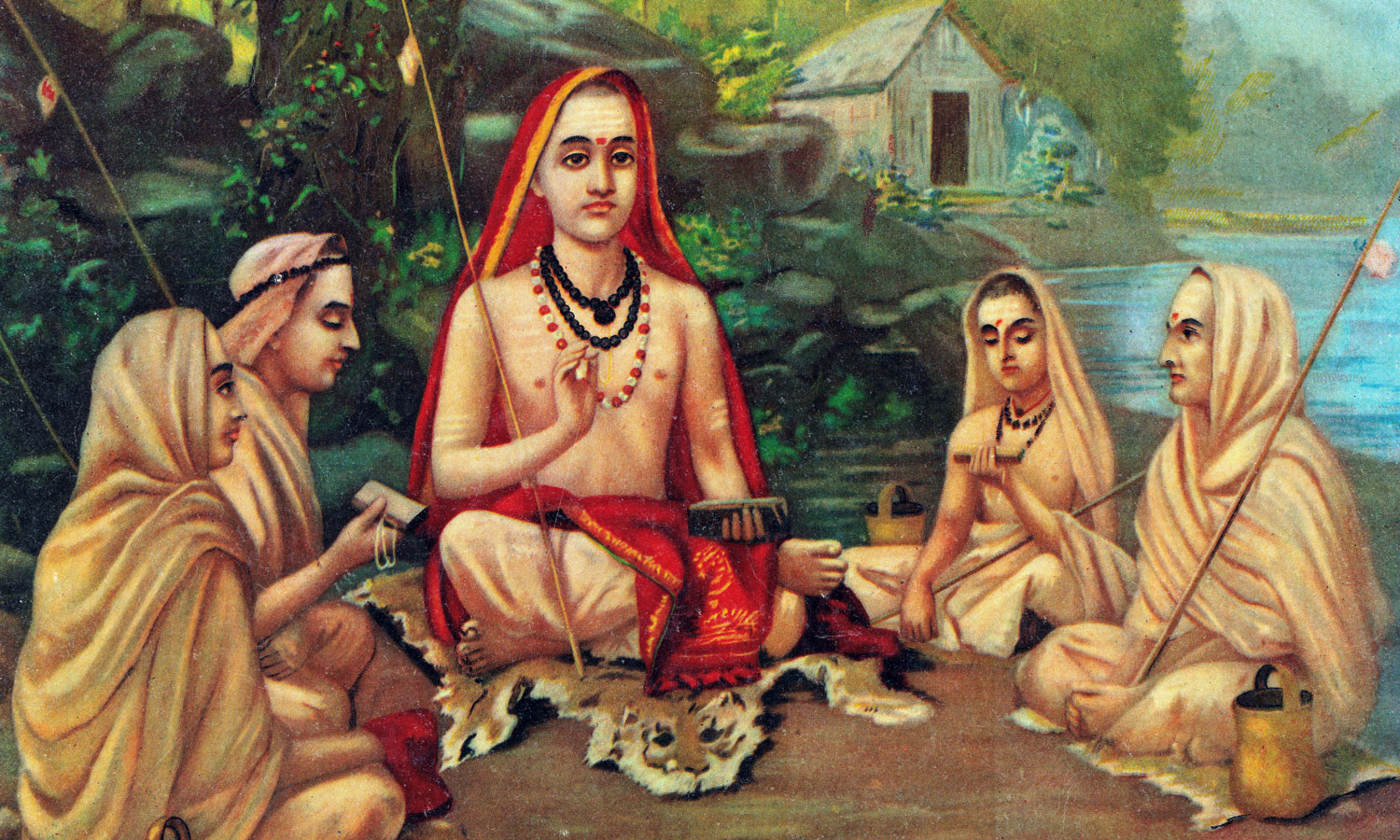
Among the countless blessed souls who received the rare privilege of learning directly from Jagadguru Sri Adi Shankaracharya, four extraordinary disciples emerged as brilliant extensions of the Master's light. Each manifested a distinctive spiritual excellence that complemented the others, together forming a perfect mandala of wisdom, devotion, service, and realization:
- Sri Sureshwaracharya. The repository of boundless scholarship (Vidya)
- Sri Padmapadacharya. The embodiment of supreme devotion (Bhakti)
- Sri Totakacharya. The exemplar of selfless service (Seva)
- Sri Hastamalakacharya. The living testament to absolute Self-Realization (Jnana)
The Foundation of a Lasting Legacy
Bhagavatpada entrusted each of His primary disciples with the task of heading one of the four Amnaya Peethams He established, as its first Acharya.
Dakshinamnaya Sringeri Sharada Peetham (South)
Location: Sringeri, Karnataka
First Acharya: Sri Sureshwaracharya
Presiding Deity: Sri Sharadamba
Paschimamnaya Dwaraka Peetham (West)
Location: Dwarka, Gujarat
First Acharya: Sri Padmapadacharya
Presiding Deity: Sri Dwarakadhisha
Uttaramnaya Jyotir Peetham (North)
Location: Joshimath, Uttarakhand
First Acharya: Sri Totakacharya
Presiding Deity: Sri Badrinarayana
Poorvamnaya Govardhana Peetham (East)
Location: Puri, Odisha
First Acharya: Sri Hastamalakacharya
Presiding Deity: Sri Jagannatha
A Living Tradition
The continued functioning of these four Maths across twelve centuries bears powerful testimony to the enduring vision of Sri Adi Shankaracharya. Through political upheavals, social transformations, and the passage of time, these sacred institutions have remained steadfast in their mission of preserving and propagating the principles of Advaita Vedanta, and upholding the eternal values of Sanatana Dharma.
The four primary disciples not only established the initial framework for these monastic traditions but also set the exemplary model for the qualities that would characterize the illustrious lineage of Acharyas who would follow in their footsteps—combining profound spiritual realization with tireless dedication to the welfare of humanity.
Today, as seekers continue to receive guidance and blessings from these hallowed institutions, we witness the living fulfillment of Sri Shankaracharya's compassionate vision—a spiritual constellation designed to ensure that the lamp of divine knowledge would never be extinguished, regardless of the changing winds of time.
The philosophy of Vedanta

The great soul Sri Bhagavatpada Shankara, incarnated to expound the Advaita Siddhaanta (philosophy) to the world. The term Vedanta refers to this philosophy of Advaita. No one should think that Advaita Siddhaanta (philosophy) was founded by Sri Shankara. This (philosophy) has been revealed in the Upanishads from time immemorial. The Lord has also taught the same in the Bhagavad Gita. Sri Veda Vyasa has also propounded the same (philosophy) in the Brahma Sutras. But before the advent of Sri Bhagavatpada, there was no one who could make people understand this Advaita Siddhaanta correctly. Many dissident schools of thought were cropping up.This was because, the propagators of the dualistic school of thought, were able to find some Upanishadic statements (that seemed to support their stand). Even atheists who talk of Asadvada, were able to find a (seemingly supportive) statement in Vedas. By using very weak logic, many arguments against Advaita were prevalent before the time of Sri Shankara Bhagavatpada. In order to bring such people to the correct path, Sri Bhagavatpada incarnated to make people understand the philosophy as revealed in the Upanishads.
One must not pick an arbitrary Vedic statement and try to interpret it. The interpretation of Vedic statements must be consistent and proper. The Vedas are the Supreme authority. vedasya hi nirapekSham praamaaNyam raveriva roopaviShaye — thus, Sri Bhagavatpada has highlighted the authority of the Vedas.
It is incorrect to say that the Vedas — the Supreme authority — has contradictory statements. For instance — “ na tasya pratimaa’sti ” — if you understand this to imply God has no image , “na tat-samashca-abhyadhikashca dRshyate” — is another Vedic statementn means “No equal or greater entity is to be seen” — accordingly, if you need to arrive at the meaning pratimaa — saadRshyam naasti i.e. None is comparable to Him.
Therefore, we revere the Lord as unimaginably and infinitely powerful. His power is “acintya” — beyond our imagination. And His power is “aparimita” — having no limitations. The Consciousness that has such unimaginable and infinite power is only one. There cannot be a second entity that is comparable to That. This is the right meaning of the Upanishadic (Vedic) statement. Hence one must not understand the meaning based on misinterpretation of some Vedic statement. One must keep in mind all the Vedic statements and give the meaning consistently and properly. Hence, Sri Bhagavatpada emphatically said that if all Vedic statements have to be interpreted properly we have to admit that Advaita alone is the conclusion of the Upanishads. He proclaimed that no other interpretation is possible. If Advaita alone is considered to be the philosophy of the Vedas, then would it not give rise to many objections? For all such objections, Sri Bhagavatpada has given explanations. One such objection is “In Advaita, it is said that the Supreme Consciousness (Parabrahman) alone is real and nothing else is.” Then what about all the activities happening in the world? Now You are the Guru, we are the disciples. You are teaching us. Tell us whether this is real or unreal? If everything other than Brahman is Mithyaa (illusion), does it mean that both Your teaching and our listening are also unreal? And are all the activities happening in this world also an illusion? You need to give us an answer for this.
Sri Bhagavatpada replies — sarva-vyavahaaraaNaam-eva praag-brahmaatma- vijnaanaat satyatvopapatteH
There are three types of truth.
The first is — trikaalaabaadhya satya — what we call the Eternal Truth.
The second is true only until Brahma-jnana is attained. It is called “vyaavahaarika satya.”
The third seems real only during the time of perception. It is called “praatibhaasika satya.”
We call this world, “vyaavahaarika satya.” That is, all of this is true until you attain Brahma-jnana. Upon attaining Brahma-jnana, Brahman is the only Truth that exists, and nothing else has existence. Those who raise objections against Advaita Siddhaanta, do not understand this explanation given by Sri Bhagavatpada. They raise objections to Advaita Siddhaanta without a proper understanding. “Oh! Advaita means everything is void.” — No! Nothing is denied reality.
We have not said that Karma (actions) has no importance. Then do you mean that Karma should be given up after Realization? For the one who has attained Advaita saakshaatkaara (Realization), we need not tell him to give up Karma — it will leave him on its own. Hence, we always stress that until one attains Advaita saakshaatkaara, one must perform actions (Karma). Don’t raise a hue and cry that Advaita will lead to the neglect of Karma Shastra (actions), Upasana Shastra (worship). All of these have importance. Advaita Siddhaanta has to be properly understood.
Someone asked, ” Swamiji, If you say that everything other than Brahman is unreal, then are the Vedas unreal too?” Are not Vedic statements also unreal? And is not Knowledge acquired from such statements also unreal?, when knowledge obtained from unreal statements is unreal, then how can Advaitic knowledge be the Truth?
Sri Bhagavatpada replied — shankaa-viShaadinaapi maraNa-sambhavaat
Yes — a real action can come about from an unreal statement. Where can this happen?
A person ate something, Another person told him, “This is poison! You have eaten poison!” Then that person began to feel strongly, “I have eaten poison, I have eaten poison…”, eventually resulting in his death. In reality, what he ate was not poison. He died because he developed a false notion that he had eaten poison.
Thus the unreal poison resulted in his death.
Similarly, to the question, “how can knowledge obtained from Vedic statements be true when everything is unreal?”
We dream. Everyone knows that dreams are not true. However it is said that a dream may result in the occurrence of an actual event. It is said that certain types of dreams, give certain type of results. However, our dreams are not real. And yet, they can cause a real event.
Everyone who has heard the Ramayana may know about the dream of Trijata. When Mother Sita was sitting under the Ashoka tree, when the demonesses were threatening Mother Sita, an elderly demoness,Trijata says — I saw a dream last night. In that dream, I saw Ravana smearing oil all over his body, sitting on a donkey and riding towards the south. If we see a dream where a person smeared with oil all over his body, sits on a donkey and rides towards the south, it implies that person will die very soon.” Further, I dreamt that Vibhishana was decked with all ornaments, was sitting on an elephant and riding towards the east.” The result of such a dream is that the person will be victorious. Of course, Ravana neither smeared oil all over his body, nor ride towards the south on a donkey, as depicted in the dream. However, the inference here is that an unreal dream can produce a real event. And it has happened there. Hence, to say that an unreal statement cannot bring about the knowledge of Reality is incorrect.
Sri Bhagavatpada has firmly established that the Advaita Siddhaanta cannot be shaken in any manner. However, it is now a practice for dissidents (due to their inability or lack of interest to understand its meaning), to criticise Advaita. As proof that the Advaita Siddhaanta is Supreme, Sri Ayyanna Dikshitar has mentioned in the text, Vyaasa-taatparya-nirnaya that, even philosophers of other schools, have taken the meaning of the word “Vedanta” to mean Advaita Siddhaanta alone! Is any other testimony needed to say Advaita alone is the essence of the Upanishads! This Advaita Siddhaanta was propounded by Sri Bhagavatpada. Subsequently, many great personages have further elaborated on the Advaita Siddhantha.
The official text
Introduction: Sri Adi Shankaracharya
Read the official text