Sri Sureshwaracharya
2.820 - 834Dakshinamnaya Sri Sharada Peetham, Sringeri
2 chapters
Sri Sureshwaracharya
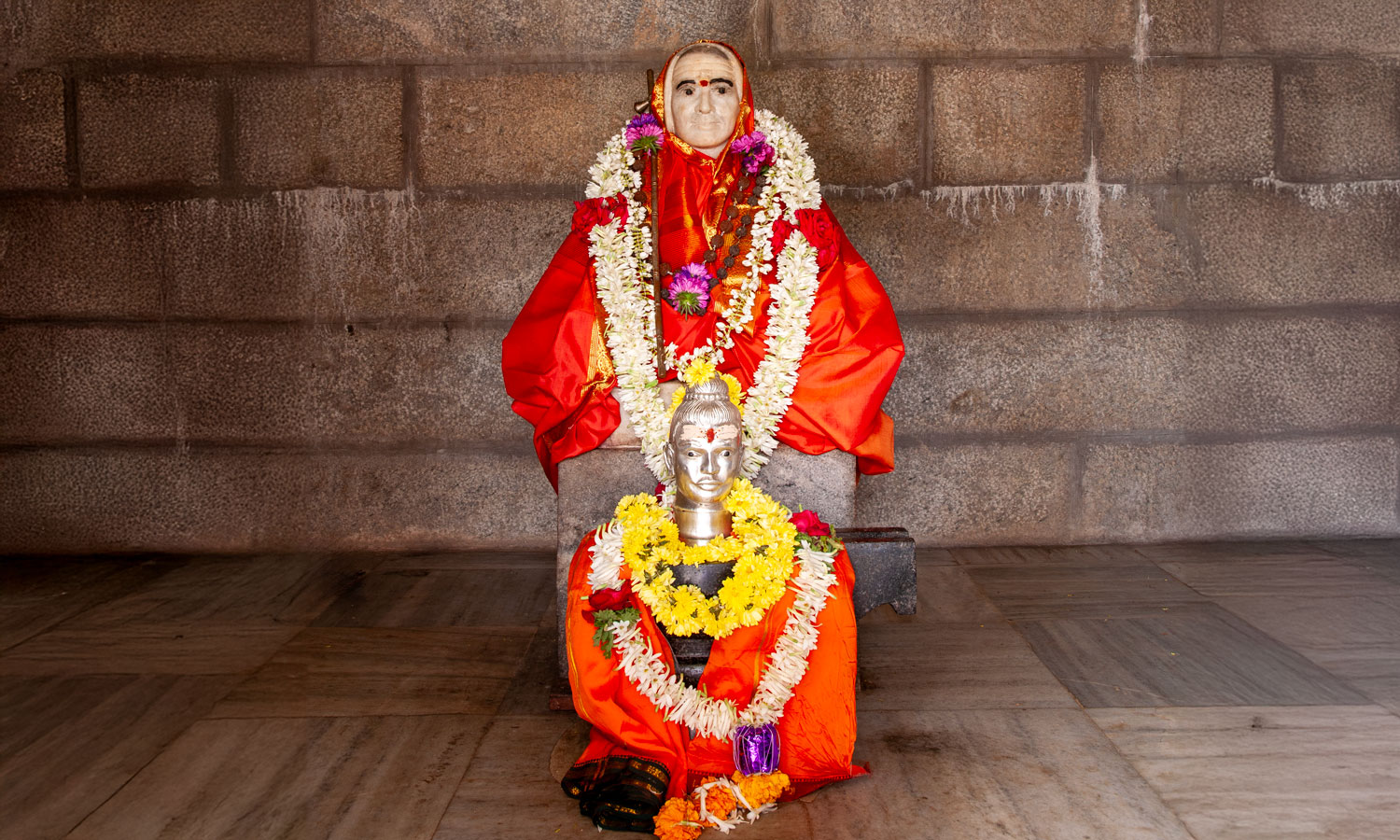
विश्वं मायामयत्वेन रूपितं यत्प्रबोधतः ।
विश्वं च यत्स्वरूपं तं वार्तिकाचार्यमाश्रये ॥
A lucid gloss He wrote upon the Truth, that the illusion which pervades the world;
Is embedded nowhere but in the mind, Sureshwaracharya, Him I salute!
First Jagadguru of the Dakshinamnaya Sringeri Sharada Peetham
Sri Sureshwaracharya holds the distinguished position as the first Peethadhipati (pontiff) of Dakshinamnaya Sringeri Sharada Peetham, the renowned centre of learning established by Sri Shankara Bhagavatpada. A philosopher of exceptional caliber and a scholar of profound depth, Sri Sureshwaracharya made enduring contributions to the Advaita Vedanta philosophy that continue to illuminate spiritual seekers to this day.
Contribution to Advaita Vedanta
While His Guru, Sri Shankara Bhagavatpada, articulated the core principles of Advaita, Sri Sureshwaracharya fortified this philosophical tradition by:
- Refining and clarifying its fundamental principles
- Addressing potential misinterpretations of His Guru's works
- Producing authoritative commentaries that stand as masterpieces of philosophical literature
- Establishing a lineage of scholarship that continues unbroken to this day
The Path to Enlightenment: From Mandana Mishra to Sureshwaracharya
The Vedic Tradition
Vedic wisdom manifests through two complementary philosophical systems:
- Poorva Mimamsa: Focused on ritual traditions and proper interpretation of Vedic injunctions
- Uttara Mimamsa (Vedanta): Concerned with the ultimate spiritual truths and liberation
While both systems revere the Vedas as the supreme authority, they differed significantly in their approach to spirituality and the nature of the Divine.
Sri Kumarila Bhatta & the Quest for Mandana Mishra
In His divine mission to reestablish the Vedas and proclaim Vedanta as their ultimate teaching, Sri Shankara Bhagavatpada sought an audience with Sri Kumarila Bhatta, the most renowned master of Poorva Mimamsa. Sri Shankaracharya wanted the erudite Sri Bhatta to review His Brahmasutra Bhashya and write a vartika (critical gloss) for the same. When He arrived at Prayag, He found the great scholar engaged in the act of self-immolation as an expiatory ritual for past sins1., Sri Kumarila Bhatta, who was deeply overjoyed to realise his long-cherished wish of the Acharya’s Darshan, recognized the significance of Sri Shankaracharya's mission and directed the Acharya to meet His most distinguished disciple.
"Go to Mahishmati," Kumarila Bhatta instructed the Acharya, "and there you will find Mandana Mishra, the dearest among my disciples and a master of all branches of learning. If you can defeat him in philosophical debate, the superiority of Advaita will be revealed to the world." Having received the blessing and counsel of His revered contemporary, Sri Bhagavatpada accepted this momentous challenge.
What followed was extraordinary in the annals of spiritual history. Rather than waiting for a seeker to approach Him with devotion and service—the traditional path of disciple to guru—it was Sri Shankara Himself who embarked on the journey to Mahishmati, traveling in search of the one who was destined to become His disciple.
Mahishmati stood as a jewel within the vast Magadha empire, which stretched far beyond its capital at Pataliputra. When Sri Bhagavatpada arrived with His followers, the townspeople eagerly described Mandana Mishra's magnificent residence. So great was the scholar's prosperity that his home rivaled the splendor of a royal palace, befitting one of such extraordinary learning and accomplishment.
Scholar Extraordinaire & the Divine Couple
Mandana Mishra, whose birth name was Vishwarupa, had earned his honorific title through an unparalleled scholarship that commanded universal reverence. Together with his wife Ubhaya Bharati, they formed an ideal partnership of minds and souls—equals in learning, ethical character, and unwavering devotion to Vedic principles. Such was their spiritual stature that tradition regards Ubhaya Bharati as an incarnation of Saraswati Devi, the Divine Mother of Learning, while Mandana Mishra is revered as an embodiment of Brahma himself.
The Miraculous Entry
When Sri Bhagavatpada reached the palatial mansion, He found its doors securely bolted from within. The ancient Smriti texts, which govern the conduct of traditional sannyasis, strictly forbade entry into closed dwellings. For a moment, the Acharya paused in contemplation. His divine resolve to liberate Mandana Mishra from the confines of rigid ritualism burned bright within Him. Compassion for His destined disciple transcended all conventional restrictions. Drawing upon His yogic mastery as a perfected being, Sri Bhagavatpada employed His supernatural powers and passed effortlessly through the sealed entrance.
The Unwelcome Guest
Mandana Mishra harbored a deep-seated aversion to sannyasis, viewing the renunciate order through the lens of his unwavering ritualism. In his conviction, sannyasa represented nothing more than an escape route for those too weak to embrace the demanding discipline of Vedic ordinances. The timing of Sri Bhagavatpada's mystical appearance could not have been more provocative—Mandana Mishra was conducting a solemn shraddha ceremony, with brahmin guests assembled and the sacred meal about to be served.
The sudden materialization of a saffron-robed sannyasi sent shockwaves through the gathering. Mandana Mishra's fury erupted like a sacred fire disturbed. Sharp words flew between the two titans of learning, each defending their philosophical ground with passionate intensity.
Sensing the volatile situation threatening to spiral beyond control, the assembled brahmins intervened with diplomatic wisdom. They respectfully suggested that Mandana Mishra invite the distinguished visitor to participate in the shraddha by occupying the honored Vishnu Sthana. True to his ritualistic nature and recognizing the sanctity of the ceremony, Mandana Mishra extended the invitation with proper protocol.
Sri Bhagavatpada, however, courteously declined. "I have not come seeking alms," He declared with quiet authority, "but to engage in philosophical discourse."
Mandana Mishra's eyes brightened with intrigue—never before had he encountered a scholar who dared challenge his intellectual supremacy. The prospect of dialectical combat stirred his competitive spirit, and he welcomed the challenge with enthusiasm.
The sacred shraddha resumed its ordained course, while the two great minds agreed to meet in philosophical battle on the following dawn.
The Sacred Contest of Eight Days
As the first rays of sun pierced the morning sky, both scholars completed their respective morning observances—Sri Bhagavatpada following the austere disciplines of sannyasa, while Mandana Mishra performed the elaborate rituals prescribed for the householder's path. When they assembled for their momentous encounter, both disputants turned to Ubhaya Bharati, seeking her consent to serve as judge. Her unparalleled wisdom, absolute impartiality, and supreme scholarship made her the only person capable of following their discourse as it soared to the most sublime philosophical heights.
Understanding the practical demands of overseeing such an intensive debate while managing her household duties, the divine mother devised an ingenious solution. She presented each contestant with a fresh garland of flowers, declaring with authority: "He whose garland withers first shall be deemed the vanquished." To elevate the stakes to their ultimate consequence, both men solemnly agreed that the defeated would abandon His current way of life, embrace the ashrama of the victor, and accept discipleship under Him.
The Transformation Begins
What followed were eight extraordinary days that would reshape the spiritual landscape of India. Two towering intellects, each supremely versed in the ocean of Vedic knowledge, engaged in discourse that continued seamlessly around their daily obligations—ritual observances, meals, rest, and essential duties all woven into the fabric of their philosophical combat.
With each sunrise, subtle changes began manifesting in Mandana Mishra's being. Sri Bhagavatpada's luminous arguments gradually illuminated corners of truth that rigid ritualism had left in shadow. The householder-scholar found His lifelong convictions wavering like flames in wind, while an inexplicable faith in His opponent's wisdom began taking root in His heart.
The Moment of Surrender
On the eighth day, as philosophical dawn broke within Mandana Mishra's consciousness, complete transformation arrived. Sri Bhagavatpada's words rang with divine authority: "Once the veil of ignorance is lifted, the individual soul merges completely with the Supreme Brahman." In that sublime moment, Mandana Mishra perceived the limitations of his dogmatic stance with crystal clarity, while the profound truth of Advaita blazed forth like the sun dispelling darkness.
Glancing down at His chest, He discovered what His heart already knew—His flower garland had withered completely. Overwhelmed by the magnitude of His realization, the great scholar fell prostrate before Sri Bhagavatpada, touching the blessed feet of His new master. In a voice trembling with newfound humility, He pleaded: "O Teacher of the Universe, forgive this humble servant's audacity. For eight days I have dared to oppose you in ignorance. Restrain your righteous displeasure, O Jagadguru, and shower your boundless grace upon me."
Divine Revelation and Sacred Transition
At this climactic moment, Ubhaya Bharati's human form dissolved like morning mist, revealing her true nature as Saraswati Devi, the Divine Mother of all Knowledge. Before departing to her celestial realm, she bestowed upon Sri Bhagavatpada a precious boon: "Wherever you invoke my presence with devotion, there shall I dwell eternally."
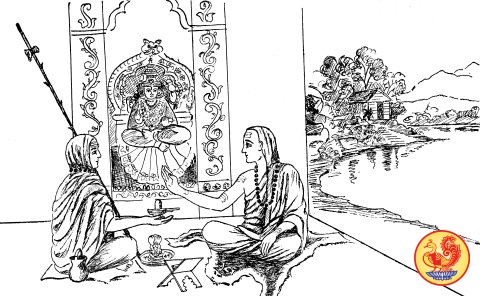
Mandana Mishra's metamorphosis into a sannyasi began with the ultimate act of renunciation. In His final ritual as a householder, He distributed all His vast wealth to the needy, symbolically severing every material bond. Then, in a ceremony both solemn and sublime, He received sannyasa from the hands of Sri Jagadguru Shankara Bhagavatpada Himself.
Birth of a Spiritual Dynasty
The newly initiated monk received the yogic name Sri Sureshwaracharya, marking his rebirth into the highest spiritual order. As Guru and disciple embarked on their sacred journeys across the subcontinent, destiny guided them to the hallowed hills of Sringeri. There, invoking the divine presence of Saraswati Devi as promised, Sri Bhagavatpada established the Dakshinamnaya Sringeri Sharada Peetham—the first and most revered of the four cardinal monasteries that would preserve and propagate Advaita Vedanta for millennia.
In a gesture that crowned their extraordinary relationship, Sri Bhagavatpada installed His transformed disciple as the inaugural head of this sacred institution. Thus was born the lineage of Jagadguru Shankaracharya Sri Sri Sureshwaracharya, a title that would echo through the corridors of spiritual history.
The Scholar's Legacy
Sri Sureshwaracharya's brilliant intellect, now illuminated by Advaitic wisdom, produced literary treasures that remain cornerstones of Vedantic study. His masterful metrical commentaries—the Vartikas—on Sri Bhagavatpada's interpretations of the Taittiriya and Brihadaranyaka Upanishads stand as monuments to His philosophical acumen. His exposition of the Dakshinamurti Stotra, celebrated as the Manasollasa Vartika, reveals the deepest mysteries of the silent teacher.
Perhaps His most influential independent work, the Naishkarmya Siddhi, presents a comprehensive analysis of His guru's fundamental teachings in crystalline clarity. His commentary Balakrida on Yajnavalkya's Smriti demonstrates His continued mastery of traditional scholarship, now elevated by Advaitic understanding.
In the galaxy of Advaitic luminaries, Sri Sureshwaracharya shines as the brightest star after His divine Guru, His transformation from ritualistic householder to enlightened sage serving as eternal testimony to the power of truth over dogma, and wisdom over mere learning.
Footnotes
- The act of treachery towards one’s own Guru – in order to refute the Buddhists, Sri Kumarila Bhatta had disguised himself as a Buddhist monk and attended a Buddhist university to thoroughly understand the Buddhist philosophy. Later he used the same knowledge learnt from his Buddhist teachers to refute and defeat them in debate. To atone for this act of guru-droha (or treachery against one’s Guru), Sri Bhatta decided to immolate himself.
Works of Sri Sureshwaracharya
Sri Sureshwaracharya works expound the philosophy of non-dualism. He explains that Bramhan is the only Reality(Sat) and the substratum of the world. Following is the list of His works.
- Vartika on Taittriya Upanishad Bhashyam
- Vartika on Brihadaranyaka Upanishad Bhashyam
- Mansollasa
- Panchikarana Vartikam
- Naishkarmya Siddhi
Naishkarmya Siddhi
It is well known that the Brahma Sutras, Sri Shankara’s bhashyas and the Vartika are together like the confluence of the Ganga, Yamuna and Sarasvati, and this Triveni removes our sin and emancipates us.
Among the hundreds of Sishyas of Sri Shankara, the four, namely Padmapada, Sureshvara, Totaka and Hastamalaka were the most important, and among these Sureshvara, the Vartikakara, was the foremost.
Sri Shankara who through his instruction was spreading the Advaita Vidya throughout the land, desired that a Vartikam should be composed for his bhashyas, similar to the Mimamsa and Vyakarana Vartikas, and expressed it to his sishyas. Sri Shankara told Sureshvara to write a Vartika on the bhashya of the Brhadaramyaka Upanishad belonging to the Kanvasakha of Sukla Yajus and on the Taittiriya Upanishad bhashya and in addition to write an independent work. Sureshvara wrote the Naishkarmya siddhi which Immensely pleased the Master and then the other two works.
Being a prakarana, Naishkarmya siddhi lays down the Vishaya (topic) its significance, adhikara (qualification) and Correlation(sambhanda). The first adhyaya inquires into the authority of the shruti and lays down that all of them have for their final goal (Parama tatparya), the Brahman. The second chapter correlates the other authorities, the third deals with the disciplines. Shravana, manana etc. and tie fourth and concluding chapter explains Kaivalya or liberation and Jivanmukti. The Vartikakara concludes with adoration to his great Master.
Naishkarmya siddhi, of Sri Sureshvaracharya padah wellknown as Vartikakarapadah, is though comparatively short, an outstanding accomplishment of exceptional importance among the works of the Advaita Vedantins. The other ‘siddhi’ works are. Ista siddhi by Sri Vimuktatman and Advaita siddhi by Sri Madhusudana Saraswati which, like the Naishkarmya Siddhi, closely follow the Bhashyas of Pujya Sri Shankara Bhagavatpadah, and the earliest of these viz Brahmasiddhi by Mandana presumably an elderly contemporary of the Bhashyakara, which differs in certain respects from the view points of the Bhashyas.
Naishkarmya siddhi-the name could be believed to have arisen from the word in the Gita verse-“ Naishkarmyasiddhim paramam sanyasenadhigachhati” rendered in the Bhashya as ‘Naishkarmyam cha tat siddhischa’ or Naishkarmyasiddhi meaning attainment of the state of Actionlessness i. e , Brahman-Atman or the decisive conclusion as to the Actionlessness of Brahman- Atman, the work being called so because of its role in leading to that state -is an independent work (Madhaviya Shankara Vijaya Sarga 13, Sloka 49, and Guruvamsa Kavya, Sarga 2 and Sloka 89) of Sri Sureshvara which has won the appreciation of his Master who initiated him into the Sanyasa asrama after his defeat in controversy. It is a manual of Advaita-Vedanta, in four chapters. in verse, and providing the necessary links between them and the elucidations of their contents given in prose by the author himself, written not for securing fame, return or praiseworthiness but as a measure intended to purify and elevate his own intellect. It establishes the Nishprapancha Brahma, the transcendental Reality unconnected with and unconditioned by the world which itself is shown to be mithya i.e., devoid of fundamental existence. The work, like the Vartikas, revels in Yuktis, upholds the view point of the Bhashyakara and refutes those of others especially of Mandana. A few illustrations are given below.
It is the decision of the Vedantin that whatever ‘appears’ in our parlance is to be regarded as due to Ajnana (Nescience), The question arises as to what are the locus (Asraya) and the object (Vishaya) ignorance. That Brahman is the Vishaya is agreed upon by all without dispute. Mandana and Bhamatikara who follows Mandana in this respect as also in a few other respects, believe that Jiva is the Asraya. Sri Sureshvaracharya, however, maintains that Brahman is the Asraya in accordance with the Bhashya. He is faithfully followed by Samskhepa Sariraka charya.
A second question arises when Maadana, a kind of Jnana karma Samuchchayavadin that he is says that Tattvadarsana Abhyasa (a kind of upasana) as also the performance of Yagnas are to be resorted to till the end of one’s life even if Sabda Jnana has been attained As a corollary it is maintained that a Grihasta has greater chances of gaining Visuddha vidya than a Sanyasin who has renounced even the Nitya and Naimittika Karmas. These views are strongly refuted by Sri Sureshvaracharya, who maintains and supports the view point of the Bhashyakara that in their cause, context and results (means, make up or constitution, fruit) the Karmas turn out to be very different, nay the very opposite of SamyaJnana, and as such, like light and darkness the two cannot co-exist. Nidhidhyasana on this view is only to get rid of Viparitabhasvana. Necessarily, it follows that renunciation of all action is vital for securing Atmajnana. The Nitya and Naimittika karmas are not absolutely useless. They cannot coexist with Jnana. They work themselves out on producing Vividisha. No Jnana karma Samuchchaya is possible. At least only karma Samuchchaya with the karmas as preliminary to jnana.
Regarding Mukti, Sri Sureshvaracharya subscribes to the doctrine of sadyo mukti, release immediately on attaining Jnana. He explains the text ‘Tasya tavadeva chiram’ accordingly and solvely the problem of the Gurusishya parampara by analogy of the dream or by tracing the wholething to the Avidya of the Sishya who regards the Mukta as his Guru etc., though the latter is not aware of anything else except the only abiding Reality viz., Brahmana-Atman. He also mentions the ‘Sampradayika View’ as it is called of the Jivan Mukti and refutes the possibility of Yathestacharana by pointing out its absence even in the Mumukshu. The texts like ‘Na me Matr vadhena’ etc., are only eulogies in praise of Jivanmukti. This view also solves the problem of the Brahma vidya Sampradaya by Gurusishaparampara.
The Mahavakyas such as Aham Brahmasmi are to be understood on the basis of Abheda samanadhikaranyam. This again is faithfully followed in Samkshepa sariraka. However, in the case of Aham Brahmasmi the principle of Badhayam samanadhi karanyam may be employed as well. If the ‘Aham’ buddhi is removed, the duality disappears as the snake (in the rope ) does on the disappearance of darkness.
Thus, the Great Srimat Sureshvaracharyapadah, the expert in pada, Vakya and Pramana, Master of both the Karma Kanda and Jnana Kanda, who is always faitful to the views of his Acharya has, by composing the Nishkarmya siddhi, conferred Anugraha on his Sishyas in every respect.
The official text
Sri Sureshwaracharya
Read the official text