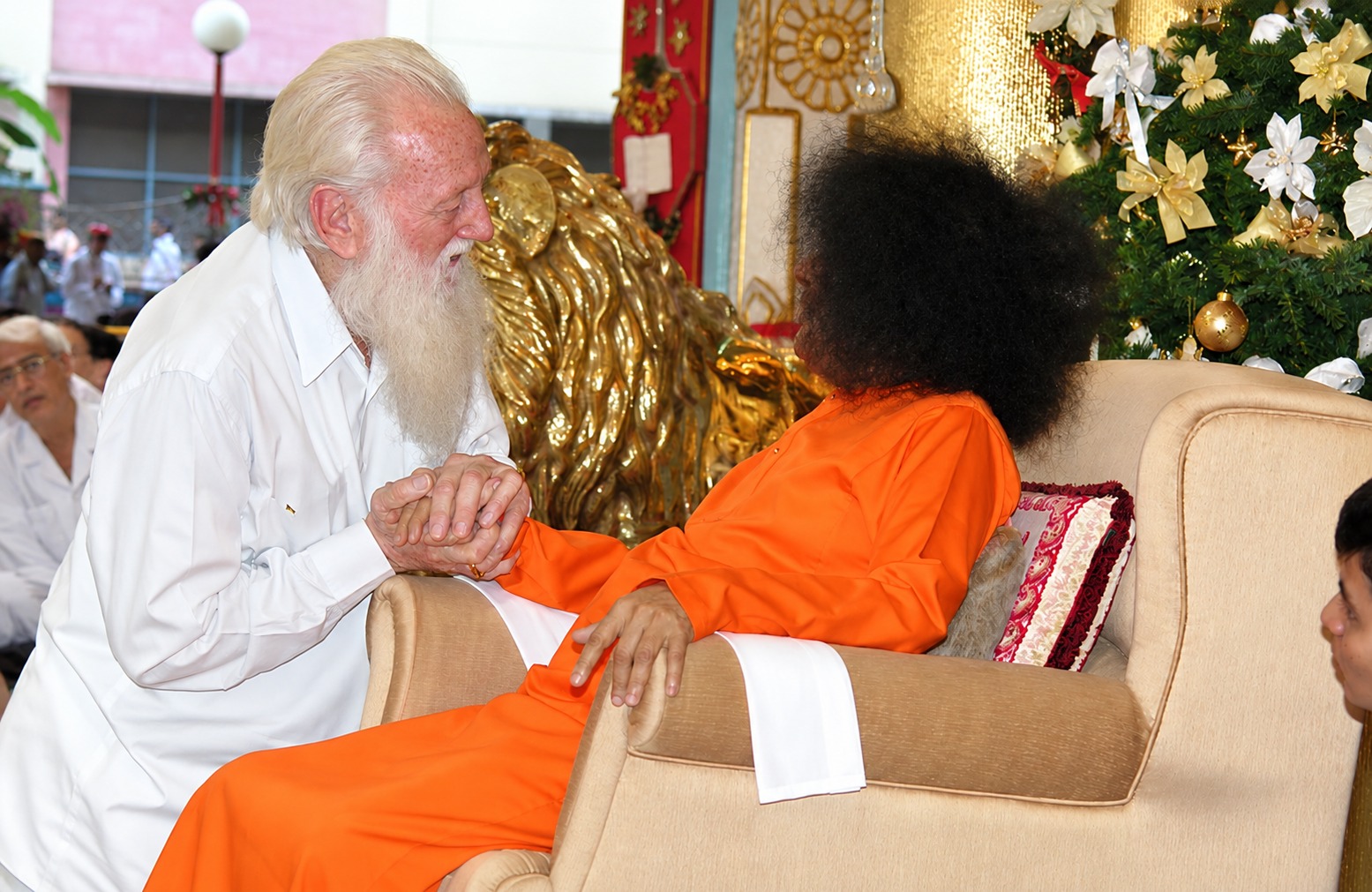
Arthur Hillcoat
18 June 1928 to 13 August 2014
The Maharishi of Mt Tamborine
21 chapters
Bhagavān Śrī Sathya Sai Baba called him the Lion. For thirty-five years Arthur Hillcoat of Queensland told all who came to hear him, in plain words that were pregnant with the Truth, and with much laughter, that only God exists, that the love they were looking for was what they already were, and that everything in their lives, the hard things most of all, had come to bring them home.
He never wrote a book, and he never spoke from notes. What he left is what he said: talks given in halls and Sai centres from Brisbane to Hollywood, from Fiji to Sarajevo, and on Christmas Day before Swami in Prasanthi Nilayam; an interview recorded on the verandah of the ashram; the stories he told over and over because people asked for them again. This life is told in those words. Where he told a story more than once, the tellings are gathered into one. Where he explained a teaching, it is set down as he explained it, with his jokes and his examples.
He would not have wanted it called his life. "So you see all that training," he said once of the long road from a quiet boy who could not speak to two people to a man who addressed thousands, "it doesn't matter what you are or what you haven't got or you don't have abilities. If the Lord wants you to do something he gives you what you need to do it."
1. Where's Grandma Gone?
Arthur Hillcoat was born in Queensland on 18 June 1928, and he was a Queenslander all his life. He grew up there, worked there, raised his family there, and when at last he made a home with Poppy it was on Tamborine Mountain, in the green hills behind the Gold Coast, looking out to the sea.
The first thing he remembered learning about God was that the grown-ups were not telling him the truth. He was ten or eleven when his grandmother died, and he told the story of that day more than seventy years later as if it had happened the week before:
So after the funeral and everything the relatives were all at the house, and so I said to one of them, I said, "Where's Grandma gone?" "Oh," they said, "it's so wonderful, Grandma's gone to heaven, it's so wonderful for her." And that's caused confusion, because if it was so wonderful why were they crying? And I started off in life thinking there's something they're not telling me, something they're hiding from me.
He spent the rest of his life finding out what it was. Much of what he had been taught as a boy he came to call plain mistakes, and he would say so to a hall with a smile:
We were told that we were terrible sinners and not worthy of God, and we were taught that God was up there on cloud nine somewhere watching us with a big stick in his hand waiting to punish us. But this is not true. The God we know is a loving God. There's no punishment.
"It's a case of not of learning anything," he said; "it's a case of unlearning what we've been given in the past which was not the truth."
A boy who wagged school
He never claimed book-learning for himself. "I didn't have a great schooling, very little really," he would tell a hall full of devotees, and then, leaning towards them: "Matter of fact I used to wag school. Don't tell anybody." He added that he did not think he had even finished the sixth grade.
Yet something else was growing in the boy that school had nothing to do with. When he was about fourteen a longing came over him that never went away:
When I was very young; in my teenage years; early teenage years … I had this yearning to speak about God; a very deep yearning. Fortunately no one asked me to; because I wouldn't have known what to say. But the yearning was there.
He looked for God in church, and in more than one church. "I'd go to any church," he said. In one of them he learned a lesson he was still telling decades later:
And there was a fight and I had to order the ice-creams. There was a last meeting and I said: "The soft drinks will be here, and the ice-creams will be here." One lady rather fiercely said to me: "Who did you order the soft drinks from?" It didn't sound too good to me but I said: "Tramackeys" and then she really abused me. "How dare you do that? How can you do this sort of thing?" I said: "What have I done wrong? I don't know, they have the best soft drinks!" She said "That's beside the point; they are Catholics!"
So I stepped back because here one moment they were talking about a loving God; but only for us; not for anyone else. We can never limit God but it limits us if we think that way.
For a time he hoped to become a priest. The hope never left him; it only changed its shape. Once a priest asked him to give the Sunday sermon, and he learned what kind of preacher he was:
The priest asked me whether I would like to do his sermon for it, and it was on religion. I said no, I couldn't do that, but if you want me to speak on spirituality I will. And he said yes.
Asked once whether the love he later found was what he had felt in church, he answered without hesitation: "No, no, it's not the same. The religion is one thing and it's a very important thing, but spiritual is greater."
Cranes and ship repair
He left school for a working life with the Queensland Government on the Brisbane wharves, where he drove the heavy machinery. "When I got a job and everything," he said, "I drove big machinery, big cranes and semi-trailers and everything." Then one day a feeling came over him that would not go away:
But suddenly when I was driving big machinery and everything at the the government, I had a feeling that my life had to change. I had to do something, and I felt it was my, my work I had to change. And so I said to the superintendent there, "I don't want to drive this machinery all my life. If you have a semi clerical job come up, …" And you know, in 3 weeks I had the job.
The new job was costing and reporting on ship repairs in the dry dock. Six months into it, word went round the department that a firm of management consultants was coming in to choose men to train as consultants. He told the rest of it many times, and it never lost its wonder for him:
I said to the young chap I was working with, I said, "You know, Bill, I got a funny feeling I should put in for this." "Oh," he said, "Arthur, this is just to make it look good. They know already who they want. Apart from that, you're too old." I was 39, and I know what he'd say about me now. But anyway I said, "I'm going out for lunch. When I come back I'll make up my mind." But as I walked back into the establishment, the superintendent called me over and he said, "Arthur, I hope you don't mind this, but I put your name in for one of these jobs." You see, I had had to do nothing. It happened.
"I was cheeky enough," he admitted years afterwards, "because I didn't have the education to do that." There were intelligence tests and interviews, and within a fortnight he was a trainee consultant with PA Management Consultants. The training lasted six weeks, and then came his first assignment:
My very first job was to lecture to my previous superiors on the principles of management and the principles of control systems. Frighten the life out of me. You can see my hair went white.
The joke had a truth in it. "At that time," he said, "I couldn't really stand up and talk to two people. I was a quiet boy."
The next big task was harder still. One of the senior consultants, who had made no headway with it himself, asked him to design a new costing and reporting system for ship repair: "We want you to design a new costing reporting system that will instead of shipping companies getting their bill 3 months after the ship goes out of dock." Arthur built a system that would give the superintendent the cost of every job on the ship each day, and a running total, so that the account could be ready within two or three days of the work being finished. It went to the Auditor-General's Department for comment.
So, you see what happened was that the Auditor General's Department sent it back without any changes. And I thought, "Now, how on earth did I do that?"
For a while he thought he had been rather clever. Later he saw it differently, and that turning round is the whole of his teaching in miniature:
Now I thought at that time … I was pretty clever there that I got that … because in my early life I felt that I did this and I did that. Soon after I found that everything just happens.
He worked as a management consultant for the rest of his working life, and in time the boy who had not finished the sixth grade completed a university degree. The work itself became his schooling for what was to come. "What I had to do was to train people to use the systems that I designed," he said. "So, therefore, I was talking more and more to people."
He married and had four children. Like most men of his generation he smoked, and in time he gave it up.
Why me?
Hardship came, and it kept coming. He was frank about how he met it at first:
I went through some heavy parts in my life and I used to look up and say "Lord, why me? Why me again?" And it was as if the Lord was saying: "Why not you? And here's a little more for you!" You know the feeling? Because I was so upset, I was asking the question: "Why me? Why me? Poor me!" you know.
In 1972 his brother died. "I had a brother pass away in 1972 and it knocked me for six," he said, "and I had a bad experience out of it. So I said then I must search all the more. I must find the truth. I must come to see that, because I couldn't go through this again."
He never sought out methods. "I never tried to find techniques," he said. "There's no such thing as a technique; there's only such thing as work. All I ever wanted was the truth."
Later his mother died, and, he said, "it was so much easier." Later again his father, and Arthur was with him at the end, as he had been with all three:
My father opened his eyes and looked up at me and he said, "Not much now." I said, "Oh Pop, I'm so happy for you. This is what you've been waiting for." And he nodded his head and smiled. After a little while a smile come back to his face, and he opened his eyes and looked up, and he went "Oh," and he was gone.
What had changed between his brother's death and his father's? He answered it himself: "simply that I'd come to see the simplicity of life."
The questions had changed too. In the end he stopped asking why it was happening to him, and began to ask what it was all for:
And then one starts to ask "What's the purpose of my existence? What is life all about? Why is there suffering? Why do some seem to suffer more than others? Who am I? Who am I really?" And it's only then that we start to get answers. Then God reaches out a hand to us and then our life begins to unfold with greater understanding.
"It's only then that God takes you by the hand," he said, "and I really mean that, takes you by hand."
2. A Book That Would Not Wait
He first heard the name of Bhagavān Śrī Sathya Sai Baba in 1977, through the teacher Alexander Everett. "I didn't read about him until 79," he said, "but the moment that I read about him, that was all I wanted in my life."
The two years in between he told against himself. Asked once, at Prasanthi Nilayam, how he had come to know about Swami, he began there:
A man was speaking one time and I was listening, and he said you should read the book Sai Baba: The Holy Man and the Psychiatrist. But for two years I dodged … whenever I saw the book I thought, I must get that one day.
Meanwhile in Brisbane a couple named George and Muriel Isted had come back from India in 1977 with Swami in their hearts. Their home became the place where all who wished to know of Swami could come, and in 1978 a friend of theirs from Victoria showed films of Swami there. Arthur was one of those who came to watch.
Early in 1979 the speaker came back, and this time the book came looking for Arthur:
The man was back two years later, which was early … 1979, and … a lady said, "There, Arthur, I have a bookseller friend that's in difficulties financially, and I've bought a lot of books off him, and one of those books is almost shouting at me that I must give it to you." And she gave it to me. It was Sai Baba: The Holy Man … the Psychiatrist. So Swami got tired of waiting for me to to buy the book.
He read it, and he knew:
And I read that, … all I'd ever wanted to say, all I ever felt within myself was there.
"I knew who he was the moment I read," he said. "This is what I want; this is what I've been waiting for." He counted it among the great blessings of his life that, from that day, he never had a doubt. "Matter of fact I've been very blessed in a way," he said, "is that from the very moment that I first read about Sai Baba there's never been a doubt."
Is it you, or my monkey mind?
There was one thing, and only one, that troubled him. He did not doubt who Swami was. He doubted himself. Was this longing to go to India really Swami calling him, or only his own mind? So he asked:
Prior to coming I had uncertainties about whether I should be coming at all, because one starts to be concerned about whether Swami is really calling or whether it's one's mind. And so I just said, "Swami, I'm confused. Please tell me if you really want me to come." And two, two days later I was in another city running a training program, and I went out to buy some lunch. I took my wallet out, and I had a picture of Swami under the plastic in the front, and I opened that up …
What he found was the photograph covered in vibhūti, Swami's sacred ash, with a class of trainees waiting for him:
It's covered in vibhuti. That wasn't easy, because I'm trying to run a training program. … I'd get them busy with something … have another look, and oh, it's still there. So you see, he answered me.
"It's one of those things, you know, you can read about it in books happening to other people," he said, "but when it happens to you, it really blows your mind. How can this happen? How can it finish up in my wallet in my pocket under the plastic on the photograph? Of course, that was enough evidence for me to … go anyway."
Bombay
He set out at the end of October 1979, and he went alone. On the way he did something that showed what kind of seeker he was: he broke his journey in Bombay to sit with a sage. "For me," he said, "it was simply wanting to be with true holy ones, not make-believes."
When I went to Swami first in '79, on the way there, I stopped off in Bombay. And I sat with Nisargadatta Maharaj.
Sri Nisargadatta Maharaj, the great teacher of non-duality, stayed with Arthur all his life. "He was quite volatile," Arthur remembered with affection, and he told how, even when the sage was dying of cancer of the throat, someone said something that roused him, "and he propped himself up, and he started thumping the bed. 'All the time you've been coming here, and still you don't understand. I am the pain.'"
One exchange of Nisargadatta's became one of the stories Arthur told most often. A man was telling the sage of everything he had achieved:
The man was telling him of all his achievements: "Oh yes, Swami, I have done this and I've achieved that, and … I've been successful in this," and everything. And eventually the old saint said to him, "Oh, you've achieved all that," and the man's attitude was as if to say, "Oh yes, … here's a couple more I forgot." And so the old saint sat there for a little while and he said, "Tell me, what part did you play in your own conception?" Man was a little stunned and looked at him and said, "I didn't play any part in that, Swami." "Oh, then what part did you play in looking after that little form between conception and birth?" "I didn't have anything to do with that either, Swami." "Ahuh. And what part did you play in choosing the environment into which you were born?" "No part, Swami." "What part did you play in choosing your own parents?" "No part, Swami." "Can you guarantee that 10 minutes from now you'll still be alive?" "No, Swami." The old saint smiled and said, "And still you think that you can make things happen."
Then he went on, south, to Prasanthi Nilayam.
3. Five Weeks, 1979
"It wasn't an easy journey," he said of that first visit, "because I came alone, and a cultural shock, different things happened, food wasn't quite right for me, so I went through some difficulties. But Swami took me to the bottom in all ways, but he was always there then to pick me back up again."
Asked how Swami had taken him to the bottom, he began with the flight out of Australia:
Well, I'll tell you. It started from the moment I left home. On the plane, empty seats right around me … but that was okay. But it was leaving family, going on a journey that I didn't know how it would turn out, and so I was feeling sad in one way. And in the middle of that, and as we flew over Australia, a young boy of about eight, dark skin, came and touched me on the leg and said hello. And I said hello to him, and he stood watching me, and he said, "Have you left any children at home?" And he must have seen the reaction in me, you see, and he said, "Wait," and he ran away, and he came back with a drink. "Drink this."
The interviewer asked who the little boy was. Arthur only laughed and went on:
He gave me the drink and then he went away. A little while after he was back, and he had a parcel … something for children, and he said, "When you return home, take these to your children." I never saw him on the flight again.
"I sat there," he said, "tears flowing."
Three mornings
At Prasanthi Nilayam in those days, he remembered, Swami was with the people constantly. "They would talk to you almost every day," he said. "You could give letters, … you can have things blessed, and he was just a joy." But the man who had longed for this for two years found that he could not lift his eyes to it, until the third morning, when Swami turned and asked him where he was from:
And with this tremendous love, and … the fear … how I could answer, how can I reply to the divinity itself … And Swami made it easy for me. He came, and I've been sitting in my room that morning thinking, "Oh, if only Swami would send me home." … As he would come I'd drop my eyes and watch his feet go by, and when he'd gone … look up. But on the third day, when I was saying, "Swami, send me home," the same thing happened, except that as soon as I looked up again he turned round … "Australia, Swami." He looked at me for a little while, then he said, "Are you … a little longer?" And of course I melted. I said, "Yes, Swami." And he placed his hand on my head and said, "That is very good. I will see you." And … he walked away, left me sitting there sobbing.
What could make a grown man sob? He had been loved before, he said, by loving people. "I felt love, but I've never ever felt that divine love until I come to Swami." Pressed to describe it, he would not try:
It is a love beyond anything you've ever experienced before. There are no words to explain that. You can only feel that and know it.
The tear of Shiva
The touch on the head was the beginning of the agony. "When he had touched me on the head out on the line that afternoon," he said, "I had dysentery … I really had a clean-out, you know, for three days." Then came the interview:
After 10 days Swami gave me an interview, and so I went in, and he was talking to a number of people. Then he looked at me and he said, "How was your health?" … I said, struggling to say something, and I said, "Fairly well, Swami." "Oh," he said, "not so good, not so good. I'll give you something to improve your health." And he spun his hand and he materialized a rudraksha, and because of tears in the eyes I thought it might have been a pill. … And he said, "Place this in water every day and drink the water," which I did.
"The tear of Shiva," he called it. "I think it's hidden away here somewhere." He did as he was told, faithfully, and grew worse:
I knew that drinking this water was doing something to me, but because he told me to do it, there's no way that I could stop. And so gradually I went downhill, and I have developed a very bad cough. There was a man in the room with me, and he said, "Were you ever a smoker?" And I said, "Yes, I used to be years ago, but I don't smoke anymore." He said, "You may have been due to have lung cancer, and … might be getting rid of that for you." But I wasn't terribly interested in that. I was too sick.
Swami's birthday was coming, and the foreigners had been put up in the new girls' hostel, then still being built, "the first floor was there and so we were sleeping in there." There the illness grew worse:
The doctor gave me some medicine, and the complaint seemed to thrive on it. It got worse, and so to the point that I'd collapsed … and I couldn't get up or do anything. … They got a doctor for me, and the doctor came, … another prescription, … but it was the same stuff that I had before, which wasn't doing me any good at all. But as two men took them up to the ashram to have it dispensed, another doctor stopped those two men and said, "Don't have that prescription filled." He said, "The Swami has sent for me and told me to go to this man twice a day."
The treatment, he said, was the strangest he ever received:
He was scratching in a bag, pulled a paper bag out, "and have one of these," scratch around again, "have one of these too, and have a sip out of this bottle." … But he, he patted me. He said, "You were not to worry. Swami has sent me, and we are going to make you … for his birthday." And that was four days away. Within a number of hours I knew I was getting better.
The next day he could take a shower. He found a little shop in the village that sold rolled oats, and had some porridge. Then came the birthday:
On the birthday I, very fragile, but I managed to get up there, and as I was coming to the … hall, I'm thinking to myself, "But no way I can sit on the floor." And as I got to the hall a man came out and said, "Come, there's a chair here." … Everything, everything was taken care of.
Never again
Years later he summed up the whole of that first visit in a single phrase: "five weeks of mental, emotional and physical agony." When it was over he made a vow:
When I left the ashram, and the agent said to me, "We'll see you again," I said, "No, no, I'll never be back." … Course, Swami must have been sitting back laughing about it.
Swami had not finished with him. The day Arthur left for Bangalore to fly home, Swami came to Bangalore too, and Arthur went out to see Him:
So I went out there to see him and I had a couple of complaints at the time but he called me for an interview. And he told me, don't worry, everything will pass. It'll be all right. And I wanted to ask about my son with his studies, but I couldn't get it out. Because the enormity of the love that was coming from him, I just had tears. I couldn't talk. But he answered the question I was thinking about anyway.
"He will do all right," Swami said of the boy; "I'm looking after him." And, Arthur said, "it certainly worked out. He was looking after him."
He returned, of course, again and again, for more than thirty years, and he came to see that first visit as a gift. "It was a really a beautiful introduction to Swami," he said, "because after that, when I, I came back naturally, and after that I had many experiences with Swami."
For years, though, he could not be near Swami without weeping, and he told how that ended:
For many years it was like that. Whenever I was with Swami the tears would just flow, until one time in my mind I said, "Swami, please, just for once let me speak to you or look at you without tears." … I just wanted to enjoy it and not have to look through tears. And so he walked past about six feet, then he turned around, and he just stood there looking straight into my eyes, and the more he looked the more my smile widened … thought I'd have to move my ears back, you know. And it was such a wonderful experience.
"These things dig at your heart," he said, "and it goes beyond all understanding."
4. Films, Groups and the Repair Shop
He came home from India in the closing weeks of 1979 with nothing but a love he could not explain and a body that had been through five weeks of trial, and he set to work. He bought films of Swami from America and travelled with them, showing them up and down the coast and inland from northern New South Wales all the way to Cairns. After one screening in Townsville in August 1980 a group formed there to sing bhajans every Monday evening, and others grew up in the same way. In 1980 the Brisbane devotees reached out to the Indian community in the city and began singing with them on the last Sunday of each month, and by mid-1982 they were holding bhajans at Clontarf Beach as well.
The groups
He began, too, to take people to India himself. For years he led groups of Australians to Prasanthi Nilayam, and he never forgot what Swami said to the very first of them. Long afterwards he asked a hall of devotees a question none of them could answer, which was why they had gone to Swami at all, and then answered it for them:
Well, I've got to tell you anyway: you went to Swami because he called you. It's as simple as that. There are many reasons that people give, you know: went there because of illness, or went there because I lost my job, or I was unhappy, or all sorts of reasons. But in truth he called you.
One time he said in an interview, matter of fact it was the first group that I took … and … looked around at them. "Oh," he said, "I'm so new to all of you, but you are all old friends of mine." How beautiful. And that applies to all of us.
To every group he gave the same advice before they ever reached the ashram:
I was always telling the groups that I had brought over here: don't worry, yearn for an interview with Swami, but if you don't get one, just accept that. Don't spoil your trip by getting all agitated and worried about it.
One of those groups, in the early 1980s, included a family from the Gold Coast: Poppy, her husband John, who was gravely ill, and their children. Arthur was the group leader. That was how he and Poppy met. Poppy had her own story of that first pilgrimage; what began on it was a friendship between Arthur and the whole family.
The Brisbane Centre
In May 1983 the Brisbane group was affiliated with the World Council of the Sathya Sai Organisation and became the Central Brisbane Centre. Arthur was its first Chair, and Poppy came to work beside him as its Secretary.
They wanted to serve, and at first they did not know how. He told the story years later as a confession, and the room laughed with him:
I can remember back many years ago when we started to do … and we didn't know where to start. Well, had no idea. And so eventually we decided that we would see what we could do for the patients of the Blue Nursing Service: … bring them into the center, give them afternoon tea, and to sing song, and everything else, and the companionship. … And so we went ahead, and we didn't tell them who we were. But for 2 years, and each … once a month we would go out and bring people in, and we thought we were doing well. But once a month, once a month, that's all we did, and we thought we were doing marvelous things. And then of course we heard about what they were doing in Malaysia, and how much effort they were making over there, and we found out that we were doing, doing nothing.
The interesting thing was that the lady from the Blue Nursing Service, and her husband was the minister, she came there once when we were having a Christmas party for them, and then she talked about us being … so we had hid for two years, but she dropped the plot, you know.
The lesson he drew was the one he drew from everything: "We have to make effort, and continue to make effort, until we understand Swami's teachings, and we be of service to everybody."
The repair shop
For a few years, he said, Swami gave him everything: interviews, blessings, closeness. Then in 1983 he learned something about himself. He called it the repair shop, and he liked to tell it precisely because it did him no credit:
And after that I had many experiences with Swami, and it was going, it seemed to be giving me everything, until 1983. And then I found out that there was such a thing as a repair shop. I like to tell this story, because it makes us think about what we're doing.
So on this occasion I had a group of 32, and Swami called us for an interview. Up we went …
They went up onto the verandah and sat, and Swami came back along it from darshan:
And as he come past me he looked at me and he said, "Not your group. I'll see your group later." And that's where the confusion came in, because we were the only group there. And what made it more confusing, that Swami then turned to the men in the group and said, "Go in." So then he worked towards the ladies of the group. So the men got up. I got up too. Immediately turned around, he said, "Not you." I didn't know what was happening, but fortunately the ladies got onto him and told him that … I belong, you see. And he looked at them, and looked at me, and looked back at them again, and said, "Is he …" I'd taken the group there. So then he said, "Go in." So I went in, sat down, and no, no, no sooner sat down in the interview room than Swami looked in the door: "Not you. Come out." Well, you can imagine how I was feeling by then. It was a state of stress. So I got up, and I was coming out, and I was just to the door, and then he said, "No, no, no, no, sit down, sit down."
So I can't remember much of that interview at all, because I was buzzing. … For 24 hours I was in the repair shop. I could think of nothing, I could talk to nobody, except "Why? Why is it so? It's for my benefit, but why is it so?" At the end of 24 hours it came, and everything was lifted, and … the workshop was finished.
What had come to him was the reason:
You see what had happened: at the moment Swami said "interview," I thought of my previous interview. … Sat beside Swami, and he would be talking, and he'd keep rubbing me down the back of the head. Occasionally he'd turn to me and say, "Isn't it, sir?" and I'd say, "Yes, Swami," and put the head a little closer, you know. And so it was magnificent. Now there's nothing wrong with yearning to sit near Swami. There's nothing wrong with yearning to have him stroke you down the head. But if you're a group leader, what is wrong, that you place yourself ahead of others in the group. Because I wanted to get right beside the chair again, so as I could be right next to Swami. So even when I did get there, he looked in and said, "Not you. Come out," and brought me to the very back of the room and set me down there.
"That's a very good lesson to remember," he said, "particularly if you're playing a leading role: that you must never place yourself first. You must think of others."
5. Eight Words and a Heart Attack
In 1985 something was given to him that he carried for the rest of his life. He never said who gave it, or how; only what it was, and that it was enough:
Something was given to me back in 1985: eight words. If you think about them, the whole truth is in them. All action is God. All reaction is man.
Everything he taught in the thirty years that followed was an unfolding of those eight words. They were tested almost at once.
Four o'clock in the morning
In 1986, at four o'clock one morning, he woke with a pain he would describe for the rest of his life:
But in 1986, at 4:00 in the morning, I woke up with terrible pains across the chest, down both arms, with a feeling that I was going to burst. And eventually I rang a doctor, because it became so serious. While I was waiting for the doctor to come it got even worse again, and I really expected that I was going to burst wide open.
"It was a frightening thing," he said, "because it felt as if the body is going to explode and I would splatter all around the room; you know that sort of a feeling." And then the mind had its say:
As I reached for the vibhuti, monkey mind is always there to challenge things. So as I picked up this vibhuti, monkey mind says: "I wonder if this is as good as the real stuff." Because you see, this came off of a photo in Malaysia. But I continued to do what I was doing; regardless of the mind, and I put that in my mouth and boom! All pain stopped! Immediately! Totally gone!
"The moment it hit my mouth all pain was gone," he said. "It was as if someone had just cut it off with a knife."
Then the comedy began:
The doctor arrived and asked: "So who is the patient?" I said: "I am!" He said: "What's wrong?" I said: "I am okay." He said: "You wouldn't ring me at this hour in the morning unless you had a good reason; tell me about it." So I explained it to him and he said: "You must go to the hospital immediately; you've had a massive heart attack!" And I said: "But I am okay!" He said: "I will not leave the house until you agree to go!"
Arthur offered to have one of his daughters drive him. "No, no," said the doctor; "it must be in the heart ambulance!"
The heart ambulance arrived and they rushed in with their kick start gear and everything else. And they said: "Who's the patient?" – since I was walking around the house! I said: "I am!" They dropped everything and actually picked me up and carried me to a chair! And while one was checking me out, the other one was trying to sell me a very bad program: "No longer can you do the things that you used to do. Once this has happened to you, you must change your way of life. You've got to go very quietly now; be very careful!" So I listened to them all the way to the hospital. When I got there; there was a young Chinese doctor - very nice young man – and he checked the ECG. He said: "Everything's alright. I can't find anything wrong."
"I never ever did find anything wrong," he said, "never had the problem since."
He did not tell the story for the drama of it. He told it for what it showed:
So you see Sai is there. Sai is within oneself. At least that which is expressing itself through Sai is within oneself. And if one asks - with faith - the Lord will look after you.
And he told it with the old Indian story he loved, of the devotee who called and called for Krishna:
Most of you would know the story of Krishna when someone was calling Him: "Krishna! Krishna! I need You!" For four days! And finally Krishna turned up and the chap spoke harshly to Him: "What's taken you so long?" And He said: "You had placed me so far away from you that it took so long for me to get here." We don't have to do that, do we? Because we know that the formless God is within oneself.
Twenty years later, asked how Swami had changed his life, he came back to that morning. "I went through a major heart attack," he said, "but when I took his … the sacred ash, everything stopped, and the doctors then could find nothing wrong with me. So the enormity of that was beyond expression. How can you say anything about it except tell a story? And the story limits what really happened."
Sticks and stones
That same year Swami gave him a new charge. When the Sathya Sai Organisation of Australia was given a Central Council of its own, Arthur was chosen as its first Chairman, and from 1986 to 1990 he worked to draw the centres and groups across the country, each of which had grown up in its own way, into one family, with his old friend Howard Murphet beside him as adviser.
Not everyone welcomed him. Many years later, at home on Tamborine Mountain, he told some young visitors how two men had come to him with a bag of stones, ready to throw them, when Swami named him to lead the work in Australia, and how Swami had told him not to be afraid, to do his job, and that He would take care of everything. Poppy, listening, added that every time those two tried to bring in something to quarrel over, Arthur went from place to place saying "Love and Peace".
What an organisation is for
Arthur never mistook the organisation for the purpose. He had seen its committees and its quarrels from the inside, and he spoke about them with a frankness that made people laugh and then think. "Why is it that we get upset with things?" he would ask:
Why do we find even in our own organization there are arguments, and there are differences, and there are frictions, and everything else? I often say that our organization is there for our benefit, to bring these opportunities to us, to lead us back to …
Years later he said the same, and went further:
Now Swami doesn't need us. He doesn't really need the organization, but the organization is here for us, to give us an opportunity to grow and learn. And when I say to grow, to come to understand. When Swami says "Love all," for instance, do we find that easy to do? Can you love everybody? It's not easy … but we have to understand that if you understand that the other person is your very … it makes it easier.
The test of a leader, he knew from his own repair shop, was simple: never put yourself first. The test of an organisation was simpler still. He gave it in an image he loved and returned to all his life:
If only we could be like the mango tree. The mango tree doesn't say, "He's Fred coming up the road, he's a nice chap, he can have a mango. Here's Henry coming, he's not so good, he doesn't get one." See, the mango tree is there for everybody. We need to be the same way. We need to be available to anybody, to help, to be of service, to be a friend.
6. The Love of a Thousand Mothers
Of all the stories he told, this was the one people asked for most, and the one he could least tell without tears. He told it for the rest of his life, and each telling kept something the others let fall.
He had carried a hernia for about ten years. In December 1987, the day he arrived at the ashram, it strangulated.
When I got into the ashram, it became strangulated. … And for about 7 days, I put up with it.
Then it grew worse:
An Australian doctor here was looking at me, and in the finish he said, "I'm worried about you with this." He said, "You'll have gangrene." He said, "Stay on your bed. Don't even get off it." So I did for another three days, but it was getting worse.
He turned to Howard Murphet, the senior Australian devotee who sat with him on the Central Council, and asked him to put the question to Swami in the morning: should Arthur go to Bangalore for an operation? Howard came back from darshan full of joy:
And when Howard came back down later in the morning, I said, "What did Swami say?" He said, "Arthur, it's the most beautiful time I've ever had with Swami. He was so beautiful, and he held my hand, and I told him what was wrong, and he said, 'Yes, I know. But I am looking after him.'"
Swami had told Howard the trouble had already turned bad. "But he said to Howard," Arthur went on, "'But you must not worry about him. I'm looking after him. I will take care of him.'" He was to be brought up that afternoon in a wheelchair.
Three white tablets
So they took me up, and the interesting thing was of course the wheelchair they brought had no footrest, which is a bit difficult with that sort of a complaint.
"So I had to hold my legs up in the air all the way up," he said. They put him on the verandah. Swami gave darshan, and called a group of Chinese devotees into the interview room. Then He turned:
Then he beckoned for them to wheel me forward. When I got to him he struck me on the leg, the leg, and then took my hand, said, "Stand up, go inside." So went in and slid down the wall, sat on the floor. So when he came in he looked at me and he said, "You've got pain." But being a big Australian, you know, I said, "It's all right, Swami." He looked again and he said, "You've got pain," and I said, "Yes, Swami." So pulled his sleeve up, turned his hand like that, bang, and three pills, three long white pills fell from his hand into my hand.
The tablets had brand names on them. "None of the doctors or the Indian doctors had any idea what they were," he said; "I just say they came from Swami's pharmacy." Swami told him to take one at once:
He said, "Take one now." … And I took that, and he then took the other two off me and wrapped them in tissue paper and put them in my pocket like I was a little boy and I might lose them. And he said, "One this evening, one tomorrow morning."
"And then it was the mother," he said.
The inner room
Swami spoke to the Chinese group for a while, and then beckoned:
After a while then he beckoned to me, and he said, "Come." So I got up to go into the other room with him, and I went to move quickly, and he said, "No, no, no, no, just slowly." So I went in the other room, and I saw two chairs, and I thought we were going to sit down and he was going to explain to me … what was the problem. However, he wheeled me around and stood me against the wall where the others couldn't see me, and he looked at me and he said, "Very bad hernia." And I said, "Yes, Swami." So away with his hand again, and then when he flipped it over it was covered in a yellow fluid oil.
He massaged the oil into the hernia. "I really can't tell you what that's like," Arthur said. Then Swami went to get a cloth to wipe His hand, and Arthur came to the moment he could hardly speak of:
When he came back he came back as the mother. They say about that it's the love of a thousand mothers, and he just looked into my eyes. Even now it brings tears. But the point is, he'd, while he was looking into my eye as he reached down, he lifted my shirt, he straightened the trousers, tucked the cords in, and put the shirt … down, just like I was a little boy.
Another time he told it in almost the same words: "He came back and just kept looking in my eyes, and while he was looking in my eyes he lifted my shirt up and straightened the trousers and tucked the cords in again, like as if I was a little boy, and then put the shirt down, made sure it was neat."
Back before Christmas
Then he said, "Now you can go to Bangalore and just have a small operation." And so immediately in my mind I thought, "I'm not going to be here for Christmas," because this was on the 18th of December. And as quick as I thought that, he said, "Don't worry, you'll be back for Christmas." He said, "I will make all the arrangements. I will take care of everything."
"Because you could hide nothing from him," he said. "He knows your whole life, he knows your past, your present, your future, every single thing."
Swami did take care of everything, and with a care for proper form that amused Arthur:
And what did he do then? He sent two doctors to see me, to come back to him and tell him what was wrong with me … but you see, Swami is a stickler for protocol. Doctors have a role to play, and he sees that that happens. So they reported back to him.
Within the hour word came: a car would call for him early in the morning and take him to Bangalore, where a devotee doctor would meet him and take him to a hospital. A friend who was staying with them was told to go with him. "So he was my servant, my nurse, my everything," Arthur said, "and it was delightful."
The hospital
The strangest part of it, he said, was what went on inside himself:
We were taken to a private hospital where the surgeon examined me, and we discussed the operation. It was different from anything else I've ever experienced, because it was as if it was happening to someone else and not to me. There was no concern about it, no anxiety, but talking about it as if I was talking for someone.
He told of his conversation with the surgeon with a laugh:
And so I said to the doctor, "What sort of an anesthetic will you be using?" And he said, "Oh," he said, "oh, we've got several types. What would you like?" And I said to him, "I don't know too much about the last one I had was in the back of the hand." "No," he said, "we'll do that." Then I said, "Will you be putting a support in so that doesn't happen again?" "Oh yes, I've been told everything must be taken care of." I said to him, "Well, my friend who had to come with me, is there a nice handy place nearby where he can get food for us?" He said, "I've been told that you must be cared for."
The surgeon's own wife, Arthur discovered, would cook their meals and send them to the hospital. "Everything was taken care of."
The operation was at noon on Sunday the twentieth. "He said it'd be about 45 minutes," Arthur said; "it actually went an hour and a half." The only discomfort he remembered was the bed, with its steel top and very little between it and him: "I had more pain from that than I had from the operation."
On the third morning he told the surgeon he was leaving:
I said to the doctor on that third morning, "Doctor, the car's coming for me today." "Oh no," he says, "far too soon, you can't go yet." And I said, "Well, the arrangements were made before I came in. That's when I'd be going back." "Oh no, far too soon, but I'll take the dressing off and have a look." So he took the dressing off, and he stood there looking at it, and he said, "Oh yes, yes, yes, you're going." And then I had a look. … It was totally healed.
At the Ganesh gate
They drove back that afternoon, Arthur sitting up in the back of one of the little cars, the devotee doctor travelling with them. What happened at the ashram he never forgot:
He insisted on the car coming in on the men's side, coming through the Ganesh gate, down on the men's side. And … Swami came out, and he gradually walked across, and the doctor met him at the gate and gave him a report on what, what had happened. And then he came out the gate and up, and leaned into the back of the car to ask after my health, and it was so beautiful. And he said, "You realize that in your own country with that operation you'd have been in hospital 10 to 15 days."
Swami had been ahead of him all along. While Arthur was still in Bangalore, Swami had told a group in the interview room, as Poppy remembered it, "And Poppy, operation successful. No worry." That was the day before the operation took place.
The day after his return was Christmas Day. "I went and had Christmas dinner with Howard … and Jack Hislop," he said, "so it was a nice time, wasn't it?" The surgeon had written that he must have complete rest for six weeks. "Two weeks after the date of the operation," he said, he was out walking with Poppy. "Now I wasn't running, but we were there walking and doing what we wanted to do. So you see, with Swami anything can happen."
7. The Yogi of Tiruvannamalai
He never stopped seeking the truth, and the search took him to other holy ones besides. One of them lived at Tiruvannamalai, beneath the hill of Arunachala: Yogi Ramsuratkumar.
Call my name
Arthur sat with him in silence, and the Yogi made him a promise: whenever Arthur needed help, he had only to call his name, and the Father Himself would come.
A few months after that visit, back home in Queensland, the promise was put to the test. He had been enquiring for years, and he came to a place where it seemed he could go no further. Then he remembered what the Yogi had told him, and he called on his name:
A few days later some friends asked him to come with them to look at a piece of land they hoped to buy, and he went with them, sitting in the front beside the driver. As they drew near the land, without any effort of his own, his attention sank into the Heart. The tears ran down his face, and he remembered the Yogi's promise.
When his path next led him to Tiruvannamalai and he was blessed to sit once more before Yogi Ramsuratkumar, the gratitude that had filled his heart since that drive in Queensland poured out as a poem:
Yogi Ramsuratkumar
I Travelled From Australia
Indeed I’d Travelled Far
When Came Across A Holy Man
Yogi Ram Surat Kumar
Sat With Him In Silence
Felt A Love Within So Strong
For At Last I Was Before Him
And I Had Waited Long.
Several Times I Had His Blessings
The God Within Me Stirred
An Initiation Into Silence
Spontaneously Occurred.
He Said “When You Have A Problem
From Which You Feel You May Succumb
You Have But To Call My Name But Once
And The Father Himself Will Come”.
In Later Weeks When Troubles Came
And Which I Felt I Could Not Bear
I Called Upon The Yogi’s Name
In A Moment – I Was In Father’s Care.
I Give My Thanks Most Everyday
To Be Given So Much Grace
And When E’er I Sit And Close My Eyes
I See The Yogi’s Saintly Face.
I Have So Often Wondered Why That I
Should Have Been Brought From So Afar
But I’ll Always Look To Him With Love,
To The Yogi – Ram Surat Kumar.
Decades later, at home on Tamborine Mountain, he was still telling young visitors of Yogi Ramsuratkumar's "promise of helping him once when he needs an answer, which eventually happened."
A man in the rock
He spoke of the Yogi ever afterwards with great tenderness:
He played a role of a beggar for quite a number of years until they found out he was no beggar at all he was a sage … from Arunachala and we sat with him on numerous occasions and he was so loving but he would not accept that he could do anything
But he could, and Arthur saw it:
But one of the things he did suddenly he jumped up and he had two men with him he said come. And they ran over to a lake or something that was there, and there were a few people there. And they'd been trying to get a chap out of the water for about two hours. And they couldn't. He'd gone into the water, and his foot had slipped into a crevice. And they couldn't get him out.
And so he said to one man, you stand there and don't move. And he said, you stand there and don't you move. He went to the edge and he said to the man it's all right now you'll be out in ten minutes. Ten minutes went by and the man's foot slipped out of the rock.
"He was so beautiful," Arthur said.
The poem in the Yogi's house
The Yogi kept the poem. On the evening of Thursday 12 May 1988, a professor from Chennai who had lately become his disciple sat with him on his verandah in Tiruvannamalai and told him that the Yogi's name had carried him through a crisis. "Yes whenever you are in trouble, just call this beggar's name with faith," the Yogi said. "My Father will rush help to you immediately." Then, as one of the party wrote afterwards, "He got up, went into the house, and brought us a copy of a poem written by Arthur Hillcoat, in which the Australian devotee had mentioned the power of the Yogi's name. He gave it to Professor asking him to keep it with him for some time."
The poem was not forgotten. In November 2013 the young man who had sat with Arthur on Tamborine Mountain went to Tiruvannamalai, and told Ma Devaki at the Yogi's ashram that he had come to know of the Yogi through Arthur Hillcoat. She had seen the beautiful poem Arthur wrote, she told him, and she wanted a message carried to him.
8. The Mahāvatār Sends His Love
Holy men drew him all his life, and he sought them out. "My love to be with Holy Ones," he called it. "So we were fortunate to be with some wonderful holy ones," he said in the last years of his life, and among them was the one he called Babaji, the Baba of Nainital, who sent his message to Swami as the Mahāvatār.
On his early journeys he roamed the north of India, from one holy place to the next, wherever a saint or a sage might be found, and he came back so often that a friend once suggested that he learn Hindi. Arthur warmed to the idea, and then, almost in the same breath, he turned within and asked whether it would bring him one step nearer to realising the Truth. It would not, and he let it go there and then. Ever afterwards he told that small story to the seekers who found their way to him, so that they might see how wholehearted the search must be. The Truth, he would tell them, must be sought as a man would crawl over broken glass to reach it; that is how steadfast the seeking has to be.
Ten o'clock in Nainital
He and Poppy went up into the Himalayas to see Babaji. On the way a tack ran into Arthur's foot, and by the time they reached Nainital it was infected and swollen, and he could hardly walk. A devotee of Babaji's rang him to say that his visitors were coming up to see him but could not get there because of the foot. Babaji said he would come to them at ten o'clock the next morning:
And at ten o'clock they put us into a bigger room and ten o'clock he arrived and with the flourish and looking a little older in the face but his skin was just like a youth so he came but he put his hand around the foot and he said this will give you no more trouble
It was a blessing from God, Babaji told him, something coming out through the extremities.
Years later, at home on Tamborine Mountain, Arthur told a young visitor that the first thing Babaji had said to him was "Arthur, why did we not meet for so long?" and that he did not know what to say. Someone there asked Babaji about Armageddon, and how close it was. "As close as you are to me," Babaji answered. He told the yogis with him that Arthur would be of help to them, and that they should take him with them, and he spoke of the caves where twenty-eight other yogis lived, Jesus among them.
Then he sent Arthur out of his body:
Yes, he touched me and then he turned to Poppy and said he's gone.
"There was no thought, absolutely no thought," Arthur said. "There was nothing except seeing." Then he heard Babaji calling, "Arthur, come back, come back Arthur," and he was not thinking of coming back or staying or anything, and the next minute he was back in the body:
And he said, what did you see? And I said, I had to think about what I'd seen. And I said to him, there were beautiful colored jewels floating by. And he said, they were the seven colored rays. I'd read about these before, but that wasn't what I was after, you see. I was looking for truth.
So Babaji sent him out again, and called him back the same way, and asked what he had seen this time:
And I said, it was as if all the veils of ignorance was parting, and I'd see everything, but his voice came. … so I missed it, but that doesn't matter now.
The cave of Shiva
In the early 1990s he and Poppy went up into the Himalayas to the cave of Patal Bhuvaneshwar. They had heard of it from James Redmond, who had come down to Prasanthi Nilayam for permission to film the Christmas programme and told them what he had seen there. "I said to Poppy, you know, we should go there," Arthur said.
He had imagined walking into a cave and looking around. It was not like that. There was a little opening in the rock, and they went down backwards, the roof was so low, some forty feet down. At the bottom the guides showed them Śeṣa Nāga with his heads spread on the ceiling, a backbone running along the floor, a headless Ganesh with water dripping onto it, a tree with fruit, all in black rock and none of it, they were told, made by man. There was a little square opening called the doorway to mokṣa: "So I just tell people I ran through it ten times." In a tunnel going up into the rock, by a strong torch, they were shown what was said to be an old sage still doing tapas. The wall, when he put his hand against it, was hairy, and water came down from the back of Shiva's head, the Ganges, onto three small liṅgams. Then the puja began, and what happened next frightened him:
… This cave, the abode of Shiva, and as the pundit started chanting and doing the puja, which was very loud, I found myself as if a veil had come up, and I was separate to the others, and I found myself chanting softly in a language that I didn't know. … I've got to stop this, they'll think I've gone crazy, you know. Eventually I did stop it.
But then at the, towards the end of the puja, the prayer, we sat in silence, and then for a westerner a golden Ganesh appeared with its hand in blessing. … And then it slowly faded, and then Lord Shiva appeared, and then Lord Shiva changed to the … the dancing Shiva, and that blew me away. You know, it's a very big experience for a westerner.
He did not know what to make of it. "All I wanted to do was get to Swami and ask him," he said, "if I'd gone crazy." Swami was at Whitefield, and the answer came in front of the students:
So he was in Whitefield, and I would go in at those times with the students, and he called me. He said, "Tell them some of your experiences." And … was my chance, and I said, "Swami, should I tell them about the cave?" He said, "Yes, tell them." And I said, … "Should I tell them the experiences I had there?" "Yes, tell them everything." I said, "Swami, were they real experiences?" … He said that they were real experiences: "Tell them everything."
"It was a big relief to me that Swami said all that," he said. Later a professor from Kerala translated for them part of an old text about the cave, and they read there about everything they had seen in it, written long, long ago. "And that's when we realized what a sacred place it was."
A message for Sai Baba
On Arthur's last journey into the mountains, Babaji gave him a message to carry back:
The last trip up there he said to me, "Arthur, when you see Sai Baba, tell him that the Maha avatar sends his love, and he will speak with you."
He carried it until Christmas. Swami had always looked over the Christmas play on the verandah, but this time He said, "Come inside":
So I went inside, we just stood there, and he read through the thing, the play, and then he said, yes, very happy, very happy, and he just stood there waiting. And so I said to him, Swami, you know my great love for holy ones, true holy ones. He said, yes, I know.
He told Swami he had been with the Baba of Nainital, who had given him a message:
He told me to tell you that the Maha Avatar sent his love, and that you would speak with me. And I swear that his eyes glistened like diamonds, and he looked into forever. And very quietly he said, yes, I will speak with you.
"But it wasn't then," Arthur said:
It was 18 months later and we were in with Swami and he was talking to … and then he suddenly cut it short and he leaned over to me and he said, I will speak with you. I'll speak within you. I will speak through you.
"What can you say?" he said. "I just said yes Swami."
He never saw Babaji again in the body. He saw him sometimes in dreams, he told his young visitor on Tamborine Mountain, and Babaji wrote to him afterwards, asking him to come and join them, though he knew Arthur would not be able to; and still Babaji kept asking.
9. The Lion
Swami gave him his name. Arthur was a big man, with a beard and a great white mane of hair, and when Swami wanted him on the verandah He did not call him Arthur. "He usually calls lion," Arthur said. The name went round the world after him; devotees in every country he visited knew him as the Lion, and Poppy, beside him, became the Lioness.
He told the story of the day Swami showed the students His lion more often than any other, and he never told it the same way twice. On this day, he said, Swami did not call out the name:
But this day he didn't do that. He was talking to the students in the Mandir, and suddenly he stepped out the door, and he looked across at me, and he just went … never said a word. I didn't know what this was about, but I went to him and I said, "Yes, Swami."
"I just went on my knees before …" he said. "'Oh,' he said, and so innocently and sweetly, 'oh, they just wanted to see you.'"
He said: "The boys just want to see you." I said: "See me Swami?" He said: "Yes, they want to see you. Go inside!" and so I stepped inside.
There was a great roar from the students - hilarious; and then I knew that Swami had been up to mischief. When I saw one of the students later I asked: "What was the roar about when I came in?" He said: "Oh, Swami was teasing us." I said: "What do you mean teasing?" He said: "Swami pulled up His sleeve, and started to move His hand and said: 'Would you like to see a lion?' And the students said: 'Yes Swami!' So He called me.
"You see," he said, "our Lord has a beautiful sense of humor and He teases the students and you become a part of it and it's wonderful." And again: "But that doesn't matter. You're with him, and he's speaking with you, and the glory of that was beyond expression."
He used the name to put a hall at ease wherever he went. Once, in Los Angeles, he opened a talk with it: "I heard something mentioned a little while ago about the fact that Swami calls me a 'lion' but I don't want you to have any fears; I am really only a little pussy cat."
The name was so much his that Swami used it in passing. One evening in June 2000, after talking a long while with the students about their hostel, Swami came towards the interview room and noticed the long white beard among the devotees. "Lion," he said, "when did you come?" Arthur went over and lay full length at His feet, and Swami blessed him.
The golden dancer
Swami's teasing found him out again on the night of the sixty-fifth birthday, in November 1990. He told this story often, and it grew funnier with every telling:
We were down here in the Hill View stadium on the sixty fifth birthday and there was a cultural program in the evening. Swami was in the orchestra pit. I was a few feet away from Swami. And the children put on a drama.
And after it was stated that a special dance of Shiva would be demonstrated; and since that was near to my heart, I looked forward to it. And this beautiful lady had come on stage in gold - fully in gold, with long eyelashes and beautiful - and started to dance.
Then I start to get concerned: "What's this young lady doing dancing in front of Swami?" As you know in India, once ladies reach the age of 12, they don't dance any longer in front of all. So I was a bit concerned about it. So I just looked to see if Swami was alright. But there was nothing showing on His face, it was just blank!
"His face was poker face," he said, "not a sign of anything. So I'd watch the dance, it was beautiful, but again I'd look at his face. Nothing showed. This went on all through."
When it was over, Swami walked across quietly towards me and asked: "Have you ever seen that dance before?" I said: "No Swami, but it was very, very beautiful." "Oh yes," He said. There was a twinkle in His eye and He leaned over to me and said: "But that wasn't a girl; that was a boy!"
"I'm never sure anymore," he said. "I never say anything." And another time: "Oh, I've been more careful since then." But the point was not the joke. "Although all those thousands of people that were there," he said, "he was aware of what I was thinking."
The rings
On the first visit Swami had given him a rudrākṣa. Later, in an interview, He gave him a ring, gold, with Aum upon it, and the ring would go only on the finger that wore his wedding ring. "So I said to Poppy you know Swami wants that ring on here," Arthur said, and Poppy moved the wedding ring to another finger. Swami had not finished:
Later I come back and Swami's looking at my hand and he materialized another ring, put it on this finger but I couldn't get it on because this ring was there then, you see. … And so I said to Poppy, oh, I think this wedding ring has to go.
So the wedding ring went, and Swami's second ring took its place. Six months later, at home, as he was getting ready to come back to India, he heard a tinkle, looked down, and the ring was gone. He searched the floor and found no sign of it.
And so, when I came back, I said to Swami, the ring is gone, Swami. And he grabbed my hand and he said, I know, I know, I know. He'd taken it, you see. And he said, never mind. Later, I'll give you another one.
Some eighteen months later, while Swami was talking with Poppy in the interview room, He had a ring in His hand, a diamond, and He put it on Arthur's finger:
And he put that on and he said, whenever you need … I will be there. … And he's been there ever since.
Arthur said that Swami showed Himself in that diamond in different ways, sometimes full face and sometimes from the side, and he would offer to show it to anyone who asked.
What makes you cry
Asked whether it was Swami's words or His presence that mattered more, he would not separate them:
Everything about him … every single thing about him is absolutely wonderful. The love is beyond any expression, and it's that love that makes you cry. I was just out in the village a little while ago, and a man had a problem, and I went to speak to him. There was another man there called out to me, so I, I went to him, and he's crying. I said to him, "What's wrong?" He said, "Swami came past me this morning, and he looked straight into my eyes."
"And I can still cry," Arthur said. "That's it."
Once, without thinking, he went up to Swami and lay full length at His feet:
When I was getting up he said to me, why did you stretch out like that? And I said, because I love you. And oh, he said, and I love you.
The interviewer asked whether the thrill was still there, after twenty-seven years, when Swami came along the verandah and took his letters. "It doesn't," he said, of the thrill ever leaving. "You think that you're strong and right again, but … Swami does something or says something to you, and the tears well up again."
What was his best time with Swami? "I usually say all the time," he said. Once Swami saw him six days in a row, the first three days alone. But the time that suited his search best was the day Swami called him inside with one student:
He spoke a couple of words to us and then he was sort of leaning in his chair and his eyes closed and his face muscles dropped and he was gone and so we sat there and waited for him to come back.
"He was doing something, work," Arthur said. "That was backwards and forwards. He'd come back and say a couple of words and then be gone again." Afterwards, walking back to his room, a lady asked him how the interview had gone, and he could not speak; he would have come quite undone.
He hardly ever asked Swami anything. Only once did he ask whether Swami had any advice for him. "Advice?" said Swami. "What advice? You don't need advice." He took it to mean that all was in Swami's hands, not his. "Everything is done by God totally," he said.
And the interviews? "Many interviews, yes, I have." If he had one more, what would he ask? "I don't have any questions. … Not at all."
10. Poppy
Poppy was born on 8 September 1934. She began her working life in a bank in Melbourne, and later went into partnership running a restaurant in that city. In time she moved north to the Gold Coast in Queensland, an hour south of Brisbane, with her husband John and their children.
Then John fell seriously ill, and was mostly confined to a wheelchair. She told the rest herself, years later, on the verandah at Prasanthi Nilayam:
Well, I knew nothing about Sai Baba at all until a friend had actually lent us a book … by Howard … And … we had illness in the family, so we decided we'd come, because we wanted to have a miracle to happen. And it did happen. So within three months we were here. So I hadn't been to any centers. I knew nothing about India, nothing about Swami other than what I read in the book. So we really came cold turkey, and of course it was a great cultural shock when we arrived, and I thought, "What have I done?"
The book was Howard Murphet's. The group they came with was Arthur's. Her first sight of Swami was a disappointment, and she was honest about it:
Our first visit to Swami was in Whitefield, and he came out and just walked around maybe for five minutes, and then he went. And I thought, "I've come for all these thousands of miles to see him, and he didn't even give … a talk like you would a minister at church." Oh, you know, I expected him to sort of stand up at the pulpit and tell us what was right and what was wrong. And I asked a couple of ladies that were sitting beside me, and they got the giggles. They thought it was really funny, and I became quite angry.
They stayed six weeks. "I don't do things by halves," she said. People told them that Swami never took anyone in a wheelchair into the interview room, and they accepted it, but they went on praying. Then her son had a dream:
My son had a dream the night before, and he said, "Swami's going to take us in for an interview, Mum, but you have to ask." So I was sitting with my daughter in, in the lines, and Swami came by, and Debbie's nudging me and said, "Mum, you have to ask." And I said in a very quiet voice, "Interview, Swami," and he walked on. She said, "You have to say it louder." … So I said, "Interview, Swami." Then he turned around … I said, "Interview, please, …" And he said, "How many?" … He said, "Go." So that was our interview. Was really beautiful. He spoke to all of us, advised us, told us that we would be okay.
They took it to mean John would be healed. He was not. Asked what she thought Swami meant when He told the families of the dying that all would be well, she said: "Well, now I understand that it means that maybe their passing will be okay, that they will go on to a better life."
When John died, Poppy was already well along her own path. She became a mainstay of the Sai group that grew up on the Gold Coast, and in 1983 she joined Arthur in the work of the Brisbane Centre.
"Do you love him?"
In 1990 Swami gave His blessing for Arthur and Poppy to marry. His four children and her two were grown, and the newly-weds were free to work and travel together. Poppy told of the one question Swami ever put to her:
It was actually in an interview, ok, and Swami looked at me, and he said, and that was the only question that he asked, in a group, … not just by ourselves. He said, "Do you love him?" And of course the tears rolled down my face, and I said, "Yes, Swami," and Swami's eyes just rolled around in his head as if to say, "Oh yes, I know." … But it was quite embarrassing to be asked a question like that in front of everyone.
Arthur's version was shorter. Poppy came three years after him, he said: "We weren't married until after that, … you see. And I thought that I was just going to sit on the mountaintop … you know. But … knew I needed somebody to look after me, and he made a wonderful choice. I often say she's my little Greek goddess."
They made their home on a mountaintop after all, on Tamborine Mountain behind the Gold Coast, where the sun came up over the sea. Those who knew them said they were the perfect balance of Shiva and Shakti in human form. "The beautiful part is, you see," Arthur said, "that we travel the world speaking in different countries. We work as a team. One time I used to move about on my own, but now we have the, the wonder of being able to work together like this. It's beautiful, beautiful."
At the gate
The two of them were often the first faces a newcomer saw. One day in 1991 a woman named Wensley Roth, who lived across the border in New South Wales and was recovering from cancer, was driving along a road when she saw a sign over the entrance to a ground: "Sathya Sai Camp". She stopped to ask. She told the story afterwards to Howard Murphet:
The two I spoke to were Arthur and Poppy Hillcoat, who became my friends later. They confirmed that it was a Sathya Sai Baba camp and kindly invited me to join the camp.
She came the next day, heard bhajans for the first time, and heard Arthur speak. They gave her a photograph of Swami seated cross-legged and two of Howard Murphet's books, and in the following year she went to Prasanthi Nilayam herself.
Over the cliff
The mountain road nearly took her:
Some years ago, we would go swimming with disabled people. We live on a mountain top in Queensland, Australia. And the drive up and down is quite steep. We had overseas visitors staying with us at this particular time so Arthur stayed behind to take care of them and I went down to the bottom of the mountain on my own.
On the way home, I did a little shopping and as I was driving up the mountain, I was discussing the events of the morning with the Lord. It was raining lightly. And all of a sudden, the car went into a slide - there must have been some oil on the road. And due to my inexperience, I had the foot on the brake, my hands on the steering wheel and I prayed to Swami: "Swami, please don't leave me now." And over the side of the mountain I went.
The little blue sports car she loved hit a tree and came to rest a little further down at a precarious angle. A passing truck driver called down to ask whether she was all right, and she climbed back up to the road; he slipped on his way down to help her, and they both reached the roadside safely. He radioed his office, and his office rang Arthur:
And the girl said to Arthur: "Your wife's gone over a cliff." It was amazing that he didn't have a heart attack.
But he didn't and he came and picked me up. The car was a complete write-off. The only safe place was where I was sitting. … We went home. I rested for a little while, and then I got up and prepared dinner for our guest. So really Swami was with me all the way.
"No hearing aid"
In the later years Arthur's hearing failed, and Poppy turned it into one of the best stories they told together. She opened their talk in Hollywood with it:
Everybody probably knows Arthur's hard of hearing. And for some years I would say to him, "Let's go and get a hearing aid." But Swami told him, "No hearing aid." So eventually after many years of … we were in an interview and I said to Swami, "Swami, what are we going to do about Arthur's hearing?" And Swami said, "Don't worry. I bless." … That was the end of that story. So 6 months later we were in the interview room again. And again I asked Swami, "Swami, you know, it's not getting any better. Please, can we do something about his hearing?" You notice I said we. I don't know why I said we. But Swami said, "Don't worry. I bless. I bless." 6 months later we were back there again.
And Swami said, "Don't worry. I bless. I bless." And then gave me a big whop on the ear. So now I hear better and his hearing's getting worse. What to do?
"Yeah," said Arthur, "mine's definitely getting better."
Swami joked that it was Arthur's chance to listen within. On their travels Poppy became the one who passed devotees' questions to him, and he began to shorten his own talks to give her time, until she was speaking in her own right beside him. In Hollywood, in the year Swami left His body, it was Poppy who spoke first.
Good girl
Poppy had her own lessons from Swami, and she told one in Hollywood. Swami used to tell her she was a musician who played the guitar:
But I'm not a musician. I've never been a musician and I don't play the guitar. But I think, and I'm quite sure, he was referring to my mind. My mind was always churning over and chattering and didn't stop.
And Swami came in as if he was gliding along the floor, you know, his feet didn't seem to touch the floor at all. And he came and stood in front of me. And he just looked into my eyes. And he just looked and looked and I looked back. There was nothing in my mind. I didn't want to ask him a question. I didn't want anything. … And I was perfectly content to look into those beautiful eyes of his. And then eventually he walked away. And as he walked away he said, "Good girl." So at last that mind of mine had stopped thinking and asking and doing and all that stuff that it does.
That was at a rehearsal in the Poornachandra for one of the Christmas plays, which was where, for many years, the two of them were to be found every December.
Asked how Swami had changed her, she said: "I'm not the same person that I was. … I was very rigid in my way of thinking. There was no, there was only black and white. There was no gray or pinks, and all that's changed." And asked who Arthur was, she called him her husband, and her best teacher.
11. Christmas in Prasanthi Nilayam
At Prasanthi Nilayam, Christmas came to mean Arthur. He organised it, and very often he was the one who spoke before Bhagavān Śrī Sathya Sai Baba on Christmas Day. It began with a message he did not want:
And then later on … 1989, I think it was, Swami sent down word … to our flat. … One of the students came, and he said, "The old lion, the young lion or … one of the three will speak on Christmas." Frightened the life out of me. I mean, I can talk about Swami everywhere, but standing in front of him and talking, you know, that was another trial. But anyway, the point is that I did that, and then for a number of years I spoke every Christmas.
The Christmas Committee
The charge itself came in a single word. "He just came to me," Arthur said, "and all he said was Christmas, and I said, Swami, do you want me to do Christmas? He said yes, and walked off."
He became chairman of the Christmas Committee, and for more than ten years he arranged the celebrations that drew devotees from every country in the world to Prasanthi Nilayam in the last week of December. John Behner, who came after him, remembered how it started:
"When Arthur started as the Christmas Committee chairman there wasn't even a Christmas committee - just Arthur with Swami to guide him. Then Robert Bruce (from America) would help him, and between the two of them they would organise the activities. Arthur, with his loving style of guidance, was able to get the devotees to do their very best. Poppy was always there to help as a sevadal. She knew all the foreign ladies and so she could seat them in an order which did not ruffle feathers."
When an enthusiastic team brought him a drama that was not right for the day, he had a gentle way of saying so: "Tom, my boy, I think we'll do something else."
Swami, he said, never told them how to keep Christmas, "but there were traps." One year a lady came to him and said Swami had told her to get her play ready. The committee had not even met, and he told her so. The next day she was back: Swami had asked her in the lines whether she had started her play. The day after, Swami had asked her son. When the committee met, Arthur told them what had been happening:
I said, this happens to be a trap. Our job is to select the best play, what we think is the best play and take it to Swami then for His blessings.
It was not her play that they chose, and Swami looked at theirs and said He was very happy. Then He walked over to the lines where the lady sat and asked her, "are you getting your play ready?" She said, "Swami, you didn't select our play." "You're an actress," said Swami. "So," said Arthur, "shall I say, stirring the pot."
Others? What others?
One year, as Christmas drew near, Swami stopped beside Arthur and asked how the preparations for the Christmas decorations were progressing. Arthur answered simply, Swami, the others are taking care of it.
Swami's reply came at once: Others? What others?
The words struck him like a thunderbolt. In that instant he realised what Swami meant. There are no others. God alone exists. Those words stayed with him for the rest of his life, and he told the story again and again, so that all who heard it might take it to heart as he had.
The phoenix
On Christmas Day 1998, in front of Swami, he told the gathering how a Prasanthi Christmas came to be. He spoke of it as a resurrection:
Thinking about this wonderful Christmas that we've just had … sent my back, my mind back in time to the previous Christmas, and at this time all that existed of that were the ashes. About 9 days ago Swami gave us permission to have yet another wonderful Christmas, so all we had at that time were the ashes of last Christmas. And so we present Swami with a program for his blessings, and then we all gather together in one of the halls, and we break up into separate groups, the different sections of the program. And it's amazing that every time, all the right people are there for every section of the Christmas program. Nothing is wanting.
We had no dramas at that time when we began, but then in came about 7 or 8, and then we have to go through those and do what we believe to be right and which is the best program for this time, and we then present that to Swami. And then come the head of all the sections, who have to work together and plan what is going to happen. We have a main choir, who we heard yesterday, who are absolutely delightful. We had the children's choir last evening, and those beautiful young children there, within those few days came up to be able to sing so beautifully … and then the play itself took form with the play choir, and then the phoenix rose from the ashes. It is simply like that.
In those few short days we've had this love, this sharing, and to me this Christmas was even a more loving Christmas. And you might have noticed that our dear Lord has been spreading love all over us and around us, because he's reflecting how we are. If we can be loving and work together in harmony, in unity, the love can't stop flowing from the Lord. And that's the way I've seen this Christmas. Each year they're different, but it comes out beautiful because the Lord is here. The Lord is here, and it becomes a beautiful Christmas in spite of all the, all the trials we go on with through that time, wanting this and wanting that. And sometimes we can't have everything, and we have to be innovative and do it in a different way, and that's all a part of the training, all a part of learning to accept life exactly as it comes to us.
The Christmas talks
Year after year he gave his talk just before Swami rose to deliver the Christmas discourse. On Christmas Day 1993 he spoke on how devotees from overseas should conduct themselves during their stay in Prasanthi Nilayam, so that they might take the greatest benefit from coming to the Lotus Feet of Bhagavān. On Christmas Day 1995 he spoke again, and Swami's message that day took up the same thread: practise divine love, not worldly love, search for your own faults, and do not criticise others.
The 1998 talk is the one that survives whole. Having told how the Christmas was made, he turned to what it was for, and he began with Jesus:
Jesus said, "Be ye as little children." Back in the time that Jesus said this, for me I see it that the little child wants for nothing as long as it gets its food and it is hugged and loved. That's all it needs. It doesn't know anything about tomorrow or yesterday. It doesn't know anything about the past or the future. That little child lives right now in the now. This is the way that we have to do it. This is the way we have to see it.
And if I can explain that again in a different term, because it's a different time now to 2,000 years ago, then we might say that we can get great spiritual understanding from watching a video. Because what are we doing when we're looking at the screen? We're watching the picture as it is, right at the moment. We're not sitting there worrying about the bit of tape that has gone by, which we might call the past, and we're not sitting there worrying about the little that has to come, which we might call the future. We're focused on right now.
Swami had said that very morning on the verandah, "All are one," and it took Arthur back to a dawn on Tamborine Mountain:
Swami just said to us this morning on the veranda, "All are one, all are one," and that reminded me very much of an experience that I had a few years ago, when I'd been very ill, and I was recovering from it, and Swami had sent me … and this morning, just before daylight, I was sitting in the sun room, and the sun came up across the sea, and I could see across the hills and everywhere, and the birds were … and flying past, and suddenly what I saw reduced me to tears. And when my wife asked me what was wrong, I said, "Look, look out there. There's the sun, there's the sea, there's the sky, there's the land, the trees, the birds flying, and all is God." … And in that moment I knew.
You see, Swami one time said to us in the interview room, he drew a circle on the wall and said, "How much is that?" I said, "Zero, Swami." And he put one in front, and he said, "How much is it now?" We said, "10, Swami." And he kept, kept adding zeros, and they came up with a million, and he said, "A million dollars, so much money. How much money have you got though, if I take the one away?" "Nothing, Swami." He said, "God is like that." And doesn't that explain it simply?
And what is Swami doing when he tells us these things, when he uses analogies? He's pointing us in a direction, and there is only one direction, as that Jesus said 2,000 years ago: the kingdom of God is within. But we didn't listen, and we've been coming back lifetime after lifetime, being dragged through life complaining all the way. We need to come to a point when the Father himself is here and telling him and telling us that we must discover our own true nature.
Then he asked them what they would do with it:
Now we've had this wonderful time at Christmas. Is that going to be wasted? Do we go away from here now and then we tell everyone when we get home, "Yeah, it was a wonderful time, was beautiful," and that's all there is to it? We should take every little experience that we have here to look within and try and find out what our true nature really is.
He told them the story of the king and the pin, which ended, "There's no free lunch":
You see, we don't get anything for nothing. If we do nothing, we get nothing. We must make the effort ourselves before we can get anything back in return.
We go on and on. Some 2,000 years ago we were told the truth. What have we done? We're very fortunate, because the Father himself has drawn each one of us to him, so that we may, may come to know the truth and come to understand. But we must make that effort. We must make that effort. And why can't we make that a new year resolve, to make that effort? Well, there's a very good reason why. It's because even if we do make it, the world will get in the road once again. The world will get our attention, and we look for our happiness out of the world, and we're looking in the wrong direction. The Lord himself is telling us to look within, and there we will find the truth.
Why can't we make the effort? We make so much effort for the Christmas program. Why can't we make that sort of effort in following the teachings of our Lord? I wonder. You know, it's only the Lord that could have the patience with us, because Swami has been talking to us for many years and telling us what we need to do, and … it would only be the Lord that wouldn't be frustrated by it all.
He spoke of the pilgrimage he and Poppy had made through Israel in the footsteps of Jesus:
We went to the Mount of the Beatitudes, we went to Galilee, we went to the town of Jesus, we went to Jericho and Nazareth, Bethlehem, and into Jerusalem, and we walked in the Gardens of Gethsemane, and at the holy Garden Tomb, we walked the Stations of the Cross. The thing that I wanted to mention was that what was there 2,000 years ago is still there. You can experience that love. You can experience, you can feel it there amongst all that's going on.
And he ended where he always ended, with a pledge:
Why don't we make this pledge to Swami? How many could drop at Swami's feet and say, "Swami, my life is yours totally. I accept everything that comes my way without complaint and without becoming over excited about it." And then we will truly experience the love of our Lord and be at one with him, and then there will only be the one, and not all that we see.
Year after year
The thread ran on from year to year. Having urged the devotees in 1998 to look within for illumination, since God Himself had come on earth to teach them, in 1999 he spoke on the need to put Swami's teachings into practice. At Christmas 2001 he was the first speaker: Christmas, he said, was the time of remembrance of the birth of Jesus, of his life, his teachings and his sacrifice for mankind, so that our lives might change through service to society and through looking within, since the kingdom of God is within us, as Jesus taught. In 2002 he urged them to look within and recognise their real nature, which would take them out of the duality of joy and sorrow and make their lives simple, and he said that nowhere in the world was Christmas celebrated with such piety and devotion as in the Divine Presence. In 2003 he explained the teachings of Jesus and of Swami, both of whom stressed the need to look within and find the kingdom of God; he spoke of the unity of mankind, of the one divine spirit present in every living being, and of the divine light of love with which every being is invested, to spread all around the world. In 2004 he opened the afternoon with Christmas greetings to the huge gathering and introduced the speakers Swami had blessed to address them. On Christmas Day 2007 both Arthur and Poppy spoke before Swami and the thousands gathered there, and Poppy said that two thousand years ago Jesus taught, "Love even your enemies and love your neighbour as yourself," and that Swami now taught the same in an even simpler and broader way: "Love all, serve all."
"Just go"
In the later years Swami stopped telling him ahead of time:
Except for the last two years, … Swami hadn't mentioned me speaking. And so I was sitting back taking it easy, you know. And he's sitting there just looking around at everybody. And then he looks across at me, you … I got up and I went over. I said, "Yes, …" He said, "You ready?" I said, "Yes, Swami." … And so I, I spoke. The following year almost the same thing happened. Except that he was sitting there … Then he just turned and looked across at me. … He turned away again. So I just sat. After a little while he looks back and looked at me a little harder. So I got up and went over. And I said, "Yes, Swami." He said, "Speak to them." And that was it.
The quiet boy who could not talk to two people had come all the way. "I've been brought through to the point where he said you can, if anyone ask you to go and speak, just go. Don't come asking me. Just go."
12. I Kept Swami Busy
From 1990 he carried Swami's work to New Zealand, Fiji and the islands of the Pacific, and he and Poppy crossed the Tasman and the Coral Sea so often that they became family there.
"We used to go to Fiji and … New Zealand quite often," Poppy said, "because Arthur was the central coordinator for those countries." In New Zealand a former national chair, Doug Saunders, and his wife Sieglinde never forgot his humour, nor the look on Poppy's face as Arthur ended talk after talk "dancing madly back and forth across the stage whilst singing 'Om Shivaya, Om Shivaya.'"
The bang on the wing
The travelling was not always easy. Poppy told of one flight home:
And one year when we were coming back we boarded the plane in Christchurch. There was nothing unusual about that and the plane took off … And yeah, we were all, we're sitting comfortably in our seats, and, and all of a sudden there was a loud bang on the wing. And the hostesses started running around and looking in the lockers, and they had fire extinguishers … Then all of a sudden all the lights went out. The pilot didn't say anything. And we're sitting there in the dark, but the screen was still showing, and it showed that the plane was going down and down and down. And of course we were saying our Gayatri mantra, and we were saying many Sai Rams.
Eventually we could see the lights on the runway and the plane made a safe … But as we landed there were three fire trucks racing down beside the plane until it stopped. Plane stopped. The chutes went down and we had to jump on the chutes and, and get out of the plane, but there was no panic. No one was pushing and rushing to get out. In fact, we were taking so much time about it that the fire chief got on the plane and told us to hurry up.
Swami had once said, when a plane had come down near Bangalore, that if only one person on it had said the Gāyatrī mantra it could have been saved. "So it's a good thing to remember when you're in a plane," Poppy said: "when it takes off, say the Gayatri mantra. When you're up there, say the Gayatri mantra."
Would you accept prayer?
For years Arthur suffered from acute pancreatitis, "which is a very painful thing," he said. The first attack came in 1983, at a conference in Canberra. He was taken into hospital gravely ill, and the doctor stayed with him until about three in the morning. Lying there between pethidine injections, he turned to Swami, as he could at any hour, and said:
Swami, you told me you'd always be with me and you'd always take care of me. And now that's all I've got.
From that night he began to get better. The doctor who had sat with him came back with a visiting surgeon, and Arthur could hear him telling the surgeon:
I don't know what's going on. He's had no treatment, and I was about to operate to find out what was wrong with him before he died.
The surgeon came over and told him he was something of a mystery, and asked whether he had any idea why he was getting better with no treatment at all:
You just couldn't tell him the truth, could you? So I just simply said, "Well, would you accept prayer, doctor?" "Oh yes, of course." And off he went.
Swami, Arthur said, "can answer our call from anywhere."
Yet the illness had not finished with him. From 1984 it brought him back to hospital again and again, some six years in succession, and the doctors warned him that it would only get worse and that he would have to spend more and more of his time in hospital. They named it pancreatitis, but they could not find why it kept coming. One doctor proposed taking out his gall bladder, though he could not promise it would put things right, and nothing came of it.
Landing in Fiji
The worst attack of all came in 1993, on one of his journeys to the Pacific. It struck as his plane was coming in to land in Fiji, and "the pain management over there wasn't too good," he said, "so therefore it got away from us a bit. I eventually got back to Australia and went into hospital there. It was very bad, and I lost about 11 kilo during the process." For a time it seemed he might not recover, and he spoke to Poppy:
Look, I don't know what the Lord has in mind for us, but if time is up, let us both just accept that. Let's not get upset about it or anything.
Poppy would have none of it. Calling him by his full name, she answered him:
Swami said I was your permanent wife, and if you leave me now, I'll jump on your ashes.
She was not letting him go, and he came through it.
Meanwhile, in India, their friend Valmai, from Australia, was in the interview room:
A friend was here at the ashram, and she went into an interview, and Swami said to her, "How's the beard?" And she said, "You mean the lion, Swami?" And Swami said, "Yes." She said, "He's very, very ill, Swami." "Oh, he eats too much," and laughed. And then she said, "Oh no, Swami, he was very, very ill." He said, "No, no, no, he gorges wherever he goes." Again he laughed, you see.
"I wasn't a big eater," Arthur said. Valmai would not leave it there:
But anyway, she said again, "No, Swami, he's very, very ill." "Yes, I know, but he will be all right." And she said, "Well, Swami," as if to say, "You sure?" because, "I'm going to ring them at home and tell them." And he said, "Yes, yes, you ring them at home. It'll be all right."
At the end of the interview, as Swami was giving out vibhūti, He turned His back on everybody. But Valmai could just see past Him, and she watched Him reach in, take some vibhūti, and simply hold it in His hand. Then He turned round and said, "Give to the lion."
"Well, that was lovely," Arthur said. Valmai told him afterwards:
I ran and got an envelope quick and put it in and marked it for you. I didn't know, he might have been preparing you to die.
His recovery was fine. "So you see," he said, "he's thinking of you. He knows about you. He knows what's happening every moment, and his love just finds you wherever you are and takes care of you."
So busy
"I kept Swami busy," he said, "so busy."
Some years before 2011 he had a stroke. "They carried me off to hospital," he said. "Poor Arthur, you know, … this is the end of him. But it wasn't like that. I was in hospital for a week, and then I came home. And I've been all right ever since. Because, see, he stepped in again and fixed it."
Once, out walking, he was struck by a pain so severe that he had to sit down by the side of the road. A woman driving past asked whether he needed a lift home, and he did. The doctor gave him treatment and a spray to carry for the angina, and told him he would need something more permanent. He was due at a meeting in New Zealand, and he went, with the spray in his hand under the table:
And then the angina came on, and so I thought I was being clever and when the pain come on I just had the spray in my hand I just put it up and made out that I was coughing.
The doctor on the council there noticed, and took him aside afterwards. "Don't let the knife touch you," he said, and he booked Arthur into a chelation clinic, with more treatments in Christchurch and at the conference in Rotorua. In the clinic Arthur overheard a woman being told of a doctor on the Gold Coast, near his own home, who gave the same treatment, and so he went on with it when he got back. With the chelation, and with cayenne pepper, "it became all right," he said.
Years afterwards, in the interview room, Swami was talking to a cardiologist about heart operations, and about how hard they were on the patient:
Then he turned and looked at me and he turned back to the cardiologist. He said, I fixed him up seven years ago.
There had been no operation.
At least three times, too, blood clots sent him into a coma, and he came back each time. Once, when he lay in intensive care, Poppy was moved to speak out: "Arthur Hillcoat, if you die now I will never speak to you again!" A short while later he returned to normal consciousness, none the worse.
Years afterwards the pancreatitis came back one more time, and it came, he was sure, for a reason. He and Poppy were on their way to New Zealand for the national conference, and they had been talking about going down to Christchurch:
It was just before the earthquakes over there. And I said to Poppy, "I can't understand this." I said, "I haven't had any trouble for years and years." I said to Poppy, "I haven't had any trouble like this for years." But I said, "I've got pancreatitis."
He was taken to hospital by ambulance, and after six days in hospital the surgeon told him every test was clear and he could go home. But he missed the conference, and he did not go to Christchurch. "So again, he stepped in," Arthur said. "So I see he can do this for us. But we must have true faith in that fact. Because if you have that true faith, he'll answer."
13. No Unhappy Day
Arthur and Poppy went to Bosnia after the war, and the people who came to hear them had more questions than any audience they had known. He laughed when he told it:
It was just after the war that they'd had. And they had so many questions. They wanted to know this, they wanted to know why this, they wanted to know something else.
He did not get so much as a cup of tea, and the questions went on for nine hours.
From Bosnia they went to Prasanthi Nilayam, and there the news reached them. The man to whom they had trusted their savings had stolen them. It was, Arthur said, "a very large sum," most of what they had. What they did then he told many times:
When we were coming back from Bosnia, we were called into the ashram to be with Swami and while we were there; we received word that our investment advisor had stolen our money. It was a very large sum. We didn't go into a panic and rush to change our flights to go home. We were there with Swami! Where we were to be! And before we left for home, at the appointed time, we had an interview and I didn't even need to discuss it.
I simply said to Swami: "Swami, you know what happened to our money! But we have got another house there; we'll sell that to get our money so we could continue to do our work." He looked at me and said: "No don't sell."
"Once he tells you don't sell it," Arthur said, "that's the way it is. Even if somebody wanted to buy it, it wouldn't work out."
People asked how they could possibly go on, and his answer is the plainest statement of how he lived:
You'd think that having that money in hand would have made things easier. Someone said: "What are you going to do? How can you go to different countries in the world now?" I said: "You don't understand! If the Lord gives you a role to play, the Lord also gives you all that's necessary to carry out that role." It's as simple as that! But we have to have faith in that; it's not just something to have roll off your tongue; you have to believe in that - and not only believe in it - we did not have one unhappy day about that or about that money going!
He would not call it bad luck, and he would not call it injustice:
So for us it was an understanding there was something in our lives that had to come to us; either it was our karma - perhaps we had robbed somebody in some other lives or it was a test being given to us by the Lord to see what our reactions would be - whether we were really living what we were talking about.
Swami had told them the same thing in another way, long before. Poppy remembered a year when Arthur decided against a trip to Indonesia because they had been travelling so much and spending so much:
When we arrived in India, Swami took us in for an interview and when we went to the private interview room, the first thing He said to us was: "Don't worry about your traveling expenses; there will always be enough." So we'd take Him on His word on that one.
The cliffhanger
It was a hard trial all the same. "These didn't come lightly," he said, "because they come as a severe test." For three years nothing came back:
So we went through it for three years; nothing came. Money in hand was running down to the point just before we were to leave to come on this journey, it was down to 5,000 Australian dollars. We could have sold this house you know. But Swami said: "No, don't sell it." And we did just that. We weren't tempted to say: "Well things don't look well, should we sell it?"
They had bought their tickets for Russia, England and America. "But, we had no money left," he said. "And I said, 'Well, Swami said to go. So, we just hope that someone will feed …'" Then the answer came, in the way he had learned to expect:
However, if you know Swami well, you'll know that he has cliffhangers. 3 weeks before we were … leave, a check came from the Fidelity Fund that gave us some money, so we could feed ourselves. Everything is taken care of.
"Not what we lost, of course," he said, "but enough to keep us going. And it's gone well, hasn't it? It's still going okay. So, he looks after us."
The man who took it
What moved people most, when they heard the story, was what Arthur said about the thief. The man was caught and went to prison, and Arthur's only grief was for him and his family:
Why should we feel angry about the man who did this? Why should we want to see him suffer? Why should we want to get even with him? Why should we want to see him go to jail as he has now? The sadness I saw is what is terrible. He had three young children. The other children in school were teasing and telling their father was a thief. The family has broken up. The family has come to America now to get away from all the strain that went on, and he is in jail.
Why should we feel bad about him? If we met him in the street tomorrow, we would give him a big hug because He is playing out his role in life. How do we blame him? Now if we had lost our money through bad judgment or something by accident then that's another matter, you see. But this time, he did it with the intent to steal. And therefore he is getting his karma fairly quickly, but it gives us no joy for that.
He always said of it that the two of them never had an unhappy day, and that even this did not cause one, not even a ripple.
14. Ambassadors of Love
From 2003 the visits to Puttaparthi led out into the whole world. He and Poppy travelled to America, the United Kingdom, Italy, Greece, Hungary and Israel, to Fiji, to the north and south of India, and all over Australia and New Zealand. Above all they went to the countries where Swami's message was new and where life had lately been hard: Russia, Croatia, Serbia and Bosnia. Swami Himself gave them the name for what they had become, and said it would be theirs from then on. They were His World Ambassadors of Love.
Unity and Love
In September 2003 they were in Los Angeles, and at the Ebell Club Arthur told the devotees what Swami had given him to say:
Swami - when we were planning to come away on this journey - said to talk about Unity and Love. So that's something that I have to do.
And I probably only used these words in the beginning "Unity and Love." Firstly, we cannot have unity unless there is love. Secondly unity just doesn't mean in our center.
He told them what he had found on their travels:
You know, life is very beautiful. Wherever we go in the world, we find love. And you know it is interesting; I used to simply say that you find love mostly in countries which have suffered - like Bosnia, Croatia, Macedonia, Russia - but that's not quite true - but the intensity is a little more. Because they are forever asking, asking, because they are searching so much for understanding.
And he told them of a young man who had come up to him at the ashram:
There was a young man who came to me into the ashram once and he said to me: "Can I talk to you?" I said: "Yes, of course!" Then he said: "I am from Bosnia. This is my first visit. And the reason for me coming is that in Bosnia, when the shells were falling, there were people running around there helping others; helping to give them shelter; binding up their injuries and so forth. And I thought what's wrong with these people? Are they mad being in the middle of this?
So I said to a couple of the people: 'Who are you? What are you doing? Why are you out here like this risking your lives?' They told me they are devotees of Sai Baba; a holy man in India. And I thought: 'What's that got to do with it?' But you know I talked a bit more to them and I decided I had to come to India to see what it was that inspired these people to risk their lives?" But what a wonderful inspiration for that young man to see what the organization was doing in that country.
In Sarajevo, the former national president remembered afterwards, the two of them were always welcomed "not as guests, but rather as family members." In Split the Sai centre wrote that they had been "Connected together by Swami's Love." In Serbia, where they shared what they had lived close to Swami, they were remembered "shining with goodness, simplicity and authority, which originated from love."
England and Russia
They toured many of the British centres, and the former Central Coordinator for the United Kingdom and Ireland remembered them as "always loving, joyful, kind, natural and never complaining, even when elderly and traveling huge distances in Swami's service." In August 2009, at the Brighton and Hove centre, he called himself, with a smile, just a beggar, and told some thirty people that Swami wanted less talk of miracles and more of His teachings. At one point he seemed about to shock them by saying that Sai Baba was not God, and then explained: the body of Sai Baba is not God, just as Swami tells us that we are not the body. Swami had said, he told them, that the Golden Age was at hand, like a plane on the tarmac with its engines ready to start, and that they must not miss the chance to be aboard it by putting His teachings into practice. Poppy sat at his side and passed him the questions. On a sunny August day during that tour their hosts took them out on the Thames from Henley, and remembered afterwards their humour and their "undivided, non-discriminating love".
In 2005 they went to Russia. Their host there, Oleg Kulakovskiy, found that he and Arthur had learned of Swami from the same man, Alexander Everett, he in Russia in 1999 and Arthur in Australia more than twenty years before. He told what happened when it rained on the day set aside for sightseeing around St Petersburg and Pushkin, and he took them instead to the country house of his wife's parents, a scientist and a doctor who had grown up in a materialistic Soviet family and were wary of his work for Swami:
"After the initial acquaintance, I felt some tension from parents' side. There were straightforward questions about vegetarianism, 'Indian' religion, and so forth. I started to worry, but then I let the situation go and went for a walk with my little daughter. 'Come what may,' I thought, 'May Swami Himself arrange everything.'"
"After 1.5 hours, when we returned, the atmosphere had changed, it was filled with love and goodness. And when it was time to say goodbye, the parents did not want to let Arthur and Poppy go for a long time. They asked them to come again during their next visit. When they were parting, Mom's eyes were full of tears. This is the power of influence of a pure devotee."
At home
In Australia, Poppy's sister lived in Sydney, and once and often twice a year the two of them came down from Tamborine Mountain to see her. Whenever the visit took in a Thursday they went to the Gordon Sai Centre, where everyone waited for the news from Prasanthi and from the far places they had been: Eastern Europe, the South Pacific, North America. What struck the people there, Ian Abrahams remembered, was "the continual evidence of Grace, how the Sai Hand was paving the way for them to meet spiritual seekers."
Without notes, as always, he opened the National Service Retreat in Melbourne in August 2008 with a joke at his own expense:
I just got a nasty shock. … They think I'm old.
And he closed it with another: he had meant to say something about service projects around the world, he said, but "I'm a bit like Clint Eastwood in the movies, you know, that he never draws his revolver unless he fires it, if only into the sky."
The dance that closed so many of his talks was not forgotten. "Many a floor shook in harmony with the beat of Arthur dancing around when singing 'Om Shivaya Om Shivaya,'" his friends remembered.
Arthurisms
His friends collected the things he used to say, and called them Arthurisms:
Remember my boy! Everything is perfect!
Be the Love that you are!
Ah, I've been waiting for you!
Do nothing. Softly, softly, catchee monkey.
Ronny, I'm just a simple man. I'm not one for big words and complicated ideas. I just tell people the Truth as I see it. I always say the same thing, but nobody seems to mind.
Play the role He has assigned and have fun. All that is, is perfect.
I move with the speed and grace of a thousand gazelles.
15. Only God Exists
He liked to say that he always said the same thing, and that nobody seemed to mind. Said in a hundred halls in a hundred ways, it came down to three words. He put them to the devotees in Los Angeles like this:
You see, only God exists. It's very simple; only God exists. And all else that we can see, touch, smell, taste, exists within God; like the fish in the fish bowl. But that which you are is that in which all exists. Swami tells us that over and over again.
He says: "You are God!" The only thing is that if you come to understand this and feel that to be so; then you don't go down the main street tomorrow calling out that you are God! Know it within yourself! If you call it out too much around the ridges, you'll find a vehicle come and two men with white jackets will take you for a drive somewhere! But this is what Swami is here for! It's the Avatar. Why do we keep putting it off all the time? Why is it that we don't seek to understand what He is telling us? Over and over again.
He knew how it sounded. "Perhaps you'll think, well, poor old Arthur has gone round the bend at last," he told one audience. "But the truth is …"
The one current
His favourite way into it was a story from a hotel room in Bangalore:
We think we are separated. I remember once in a hotel in Bangalore, it was evening and I wanted to write a letter. But I couldn't see right; all the lights were on. I looked at the globes - they were all 25 watts. But you see, if you had a 100 of those, you still wouldn't have had good light. So I went to the manager and I said: "Look, I can't see out there! Would you have a 100 watt lamp?" "Oh yes of course!" he said and gave it to me and I took the 25 watt out and put the 100 in and then I had plenty of light!
And then it dawned on me there's only one current that comes into this building. And that electrical current there was waiting to express itself as light. But the amount of light depended on the quality of the bulb! I thought: "Isn't it just like God? The Divine current is ever ready to express itself as Love and Light through every one of these human globes. But it depends upon the quality of the globe as to how much Love and Light can be expressed."
So we need to ask ourselves what sort of a globe am I? How much love and light am I expressing? One might be satisfied with a 25 watt. One might say well, perhaps 75 is okay or a 100. But whatever it is, we have to ask ourselves then how much do we really want to express? Some might say I would like to be a 100 watt globe; some might say a 500 candlepower; some might say a million candlepower; others may want to express that which can't be expressed. But we can't do that without understanding and making the effort to understand.
He took the image one step further. Swami tells us, he said, that wherever we go people should see Sai within us; and how can they, if we are only a twenty-five watt globe? Then he turned to death, "relating to something that doesn't really happen anyway, which is death":
… Where has the current gone? It hasn't gone anywhere. The current is still there. It's only the globe's blown. And what happens? You put a new one in, and you've got reincarnation in simple terms.
"Don't limit him to this name and form," he said at the end of that talk. "See him in every face, in every tree, in every animal, in every bird, because it's the one current lighting them all up." The only thing worth praying for, he said, was to be a bulb of five million watts, "so that we express that light, so that God, who is trying to express itself through this form, can do so in all its brilliance."
To a service retreat in Melbourne he put it the same way: "As the lights in this building here, only one electrical current is coming into this building, but it lights all the globes that are here. It's the same with these human globes. There's only one current lighting each form."
Do not limit Him to India
The current is everywhere, and so is Swami. That was the point of nearly every miracle story he told:
When you're there amongst a million people or whether you're over in … he knows every moment what's happening with you. If you see him, if you limit him by seeing him in India and see him only in that form, then we limit our access to Swami. If we know that that which he is, that which is expressing itself through that form, is in reality what we are … therefore he's there every moment and will respond every moment.
He said it again when he was asked why he of all people had been drawn to Swami, and why the people who could not come to India should not feel left out:
We don't exclude people who can't get here, but are very devoted to Swami, have great love for him. … You're talking now about formless God in human form … and that's everywhere. Even you can't be away from that.
"The Body is Beautiful; the Love that comes is Beautiful; and we love that Form," he said in Los Angeles. "But we should also love the Formless and relate more to the Formless because that can be with you and is with you wherever you are in the world; it cannot be away from you, you see!"
The waking dream
When Swami said, "All this is your own imagination," people objected, and Arthur answered them with the dream:
What does Swami mean when He said: "All this is your own imagination!"? It's hard. But you see, I always call it the waking dream. But people say to me: "But it's not a dream at all! It's tough sometimes. And you have to suffer; and sometimes you go through a lot of pain; sometimes you get happiness; it's the pleasure/pain principle all the time!"
My usual response to that is: "But isn't it like that in the sleeping dream also?" I am sure we have all had a bad dream as we call it! If you had a bad dream when you are being chased by a lion and your little legs won't move fast enough, and the lion is gaining; and you know the fear is so great; it is a reality! And you wake up with your heart pounding and you're perspiring and when you realize, you say: "Oh thank God it was only a dream!" We've had that, you see! But then we think this one is real. The sleeping dream and the waking dream are only different in the fact that the waking dream seems longer.
On Christmas Day 1998 he told the gathering what it would be like to wake:
Then we can step back from this great dream that we believe to be true and see it for what it is, and then it will be like the sleeping dream, when, when we wake up, we say, "Thank goodness it was only a dream." And when we see this for what it is, we no longer are caught up in all the swings of the pendulum, the pleasure pain principle, because then all becomes love.
The play of consciousness
In his later talks he spoke of the whole of it as a play, which God plays to know Itself:
God, which is the totality of everything, was totally unaware of itself in its pristine state of eternal silence. … And therefore this big play of supreme consciousness has come into being, and all this has appeared within consciousness. This that we think, this reality, is nothing but that play of consciousness.
Certainly it looks as if we're doing things, things, and it looks as if children are being born, and all sorts of things are happening, but in truth it's only this play of consciousness.
And in Hollywood in 2011, a few months after Swami had left His body: "The world is merely a picture projected upon the screen of consciousness by consciousness itself. All this that we think, you know, God's out there somewhere, is not right. Because God is the indweller."
He quoted the great sage of Arunachala to the same end: "Ramana Maharshi, … most famous words of all, when he said, 'There is neither birth nor death. There's neither destiny nor free will. There is neither pathway nor … This is the final truth.'" He did not mean that one could simply walk out of the world:
You see, because this great play of consciousness that we think is real isn't real. We can't get out of it, because we're brought in onto the stage, and we have to stay for a certain amount of time.
At Christmas in 1998, telling of Ramana Maharshi's last days, he said that this was why a great soul is never gone:
It's like the great sage … when he was leaving his body, someone said to him, "Swami, please, you have the power … yourself, don't leave us." And he said, "Leave you? Leave you? Where could I go? I will always be here." … Because it was God that was expressing itself through the form of …
Who's going to do my work?
The question he was asked most, when he spoke like this, was a practical one. He answered it in Los Angeles:
We must come to understand that our own true nature is Divinity. Some people say: "Well what am I going to do? If I realize that, who's going to do my work?" You see, that's a misunderstanding. The body must remain until its appointed time to leave. The body must still carry out the role that it has been given in this lifetime.
You see, there are two roles to play then - a role of understanding and living a Godly life and allowing the body to play out its role. But people think that once you have come to understand something, you have to give up your body or something! It's not the case! What it brings is a greater life; a greater understanding and the joy of understanding this great hoax.
There are no others
The deepest thing Swami ever said to him was three words, said quietly, about the Christmas programme:
Swami asked me a question about the Christmas program. And I said, "Oh, Swami, the others are fixing that up." And he looked at me and he said, "There are no others." Now, we sit here and have a look around. There's a few here, isn't there? But in truth, he was talking from the deepest level of truth.
"He looked at me with that such a beautiful and sincere face," he said, "and he said quietly, 'There are no others.'" He would close on those three words when he told a hall full of devotees that he loved them.
The same truth, he said, was behind the day Swami rose to give a discourse and then withdrew without giving it:
You know, a couple of years ago a tragedy happened! Swami got up to give a discourse, and then walked off; and didn't give a discourse! And said He would never give a discourse again! It's terrible; when the Avatar is here and He has to do this to try and get our attention! Two days later He gave a discourse to explain. He said: "Why are you not listening to me? Nobody is listening! I've told you in every way possible. Tell me what you want me to do so that you'll understand?"
So you see when the Avatar does this; He is not doing it for fun: "Oh this is the thing that I'll do today." He is trying to get our attention that one's own true nature is that which you have always prayed to; that - that which is expressing itself through the form of Sai is who you are! And we have to make an effort to reach this. And isn't it worth it?
16. Who Am I?
If only God exists, why does it not feel that way? Arthur's answer was always the same, and he put it first in almost every talk he gave. "That which causes all our worldly problems," he said in Queensland, "is simply that one has forgotten who one is." In Los Angeles he put it: "Most misery is caused because one has forgotten who one really is." In Hollywood, in 2011: "The greatest problem for mankind today is that mankind has forgotten who it is."
So the work was to remember. As he said of what he had been taught as a boy, remembering is not a matter of learning something new; it is a matter of unlearning what was never true.
The search for understanding
He set out the path most fully in Los Angeles in 2003:
What is it that we need to do? It's very simple to say that we should change or we should do this or that. But how do we go about that? First, we must understand that the only thing in life - Swami tells us - is change. However, Swami has also said to us if you are looking for self-realization or if you're looking for enlightenment; then you are selfish. He said that because you are looking for something for yourself when you should be looking for something to share with others.
So what is it that is the most important thing to search for? In my mind it's your search for understanding. Understanding what life is all about. Understanding what steps one has to take to come to know the Truth. The more one understands, the more simple life becomes. We must continue to search to understand so that the time will come when we are open to the total Truth.
The search we have must come from an understanding. We must continue to search, make the effort that at such times as our understanding reaches a point that we realize that even the effort is a stumbling block - because there is nothing to reach! You are that at this moment; but don't know it. Most misery is caused because one has forgotten who one really is.
Swami tells us over and over again: "Embodiments of Love." Swami tells us that we are Divine. But do we really listen to Swami? Swami tells us beautiful words and they are lovely; and we get a good feeling about it but when we leave, do we think about that? Do we take time to search for understanding? Without that, without the understanding, how can we ever know the Truth? What are the things that get in the way? Things that get in the way are the fact that firstly we believe we are separate, and that we have free will and that we can do things and we can achieve things. How sad it is that we think that!
Innerstanding
Understanding, he came to say, was only the beginning. It belonged to the mind, and the mind could only take a person so far. Beyond it was something he called by a word of his own, innerstanding. He explained it this way:
To find out who you are with the mind, we know what the mind is, but making effort with the mind only takes us so far, and we come to see that even the effort itself is a stumbling block in our life, because understanding is of the mind. But once you get to that point, then you can start thinking about inner standing of who you are, and that there is only one in life, and that is God.
And again: "We need to continue to make effort until it brings you to a point of … that you realize that even that effort is a stumbling block. But that doesn't mean to say that we're … It means then that we must look for inner standing, a knowing within oneself, a finding out who you are." Asked once whether understanding made a person free, he laughed: "Except when my wife tells me to do things."
Nothing to reach
He took it to the end:
In the early stages we have to make effort for our spiritual growth. We have to do this, we have to do that, and what have you. But there comes a time when you see that even the effort itself is a stumbling block, because while we're making that effort it means we're trying to reach something, and there's nothing to reach. I am that. You see the simplicity of that? There's nothing to reach. … The only thing that one has to realize is that one has already realized. That's all.
And then once you experience that love, the difficulty arises in a sense, because you can't explain it to … else. It's a love … There are no words, no words at all for that.
He loved Ramana Maharshi's way of saying it, and gave it to the Christmas gathering in 1998:
When someone … said to him, "Swami, what is the quickest way that I can become realized?" and he quietly said, "The quickest way you could become realized is to stop believing that you are not realized." Isn't it so simple? It's so simple.
And in Hollywood he told what Swami had said of all the methods people use:
Swami said, as, as Poppy mentioned, "Who am I? Who am I? Who am I?" And … he said, "And what are you all doing? Wasting your time. Wasting your time." He said, "I'm not telling you that you shouldn't do this, but I want you to know that it will not bring you to the truth. You'll not realize who you are."
Poppy, who had heard Swami in a discourse ask "Who am I?" again and again until she thought he would topple over, took up Ramana Maharshi's way of asking it. "And while I was awake that's what I've been practicing," she said. "Who am I? Who am I really? And it's a wonderful way to put you to sleep, I can tell you. But you're talking to God anyway, and it's just the most important thing to do."
Methods were never Arthur's way. He followed Ramana Maharshi closely, he said, "but even his teachings or his techniques, meditation, I never, because that wasn't right for me. All I had to do was search for the truth." For him the search meant being with true holy ones, and "spending a little time every day," reading aloud to Poppy from the books of great teachers.
God's grace at its very best
He did not pretend the search was comfortable. It began, he said, in suffering, and for that reason he called suffering grace:
We keep asking for God's grace. Usually when we ask that we're thinking of goodies, you know: "I'd like this, and I'd like that, and oh, please give me this." But in truth God's grace is at its … when you're suffering. If we're having a, a good time and enjoying ourselves, you know, do we change a great deal? No. … We just float along with it. But it's when we suffer, when we go through hardship, when we go through grief, when we go through loss, when we go suffering, that's what makes us ask why. What's this all about? And you start looking for answers.
In Los Angeles he said it in one sentence that people remembered:
But when one gets enough suffering - that's why I say; suffering, pain, loss, grief - any type of suffering is God's grace at its very best. Because when we get enough of suffering, we will start to question.
And again he told it against himself:
I remember many years ago I used to sit there and say, "Oh my God, Lord, why me? Why me again?" And as if someone was there saying, "Well, why not? Here's just a bit more." … And so it goes on, because while ever you're saying "Why me? Why me?" we're not getting the message. Eventually, instead of saying "Why me?" you say "Why? Why is it so? What's the purpose of my existence? Why do I suffer the way … Why do some seem to suffer more than others? Why does all this go on? Where's the fairness of it?" It's only when you start to ask that way that God, as he conditions you, will bring you along, and you'll get answers. … Some seem a long time coming, but they do come. You could be assured of …
The man in the river
Once the search has begun, he said, even grace is not something to beg for. In 1994 he told a story of Ramana Maharshi:
There's a man sitting with … pleading with him: "Swami, please give me your grace, please give me your grace. … I need your grace. I'm leaving today, I need your grace." And the old saint looked at him and smiled, and he said, "You remind me of the man … standing in the river up to his neck in water, crying out that he's thirsty." You see, the grace is the fact that we know about him, that we're here with him, and that we can sit and look upon his face, that we can know he can't be in another place, any place away from us, that he's always there.
There's no free lunch
But he never excused anyone from the effort, and to make the point he told one story more than almost any other. Here it is as he told it in Melbourne:
Some of you have heard this, but I'll tell you a story about a great king who loved his people so much that he sent his ministers out into the world to find the truth, so he could give it to his people. And so his ministers went out, and a long, long time they came back, and he said to them, "Did you bring the truth?" And they said, "Yes." And he said, "Where is it?" And they said, "In all those wagons of book, books." The king said, "That's no good. Most of our people can't read, and for the ones that can, it would take many lifetimes for them to read the books. You must go out and bring it back in simple terms." So they went out again, and eventually they came back, and he said to them, "Did you bring the truth?" They said, "Yes, we did." "Is it simple?" "Yes," they said, "very simple." He said, "Where is it?" … "It's engraved on the head of this pin." And so he got a magnifying glass, and he looked, and lo and behold, there was the truth engraved on the head of the pin, and there on the pin were the words: "There's no free lunch."
"We don't get anything for nothing," he had said at Christmas in 1998. "If we do nothing, we get nothing." And in Hollywood: "Everyone must make the effort to find … Now, even the ones that have found that can't give it to you. One must look for oneself. One must search."
17. All Action Is God, All Reaction Is Man
The eight words given to him in 1985 were the centre of his teaching. He laid them out most fully in a talk that began with the healings and then left them behind. "We talk about all these little stories now," he said, "but the stories are fine, and they're helpful, but we need to go beyond the stories. We need to say, well, what does all this do for us? Why are we here with Swami?"
Are we really living as he would want us … Are we being the sort of devotee that Swami wants us to be, asks us to be, sometimes begs us to be? We need to see what sort of things are happening in our lives, and then we will have a rough idea of, of whether we're being just the devotee. In other words, what I'm saying is how we're reacting to our life.
Something was given to me back in 1985, eight words. If you think about them, the whole truth is in them. All action is God. All reaction is man. You see, life's events don't have an energy of their own. They simply just come as a part of our … What gives them energy is our reaction to that event. We can react badly, or we can simply accept it, that this is a part of my life.
He had just come through the worst of his illnesses, and he drew on it:
The illness that I've just had, someone would say that was very bad. It wasn't bad. It was difficult. It wasn't bad or good. It was simply something that had to take place in my life, and I had to go through with it. So the easiest thing is, when a life's event come, accept it and say, "This is something I have to work through, and it might, might be difficult, but it is my life."
"When anything difficult comes into one's life," he said, "one doesn't need to complain about it. One merely … has to say, 'This is my life,' accept it, because if you fight against it you'll have misery."
We make nothing happen
Why is it so hard? Because, he said, we believe we are the ones doing it:
Why do we, why do we get caught up in things? Because we think that we actually make things happen in our lives, that we go out and be successful, we can achieve this, we can achieve that. But this is not so. But the point is, because we believe it to be so, we also believe that others can make things happen, and … making most of what happened to us, and we want to object to that, or get even, or be angry, or tell them off, or have arguments with them, or whatever is the case. And it's so simple, if only we could understand and grasp … that we can make nothing happen except our own misery because of our reactions to what is happening.
This was where he told the story of Nisargadatta Maharaj and the man of many achievements, the one that ends, "And still you think that you can make things happen." And he added what the sage used to say:
… At the very moment of conception a photograph is taken, setting out the life, its events and its duration. You see, these things are set out for us, and they're going to happen. … Only instruments of the Divine, and other instruments are used to bring events to us, and then we wish to attack the instruments that have played such a role, and then we react to everything …
He said it again, as plainly as it can be said: "We need to understand that our life is set out for us at the very moment of conception, and what is set out in that life must … What is not set out in that life can't be made to happen. It's that simple. If we just learn to play out our role and enjoy life, even the hardship."
"If we have difficulties in our life," he told the Christmas gathering in 1998, "it's because of what we've designed ourselves in lifetimes":
And yet when we go through a difficulty it's so much easier to blame somebody else, isn't it? Even if we make a mistake, it's better to blame somebody else. … And yet a mistake is a part of learning.
Christine
To make it plain, he told what happened when he took it into a schoolroom:
I was talking at a … school one time, and I said to them, said to one young lady, "What's your name?" She said, "Christine." And I said, "All right, Christine." Now, I said to the others, "If I come along and I give Christine a good kick in the leg, and it hurts her, Christine gets upset about it. Now, it's bad enough that she gets angry, but she wants to blame me for her anger." See, and all, all came in at once, you: "Oh, but you kicked her!" I said, "Yes, and I'm responsible for her pain, but not her anger. She could say, 'My, my goodness, Arthur, that did hurt,' or she can get angry and abuse me, and then I get caught up in it …"
You see, the point is, we choose our own reaction. We don't sit and think about it and choose it. It chooses automatically, because of how we are, of how we are in this lifetime. Does that make sense to you? … Think about it tomorrow if you get angry.
The front wheel
If we are not the doers, what are we? He reached for the plainest image he could find, the family car:
If we look at another totality, your own car, for instance: it's a totality of a car, and all the different parts have a function to play. And you walk out to your car one morning, and the right hand front wheel said, "I don't work in with the rest of it. I please myself. I do what I want to do." Now, we'd laugh, wouldn't we? We'd really laugh at it. And yet that's what we've been doing life after life, believing that we can make it happen. And you start the car up and put it into gear, the wheel has to turn. … Doesn't have a choice. We're no different to that. No different.
He did not leave the lazy man or the successful one out of it:
Our functioning must go on. Even when we sit and say, "Look, that man's lazy. He hasn't done any work for 10 years. He does nothing." It's all in his life, and in truth he doesn't have a choice of that at all. If, if someone is successful, they can't puff up with … because it was no effort of theirs that brought it about. It is God's will only, in accordance with their pluses or minuses in their previous …
And he said where it all led: "We need to understand that the world, the universe, that we are not within that world and universe. In truth the world and the universe is within us. That which I am. How can it be any other way?"
The receiver of stolen property
Swami, he said, had put it more sharply than anyone:
Swami mentioned one time, he said, "If you accept praise for something that is done, then you are the receiver of stolen property, because you are not the doer, only the means of it being done." That's all.
And once Swami had asked him, out on the verandah, what he wanted:
Swami also said to me on the … one day, "What is, what, what do you want?" And I said, "Swami, only to be a good instrument." And he smiled and said, "Yes. Then just do your duty, but leave everything else to God."
He knew the objection: if we are not the doers, why decide anything? He answered it for people who had to run businesses and committees and families:
You see, we have to make decisions in the roles that we play, the function that we have. We must make decisions, decide whether we're going to do this, do that, or do something else. When we, … when something happens that works out all right, we puff up a little bit, you know, with our importance, because we made a very good decision there. And then we abuse ourselves if we don't make a good decision. And all that happens really is that our decision doesn't agree with God's outcome. That's one of the most important things we have to remember. All outcomes in our life will be God's. All we have to do is to play a role. That's all.
It makes it easy. It makes it easy in … because we know we've only just got to do our best and then be prepared to accept God's outcome. That's all. But we're usually worried: "Oh yeah, I don't know what to do about this. If I make a mistake I'll look foolish, or I'll get the sack," or whatever it is, you know. But we just have to go ahead doing what we believe to be right. Swami has said, "Have the strength and the courage to do what you believe to be right, without intent to harm anybody."
You're being lived
People argued with him about free will, and he would not argue back. He told of one who tried:
I've had different people want to argue with me. I don't argue. … Greek man. … I said to him, "There is no free will." "There has to be free will," he said. "There has to be free will. I decide to do this or to do that or whatever else." I said, "You might decide to do it. Sometimes you might get it right. Sometimes you may not." But you get enough right that it leads you up the garden path. And you think you can do anything.
He closed it with two masters. Nisargadatta: "Don't you know, don't you understand that you're not … You're being lived." And Swami, to someone who insisted on free will: "If you think that you have free will, why don't you cure your own illness?" "See," said Arthur, "we don't do that, do we? We rely on a doctor or somebody else. But … you're wiser to rely on Swami."
The food bag
None of it made the body or the person worthless. It put them in their place. "We can hold … spirit," he said; "think about what we really are":
Not this psychosomatic apparatus. Or should I go further and call it something sweeter? It's only a food bag. That's all it is. It's all it is, it's a food bag that can be the temple of God, which is the temple of God which we need, through which to express that which we are.
We only differ is that when we see beyond this apparatus, this food bag, as I called it before, when we look beyond that, we see a love that we have never known. And the more that we focus on God, the more we leave everything to God and walk towards God, then you'll meet God, and you'll find as your very self, not something that's different.
"Footprints in the Sand" was on the walls of many homes he visited, and he told a hall in Melbourne that he had found it was not quite right. In the poem, God carries a man through his hardest times. "But you know, I found that's not right," Arthur said. "I found, for me, when I look back over my life, I was carried all the way, every step of the way. God does everything. We can claim nothing."
18. Be the Love That You Are
When an interviewer at Prasanthi Nilayam asked him what one lesson he would teach the whole world about Swami, Arthur said it could only be one thing, the one Swami always said: love all. Then he said what loving all meant:
Because it becomes so simple. Yes, we can't let people trample on us or do things wrong to us, but we must love the indweller. We might, we may have to deal with the behavior, but separate the indweller from that. Deal with the behavior, but always love the person, regardless of what role they're playing in life. Because in all the lives we've played, we surely must have learned not to be judgmental of the role of others, because in those many, many roles that we play, it, they haven't all been good ones.
His friends in Brisbane said afterwards that the message of his whole life came down to six words, and he gave them to everyone he met: "Be the Love that you are!"
Worldly love
He began by saying what love was not:
As we're growing spiritually we learn that, and we're told that we should be loving, kind … others. And so, okay, after a while we'll try that. Usually happens to the ones that we feel … about, and not with the ones we don't feel okay about. You see, it's conditional. In other words, it's worldly love: "Yes, I, I, I love you if you do the things I want you to do, or if you please me, but if you don't, then I'll take that love away." That's … the way that it is in the world.
Some people say, how is it that, what is this thing called love in the world? One moment you have it, and the next minute it's gone. Where does it go? It really doesn't go anywhere, because it simply means that if a person is starting to grow, one grows beyond the frequency of the other, that thing that was called love, then it's not there anymore. … It's only just people are feeling compatible with each other.
We need to go beyond that. We need to try and get a glimpse of our own true nature, which is that love, and not the love I've just been talking about. If you get one glimpse of what you really are, of that love that Swami is, that Jesus was and is today, one glimpse of that will allow you to separate behavior from the person. And even though in playing out one's role one has to deal with the behavior of a person, the love is never withdrawn. It's always there.
Not a piece of cake
Then love is no longer something one does at all:
If I can put it in another way, the love that you are, then you are the love. There's no effort. If we're making an effort to be loving and kind, it's not the love that Swami is. … Love is not like a piece of cake. You can't cut slices off and give to people. When you get a glimpse of your own true nature and the love that you … really, then you don't feel excited and happy if someone experiences the love that you are. You don't feel upset and worried if someone doesn't feel it, because you're only the love. That's all.
He said the same to the devotees in Los Angeles, under the title "The Path of Love":
We must get to the point where we can love everybody. Love is not something that is a commodity that you can grab a piece and hand it to somebody! When you search within yourself and continue that search until you can sit in true silence; after some time you will come face to face with God and then you will see your Self for the very first time.
Love is not something that is apart. Love is your own true nature. You are the Love itself! Why does one deny seeing that, experiencing that and being that Love? It's there already - we don't have to make it happen. We just have to get to the point of realizing that one's true nature is Love itself.
Then of course, one never has to make an effort to be loving and kind to anybody ever again. Why should you? You are the love itself and it's there for all. Then it's like the mango tree.
The mango tree doesn't say it's George coming up the road, he's a nice fellow he can have a mango. He's Arthur, he's not so good, he doesn't get one. Of course the mango tree doesn't do that; the fruit of the mango tree is for everybody - it's not judgmental.
Then if someone experiences the love you are, you don't feel elated; if someone doesn't, you don't feel disappointed - because there are no expectations; you are the Love, you just be that!
The tiger and the cobra
People always asked him the obvious question. If everyone is God, and all must be loved, what of the people who do harm? He answered with Swami's own answer:
A man said to Swami: "Swami I am confused! You tell me that we are all God; and then you tell me not to mix with bad people. I am confused!" Swami said: "There is no confusion. You see the tiger and the cobra, God is there also, but do you play with them?"
We move ourselves away from the behaviors you see, not from the person. If we move away from the person, it's because of the behavior not because a person doesn't seem to be good.
"You might have to take action," he said, "but only take action against the behavior, never against the person. One must love the other person. As you even see Swami sometimes, he'd stamp his foot … But you see, it was only to get their attention. He was only addressing the behavior. That's all."
And he gave the hardest version of it, in Los Angeles:
You see, it's so simple. Be loving to everybody - and I mean everybody! Think of the person that you consider to be the most cruel man in the world - just pick one out, it doesn't matter which one - and then think about you loving him or her. That doesn't mean to say that you let everyone walk all over you - of course it doesn't mean that.
He had lived that teaching. When the man who had stolen most of their savings was in prison, Arthur said that if they met him in the street they would give him a big hug.
"Nothing is as it appears to be - absolutely nothing," he said in Los Angeles. "As I said each one's world is different but the basics are the same. If we focused on the anger and hate and bloodshed in the world then that's the way that our world will be."
Love yourself first
There was one more person to be loved, and Arthur found that many people left that one out. He told of a week he had spent with Dr Elisabeth Kübler-Ross:
During a break there was a man sitting beside me, and he started to cry. And I said, "What's, what's the matter? Why are you crying?" And he said, "Arthur, there's no love in my life … no love in my life for 30 years, and I can't take it anymore." I said to him, "How do you feel about yourself?" He said, "I hate myself." "Oh, why do you hate yourself?" He said, "I did something wrong to somebody 30 years ago. I've never forgiven myself." So I said to him, "Would you do it again?" "No, I'd never do it again." "Then why don't you be joyful that you've learned something out of the experience? Bring that person into your mind, and explain why it happened, what you got from it, and that you would never do it again, and ask for their forgiveness. Because first you must love yourself for who you are. If you love yourself for who you are, you project love to others, and when you project love to others, love comes back tenfold. Love is the greatest power in the world."
Torch bearers
In Los Angeles he looked round the room at the end and said what he saw:
Looking around the room, I see so much love and so much fear of having the audacity to be that love, to express that love. Stop the search and be as you are. Look within and see that. This is not reserved just for the men; it's for ladies also. It's not reserved just for the king and not the beggar; this is for every individual - regardless of what role is being played in life. Understand that your role is very important in life and it is becoming more important because you've been drawn to Sai. Now you must become the torch bearers, you must become that which sheds Light and Love wherever it goes.
And as you go back into the centers or your homes; realize that it's one's duty to shed that light and that love to all that one sees. Never let it be restricted because someone appears to be playing a bad role.
So be the Love you are. Don't doubt that that is your own true nature. And you have the ability to shed that Light and Love into the world. You see; the world really needs it now. And what would we be doing by doing that? We are playing our role to assist Swami's mission to bring change - to bring the Golden Age. And you know, Swami is not going to walk out in darshan time one morning and ring a bell and say: "The Golden Age is here, everybody change!" No! We must change! The Golden Age is within one's self and once you see that, you will shed that Light that is necessary not only for the Age, but for Swami's mission.
"For instance," he said, "if we took on board the words of Jesus when He said: 'Love ye one another, as I love thee!' - everything in the world would change. If we take on Swami's words – 'Love All, Serve All'; if we just lived that one teaching, it would change everything within the world."
He ended the Queensland conference in 2010 as he ended so many talks: "Be the love you are, and I'll say something quite ridiculous: I love you, because … who is there to love whom? There are no others."
19. Living the Teaching
Every story he told had one point, and on Christmas Day 1999, before Swami gave his discourse, he said it plainly: we could make Swami happy only by living His teachings in our day-to-day lives.
Why were you called?
He began with the question every devotee comes to ask: why me, out of all the people in the world? He had asked it himself:
Years ago I used to ask over and over again: "Why of all the people in the world, why me? Why has the Avatar drawn me to Him?" I asked that many times. But Swami eventually said to us one day if it's your good fortune in coming to me you must give thanks to the merits earned in previous lives. So, it is good if we can play our roles well in this particular life.
Asked why he, and not everybody in the world, he answered:
We all have to go through a particular life, a particular role we have to play. It's like not all fruit ripens at the one time. It depends when you're ready for it, and he knows, you see. Many people think that they've decided to come here, and, and they're responsible for being here, but it's not the truth. … He also said, "Some of you come here because of sickness, some because … worries, some because of fears, but that's not the reason. The reason is you're here because you've been called here."
He told, more than once, what Swami said in the dining room at Kodaikanal to a man who supposed he must have done something good in his last life to be in that room with Swami:
Swami looked at him and he said "Your last life? A thousand lifetimes just to get into this room." And if we've lived our thousands of … do you think we've been saints all the way along the road? Of course not. We've had our bad times and our difficulties and done things wrong and whatever else. So, if we see someone who's playing a particular role, we should not criticize that person. We may very well have played that role many times over our lifetimes.
And having been called, he said, the question turns round:
So I say these things because of what he's done for us in calling us to him. What have we done for him? Are we really good … Yes, we do service work, and we do things. But do we do enough? Is it only a small amount? Do we make little effort? I'm talking in general now. So we have to come to understand that because he has brought us to him, and we have the opportunity of his guidance, and that he's pointing the way home, although we don't always listen, therefore we should think about how much more we can do.
Service
Service, for Arthur, was not a duty added on to the search for the truth. It was one of its roads. He said so in Los Angeles:
So, as we go out and be of service to the world we should not go and sit in a corner somewhere and think about your own true nature; or try to understand it. The thing is to do this while one is being of service to others.
And in Melbourne, at the service retreat:
Swami says "Love all," … if you understand that the other person is your very … it makes it easier, except that we continue and continue to focus on the fragmentation of this great play of consciousness, instead of seeing the oneness of all things. And in being of service to others, and realizing that the, the receiver of the service was … one's very self, it helps us to perceive eventually that there is only one.
So one last thing on this little presentation is simply: do all the service that you can, but above all listen to Swami's teachings. Take them in and live the teachings.
We'll talk about service here all the weekend, but we need to go out into the world again after this weekend and do as much … as we can, because that will lead us to find the truth. It's one way that the person can come to find their own true nature, is being of service to all others, all living forms, not just people.
Keeping the ego at bay
He never forgot the lesson of the repair shop, and he never stopped telling it against himself. The interviewer who filmed him at Prasanthi Nilayam, at the end of an hour of stories of Swami's grace, said that he still could not get over the feeling that Arthur was special, though Swami did not want anyone to feel special. How, he asked, did Arthur keep his ego at bay, with Swami blessing him over and over again?
Very simple. Come to know … you can say to yourself, "I know nothing, I can do nothing, I am nothing," at the same time knowing that you are everything.
He said the same in Hollywood with a warning attached: the most important thing of all is to realise that you are pure love, and "it's not bragging or anything else. You just realize that's the case. If you go around skyting about it, then you'll have a rather nasty fall." And in Queensland: "Many people think they're lesser … others, and some think they're greater than others, but we just have different roles to play in life. That is all."
Pray, until you know
If we are God, why pray? Arthur and Poppy were asked it constantly, and they answered with Swami's own reply. Poppy told it in Hollywood:
A devotee said to Swami once when in an interview, he said, "Swami, you tell us that we're God." And Swami said, "Yes, you are God." And he said, "But Swami, if we're God, we don't really need to pray to God." And Swami said, "Yes, that's right. You don't need to pray to God. But until you know you're God, keep praying."
At almost every meal they shared, Arthur said grace, and his friends came to know it by heart:
Arthur's Food Prayer
Dear Lord, You are the provider of the food, the consumer of the food, the very food itself.
We make this offering back to you now,
As indeed we offer all our words, thoughts and deeds of this day.
Lord, may all the people everywhere be happy.
May there be enough food to eat, enough water to drink,
And may all have shelter from the elements.
May all hearts be filled with love and compassion and minds be at rest.
We have no complaints whatsoever Lord,
And, above all, we ask that you draw each and every so called individual
To become aware of the Truth,
To live the Truth and thus, be free.
Happy, happy, happy
Poppy summed up for the Hollywood devotees what Swami had told the two of them, over and over, through the years:
Swami had been telling us all over the years, "Happy, happy, happy. Be happy. Make others happy, then you'll make God happy." He didn't like castor oil faces. He didn't like us to look sad or miserable and accept whatever came our way but be happy about it. And then one time he said my life is my message. And then he changed that and he said your life is my message. So what message is our life giving? Not only to those close to us but those who see us at other times. That's very important.
At Prasanthi Nilayam
At Christmas 1993, when he spoke before Swami on how devotees from overseas should conduct themselves at Prasanthi Nilayam, he was giving the counsel he had given his own groups for years: yearn for an interview, but if none comes, accept it, and do not spoil the visit with agitation and worry; never place yourself ahead of others; and do not think Swami is only there. "If you limit him by seeing him in India," he said, "then we limit our access to Swami."
He told his interviewer that the old days of daily interviews were gone, and that nothing had been lost. Just to be there was enough:
For instance, if … walks past me just looking at me, and with the stern face, and says nothing, it's wonderful, because you're there with him.
"We just need to be," he said, "not wanting everything from him all the time, just to be with him, just to know that he's brought us here, not even asking for his grace."
And when the Christmas was over and the devotees went home, he asked them to take it with them: "We should take every little experience that we have here to look within and try and find out what our true nature really is."
Who is Sai Baba?
Asked at the end of that interview who Sai Baba was for him, he answered without a pause:
God in human form. He's divinity itself. And the world is in such a mess that the Father himself has come. As he said, he can solve all the problems in one sweep of his hand, but we slipped back into it again. It has to come through a learning process of coming to understand that this great play of consciousness is such that we … play out our role that we're given from the beginning, but we play that, that role with joy.
Asked whether he had any regrets, he said he could not even regret not having found Swami earlier in life, "because I'm here." Then:
He brought me along. He taught me things, a lot of … through hardship, but most of it through enormous love.
20. After April 2011
Bhagavān Śrī Sathya Sai Baba left His body in April 2011. A month later, on 26 May, Arthur and Poppy were at the Gordon Sai Centre in Sydney, and in August they were in California, at the Sathya Sai Baba Center of Hollywood, where the devotees, like devotees everywhere that year, were grieving.
After the story of Arthur's hearing aid, Poppy turned at once to what was in everyone's heart:
What I'd like to say, you know, we're all worried about Swami's passing, or his body passing. But he's with us. He's around us. He's above us. He's below us. He's everywhere. That's all there is. There is only God. And if we can say that, if we can remember that, only God exists. It's so important.
Everything that comes our way is right for us. Everything. Sometimes we think it's not right for us, but believe me, it's right for us. Last year I had a stroke. I lost some eyesight. Why did it happen? I don't know why it happened. Maybe it's to slow me down and not to go rushing around so much as I used to. But it's all perfect.
Then Arthur stood up, and said the same thing in his own way:
See, Swami's left his body. And now many people are saying, "Oh, Swami's gone. Oh, it'll be miserable. Oh, it won't be the same anymore."
But what had expressed itself through the Sai form, he told them, was what they were. "You are also God," he said. "What you are is pure love. What you are is divine love. But how many believe it? See, that's why we have to make effort."
And he gave them what he and Poppy had come to give, and what he asked of them:
We come not to bring change. We come only as the planters of seeds. But if you wish to get the crop from those seeds, you must water it. You must make the effort yourself. Then you'll realize that your own true nature is love. Your own true nature is God. That this body has only been given so that we can carry out our roles.
"I just wish I had a magic wand to wave," he said, "so that everybody could see. … Be the love you are. Don't have any doubts about that."
In September they were in the mountains of New Mexico, at the Bodhi Manda Zen Center at Jemez Springs, where Swami's devotees of the American south-west had gathered for their Land of Enchantment retreat for most of thirty-five years. Three times that weekend the devotees gathered to hear them. They spoke of Swami's presence everywhere, of the question "Who am I?", and of "inner-standing" as a more useful word than understanding; what we see and live in, Arthur told them, is not a creation but a projection of the One on the screen of consciousness. On the last evening a Tewa elder, Erwin Rivera, arrived unannounced with a ceremony of gratitude, and Arthur and Poppy, who had hoped to meet a Native American elder on their journey, sat and talked with him before the evening talk.
The last Christmas
That December he went back to Prasanthi Nilayam for the first Christmas without Swami's form. On Christmas Eve Arthur, as a veteran devotee from Australia who had long led the Christmas Committee, lit the lamp that opened the evening. On Christmas Day the second speaker was to have been Fr Charles Ogada, and he gave way to the veteran from Australia. Arthur spoke on the importance of following Bhagavān's teachings. He went deep into them, quoting Nisargadatta Maharaj and Ramana Maharshi, to press the point: follow Bhagavān and His teachings.
More than twenty years had passed since a student brought word to his flat that he might be one of three to speak on Christmas Day, and the thought had filled him with fear.
Two days later he sat in the studio of Radio Sai, and was asked how it had felt when Swami called him His lion. He answered with what was in his heart that Christmas:
And he really hasn't gone anywhere. The body has been placed aside. And as I mentioned the other day, it gives us the opportunity to relate to the Formless God, that we're not badgering Swami looking for things and wanting answers to things.
He and Poppy had sat close to the samādhi that week, he said, quietly, with none of the old pushing to get to the front: "to go up there quietly and sit and listen to the Vedas and then to the Bhajans. It's beautiful, it's peaceful, you're peaceful within."
At home on the mountain
Home was the house on Tamborine Mountain, and people came up the mountain to find him there. One Saturday in May 2013 a young visitor from India, working in Brisbane, came with friends for the day. Poppy was in the garden picking leaves for a Greek salad when they arrived, and Arthur came out joyfully to greet them. He showed them round the house and its pictures, told them over ginger cake how he used to hide from the school bus as a boy, and, after his afternoon nap, answered their questions until evening. Asked how to find the truth, he told them, as the young man remembered it, to ask of any task, "will it take me closer to truth", the very question he had once put to himself over learning Hindi, and if the answer was no, to look for the next one; it was the effort to find the truth that mattered, and patience above all, for when you are meant to find it, all the pieces fall into place. They watched the sun set over the sea from the mountain, and he talked about the birds. When they left he held them close, and the young man went down the mountain deeply moved.
21. Be the Love You Are
On 13 August 2014, Arthur merged with Bhagavān. Soon afterwards his friends gathered to celebrate his life, and a poem was read that had been sent to Poppy from Malaysia by Jega Jagadeesan. It began:
A great tree crashed in the great garden of Sai,
And the sound of its falling sent shockwaves to all.
Should we moan and wring our hands and cry,
Or should we, in the greatness of this lion, heed Sai's Call?
Dear Dad Arthur, what great times we had,
As we walked together in the great adventure of Sai!
Wafting in my memory are your words of wisdom,
And the joy you gave all of us with your dance and Shiva cries.
You gave a rare leadership of Love,
Not the rule of an iron fist,
Poppy treasured it.
From everywhere he had been
The tributes came from every place the two of them had carried Swami's message. From New Zealand, its national president, Ravi Rudra: "Arthur was a gentle white lion that roared the atmic truth that 'all are one' while Poppy, with her twinkling eyes and friendly smile reached out to everyone she met." From Russia, Oleg Kulakovskiy: "Arthur for me was the apostle of Swami, a pure instrument of His teachings." From Fiji, the national council president, Mohan Lal: "In Fiji, there are not many who had not been close to them and touched by them. They visited these shores ever since I remember, for thirty years. The value that Hillcoats loved most was 'Love'. This, in fact, defined and shaped their life." From Sarajevo, Jadranko Panjeta: "The Divine Couple were always welcomed to Sarajevo, not as guests, but rather as family members, whom we rarely saw but whose visits have stayed imprinted in hearts and will be visible within forever." From Serbia, Verica Sekulic Opacic: "Their presence renewed our souls' belief in the possibility of love in this world."
Let go, let God
He had a saying of his own, one of his favourites, short enough to carry anywhere. He would give it by its initials, twice over, and then say what they stood for:
Poppy
Poppy stayed on a little while without him. She was already unwell when he went, but she had told her friends she could not leave her body yet, for she had Arthur to look after. Now she kept her dignity and her joy, and when friends asked after her health she would smile and say, "It's just the body," or, "I'm not going anywhere." She followed him on 7 March 2015, at the age of eighty, and the Lion and the Lioness were together again.
Some time before, the two of them had written to friends in Brisbane, Shaun and Fiona Brown, a few lines that their friends kept and passed on:
"Know that our love is with you always, regardless of whether we are in form or not in form. But most of all, know that He is your very Self."
Shining embodiments of Swami's love and wisdom, the Browns wrote, "their life's message was, 'Be the Love that you are.'"
The last word
He had said it a thousand times, and he said it to the national conference in Queensland in 2010, when he was eighty-one and had been talking for twenty minutes about how nobody ever achieves anything, and how the whole world is a play of consciousness, and how there are no others:
So I say to you in this short session to be the love that you are. Never doubt that.
And in Los Angeles, seven years before, in words that stand over the whole of his life:
Swami is giving us this opportunity to see that, to be that love and to understand the Truth because you are Divine Love not worldly love. You are the Truth, you are the Peace; you are that in which all this exists. Hasn't Swami been telling us this all these years? What have we done? This is our opportunity in this lifetime to realize the Truth and to be that.
He closed that talk: "Aum Jai Sai Ram."
With gratitude
This life is told in Arthur's own words, as they were recorded and kept by others. Our thanks go to the Sai centres and gatherings that recorded his talks, from Brisbane and Melbourne to Los Angeles and Hollywood; to Radio Sai and its journal Heart2Heart, which kept his conversations with Poppy and published the tribute to them both; to Sanathana Sarathi and The Prasanthi Reporter, which reported his words in Prasanthi Nilayam; to SAI BABA TV, the Sri Sathya Sai International Organization and Sai Mananam, which kept his recorded talks; to Glimpses of a Great Yogi, which keeps his poem to Yogi Ramsuratkumar; and to the devotees who wrote down their own memories of Arthur and Poppy and shared them for others to read.