Meetings with Sages and Saints
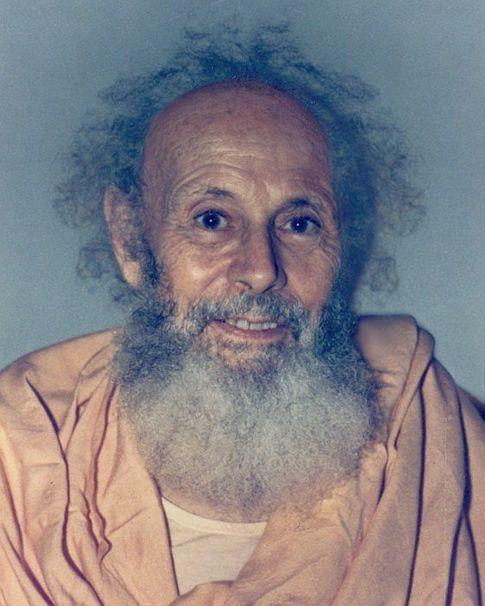
SWAMI ABHISHIKTANANDA
Life
Henri Le Saux, popularly known as 'Swami Abhishiktananda' was born on August 30, 1910, in Brittany, France. From a very young age, he felt a calling to the priesthood. So, in 1929, he decided to enter the contemplative life as a monk of the Benedictine Order. As he wrote, "What has drawn me from the beginning, and what still leads me on, is the hope of finding there the presence of God more immediately than anywhere else. When it is a matter of seeking God, I hope I shall not be disappointed."
Though leading the life of a monk, he was seeking a more contemplative way of life. Soon, he felt the call of India. Le Saux contacted Father Jules Monchanin who had worked in India since 1939. His reply was most encouraging, "Learn as much English as you can. You should have no objection to a purely vegetarian diet -- essential for the life of a sannyasi. You will need complete detachment from the things of the West and a profound love for India." Having completed all the necessary formalities in the summer of 1948, Henri Le Saux set off for India.
The future Swami Abhishiktananda reached the Indian east coast through Sri Lanka on the 15th of August. Two days later, he met Fr. Monchanin in Kulitalai, Tamil Nadu. It took him several months to become acquainted with the new life. “India reveals Herself to those who are prepared to be still; and, over a long period to listen humbly at close quarters to the beating of Her Heart; only to those who have already entered sufficiently far into themselves, into their own depths, to be able to hear in the Inner chamber of the Heart the ‘secret’ that India is ceaselessly whispering to them by means of a ‘Silence’ that transcends words. For, Silence is above all the languages, through which India reveals Herself; imparts her essential message -- the message of Interiority, of that which is ‘Within’.” At the end of 1948, there was a great change for the good. An encounter with Bhagavan Sri Ramana Maharshi at Arunachala brought about, "a genuine retreat as well as an introduction to true Hindu monastic life." The meeting with the Maharshi left a tremendous impact on Le Saux - from then on, he focused his spiritual search on an even deeper level by starting to realise the truth of Advaita. "Ramana's Advaita is my birthplace," he wrote. He proudly asserted, "In the Sage of Arunachala, I discerned the unique Sage of the Eternal India". During the following summer in 1949, Le Saux and Monchanin had another (and last) darshan of the Maharshi.
It was in those striking and austere surroundings around the Maharshi that he experienced the non-dual Presence from the depths of his consciousness, making Abhishiktananda declare, in the later years : “It was a real Revelation”. We can get a glimpse of the nature of this ‘Revelation’ from his description :
“Anyone who is the recipient of this overwhelming Light is at once petrified and shattered; he can utter no more ‘words’; he cannot think any more; he just remains as ‘Being’ -- outside of ‘space’ and ‘time’ -- alone in the very aloneness of the Alone !”
On March 21, 1950, the two monks, started the ‘Shantivanam Ashram’ on the banks of River Kaveri, at Kulitalai. At first, the original purpose was to found an Indian Benedictine Ashram - "an ashram, Hindu in form, where Hindus and Christians would hold silent communion in the quest of the Unique." The two monks adopted Indian names - Le Saux became 'Swami Abhishiktananda', meaning ‘bliss of the anointed one’. They adorned the ochre robes of sannyasis. Though a monk for twenty-one years, Swami Abhishiktananda was not fully aware at that time of the implication of sannyasa being a sacred Hindu tradition which should be received from a Guru through an initiation ritual. “Man’s primary task is to enter within, in order to encounter himself. Whoever has not encountered himself within himself has never encountered ‘God’; and, whoever has not encountered God in himself, has never encountered himself. No one encounters God apart from himself. God is he who is at the Heart of all, at the Source of all. So long as anyone has not entered that Source within, is simply cherishing the external idols which he has created for his own petty imaginations.”
At the same time, Arunachala continued to attract him. So, in March-April 1952, two years after the Maharshi had dropped the body, he moved to a cave called ‘Vannaatti Guhai’ on the sacred hill for a ten-day retreat in complete silence. There a spiritual experience was followed by further retreats. It was during one such retreat in 1953, that he met Harilal (H.W.L. Poonja), a disciple of Sri Ramana Maharshi. During his several stays in the caves of Arunachala over a period of three years, Abhishiktananda met a number of people who helped him to immerse himself completely in the Direct Teaching of the Maharshi.
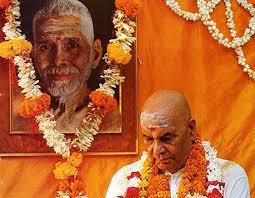
Harilal W.L. Poonjaji
In December 1955, Swami Abhishiktananda visited Swami Gnanananda Giri at Tirukoilur who gave him a spiritual and non-formal initiation. The only spiritual practice that Gnanananda Giri recommended was dhyana, meditation: "Return within, to the place where there is nothing, and take care that nothing comes in. Penetrate to the depths of your Self, to the place where thought no longer exists, and take care that no thought arises there! There, where nothing exists, is Fullness! There, where nothing is seen, is the vision of Being! There, where nothing appears any longer, is the sudden appearing of the Self! Dhyana, is this!"
Feeling more and more attracted to the Himalayas, Swami undertook several journeys and pilgrimages. In a letter to his sister, he wrote: "The Himalayas have conquered me! It is beside the sacred River Ganges that 'Shantivanam' ought to have been. I do not know if that would ever happen, but how splendid it would be!" With the passing away of Fr.Monchanin in 1957, and with no candidates having joined the ashram, Swami finally decided to leave 'Shantivanam Ashram' and settle as a hermit in the Himalayas. In 1968, he found Father Bede Griffiths, a British Benedictine, and, handed over ‘Shantivanam Ashram’ to him.
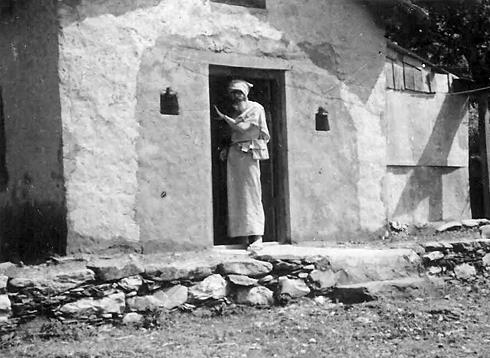
Swami Abhishiktananda at his hermitage in Gyansu, Uttarkashi, Himalayas
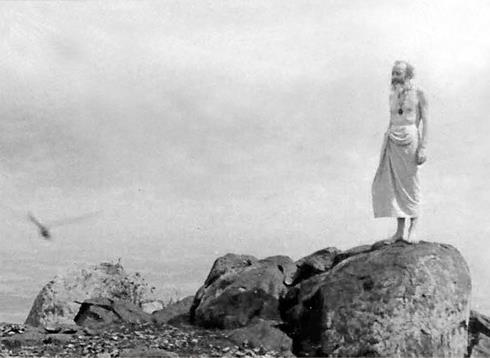
On the Summit of Holy Arunachala
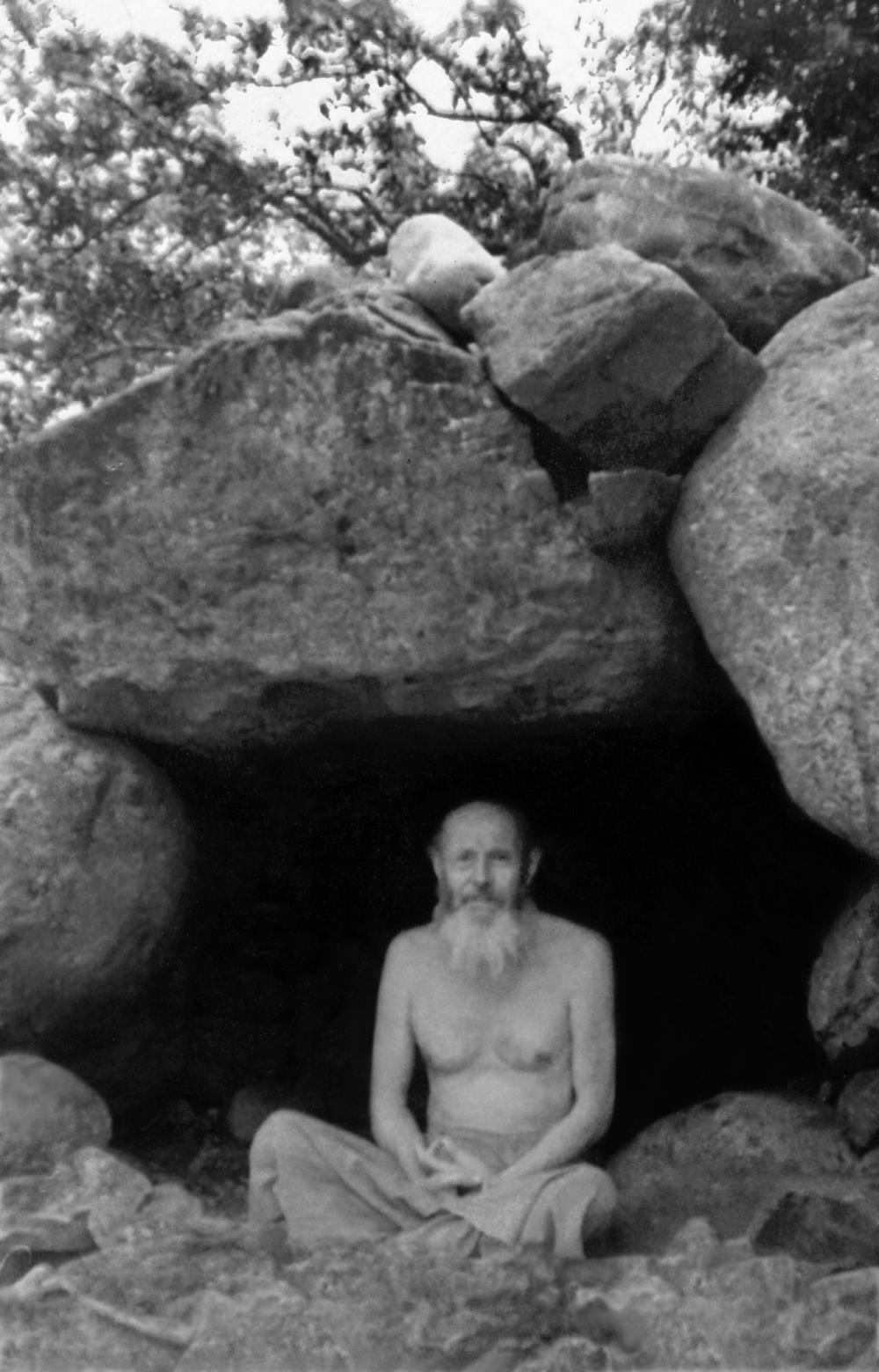
“.....Swami Abhishiktananda inside the cave on the Holy Hill - Arunachala…..”
In the autumn of 1971, after a two-year correspondence, Swami Abhishiktananda met a twenty-seven-year old French student, Marc Chaduc, who soon became his disciple. In 1973, at the Ganga Ghat of Sivananda Ashram, Rishikesh, Swami Chidananda Saraswati initiated Marc into sannyas and named him ‘Swami Ajatananda’. It was when Swami Abhishiktananda and Swami Ajatananda were spending time together in a deserted Siva temple in Ranagal, that they both had an intense spiritual experience. Sometime after this, Abhishiktananda suddenly suffered a heart attack when going down to Rishikesh one day to fetch provisions. He survived only for five more months. For him though, it was a state beyond life and death and an awakening to the Self. He wrote to Swami Ajatananda, "I AM. The awakening has nothing to do with any situation. The ‘Awakening’ - ‘Prabodha’ - just IS."
The awakening experience -- Atma Sakshatkara -- was overwhelming! Swami Abhishiktananda spent his last months in absolute Peace and Bliss - a state of profound Realisation of the Truth, beyond all religions.
Swami Abhishiktananda’s Mahasamadhi took place on the 7th of December, 1973.
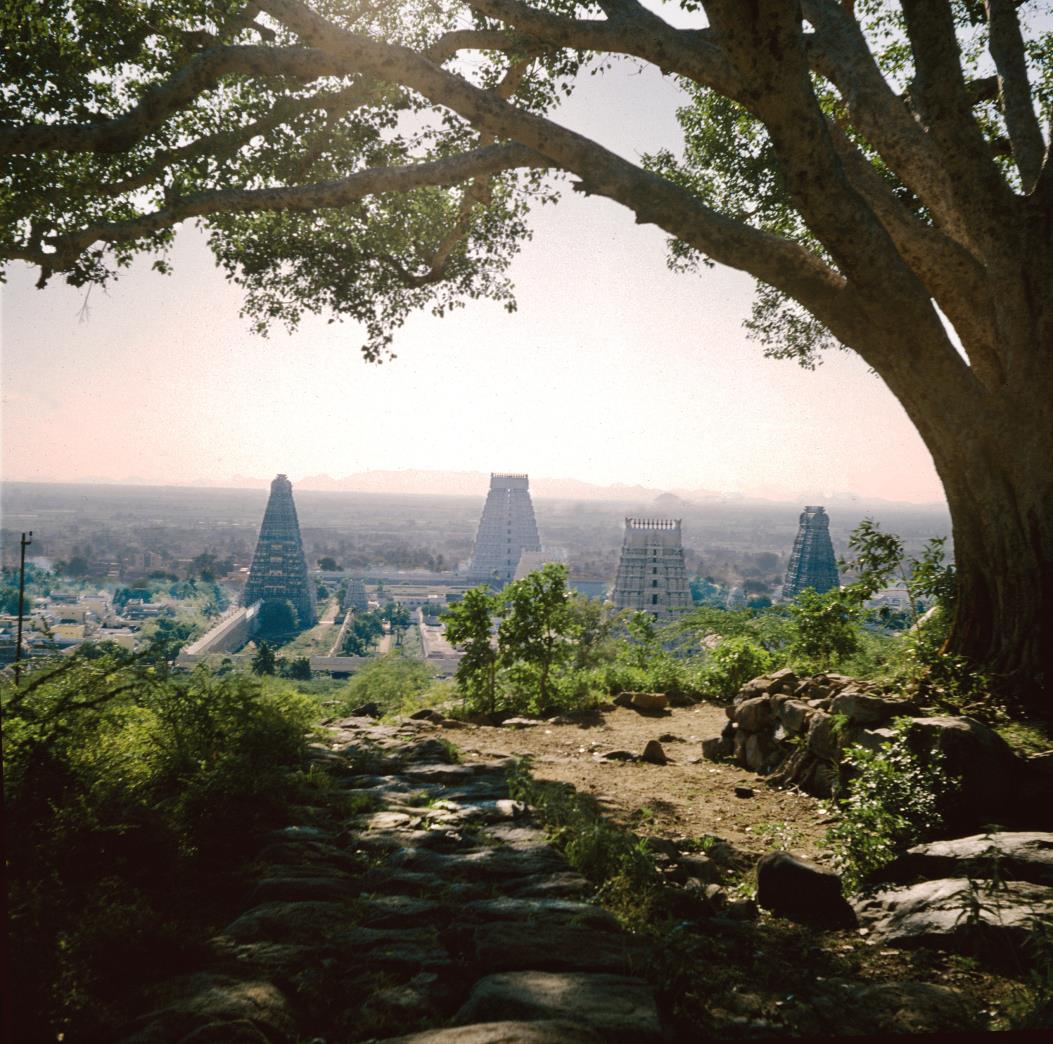
Sri Arunachaleswara Temple viewed from the Holy Hill
SWAMI ABHISHIKTANANDA AND ME
I think it was in 1956-57. It was a hot summer. In those days, Sri Ramanasramam hardly had any visiting pilgrims. At about 1 p.m., I was seated in the verandah of the New Hall facing the entrance to the Ashram and very close to the steps guarded, as it were, by two stone elephants – one on each side. With me was my teacher, T. K. Sunderesa Iyer. During most of such sessions with TKS, I would be simply looking at him, in silence and tremendous admiration! Admiration for what? I didn’t know nor did I make any effort to know !
Suddenly, I noticed TKS making efforts to get up. He was looking intently at two Western sannyasins who were just entering the Ashram. The moment they came nearer, the elder of the two prostrated before my teacher and reverentially introduced the other as his disciple. TKS introduced me to him, but added, “He is Ganesan. He is not my disciple, but my guru! He bears the name of my guide-guru, Kavyakantha Ganapati Muni! ” Both of them laughed in hearty spiritual communion!
Turning to me, TKS said, “He is Father Dom Henri Le Saux, a French Benedictine monk. Having taken sannyasa, he is now popularly known as ‘Swami Abhishiktananda’. A devotee of our beloved Bhagavan, he came to Sri Bhagavan in 1949. He once told me that his search for the Truth ended the moment he stood in the presence of Sri Bhagavan. It seems Sri Bhagavan then told him, ‘Do not meditate – just BE! Do not think you are – just BE! Do not think about being – you ARE!’ “He lives now in one of the cave-huts up on the Hill in line with Virupaksha Cave. You should visit him. Swami has always been kind to share with me his spiritual experiences. He is a true spiritual pilgrim, immersed in Truth!” The two sannyasins took leave of us and went to the Old Hall to meditate.
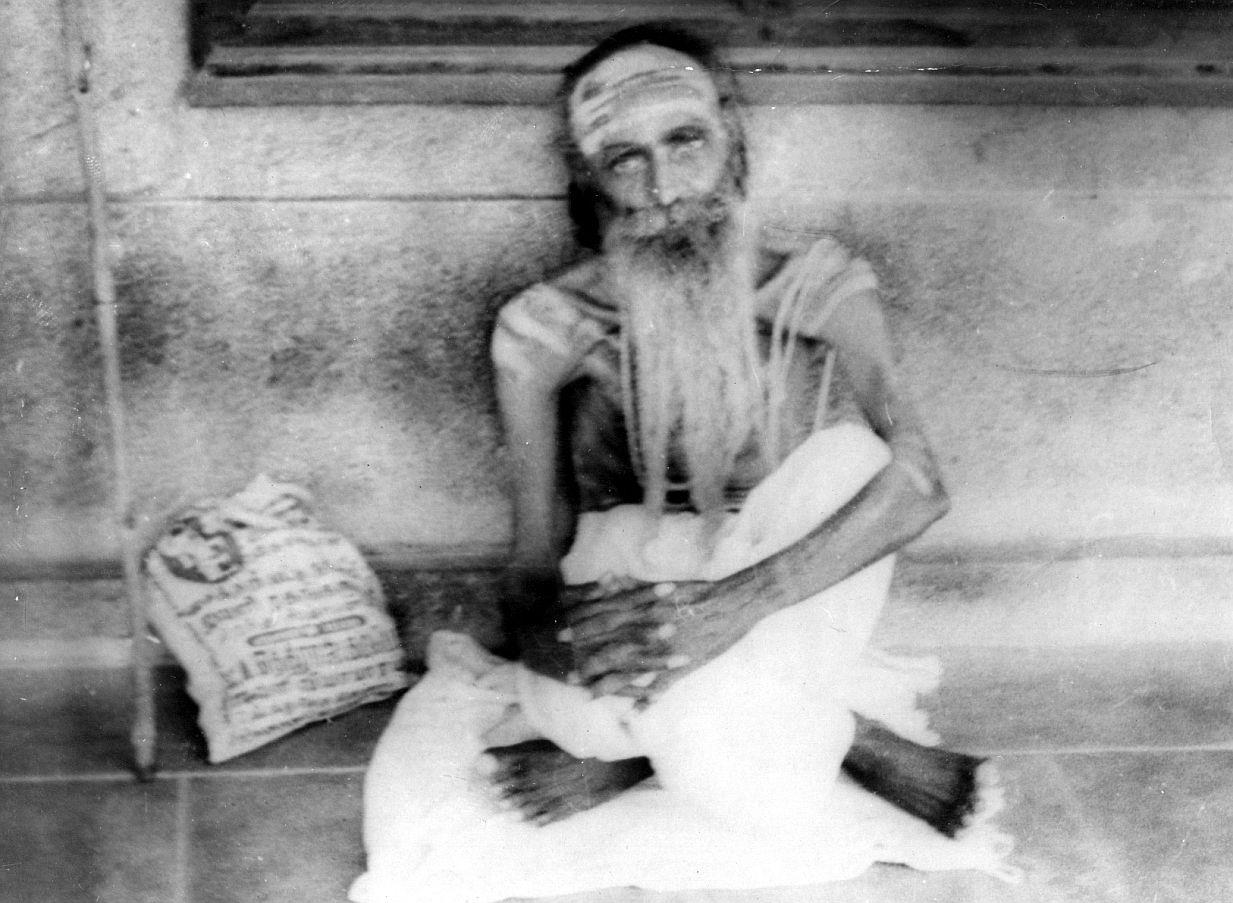
Pundit T.K.Sundaresa Iyer - ‘seated in the verandah of the New Hall’
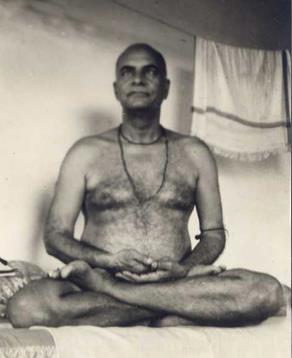
Harilal .W. L. Poonja in deep meditation
I became deeply inquisitive in knowing more about this Western hermit living on the holy hill. After a bried period of silence, I requested my teacher to narrate some spiritual experience the Swami had shared with him. He kindly shared with me the most interesting reminiscence of Swami Abhishiktananda. (For the sake of accuracy, I quote that fascinating narration from Swami’s book, instead of paraphrasing what my teacher told me!) It was about how H. W. L. Poonja (Papaji) strengthened Abishiktananda’s rootedness in the direct teaching of Sri Bhagavan. I was spellbound listening to it!
Swami Abishiktananda: “The first time that I met H. W. L. Poonjaji was in the cave of Arutpal Tirtham, up on the Hill, on March 13, 1953. It was about four in the afternoon. I was sitting on my stone seat outside the cave. I asked him, ‘How did you manage to get here? Who could have told you about me? Who directed you to my cave?’ ‘You called me,’ replied Poonjaji, looking me straight in the eye; ‘and here I am. Let me say it again; it was you who called me. The Self attracts the Self. What else do you expect?’
“We spoke about the Maharshi, his teaching and his disciples - all of which he was perfectly familiar with. Near me lay some books, including The Bhagavad Gita and the Upanishads. As our conversation passed from the subject of the Maharshi to that of the Scriptures, I picked up one of my books to quote a text from it. ‘And, what is the use of all that?’ asked Poonjaji bluntly. ‘All your books, all the time lost in learning different languages! Which language do you use to converse with the Atman (Self)?’
“As I attempted to defend my point of view, he cut in again, ‘Forget about it! In fact, apart from the Self, what else is there? So, your English, Sanskrit and the rest, how do they benefit you? Are they any use for conversing with the Self, for speaking to yourself? None of that leads anywhere useful. The Self has nothing to do either with books, or with languages, or with any scriptures whatever. It IS – that’s all!
“I, also,’ he continued, ‘was mad about reading once; but I never learnt anything from it. Now I read nothing, or so little as makes no difference. Not even the Gita, whose words in the old days were all the time ringing like music in my heart. I don’t meditate any more either – the Self has nothing to do with meditation. It is the same with japa, repetition of divine names, mantras, litanies, bhajans, every kind of devout prayer and lyric. At one time, I quite naturally made use of all these – and with great fervour.’
“When I expressed surprise at this, and reminded him of the teaching of Sri Ramana, he was willing to go so far as to say that as the time of the ‘crossing over’ approached, when worship and prayer become too artificial, and even unnatural, then – with the Guru’s approval, of course – one might abstain. I therefore reacted pretty vigorously to Poonjaji’s remarks.
“ ‘Who realizes or has realized the Self?’ he replied. ‘That is all a matter of words. The Atman cannot be reached. Apart from the Self, what else is there? Who reaches the Self, except the Self? Non-realisation is simply an excuse that one gives for trying to escape from the Real; and, continuing to lead with a clear conscience, a stunted life of prayers, devotions, and even asceticism, all no doubt very satisfying to the little ego, but in fact utterly useless. Has the Sun really set, merely because I have closed the shutters? The fundamental obstacle to Realisation is precisely the notion that this Realisation is still awaited.
“ ‘Of course,’ he conceded, ‘reading is not to be entirely rejected. It is better to read than to daydream or gossip. And, meditation is better than reading. However, it is only in the ultimate Silence that the Atman is revealed, if one may so speak. But once again, we have to guard carefully against supposing that this Silence has anything to do with either thinking about it or not thinking about it. For, the Atman cannot be reduced to anything capable of being said, thought or taught, or equally to the negation or absence of thought. You are a lover of Silence. You have done so remarkably well. You are quite ready. What are you waiting for?’
“I responded, ‘Ready for what? Alas, I feel myself so feeble when before God I recall what I ought to be.” He roared, ‘Enough of this nonsense! Stop talking about differences. There are no differences anywhere. There is only the Self. God is the Atman – the Self of all that is. I am the Atman. You are the Atman. Only the Self exists, in Itself and in all.’
“But, how do you know that I am ready?” ‘When a woman is ready to give birth, can she be unaware of it? When every woman who has already been a mother knows the signs without a shadow of doubt. It is the same with those who are near to the awakening, or rather, whose ‘I’ is on the point of disappearing in the Light of the essential and unique ‘I’. I saw it in your eyes this morning when we passed each other in the bazaar without you noticing; that is when you called me.’
“You are speaking as if you had been sent here expressly to give me this news. But if, as you say, I am so near to the awakening, why do you not go ahead and awaken me?” He asserted, ‘There is no question of awakening anyone at all. Who indeed is the sleeper? How could one awaken that which does not sleep and has never fallen asleep? Sleeping, dreaming, being awoken – all that is a matter of the body and the senses, which are located in the body, including, of course, thought, desires and will. Are you this body? Are you this thought which you have of being or existing within the limits of this body? When you are in deep sleep, do you still have any thought or awareness that you are? But still, even then you exist, you ARE. You are in truth neither this body which sleeps or alternatively keeps awake, nor this thinking mind, sometimes clear and sometimes confused, which flutters about within you, constantly picking up impressions on every side, nor are you even the awareness that you have, beyond all these thoughts, of being – an awareness which vanishes in deep sleep, in coma and at the dissolution of the body.
“ ‘It is through YOU that it is seen and heard, through YOU that it is thought and willed. You are what remains when nothing is any more seen or thought, willed or heard. That is the Atman - the Self - it is what YOU ARE yourself in reality and beyond all outward appearances which change and pass away. Tat Tvam Asi - YOU ARE THAT! What prevents you from realizing this?
“ ‘Can you remember the time when you were born? Can you discover in your memory some moment which would have been the first moment of your existence? Have you any awareness of beginning to exist? Did you not exist already, well before the time when you can remember that you existed? If your being is tied to the memory that you have of it, then what happened to you in the times of which you have no recollection? What happens to you at the moment when consciousness goes to sleep?’
“After a pause, he asserted, ‘Let me tell you again, there is only one thing that you lack. Enter into the Guha – the Cave of your Heart – and there realize that YOU ARE!’”
(from The Secret of Arunachala, pp. 81—86)
* * * * *
After a few months, I ventured to go in search of Swami Abhishiktananda living in a small hut on the hill. He was in deep meditation. I waited patiently outside with immense interest to learn what a studious sadhaka (spiritual aspirant) should do while treading the path of spirituality. Soon, he received me with warmth, love and tenderness. I then raised that doubt of mine.
Swami seemed very pleased at my eagerness and said, “Ganesan! Instead of me explaining to you every detail of the nuances embedded in treading the path, I will narrate to you the life of a serious sadhaka who impressed me very much. She lived in the next cottage. Please listen with attention.” (For the sake of authenticity and clarity, again, I quote this important story from Swami’s book.)
“Sundarammal belonged to a wealthy Telugu family of Madras. She married young but lost her husband soon after. As a widow she continued to live at home, surrounded by the love of her parents and brothers. She rarely went out, and when she did, it was always with her father.
“One day, he took her to the neighbouring temple to hear a talk given by a sadhu, who was a devotee of the Maharshi. He narrated to the audience – with religious fervor – details of how the Sage’s spiritual transformation at the tender age of sixteen took place at Madurai, his disappearance from home, his resort to the Mountain of Arunachala and how serene his presence is, showering peace and bliss on all who visit his ashram at the foot of the Holy Hill. Sundarammal was deeply moved. She begged her father to allow her to accompany some pilgrims to Arunachala. He refused, but promised that he would soon take her there himself.
“But the promise was not fulfilled. Sundarammal passed the time thinking of Sri Ramana and praying to him. She soon lost her appetite and was unable to sleep. Her father always had some especially urgent work which prevented him from taking her to Tiruvannamalai.
“One afternoon, about four o’clock, she seemed to see Sri Ramana coming down the mountain and approaching her. ‘Sundarammal, have no fear!’ he said to her. ‘It is I. Enough of this weeping and not eating or sleeping. Come, I am expecting you.’ Her heart was filled with joy. Once more she appealed to her father, and once more he put off the pilgrimage to another day.
“Some weeks later, she was alone one night in her room, weeping and calling on the Maharshi. Then, quite worn out, she fell asleep. Suddenly she felt a blow on her side and awoke with a startle. It was about three o’clock in the morning. There was the Maharshi standing by the head of her cot. ‘Come,’ was all he said.
“She followed him downstairs, crossed the hall and came out on the verandah. Hardly had she reached it when to her alarm she found herself alone. The Maharshi had disappeared. She sat down uneasily. Soon, a rickshaw appeared, and the rickshaw puller asked, ‘Is this Number 12, and are you Sundarammal? An old sadhu told me to come here and take you to the bus stand. Get in.’ Sundarammal thought quite simply, ‘It is Sri Bhagavan, the Maharshi,’ and, got into the rickshaw.
“At the bus stand, she and the rickshaw puller were both surprised not to find the old sadhu. However, she asked for the bus going to Tiruvannamalai and got in. Somewhere on the way, her bus passed another one from which someone alighted and then entered the Tiruvannamalai bus. ‘Are you Sundarammal?’ he asked. ‘Yes, I am’ she replied. ‘Good. Sri Bhagavan has sent me to look for you.’
“In the evening, she reached Tiruvannamalai and retired for the night to one of the large halls reserved for pilgrims. She prepared a cake to offer to Sri Bhagavan and fell asleep full of joy. The next morning, she went to the Ashram and fell at the feet of Sri Bhagavan. ‘Here you are at last. Did it take so long to reach me?’ he said to her. Sundarammal felt blessed and was in ecstasy. She was in the immediate presence of her Satguru Ramana!
“Some days later, her brothers arrived, unable to understand how this child, who, by herself, had never set outside her home, could have managed to reach Tiruvannamalai. But, Sundarammal was so deeply absorbed in Sri Ramana’s presence that she never even noticed her brothers, either in the Hall or at midday in the dining hall. Only in the evening were they able to approach her. They told her how upset everyone was at home and begged her to return. If she wanted, they would build her a hermitage in their garden. But nothing moved her, and the brothers even spoke of taking her home by force. ‘If you do, I will throw myself into a well,’ she said. Her brothers had to yield, but they soon returned with their father. They found her in a cottage near the Ashram and arranged for her continued stay there. During the fifteen years that remained of the Maharshi’s life, Sundarammal never left Tiruvannamalai even for a day.”
Seated next to a Western hermit up on the hill, listening to this remarkable journey within of a sincere aspirant as to how Sri Bhagavan practically guided Sundarammal, was a thrilling and ecstatic spiritual experience for me.
After a few years, I went up the hill and again met Swami Abhishiktananda. He was very kind and requested me to visit his ashram at Kulitalai situated on the banks of River Kaveri, though he himself was then staying at the Himalayas. He introduced his disciple, Father Bede Griffiths to me. Father Griffiths would visit Arunachala every year for the Karthigai Deepam. It was my pleasure to receive him and his disciples and host them at the Ashram. On every such occasion, Father Griffiths would request me, with deep affection, to visit ‘Shantivanam Ashram’ and take rest there for a few days. It was very kind of him. However, in those days, I was busily engaged at our Ashram with continuous work. So, I could never go. Consequently, my cherished wish to visit ‘Shantivanam Ashram’ got postponed year after year.
Though it was the time -- later half of 1970 -- when both Swami Abhishiktananda and Father Bede Griffiths had dropped their bodies, another Arunachala resident and Western devotee of Sri Bhagavan - Hamsa de Reede ( later, known as Swami Hamsananda) - took me in his car to his ashram in Kerala. The purpose was to decide whether we could help start, a book stall of Sri Bhagavan’s books there. On our way back to Arunachala, Hamsaji asked me whether I would have any objection if he detoured and went to Kulithalai and stayed at the serene Shantivanam Ashram for a day. I was delighted! With joy I said, “Please take me there!”
During my stay at that ashram, my heart was filled with gratitude and fulfillment. Is not the ancient saying, “Great men’s words would never go in vain,” absolutely true?! I paid my homage and obeisance to the spiritual presence of Swami Abhishiktananda and Father Bede Griffiths at ‘Shantivanam Ashram’, Kulitalai.
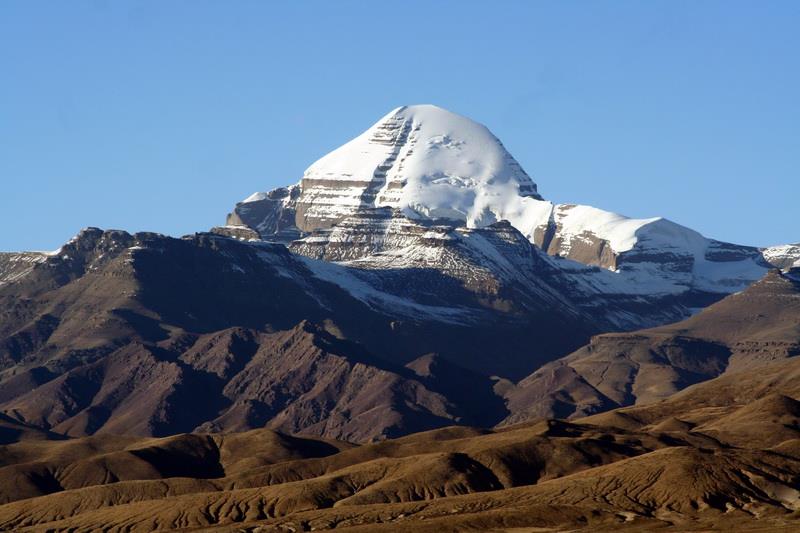
‘Mount Kailash’ in the Himalayas