Paramahansa YoganandaHis autobiography
All chapters7 of 48
- Chapter 1: My Parents and Early Life
- Chapter 2: My Mother’s Death And The Mystic Amulet
- Chapter 3: The Saint With Two Bodies
- Chapter 4: My Interrupted Flight Toward The Himalayas
- Chapter 5: A “Perfume Saint” Displays His Wonders
- Chapter 6: The Tiger Swami
- Chapter 7: The Levitating Saint
- Chapter 8: India’s Great Scientist, J.C. Bose
- Chapter 9: The Blissful Devotee And His Cosmic Romance
- Chapter 10: I Meet My Master, Sri Yukteswar
- Chapter 11: Two Penniless Boys In Brindaban
- Chapter 12: Years In My Master’s Hermitage
- Chapter 13: The Sleepless Saint
- Chapter 14: An Experience In Cosmic Consciousness
- Chapter 15: The Cauliflower Robbery
- Chapter 16: Outwitting The Stars
- Chapter 17: Sasi And The Three Sapphires
- Chapter 18: A Mohammedan Wonder-Worker
- Chapter 19: My Master, In Calcutta, Appears In Serampore
- Chapter 20: We Do Not Visit Kashmir
- Chapter 21: We Visit Kashmir
- Chapter 22: The Heart Of A Stone Image
- Chapter 23: I Receive My University Degree
- Chapter 24: I Become A Monk Of The Swami Order
- Chapter 25: Brother Ananta And Sister Nalini
- Chapter 26: The Science Of Kriya Yoga
- Chapter 27: Founding A Yoga School At Ranchi
- Chapter 28: Kashi, Reborn And Rediscovered
- Chapter 29: Rabindranath Tagore And I Compare Schools
- Chapter 30: The Law Of Miracles
- Chapter 31: An Interview With The Sacred Mother
- Chapter 32: Rama Is Raised From The Dead
- Chapter 33: Babaji, The Yogi-Christ Of Modern India
- Chapter 34: Materializing A Palace In The Himalayas
- Chapter 35: The Christlike Life Of Lahiri Mahasaya
- Chapter 36: Babaji’s Interest In The West
- Chapter 37: I Go To America
- Chapter 38: Luther Burbank—A Saint Amidst The Roses
- Chapter 39: Therese Neumann, The Catholic Stigmatist
- Chapter 40: I Return To India
- Chapter 41: An Idyl In South India
- Chapter 42: Last Days With My Guru
- Chapter 43: The Resurrection Of Sri Yukteswar
- Chapter 44: With Mahatma Gandhi At Wardha
- Chapter 45: The Bengali “Joy-Permeated” Mother
- Chapter 46: The Woman Yogi Who Never Eats
- Chapter 47: I Return To The West
- Chapter 48: At Encinitas In California
CHAPTER: 7
The Levitating Saint
“I saw a yogi remain in the air, several feet above the ground, last night at a group meeting.” My friend, Upendra Mohun Chowdhury, spoke impressively.
I gave him an enthusiastic smile. “Perhaps I can guess his name. Was it Bhaduri Mahasaya, of Upper Circular Road?”
Upendra nodded, a little crestfallen not to be a news-bearer. My inquisitiveness about saints was well-known among my friends; they delighted in setting me on a fresh track.
“The yogi lives so close to my home that I often visit him.” My words brought keen interest to Upendra’s face, and I made a further confidence.
“I have seen him in remarkable feats. He has expertly mastered the various pranayamas1 of the ancient eightfold yoga outlined by Patanjali.2 Once Bhaduri Mahasaya performed the Bhastrika Pranayama before me with such amazing force that it seemed an actual storm had arisen in the room! Then he extinguished the thundering breath and remained motionless in a high state of superconsciousness.3 The aura of peace after the storm was vivid beyond forgetting.”
“I heard that the saint never leaves his home.” Upendra’s tone was a trifle incredulous.
“Indeed it is true! He has lived indoors for the past twenty years. He slightly relaxes his self-imposed rule at the times of our holy festivals, when he goes as far as his front sidewalk! The beggars gather there, because Saint Bhaduri is known for his tender heart.”
“How does he remain in the air, defying the law of gravitation?”
“A yogi’s body loses its grossness after use of certain pranayamas. Then it will levitate or hop about like a leaping frog. Even saints who do not practice a formal yoga4 have been known to levitate during a state of intense devotion to God.”
“I would like to know more of this sage. Do you attend his evening meetings?” Upendra’s eyes were sparkling with curiosity.
“Yes, I go often. I am vastly entertained by the wit in his wisdom. Occasionally my prolonged laughter mars the solemnity of his gatherings. The saint is not displeased, but his disciples look daggers!”
On my way home from school that afternoon, I passed Bhaduri Mahasaya’s cloister and decided on a visit. The yogi was inaccessible to the general public. A lone disciple, occupying the ground floor, guarded his master’s privacy. The student was something of a martinet; he now inquired formally if I had an “engagement.” His guru put in an appearance just in time to save me from summary ejection.
“Let Mukunda come when he will.” The sage’s eyes twinkled. “My rule of seclusion is not for my own comfort, but for that of others. Worldly people do not like the candor which shatters their delusions. Saints are not only rare but disconcerting. Even in scripture, they are often found embarrassing!”
I followed Bhaduri Mahasaya to his austere quarters on the top floor, from which he seldom stirred. Masters often ignore the panorama of the world’s ado, out of focus till centered in the ages. The contemporaries of a sage are not alone those of the narrow present.
“Maharishi,5 you are the first yogi I have known who always stays indoors.”
“God plants his saints sometimes in unexpected soil, lest we think we may reduce Him to a rule!”
The sage locked his vibrant body in the lotus posture. In his seventies, he displayed no unpleasing signs of age or sedentary life. Stalwart and straight, he was ideal in every respect. His face was that of a rishi, as described in the ancient texts. Noble-headed, abundantly bearded, he always sat firmly upright, his quiet eyes fixed on Omnipresence.
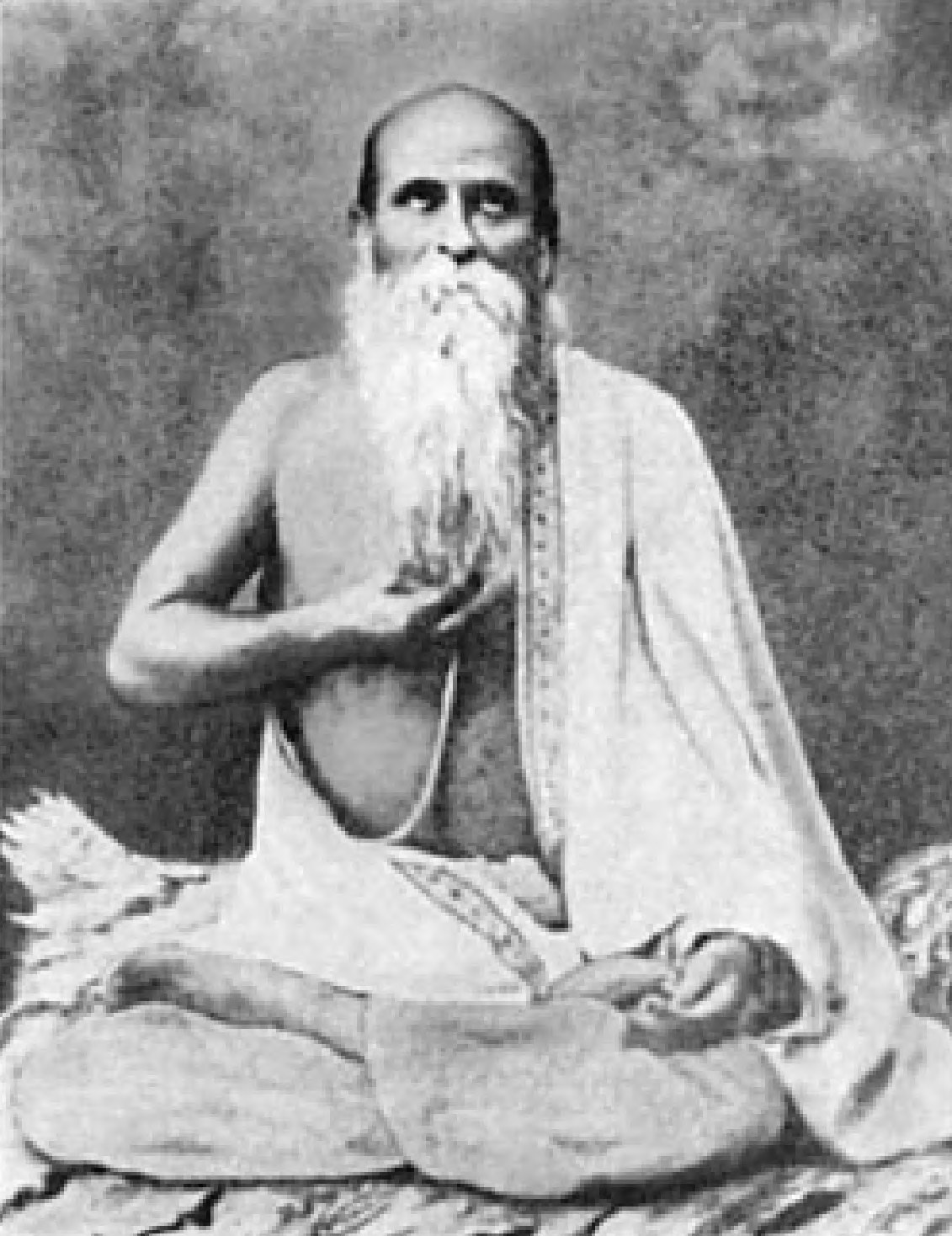
BHADURI MAHASAYA “The Levitating Saint” “Sir,” I inquired, “why do you not write a book on yoga for the benefit of the world?” “I am training disciples,” He replied. “They and their students will be living volumes, proof against the natural disintegrations of time and the unnatural interpretations of the critics.”
The saint and I entered the meditative state. After an hour, his gentle voice roused me.
“You go often into the silence, but have you developed anubhava?”6 He was reminding me to love God more than meditation. “Do not mistake the technique for the Goal.”
He offered me some mangoes. With that good-humored wit that I found so delightful in his grave nature, he remarked, “People in general are more fond of Jala Yoga (union with food) than of Dhyana Yoga (union with God).”
His yogic pun affected me uproariously.
“What a laugh you have!” An affectionate gleam came into his gaze. His own face was always serious, yet touched with an ecstatic smile. His large, lotus eyes held a hidden divine laughter.
“Those letters come from far-off America.” The sage indicated several thick envelopes on a table. “I correspond with a few societies there whose members are interested in yoga. They are discovering India anew, with a better sense of direction than Columbus! I am glad to help them. The knowledge of yoga is free to all who will receive, like the ungarnishable daylight.
“What rishis perceived as essential for human salvation need not be diluted for the West. Alike in soul though diverse in outer experience, neither West nor East will flourish if some form of disciplinary yoga be not practiced.”
The saint held me with his tranquil eyes. I did not realize that his speech was a veiled prophetic guidance. It is only now, as I write these words, that I understand the full meaning in the casual intimations he often gave me that someday I would carry India’s teachings to America.
“Maharishi, I wish you would write a book on yoga for the benefit of the world.”
“I am training disciples. They and their students will be living volumes, proof against the natural disintegrations of time and the unnatural interpretations of the critics.” Bhaduri’s wit put me into another gale of laughter.
I remained alone with the yogi until his disciples arrived in the evening. Bhaduri Mahasaya entered one of his inimitable discourses. Like a peaceful flood, he swept away the mental debris of his listeners, floating them Godward. His striking parables were expressed in a flawless Bengali.
This evening Bhaduri expounded various philosophical points connected with the life of Mirabai, a medieval Rajputani princess who abandoned her court life to seek the company of sadhus. One great-sannyasi refused to receive her because she was a woman; her reply brought him humbly to her feet.
“Tell the master,” she had said, “that I did not know there was any Male in the universe save God; are we all not females before Him?” (A scriptural conception of the Lord as the only Positive Creative Principle, His creation being naught but a passive maya.)
Mirabai composed many ecstatic songs which are still treasured in India; I translate one of them here:
“If by bathing daily God could be realized Sooner would I be a whale in the deep; If by eating roots and fruits He could be known Gladly would I choose the form of a goat; If the counting of rosaries uncovered Him I would say my prayers on mammoth beads; If bowing before stone images unveiled Him A flinty mountain I would humbly worship; If by drinking milk the Lord could be imbibed Many calves and children would know Him; If abandoning one’s wife would summon God Would not thousands be eunuchs? Mirabai knows that to find the Divine One The only indispensable is Love.”
Several students put rupees in Bhaduri’s slippers which lay by his side as he sat in yoga posture. This respectful offering, customary in India, indicates that the disciple places his material goods at the guru’s feet. Grateful friends are only the Lord in disguise, looking after His own.
“Master, you are wonderful!” A student, taking his leave, gazed ardently at the patriarchal sage. “You have renounced riches and comforts to seek God and teach us wisdom!” It was well-known that Bhaduri Mahasaya had forsaken great family wealth in his early childhood, when single-mindedly he entered the yogic path.
“You are reversing the case!” The saint’s face held a mild rebuke. “I have left a few paltry rupees, a few petty pleasures, for a cosmic empire of endless bliss. How then have I denied myself anything? I know the joy of sharing the treasure. Is that a sacrifice? The shortsighted worldly folk are verily the real renunciates! They relinquish an unparalleled divine possession for a poor handful of earthly toys!”
I chuckled over this paradoxical view of renunciation—one which puts the cap of Croesus on any saintly beggar, whilst transforming all proud millionaires into unconscious martyrs.
“The divine order arranges our future more wisely than any insurance company.” The master’s concluding words were the realized creed of his faith. “The world is full of uneasy believers in an outward security. Their bitter thoughts are like scars on their foreheads. The One who gave us air and milk from our first breath knows how to provide day by day for His devotees.”
I continued my after-school pilgrimages to the saint’s door. With silent zeal he aided me to attain anubhava. One day he moved to Ram Mohan Roy Road, away from the neighborhood of my Gurpar Road home. His loving disciples had built him a new hermitage, known as “Nagendra Math.”7
Although it throws me ahead of my story by a number of years, I will recount here the last words given to me by Bhaduri Mahasaya. Shortly before I embarked for the West, I sought him out and humbly knelt for his farewell blessing:
“Son, go to America. Take the dignity of hoary India for your shield. Victory is written on your brow; the noble distant people will well receive you.”
1 Methods of controlling life-force through regulation of breath.
2 The foremost ancient exponent of yoga.
3 French professors were the first in the West to be willing to scientifically investigate the possibilities of the superconscious mind. Professor Jules-Bois, member of the L’Ecole de Psychologie of the Sorbonne, lectured in America in 1928; he told his audiences that French scientists have accorded recognition to the superconsciousness, “which is the exact opposite of Freud’s subconscious mind and is the faculty which makes man really man and not just a super-animal.” M. Jules-Bois explained that the awakening of the higher consciousness “was not to be confused with Coueism or hypnotism. The existence of a superconscious mind has long been recognized philosophically, being in reality the Oversoul spoken of by Emerson, but only recently has it been recognized scientifically.” The French scientist pointed out that from the superconsciousness come inspiration, genius, moral values. “Belief in this is not mysticism though it recognized and valued the qualities which mystics preached.”
4 St. Theresa of Avila and other Christian saints were often observed in a state of levitation.
5 “Great sage.”
6 Actual perception of God.
7 The saint’s full name was Nagendranath Bhaduri. Math means hermitage or ashram.