Sivaprakasam Pillai
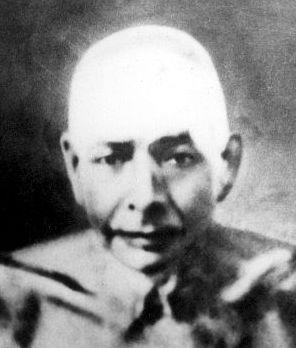
When Sivaprakasam Pillai came to Bhagavan in 1902, he was, like Gambhiram Seshayya, a government officer who had studied philosophy. Even while in college, he would introspect and ponder, “Who am I?” Sivaprakasam Pillai later said, “I thought it was a fleeting thought.” He visited Bhagavan at Virupaksha cave. As with Gambhiram Seshayya, just one glance of grace from Bhagavan and he was totally enthralled. He could see his God and guru in Bhagavan. Being a very practical and clear thinking person, his very first question was, “Swami, who am I?” This question opened the floodgates of the teaching, which to this day is saturating cultures across the world. His approach to Bhagavan’s teachings was practice oriented. Sivaprakasam Pillai posed fourteen questions to Bhagavan, who wrote the answers on a slate and on the sand. The answers were erased eventually. Sivaprakasam Pillai wrote the answers to those questions from memory.
Sivaprakasam Pillai: “Swami, who am I? And how is salvation to be attained?” Maharshi: “By the incessant inward enquiry, ‘Who am I?’ you will know yourself and thereby attain salvation.”
“Who am I?” “The real ‘I’ or Self is not the body, neither any of the five senses, nor the sense objects, nor the organs of action, nor the prana (the breath or vital force), nor the mind, nor even the deep sleep state where there is no cognizance of these.”
“If I am none of these, what else am I?” “After rejecting each of these and saying, ‘This, I am not’, that which alone remains is the ‘I’, and that is consciousness.”
“What is the nature of that consciousness?” “It is sat-chit-ananda (being-consciousness-bliss) in which there is not even the slightest trace of the ‘I’ thought. This is also called mouna (silence) or atma (Self). That is the only thing that is. If the trinity of world, ego and God are considered as separate entities they are mere illusions - like the appearance of silver in mother-of-pearl. God, ego, and the world are really Siva swarupa (the form of Siva ) or atma swarupa (the form of the Self).”
“How are we to realize that reality?” “When the things seen disappear, the true nature of the seer or subject appears.”
“Is it not possible to realize that while still seeing external things?” “No, because the seer and the seen are like the rope and the appearance of a serpent therein. Until you get rid of the appearance of a serpent you cannot see that what exists is only the rope.”
“When will external objects vanish?” “When the mind which is the cause of all thoughts and activities vanishes, external objects will also vanish.”
“What is the nature of the mind?” “The mind is only thoughts. It is a form of energy. It manifests itself as the world. When the mind sinks into the Self, then the Self is realized; when the mind issues forth, the world appears and the Self is not realized.”
“How will the mind vanish? “Only through the enquiry, ‘Who am I?’ Though this enquiry also is a mental operation, it destroys all mental operations, including itself, just as the stick with which the funeral pyre is stirred is itself reduced to ashes after the pyre and corpse have been burnt. Only then comes realization of the Self. The ‘I’ thought destroyed, breath and the other signs of vitality subside. The ego and the prana (breath or vital force) have a common source. Whatever you do, do without egoism, that is without the feeling, ‘I am doing this’. When a man reaches that state, even his own wife will appear to him as the Universal Mother. True bhakti (devotion) is surrender of the ego to the Self.”
“Are there no other ways of destroying the mind?” “There is no other adequate method except Self Enquiry. If the mind is lulled by other means it stays quiet for a little while and then springs up again and resumes its former activity.”
“But, when will all the instincts and tendencies (vasanas), such as that to self preservation, be subdued in us?” “The more you withdraw into the Self, the more these tendencies wither and finally drop off.”
“Is it really possible to root out all these tendencies that have been soaked into our minds through many births?” “Never yield room in your mind for such doubts, but dive into the Self with firm resolve. If the mind is constantly directed to the Self by this enquiry, it is eventually dissolved and transformed into the Self. When you feel any doubt, do not try to elucidate it; but try to know who it is to whom the doubt occurs.”
“How long should one go on with this enquiry?” “As long as there is least trace of tendencies in your mind to cause thoughts. So long as the enemies occupy a citadel they will keep on making sorties. If you kill each one as he comes out, the citadel will fall to you in the end. Similarly, each time a thought rears its head crush it with this enquiry. To crush out all thoughts at their source is called vairagya (dispassion). So, vichara (Self Enquiry) continues to be necessary until the Self is realized. What is required is continuous and uninterrupted remembrance of the Self.”
“Is not this world and what takes place therein, the result of God’s will? And if so, why should God will be thus?” “God has no purpose. He is not bound by any action. The world’s activities cannot affect him. Take the analogy of the sun. The sun rises without desire, purpose or effort, but as soon as it rises, numerous activities take place on earth: the lens placed in its rays produces fire in its focus, the lotus bud opens, water evaporates, and every living creature enters upon activity, maintains it, and finally drops it. But, the sun is not affected by any such activity as it merely acts according to its nature, by fixed laws, without any purpose, and is only a witness. So it is with God. Or, take the analogy of space or ether. Earth, water, fire and air are all in it and have their modifications in it, yet none of these affect ether or space. It is the same with God. God has no desire or purpose in his acts of creation, maintenance, destruction, withdrawal and salvation to which beings are subjected. As the beings reap the fruits of their actions in accordance with his laws, the responsibility is theirs, not God’s. God is not bound by any actions.”
Later, Sivaprakasam Pillai put forth fourteen more questions. Bhagavan answered them too. These twenty eight questions and answers make up the booklet Who am I?, which embodies the core of Bhagavan’s teaching and is an essential guide to seekers. It enables us to realize that we are the same Self, the same awareness that pervaded Sri Ramana Maharshi and still pervades all of creation as the pristine truth. The essence of Bhagavan’s answers to the fourteen other questions is below:
That, which arises in the physical body as ‘I’, is the mind. The ‘I’ feeling arises from the Heart or core of being. By enquiring ‘Who am I?’ the attention goes within and hence is diverted from thoughts. Perseverance in this practice gives strength to the mind to go to the source and be absorbed in the Self. Following sattvic (pure) principles such as eating simple, nutritious food in moderate quantity, and observing simple rules of good conduct, is most conducive to the development of pure qualities of the mind. This in turn helps one to pursue Self Enquiry without hindrance and without giving room to any form rising in the Self. All vasanas (tendencies) will be dissolved. One should firmly and unceasingly focus on the one Self. One should unswervingly put the teachings of the master into constant practice. Self is bliss. Whenever the mind experiences happiness as in deep sleep, samadhi, or when a desired object is obtained, it is due to the mind relinquishing its desire and being the bliss of the Self. Like a wise man who never leaves the shade, thus avoiding the scorching sun, one should always be absorbed in the Self and not allow the mind to be externalized into activity. The Self, like the sun, is unaffected by any activity of the forms of life it sustains. To keep the mind constantly turned inward and to be thus as the Self, alone is atma vichara, or Self Enquiry. If the mind subsides, all else will subside. To be and to remain in the Self, or one’s true nature, alone is liberation or mukti.
Sivaprakasam Pillai exemplified these teachings. He showed how seekers should sustain themselves in the Self after Self Enquiry. He adored Bhagavan, assimilated whatever he said and then put it into practice. However, when practicing Bhagavan’s teachings, a devotee may misunderstand. For instance, when Bhagavan extolled renunciation, Sivaprakasam Pillai assumed that Bhagavan meant sannyas. He went home, shaved his head, and donned a single piece of cloth. He even discarded the sacred thread that he wore all the time. Bhagavan looked at him and asked, “Why have you shaved your head? Go grow your hair and wear your sacred thread.” He then understood that Bhagavan had meant inner sannyasa which is Jnana and not external symbols. Attachment to the world or to its objects was to be relinquished from within.
He stayed quite often with Bhagavan at Virupaksha cave and at Skandashram. He began to mature spiritually because of his proximity to the master and imbibing his teachings. He then wanted to give up his job and devote himself fully to Self Enquiry. Bhagavan did not give him permission to do so. However, three years later, he told Bhagavan once again that he could not go to work anymore - even at work he was immersed in Self Enquiry and consequently not able to attend to his office duties. This time, Bhagavan permitted him to resign and asked him to go back to his village and pursue his sadhana.
He stayed alone in the outskirts of his village in an old Ganesa temple or sometimes in nearby forests. He constantly practiced enquiry. During this period, his state of consciousness and behaviour suddenly altered. He started laughing for no apparent reason, loudly chanted sacred hymns in Tamil, prostrated to all forms that he came across, and wore a long loincloth with a bag of sacred ash tucked into it. Bhagavan had given him this bag a few years earlier and had asked him to smear its contents on his body. (This is the only case I have encountered where Bhagavan had specifically instructed a devotee to smear sacred ash.) Sivaprakasam Pillai covered his entire body with sacred ash, carried a small staff, forgot caste restrictions and started frequenting the cremation ground and other areas occupied by the so called outcastes. In this state, he also walked all the way to a nearby temple town and back. He accepted gruel and sour food offered to him by anyone. When he returned to his village, he regained his normal consciousness. Thereafter, he visited Bhagavan many times in a year, each time staying for about fifteen days. Through all this time, the outer guru was pushing him in, while the inner guru was pulling him further inwards to atma vichara for longer periods. Often, in a state of ecstasy, Sivaprakasam Pillai composed many poems. Bhagavan appreciated and approved them. He even included some of them in the daily parayana or recitation in the ashram.
These are four of Sivaprakasam Pillai’s poems:
“From dawn to dusk I spend my day in vain talks. Not even for a moment do I think ‘Who am I?’ My lord, you have told me if you speak one word, it will multiply into many words. Ramana Deva, I am only pretending to be your devotee and not conducting myself as one.”
“I am a sinner who wastes most of his time listening to others’ misdeeds and talking about them. I have many defects myself, but if others mention them, my mind boils with rage. Thinking that there is no harm in it, I do not hesitate to utter small lies. O Ramana Deva, is it not high drama to fall at your feet as if I am your devotee?”
“Though I have become old and suffer from various diseases, I have not destroyed the desire for women. The ghost of my mind desires to see their beautiful faces, converse with them and listen to their honey-like speech. Even though I give advice to the mind, it does not subside but wanders after them. Ramana Deva, when will this delusion end and my mind become firm?”
“You know that my qualities and character are poor. You also know that among the ignorant full of defects, I am the worst. Though you know all this, you still sought me and took possession of me. Ramana Deva, how can I explain this wonder?”
A devotee once asked Bhagavan, “Bhagavan, Sivaprakasam Pillai was such a great ascetic. He unswervingly put your teachings into practice. Reading his poems, I wonder where I stand! If he is in this wretched state, what will happen to me?” Bhagavan responded with a beautiful reply: “When extolling God, Adi Shankara, and other sages have berated themselves and said the same thing. This is how sages guide others and warn seekers.”
Viswanatha Swami told me that once he asked Sri Bhagavan to show him Sivaprakasam Pillai because he knew that he was seated somewhere in the hall. The hall was crowded with devotees - perhaps it was a festive day. Bhagavan pointed his finger toward the farthest corner and said, “There, you see! With both arms covering his bare chest and seated unobtrusively like a rustic villager. That is our Sivaprakasam Pillai. He sits here like a domesticated cat. One should see him at his office. There, he is like a wild lion. His uprightness, honesty and hard work mark him out and cause everyone to approach him with awe and respect.”
Coming to know that Sivaprakasam Pillai had become old and sick and was unable to travel from his village, my father, who had not seen him, urged Kunju Swami to take him to his village near Chidambaram. The austere appearance of Sivaprakasam Pillai and his humility were outstanding. His body used to shine like molten gold with spiritual maturity. While introducing Sivaprakasam Pillai to my father, Kunju Swami wholeheartedly and reverentially lauded him as the most humble, scholar-devotee who had brought out Sri Bhagavan’s direct teaching. Sivaprakasam Pillai, in all humility and with fervent love, held the hands of Kunju Swami and put them on his eyes and on his head. With tears flowing from his eyes, he said, “These sacred hands had the great good fortune of touching and serving the holy body of my master. That merit I never had in my life. You are very blessed and infinitely greater!” After narrating this incident, Kunju Swami said, “This is how truly great people put themselves down to enhance the glory of others. Where are the ‘others’ for them? Every one is the same, single Self only!”
When Sivaprakasam Pillai was to drop the body in 1948, the news was reported to Bhagavan. Bhagavan went into a very long silence. Later, when the news of his passing came, Bhagavan affirmed, “Sivaprakasam Siva prakasam aanaar,” which means ‘Sivaprakasam has merged with the Light of Siva’. Yes, this beautiful human being had returned for eternity to Arunachala Siva.
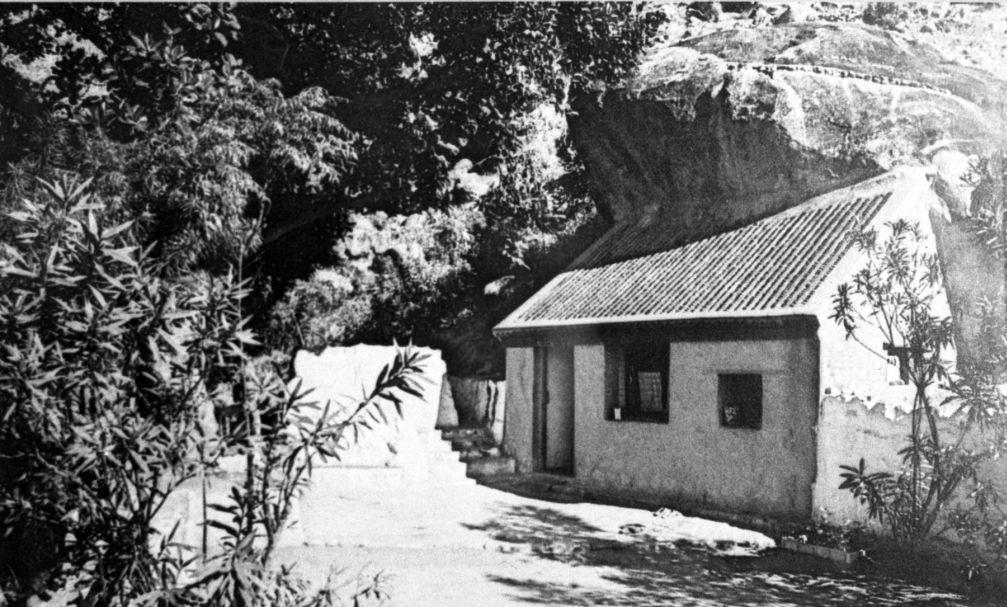
Virupaksha Cave