Gambhiram Seshayya
In Hinduism, the first function of the Lord is creation. To fulfill this, Arunachala Siva chose to create itself in the image of man, in the form of Arunachala Ramanan, Bhagavan Sri Ramana Maharshi. For the second function, preservation, he send boulders like Palani Swami, Mother Azhagammal, Ramanatha Bramhachari and others to look after Bhagavan’s body and his environment.
The third function of the Lord is destruction of ignorance through the teaching of the highest wisdom; this removes all obstacles to Self realization including the ‘I-am-the-body’ notion. To accomplish this, Arunachala drew two intellectuals to Bhagavan - Gambhiram Sheshayya and Sivaprakasam Pillai. In fact, according to the Vedanta Choodamani, a Tamil book on Vedanta, which Bhagavan loved to quote, one of the most important duties of a devotee is the preservation of his master’s teachings.
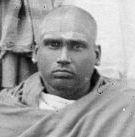
Gambhiram Seshayya came into Bhagavan’s life for this function. Bhagavan once said, “Gambhiram is not his name. Gambhiram is a title given to his family. His great grandfather was serving a king and was given the title ‘Gambhiram’, meaning ‘majestic nobility’, because of his uprightness. That became their family name.” On the first or second day Bhagavan went begging in Tiruvannamalai, he happened to stop in front of a house where four people were gambling with playing cards. When as usual he clapped his hands for food, the house owner went in and shame facedly brought out some food for Bhagavan. This man was Gambhiram Seshayya’s brother Gambhiram Krishna Iyer. From that day, he never gambled again.
Gambhiram Seshayya, a government officer, was well read in philosophy. In 1900, he was transferred to Tiruvannamalai where he heard of an ascetic Brahmin boy who lived in Virupaksha cave. Propelled by his own philosophical interests, he paid the ascetic - none other than Bhagavan - a visit. Just one glance from Bhagavan, and Gambhiram Seshayya was captivated. He saw before him in human form all that he had studied in the scriptures and a reflection of the very truth he was seeking - the Self.
He had studied many books on yoga and philosophy - particularly those of Swami Vivekananda - and had many doubts. He brought these books to Bhagavan and asked him to review them and answer his questions. He assumed that Bhagavan was observing silence. Therefore, he always wrote his doubts on a piece of paper. Bhagavan gave his answers too in writing after looking carefully through these texts. Much later, Bhagavan humourously remarked, “They said I was in silence though I never took a vow of silence. I never took a vow of fasting. Nobody shared food with me, so I was without food. Then they said, ‘Our swami is fasting.’ Nobody talked to me, so I kept quiet. And then they assumed, ‘Swami is in silence, do not disturb his silence.’”
Gambhiram Seshayya not only put forth excellent questions but also requested Bhagavan to condense some complicated passages that he found difficult to grasp. Bhagavan did this too. Many subjects were discussed and everything was explained in the light and nomenclature of the Hindu scriptures. While some of these questions were based on Self Enquiry, most were on different aspects of Hindu philosophy: yoga, sadhana, concentration, meditation, God, the world, ego, liberation, pranayama and ashtanga yoga. Of these, Gambhiram Seshayya was most interested in ashtanga yoga. While Bhagavan did explain the intricacies of other paths including the path of ashtanga yoga, he never swerved from affirming jnana marga, the path of wisdom, as the direct one. In fact, Bhagavan has remarked that while yoga is like taming the turbulent bull of the mind by forcibly yoking it, the path of wisdom is like gently taming the bull by calming it with some grass and then yoking it.
Gambhiram Seshayya served to provide Bhagavan the opportunity to read books on yoga, philosophy and other paths. With all this information, Bhagavan became like a university of philosophy. This was just as well, for he was to soon meet and compare notes with intellectuals like Kavyakantha Ganapati Muni, a scholar well versed in the Vedas. He was also to meet learned men of other nations and religions such as Paul Brunton, Frank Humphreys and Dr. Hafiz Syed, the last an authority on Islam. Gambhiram Seshayya served as a means of helping Bhagavan fulfill this function.
Gambhiram Seshayya was also instrumental in making the content of those slips of paper and notebooks with his questions and Bhagavan’s answers available for future devotees, eventually published as Vichara Sangraha, the first book on the teachings of Bhagavan in Tamil. It was later translated into English and titled Catechism of Enquiry. Afterwards, its title was changed to Self Enquiry.
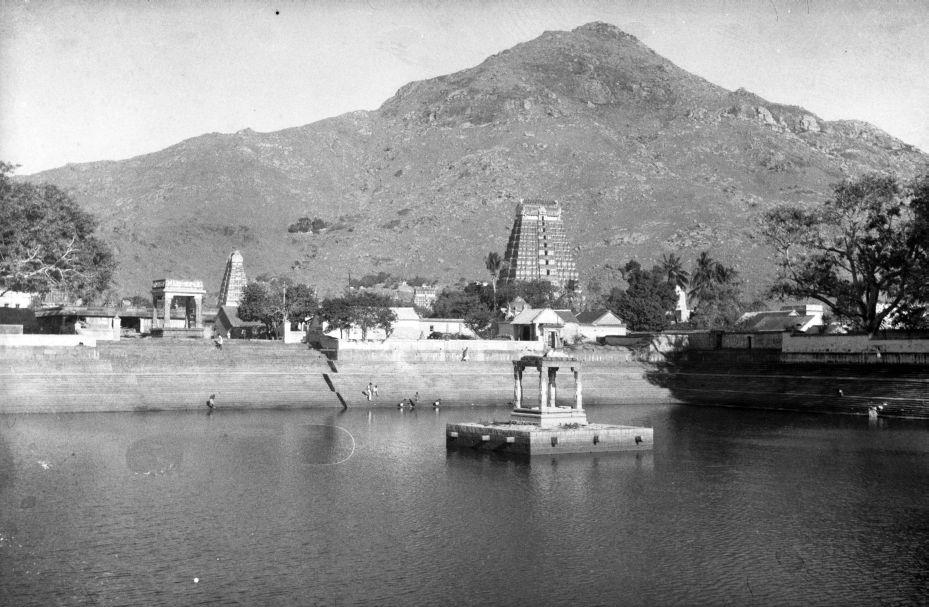
Ayankulam Tank where Bhagavan threw away his belongings on reaching Arunachala
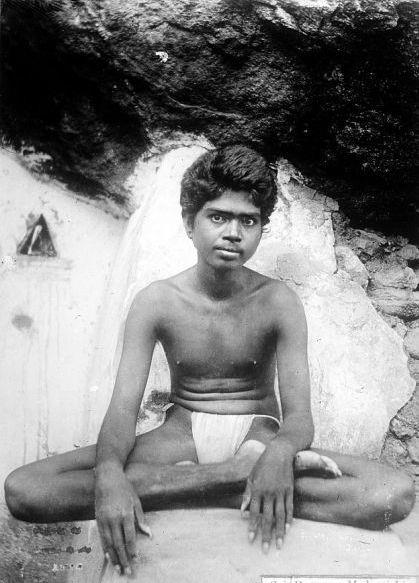
First known photograph of Ramana Maharshi