Mudaliar Paati
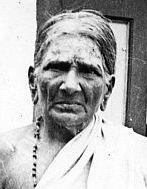
There was another adorable lady named Mudaliar Paati (Paati means grandmother). She lived in a village with her son and daughter-in-law and was serving a sadhu there. When he was about to die, she asked him what they should do now. He told her, “Go to Arunachala, there is a saint there. Serve him. Your life’s purpose will be fulfilled.”
Mudaliar Paati was very old even when she came to Bhagavan. She saw Bhagavan at Virupaksha cave in 1910. The very first glimpse of Bhagavan gave her an exhilarating spiritual experience. On the spot she took a vow, “I will serve food to Bhagavan until my last day.” Whenever she was able to, she would get money or provisions from the village. She gradually sold all her property so that she could serve Bhagavan. When she had nothing left, she bought sesame seeds from the market, which she crushed into oil and sold in the market. Whatever little profit she made, was spent on provisions to make food for Bhagavan.
Bhagavan once said, “I’m afraid of two people - Ramanatha Brahmachari and Mudaliar Paati.” What is this fear? It is not really fear; Bhagavan was a slave to selfless service, total surrender and unlimited devotion. These two people came under that category. There are many instances in Mudaliar Paati’s life that display her deep devotion. Even after Bhagavan came down to the present Ramanasramam, she insisted on serving food to Bhagavan with her own hand. She had become half blind due to old age. One day, when serving Bhagavan’s food, she stepped on the leaf on which his food was served. An attendant standing close by scolded her, “Hey! You have such poor eyesight, why do you come? When you cannot see Bhagavan, why do you come and disturb everyone?” Mudaliar Paati replied, “How does it matter if I can’t see him? Bhagavan sees me; his grace is on me, that is enough.”
When she heard that Bhagavan’s health was deteriorating after his first surgery, she wanted to see him. She had gone totally blind by now but still insisted on seeing Bhagavan. When she was brought to the hall, she strained her eyes to see. Bhagavan consoled her, “Paati, I’m all right, my body is all right.” She was not fully satisfied. She stepped outside and stood by the entrance of the hall. When Bhagavan came out, she said, “Bhagavan, stop!” She then ran her hands over Bhagavan’s body from head to foot. She is the only lady whom Bhagavan allowed to do so. After she had ‘seen’ Bhagavan to her heart’s content, he asked her, “Are you satisfied now?”
This remarkable lady spent the last days of her life in Ramana Nagar - a little away from Ramanasramam. Kunju Swami, Viswanatha Swami and Suri Nagamma were sent by Bhagavan to look after Paati and her health. They built a hut for her in Ramana Nagar. Bhagavan enquired about her daily. By 1949, Mudaliar Paati had grown very old, gone blind and had lost her daughter-in-law, everything. Yet, she continued cooking for Bhagavan. Even on her last day, she cooked a meal and made sure that it was taken to Bhagavan. She insisted on being informed when Bhagavan had finished eating her food. When that was reported to her, she blissfully closed her eyes and dropped her body. Bhagavan gave instructions to Kunju Swami and others that she should be buried like a realized being (just as he had done earlier in the case of Seshadri Swami and Mother Azhagammal). On a previous occasion - the day when Echammal passed away - Bhagavan had remarked, “Still, Mudaliar Paati is alive.” When Mudaliar Paati passed away, Bhagavan declared, “A big responsibility has been taken off my shoulders.”
The Universal Mother took the form of mother Azhagammal and gave Bhagavan his body. In the forms of Ratnammal, Meenakshiammal, Keerai Patti, Desurammal, Echammal and Mudaliar Paati, the Universal Mother fed and nurtured Bhagavan’s body. Bhagavan too expressed his gratitude towards them by granting them realization. Soon after Mudaliar Paati dropped her body, Bhagavan’s health deteriorated further. Within a few months, he too dropped his body.
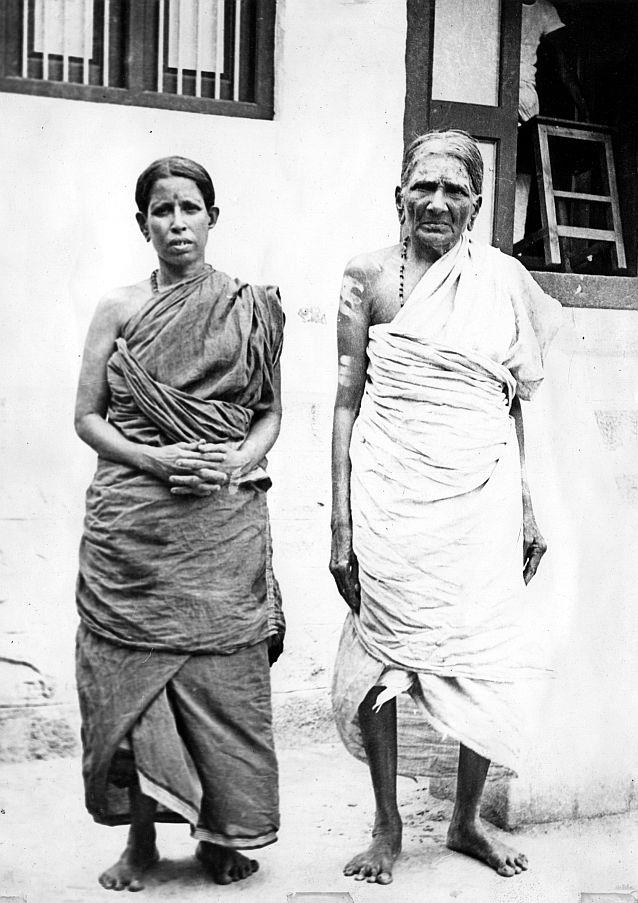
Mudaliar Paati with daughter-in-law
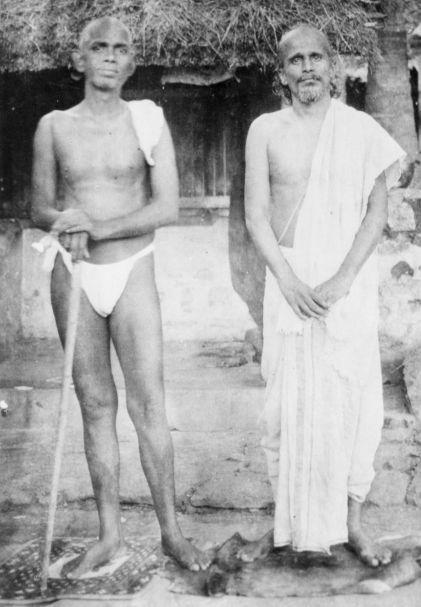
The Maharshi with Kavyakantha