Kavyakantha Ganapati Muni
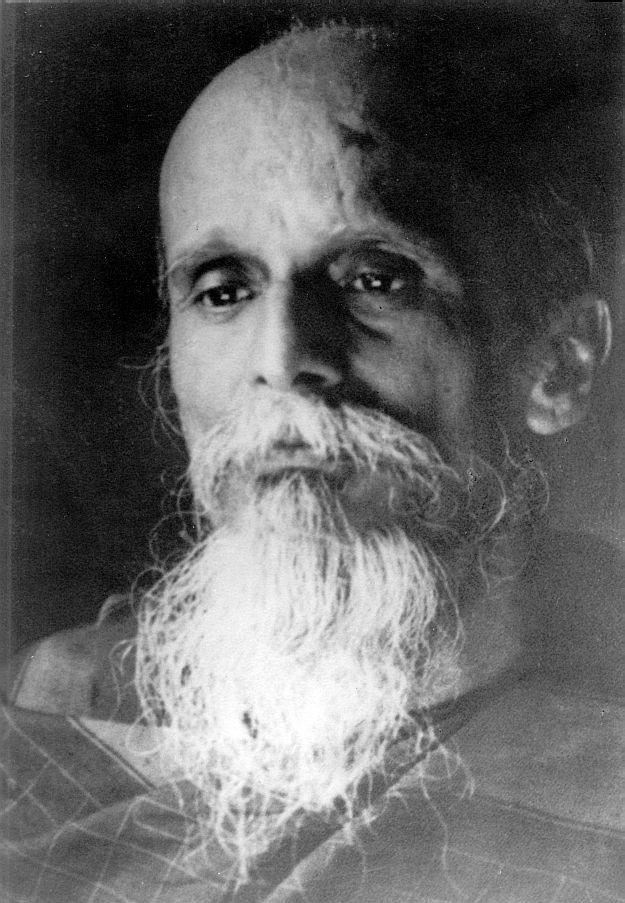
It is late nineteenth century, Navadveep, Bengal. A fourteen year old boy sits amidst a group of scholars: mathematicians, poets, a music maestro and an astrologer, among others. The mathematicians give him a six digit number to be multiplied by another six digit number. One poet recites the last two lines of a Sanskrit verse and challenges the boy to compose the first two lines in the same metre and complete it. The other poet, meanwhile, gives him a subject to immediately compose a four line Sanskrit verse on. The astrologer places before him a complex pattern of planetary positions and asks him what the consequence will be. The musician hums a few notes of a particularly obscure raga and asks the boy to identify it. Another man rattles off a random date, like February 18, 1756, and asks what day that was. As if all this weren’t enough, another man stands behind the boy and throws tiny pebbles on his back while the others throw their challenges. The boy is expected to simultaneously keep count of how many pebbles were thrown. The boy answers all of them, instantaneously, correctly, brilliantly, to the tumultuous applause of a wonder struck audience.
This boy wonder, Kavyakantha Ganapati Muni, (‘muni’ means one who is steeped in manana - contemplation) soon won acclaim all over India. He was to later become one of the foremost devotees of Bhagavan Sri Ramana Maharshi. Before he was born, his pious parents had no children. His father went to Benares and prayed at the Ganesa temple there. He had a vision of the idol of Lord Ganesa coming to life and merging with him. At the very same time, back in his village, his wife saw the idol of the goddess in the local temple turn into light and enter her. Soon after, a son was born to the couple. They named him Ganapathi in gratitude to Lord Ganesa.
However, to their utter disappointment, the boy could not talk at all. Until the age of five he remained mute and expressionless. Moreover, he was plagued with many diseases including epilepsy. In a desperate attempt to cure him, they resorted to the age old practice of branding him with a red hot iron rod. This treatment had far reaching effects. The shock unleashed the boy’s latent talents and he became exceptionally brilliant. His retentive power, his concentration, his capacity to imbibe whatever he read, and quote it verbatim increased manifold. By the age of nine, he had mastered Sanskrit literature and by the age of eleven he had memorized all the four Vedas and the Upanishads. When he was fourteen years old, Ganapati composed a drama in Sanskrit which is acclaimed even today as one of the best in that language.
The ancient scriptures mention that the rishis of yore did penance and God appeared before them and granted boons. Strongly influenced by these texts, Kavyakantha sought to achieve the same. He got married when he was eighteen years old but his fervour to have God’s darshan became more intense. He embarked on a long pilgrimage, visited temples as well as all the sacred rivers like the Ganges and did penance. His penance was rigorous: he remained silent and motionless for long periods and went without food. Though he meticulously observed all the rules of traditional penance, God did not appear before him.
When he failed to find God through one method of penance, he tried another method with equal sincerity. With every method failing, Kavyakantha finally took the last resort: doing penance in the five holy places dedicated to Lord Siva , representing the five elements - earth, water, fire, air and ether. One must visit each place in a particular order and arrive finally in the place dedicated to fire, Arunachala, where the devotee’s penance (tapas) is said to be rewarded. Kavyakantha followed the necessary rituals in each place and finally reached Arunachala in 1904. During the course of his penance in Arunachaleshwara temple, Kavyakantha once went up the hill and saw Bhagavan sitting with eyes closed, absorbed in samadhi. Disappointed by Bhagavan’s continued silence, he came away.
He took up a job as a teacher in a neighbouring town called Vellore and continued his sadhana. In 1907, he became dejected and felt that his life was futile. Though he had mastered the scriptures and experienced kundalini, he still hadn’t found a method that gave him permanent anchorage in the source of shakti that he called God. He decided, “I am going again to Arunachala, the final destination for one’s search for God according to the scriptures. If I do not attain God this time, I am going to proclaim that the Vedas, Upanishads and all the Hindu scriptures are just exaggerations of poetic minds.” With this resolve, he returned to Arunachala.
A Siva shrine is located at each of the eight cardinal directions on the circumambulation route around Arunachala. Determined to perform his penance to the best of his capacity, he went southwest to the Nirudhilingam shrine. It was surrounded by forests at that time. He took shelter in the hollow of a large, dead tree and resumed his severe penance of being silent and going without food. After the fifth or sixth day, the divine Mother spoke to him: “Until you have a guru, you cannot achieve your goal. Your guru is up there on the hill. Surrender at his holy feet and you will get his grace. Go now!”
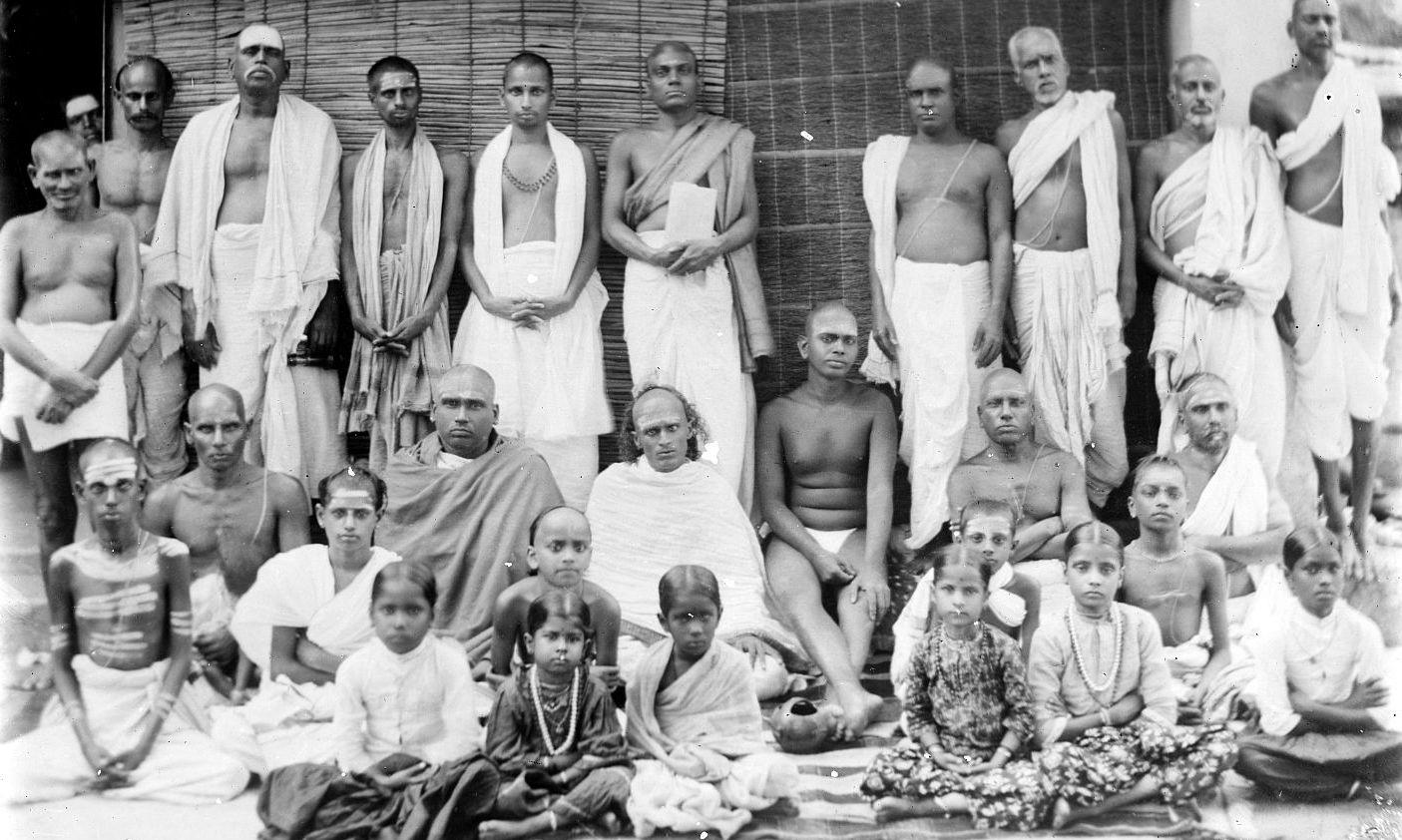
Kavyakantha at Virupaksha Cave (seated to the right of Bhagavan)
Kavyakantha leapt out of the hollow. It was one o’clock in the afternoon, and the sun was beating down hard. The Karthikai festival was on and hundreds of people thronged around the hill. Undeterred, he ran up the hill to Virupaksha cave and found Bhagavan sitting alone outside. Bhagavan directed his glance of grace at Kavyakantha. Like many devotees before him, he was transfixed and could not take his eyes off Bhagavan. Kavyakantha, an erudite scholar and an inspired poet, had never prostrated himself before any human being. Suddenly, he found himself flat on the ground in front of the young ascetic. He held Bhagavan’s feet tightly and cried, “I have read all that has to be read. I have fully read Vedanta, I have performed japa to my heart’s content, yet I have not understood what tapas is! Therefore, I have sought refuge at your feet. Pray, enlighten me as to the nature of tapas.” The word ‘tapas’ in Sanskrit literally means ‘striving for the realization of truth through flaming penance and austerity’. However, Bhagavan imparted its deeper meaning to Kavyakantha. Helping him rise to his feet, Bhagavan looked into his eyes and after some time slowly replied, “If one watches from where the notion ‘I’ arises, the mind is absorbed into that. That is tapas.” And since Kavyakantha had himself revealed that he practiced mantra japa - repeating mantras thousands of times every day, the master added, “When repeating a mantra, if one watches the source from which the sound is produced, the mind is absorbed in that. That is tapas.”
These revelations thrilled Kavyakantha. He finally understood how to be in touch with the truth through a practical method. Wave after wave of ecstasy flooded through him for hours in the presence of the ascetic. At last, when he opened his eyes, he asked the attendant, Palani Swami, for the ascetic’s name. Though he was then called Brahmana Swami, Kavyakantha learnt that his real name was Venkataraman. Kavyakantha took ‘Ramana’ from his name and since he had seen God in this ascetic, he named him ‘Bhagavan’. Bhagavan in Sanskrit means God. As he had also given a revelation about tapas which no scripture had ever explained so clearly before, to Kavyakantha, Bhagavan was also a Vedic rishi. (Rishi means sage and is derived from drashta, which means seer - one who has seen with the inner eye. A rishi is he who is ever connected to the original, inexhaustible source of wisdom.) But, to Kavyakantha, Bhagavan was not only a rishi but a maharshi - a great rishi. Therefore, he named the ascetic Bhagavan Sri Ramana Maharshi. This name, Bhagavan Sri Ramana Maharshi, the chanting of which has guided countless people to the silent, still truth, was given by this man of rare genius, Kavyakantha Ganapati Muni.
At that time, he had over two hundred disciples of his own, including noble scholars like Daivarata and Kapali Shastri. He wrote a letter to them saying, “I have found my guru. Henceforth, it is not I but Bhagavan Sri Ramana Maharshi who is our guru.” The next day, he went to Bhagavan and said “Bhagavan, please accept me.” Bhagavan graciously conceded to his request and said, “Stay in the cave that is adjacent to Virupaksha cave.” Called Mango Tree cave, its proximity to Virupaksha cave allowed the guru and disciple to visit each other every day. Bhagavan continued to pour his grace and help Kavyakantha mature spiritually.
Bhagavan held Kavyakantha in high esteem and addressed him with much respect. One day, Kavyakantha held Bhagavan’s feet and begged, “Please Bhagavan, do not address me respectfully! I am your disciple and your child. Do not address me in such reverential terms!” But, Bhagavan continued to do so. He then learnt from his other disciples and Kavyakantha’s admirers that they referred to him as ‘Nayana’ which means ‘father’ in Telugu. Bhagavan told Kavyakantha, “Hereafter, I will call you Nayana.” Nayana accepted this because in Telugu the word also meant disciple or child.
It is interesting to note that Kavyakantha was a staunch devotee of Siva , the formless father aspect of God. He had never worshipped God in the aspect of the Mother. However, from the moment the Mother showed his guru to him, he became Her devotee as well. (The side of the hill in front of which the Arunachaleshwara temple is located is called the front of the hill. The stretch from Nirudhilingam to the Eshanyalingam, south-west to north-east, is the back. A little known secret about Arunachala is that the front is the Father aspect while the back is the Mother aspect. All miracles and powers - psychic, spiritual, physical or worldly - stem from the Mother aspect. In the lives of Bhagavan’s devotees, miracles and visions took place between Nirudhilingam and Eshanyalingam. With Kavyakantha too, it was at Nirudhilingam that the Mother aspect guided him to his guru.)
He wanted to express his gratitude to the Mother by composing a thousand Sanskrit verses in her praise. He surrendered to Bhagavan and began the work after getting his permission. He chose a sacred day to complete the thousand verses. Unfortunately, he fell ill and could write only around seven hundred. The night before his self imposed deadline, he approached Bhagavan at Virupaksha cave with his problem. Bhagavan encouragingly reassured him, “Do not worry, I will come and sit with you.”
It was a wonderful sight: The young master sitting, radiating silence, his older devotee dictating extempore verses in a torrential flow and his disciples writing them down late into the night around the lantern light. Genius that he was, Kavyakantha started dictating the first line of the first verse to the first disciple, the first line of the second verse to the second disciple, the first line of the third verse to the third disciple and so on. Then, he proceeded without stopping to dictate the second line of the first verse to the first disciple, the second line of the second verse to the second disciple, the second line of the third verse to the third disciple…until at one thirty in the morning, the thousand verses were complete. Bhagavan, who until then was sitting with eyes closed in rock like silence, opened his eyes and asked, “Have you taken down all that I dictated?” Kavyakantha fell at his guru’s feet and cried “Yes Bhagavan, they are your verses!” This anthology of verses is called Uma Sahasram. Uma is the divine Mother, while ‘sahasram’ in Sanskrit means ‘thousand’. Therefore, the title can be translated as ‘thousand verses in praise of the divine Mother’. Kavyakantha revised the first seven hundred and odd verses many times but left the verses that he dictated that wonderful night, verses which he felt came from Bhagavan, untouched.
When I came back to Ramanasramam, some people for whom I had a lot of respect often spoke ill of Kavyakantha. They claimed that his accounts were figments of his imagination. I was influenced by their views. I approached Munagala Venkataramaiah, a great scholar and one of the recorders of the talks with Bhagavan. Munagala had not seen Kavyakantha and was therefore neutral about him. “Why do people pull down Kavyakantha so much?” I enquired, listing out all the transgressions he was rumoured to have made. “Ganesan, stop!” he exclaimed. “How did you know all this?” I revealed the names of the people who told me this. He replied, “They have given an opinion and you have received it. Are you sure it is the truth?” I was puzzled. “How can we know which opinion is correct?” I asked. Munagala then said, “Ganesan, don’t you know the secret? Whatever Bhagavan says is correct. Whatever everyone else says is an opinion. ”
I was still not satisfied. I had read an argument that Kavyakantha was not a Self realized soul because he had so many sankalpas. His detractors often quoted this and I was convinced by this logic. I put forth my argument to Munagala. He told me, “I asked Bhagavan the same thing - how come it is written in such and such a book that Kavyakantha was not Self realised. Bhagavan told me, ‘That is not what I said but what the recorder must have expected me to say.’” Munagala then advised me, “Go by whatever Bhagavan has said and you will be near the truth. Do not go by opinions, particularly if they divide people - whether about saints or anyone else. Do not pay heed to them. Seekers should never be carried away by negative statements made about any saint. In order to progress, this is the first rule to remember. What detractors say are just opinions and if we believe them we fall victim to the mind.”
It is true that Kavyakantha had very high ideals. However, they were not sankalpas but satya sankalpas. A sankalpa is a concentrated desire of wanting to achieve something. A satya sankalpa is that sankalpa which comes to you - not that you have a desire for it. In 1908, Kavyakantha had asked Bhagavan, “Is seeking the source of the I-thought sufficient for the attainment of all my aims, or is mass incantation, mantra japa needed?” Bhagavan replied “Seeking the source of the I-thought will suffice.” Though this was the initial advice Bhagavan gave him, Kavyakantha pressed on with his argument, “What about my aims and ideals?” Bhagavan replied “It will be better if you throw the entire burden on the Lord. He will carry them and you will be free. He will do his part.” Munagala told me, “People quote only these sentences. But, Bhagavan told me what happened afterwards. At first, Kavyakantha could not grasp the inner meaning of Bhagavan’s counsel. After a few years he came to Bhagavan and said, ‘Bhagavan, I am surrendering all my sankalpas at your holy feet.’ There was no greater God than Bhagavan for him.”
Kavyakantha and his disciples plied Bhagavan with questions. Though the answers were not immediately noted down, Nayana had such a clear memory that he later condensed Bhagavan’s answers into verses and recited them, saying, “This is from the third chapter of Ramana Gita,” or, “This is the eighth verse from the second chapter in the Ramana Gita.” He had not yet written Ramana Gita and people used to wonder at his claims. Finally one day, he sat down and wrote the entire Ramana Gita of three hundred verses. He wrote the questions with their answers and showed them to Bhagavan, who verified each one of them and remarked, “Perfectly correct.”
In Ramana Gita, one of Bhagavan’s answers about women is most revealing. Nayana questions Bhagavan, “Are not women equal to men?” Bhagavan answers, “What is woman or man? It is based on the body. For the soul there is no difference.” Then Kavyakantha asks “Is it possible for women to master the scriptures?” Bhagavan replied, “Without a doubt.” Nayana went on, “Can women get Self realization? Do they become jnanis?” “Without a doubt,” the guru said. “For the soul which has to achieve realization there is no difference.”
In 1922, when Bhagavan’s mother attained mahasamadhi, it was not Bhagavan who wanted to entomb her, glorify her or build a temple for her. It was Kavyakantha who told Bhagavan, “According to the scriptures and your words in the Ramana Gita, she is a realized soul. She should be entombed with all sanctity.” He administered this task and it was over her samadhi that the Matrubhuteshwara temple was constructed. Kavyakantha even assigned the temple its name: Matrubhuteshwara, meaning ‘the Lord who has become the mother’. Thus, the idea of the temple, the nucleus around which Ramanasramam was built, came from Kavyakantha.
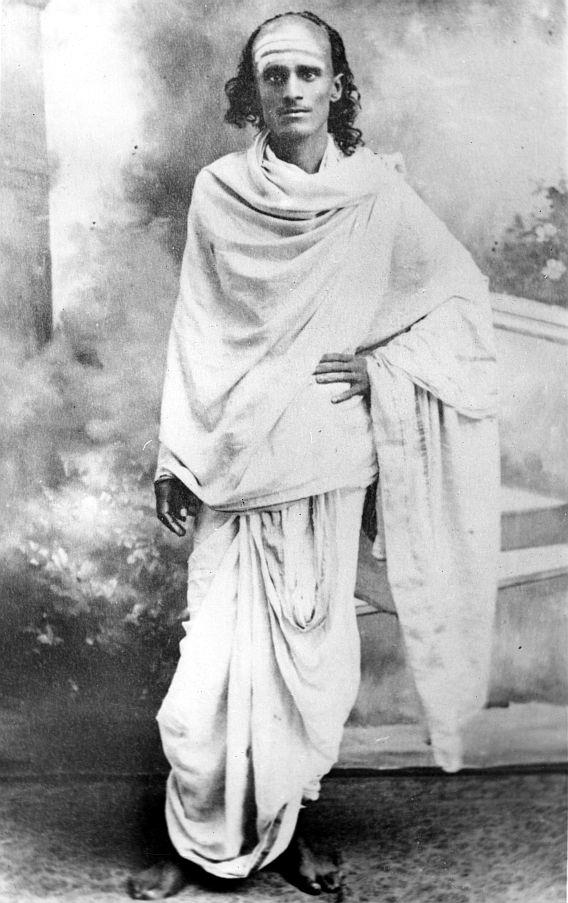
Kavyakantha in his younger days
Kavyakantha was a great man. Due to his intense penance, his kundalini rose. According to the scriptures, when the kundalini goes to the sahasrara, the crown of the head, its power passes through the head and reaches the sun. Kavyakantha did not want this to happen. Being Bhagavan’s disciple, he wanted Bhagavan to place his hand on his head. Kavyakantha later said, “The moment Bhagavan put his hands on my head, it was like cool moon rays raining down on me. The pain completely subsided.” Prior to this, some of Bhagavan’s other devotees reported seeing a faint vapour like substance rising from the top of Kavyakantha’s head.
My teacher T. K. Sundaresa Iyer, Kunju Swami, and Viswanatha Swami experienced another incident involving Bhagavan’s grace upon Nayana. At one time, while doing penance in a Ganesa temple in Tiruvottiyur near Chennai, Kavyakantha felt he was unable to progress spiritually. He prayed to Bhagavan, “Help me! Help me!” In response, he felt Bhagavan appearing before him, putting his hand on him, releasing him from his spiritual stagnation and then disappearing. Kavyakantha immediately told his disciples about what happened. At about the same time in Skandashram, Bhagavan collaborated, “I was lying down and all of a sudden my body started floating. I heard the word ‘Tiruvottiyur’ and walked down the main street. I saw a Ganesa temple and entered it. Then, I was suddenly back at Skandashram.” T. K. Sundaresa Iyer asked, “How did this happen, Bhagavan?” Bhagavan replied, “It is the sankalpa of Nayana. It was not my desire to go.” He continued, “With this experience I also understood how siddhas - legendary sages and saints - travel in the astral realm. Perhaps it was the same for me. Still, it was not mine but Kavyakantha’s desire that made it happen.”
One day, when Bhagavan was coming down the hill along with Nayana, Sundaresa Iyer and other devotees, he suddenly stopped and said, “Nayana, look at me right now! The sun, moon, stars and planets are revolving around my waist.” The onlookers could not see the spectacle but they did see Bhagavan’s body glowing with a brilliance. Overawed, the devotees prostrated in front of the master and chanted the sacred Purusha Suktham, a chant sung by ancient sages praising the Lord of the Universe where the sun and the moon are described as the two eyes of the Lord.
Bhagavan vouchsafed that after the kundalini and Tiruvottiyur experiences, an electric current had begun to pass through Kavyakantha’s body. Consequently, he could not walk barefoot on the earth without getting an electric shock. He began to wear wooden slippers but would reverently take them off in his master’s presence. Bhagavan would compassionately say, “Nayana is coming. He cannot walk barefoot. Place a non-conductor, a wooden plank, for him to sit on. Give him also a woollen blanket that he can walk on.”
We must respect Bhagavan’s relationship with Kavyakantha. How the master looked upon his disciples is more important than how a fellow disciple looked upon another. A sage like Bhagavan admired Nayana - that is what seekers and devotees of Bhagavan should consider. Devotees of Bhagavan are indebted to Kavyakantha Ganapati Muni: Firstly, he was the one who gave the master his celebrated, sacred name. Secondly, he was the first person who persuaded our master to start talking. Before him, Sivaprakasam Pillai, Gambhiram Seshayya and others assumed Bhagavan was in formal silence and received Bhagavan’s answers only in writing. It was to Kavyakantha that Bhagavan started giving answers orally. He was also the one who insisted that Bhagavan write a poem in Sanskrit in the arya metre. Bhagavan replied that he knew very little of Sanskrit and its metres. Kavyakantha explained the rules of the arya metre and repeated his request. A day later, Bhagavan presented to an amazed Kavyakantha , two flawless verses. Then, on the following day, he presented three more. It seems that the Muni exclaimed to his disciples, “Can any of us write like this?” These five verses form a hymn - Arunachala Pancharatnam - that is chanted daily in front of Bhagavan’s samadhi:
“Ocean of nectar full of grace, engulfing the universe, universal splendour, Oh Arunachala the supreme Self, be thou the sun and open the lotus of my Heart in bliss.
Oh Arunachala, in thee the picture of the universe is formed, has its stay and is dissolved. This is the sublime truth. Thou art the inner Self who dances in the Heart as I-I. Heart is thy name, my Lord!”
He who turns inward with untroubled mind to search where the consciousness of ‘I’ arises, realizes the Self and rests in thee Arunachala, like a river when it joins the ocean.
Abandoning the outer world, with mind and breath control to meditate on thee within, the yogi sees the light, Oh Arunachala, and finds his delight in thee.
He who dedicates his mind to thee, and seeing thee always beholds the universe as thy figure, he who at all times glorifies thee and loves thee as none other than the Self, he is the master without rival, being one with thee, Arunachala, eternally in thy bliss.”