T. K. Sundaresa Iyer
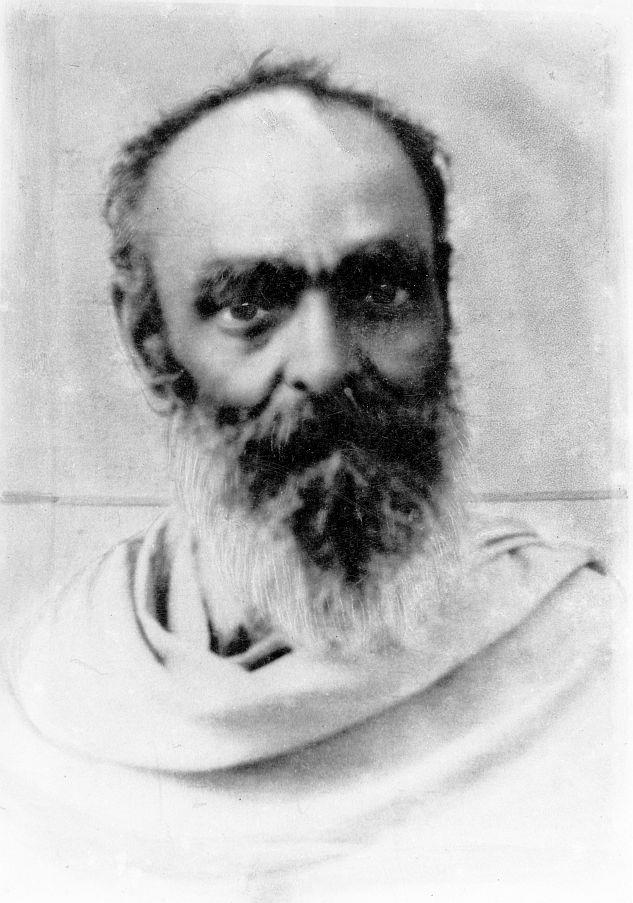
Every second we spend hearing or reading about the old devotees of Bhagavan, we naturally walk in their footsteps. And we move closer to that same Arunachala, the Self, in whom they were reabsorbed. Hearing about them from old devotees like Viswanatha Swami, Kunju Swami, Annamalai Swami and others, dissolved me into states of silent ecstasy. To experience this ecstasy, all we need to do is listen to Bhagavan: “Shift your attention from unreality to reality. Unreality is the body-mind complex and the world.” Let us shift our attention from the unreality of thoughts to the reality of living in the immortal presence of these glorious devotees.
In the Hindu culture and tradition, we are all familiar with the term ‘guru’, its meaning and significance. Nevertheless, a few may not recognize the significance of an upaguru. We owe equal respect to the upaguru, the one who points us to the guru. The upaguru may be a book, a tree, or a friend; it does not matter. The upaguru and the guru are to be looked upon with equal regard and reverence. We are as indebted to the upaguru as we are to the guru.
I happen to have two upagurus. My first upaguru is my mother. My first memory is of the time when I was one and a half years old. I was in the cradle and my mother was singing a lullaby - a Ramana lullaby. Every time she wanted to make me sleep, she sang that Ramana lullaby. When I close my eyes and pay attention to my Heart, even now, I can hear my mother singing that lullaby. She sowed the seeds of my devotion to my master. When I was a crawling baby, she would seat me in front of Bhagavan. When I grew up, she would tell me every day, “Go and prostrate before Bhagavan. Look at his eyes and receive his blessings.” When I began school and shared any episode with her, she would say, “Go and tell Bhagavan.” If I got a new pen, my mother would say, “Go and show it to Bhagavan, place it in his hand and receive it back.” Until she died, this loving mother’s one commandment to me was, “Bhagavan is enough for you. You need nothing else.”
My second upaguru is my school teacher T. K. Sundaresa Iyer. We used to call him TKS. His humility was exceptional and his simplicity extraordinary. He was my teacher in the sixth grade and paid a lot of attention to me. Every day, he would come to Ramanasramam. He took particular interest in me. He would call out, “Ganesa, come here, a holy man has come. Prostrate before him.” Or, “Ganesa come here, a lady saint has come, prostrate before her,” or, “This swamiji has come from the Shankara Mutt, prostrate before him.” He would prostrate and command me do so as well. So much so, that some people in Ramanasramam, would object to this and say, “TKS is a crazy man, and he is making Ganesan crazy too. He makes him prostrate before eccentric people, saying that they are all holy saints and sages.” I believe it is the extraordinary grace of my master, Bhagavan, which guided me to TKS, my teacher.
Later, when I grew up, it was he who introduced me to the sages and saints of India, either in the body or without the body. It was he who directed me to Swami Ramdas. TKS had this intuition that Swami Ramdas would guide me. Swami Ramdas saw that his spiritual heir, Mother Krishna Bai, was the one to guide me all my life. There were a few living saints, like Tiruchi Swami; even when he was almost unknown, TKS would make me prostrate before him. When Yogi Ramsuratkumar was absolutely unknown in Tiruvannamalai, he would sit in silence with TKS for hours. One day, TKS pointing at Yogi told me, “Ganesa, here is a siddha purusha, give him some food, he is hungry.” I ran to the kitchen, brought food and offered it to Yogi.
The only process by which the spiritual Heart opens up is that which my master Bhagavan Sri Ramana Maharshi described, “It is like a lotus bud in which the petals have to be opened. Only when the petals open, can you have spiritual experiences.” Reading scriptures or practicing spiritual disciplines cannot open these petals. No yoga can open it. Only the look, the proximity and the blessings of holy people who have already trodden the path works; just by one look they can make one petal open in your heart. This is not just a euphemism. For me, each petal was opened by contact with a particular master.
Once, I asked TKS, “When we have Bhagavan as our teacher, why are you directing me to saints?” He gave me this beautiful clarification, “Bhagavan is the vast ocean. He is the cosmic consciousness, while all the sages and saintly people are like rivers. Where do you stand Ganesan? I want you to be at least a drop of water. You come to know yourself to be a drop of water only when you recognize the love of the rivers, rivulets and streams that actually take you to the ocean. The ultimate end of all movement of water, our scriptures say, is to reach the vast ocean from where it comes. It is a cycle. To be a part of the ocean you must become conscious that you are already a drop of water. That drop of water has to merge with rivers to reach the ocean. A drop of water will not otherwise be able to be the ocean.” This teacher taught me humility, silence, and the greatness of sages and devout people. Without recognizing the greatness of saintly people, humility will not come, because one will be dominated by the worldly mind. It was he who revealed to me for the first time that Arunachala is Ramana and Ramana is Arunachala, the Self.
In the early days of my life as a resident of the Ashram in the 1960s, I realised by dint of my study of Sri Bhagavan's books on 'Self--Enquiry' ; and, thanks to my association with the direct disciples of Sri Bhagavan, the uniqueness of His ' Direct Teaching' of 'Self--Enquiry. However, in my youthful fervour and enthusiasm, I began to think poorly of the efficacy of other less direct paths, such as 'Bhakti ', 'Karma ' and 'Yoga '. Little did it occur to me that Sri Bhagavan Himself has often spoken in praise of such systems, though He always taught that they ultimately merge in 'Self--Enquiry' !
The watchful and caring eyes of my teacher T.K. Sundaresa Iyer, did not miss all this. He came to me, one night, and gave me an Ashram Library book :" The Life and Teachings of Sri Ramakrishna Paramahamsa " by his 'Eastern and Western Devotees' [ 400 and odd pages ] and insisted that I read it. By the time I had read 50 pages, my whole being bowed down before this Great Saint of Dakshineshwar ; and, my spiritual life attained a new dimension ! From then on, Sri Bhagavan's "Vachanamrutam" [ "Talks with Sri Ramana Maharshi" ] and Sri Ramakrishna's "Kathamrutam" [ "The Gospel of Sri Ramakrishna" ] became my supreme spiritual guides. During my spiritual Inner Journey, I could meet with nearly thirty Mahatmas, who opened one inner window after the other in me !
I understood the immense wisdom and importance of what Sri Bhagavan once declared : "What I preach is 'devotional enquiry' !" and " The absence of thoughts is ' Bhakti ' . It is also ' Mukti '. The ' Jnana ' method is said to be ' Vichara ' (Enquiry ). That is nothing but 'Supreme Devotion' ( 'Para Bhakti' ). The difference is in words only." -- [ "Talks " No.650 ]
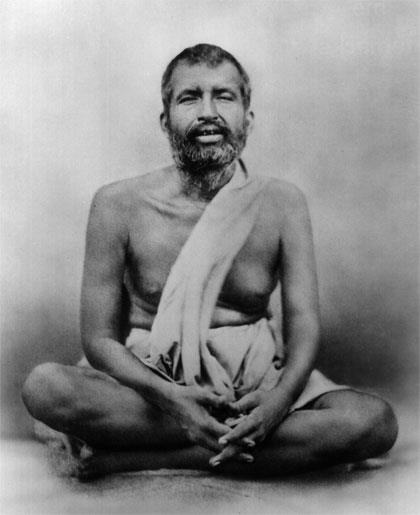
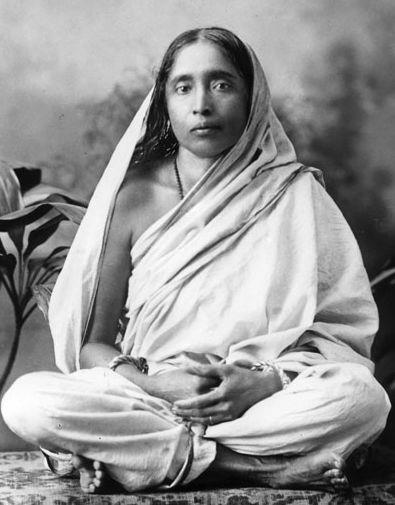
Sri Ramakrishna Paramahamsa and Mother Sarada Devi
TKS came to Bhagavan in 1903, when Bhagavan was in Virupaksha cave. He was then just twelve years old. One of his relatives told him, “Lord Arunachala himself is seated in human form in Virupaksha cave.” In those days, Bhagavan was mostly in silence. Rarely would he utter a word or two. When TKS came, Bhagavan, who had his eyes closed, opened them and blessed him with a glance of grace. Later, TKS told me, “It was not a human body that I saw. It was a living statue of burnished gold. Bhagavan looked at me. There were about ten people around him singing Tamil songs when Bhagavan very compassionately looked at me and asked, ‘Won’t you sing a song for me?’ It was a surprise for everyone else because Bhagavan was mostly in silence and rarely asked for anything.” A thrilled TKS sang a song by the saint Sundarar, one of the sixty three saints about whom Bhagavan had read in Periapuranam. The translation of the song is, “No other support do I have except your holy feet, oh Lord, by holding onto them I shall win your grace. Ancient sages have sung your praises. Oh Lord! Grant me the boon that my tongue should constantly repeat your sacred name even if my mind strays away.” When TKS finished, Bhagavan was very happy. He said, “Yes, yes, that is what should be done.” This became the first upadesa for this twelve year old boy. All his life, until his last moment, he carried with him three or four books containing hundreds of Tamil songs composed by saints and sages. This first upadesa was his guiding light.
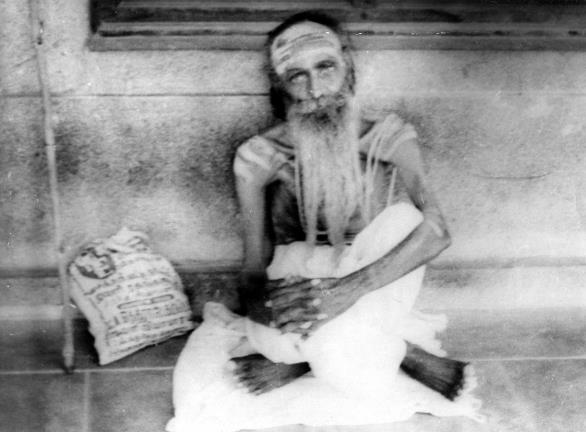
T K Sundaresa Iyer immersed in Silence
Every day, this boy would go to Virupaksha cave and spend time with Bhagavan. In the course of time, he became a teacher. He began to have doubts about his spiritual development. One day, he felt, “Why should I go and be with this saint? I am not improving at all. There is no perceptible change in me.” For three months he did not go to Bhagavan. One night, he woke up and saw his pillow wet with tears. He felt, “Oh, I miss my guru!” Early in the morning, he ran up the hill. Bhagavan, who was now staying in Skandashram, stepped out just then and waited for TKS. When TKS saw Bhagavan in the distance, he could not control his emotions. He ran crying, fell at his feet and drenching them with his tears said, “Bhagavan! Please forgive me!” Bhagavan lifted him up and said, “This is the hundredth day.” Bhagavan, had been counting. “It is hundred days since you came. What happened to you?” TKS replied, “Bhagavan I am sorry I have not come, I have done a foolish thing. But, Bhagavan, I did not see any improvement within me and I did not feel any benefit by coming and sitting with you.” Bhagavan said, “Well, that is all right. You did not see any benefit, but did you not feel the loss?” Recollecting this, TKS told me, “We go to Bhagavan not to have any benefit from him. Without him, we have no life whatsoever. We should not miss the opportunity of having this bliss within our Heart, otherwise we will miss that.”
Because of his meagre income as a school teacher, TKS could afford to take only a small quantity of sugar candy or puffed rice as an offering to Bhagavan. One day, he did not have even that much. Sad, he went empty handed and fell at the feet of Bhagavan, “Bhagavan, I am so unhappy. I do not have any money, so I could not bring you any offering.” Bhagavan smiled and said, “Why, you brought the most important thing. Everything else is unimportant.” TKS was puzzled. “You brought yourself!” declared Bhagavan. The case in point here is that you should never exclude yourself from the spiritual journey. It is very easy to extol the guru and his teachings. In the process, you should never exclude yourself - you are equally important.
As the days passed, he was often filled with doubts. Once, he asked Bhagavan, “What is that one thing Bhagavan, knowing which all doubts are resolved?” Bhagavan replied, “Know the doubter; if the doubter be held, the doubts will not arise. Recognize for certain that all are jnanis, all are realized beings. Only a few are aware of this fact. Therefore, doubts arise. Doubts must be uprooted. This means, that the doubter must be uprooted. When the doubter ceases to exist, no doubts will rise. Here, the doubter means the mind.” TKS asked, “What is the method, Bhagavan?” Bhagavan answered sharply, “Enquire ‘Who am I?’ This investigation alone will remove and uproot the doubter mind and thus establish one in the Self, the transcendental state.”
On another occasion, TKS had another doubt. He was a pundit, a traditional man, who had read many scriptures. Thus, the six chakras, the psychic centres, kundalini and so on, fascinated him. He asked Bhagavan about them and Bhagavan replied, “The Self alone is to be realized. Kundalini shakti, visions of God, occult powers and their spell binding displays are all in the Self. Those who speak of these and indulge in these have not realized the Self. Self is in the Heart and is the Heart itself. All other forms of manifestations are in the brain. The brain itself gets its power from the Heart. Remaining in the Heart is realizing the Self. Instead of doing that, to be attracted by brain oriented forms of disciplines and methods is a sheer waste of time. Is it not foolish to hold on to so many efforts and so many disciplines that are said to be necessary for eradicating the non-existent ignorance?”
In 1920, Bhagavan introduced TKS to Kavyakantha Ganapati Muni who was then living in the Mango Tree cave. Every day, TKS would visit Bhagavan, so Bhagavan told him, “Go to Nayana. Learn the Rig Veda and other scriptures.” When TKS met Nayana, he was spellbound by his brilliance, his aura and his tremendous achievements in traditional knowledge. He submitted himself as a student and started learning the scriptures. Every day, both Nayana and he would go to Bhagavan, and Bhagavan would give them guidance. But TKS at that tender age was overwhelmed by the magnitude of Nayana’s erudition. One day, he expressed this, but Nayana corrected him. He said, “Sundaresa, without Sri Bhagavan’s grace the intricacies of the scriptures are beyond one’s power of understanding. One word from Bhagavan makes everything clear.” He then understood what tremendous respect Nayana had for Bhagavan.
We saw three events in the chapter on Kavyakantha Ganapati Muni - the extraordinary experience of the rising of his kundalini, the remarkable manner in which Uma Sahasram was completed and Bhagavan declaring to Nayana that the sun, moon and stars were going around his waist. TKS had the golden opportunity of being present on all the three occasions. He affirmed to me that they were the rarest gifts showered on him for being close to Nayana.
Kavyakantha had about two hundred odd scholarly devotees. To all of them he said, “From now on, I am not your guru; Bhagavan Sri Ramana Maharshi is.” Sometime after Bhagavan had come down from the Hill to the present ashram, these scholars, well placed in the world, felt that the future of Ramanasramam was looking bright. They felt that if Nayana ultimately became the manager of Ramanasramam it would augur well for the ashram’s future. There was another group who wanted Bhagavan’s brother Niranjanananda Swami to become the manager. One day, Nayana and his devotees went to the hall and Nayana’s devotees appealed to Bhagavan, “Bhagavan, we all feel that Nayana should become the manager.” Bhagavan, after a long silence, instead of replying to the devotees, turned to Nayana, “Nayana, why do you get involved in such things? Let him take over and suffer.” In Tamil, he used the words ‘avane kattindu azhattum,’ meaning, ‘let him hug this and cry.’ Nayana prostrated before Bhagavan, got up and declared, “Bhagavan, from now on, Chinna Swami will be the manager.”
When he took leave, the other devotees also came out. Nayana told TKS, “From today, all of us must give unconditional support to Chinna Swami to manage the ashram.” TKS took this very seriously. By that time, Nayana had already started a huge society with over ten thousand members to work for the independence of India. They intended to chant mantras all over India. TKS was the general secretary and Nayana was its president. But when Nayana said, “You will extend full support to Chinna Swami,” TKS started working in the ashram office. A deeply spiritual man and a scholar in the Vedas, TKS was also a pundit. He knew three languages - Sanskrit, Tamil and English. He was therefore entrusted with the ashram correspondence. He took that opportunity to be in close contact with Bhagavan. He would take every spiritual seeker’s letter that came to Bhagavan and ask for his suggestions. Bhagavan would explain what was required and he would write it, come back again and show it to Bhagavan for his approval before sending the reply.
Bhagavan had already written many verses and teachings like Who am I? and Self Enquiry. Some of the scholarly devotees wanted everything to be collected and brought out as the Collected Works of Ramana Maharshi. They gathered all the Tamil works of Bhagavan and sent it to the press. But a preface still needed to be written. Muruganar and Natanananda were both Tamil scholars, but they backed out saying, “How are we qualified to write a preface to Bhagavan’s original writings?” There was much hesitation in the ashram and the preface was thus pending. One day, TKS came very late at night from the town. When he entered the hall, Bhagavan told him, “Why don’t you write the preface yourself?” He was shocked but he knew that whatever came out from Bhagavan was the truth and a commandment. He said, “Bhagavan, how can I write? But with your grace, what is not possible?” Bhagavan said, “Write it. It will come all right.” He sat down, looked at Bhagavan and the writing flowed. When he completed it, he placed it at Bhagavan’s holy feet and Bhagavan read it. Since Bhagavan had read it, TKS started to leave. But Bhagavan called him back, “Come. Why have you said ‘It is hoped’? Why not say, ‘It is certain’?” So saying, he effected one change in the last sentence of the preface: “It is hoped that Sri Bhagavan’s grace, in the form of these collected works, will give liberation and bliss to all seekers who take these collected works into their Heart.” Bhagavan changed ‘It is hoped’ to ‘It is certain’. The Tamil word was ‘nambugiren’, ‘it is hoped’. Bhagavan changed it into ‘thinnam’. ‘Thinnam’ in Tamil means ‘absolutely certain’. After Bhagavan’s correction, the preface ended with this assurance: “It is absolutely certain that Sri Bhagavan’s grace in the form of these collected works, will give liberation and bliss to all seekers who take these collected works into their Heart.” (To this day, there are many who are being guided by this book, and many whose life breath is the collected works of Bhagavan, either in the original Tamil or in translations. My friend, philosopher and guide, Arthur Osborne, used to swear by The Collected Works of Ramana Maharshi.)
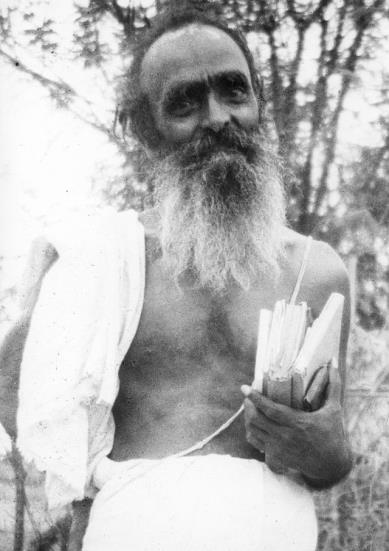
“My teacher” TKS holding ‘Nool Thirattu’
The collected works were originally only in Tamil. Arthur Osborne felt that it should be translated into English and made available all over the world. He had already found a publisher in London. Only a few verses had been translated into English. There was much work to be done but nobody was assisting Arthur Osborne. It was my teacher, TKS, who sat along with Arthur Osborne and helped him. When Osborne went home, TKS would dictate to me and I would type it and give it later to Osborne. Thus, it was left to my great good fortune to type out the entire text of this most sacred work.
My teacher TKS was also a very good poet in composing Tamil verses. He wrote six verses glorifying satguru Ramana. When he placed these poems at the feet of Bhagavan, again Bhagavan corrected only one word in verse 5. Instead of “whose grace is flowing, blessing all,” he changed it to “whose grace is directed, blessing all.” TKS explained to me that grace is the divine power always available to all. In the relationship between the teacher and the taught, it is the guru who helps channelise the grace to be imbibed by the disciple. The change that Bhagavan made was from ‘payum’ (‘is flowing’) to ‘paichchum’ (‘is directed’). What a subtle yet sublime transformation!
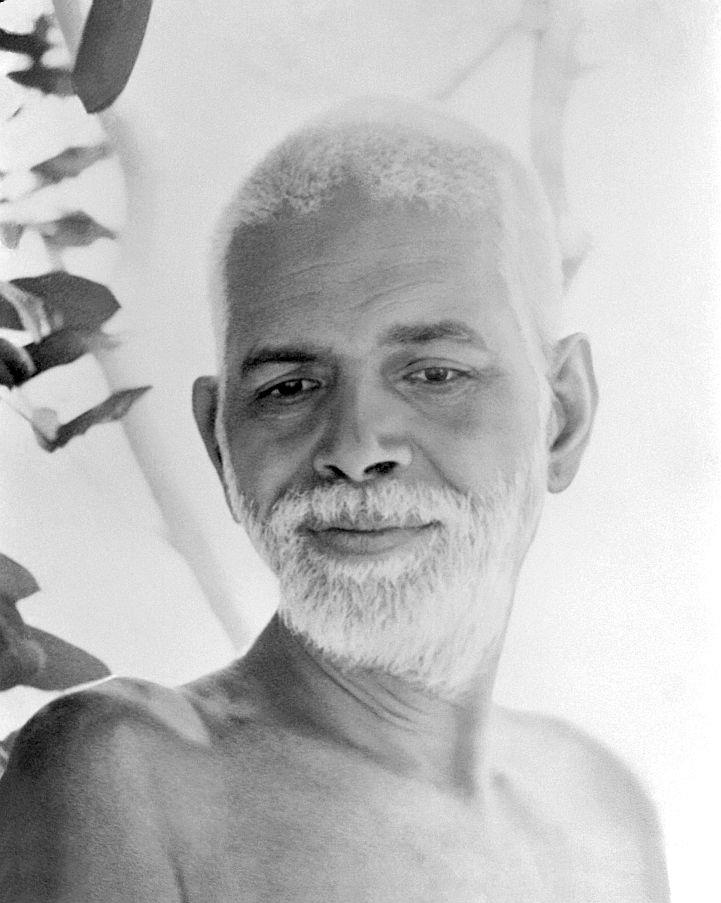
In 1963, there was a German mystic, Lucy Cornelsson, who studied Tamil while staying in Germany, because she wanted to translate Bhagavan’s collected works from original Tamil to German. She translated it and wanted a verification of it. So, she came to the ashram but nobody helped her. Again, it was TKS who told me, “She is a mystic, prostrate before her.” (Lucy became Lucy Ma for me.) The collected works in German were verified and perfected with the help of TKS. Though an erudite scholar, he was the epitome of simplicity. Many people did not know about TKS because he was so unobtrusive.
Once, when I was typing a long passage dictated by TKS in the office, Duncan Greenlees, a westerner devoted to Bhagavan’s teaching came in. “What are you typing? May I read it?” I said, “Yes, of course.” It was a beautiful passage of Bhagavan’s teachings. He said, “Can you tell me who wrote this?” I replied, “My teacher TKS.” “Do you have any more of his writings?” he asked. I replied, “I have got six or seven files.” Duncan Greenlees pleaded with me, “Will you please give me these files? I will take them and edit them.” This much acclaimed book that Duncan Greenlees edited so ably is At the Feet of Bhagavan. When Greenlees brought the manuscript, he asked me, “What title can we give it?” I suggested that it be called At the Feet of Bhagavan. TKS was very happy and said, “Go and place it at the feet of Bhagavan.” I took the manuscript to Bhagavan’s shrine.
I spent hours with TKS. Most of the time, he would be silent. He would take me around the hill or up the hill to Skandashram. Sometimes, when he spoke, he would say things of tremendous interest. He once told me, “Ganesan, when I was with Bhagavan he once told me, ‘Siddha purushas living in Tiruvannamalai, India, and elsewhere in the world, all come to Arunachala to go around the hill. Sometimes, they come in the form of light.’” Bhagavan told TKS and some others that he had seen this light. He continued, “If one has true devotion, one can see the light.” TKS told me, “Many of us old devotees have seen that light moving around Arunachala. Have a longing, Ganesa, but do not expect, do not put a time frame, do not even say it must be seen and do not have arrogance. Have complete, prayerful humility and it will be revealed.”
I would like to share with you that I have seen this light not once, but three times. The first time I was alone and the second time I was with a Japanese group. I was sharing with them that this light could be seen; they sincerely asked, “Can we also see it?” I looked and it was there. All of them saw it and all of them prostrated before it. The third time was in 2003. It was around 6.30 p.m. when I was going round Arunachala with a group of devotees from Madurai (around 60 of them), Nochur Venkataraman and a few others around the hill. As we were approaching the pancha-mukha darshan spot, we decided to sit on a rock. As we sat, the Madurai devotees realized that it was getting late for dinner at the ashram. Saying so, they left us. I suddenly remembered that T.R. Ramachandran, a close friend of mine, used to chant the Shivopasana Mantra (....sadyo jaatam prapadyaami sadyo jaataaya vai namo namah...), whenever we sat on this rock. I asked Nochur Venkataraman whether he could chant that. He chanted the mantra, while we sat there listening to it. Soon after the chant, we prostrated and as we got up, we all saw the light.
One day, some Vedic scholars along with TKS, were going around the hill chanting the Sama Veda. They suddenly saw four or five tigers seated in the middle of the road. Petrified, they stopped chanting. For a long time, the tigers looked at them and then got up and disappeared into the forest. Bhagavan was at Skandashram. TKS ran to him and told him what had occurred. Bhagavan said, “Why did you stop chanting the Vedas? They were siddha purushas, eager to listen to your chants. You should have continued chanting the Vedas.”
TKS told me that inside the mystical Arunachala, there are vast realms. He said that Bhagavan had shared this vision with him. Thrice, Bhagavan had visions of being inside the hill. TKS said he had also had that experience. I would like to reveal that I have also had this experience of being inside the hill. Have faith, trust the mystery, have devotion, be humble, and surrender. If a person is elder to you even by a day, prostrate to him or to her and then humility will come, and you will enjoy this spiritual freedom. Prostrating to another person is not enslavement. It is freedom, blissful spiritual freedom. However, it is more important to have ‘Arunachala’ in our Heart – ‘agamey ninaippavar’ (“ அகமே நினைப்பவர் ” ).
Bhagavan was very kind. Once, Chinna Swami had a quarrel with TKS because he had gone and prostrated before a saintly lady. “When Bhagavan is here, why did you go and prostrate before someone else?” shouted Chinna Swami. TKS was upset and so did not have his food. Early next morning, when he arrived, Bhagavan was making idlis in the kitchen and saw his disturbed face. He said, “Come on, sit down and eat some idlis.” TKS replied, “Bhagavan, I have to rush to the school, I have classes.” “Hey, the cat is out of the bag! Today is Sunday, which classes are you teaching? Come on, sit down.” Bhagavan brought a leaf and put it there. “I have made some special sambar.” Bhagavan sat next to him and piled up the idlis. TKS later said, “I have never eaten so many idlis in my life!”
In his earlier days at Ramanasramam, Bhagavan would dry his towel on a clothes line at the farther end of the hall. There was a sparrow’s nest with three or four eggs there. One day, while Bhagavan was pulling out the towel, one egg fell down and cracked. Bhagavan was taken aback. He told the attendant, “Look, look! See what I have done today!” He took it up and looking at it tenderly, exclaimed, “Oh, the poor mother will be so sorrow stricken; perhaps even angry with me for causing the destruction of her expected little one! Can the cracked eggshell be pieced together again? Let us try!” He then put a wet cloth around the egg and said, “I hope Arunachala will save me from this sin.” He put it back and every few hours he would come and change the wet cloth. After seven days, he saw that the crack had healed and said, “Look! What a wonder! The crack has closed, and so the mother will be happy and will hatch her egg. Arunachala has freed me from the sin of causing the loss of a life!” One fine morning, the egg hatched and the little young one came out. With a gleeful face, Bhagavan took the chick in his hand, caressed it with his lips, stroked it with his soft hands and passed it on for all to admire.
Once, TKS narrated to me a special dimension in Bhagavan’s solicitude: “Bhagavan’s solicitude towards the wives of those serious seekers who chose to be with Bhagavan at Arunachala and serve him, was extraordinary.” He referred to many incidents that took place in the lives of Muruganar’s wife, sub-registrar Narayana Iyer’s wife and my mother Nagalakshmi. In that light, he unfolded a page from his life’s book. TKS had lost his wife, leaving him with a son. This plunged him deeply into spiritual striving. But, his elder relatives pressurized him to marry again. TKS stoutly refused. One day, unable to deal with their continued pressure, he went to Bhagavan’s presence. Bhagavan was up on the hill. Looking at him, Bhagavan said, “Allow life to take its own course. Do not resist. All will be well at the end.” He further added, “When one is directly under the sun, can darkness ever creep in?” TKS agreed to marry again. His second wife bore him two children. Bhagavan was extraordinarily kind to TKS’s second wife, paying special attention to her whenever she happened to be in his presence. TKS told me that many of the scholar devotees and affluent devotees ignored him. He reasoned it out by saying, “Perhaps, their dislike was due to my being very poor and not possessing any academic qualifications. They used to openly insult me saying, ‘After all, you are only a school teacher!’” When I became morose and sad on hearing this, TKS patted me on my back and said, “Bhagavan always treated me with extraordinary love, affection and care. Can there be a more fulfilling treatment meted out to me than Bhagavan’s solicitude?”
In 1933, at the age of thirty six, TKS still felt incomplete. So he prayed to Bhagavan, “Bhagavan, show me your real form.” Bhagavan said, “Sit down there,” and directed his glance of grace. TKS’s Heart opened, and he closed his eyes in ecstasy. Bhagavan told him, “Whatever you want to see, see now.” TKS’s chosen form of God was Rama, so he asked to see Rama. For two hours, he had the darshan of Rama crowned, seated on the throne with his wife Sita, surrounded by his brothers and with Hanuman, the monkey devotee, at his holy feet. When he came out of ecstasy, Bhagavan asked, “What did you see?” TKS shared the description of what he had seen. Bhagavan said, “Go and bring Dakshinamoorthy Ashtottaram.” (Ashtottaram means one hundred and eight names). “Read the fifth verse. In it, the name given to Dakshinamoorthy is ‘Yoga Pattabhiramaya Namaha’, which means Dakshinamoorthy is Rama. It is said that Rama’s capital city, Ayodhya, has eight corners and nine gates. Tiruvannamalai has eight corners and nine gates; Tiruvannamalai is Ayodhya and Rama is Arunachala (Dakshinamoorthy).” TKS said, “I wanted a God, a scripture and a devata (a god in form) to be worshipped. Bhagavan became my universal God, his collected works became my scriptures and Rama was my devata; Bhagavan proved that he was Rama by giving me Rama darshan.”
Once, I asked him, “How did you compose the mantra Om Namo Bhagavate Sri Ramanaya?” TKS was kind enough to share the following: “From my early childhood, I was deeply devoted to Lord Krishna. Generations after generations of our family were initiated into the mantra, ‘Om Namo Bhagavate Vasudevaya.’ Vasudeva is another name for Sri Krishna. Hence, I read with great interest and delight the Bhagavad Gita and Srimad Bhagavatam. I longed to have the vision of Sri Krishna. One day, a line from the Bhagavad Gita where Lord Krishna declares, “Jnani tu atmaiva mey matam…” meaning, ‘The jnani is my own Self’, went deep into my heart. I thought, while I have at hand Bhagavan Ramana, who is himself Vasudeva, why should I worship and long to have the vision of Sri Krishna separately? Thus, I contemplated: ‘I want one single mantra, a single God and a single scripture, so that there is no conflict of loyalties.’ Suddenly, it dawned within my heart, ‘Om Namo Bhagavate Sri Ramanaya’. My Heart continued resounding with it without a gap. I ran to Bhagavan and told him of the advent of the sacred mantra. He bestowed the mantra with his full approval. Later, I counted the syllables in the new mantra. It was twelve. The Vasudeva mantra too, contained twelve syllables. I was delighted. Coming to know of Bhagavan’s full approval of the mantra, the ashram management accepted it so fully that they even altered the original ashram crest so that beneath the symbol of ‘Om’ the words ‘Sri Ramanasramam’ was replaced with ‘Namo Bhagavate Sri Ramanaya’.”
Before coming and settling down permanently at the ashram, I had worked in two different firms. I had divided my first month’s salary from each firm into two and sent it to my two upagurus - my mother and my teacher, TKS. Those were the last days of my revered teacher. He was very seriously ill and bed ridden in a house opposite the ashram. I was visiting him every day. It was his last day. He said, “Ganesa! These people who look after me are very poor people. So, please utilize the amount in this envelope for my funeral expenses. I want you to carry my body, chanting ‘Arunachala Siva ’ all the way to the cremation ground.”
Though I was crying all the time, I asked him, “How did you get so much money?” He smiled graciously, and said, “You remember, twice you had sent me your first month’s salary for my daily expenses. I did not spend it; they were so dear to my heart. Now, you yourself can spend it on my last journey - back to Arunachala!” He gave me a pat on my head and said, “This is my blessing to you! See! I am giving you my all!” Can anything else in the world equal the beauty and splendour of that single touch of wisdom?!
“Oh Lord! Grant me the boon that my tongue should constantly repeat your sacred name even if my mind strays away”.
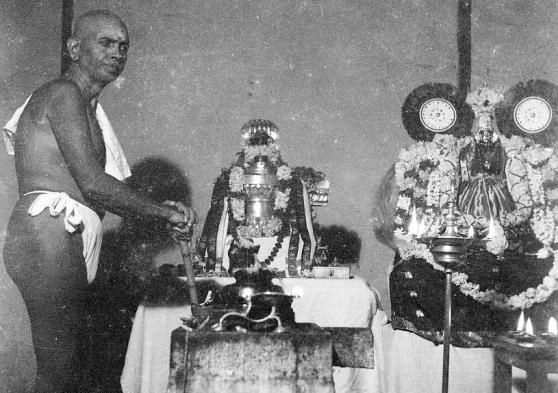
Bhagavan inside the old Mother’s shrine
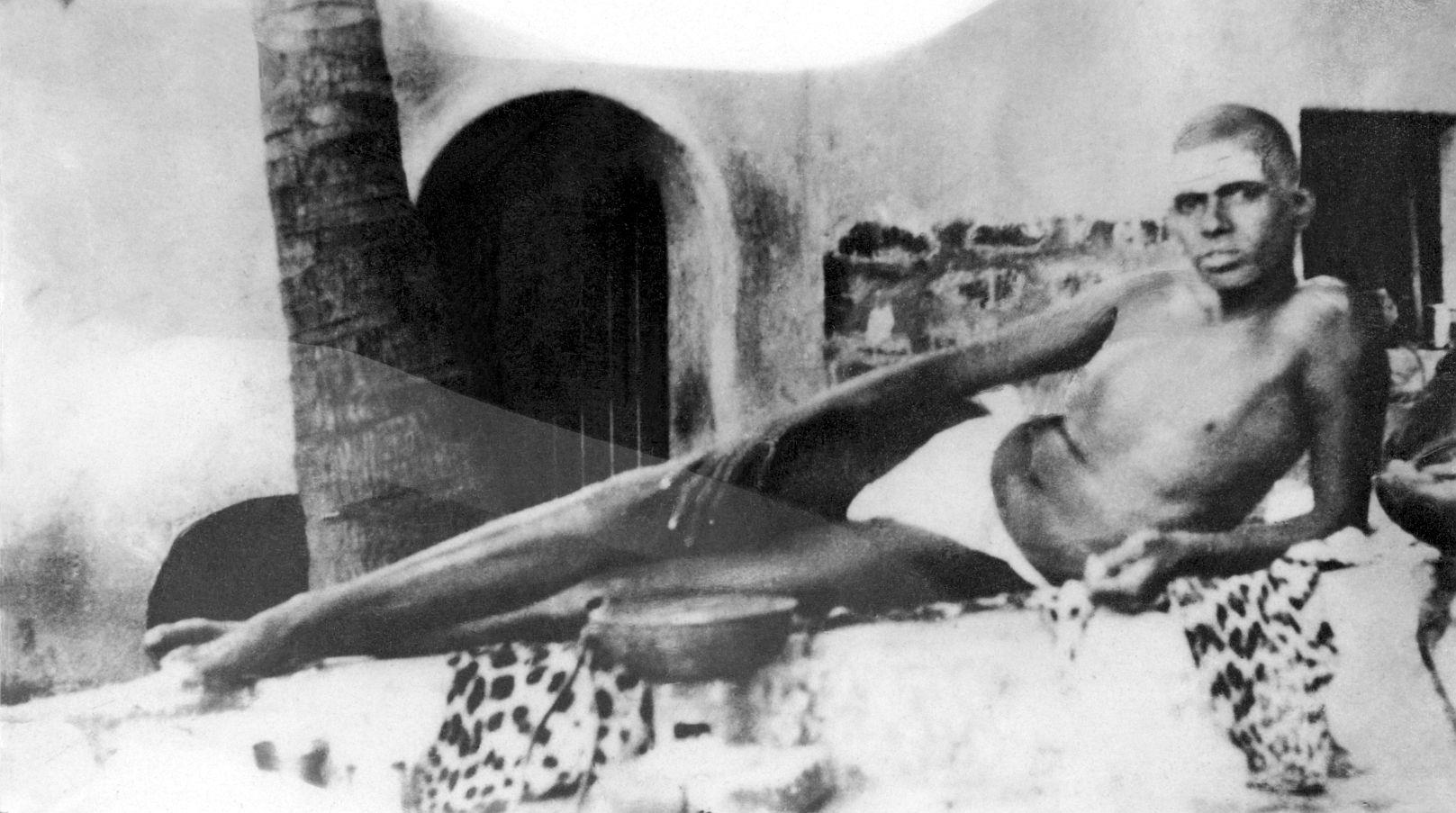
Bhagavan at Skandashram where Shastri Mama first met Him