Venkatesa Shastri
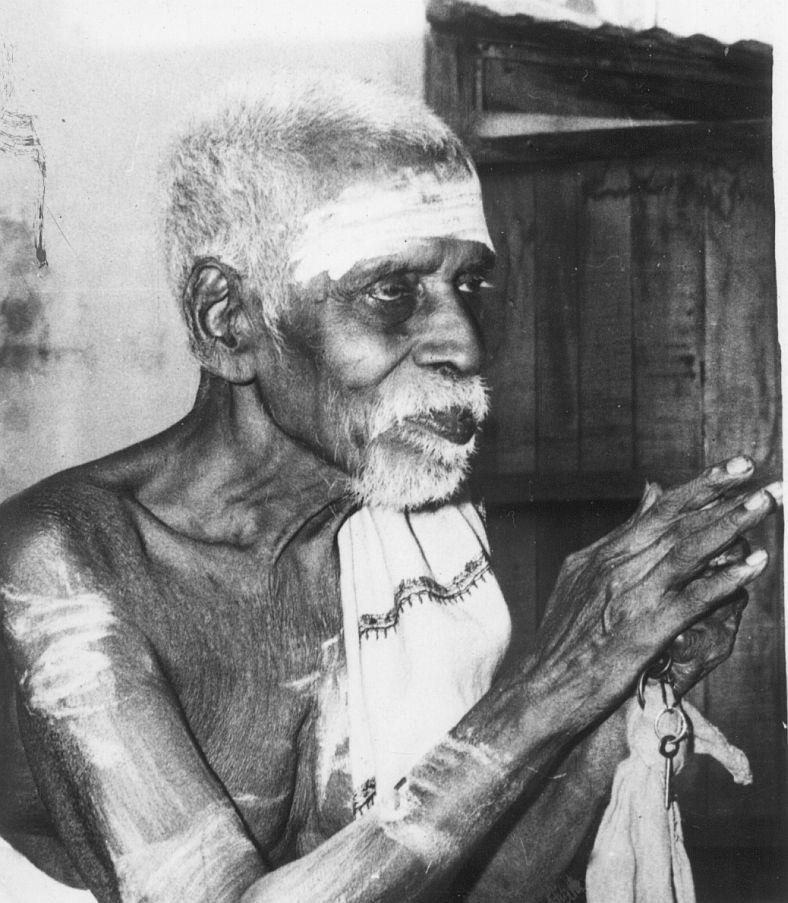
Legendary masters, right from the Vedic rishis to Bhagavan, left their teachings so that we regain the natural state of being that they are established in. The fact is that whoever listens to or reads the teaching should intend to be that - not through an act of change, but by just ‘being’. A significant teaching in Who am I? is detachment or desirelessness. This is not different from wisdom. Desirelessness is refraining from turning the mind outwards to any object. Wisdom means the appearance of no object. In other words, not seeking anything other than the Self is detachment or desirelessness; not leaving the Self is wisdom.
One of Bhagavan’s ardent devotees, a simple and humble man, practiced these two - absolute detachment and shining wisdom - in a very natural and remarkable way. He was none other than Venkatesa Shastri, or Shastri Mama as we fondly called him. (Shastra means scriptures and one who has mastered the Vedas is given the surname Shastri. Mama means uncle in Tamil.) He lived in the world, but was untouched by it. Soaked in wisdom at all times, he showed that there is no contradiction between work and wisdom.
Shastri Mama was Bhagavan’s distant cousin. His mother passed away when he was very young and his father married a second time. Though his stepmother often tortured and ill treated him, he suffered her atrocities silently. When he was three years old, she twisted his hand and thrust it into the kitchen fire. His fingers were permanently deformed, but he bore the scar of the horrific incident uncomplainingly. His father, unable to mend his wife’s ways, took him further south to Kochi in Kerala where he thought his son would be happier. He enrolled him in a residential school of ayurveda which also taught astrology. Fortunately, the mentor of that school was the head of the royal family of Kochi, an impressive astrologer and ayurvedic doctor himself.
Shastri Mama was exceptionally brilliant. Within a year, he mastered thousands of Sanskrit verses which normally took over fifteen years to learn. The teacher was so impressed by this boy’s genius that he decided to mentor him personally. He took his protégé back with him to his palace and told him, “Ordinary astrology is not your subject. I am going to teach you prashna, the highest form of astrology.” The literal meaning of the word prashna is question. In ordinary astrology, when a child is born, a horoscope is cast based on the planetary alignments at the time of birth. The horoscope is referred to throughout the child’s life and his or her future is predicted through an intellectual interpretation of planetary alignments in the horoscope. On the other hand, a person who has mastered prashna does not need the horoscope; instead, he mentally draws the birth chart based on mathematical calculations using the time of questioning, the name, the direction which the questioner is facing, the place from where he hails, his father’s name, his mother’s name, the first letter of the sentence of the question, the first word of the question, etc. He then taps into his well of higher intuitive knowledge and waits for an answer. The predictions come from within. Needless to say, they are accurate because they come from the intuition, inner understanding.
When Shastri Mama completed his course, he was obliged, as per Hindu custom to give his teacher guru dakshina - an offering made in gratitude for knowledge imparted. The teacher was very proud of him but knew that Venkatesa Shastri was too poor to give him anything. He said, “I am going to ask you for guru dakshina.” “Whatever you want, my master, please let me know,” his disciple replied. The teacher gave him a picture of Lord Subramania, the second son of Lord Siva. Subramania is the god of wisdom, silence and absolute detachment. “Worship him and he will guide you all your life. This is the guru dakshina I want from you,” the teacher said. Shastri Mama took his teacher’s gift as his blessings and went back to his village. He became a renowned and prosperous astrologer whose predictions were always accurate.
One day, one of his uncles brought him a picture of Bhagavan Ramana Maharshi. Shastri Mama placed the picture with reverence in his pooja room, next to Lord Subramania’s picture. One morning, when meditating, he opened his eyes and saw the picture of Bhagavan transforming into the Lord’s picture and the Lord’s picture turning into Bhagavan’s image. Unsure whether it was a dream or vision, he observed this transfiguration for nearly half an hour. He felt that perhaps his teacher had wanted him to have Lord Subramania in human form to be his guide all his life. So, in 1917, he came to visit Bhagavan at Skandashram. As soon as he arrived, Mother Azhagammal recognized him as her relative. Bhagavan too, concurred, “Yes, I know, he is Subbu’s son.” Before meeting Bhagavan, most of his devotees had only heard his name and had no idea of his spiritual stature. Therefore, none had any preconceived notions of his significance. But, all realized it in their first meeting with him. Similarly, when Shastri Mama saw Bhagavan, he realized he had found his Lord and guru - the Lord of renunciation, wisdom and silence - even though Bhagavan had not yet spoken a single word to him.
He was convinced that prashna, his chosen branch of astrology, was the most perfect science. He mustered courage, approached Bhagavan and in all humility, yet with full conviction, put the following question: “Bhagavan! Is not astrology the best and most accurate of all sciences?” Bhagavan looked at him intently for some time. Slowly, but firmly, he replied, “The science of the Self is superior to all other sciences.” Shastri Mama was at the height of his career and every prediction of his was very handsomely rewarded. He was thus earning a lot of money, amassing wealth. These conclusive words from the master sowed the seed of renunciation in him. He felt it was futile to live in an ever changing world and decided to live with his master. But, according to Hindu custom, if an elderly relative is present, one must take guidance from him or her. So, he went to Bhagavan’s mother and said, “I want to renounce the world and stay with Bhagavan.” “How can you do that?” she exclaimed. “We have decided on a girl for you right from your childhood and she is waiting for you. You must honour this commitment and marry her. How can you come away here?” Shastri Mama glanced at Bhagavan. Bhagavan gave a smile of approval. Shastri Mama went back to his village, married the girl - her name was Visalakshi, and she was called Sala. He then lived very happily for a few years as a successful astrologer.
The following is an example of his mastery of prashna: After his marriage, he spent much of his time in his pooja room. Once, when he had a visitor, Sala informed him, “Nagappa Chettiar has come.” Shastri Mama replied without even getting up, “He has lost his diamond ring and suspects that his servant has stolen it. Tell him he should not suspect anyone. While Chettiar was washing his clothes in his courtyard, his diamond ring slipped from his finger and now lies underneath the banana tree near the well.” The prediction proved to be absolutely accurate. This was the precision with which he worked. Not surprisingly, even the police came to him for assistance in tracking down criminals!
After some time, a son was born to them. He drew his son’s horoscope and to his terrible shock realized that his son was destined to die in his teenage. The horoscope also said that he would not have another son. He did not tell his wife this, but overcome with grief, he sought refuge in Bhagavan at Ramanasramam. While Bhagavan was going up the hill, Shastri Mama followed him and told him about his son’s horoscope and its dire prediction. After walking some distance, Bhagavan turned to him and said, “You have been in Kerala, in the far south. In Kochi, you must have noticed plenty of jackfruits.” A jackfruit is a tropical fruit bigger than a watermelon and its uniqueness lies in the fact that the fruit comes out of the trunk of the tree, and not from the branches. At the time of bearing fruit, many shoots spring out, but only a few survive while the rest whither and drop away. The tree finally bears only a few fruits. Bhagavan continued, “To give room for the bigger and healthier fruits, the other shoots, almost fifty or sixty of them around one big fruit, drop off.”
Shastri Mama immediately understood that Bhagavan was not going to rescue his son. He prostrated before Bhagavan and went back to his village. Before leaving, he held Bhagavan’s feet, wept and said, “What is the refuge for me? Give me courage!” Bhagavan then quoted the verse Hridaya kuhara madhye which he had composed in Virupaksha cave: “In the centre of the Heart-cave, there shines alone the one Brahman (pure awareness) as the ‘I-I’, the Self. Reach the Heart by diving deep in quest of the Self, or by controlling the mind with the breath, and stay established in the Self.” Hearing this, Shastri Mama was established in the complete trust and faith that he had two courses which were in fact complementary - to do Self Enquiry and to completely surrender. To do Self Enquiry one must completely surrender and to surrender one must do Self Enquiry.
On his return, he told Sala and his son, “I have decided to go and live with my master, but I will not leave you in the lurch. I will earn enough for both of you to live comfortably. I will provide for you and then go. My decision is final.” His wife, though a simple, illiterate villager, gave a prudent reply, “If you are going to a place, giving up all of this, then that world must be better than this. Why don’t you take me along with you? Why do you want to leave me in a lesser place? Shastri Mama asked in surprise, “But what about our son? I thought you will want to stay here and bring him up.” To this, his wife replied, “I will leave him with my younger brother and come with you.” In Hindu families, relatives gladly step in to help and such responsibilities are not considered burdens.
Shastri Mama warned her: “I am going there as a beggar. I will not pursue my profession in astrology and won’t earn money. I am going to live with my master, completely without desire, absolutely detached and aspiring for wisdom. I will do whatever my master says and don’t even know how I’m going to get food or shelter.” Resolute, she insisted, “Whether you experience pain or pleasure, success or failure, achievement or failure, I’d like to share it with you.” According to Hindu laws, a wife has the right to demand this share from her husband. As she was prepared to undergo any austerity with him, Shastri Mama could refuse her no more.
They reached Ramanasramam and since in those days women could not stay at the ashram, Chinna Swami, Bhagavan’s younger brother and manager, told Shastri Mama, “Do pooja in the shrine of the Mother and let your wife stay in town with my son Venkatoo’s family. Let her serve and be with Bhagavan’s sister and Venkatoo’s wife, while you serve here.” Shastri Mama communicated this to Bhagavan. Bhagavan kept quiet for some time and then turned to him saying, “Attend to the purpose for which you came.” Shastri Mama understood what Bhagavan meant. His function was not to do pooja and work for food. The reason for which he came was to give up everything, be without desire and discover wisdom - after all, desirelessness and wisdom are the same.
He took his wife with him to Adi Annamalai, a remote village halfway around the hill and lived in a shelter there. Every morning, the couple would walk around the hill to spend the day with Bhagavan, with no thought of food from the ashram. In the evening, they would complete their circumambulation of the hill and return to the shelter. People in the village began to notice this simple couple and took pity on them. They had no vessels, no rice or lentils to cook. So, the kind villagers started bringing bananas, peanuts, as well as some roots and begged them to eat; they supported the pious and simple couple like this for many years. Being in Bhagavan’s presence every moment, austerity became deeply rooted in Shastri Mama and Sala. Both lived on peanuts and bananas, or whatever the compassionate villagers placed before them. Though the ashram served delicious food, they were not tempted. They forgot what it was like to eat rice, wheat, pulses and other things in the staple Indian diet, and yet, they were completely happy.
Whenever Bhagavan wanted some explanations from the Vedas, in Kavyakantha Ganapati Muni’s and Jagadisa Shastri’s absence, he would take Shastri Mama’s help. Shastri Mama, who was also a gifted poet, would give him the answers in Sanskrit verses. One day, Bhagavan asked him, “You give such beautiful answers; does Sala recognize the content of these verses?” “Bhagavan, she is a villager and almost illiterate. She does not know the content because I don’t share this with her,” he replied. Bhagavan persisted, “No, you should raise her to your level. Does she not know Tamil?” “Yes, Bhagavan, she knows.” “Then, translate whatever you write for me in Sanskrit into simple Tamil which she can understand, and teach her.”
In my childhood, I knew that Shastri Mama had written many songs based on Bhagavan’s teaching because my mother would sing them to me. The verses were simple but beautiful. One song that I particularly liked went like this: “Kalkandu vangiduvir guru para kalkandu vangiduvir, Kalkandu vangiduvir guru para kalkandu vangiduvir…” Kalkandu means ‘sugar candy’. When translated, the verse means ‘Get freely this sugar candy which comes from the holy feet of the master. This sugar candy is the nectar of wisdom and it pours forth from the holy feet of the master. By falling at the feet of the master, get this nectar which is always available to you’. As children, we were very fond of this song because we loved sugar candy!
Shastri Mama’s son, Balu, came to Tiruvannamalai once in a few years to be with his parents. By this time, Shastri Mama was teaching Sala how to be detached but had not told her that their son was going to pass away in his teens. This boy was a little older than Sundaram and me. During one of his visits, we even had a group photograph taken with Shastri Mama, Sala, my parents, Sundaram (my elder brother), Mani (my younger brother), Bhagavan’s sister, Balu and me. This photograph can be found in the ashram’s archives.
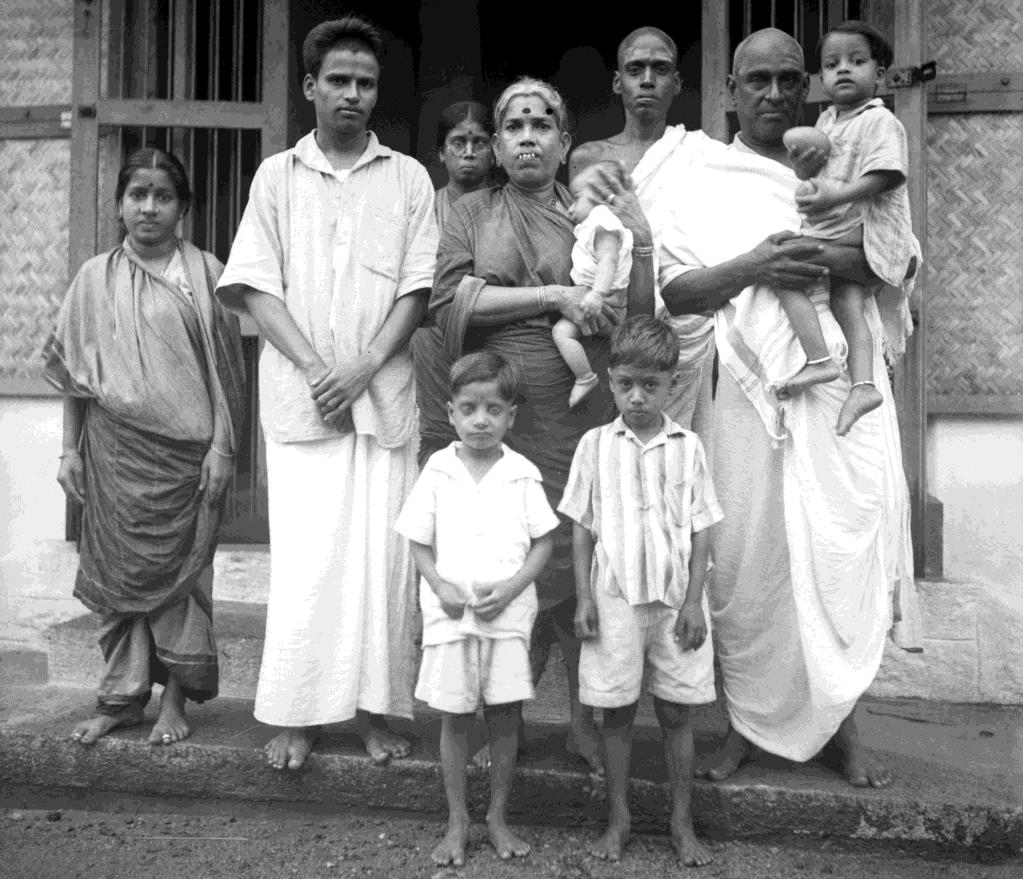
(l to r) Nagalakshmi, TNV, Athai (with baby Mani), Pichu Iyer (with child Ganesan), (front) present President Sundaram, Balu, (back row) Sala and Shastri Mama
During Bhagavan’s illness, Shastri Mama performed a special ritual called Mrityunjaya japa along with some pundits. Mrityu means death and jaya means victory. Therefore, this translates as victory over death. According to this Hindu ritual, if the mantra is chanted several thousand times, a person whose horoscope predicts an early death can be saved from dying prematurely. Bhagavan seldom agreed or disagreed with the wishes of his devotees; he just cooperated with them. The chanting was to be done in the school for the Vedas, in front of a pot of water. Chanting is said to charge the water with the powerful vibrations of the japa, which is then given to the afflicted person to drink. One day, the recorder of Talks with the Maharshi wondered why an illumined master like Bhagavan was drinking this water. Bhagavan looked at him, looked at the sun, then pointed to the right side of his own chest and quoted a line from the Taittriya Upanishad, “Sa yaschaayam purushe yaschaasau aaditye sa ekaha.” (II.12). This translates as, “The energy which is in me and the energy which is in the sun is the same one.” With this, Shastri Mama understood that Bhagavan was not taken in by these mantras but only cooperated with his disciples for their peace of mind, so that they could feel they were doing some service for their master’s well being. By the time he had been with Bhagavan till his last days, Shastri Mama had had glimpses of the Self. He was already a master of austerity and absolute desirelessness, but needed to be blessed with complete wisdom. This was accomplished when Bhagavan blessed him with a divine look.
I had the good fortune of moving closely with them, particularly with Sala Mami. She was always very kind to me. When all my relatives were worried that I was not married, though my parents never forced me or even insisted that I should get married, Sala Mami sat me down one day and said, “What are you going to gain by getting married? Even this one body is a burden. What is the use of getting another body? And it is an absolute fallacy that this other body can give you pleasure. The pleasure, the happiness comes from within, from the surrender of the body. In sleep, you are very happy because then, there is no awareness of the body. Why do you want to have one more body to take care of, thinking that it is going to give you happiness?” Her wise counsel helped me steady myself. This is the advantage of satsang.
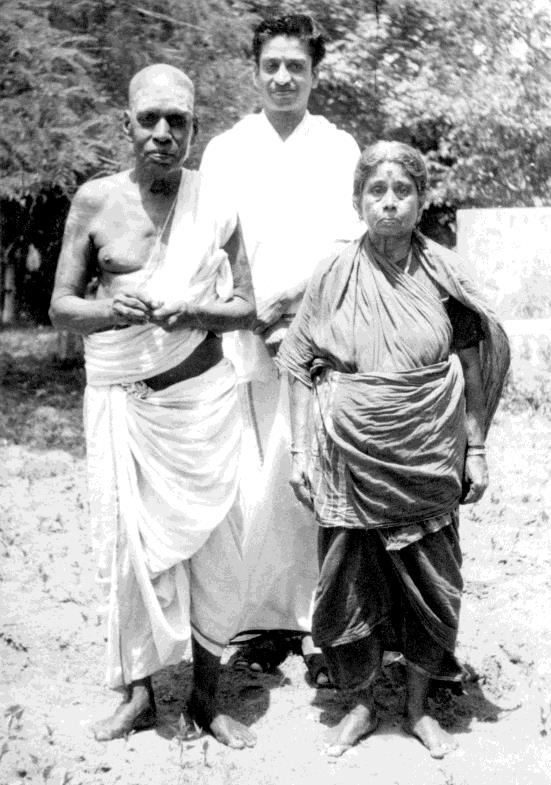
Shastri Mama and his wife, Sala, with Ganesan
After Bhagavan dropped the body, Shastri Mama’s son, Balu, who was studying in a far off village, completed his schooling. My grandfather, Chinna Swami, asked him to be brought to the ashram. He got him a job in the district office in town. After some time, he expressed a wish to have his parents live with him, so Chinna Swami asked Shastri Mama and Sala Mami to do so. Shastri Mama knew the exact date and time when his son was going to pass away and that it was only a few months away. Three days before the fatal day, Balu came down with a raging fever and died at exactly the predicted time. This is what Shastri Mama himself told me, “I thought Sala would not be able to bear this, so I didn’t tell her of Balu’s imminent death. On the contrary, the way she received her son’s death is remarkable. She is greater than me - she did not shed even a single tear. Instead, she consoled me saying, ‘He has gone back to Arunachala. We are so fortunate that he came here and gave up his body to be united with Arunachala.’”
After their son’s death, they lived in a cottage in front of the ashram. My father, Venkatoo, requested Shastri Mama, “Why don’t you come and help me in managing the pooja at the ashram?” Shastri Mama, now a man of deep wisdom, undertook the pooja in Bhagavan’s shrine. This is how I got to know him. For some reason, he was very deeply drawn to me. From the moment I moved to the ashram, he paid special attention to me. He told me, “For us, Bhagavan is God, Bhagavan’s form is Truth, and Bhagavan’s name is Truth.” I asked him what he meant by that. He replied “Do you recognize who Bhagavan is? Bhagavan is arivunmai nishtan - he is truly a Self-realized being; aanma vittaavaan - established ever in the Heart, as the ‘I AM’, and arivaal pulan chettraan - he has already won over the dictates of the five senses through inner wisdom.” I asked him, “What should I do? How can I serve?” “Venerate him and share his name and reputation. Share the teachings with other people so that they can discover this inner joy and this inner wisdom,” he said, adding, “And what should you adore him as? Arivangiyaavan. Do you recognize who he is? He is a flame of wisdom. Tell the world Ramana is not just a body, not just an individual. He is pure wisdom. He is arivaan gulisattaan. Gulisattaan means ‘thunderbolt’, the most powerful weapon that destroys the enemy’s ignorance. Our Bhagavan is that thunderbolt that will destroy all forms of ignorance. He is kaalakaalan, the conqueror of the time-space concept and chaavinaimaai veeran, a colossal hero who has conquered death.” Bhagavan has written these words in Ulladhu Narpadhu Anubandham, Reality in Forty Verses Supplement, v.28.
Shastri Mama talked to me all the time about Bhagavan and made me experience his presence. By this time, Shastri Mama had taken up a job at the ashram. He was an assistant to Kittu and Appuchi, who were young priests. They would instruct him to fetch things for them, and he would run their errands. It pained me deeply that this realized mahatma was assisting two priests who were younger than him, uncomplainingly, while they did not even recognize his spiritual stature!
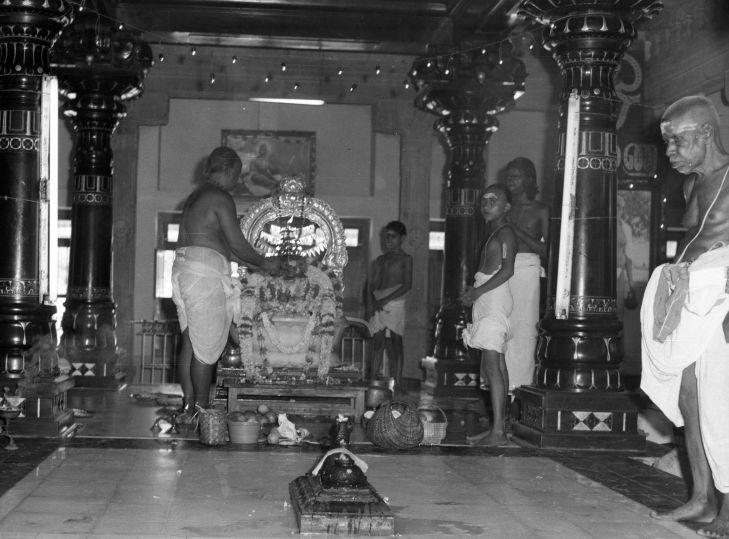
Shastri Mama at Bhagavan’s Samadhi shrine (extreme right)
The Nagappa Chettiar prediction of Shastri Mama that we shared earlier was only what I heard from him. Though I totally believed it had happened, I needed to feel for myself the impact of such miracles. Shastri Mama did perform a number of ‘miracles’. Since my brain or intellect could not grasp the logic behind them, I was thrilled when such happenings took place right in front of my own eyes!
A French lady, Edith Deri, was a chief accountant of an international French bank in Paris. Every year, she would come to the ashram to spend the three or four weeks of her annual holidays in meditation. After finishing her work for the day at the bank, she would directly go to the airport, board the plane in Paris, alight in Mumbai, catch a train and come straight to Tiruvannamalai. She used to plan her return journey just as meticulously to make sure she spent maximum time at the ashram. Every minute of her stay at Bhagavan’s ashram was that sacred for her!
On the year of her retirement from her bank job, sometime in the 1970s, she bought gifts for me and every other resident of the ashram. So, in addition to her usual, single piece of baggage, she was carrying an extra bag that trip containing all the gifts. She was to arrive at the ashram on a particular day but did not. I was very surprised as this had never happened before. One day, as I was standing in front of Bhagavan’s shrine, attending the morning milk offering pooja, I felt two hands resting affectionately on my shoulders from behind. It was Edith Deri, my ‘French Mother’! She whispered into my ears, “I have lost my gift box. That is the reason for the delay.” Something made me move towards Shastri Mama who was participating in the chanting of the mantras. When I went very close to him, spontaneously he turned towards me and said, “Nothing is lost. She will get it back!”
After the pooja, I introduced her to Shastri Mama. She gave the details, “Usually, I travel only by Air France. This year, being my retirement year, I took Kuwait Airlines as it is cheaper. When I reached Mumbai, I discovered that the bag containing all the gifts was missing. The airline assured me that I would get it by their next flight. I waited for a day. But, even after repeated searches, they could not locate my lost bag. The airline has assured me that they will somehow find it and forward it to our ashram address.” Using his prashna expertise, Shastri Mama declared that her missing bag was neither lost nor stolen and that she would get it back.
A few days later, the airlines sent her a letter apologising for not being able to locate the box and promising to compensate her if she gave details of the contents of the box and their cost. She was disappointed with Shastri Mama’s prediction. When we met Shastri Mama the next day, she expressed her feelings frankly. He was visibly irritated, “What? She doubts the prediction? I see her box right in front of my eyes, in a large room, untouched by any one!”
A week after Edith Deri left the ashram for France, I got a letter from her in which she was all admiration for Shastri Mama: “Your astrologer saint is truly great! His prediction was hundred percent correct! At Kuwait airport, as there was a lot of time to catch my transit flight, I chanced to enter a big hall where all the baggage is stored. And what do I see? My missing bag, by the entrance on the floor. That too with no tag. All the other bags had their tags and were neatly arranged in rows of shelves! Except mine! I happily reported it to the office and they apologized for the oversight. They, however, did explain to me that they had repeatedly verified the bags on the shelves for my missing bag, but had inadvertently ignored the bag lying at the entrance door. Good news for you all ! I am coming next month just to give my gifts to the ashram workers!”
One of the first instances of Shastri Mama’s guidance came to me when I was reading a book on the miracles of a living saint. Neither could I put the book down, nor sleep the entire night. I felt I must meet this master and that I too must possess the power of performing miracles. After the day’s pooja, while I stood in front of the old office about thirty feet away, Shastri Mama suddenly said, “Ganesa, stop! Stay there!” I obeyed him. “I order you not to have any thoughts,” he commanded. He then held out a bunch of grapes and said, “Now tell me how many grapes are there in this bunch.” “Thirteen,” I replied. “Come here and count them,” he commanded again. My guess turned out to be accurate. “How did you say thirteen?” he asked. “I don’t know,” I answered, puzzled. “Don’t say that. You cannot get away by saying that. Tell me how you thought there were thirteen grapes?” he pressed. This time, I kept quiet. “You know I told you to stay without thoughts.” he said. “Why did you not say fifteen or ten or eleven? How did you say exactly thirteen? When you were without thoughts, I put that number into your mind. I had already counted them. A miracle is nothing but a stronger mind occupying a weaker mind. Never get distracted by a miracle.” I was amazed. I had never spoken to him about the book. He said, “I am not saying this without support.” He quoted from one of Bhagavan’s verses, “To enquire into and abide as the Self, which is the ever present Reality is alone the true attainment, the greatest siddhi. All other siddhis or occult powers are equivalent to powers enjoyed in the dream state. When the sleeper awakes, are the dream powers real? Can those who stay in the state of Self, thereby casting off all forms of unreality, ever be deluded by indulging in the siddhis?” At one stroke, Shastri Mama wiped out for ever any inclination I might have had for siddhis or occult powers!
Shastri Mama was the most profound, yet simplest man with whom I have interacted. In the Vedas, it is said that the ultimate truth is smaller than the atom and bigger than all the cosmos put together. With no one was this truer than with Shastri Mama. It was he who chose my present home, ‘Ananda Ramana’. When this house came up for sale, I told him that I wanted Anuradha to buy it. He was totally blind at that time. He instantly said, “No. You should own it.” He added, “Take me to that land.” I took him around every inch of the land. At one spot, he stopped and asked me to describe the location. I said, “There are two trees here - one a peepul tree and the other a neem tree.” Before I could say anything more, he interrupted me and smilingly said, “Yes, Lord Ganesa has chosen this spot. The peepul tree represents the Father aspect and the neem tree the Mother aspect. Lord Ganesa is the son of Lord Siva and Mother Parvati. Make a shrine for the idol of Lord Ganesa in between these two trees. Since Lord Ganesa himself has selected the spot, I have named him Samartha Vinayakar - auspiciousness showering Ganesa.” In accordance with his guidance, I bought ‘Ananda Ramana’ with the help of a friend and constructed a shrine for Lord Ganesa at the spot Shastri Mama had indicated. On the day of the house warming, he himself guided all rituals, including the pooja to Samartha Vinayakar. When I prostrated to him and sought his blessings, he was very gracious to tell me, “The world around you will ignore you and give you up. But, don’t worry. Samartha Vinayakar will protect you and guide you. I will also initiate you today into a special Ganesa mantra which should neither be written down nor chanted loudly. Do the japa of it only inwardly, within your Heart. Ignore the world. Turn inward and always be submerged in that japa in your heart. You are ever blessed by Bhagavan!”
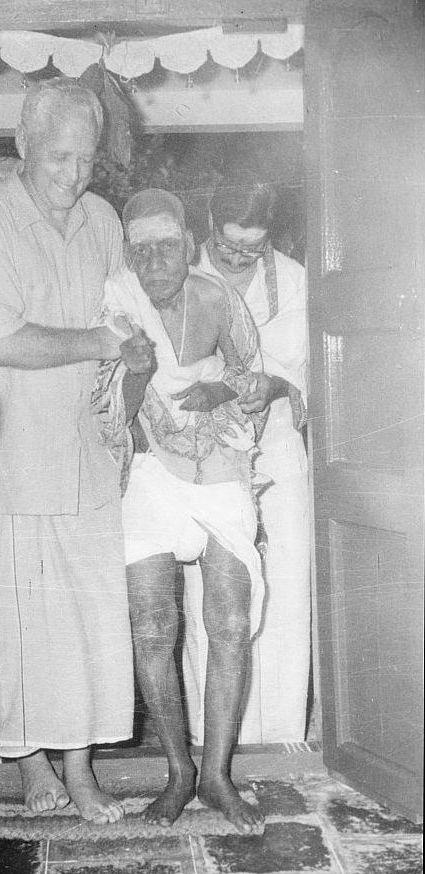
Shastri Mama entering the Old Hall assisted by Hugo Maier
In his last days, Shastri Mama fell from his cot and broke his hip. Hugo Maier, who helped many devotees in their last days by attending to them and giving them homeopathy medicines, examined Shastri Mama and said, “He is too old to undergo any surgery.” Shastri Mama only said, “Why pay attention to the body? It is going to die anyhow. How does it matter whether it goes in pain? I am not the body.” “Mama, kaal romba valikiradhaa?- is your leg hurting terribly?” I asked. Smiling despite the obviously excruciating pain he was going through, he replied, “Kaalai yedhukku paarkiraai? Mukkaalai paaru. Anandamaa irrukaen.” In Tamil, kaal means leg and it also means ‘a quarter’, while mukkaal means three quarters. By punning on the word kaal, he was in effect telling me, “Why are you focusing on the small quarter portion, the body? Focus on the larger portion, the Self. I am in absolute peace, in absolute bliss”. Though his body was in pain, he was all the time in ecstasy.
I intuitively felt that his last day had arrived. I took along my friend Anuradha to receive the blessings of this wonderful saint. I held his holy feet and requested, “Please bless me, Mama.” He humbly replied, “Only Bhagavan gives blessings.” “No. You must put your hand on our heads and bless us,” I insisted. He finally agreed. I asked him if we could do anything for him. “Ask Anuradha to sing Bhagavan’s Arunachala Pancharatnam,” he answered. While Anuradha and I sang that sublime hymn of Bhagavan, Shastri Mama kept his palms together on his chest. Tears of ecstasy flowed copiously from the outer corners of his eyes. Soon, Shastri Mama merged consciously in the Self.
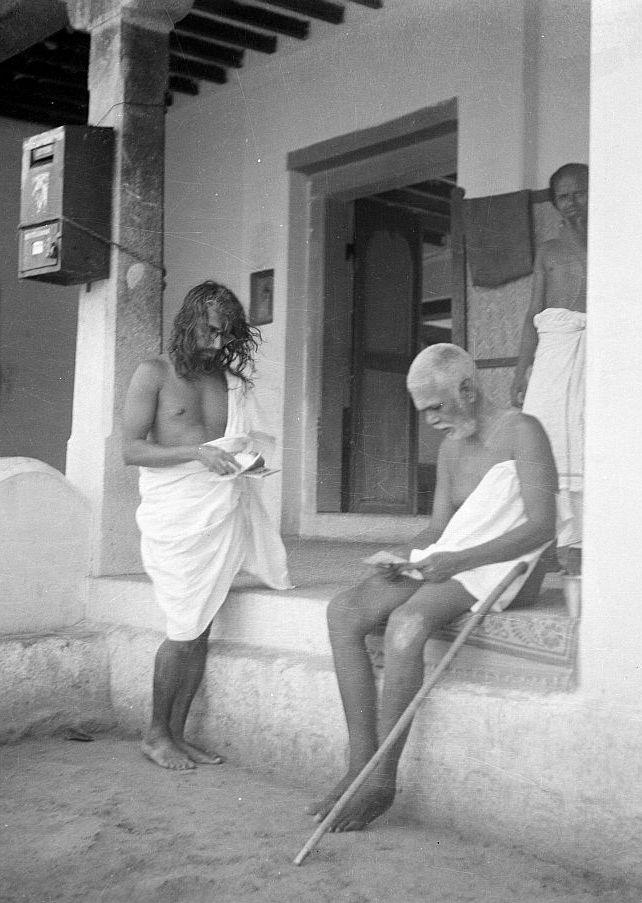
Bhagavan reading letters in front of Ramanasramam Post Office