Viswanatha Swami
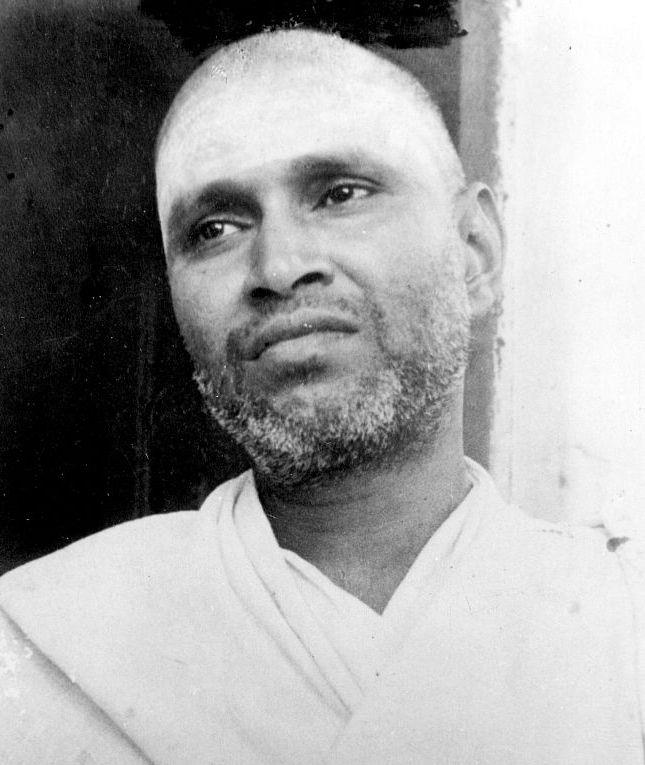
Bhagavan’s mother Azhagammal’s brother lived in Dindigul. His wife died soon after giving birth to a son. Bhagavan’s parents brought the orphaned child, Ramaswami, to their home and raised him with much affection and care. Just before Bhagavan was born, Mother Azhagammal told the midwife, “I am very excited, I want this to be a girl who can be the wife to my brother’s son!” That night in Tiruchuzhi, when Bhagavan was born, the blind midwife shouted, “Azhagu! It is a boy! Be happy! I saw a brilliant light. Azhagu, rejoice!” Azhagammal was disappointed that it was not a girl. And in her disappointment, she overlooked this remarkable incident of the blind midwife seeing a brilliant light.
In his later years, Ramaswami became a lawyer known for his upright character. He was also a strict disciplinarian who was held in high regard because of his service to society. One of his sons was Viswanathan. Like his brothers, Viswanathan was brilliant and gifted with a sharp intellect. Along with his brothers, he too was deeply involved in India’s freedom movement. In 1921, when still in college, he was arrested for opposing the British government. The university examinations were to be held, so his father bailed him out. But, instead of going to his house in Dindigul, he got off at Tiruvannamalai to meet his uncle, Venkataraman, now known as Ramana Maharshi.
This is how he describes his very first encounter with Bhagavan’s glance of grace: “Bhagavan was standing in an open space in front of Skandashram. When I first laid eyes on him, I saw in him something quite arresting which clearly distinguished him from all the others I have seen. He seemed to live apart from the physical frame, as though quite detached from it. His look and smile had a remarkable spiritual charm. When he spoke, his words seemed to come out of an abyss. One could see immaculate purity and non-attachment in him and in his movements. I sensed something very refined, lofty and sacred about him. In his vicinity, the mind’s distractions were overpowered by an austere and potent calm. In his presence, the unique bliss of peace was directly experienced. This, I would call Ramana Lahari - the blissful atmosphere of Sri Ramana. In this ecstasy of grace, one loses one’s sense of separate individuality and there remains something grand, which pervades all and devours all. This indeed is the spirit of Arunachala that swallows up the whole universe in its gracious effulgence.” It is no wonder that after this experience of ecstasy, Viswanathan stayed on for a few days.
Bhagavan’s mother, Azhagammal, and Bhagavan’s brother, Chinna Swami, were also present. They knew Viswanathan from his childhood days and were aware that he was a Sanskrit scholar even at that tender age. So, they asked him to recite some holy Sanskrit verses. When the recitation was over, Bhagavan slowly turned his attention to Viswanathan and said, “You have learned all this; this was not so in my case. Before I came here, I knew nothing, I learned not a thing. Some mysterious power took possession of me and induced a thorough transformation. Whoever knew then that this would happen to me! Your father, who intended in his boyhood to go to the Himalayas to perform tapas, became the head of a large family, and I, who knew nothing, have been drawn and kept here for good. When I left home in my seventeenth year, I was like a speck swept away by a tremendous flood. I knew neither my body nor the world, whether it was day or night. It was difficult to even open my eyes; my eyelids seemed to be glued down. My body became a mere skeleton. Visitors pitied my plight because they were not aware of how blissful I was. It was only years later, when I happened to look into some of the books on Vedanta which were brought to me, that I came across the term Brahman. I was amused and asked myself, ‘Is this experience known as Brahman?’”
Viswanathan had to leave. As he bade farewell with a heavy heart, Bhagavan handed him a copy of Sri Ramana Gita. (It contains Bhagavan’s answers to questions put by Kavyakantha and his disciples, and is invaluable to every seeker.) While giving it to him, Bhagavan said, “Give it to your father and ask him to read it.” Viswanathan studied it thoroughly in Dindigul. He was immersed in studying it, particularly chapter eighteen, wherein Bhagavan’s greatness is extolled in exquisite Sanskrit poetry. This moved Viswanathan so deeply that he decided to give up the world and go stay at the holy feet of Bhagavan.
In January 1923, he went back to Tiruvannamalai without informing his parents. By this time, Bhagavan had already come down to the present Ramanasramam. When he presented himself, Bhagavan’s first question was, “Did you leave any letter or tell your parents about coming here?” Viswanathan shook his head. “I did it when I left my home, why did you not do it? Now, write a letter to your parents that you are here safe and sound,” Bhagavan instructed. Bhagavan then permitted him to stay. Viswanathan discovered that Bhagavan’s power and presence were so strong, that he did not need any formal sadhana (spiritual practice). But still, he studied Bhagavan’s works thoroughly and worked in the ashram in Bhagavan’s inspirational presence. The more he studied Bhagavan’s teachings, the stronger his conviction became that the mere presence, the mere proximity and company of Bhagavan, was more than enough. His conviction grew even stronger when he later read one of Bhagavan’s verses in The Supplement to Forty Verses on Reality, “When one associates oneself with the company of a sage, there is no need for religious and spiritual practices, just as there is no need for a fan when the cool, southern breeze blows.”
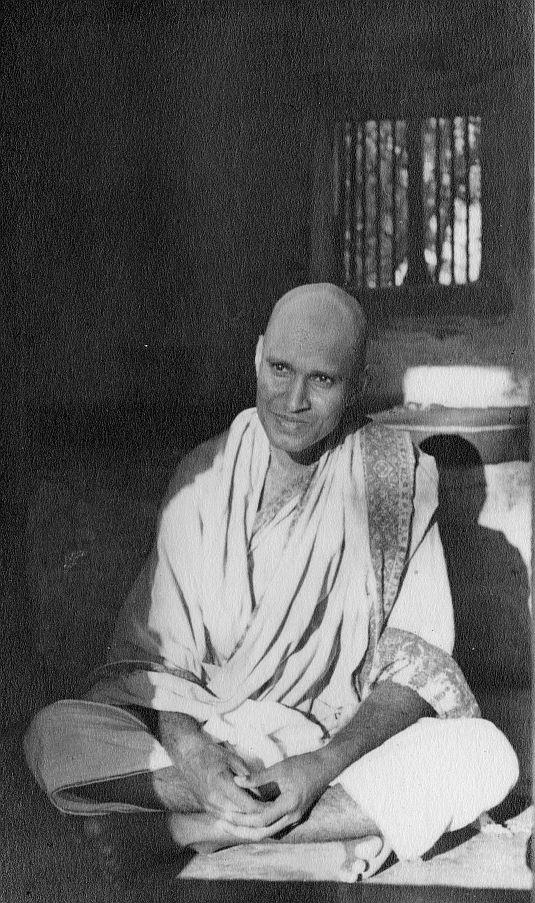
Viswanatha Swami in his hut at Palaakothu
After a few days, Bhagavan asked him what mode of spiritual practice he was ready to take up. Viswanathan replied that from childhood he was drawn to the Gayatri mantra, one of the holiest Hindu mantras, and that he had been chanting it. Bhagavan replied, “That is very good, but you must practice it sincerely, every day at a particular time, totally attuning yourself with it.” Bhagavan then took Viswanathan behind Ramanasramam, to a small cave on the hill. If one sits there, one can view Arunachala on the eastern and western sides, without the discomfort of the burning sun. Bhagavan told him, “There is a particular time when you should do the japa. I will come and inspect your practice, so be very disciplined about it.” Viswanatha Swami actually took me to that cave and I was elated when he said, “Bhagavan did come and check, those were not merely words.” However, being completely engrossed in his japa, Viswanathan was not aware that Bhagavan checked many times to make sure that he was capable of fulfilling his commitment.
Viswanathan lived with Bhagavan from 1923 to 1927, doing arduous practice. This was the period of effulgence and of effort. The guru bestows his grace when the disciple sincerely makes the effort. Viswanathan was not sure how far he had progressed and so he asked Bhagavan, “Bhagavan, how can I rise above my present animal instincts? My own efforts have proven futile. I am convinced that only a superior power can transform me.” Bhagavan replied with great compassion, “Yes, you are right. It is by awakening a power higher and mightier than the senses and the mind that these can be subdued. If you awaken and nurture the growth of that higher power within you, everything else will unfold mystically. One should sustain the current of meditation uninterruptedly. Moderation in food, and similar restraints taken up studiously and judiciously, will be helpful in maintaining inner poise.” Bhagavan added, “Viswanatha, do not mingle with people who come here. Do not waste time socializing, talking with people and also getting attached. Keep your talking to the minimum.” Viswanatha Swami devoutly adhered to Bhagavan’s words, so much so that whenever he spoke, his voice was almost inaudible. He restricted his movements to going to the town to beg for food. Some old devotees told me that Viswanatha Swami was known for his soft spoken demeanour and restrained movement.
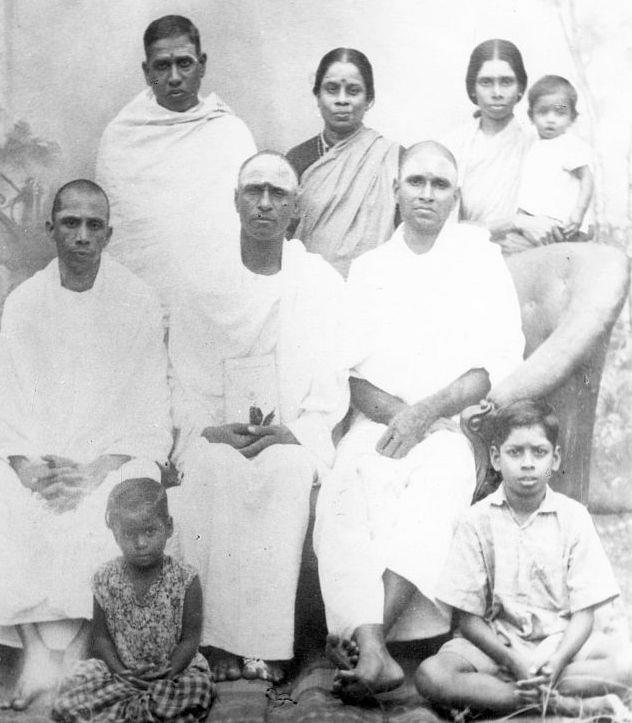
Viswanatha Swami with Ramana Padananda and the family members of Somasundaram Pillai
I want to share a very interesting incident which Viswanatha Swami described to me about this important stage of his life. After four months of him coming to Bhagavan, a letter arrived from Dindigul stating that Viswanatha Swami’s father was coming for a visit. Viswanatha Swami showed this letter to Bhagavan, who said, “Viswanatha, your family is also coming. Go to the railway station, receive them, but do not talk to your father without my presence. Receive them and drop them in the town where they have arranged for a house to stay in. As for you, go back to your cave and keep doing your japa. I will send word for you, but even then, do not talk to your father. Come and prostrate - not to me, but to your father - and stand in silence. I will look after the rest.” Viswanathan’s father, Ramaswami, did not know Bhagavan’s spiritual stature. He knew him as Venkataraman, a runaway relative who had taken to ascetic life. At that time, the Old Hall at Ramanasramam was being built and so Bhagavan and the others had moved to a mantap across the road. When Viswanatha Swami’s father went there and saw Bhagavan, he could at once sense his spiritual stature. The next moment, he prostrated before him in absolute awe and devotion.
Then, Bhagavan sent word to Viswanathan. As advised, he came and prostrated before his father and stood next to him with folded hands and bent head. Ramaswami was very angry. He turned to Viswanathan and said, “All this is enough. Now, pack up and come with me. That is why we have come - to take you back to Dindigul.” A stony silence pervaded the mantap. Bhagavan looked at Ramaswami and said, “Viswanathan has taken to the path of surrender and self purification.” Ramaswami was not fully satisfied. Bhagavan reasoned with him, “Allow Viswanathan to stay here. It will do him good.” This word worked like magic and the father melted. He looked at Bhagavan and his paternal instincts influenced him to plead with Bhagavan, “If Bhagavan takes the responsibility of Viswanathan’s spiritual fulfillment, I will have no objection in leaving him here.” There was complete silence again. Viswanathan never expected this and everyone looked at Bhagavan. Bhagavan compassionately turned and made this declaration in public: “Yes, I will take the entire responsibility of Viswanathan’s spiritual growth.” In Chinna Swami’s case, Bhagavan assured his mother in private that he would take the responsibility for Chinna Swami, but with Viswanatha Swami, he declared this in public. However, these are not two isolated instances. When we sincerely dedicate ourselves to practice, it is Bhagavan’s assurance, even now, that he will take the entire responsibility of each one’s spiritual fulfillment. Remember Bhagavan’s holy words: “The effort of the seeker and the grace of the guru are synonymous and simultaneous.” Our part is only to make the effort.
Viswanatha Swami was extremely happy - his arduous practice had begun. Bhagavan took him along during his walks and explained to him the verses that he had composed on jnana (wisdom) and bhakti (devotion). Bhagavan took complete care of him. Viswanatha Swami later told me that being alone with Bhagavan and having his words explained exclusively to him were the greatest boons that he received from Bhagavan. One day, when Bhagavan and Viswanatha Swami were cutting vegetables, Bhagavan told him, “You should be capable of making use of even dust. At the same time, you should also be able to reject the entire cosmos as nothing but mere dust.”
The relationship between the guru and disciple was deepening and Bhagavan perhaps felt that Viswanathan needed a firm rooting in scriptural studies. Kavyakantha Ganapati Muni was then staying up on the hill. So, in 1927, Bhagavan sent Viswanathan to Kavyakantha to study the scriptures. Even when Kavyakantha came down in 1929 to stay in Palaakothu, Bhagavan specifically told Viswanathan, “Nayana is staying in a hut in Palaakothu. Go stay with him, serve him and learn from him.” Every day Bhagavan visited that hut. He would always enquire, “Nayana, how is Viswanathan?”
The guru showed him the teacher and this encouraged Viswanathan. His study of Sanskrit scriptures helped him create verses extempore. Once, he wrote five verses and placed them at Bhagavan’s feet. Bhagavan read them and he said approvingly, “They are very good. Why don’t you continue to write? But first, show them to Nayana and get them verified.” Both Viswanathan and Kavyakantha, thus worked together and put together the one hundred and eight names of Sri Bhagavan, called Sri Ramana Ashtottaram. It came from the hearts of Viswanathan and Nayana, and was approved by Bhagavan, the Heart and hence it is eternal. It is a treatise, an unfading sacred flower about which Viswanatha Swami later told me, “I was fortunate enough to place this at the holy feet of Sri Bhagavan.” Viswanatha Swami continued his spiritual practice and the years rolled by. One who lives the truth, lives in and as the eternal now. To such a one, time doesn’t matter because time is an illusion - Viswanatha Swami was in timeless ecstasy.
He got a rude shock when Bhagavan’s health failed and he had to be operated on. This caused him deep pain. He went to Bhagavan and said, “Bhagavan, permit me to serve you day and night and to be with you.” Bhagavan turned to him and said, “You have work to do.” Saying this, he politely declined his request. On Bhagavan’s last day, there were a few people, including myself, inside his room. Outside, Bhagavan’s devotees were chanting Aksharamanamalai, the heart melting verses composed by Bhagavan on Arunachala, the Self. Bhagavan had already requested the attendants to help him sit up. The louder the chorus ‘Arunachala Siva , Arunachala Siva ’ became, the more were the tears of ecstasy that rolled down from Bhagavan’s eyes. Viswanatha Swami was witnessing the exalted spiritual splendour that was unfolding. He suddenly felt the gracious look of Bhagavan falling on him. He saw lightning flash within himself and the core of his Heart opened. He felt Bhagavan pouring grace into his Heart and was overwhelmed with ecstasy. The next moment, he saw Bhagavan smile and give a nod of approval as if to say that what Viswanatha Swami had experienced was the real state. Bhagavan had awakened spiritual realization in the son in accordance with his word to the son’s father, Ramaswami. This is how Viswanatha Swami recounted that moment of ecstasy: “Having received that grace, the climax of my own spiritual experiences in the proximity of Bhagavan took place during those last moments. As I stood in that small room, everything became shadowy, enveloped by an invisible, pure awareness, the one and only, ever present Reality. There was not the least feeling of separation from Bhagavan or the least vestige of sorrow on his physical death. Instead, there was a positive ecstasy and elation of spirit, which was nothing but the natural state of the Self.”
After Bhagavan attained Mahanirvana, Viswanatha Swami received a call from Dindigul that his mother was ailing and bedridden. There was nobody to attend her. Viswanatha Swami went home and saw that there was nobody to even serve her food. He attended to her day and night. He cooked for her, bathed her and nursed her for months. During this time, he remembered what Bhagavan had said: “You have work to do.” His mother always kept a small and special notebook with her. Before she passed away, his mother opened her notebook in which Bhagavan himself had written Sri Ramana Ashtottaram in his small, beautiful handwriting. She had been chanting the names every day. In her last moments she said, “Viswanatha, I bless you,” and gave him that notebook. Sometime after this, when he was still at Dindigul, he had a dream in which Bhagavan appeared to him and asked him to come to Ramanasramam. When he went there, he found that Chinna Swami was ailing. For the next six months, he attended on him day and night. When Chinna Swami died in 1953, Viswanatha Swami disappeared from Ramanasramam.
Knowing Viswanatha Swami’s greatness, I kept searching for him after I came to Ramanasramam in 1960, but he was nowhere to be found. I could not find his whereabouts. One day, I was walking on the streets of Chennai when an old friend of mine met me and told me in great joy, “Ganesa anna! I am so happy because I am just returning from a meeting with Viswanatha Swami.” My joy knew no bounds. “Viswanatha Swami is here?” I asked incredulously. My friend provided me the address and I immediately went there. He was living in his brother’s rented house. When I walked in, he was in the kitchen, cooking for the family. I prostrated before him right there in the kitchen. I cried, “Swami! Is cooking your job? Is not your place in the abode of Bhagavan? Is not Ramanasramam your home?” He replied, “ Ganesan, what is wrong in being a cook? We need only a little food for the stomach. That, I get here by working here. The inner food, Bhagavan has already given.” I begged him to come back to the ashram and he did.
Serving Viswanatha Swami was one of the most fulfilling functions in my life. Viswanatha Swami’s presence actually enhanced the sweet fragrance of the ashram’s ambience. Slowly, other devotees came back. In those days, before the large hall was built, Bhagavan’s samadhi was merely a thatched shed with an open space in front. I used to sleep there on a mat on the floor. Some nights, I would feel the poke of a walking stick. I would wake up to find Viswanatha Swami standing next to me and silently beckoning me to follow him. He would have me walk in silence to the cemetery near Yamalingam, two kilometers away from the ashram on the pradakshina road. We both would sit on a raised platform, behind which all the dead bodies are buried or cremated. He would draw my attention to the hill, and we would sit in silence for two or three hours and then walk back. This happened a few times. It was later that I understood this saint’s insight. It is next to Yamalingam, that my house, ‘Ananda Ramana’ is now situated. These walks to Yamalingam took place in the 1970s. In 1986, this house was given to me and I moved to stay permanently there in 1995. Just as Bhagavan cared for Viswanatha Swami, Viswanatha Swami, whom I cared for, took care of me and my spiritual practice. He has thus cared for many others, even as other devotees, graced by Bhagavan, have taken care of ever so many aspirants. It is thus, the beautiful chain of grace continues to link us to the truth that is ever present as Bhagavan.
Viswanatha Swami was a symbol of utter simplicity and that is why I refer to him as the superman of simplicity. When I was young, many visitors who were emotionally upset or mentally imbalanced would come to the ashram. I did not know how to handle them. Viswanatha Swami would volunteer to take care of them. On many occasions he would take them individually up the hill, around it, or to the temple, talking to them softly and seeing that their problems dissolve. His perfect way of imparting the nature of truth was by making them experience and transcend the limitations of mind and body.
I had just read the Bible and I was talking to a friend about it. I did not like the story of Moses where he touched a rock with his staff and water flowed out from the middle of the rock. I said, “At least, they could have written that Moses touched the ground and then water flowed out. How can water come out of a rock?” As I was saying this, a hand took hold of my arm. It was Viswanatha Swami. He led me straight to Skandashram put my hand between two rocks and made me feel the natural spring oozing out from there. Then, he said, “Bhagavan brought me here, put my hand beneath the rocks and showed me the water. Bhagavan touched this rock and this water flows perennially.” He solemnly added, “Never doubt a sage’s statements or actions. How can you doubt that Moses was not endowed with that grace by God to bring water from that rock? Be careful, Ganesan.” This corrected my spiritual thinking, because he brought my mind back to the Heart. If you again go to the mind, the intellect, you will continue to doubt how water can come out of a rock. Even now if you go to Skandashram, though it has been hidden, you can put your hand and feel the spring coming right from the bottom of the rock and not from the sand. Moreover, below it lies another flat rock.
Arthur Osborne managed the journal, The Mountain Path, single handedly for six years. I was the managing editor when he suddenly passed away in 1970. I did not know what to do. Mrs. Osborne came forward, saying, “Ganesan, do not worry. I will take it over.” For two years she shouldered that responsibility. However, because of ill health and other problems she requested me to find someone better equipped to handle the responsibility. She brought bundles of unedited articles and put them on my table. I was completely perplexed. The next day, Viswanatha Swami walked into my office and beckoned me. He spoke very sparingly. He took me to the forest behind the ashram, brought me back and then took me to his room. He smiled at me and said, “I feel instructed by Bhagavan to help you. I will take over the editorship. Honestly, Ganesan, I do not know the subtle art of editing, but it should not bother you. I will learn it. Send all those unedited articles to Professor K. Swaminathan who is an expert editor. He edits with red ink. When the edited articles come in, I will study them and learn.” Being a realized person, he picked it up in no time at all. Professor Swaminathan, himself the editor of a leading newspaper in India, and, much later, hailed by a renowned publicist, as the finest book editor of India, said, “Viswanatha Swami’s editing is remarkable!”
Coming to stay permanently in the ashram at a very young age gave me the advantage of staying in close contact with the old devotees. Their proximity gained for me the unseen spiritual benefit of effecting in me true all-round maturity. I could earn their wealth of jnana by just serving them. How true is the scriptural declaration: "Through service to mahatmas, a seeker gains spiritual benefits which cannot be got by study of scriptures or, by any other discipline." The greater reward that I got through such proximity was the possibility of my persuading them to write their reminiscences. Though I could not succeed in this with Viswanatha Swami, I was immensely satisfied that I could persuade him to translate Talks with Sri Ramana Maharshi into Tamil. One solid reason for my strong pleadings with him was that Sri Bhagavan had himself made Viswantha Swami translate most of the Sanskrit texts selected by him into Tamil. This was how, in the 1970s, the first volume of Talks with Sri Ramana Maharshi was first brought out in Tamil as Bhagavat Vachanaamrutam. It was an instant success! After some time, the comprehensive volume too was published. The special feature of this book is that the Swami having been present when the talks took place, has used mostly the very words used by Bhagavan.
In 1979, both Viswanatha Swami and I planned that for Bhagavan’s birth centenary in 1980, we needed to work together and bring out issues dealing exclusively with the direct teachings of Bhagavan. Unfortunately, Viswanatha Swami had a sun stroke. He came to my office and said, “I am ill. Come to my room.” I followed him into his room, where his behavior was alarmingly abnormal. He kept standing and sitting restlessly, like a clockwork toy. I was shocked and upset, not knowing what to do. “Do not pay attention to my body. I am inwardly in a blissful state. Attend to the inward state of mine,” he counseled. “Send a telegram to my brother. I will not give you trouble to nurse me for long. The second day I will drop my body. Bury me in the simplest way - I want no rituals. But come in the evening at four, I have a message for you.” I went at the appointed time.
In that seemingly restless state of standing and sitting, he again told me, “Do not pay attention to the body. Listen to what I am saying.” This is Viswanatha Swami’s message and it has been guiding me very powerfully: “The body is affected, perhaps the mind also. But, the spirit, the Heart, is unaffected, and the Heart is speaking through me. Though there is so much of confusion, turbulence and misery in manifestation, all of that belongs to the realm of the mind only - the ignorant mind split as object and subject. All experiences of life are relative, related to the experiencer who is nothing but a shadow having no intrinsic reality of his own. The reality in every person is the ultimate, pure existence which is the pure state of ‘I AM’, the awareness-absolute, which does not split into subject and object. It is the only thing that matters. If the ego and all its experiences are dismissed as passing shadows, the ever present, ultimate reality alone will be self evident. If one even intellectually is convinced of this truth, one will gain detachment and mental peace. We should now and then, stop for a while, stand aloof and experience this immutable and immaculate awareness-absolute, the still ‘I AM’, which alone matters, which alone is, despite the manifestation of endless variety of experiences. The Buddha, Jesus Christ, Adi Shankara and Bhagavan Ramana are a few standing monuments affirming the reality which is our very own being. The very sight of these pillars of light reminds us of this reality and brings us the peace that passes the mind’s understanding. Only the finite mind, the ‘me’, has to be relinquished to merge and dissolve in the ever-present, infinite reality of ‘I AM’. I bless you Ganesan.”
I prostrated before him, one of the blessed devotees who came to Arunachala drawn by the Grace of Bhagavan, basked in the sunshine of his Presence, gained Self-Knowledge of ‘I AM’ and guided earnest aspirants to gain it, by Self-Enquiry. From him I learnt that it is not enough if we just read some books, and get convinced intellectually by the statements in them. I also learnt that we must experience these teachings as states of one’s own inner peace and stillness.
Let us pay homage to Viswanatha Swami by remembering a few verses from his Sri Ramana Ashtottaram glorifying Sri Bhagavan: “Prostrations to one who dwells ever in the Self of pure awareness! Prostrations to one who is self-luminous like the sun, dispelling the darkness of ignorance! Prostrations to one who is the embodiment of unbroken awareness! Prostrations to one who is the light of awareness! Prostrations to one whose birth is for the purpose of spiritual awakening! Prostrations to one whose advent is for giving salvation to the whole world, to enable every being to recognize itself as the eternal ‘I AM’!” Though the literal meaning and purpose of the above verses looks like adoring Bhagavan Sri Ramana Maharshi, the true inner meaning is much more significant and important - to pursue the inner path by staying in the Heart as ‘I AM’. Bhagavan said that one can write a whole biography out of these 108 verses.
Viswanatha Swami, as predicted by him, dropped his body fully conscious and peacefully on the second day. His samadhi inside the ashram, close to Arunachala, is a place of serenity, the same serenity his physical presence emanated all his life – a peace filled boulder!
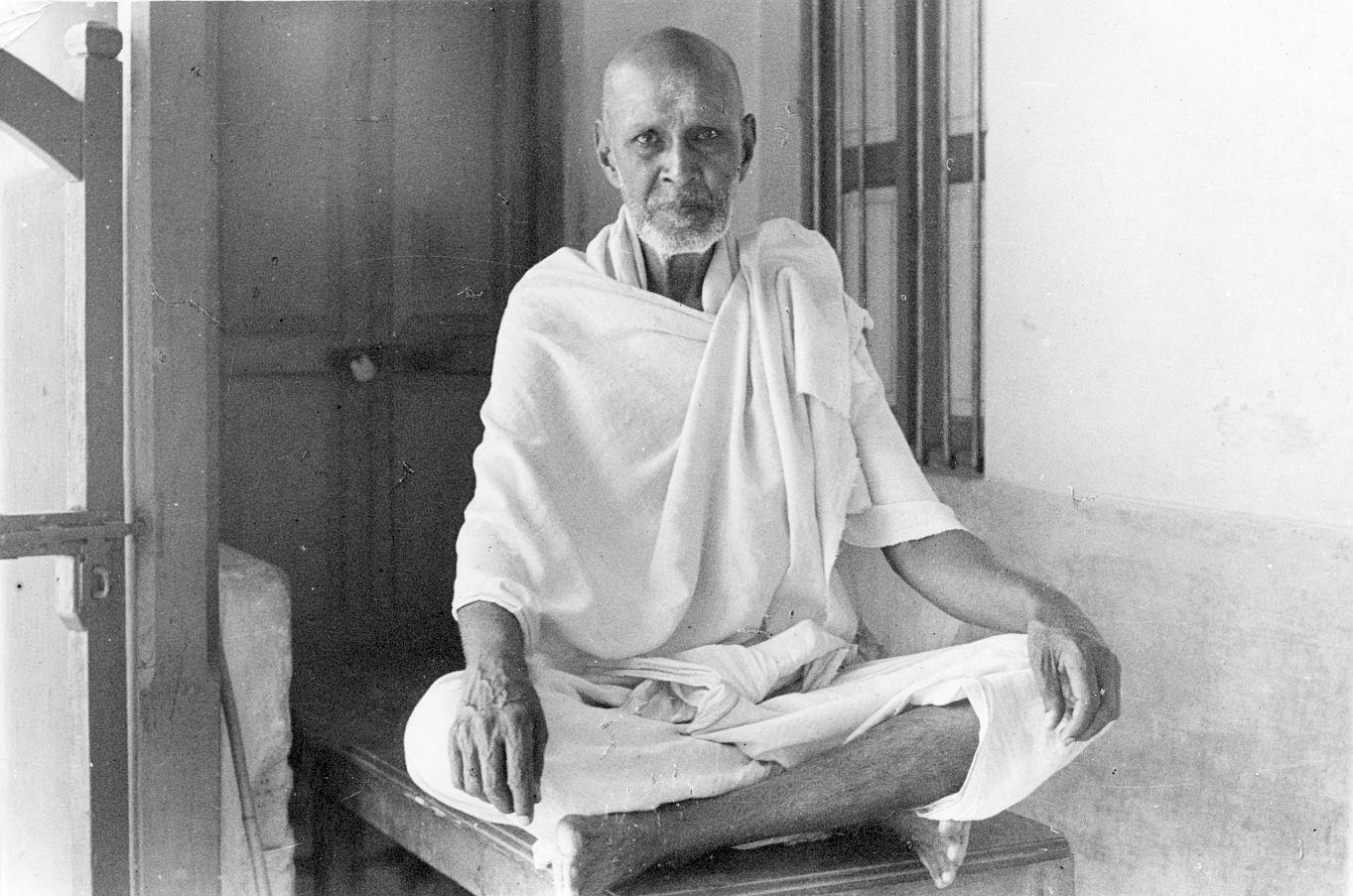
Staying at the Ashram, Viswanatha Swami guided spiritual seekers on the direct teaching of Sri Bhagavan
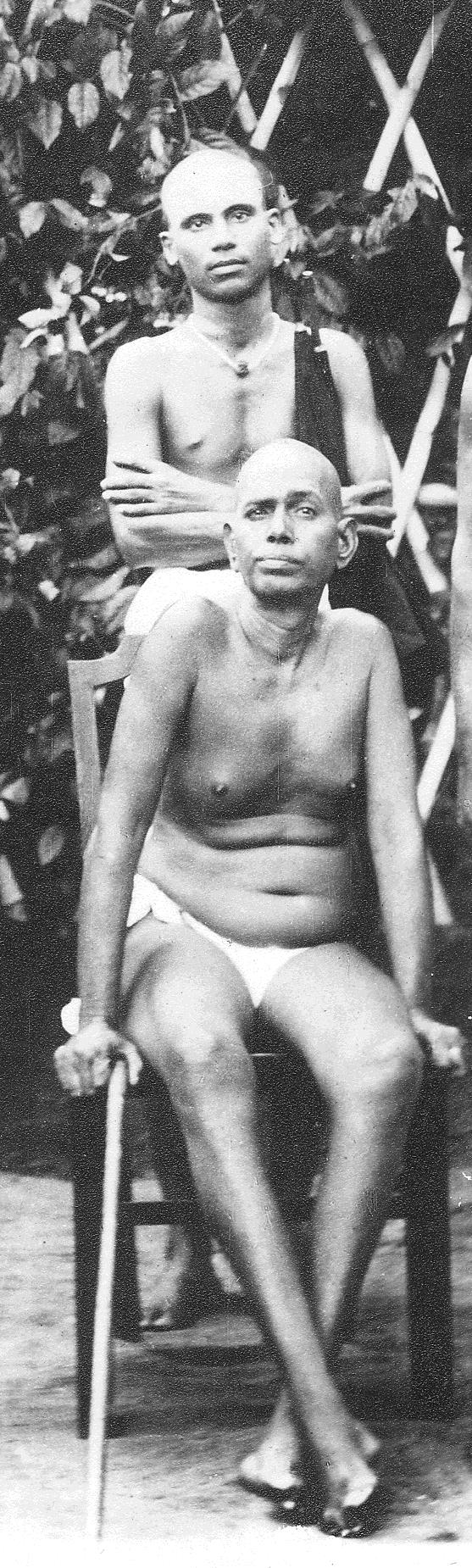
Sri Bhagavan – Annamalai Swami