Daivarata
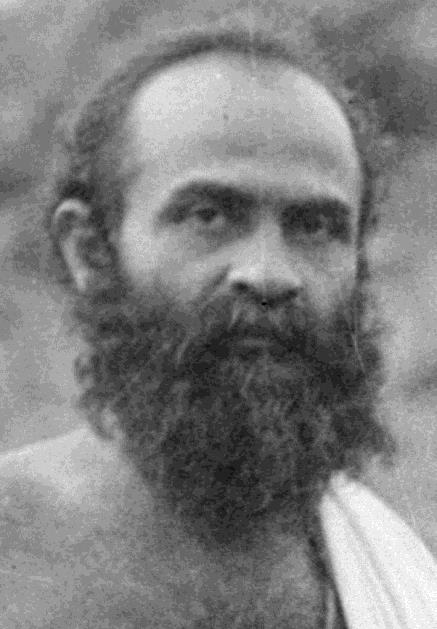
Daivarata was revered as a Vedic rishi and master by people like Madan Mohan Malviya, Vinoba Bhave, Dr. S. Radhakrishnan, and India’s first president, Dr. Rajendra Prasad. In fact, Vinoba Bhave directed all those who approached him with doubts on the Vedas to go to Daivarata.
Daivarata came and stayed with Bhagavan at Skandashram. Bhagavan was very fond of him. Being a very austere saint, he would stay with Bhagavan, but go to the town to beg for food every day. He would bring whatever food he got to Skandashramam and place it before Bhagavan saying, “Indraya swaha,” meaning, ‘I am offering this to the Lord of lords.’ Only after Bhagavan took something from it, would he eat the balance.
In 1917, he was seated in front of Bhagavan in Skandashram along with Kavyakantha Ganapati Muni and six other great scholars. They plied Bhagavan with beautiful spiritual questions. All these questions and answers have been recorded and brought out as Sri Ramana Gita. Daivarata asked Bhagavan a crucial question demanding a definite answer. He asked, “Bhagavan, what is the paramount duty of a seeker?” Bhagavan replied, “Discovering one’s own true nature is the paramount duty.”
From his childhood, Daivarata was interested in singing bhajans. He used to dance while singing them. In those days, Bhagavan used to go around the hill along with the devotees. Whenever he saw Daivarata, Bhagavan would look intently at him and Daivarata would start singing and dancing from one side of the road to the other. Devotees too, would start singing and dancing. Daivarata was so captivated by Bhagavan’s beauty that he writes, “His eyes always glitter with spotless light - full of peace and pure love. Like God’s, his eyelids too do not close. Even though his eyes are so wide open, they remain steady and introverted. To sit and gaze at his countenance is by itself true worship. People become so engrossed in his darshan that they do not like to leave his divine presence.”
Daivarata is the only person who has described Bhagavan’s voice. No one else has spoken on how Bhagavan’s voice sounded. He says, “Maharshi’s voice is melodious and soft as that of a child. It is exceedingly sweet. At times, it is so soft that it is not even heard clearly. It must be listened to with attention. When we hear his voice, we feel as if we are hearing a divine and subtle voice coming across the firmament. His is the form of divine speech so vastly extolled in the Vedas.”
Daivarata’s original name was Ganesa Shastri Kosoimani. He was called Ganesa and sometimes Gajanan. How he came to be known as Daivarata is an interesting story by itself. In Hindu culture, we live our life as initiated by the sages. It so happened, that he once met a saint from Ujjain who initiated him into bhakti marga, the path of devotion. After a few days, another saint came along and trained him in hatha yoga practices. He spread bhakti and yoga all his life. Next, Gajanan met Kavyakantha Ganapati Muni. Kavyakantha , being a great Sanskrit scholar, naturally attracted Gajanan. He asked him,” What is your name?” When he heard that it was Ganesa Shastri Kosoimani, popularly known as Gajanan, Kavyakantha said,” From today, your name is Daivarata.” Kavyakantha was adept at changing names. He had already changed Venkataraman into Bhagavan Sri Ramana Maharshi. It was Kavyakantha Ganapati Muni who brought Daivarata to Skandashram. At the very first sight of Bhagavan, Daivarata was swept away by Bhagavan’s spontaneous abidance in the Self, a state extolled in all the four Vedas. Bhagavan permitted him to stay with Kavyakantha up on the hill and wherever Kavyakantha went, Daivarata followed him.
Once, Daivarata was staying with Kavyakantha at the Padaiveedu Renukamba temple. He was doing severe penance in the vicinity of the deity. One day, some verses started emerging from his lips. After observing this for two days, Kavyakantha realized that it was a Rig Vedic metrical expression. Daivarata was revealing some of the lost mantras of the Rig Veda. As Daivarata was in ecstasy, some words were not audible. But most of them were taken down by Kavyakantha. These verses along with a commentary on them written by Kavyakantha was later published under the title Chandodarsana.
Kavyakantha passed away in 1936. Having lost his mentor, Daivarata left for Nepal. He felt that Nepal was the place where he could satiate his thirst for Vedic knowledge. Moreover, he felt comfortable in Nepal as its king supported him in his quest for Vedic knowledge. But wherever he went, he was in constant touch with Bhagavan through letters. Bhagavan would wait for his letters and would respond to them by writing, by thought, or simply by communicating his grace. In every letter that Daivarata wrote from Nepal, the last line would be, “Always at the holy feet of Sri Bhagavan.”
I had the great good fortune of receiving this holy man at Sri Ramanasramam in 1960. One sight was enough for me to see that here was a Vedic rishi. Although at that time he was also called a maharshi, he did not use that title at Ramanasramam. Yet, I could feel that he was a maharshi. I had the good fortune of serving him though his wants were very few. Being a staunch Hindu, he revered cows and used to drink cow’s urine. With just a cup full of cow’s urine and some margosa leaves he could live happily for days. So much so, that Bhagavan himself has talked about Daivarata’s austerity.
Having renounced the world by then and being very young, I wanted to know more and more about Bhagavan. This great man was so child like, it was easy for me to approach him and ask anything. “Swami, you have to tell me all about Bhagavan as a man and also Bhagavan as God.” He smiled at me - perhaps he was laughing at my ignorance - and uttered just one sentence, “Bhagavan was God living in the garb of a man.” He had described Bhagavan as man and God in one sentence.
He went on to say that Bhagavan had tremendous powers but was hiding them. Immediately I asked,” What do you mean by that? Can you give an example?” Daivarata said,” Yes, I can tell you but can you understand that?”I replied, “Tell me and I will try.” He said “Bhagavan has the power to go back to the past and alter the past.” I replied, “Not only can I not understand, I do not even know what you are talking about.” He was kind enough to share with me what he had experienced: Once, in 1940, he was wandering around the snowy peaks of the Himalayas, immersed in meditation. Suddenly, he noticed tears dropping from his eyes and wanted to know the reason for it. Then, some force or power from his Heart revealed to him that it was his separation from Bhagavan that was causing this anguish. Immediately, without any preparation, he headed straight for Arunachala. The journey took him fifteen days. As soon as he came, he went and stood in front of Bhagavan with tears of joy. On seeing him, Bhagavan said, “Just a few moments back I thought of you and had a strong urge to see you, and now you are here!” Daivarata called me his namesake as he was also Ganesa. He said, “Hey, my namesake, have you understood?” I said,” No, I have not understood.” Daivarata explained, “Though Bhagavan had said ‘just a few moments back’, it travelled fifteen days back and gave me a push to start my journey towards him. He even made me shed tears and realize that he was calling me. Bhagavan then went walking on the hill and I followed. Bhagavan told me, ‘Abide in the Heart. Remember the Heart is Arunachala.’ Bhagavan had called me to him all the way from the Himalayas to give me this last message. Ever since then, Bhagavan constantly lives in my Heart as Arunachala.”
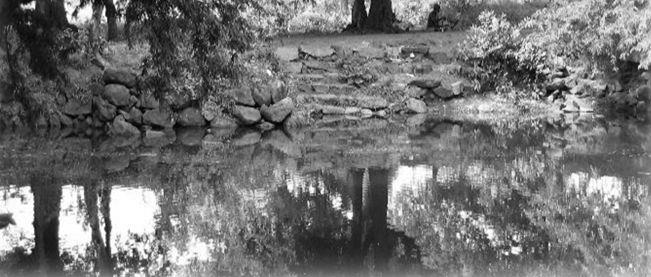
Tank at Palaakothu
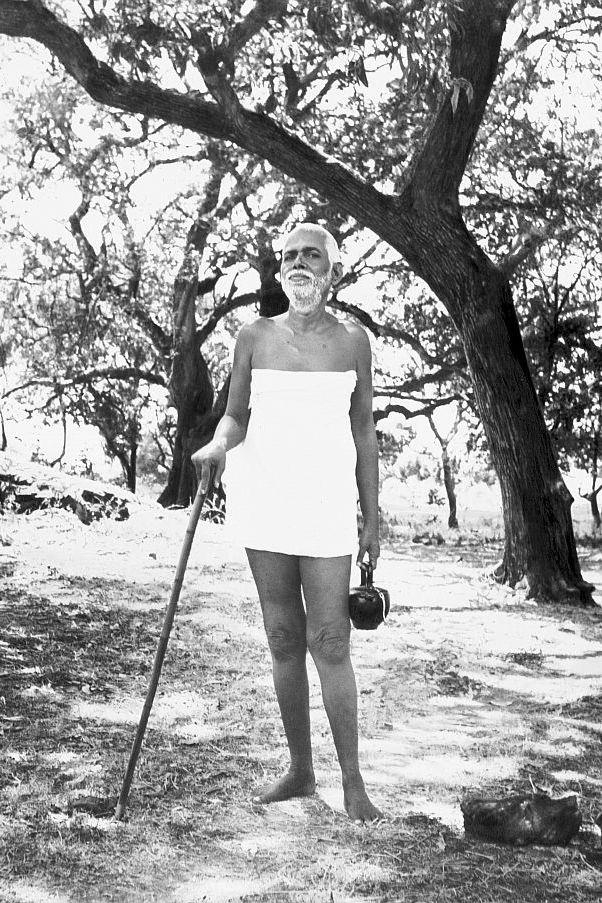
Bhagavan at Palaakothu