Munagala Venkataramiah
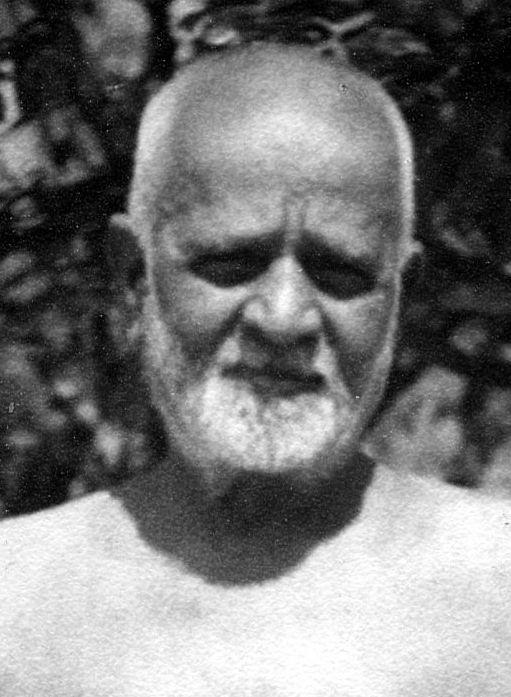
In September, 1896, a young school boy who was studying in Madurai, went home to his mother and reported, “Mother, a Brahmin boy from a neighbouring school has run away from home.” Little did he know that destiny would bind him to that same runaway boy, his namesake, that he would meet this boy, now an acknowledged sage, at Skandashram in 1918, and that from 1930 onwards, he would remain his constant companion till the end. This young school boy was S. Venkataraman, later known as Munagala S. Venkataramiah, the compiler of Talks with Ramana Maharshi, a book that is almost a bible for all sincere devotees of Bhagavan.
Munagala Venkataramiah came from a village called Sholavandan. His ancestors and his own brothers studied the Vedas in the Veda patashala there. He knew Sanskrit well, but chose to go to an English school in the next town. Subsequently, he went on to study in a college. He got married even as he was studying. Since he was research oriented, he found himself a job in a laboratory in Mumbai. A daughter was born and though he was extremely fond of his daughter, he focussed all his attention on his research work. After doing extensive research for ten years, he went back to college. He graduated from Presidency College with a gold medal and then taught in one of the prestigious colleges in Chennai from 1912 to 1918. Even during this period, he led the life of an ascetic. Professors were given huge houses to stay in on the campus. He requested his wife and daughter to stay in the huge house, while he himself lived in the small outhouse meant for the watchman. Such was his simplicity. Even in those days, Munagala Venkataramiah was eager to pursue the spiritual life. He met a mahatma who taught him the ten Upanishads, the Bhagavad Gita and the Brahma Sutra. (The mahatma told Venkataramiah to read the Upanishads every day and this is exactly what he did till the end of his life. He had all the Upanishads on his table and any time he felt inclined to, he would read them.)
Some time later, his daughter, whom he loved very dearly, passed away. He was plunged in grief and inconsolable. Restlessly, he started wandering, seeking peace. He reached Arunachala in 1918. He was told of a sage who lived in Skandashram. When he went there, he came to know that the sage was the very same runaway boy of his childhood, now known as Bhagavan Sri Ramana Maharshi. However, he had to leave as his service to the mahatma near Chennai could not be interrupted. In 1922, the mahatma passed away, plunging Venkataramiah in greater sorrow. The mahatma’s last words to his student were to continue reading the Upanishads. Munagala Venkataramiah continued studying these texts for the next five years. He visited Bhagavan once again in 1927 at Ramanasramam. During this visit, he recognised fully that Sri Ramana was his satguru and from then on stayed at the ashram. These are Munagala’s own words: “In a very critical and distressing period of his life, a humble devotee (referring to himself) sought the presence of Bhagavan Sri Ramana Maharshi for his own peace of mind, and lived in the ashram with the kind permission of Sri Niranjanananda Swami.”
One day, he got a letter from the Government of India extending a job offer as head of the research department in Delhi. The job was a very lucrative one and would have given Munagala both name and fame. The offer was in recognition of his discovery of a chemical that helped ink from solidifying. Prior to this discovery, people found it extremely difficult to write with a pen because the ink would constantly dry up. Munagala showed Bhagavan the job offer. Since Bhagavan’s reaction did not seem encouraging, he turned it down. In the presence of and under the guidance of Bhagavan, Munagala plunged into sadhana. He started living at Palaakothu.
Telugu was the mother tongue of Venkataramiah. He spoke English and Tamil fluently and was well versed in Sanskrit. However, he felt it necessary to be acquainted with literary Tamil. Bhagavan then introduced him to Tamil works, especially Saiva Siddhanta treatises written by Saivite saints. Bhagavan himself taught them to him. These were essential for one who was later to become the compiler of Talks with Ramana Maharshi. To quote Munagala (again, putting himself in the third person): “The seeker took it upon himself to note down, as occasions arose, the sweet, refreshing and enlightening words of the master. This self imposed task was undertaken for the purification of his own mind, and better understanding of the subtle and profound words of Sri Bhagavan.”
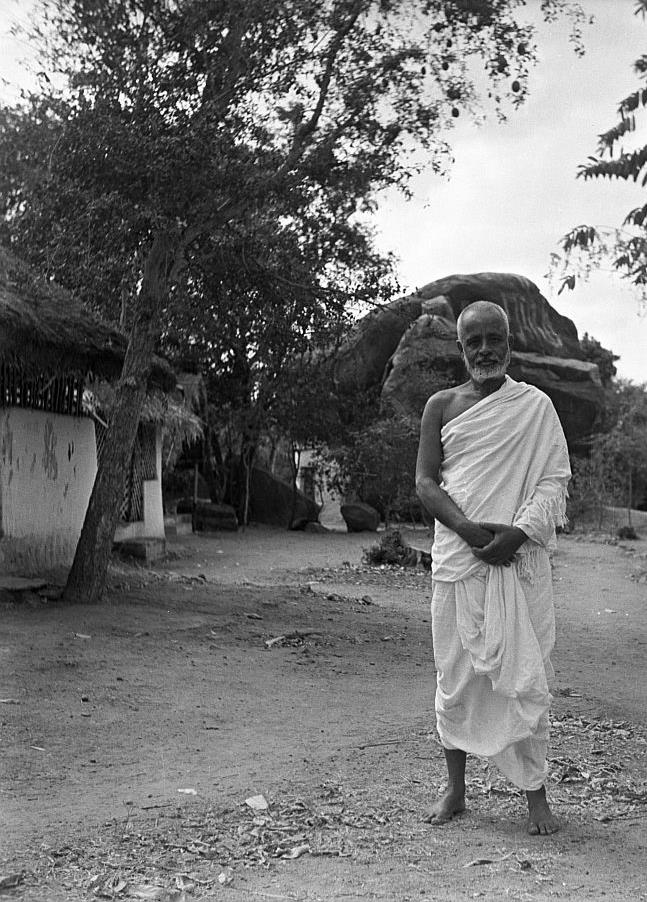
Munagala Venkataramiah at Palaakothu, in front of his cottage and the cave he meditated in
When Bhagavan answered the question of a seeker, it was not the number of words that made the answers so intense but the fact that the words were charged with a deeper meaning. Hence, translation took time. Sometimes, seekers asked questions in English or other languages and this had to be translated into Tamil for Bhagavan; Bhagavan would then give the answer in Tamil and Munagala would translate the answer into the language concerned. He had to be totally faithful to the translation.
Dr. T. M. P. Mahadevan writes in his foreword to Talks with Ramana Maharshi, “We cannot be too grateful to Munagala S. Venkataramiah for the record that he kept of the ‘Talks’ covering a period of four years from 1935 to 1939. Those devotees, who had the good fortune of seeing Bhagavan, reminisce and recall with delight their own mental record of the words of the master. Despite the fact that the great sage of Arunachala taught for the most part through silence, he did instruct through speech also, and that too, lucidly, without baffling and beclouding the minds of his listeners. One would wish that every word that he uttered had been preserved for posterity.”
Major Chadwick in his introduction to the Talks writes, “The four years that are covered in Talks were the days when the ashram reached the summit of its glory. Maharshi’s health was on the whole good and the hall where he sat was open day and night to welcome one and all. Visitors flocked there from every corner of the world; there was hardly a country that was not represented at one time or another. Sri Bhagavan glowed like the sun, and even those who did not understand him or agree with his words were fascinated and could not help but be elevated by his presence.”
Sri Ramakrishna Paramahamsa had Mahendranath Gupta, ‘M’, a school teacher, as his English interpreter. Here, Munagala was Bhagavan’s ‘M’. Munagala kept a record of whatever he interpreted. He would then take the notebook to Bhagavan, who would edit or correct what had been written. That is how we have Talks with Ramana Maharshi. I have seen the original manuscript myself, in the form of note books, with Bhagavan’s corrections. I also had the honour of typing some of those handwritten manuscripts along with devotees like ‘Typist’ Kittu and Ramamani. The whole typed bulk was submitted to a committee of selected devotees, most of who were staying in Chennai. When the edited bulk was returned, it was handed over to Munagala and Chadwick for further verification. Pages after pages were struck off with red ink, with one repeated remark on the margin, “Repetition”. When Chadwick saw those deletions, he got so upset and angry that he rushed into the office and shouted, “Who are these people to delete passages quoted from Bhagavan? Bhagavan has a special purpose in repeating the same passage worded differently. It is to suit each seeker’s individual understanding capacity. Not a single word should be removed. They were all verified and approved by Bhagavan.” His exhortation was carried out. We owe the present full version of Talks to Chadwick. Major Chadwick had the highest respect for the veracity of Munagala’s capacity. So much so, Chadwick once humourously said, “Munagala is the English mouth of Bhagavan.”
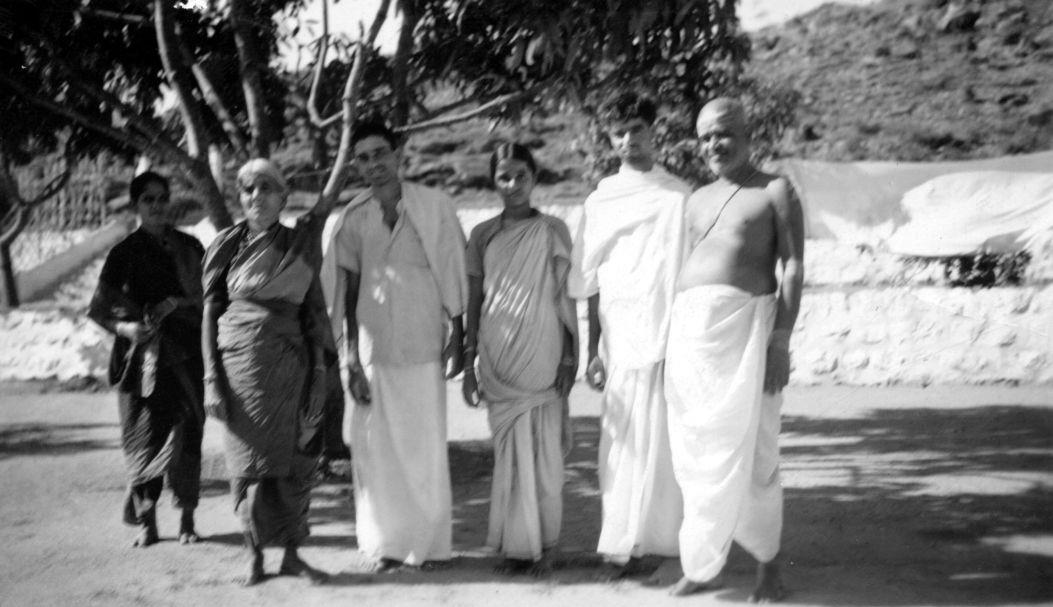
Family of Munagala Venkataramiah : wife, and daughter Kamakshi
Bhagavan sensing the intelligence and enthusiasm of his disciple, asked Munagala to translate ancient texts like Tripura Rahasya, Advaita Bodha Deepika and Kaivalya Navaneetam. It is an interesting story how Tripura Rahasya came to be translated by Munagala into English. Once, Daivarata, who was staying at Nepal, sent Bhagavan a hand copied manuscript of a Sanskrit text entitled Tripura Rahasya that he had read at the royal library. Bhagavan was happy reading it and expressed that a translation of it in English would help seekers who could not read Sanskrit. Munagala volunteered to undertake that work. On reading the English version, Chadwick was so happy that he offered help to type it and arrange for a special black leather cloth binding for it. It was then presented to Bhagavan, who kept it in the revolving library shelf next to his couch. It was lent to serious seekers who were keen to read ancient Advaitic texts. Bhagavan appreciated this English translation by Munagala so much that he encouraged him to translate Kaivalya Navaneetam (Tamil) and Advaita Bodha Deepika (Sanskrit) into English. They were also typed, leather bound, and kept in the library next to Bhagavan’s couch. Only later were they printed as ashram publications. With the cooperation of David McIver, Venkataramiah had already translated into English, Bhagavan’s Arunachala Stuti Panchakam - five heart melting Tamil poems to Arunachala. This was the seed and foundation for the future edition of Collected Works of Ramana Maharshi that was edited by Arthur Osborne. The close association between Bhagavan and Munagala is a paradigmatic example for true guru-sishya relationship.
Munagala was a personification of peace, calmness and inner happiness. A welcoming smile always adorned his serene face. He hardly mingled with the crowd. Except for worship at the shrine of Bhagavan and coming to have food at the dining hall, he was rarely seen in the public. The rest of the time, he was inside his room reading the Upanishads. He inspired many seekers, not through preaching but by his quiet, spiritual life. I was fortunate enough to come in close contact with him and be inspired by his exemplary life. That is the marvellous spiritual trait I have observed in all old devotees - they inspired the younger generation through their own living as the truth, rather than preaching about truth.
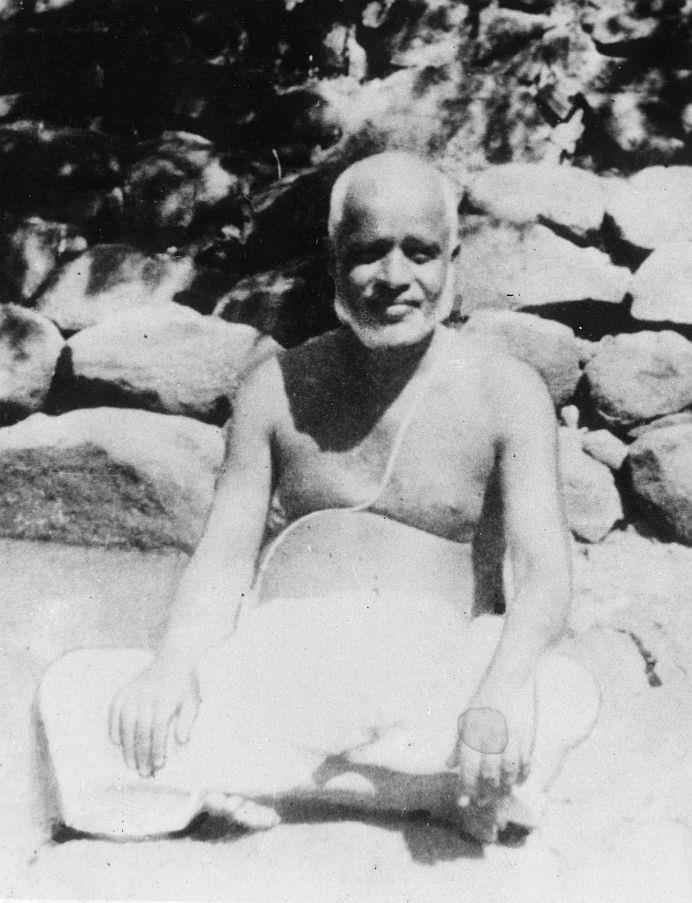
Munagala absorbed in his relentless daily sadhana of immersion in ‘Inner Silence’ at Palaakothu
Two significant incidents in my own life show how Munagala guided young seekers: When I settled at Ramanasramam in 1960, a few old devotees criticised Kavyakantha Ganapati Muni to me. They claimed that many of Kavyakantha’s accounts were merely figments of his imagination. I felt distressed. I approached Munagala, who had not seen Kavyakantha and was neutral about him. When I asked him why well read devotees slighted the veracity of Kavyakantha’s accounts, he told me, “It is not good for you to accuse any one, especially devotees of Bhagavan. How did you come to know about the accusations against that great man? Were they not the opinions of others? Opinions sprout from the mind. Truth sparkles only from the Heart. Whenever you have doubts, turn instantly your attention to Bhagavan and do not take to other’s opinions. Bhagavan will guide you. Bhagavan has extolled Kavyakantha’s immense capacity for knowledge and dedication to truth. For instance, one day Bhagavan spoke appreciatively of Kavyakantha for about an hour - how he wrote Uma Sahasram and Hara Sahasram, how he taught his students the ancient scriptures, how meek and humble he was though so learned and capable; how austere he was in doing japa and how well he achieved what he aspired for. Also, when the news of Kavyakantha’s passing away reached Bhagavan in 1936, he remarked, ‘When are we going to see another like Nayana?’” I thanked him from within my heart for this soul elevating explanation.
Another day, a lady saint named Mother Rama Devi came to the ashram. She had a lot of followers. She would go into a trance whenever some verses were sung. One evening, Munagala came to my room and invited me to attend a bhajan session of Rama Devi. I told him that I was not interested and added, “I have my Bhagavan. That is enough for me.” Munagala turned to me with childlike innocence and said, “You have read books on Ramakrishna Paramahamsa, haven’t you?” “Yes, Swami,” I replied. “You must have read about the fact that Sri Ramakrishna used to go into a state of bhava samadhi. We have only read about it but have never experienced the state. Rama Devi goes into that divine state. This is not a psychic state; it is a purely spiritual state. To my knowledge, and to the knowledge of others, after Sri Ramakrishna, only Mother Rama Devi is able to attain that spiritual state.” Munagala then took my hand and gently led me to the hall and made me sit next to him. The bhajan was going on and Rama Devi was deep in meditation. In the midst of the bhajan, she got up abruptly. Munagala told me, “She has gone into bhava samadhi. Keep looking at her and be reverential.” The bhajan was about the mother goddess destroying the demon. Rama Devi enacted the scene, dancing as if she had the sword in her hand and was slaying the demon. Rama Devi was big built. So, it was astonishing to see her quick, swirling movements. Finally she went into a samadhi after slaying the demon, just like the Puranas say. She stood on one leg, holding the imaginary head of the demon in one hand and the sword in the other. Munagala whispered to me, “With that kind of built, it is virtually impossible to stand on one leg. It is only the Lord who supports her in that position.” I have always been attached to Sri Ramakrishna Paramahamsa and have wondered about how bhava samadhi looked like. Now, through Munagala, this wish of mine was fulfilled. I was in some kind of muddled state and Rama Devi released me from that.
Whenever I went to Munagala’s room, he would be reading the Upanishads. One day, I asked him, “You are the direct disciple of Bhagavan. Why are you always reading the scriptures instead of practising Self Enquiry?” Munagala’s voice almost melted as he said, “This parayana is what my teacher told me to do. I asked Bhagavan whether I should take it up as my sadhana and Bhagavan confirmed that I should read these every day, all the time. Reading the scriptures is a fully authentic sadhana for a serious seeker. It is pure joy to be with Upanishads!” ( Parayana is done only to recollect the Self which is ever attained. Sri Bhagavan had already revealed the ever revealed Self to him.)
Munagala had another daughter - Kamakshi. She was a child prodigy and was a Sanskrit scholar. By the time she was nine years old, she had mastered almost all the great Sanskrit works. While still in her teens, she would confidently enter into debates and hold dialogues with scholars on those subjects and win. In spite of her youth, she seemed to be more knowledgeable. Bhagavan was compassionate enough to turn her intellectual knowledge into devotional wisdom. (Once, a devotee asked Bhagavan, “Is your teaching not merely intellectual?” Bhagavan replied, “I preach devotional enquiry.”) Early one morning, Bhagavan called Kamakshi into the hall as she was passing by. He gave her Srimad Bhagavatam, a book of supreme wisdom soaked in devotion mostly dealing with the life and teaching of Lord Krishna. He indicated a place in the hall and asked her to sit there and read the book. When people started coming into the hall, he called her, asked for the book, marked the place that she was at with a book mark and told her to come the next day. He asked her to come every day until the book was finished, until she had imbibed the Bhagavatham’s fusion of wisdom and devotion.
On another day, he called her and gave her a small slip of paper. On it was written the mantra, ‘Om Namo Bhagavate Sri Ramanaya’. She read out the mantra in her beautiful, stentorian voice. Bhagavan looked at her intently and so Kamakshi asked, “Bhagavan, should I chant this every day?” Bhagavan replied, “Always.” He took back the slip from her and put it in the stove which was burning in front of him. This act signified that an oath had been taken and Kamakshi had chosen to abide by what Bhagavan had said. ‘Om Namo Bhagavathe Sri Ramanaya’ means ‘obeisance to Bhagavan Sri Ramana’. Kamakshi told me that that act of grace of Bhagavan giving her the mantra completed and fulfilled her devotional approach to perfection. All her life she was chanting this sacred mantra.
In Ramana Nagar, opposite to the ashram and next to Arthur Osborne’s house, Kamakshi had a piece of land on which a small house was raised. She could occupy it only after her husband, Dr. Ramachandriah, retired from his professorship in the university. The few years that she lived in that house with her husband were the happiest years of her life. She then fell sick and was taken for treatment, where she was diagnosed with terminal cancer. She preferred to spend her last days, not as medically advised in a far away hospital, but in her own home, at the foot of holy Arunachala and near her satguru Ramana’s sacred shrine. Every day, I spent a few hours with her. Due to the heavy medication she had to take, her body started to shrink. Kamakshi, a beautiful lady, was unrecognisable towards the end. One day, I broke down and cried, “Why hasn’t Bhagavan saved you?” She replied, “You pay attention to my exterior appearance instead of my inner state. I have told you many a time, I am not the body. The gracious glance which Bhagavan bestowed on me, on the very first day of my darshan of him, established me in the Self. I rarely identify myself either with the body or the mind. The body has come and it has to go. I am eternally the Self. Release yourself from the illusion of taking the body to be true. I am always happy. I am in bliss.” With a gracious smile she added, “I bless you. Totally surrender to Bhagavan. Bhagavan will guide you.” Kamakshi passed away within a few days. I was blessed to carry her body to the cremation ground and offer it to the flame of flames - Arunachala.
Lakshmana Sarma and Munagala Venkataramiah are unique in that each of them was totally humble and shunned publicity of any kind. While Lakshmana Sarma hid himself behind the pseudonym ‘Who’, Munagala did not publish any of his works until Bhagavan’s mahasamadhi. Many years after the mahasamadhi, Munagala showed me the manuscript of his English translation of Tripura Rahasya and asked, “Have you seen this?” It was just a comment, not a request to publish it. These two devotees had erased, obliterated, their egos totally. When the book was to be brought out, I told him that I did not understand the meaning of the title. He felt it was very clear. I explained to him that the meaning would not be apparent to all. But he said, “This is what I showed Bhagavan. How can I add something now?” I told him that it would be better if it could be done for the sake of other people. He then added the subtitle Mystery beyond the Trinity.
When Bhagavan passed away, Munagala left the ashram and went to stay with his children. However, he was invited to come back to the ashram. In 1955, he took sannyas and took on the name Swami Ramanananda Saraswati. When he was absorbed in Arunachala in 1963, in accordance with his specific instructions, his body was interred inside the compound of Kamakshi’s house. Munagala Venkataramiah lives eternally as a glowing flame in the raging fire of wisdom - Arunachala Ramanan.