K. K. Nambiar
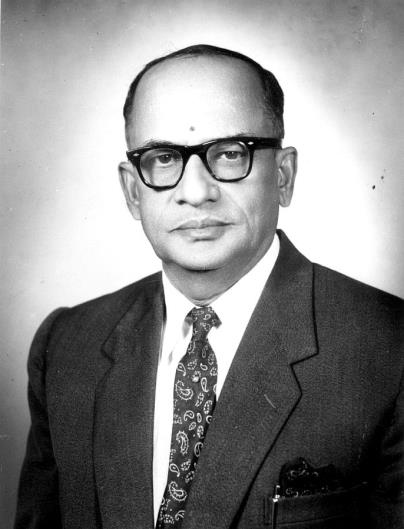
In 1932, K. K. Nambiar, a Malayalee civil engineer working for the government, laid the roads in Tiruvannamalai. The first tar road was laid by him from the hospital to Ramanasramam. He was not bothered whether the government would question him on this act. Such was his devotion!
Prior to his visit to the ashram in 1932, a Malayalam translation of the book Who am I? came into his hands. The phrase, ‘the living Maharshi’ caught his eye and he laughed out loud because he thought that maharshis had lived maybe thousands of years ago. He felt that the statement was incredible. He mocked the entire writing and refused to believe it. But, the very next day, another friend of his told him, “Do not make a mistake. I have seen him myself. He is a real maharshi. Let us go there.” This is how he came to Bhagavan. The minute Bhagavan directed his glance at him, he was captivated. When he had to leave after one hour, this is what he felt: “On leaving the ashram, I felt my heart was being irresistibly attracted to a mighty spiritual magnet, towards that divinity in human form.” Grant Duff had earlier described such an experience, but Nambiar had not read the account. He spoke from his own experience.
Nambiar could visit Bhagavan repeatedly from then on because of the grace of the guru. Nambiar’s sister’s husband was a government medical doctor who was posted in Tiruvannamalai. Nambiar made use of this pretext to visit Bhagavan. Nambiar’s brother-in-law was an atheist and referred to all sadhus as ‘rogues’ and ‘lazy people’. But again, look at the grace that was flowing! Bhagavan had a toothache and he needed to be attended on. Nambiar’s brother-in-law was on duty at the hospital and he had to attend on Bhagavan. He, however, said firmly, “I will treat him only like a patient.” The doctor, P. C. Nambiar, with whom I later interacted, said, “Ganesan, I was very arrogant and disrespectful. I told Bhagavan when I went to extract his aching tooth, ‘Bhagavan, vaaya thora,’ meaning, ‘open your mouth!’ But the touch of Bhagavan brought about a great change; a complete transformation took place and this atheist became a devotee!”
In 1936, K. K. Nambiar himself was transferred to Tiruvannamalai. By this time, his bond with the master had become deeper and stronger in every sense of the term. During a function at the ashram, K. K. Nambiar wanted to have food in the presence of Bhagavan. He kept telling himself, “I would like to see Bhagavan while eating.” There was a long queue. But such was the fervour of the devotee, and the grace of the guru, that he found himself seated exactly opposite Bhagavan! When rice was being served, he swelled up with pride and told himself, “How my prayer has been answered!” In Ramanasramam, rice is carried in a big vessel and served. Just as Nambiar was thinking about how his prayers were answered, a ball of rice that was being served to him, rolled down from the plate. Bhagavan looked at Nambiar and said, “Adu thaanaa vizhundhadhu - thaaney vizhundhadhu,” meaning ‘it rolled down by itself’. What he was trying to imply is that one should not indulge in egoistic thinking that one prayed for something and therefore got it. Nambiar told me, “From that very moment when Bhagavan said, ‘It rolled down by itself,’ a series of miracles started taking place in my life and everything was like a dream.”
One day, Bhagavan appeared in his dream. He showed Nambiar a notebook bound in black cloth; he also showed him the thickness of the book, the size, as well as the number of pages. Bhagavan said in the dream, “I want this notebook.” Nambiar woke up abruptly and pulled open his drawer. Inside the drawer lay exactly the same book! He grabbed the notebook and ran to Bhagavan, saying, “Bhagavan, you appeared in my dream and asked for this book!” Bhagavan turned to his attendant and said, “I have been asking you for this very same book for the past three days, I have been giving you these specifications. See, Nambiar has brought it!” Bhagavan had been asking the attendant for such a book because he wanted to write down Ramana Gita of Kavyakantha Ganapati Muni in Malayalam script. Look at how Nambiar brought the book to Bhagavan! But Nambiar remembered and said, “Adu thaanaa vizhundhadhu,” meaning that it happened by itself and therefore one must not attribute it to a miracle; it happened because of grace.
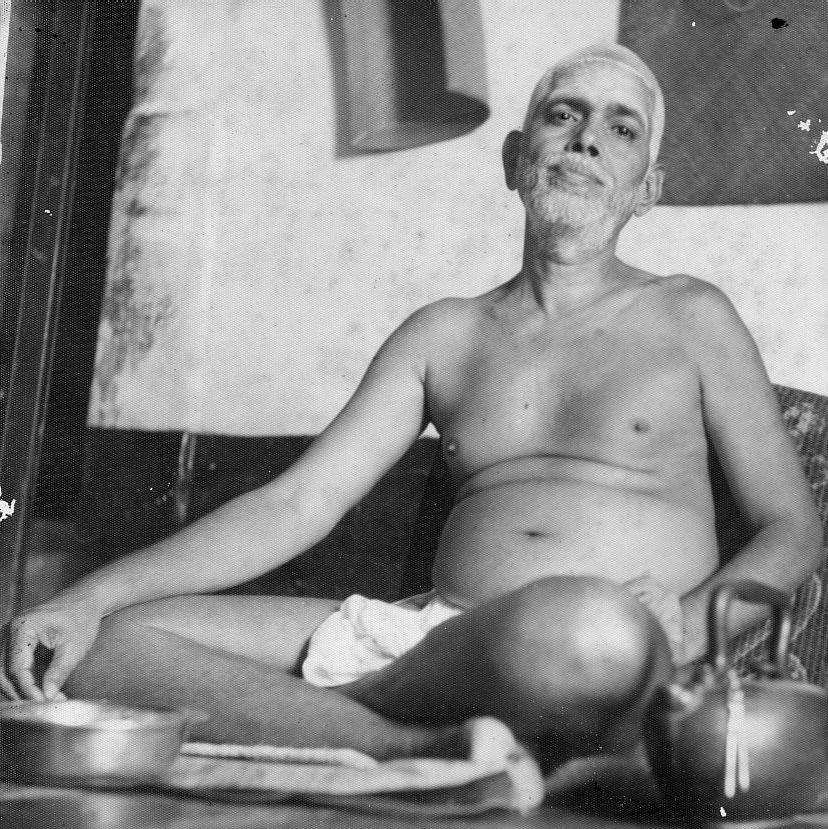
“Adu taanaa vizhundadhu - taaney vizhunduduthu”
On another occasion, Nambiar had an even more vivid dream. He dreamt that Bhagavan was seated in the Old Hall where there was a yogi called Sridhar doing pranayama. He was so focused on doing pranayama that sparks were emanating from his body and even from his head. The yogi was suffering terribly. As Bhagavan looked at Sridhar, he pleaded to Bhagavan, “Bhagavan, I am suffering. Please help me.” Bhagavan immediately replied, “Stop all these gymnastics. Pursue Self Enquiry. That is the safest, simplest, most direct and powerful way of getting to the truth.” Nambiar woke up and went to Ramanasramam. He ran into the hall and prostrated before Bhagavan. The yogi, Sridhar, was also in the hall. Nambiar signalled to Sridhar to come out. He narrated his dream and Sridhar very gratefully said, “Thank you. I was suffering so much. I wanted to ask Bhagavan, but I could not gather the courage to do so and I was also not in a condition to ask him. Thank you once again.” Nambiar understood from the dreams that one should not be drawn towards miracles, but towards the direct path of Self Enquiry.
Nambiar grew stronger from within because he understood intuitively that God is seated in one’s heart. During such moments of realization, he would recall the verse of another great saint, Sadasiva Brahmendra, “Oh Lord, I am not asking anything new from you. Oh Lord, you need not give me anything new. Give me only my own blissful state.” Nambiar would constantly repeat it. This induced him to seek satsang. When he was in Ramanasramam, he sought out the company of old devotees like Chadwick, T. P. Ramachandra Iyer, Munagala Venkatramaiah, Kunju Swami and Viswanatha Swami. As a matter of fact, he would even persuade them to accompany him to Chennai.
Chinna Swami, Bhagavan’s brother, sought Nambiar’s assistance in managing the ashram. Nambiar went to Bhagavan. Bhagavan gave his approval. From then on, Nambiar lent a hand in the official matters of the ashram. He was able to pursue the path of Self Enquiry and at the same time involve himself in mundane matters. He started his career from the bottom of the rung and reached a very high level. He dealt with colleagues, superiors and subordinates, politicians, government officials and all this must have involved a lot of energy, effort and even conflict. Yet, he is an outstanding example of an individual totally involved in Self Enquiry while at the same time leading an active external life. For him, as Bhagavan told Paul Brunton, “There is no contradiction between the work and wisdom.”
Nambiar relied on Bhagavan every second. He used to tell his friends, “Bhagavan is looking after me.” During the war, he was stationed in Chennai along with his family. He was a government officer, but even for him, it used to be very difficult to return to Chennai from his travels because the trains would always be full since the military was on the move. People could not reserve tickets. One of Nambiar’s friends challenged him one day by asking, “How are you going to return to Chennai? The entire train is full!” Nambiar replied with full conviction, “My Bhagavan will look after me.” His friend mocked, “Including your children, there are five of you. If there was only one person, we could push that person into a compartment.” Nambiar however continued saying, “My Bhagavan will look after me. Do not worry.” Nambiar travelled up to Villupuram and waited for the express train. When it arrived, it seemed to be totally packed. His friend who had come to help them board the train commented, “I told you so!” However, Nambiar staunchly said, “You have no idea about Bhagavan.” Saying this, he walked right up to the engine. Next to the engine, was a new and locked first class coach. Since he was a government officer, he approached the station master and requested him to open the coach. The family occupied the entire compartment! Whenever he shared this incident with me, his face would beam and his eyes would be moist. He would say, “Have complete faith in Bhagavan even when it comes to mundane things, like getting accommodation on a train. Ganesan, it is not a miracle; it is pure faith and compassion.”
K. K. Nambiar went on official tours to both England and America, and in all these travels he was guided by Bhagavan and met devotees of Bhagavan. The incidents are very interesting and he has captured these reminiscences in his book, The Guiding Presence of Sri Bhagavan. When returning from America, he brought with him a movie camera, something that was a marvel for people in India in the 1940’s. It was not only a marvel, but a big boon because it enabled him to shoot films of Bhagavan. That is why we have them now. Besides, he also brought back a Charlie Chaplin film and showed it to Bhagavan. I was sitting next to Bhagavan who as he watched it, laughed heartily. He enjoyed it so much that I too became a Charlie Chaplin fan!
Nambiar played an active part in the construction of the Mother’s temple. A temple is normally constructed with the help of a sthapathy, a traditional Indian engineer. Vaidyanatha Sthapathy was entrusted with the construction. But Nambiar was also called. He went to Bhagavan and stated, “Chinna Swami wants me to assist in the construction of the temple. I do not know anything about it.” Bhagavan replied, “Doesn’t matter, help him.” When the temple was constructed and the celebrations were over, a photographer was called and a photo was taken of both. On seeing the photo, Bhagavan made the comment: “The traditional engineer, Vaidyanatha Sthapathy and the modern sthapathy, Nambiar, are together!”
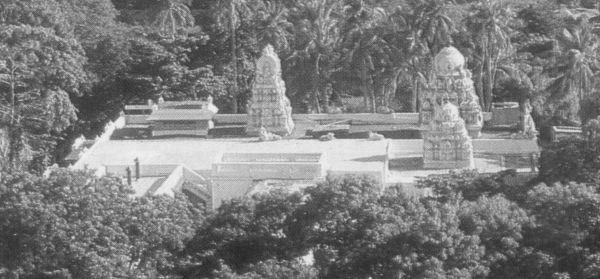
Bhagavan’s Samadhi Shrine adjacent to Matrubhuteswara Temple
In April, 1950, when Bhagavan’s condition was deteriorating, there was a controversy on where Bhagavan’s body should be interred. Though Bhagavan had expressed no opinion, it was almost like he had made up his mind about the spot, because on the very night that Bhagavan dropped his body, Nambiar had a vivid dream. He dreamt that Bhagavan had a closed door meeting with my grandfather, Niranjanananda Swami, and my father Venkatoo. However, the door was ajar. Nambiar, who was standing outside, could hear Bhagavan calling out, “Call Nambiar in.” Bhagavan then made a drawing and took all of them to the spot where Bhagavan’s samadhi is now. Though this was not the spot that had been chosen originally by other people, with the aid of his stick, Bhagavan drew exactly where his samadhi should be! Nambiar woke up from his dream and narrated the dream to my grandfather and others. They brushed him aside, saying, “You and your dreams! We will not care for your dream. We will have it on the spot that we have decided on. Do not interfere and do not tell others about your dream.” They ridiculed him about his dreams because they could not comprehend the power of the ‘rolling ball of rice’. My grandfather also challenged him, “You can have the samadhi there only over my dead body.” But the important people of the town with Annamalai Pillai as their leader came to the ashram and for no reason at all pointed out the very place that Nambiar had dreamt about! My father was also in favour of that spot. Everyone had to comply with their choice, even my grandfather.
There is something personal that I want to share about Nambiar. When I was working in Mumbai, I had a strange spiritual experience. I resigned my job and ran away to Benares. Nobody knew where I was and everyone wondered about me. For six days, I was unconscious. Nambiar, who was working as chief engineer in a private company in Mumbai, had a dream. Bhagavan appeared in his dream and showed him that I was lying on my stomach and that there was a big abscess on my back. Bhagavan placed his hand on my back and said, “Nambiar, look at Ganesan. He has this and I am going to save him.” When he removed his hand, the abscess was gone. He then said, “Nambiar, go tell Venkatoo that Ganesan will be all right. I have saved him.” That is exactly what happened. It is Bhagavan’s grace that I am able to extoll those old devotees who extolled the holy feet of the master. I pay my humble homage to Nambiar.
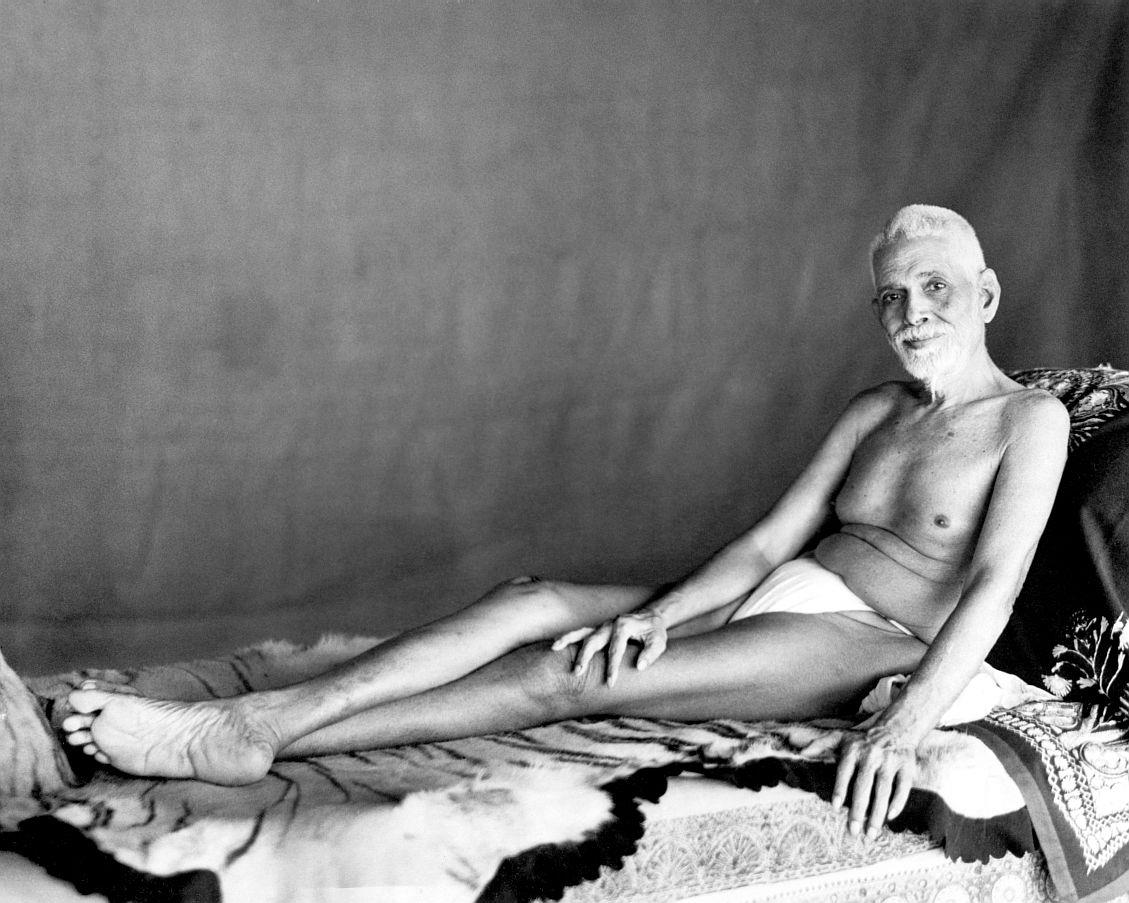
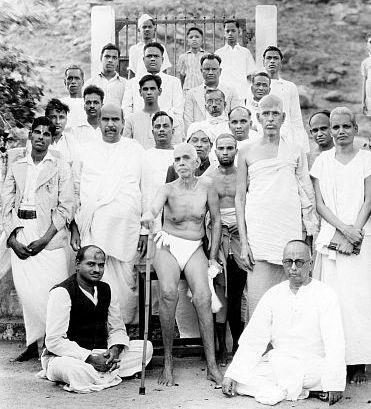
G.V. Subbaramayya with Bhagavan ( standing extreme right – 10 June 1947)