Major Chadwick
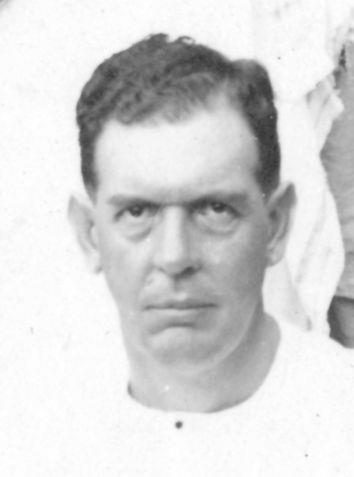
Frank Humphreys was the first westerner to come to Ramana Maharshi. He went up the hill in 1911 and seeing Bhagavan on a rock outside Virupaksha cave wrote, “From that human body, God radiated terrifically.” The second westerner who came to Bhagavan was Paul Brunton in 1930. Brunton looked upon Bhagavan as a ‘Guru’, a spiritual master. He elicited Bhagvan’s direct teaching of Self Enquiry, wrote several books on it and spread it all over the spiritual world. Reading Paul Brunton, a third westerner came to Bhagavan.
There is an eternal triangle - God, guru and man. Frank Humphreys saw Bhagavan as God, Paul Brunton saw Bhagavan as guru and the eternal triangle still had to be completed. So, the third westerner had to come. This third westerner too, came from England and he saw the most natural, the fullest human being in Bhagavan - as the wonder of wonders – and, stayed put. This westerner’s name was Allan W. Chadwick. The old devotees of Bhagavan endearingly called him ‘Satvic’. The Sanskrit word satvic means ‘pure’ or one who is free from worldly passions and attachments. (Paradoxically, this satvic man had been a major in the British army and had participated in killing its enemies in the First World War.)
In Ramanasramam, A. W. Chadwick was known as Major Chadwick. He came in 1935 to Arunachala after reading Brunton’s book. Eleven years before he came to Bhagavan, he had already formulated his own form of meditation which he was scrupulously following every day. Chadwick said, “I had argued with myself that since God had created this world, it was only out of himself that he could have done so, for if there was some other apart from him then he could not be God, the undisputed and omnipotent power. So, I decided that the seeker himself was God. My method of meditation thus was to make the mind cease from thinking as an individual and just rest in its pristine Godhead. Do not think. Just be.” How prophetic! Even before coming to Bhagavan his form of meditation was to stop thinking and just be.
Major Chadwick read Paul Brunton’s book, A Search in Secret India. In it, three chapters were dedicated to Sri Ramana Maharshi and it also had his photograph. These three chapters, and especially the picture of the Maharshi, totally captivated him. He felt, “Arunachala is my home and this Maharshi is my spiritual master.” At that time, he was in Majorca off Spain. He immediately disposed of whatever matter was pending, gave up his house and possessions in Majorca, went home to England to spend some time with his sisters whom he was very fond of. Then, he gave up his home there and started his journey to India. He never returned to England. He was the first westerner to stay permanently in Arunachala at the feet of his chosen master. The thing that we seekers have to notice is - something I felt very deeply during my association with Chadwick - there was no gap between his determination and his action. After reading these three chapters, there was no wavering or indecision. He knew that Arunachala was his home and Ramana Maharshi his spiritual master. And the next step he took was to renounce. He went home to England to fulfill his sisters’ wishes and then took off to Arunachala, never to return.
After a long journey, he arrived in Arunachala. Standing in front of Bhagavan, who he was seeing for the first time - his master in flesh and blood - he felt he was seeing, in one form, God, guru, and the perfect human being. When asked how he felt, Chadwick said, “I felt the tremendous peace of his presence and of his graciousness. It was not as though I was meeting him for the first time. It seemed I had always known him. It was not even like the renewal of an old acquaintanceship. It had always been there though I had not been conscious of it till that time. Now I know.”
Chadwick became a soldier of God, gave up his all. He cut off all relationship with his friends, relatives and fellow officers. To be an unknown sadhu in an unknown land! This is the kind of determination, renunciation and decisive action that we seekers have to imbibe. We are right in front of the truth - Arunachala and Bhagavan Ramana. Arunachala is not a hill and Bhagavan Ramana is not a person. They are the one truth, the ‘I AM’ which Hindu scriptures speak of and which God declared to Moses.
The powerful presence of Bhagavan made Chadwick decide then and there to stay permanently with his master. There was no wavering in any form. He never altered his decision, never questioned it. When such a remarkable disciple surrenders totally, how does the master respond? The master takes complete charge. The rest of his devotees thought it strange, because Bhagavan took very special interest in Chadwick. He told the management, “He has given up his all and come. We have to look after him. Food should be prepared for him without spices.” In Ramanasramam, they make a special vegetable and soup for foreigners called dhorai kootu and dhorai rasam. It was formulated by Bhagavan for Chadwick in 1935. In those days the westerner, the white man, was addressed as dhorai, meaning ‘master’. Naturally, Chadwick was also addressed like that. The vegetable dish and the soup were named dhorai kootu and dhorai rasam after Chadwick. Even today, these bland dishes carry the same names. Thank you, Major Chadwick!
Breakfast in the ashram invariably was, and still is, idli, a steamed rice and lentil cake served with chilli powder and oil. Chadwick’s appellation for that chilli powder was ‘gun powder’ because for him, it was explosively hot! So, Bhagavan ordered ghee and sugar to be served to Chadwick along with his idli. This practice continues to this day for foreigners. And in the night, because he could not eat the spicy rasam and chutney, Bhagavan arranged for some milk and fruits to be given to him. So, in every matter, Bhagavan paid special attention to Chadwick. Everyone, including the sarvadhikari Chinna Swami, noticed this. Consequently, Chadwick was permitted to construct a personal room within the ashram, something without precedent in the ashram’s history. Many years later, Yogi Ramiah, Balarama Reddiar (not N. Balarama Reddiar, but a disciple of Yogi Ramaiah) and then Devaraja Mudaliar were permitted to build three such rooms - adjacent to Chadwick’s.
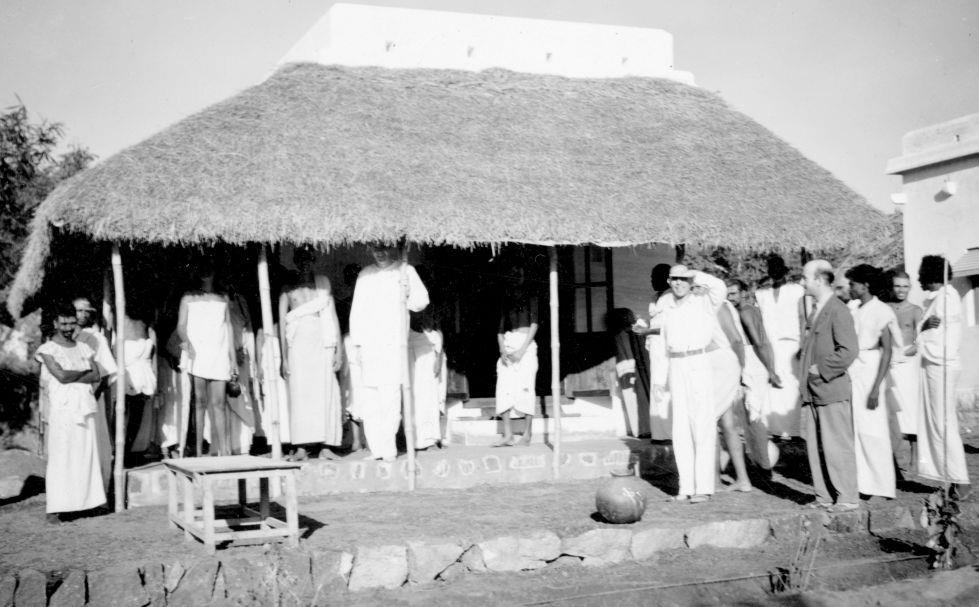
Sri Bhagavan ( head hidden) at the house-warming ceremony of Chadwick’s cottage. S. S. Cohen (with left hand covering his eyes) and Paul Brunton are also seen.
While his room was being built, Chadwick stayed in a tile roofed shed adjacent to ashram's store room. Sometimes, during his morning walks, Bhagavan would enter this shed like a friend and approach Chadwick's table. Chadwick would be seated on a chair in a corner, reading a book. Bhagavan would pick up his wallet and take out photos, identity cards, everything, and question him, “What is this? And this?” Bhagavan moved that closely with Chadwick. Even after Chadwick moved to his newly built cottage, Bhagavan used to occasionally visit him. After lunch, every day, Bhagavan would take a walk around the pond in Palaakothu. Chadwick’s room was very close and was separated from it by a fence with a wicket gate. Sometimes, Bhagavan would open it and come to Chadwick's room.
While paying special attention to Chadwick’s physical needs, Bhagavan was also guiding him spiritually. On the very first day of Chadwick’s arrival, Bhagavan talked to him so freely that Chadwick who was very tired after a long journey felt at home and at ease. After his rest in the afternoon when he came, Bhagavan sent word for a copy of Who am I? and gave it to Chadwick. And he didn’t just hand it over. He said, “Read it and practice it.” Through this spiritual gift, Bhagavan commenced showering his special spiritual blessings on Chadwick. Within a few days, he called Chadwick again and gave him B. V. Narasimha Swami’s Self Realization, the first biography of Ramana Maharshi in English. Again, he said, “Read it and practice it.” Chadwick told me that he formulated his spiritual practices based on the study of these two books.
Chadwick’s whole attention was pivoted on Bhagavan and Bhagavan’s teaching. Chadwick understood the seriousness of his responsibility as a true disciple. Thus, being very attentive, contemplating, understanding and living by the teaching and experiencing the glory of the proximity of the guru, were given paramount importance by him. He was very meticulous. Either he would meditate in his room or on Arunachala, or if he wanted some relaxation he would read spiritual books. The rest of the time he was seated in front of his master, Bhagavan Ramana.
When I asked him why he was all the time seated in front of Bhagavan, he said, “I felt that here is God and guru in human form. When I am able to be near him in his presence and his proximity, will I miss this golden opportunity? Am I a fool to have come here to while away my time?” Chadwick was one person who not only stayed permanently in Ramanasramam but didn’t waste a minute. There were no attractions or distractions for him even when other westerners came. They used to go to Pondicherry, Bangalore, Ooty or some cool place during summer.
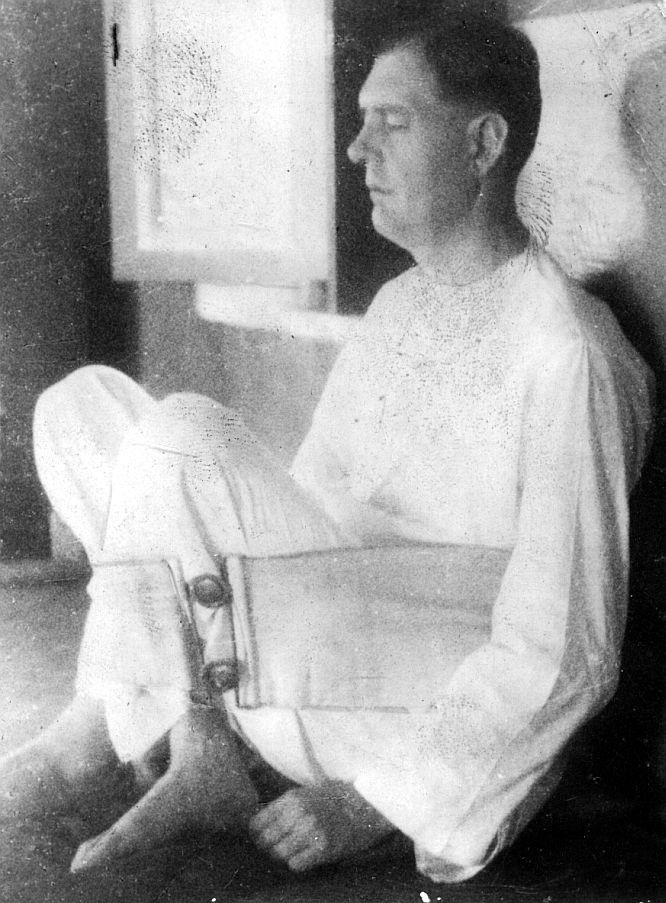
Chadwick with his meditation belt on
Chadwick told me that he rarely left Bhagavan’s presence, because he always felt, “Here is my master!” I used to be moved when he spoke like this about Bhagavan.
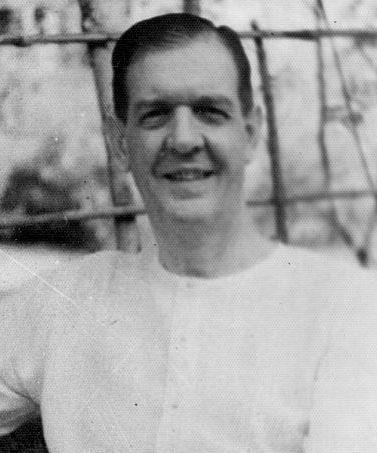
Chadwick was a towering personality. Tall and handsome, he was a very disciplined man. He had a welcoming smile and was friendly towards everyone. While meticulously attending to his sadhana, he was also very supportive of the ashram management. He even became part of it. After Bhagavan dropped the body, when the ashram had to face litigations, financial problems and internal squabbles, he stayed on in the ashram, supported the management and stood by them. Unlike Paul Brunton and Frank Humphreys, Chadwick listened extensively to the dialogues the master had with devotees and visitors. Books like Talks with Ramana Maharshi and Day by Day with Bhagavan were verified by Chadwick and Bhagavan. In Talks with Ramana Maharshi, he has written a beautiful introduction where he says, “Not only were they shown to Bhagavan but the questions there were all verified from the questioner himself - whether it has been properly noted down. And Bhagavan verified them after it was written on the notebook.” So, while Brunton was the sail that spread Bhagavan’s teaching in the world, Chadwick was the anchor giving us confidence that every word recorded was authenticated by the master himself.
I would like here to share a few incidents that took place at Sri Ramanasramam in which I too was involved. In a way, these were all connected with Chadwick. After my graduating from college in 1956, my father asked me to study further. I refused saying I would rather work and earn some money, as our family was then going through some financial difficulties. From 1956 to 1958, I was staying in Tiruvannamalai and trying my level best to get a job. Major Chadwick and Mrs. Taleyarkhan also tried to get me a job. But the higher power had a different scheme for me.
During those two years, I moved closely with all the old devotees who lived in Tiruvannamalai - Chadwick, Arthur Osborne, Muruganar, Cohen, Devaraja Mudaliar - and a host of others like Professor G. V. Subbaramayya who used to regularly visit the ashram. Something about them aroused in me tremendous awe, wonder and interest. I used to pester them, “What did you talk to Bhagavan? What was Bhagavan’s relationship with you?” Sometimes, they condescended and took some time off to tell me. I used to get excited and would feel impelled to request them to write all these precious gems down so that they wouldn’t get lost. Many of them demurred, saying, “Who am I and what can I say?” I used to plead with them, “Who is going to be worried about you? It is about what Bhagavan told you and what his relationship was with you. You owe a responsibility to posterity by preserving these remarkable reminiscences. Please note them down.”
I am very grateful to Chadwick because he was the only person who encouraged me. On many a day, when there were no crowds or much work to be done at the ashram, he would make me sit next to him and narrate a thrilling incident. I did not know then, that after narrating each incident, he was going to his room and noting it down in a notebook. In 1958, I went away from Tiruvannamalai to take a two year post graduate course in philosophy. Before I left, Chadwick told me, “Thank you. I have noted all of these reminiscences in a note book.” After my post graduation, I worked for a few months and came back in 1960 to live in Ramanasramam. The very first thing that I did was to go straight to Chadwick’s room and tell him, “Give me your prasad - that notebook in which you have written everything.” This note book of Chadwick’s was the first book of reminiscences that was published. A few days after the book was released, I received a letter of thanks from Chadwick, in which he wrote: "There is no tradition in our ashram to dedicate the book to a person of one's choice. For, every book is an offering to Bhagavan - 'Ramanarpanamastu'- dedicated to the holy feet of Sri Bhagavan. If there would have been such a custom, I would certainly have dedicated this book to you, dear Ganesan."
By that time, I had become so close to the old devotees that another person, G. V. Subbaramayya, listened to me and said, “I am writing my reminiscences in my mother tongue, Telugu.” I replied, “What is the use if you write it only in Telugu? You are an English professor. Translate it into English too.” This was the second book of reminiscences. He had it published outside. I pleaded with him and subsequently got its future editions published by Ramanasramam. A cascade of reminiscences followed: T. K. Sunderesa Iyer’s At the Feet of Bhagavan, Devaraja Mudaliar’s My Recollections of Bhagavan Sri Ramana, Suri Nagamma’s My Life at Sri Ramanasramam and then those of Kunju Swami, Balarama Reddiar and Kanakammal. The spiritual food was theirs. I was the lucky one, blessed to be the spoon that served it to hungry spiritual seekers! No doubt it was Bhagavan’s Grace that such things should happen!
If the teachings of the Buddha, Jesus Christ and Sri Ramakrishna were not recorded by their chosen devotees and disciples, how could we have known them? If these reminiscences about Bhagavan Ramana are with us today, it is primarily thanks to Chadwick. And then to all the other devotees who acceded to my fervent and persistent pleas to record them. These books of reminiscences bring out the relationship between a Sat-Guru and his surrendered disciples. They are very precious because the true stories contained in them bring the teaching closer to us. How does one put that verbal teaching into practice? We need a lot of encouragement to practice the verbal teaching. Otherwise, one Bible, one Koran and one Bhagavad Gita would have been enough. That is why the reminiscences of these old devotees, how they lived with the master, and how the master through his pure living taught the truth is important to us.
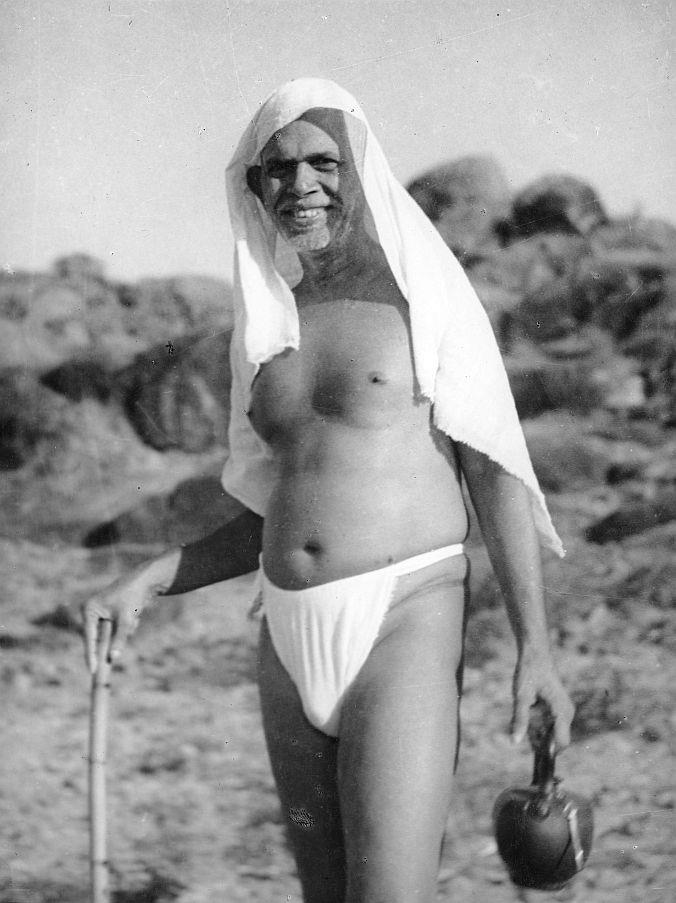
Chadwick had a unique relationship with the master. “Tell me what Bhagavan looked like when you saw him and moved with him. What was it that struck you most?” When I asked him this, his reply was the same that he wrote later in his reminiscences: “Bhagavan was a very beautiful person who shone with a visible light or aura. He had the most delicate hands I have ever seen with which he could express himself. One might almost say that he could talk with his hands. His features were regular and the wonder of his eyes was famous. His forehead was high and the dome of his head the highest I have ever seen. In India, this is known as the dome of wisdom and it was only natural that it should be so with our beloved Bhagavan. His body was well formed and of only medium height but this was not apparent as his personality was so dominant that one looked upon him as tall. He had a great sense of humour and while talking, a smile was never far from his face. He had many jokes in his repertoire and was a magnificent actor. He would always dramatize the protagonist of any story he related. When people came to him with their family stories, he would laugh with the happy and at times, shed tears with the bereaved. In this way, he seemed to reciprocate the emotions of others always. He never raised his voice and if he did occasionally seem angry, there was no sign of it on the surface of his peace. Talk to him immediately afterwards and he would answer calmly and quite undisturbedly. He did not speak unceasingly and unnecessarily. His apparent silence only showed how much foolish chatter usually goes on amongst us. He preferred every sort of simplicity and preferred to sit on the floor, but a couch had been forced on him and this became his home for most of the twenty four hours of the day. He would never allow any preferences to be shown to him. He would wander out on the hill a few times a day and if any attachment to anything on earth could be said of him, it was surely an attachment to the hill. He loved it and said it was God himself.”
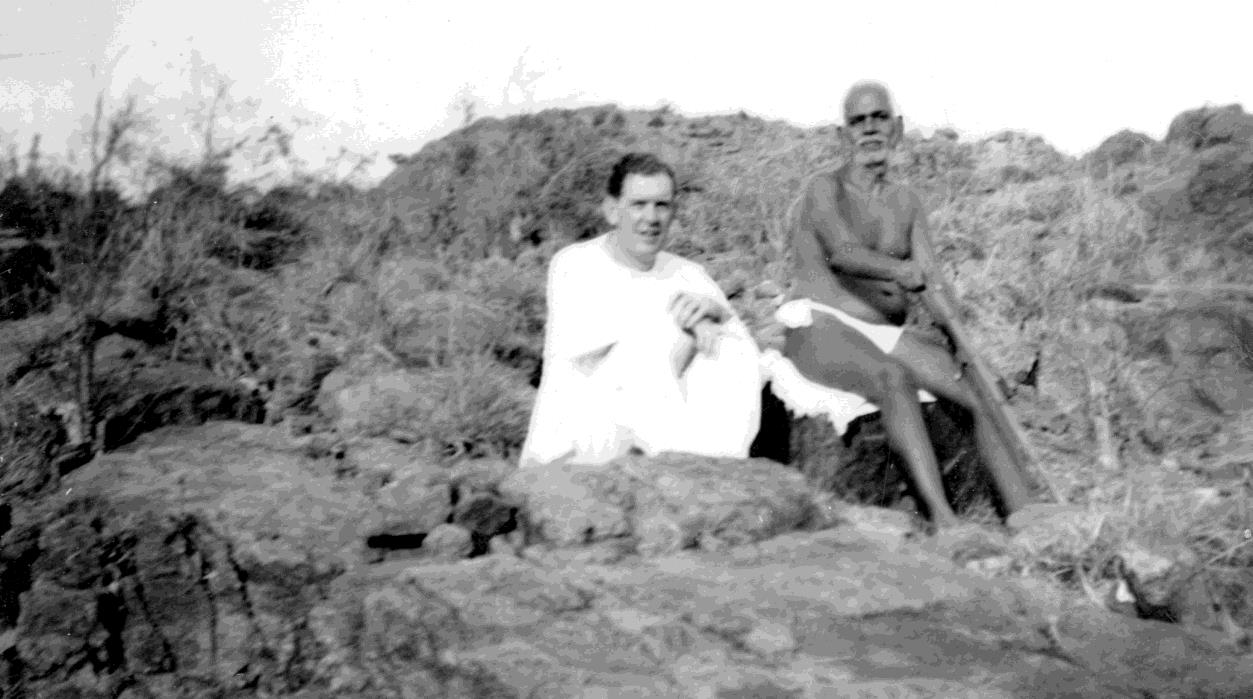
With Bhagavan on the Hill
Chadwick moved closely with Bhagavan. He did not take any action simple, small or big without consulting Bhagavan. Although Bhagavan never approved or disapproved verbally, all the old devotees of Bhagavan could tell from Bhagavan’s expression what his response was. If he approved, he would nod his head. If he disapproved, he would go into his royal silence. Once, Chadwick had a bad toothache. In those days, Pondicherry was the closest town where one could find a good dentist. He went and told Bhagavan, “Bhagavan, I have a very bad toothache. May I go to Pondicherry to have a dentist treat it?” There was that royal silence and Chadwick did not go. Within three days, his toothache miraculously disappeared. He told me, “One should always be in tune with the master. His answer is there. It doesn’t have to be a verbal ‘yes’ or ‘no’. If you adhere to that, then even if his answer is in the negative, a positive action of healing flows from it.”
As we saw earlier, Chadwick followed a strict regimen of meditating, reading spiritual books and sitting in front of Bhagavan for long periods of time. A six foot two inch man, he could not sit cross legged for long on the floor and used to struggle. Observing this, Bhagavan advised him to have a meditation belt. In his reminiscences, Chadwick writes about wearing a cotton meditation belt around his body while sitting on the floor keeping his knees vertical. With it, he didn’t have to recline on the wall or stretch his legs. He could sit for hours on the floor without any problem. From then on, Chadwick could be invariably seen sitting in a corner of the Old Hall wearing his meditation belt. Chadwick once told me that this idea was given to him by Bhagavan. I queried about why his reminiscences didn’t mention that it was Bhagavan’s idea. Chadwick replied, “I didn’t write it because Bhagavan told me not to.” I persisted, “At least you could have left a hint that Bhagavan gave it to you. That way, we would have had a glimpse without you directly disobeying him.” He replied, “I have left a hint, read it carefully.” On close reading, I discovered that Bhagavan had told Chadwick about how his father had used a similar belt. Though his father used it rarely, Bhagavan remembered it on seeing Chadwick struggle to sit on the floor and advised him appropriately. How meticulously Bhagavan looked after his devotees’ physical and spiritual needs!
There is another incident told to me by Cohen that Chadwick has not written about in his book. The person who was attending to English correspondence in the ashram office had to go away. Helpless and not knowing what else to do, my grandfather Chinna Swami called Chadwick and requested him to come to the office and take care of the English correspondence. Chadwick refused and went to his room. But his conscience started pricking him: “All of them, particularly Chinna Swami, have helped me a lot. But when he needed a little help from me, I refused.” When Cohen came in the evening, Chadwick told him about his dilemma. Cohen suggested that he go to Bhagavan and get his advice. On hearing about Chadwick’s dilemma, Bhagavan kept silent for some time. Then, he turned to Cohen and said, “Chadwick is doing Bhagavan greater service by meditating.”
Many seekers, as their meditation progresses, experience an intense and inexplicable fear. This happened to Chadwick too. He went to Bhagavan and told him about it. Bhagavan reassured him, “The fear is not for you. The fear is created by the ego and the ego has to face this fear. Ask who is facing this fear? When you ask this, the fear will drop off. The ego will bring in, particularly in meditation, many obstacles. Whatever the nature of the obstacle, immediately ask who am I? To whom is this trouble? To whom is this problem? It will immediately drop. And in raising this question ‘Who am I?’, if you notice the silence instead of looking for an answer, that silence will dispense with the ego instantly.” Chadwick’s ripeness was such, that at the very moment he listened to Bhagavan he got completely rid of the fear. He never had fear in his meditation again.
Once, Chadwick was reading a book in which it was declared that one look of grace from the guru was enough to get liberation. Chadwick had a doubt, “If one look can give liberation to anyone, then why is everyone not liberated?” He went to Bhagavan and started telling him, “Bhagavan, this is what the scriptures say.” Not allowing him to go any further, Bhagavan uttered three words: “Coal, charcoal, gunpowder.” Puzzled, Chadwick asked, “Bhagavan, what do you mean by that?” Bhagavan replied, “The look of grace of the guru is always there and has the same power all the time. But, to receive it, the seeker has to have the same intensity and be on the same wavelength. That is why seekers are said to be like coal, charcoal or gunpowder. Coal takes a long time to ignite, charcoal takes less time and gunpowder ignites instantly. So, some seekers get it instantly, some seekers take more time and those seekers who do not listen to the teaching of the master and practice it, take a long, long time.” When Bhagavan told Chadwick, “Ask ‘Who am I?’ when fear comes and the fear will go,” at that very instant Chadwick put it into practice and the fear was gone forever. Like gunpowder indeed was Bhagavan’s military disciple, Major Chadwick!
Knowing that Chadwick was very interested in reading spiritual books, Bhagavan asked Munagala Venkataramiah to translate traditional texts like Kaivalya Navaneetam, Tripura Rahasya and Advaita Bodha Deepika into English. Once the translations were done, Chadwick would have them typed and sent to a binder he knew with instructions to have two copies of each book bound with black leather cloth. He would give one copy to Bhagavan and keep one for himself. Bhagavan kept these copies in his mobile library. Whenever serious seekers, who did not know Sanskrit or Tamil, like Dr. Mees, Miss Merston, Uma Devi of Poland, W.Y. Evans-Wentz and Maurice Frydman came, he would hand these out to them. It was because of Chadwick’s interest and Bhagavan’s compassion for him that these translations happened.
Chadwick also used to have a lot of fun with Bhagavan. In those days, there were no ceiling fans in the Old Hall. Instead there was a punkah - a manually operated Indian ceiling fan made of a long, stout wooden stick attached to an equally long strip of cloth. When the rope hanging from it was pulled, the punkah would move to and fro, sending down a pleasant breeze. In the Old Hall, the punkah’s rope hung down behind Bhagavan’s sofa. One day, when no one was in the hall, Chadwick somehow folded his six foot four inch frame and hid himself behind the sofa. Then, when Bhagavan came in and sat on the sofa, he stealthily started pulling the punkah. Bhagavan was surprised because there was nobody in the hall but the punkah was moving with full speed! Since Bhagavan could only turn around very slowly, by the time he tried to find out who was pulling it, Chadwick would stop pulling the punkah and hide. Seeing nobody, when Bhagavan turned away, Chadwick would again resume pulling the punkah. This happened a few times, until finally Bhagavan called out, “Chadwick, I know you are there!”
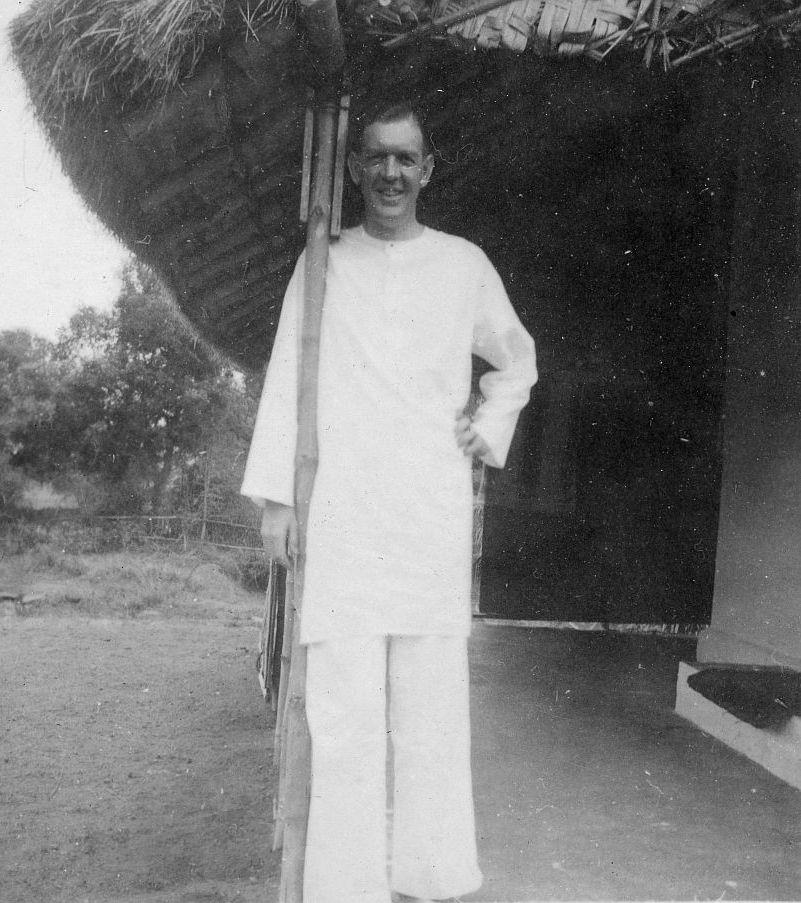
Chadwick under his cottage roof
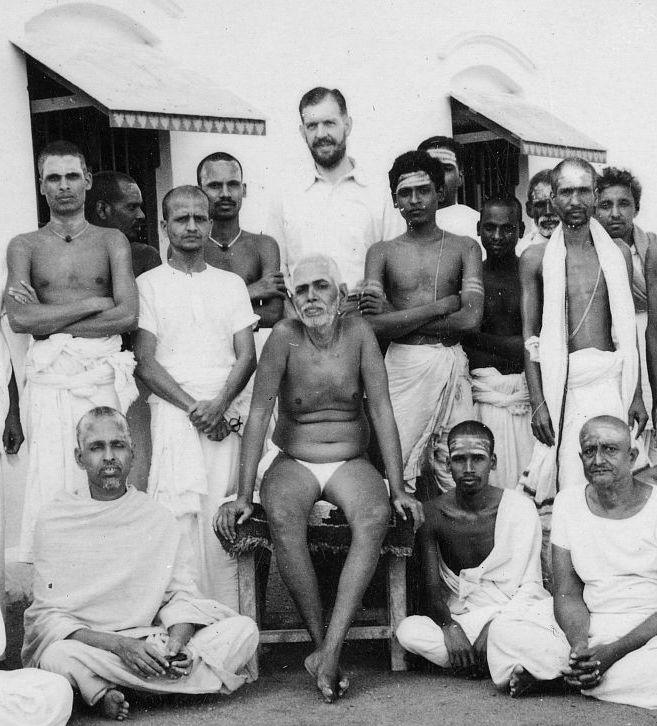
Bearded Chadwick standing behind his ‘Guru’
Bhagavan shared many of the secrets of the holy hill with Chadwick. Once, while they were in the hall, he addressed Chadwick, “Chadwick, when I was going around the hill, I was suddenly transported into the hill. I saw many cities, waterfalls, rivers, temples and people there. These people who are here now were there, and hey, Chadwick, you were also there!” After Bhagavan expressed this, Chadwick, Munagala Venkataramiah, Osborne and many others, independently had experiences in which they suddenly found themselves inside the mountain and saw waterfalls and cities with sages and saints meditating. It may look mysterious, but it is a true spiritual experience. The ‘I AM’ that we have to awaken to, is the same ‘I AM’ which is inside the hill.
Chadwick asked Sri Bhagavan to tell him more about Arunachala. Bhagavan told Chadwick about how he had roamed over the hill so much that not an inch of space on the hill was untouched by his feet. Bhagavan then narrated to him what happened once when he was roaming about the hill, during his stay at Pachaiamman temple, situated in the forest at the foot of the hill. On that day, Bhagavan happened to look up and saw a huge banyan tree on top of a steep cliff. It struck him as possibly being the mythological tree under which Lord Dakshinamurthi sat as Arunagiri Yogi. Bhagavan wanted to climb up towards it. On the way, his leg accidentally disturbed a hornet nest on a bush and was stung badly by the nest’s now angry occupants. Bhagavan said that everything he saw suddenly disappeared. He returned to the temple with a swollen left leg. Later on, Bhagavan warned devotees not to attempt to climb to that banyan tree. After narrating this incident to me, Chadwick said, “It is a great blessing to us that Bhagavan returned to the temple on that day without further pursuing his efforts to go up. Otherwise, we would have lost our Bhagavan on that day itself for Bhagavan is Arunachala himself and he would have merged with Arunagiri Yogi. Just as the light from Bhagavan’s body travelled up to the hill top and merged with it when he dropped his body on April, 14, 1950.”
Bhagavan once openly talked about how Chadwick was amongst ‘us’ previously. However, he had a great desire to be born in the west. So, he was born as Chadwick and had now come back to ‘us’. When Chadwick told me this I was not so very happy because Bhagavan never talked about reincarnation or previous births. Chadwick then pointed out, “The true import of Bhagavan’s statement is not to have any desires. That is the important thing and not whether I had a previous birth or am reincarnated.” This is an indication for us seekers never to have or develop desires. The one thing that we should always meditate on is the ‘I AM’, the awareness within us.
It was Chadwick who came closest to making Bhagavan indicate, albeit indirectly, that he is the Guru. Bhagavan never accepted the duality of guru and disciple. He never announced that he is the guru and others are disciples. But at a particular stage, Chadwick had a problem with this: “You never declare that you are the guru. But you also say that a disciple cannot get liberation without a guru. So, where do I stand Bhagavan? Am I to go in search of a guru?” Bhagavan tried to tell him that there was only the Self and there cannot be a separate guru. A true guru cannot declare himself to be a guru as distinguished from the disciple. He was trying to say that there is only one Self in everyone, but Chadwick was not happy with the answer. Noticing this, Bhagavan turned to the others, “Chadwick is not satisfied with what I have said. Ask the sub-registrar to bring a legal document that declares this. And ask the office to send their seal so that I can stamp it and then give it to him!” This is how Chadwick got Bhagavan to admit that he is indeed a guru!
Chadwick shared with me that a few days before Bhagavan was to drop the body, he went inside Bhagavan’s Nirvana Room and wept bitterly saying, “Bhagavan, you are leaving.” There also, Bhagavan revealed that he indeed is the guru through his reply: “The prime duty of a guru is to establish the certainty of his existence in the hearts of his disciples and having done that, he is free to leave.” He had already implanted the truth in Chadwick and the others and that was why he was dropping his body.
Once, I asked Chadwick, “Are you realized?” I have put this question to all of the old devotees like Muruganar, Cohen, Osborne, Sadhu Natanananda, Devaraja Mudaliar and others. None of them either said yes or no - all smiled. When I asked him whether he was realized, he did not say yes or no. Instead, he told me, “I will tell you what happened. After many years of my stay with Bhagavan - four or five years, I committed the mistake of trying to evaluate how much I have progressed spiritually. This is a thing any seeker should not do. I felt that I have not progressed. Many who saw me in Ramanasramam, looked at me like I was a sage or a saint saying, ‘Oh! He is so fortunate. He is so close to Bhagavan. He meditates so much. He is already in that state.’ This created a contradiction in me as I personally felt that I was not progressing spiritually. However, having left the material life I could not go back to a worldly life either. I felt caught between the devil and the deep sea. I was sorrow stricken. I ran to Bhagavan’s hall. He was alone. I told him, ‘Bhagavan, this is my plight. I am neither here nor there and this causes much sorrow in me.’ Bhagavan looked at me compassionately and said, ‘Chadwick, who says all this?’ Immediately, there was a current like shock in my body and I literally ran to my room, shut the doors and went into a neutral state. I was not bothered whether I was spiritually maturing or whether I would be able to stay in the world. I was in a neutral state of silence. A few days passed like that wherein I was neither happy nor worried.” The only luxury that Chadwick allowed himself was taking his bath in a bath tub which he had in the verandah of his cottage. One day, shortly after the above incident, something happened unexpectedly. As Chadwick told me later, “I was taking my bath and very honestly Ganesan, I was not in a spiritual state or in a prayerful mood when it suddenly dawned - the ‘I AM’!” He experienced it - not just as words. He was so ecstatic that he did not even dry himself. He just wrapped a towel around his waist and ran to the Old Hall from where a few days back he had run away. Fortunately, this time too, Bhagavan was alone. In this spiritual ecstasy of experiencing the ‘I AM’, where there was no Chadwick, just the ‘I AM’, he asked Bhagavan, “Bhagavan, is THIS it?” Chadwick recounted, “Bhagavan gave me the most glorious smile, and then confirmed, ‘Yes, Chadwick, THIS is THAT!’ I then asked him, ‘Bhagavan, is it so simple?’ Bhagavan replied, ‘Yes it is that simple.’ Since then, I’ve never had any doubt.”
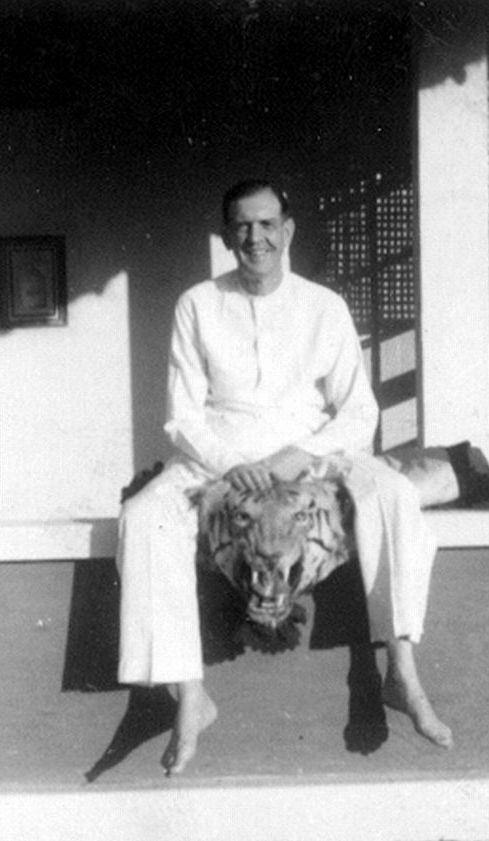
Sadhu Arunachala seated on a tiger skin
Once, Chadwick advised me, “Ganesan! Do not try to gather more knowledge, because finally, knowledge itself will become a great hindrance to Self realisation. When I made an effort to learn Tamil and sought Bhagavan's permission for it, his response was revealing. He said, ‘Why do you want to acquire one more dead weight? All knowledge will have to be finally given up to experience the truth. You have to plunge within to experience the truth, through the relentless practice of the enquiry, ‘Who am I?’ The key to Self realisation is practice, practice and practice only.’” I took that opportunity to seek one more clarification from him as to why westerners were drawn more to Bhagavan's teaching. Chadwick's reply was significant, “Bhagavan’s message certainly is much appreciated in the west. His purely rational arguments and the lack of sentiment in his teachings have great appeal. He never preached or laid down the law. Instead, he always concentrated on turning the seeker back into himself and pointing out to him that it was entirely up to him, since the guru could only indicate the way and guide him. For, no one can give Self realisation to another.”
When Bhagavan’s will was drawn and executed, Chadwick fully supported it. He was there on that day when Bhagavan drew a line in lieu of his signature in the presence of a high court judge and a court official. Later on, when some people started contesting it, Chadwick went to every relevant government office, testified that he was there when Bhagavan executed his will and that the management of the ashram was left to the family. According to Chadwick, “Instead of any Tom, Dick and Harry, if the family was made the managers, whatever happens, they will not leave the ashram. Bhagavan’s choice is the best choice.” When my grandfather Niranjanananda Swami passed away, my father Venkatoo became the manager as he was next in the hierarchy.
From 1956 to 1958, I was staying in Tiruvannamalai and trying to get a job. Finding no success, I was very sad. On one such day, Chadwick called me to his room. When I went there he said, “Ganesan, during Bhagavan’s lifetime itself, Osborne, Cohen, Munagala Venakataramiah and I were four people who were very much interested in astrology. Munagala Venkataramiah and I believed in Hindu astrology, whereas Cohen believed in western astrology. Osborne trusted I Ching, the ancient Chinese science of divination. We knew that according to the will, the next president will be the eldest son of Venkatoo - your elder brother Sundaram. But, among the three grand nephews of Bhagavan, who will be the one that spreads his spiritual teachings? This was our question. Each of us consulted our preferred divination method. All of us arrived at the same conclusion: you are going to be the one, Ganesan, to spread and pass on the teaching.” He said this in 1957 when I had no inclination to take to spiritual life or stay on in Ramanasramam. Chadwick told me, “Why do you want to go seeking a job when your place is here? Stay here!” But I did not stay and went away - only to come back in 1960. As I know now that talking on the teachings is only one way of spreading it; it became clear to me that they meant I would be the one to give talks and satsangs, even by travelling to other countries!
Chadwick was a pillar of strength for me when I came back to the ashram and started helping with its management. Whatever problem I had, whether financial or legal, Chadwick stood like a rock behind me. Once, it happened that my father was away - the year was 1961. I had been in the ashram for one year and in the absence of my father I had to take up the responsibility of taking decisions and making arrangements. The annual ten day Karthikai festival of the Arunachaleswar Temple was on. The climax of the festival was the lighting of the Karthikai Deepam by the temple management, a huge flame, on the summit of the holy Arunachala. During his lifetime, Bhagavan would be seated outside the hall from where the deepam could be seen. The moment the deepam was lit on the hill, a lamp of ghee would be lit in front of Bhagavan. After Bhagavan dropped the body, it was the ashram practice to keep a picture of Bhagavan and light the ghee lamp in front of it as soon as the deepam on the hill was lit - a tradition that continues to this day.
That day in 1961, it started raining heavily. I was agitated because we could not keep the picture and light the lamp outside as it was traditionally done. Seeing this, Chadwick came to me and said, “Ganesan, do not be agitated. We can take the picture inside the dining hall and light the lamp there.” I expressed my concern, “Though Bhagavan was never interested in rituals he was very particular on witnessing the Karthikai Deepam. How can I deviate from the ashram tradition? My father is not here and I do not want to do something that breaks the tradition.” He reassured me, “During Bhagavan’s lifetime, it rained one year just like this. Since he was keen on seeing the deepam, Bhagavan suggested that we go into the dining hall and open the big door through which one could see the hill’s summit. I was next to Bhagavan. I told him ‘Bhagavan, we will not be able to see the deepam because it is raining heavily.’ Bhagavan took his binoculars and looking through it, exhorted, ‘Watch, watch!’ And at the moment the deepam was lit on the hill, see the miracle Ganesan, I was watching eagerly, the rain stopped, the clouds dispersed for a few minutes and we got a glimpse of the deepam as it was lit. Immediately, Bhagavan said, ‘Now light the ghee lamp. The deepam has been lit.’ We too will follow suit.” I was a little skeptical because it was pouring. I anyhow followed Chadwick’s advice. Chadwick sat next to me and eagerly said, “Watch, watch!” And exactly the same thing happened. At the time of lighting the deepam on the hill, the rain stopped and the clouds dispersed. And we lit the ghee lamp in front of Bhagavan’s picture inside the dining hall - just before the clouds gathered again and hid the deepam from our view!
Due to financial problems, some of the activities of the ashram had to be stopped after Bhagavan dropped the body. The Vedapatashala, the school that taught the Vedas which was started in 1938 in Ramanasramam, had to be closed down. The pooja, ritual worship, was not being done properly. Then, Chadwick pitched in with his customary meticulousness. He restarted the Veda patashala with the help of my teacher T. K. Sundaresa Iyer and regulated the daily worship in the shrines of Bhagavan and the Mother. It was he who started the regular performance of the Sri Chakra Pooja in the Mother’s shrine. A fully surrendered devotee staying like an anchor in Ramanasramam, his very staying helped the teaching to be spread. People like Somerset Maugham, Spaulding and many other famous people who came, all talked to Chadwick. And Chadwick convinced them of the greatness of Bhagavan.
He was also instrumental in spreading Bhagavan’s teaching in a more solid way by correcting Talks with the Maharshi and Day by Day with Bhagavan. All the conversations that we now read in these books were corrected by Chadwick. WhenTalks with the Maharshi was to be printed, there was a committee who took the manuscripts to Madras and some scholar or the other struck out many pages saying they were repetitions. It was brought to the ashram before sending it to the press. I was in the office at that time and it was given to Chadwick for his approval. He came back after going through it with his whole face red with anger: “Who has struck out all this - my master’s words? How do you know? Why do you use mere intellectual knowledge and see the repetition? The repetition is absolutely essential.” This is what he writes in its introduction, “The repetition is meaningful. Not a single word has to be taken off because every word has been seen by Bhagavan and approved by Bhagavan.” If today we read ‘Talks’ and ‘Day by Day’ as they were recorded, it is all thanks to Chadwick. Otherwise we would have only a truncated portion of the Talks with the Maharshi, Day by Day with Bhagavan and other talks with Bhagavan. In this way, Major Chadwick had a major role in communicating the message.
During his last days, he became very ill and was taken to the Christian Medical College Hospital in Vellore. The illness was the result of a hernia operation he had in Tiruvannamalai which became septic. He did not want to go away from Arunachala. All of us pleaded with him to go to the hospital in Vellore and get treated. So, there he was, when his doctors sent us a message that his end was imminent. I was very eager to go but my father, Mrs. Taleyarkhan and Hugo Maier, a German doctor, told me to stay back and look after the ashram while they went and rendered whatever help they could. When they reached the hospital, the doctors said that Chadwick was in a coma and could not talk. Mrs. Taleyarkhan, moved on seeing Chadwick lying down helpless with tubes sticking out from his body, announced, “Chadwick, we have come from Ramanasramam.” Pat came the reply, “Welcome, Ganesan.” He thought that I had come. They said, “Ganesan could not come.” And then, he uttered these words, “Today is Easter.” Hugo Maier corrected him, “Chadwick, today is not Easter. Easter is one week hence.” Chadwick replied in an assertive tone, “For me, today is Easter.”
After he passed away, his body was brought to the ashram. There were many who were opposed to interring him in the ashram. Countering them, I gave my firm view, “Chadwick is the child of Bhagavan and his body should not be sent out.” Next to his room on its southern side, his body was interred. You will be surprised to know that on the northern side of the same room, his ego has a samadhi. In 1938, he was digging a small grave there. When a few puzzled devotees asked him, “Why are you digging?” he looked at them and said, “It is a samadhi for my ego.” Bhagavan once visited it, I am told.
This remarkable devotee, after serving his master Bhagavan Ramana, went back to the source and merged there. Today, we can only see the samadhi of his body and ego. If you want to see the real Chadwick you can see him here and now. Turn within, to your Heart and you will find Bhagavan there, Arunachala there and my most revered friend Chadwick there. Every day, he would greet me, “Ganesan, salaam aleykum.” It is the way that Muslims greet each other. It means, ‘peace be unto you’. Yes! Major A. W. Chadwick staying in the Heart is still saying the same thing to us all, “Salaam aleykum, peace be unto you.”
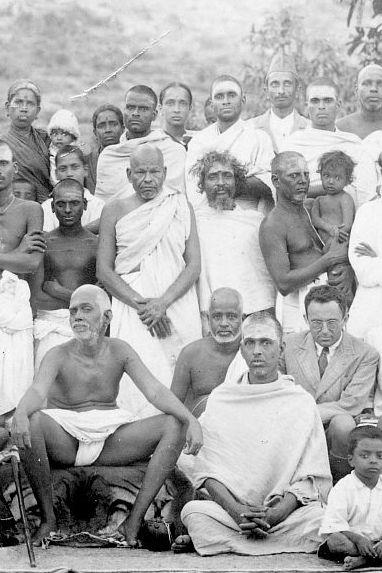
Maurice Frydman (in suit) seated on the left side of Maharshi