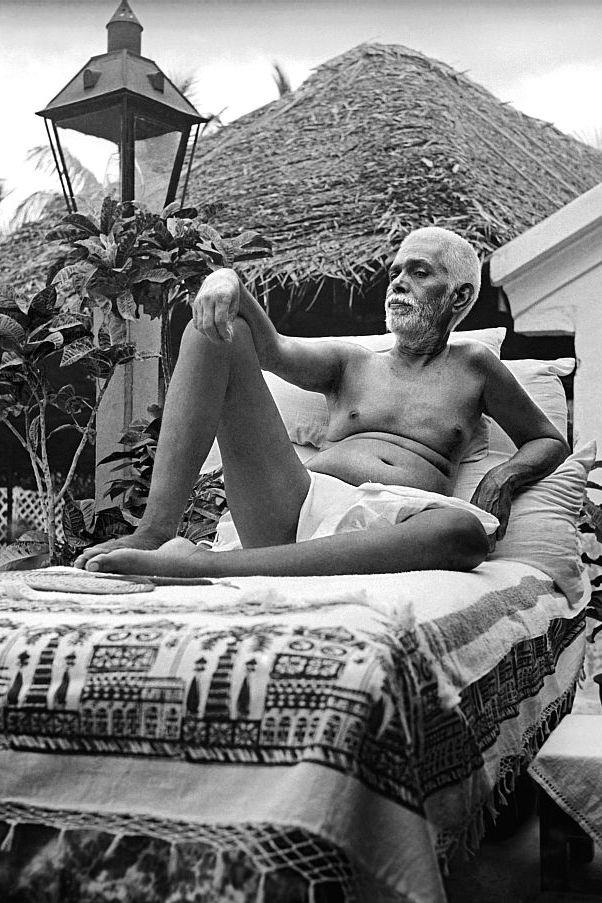
S. S. Cohen
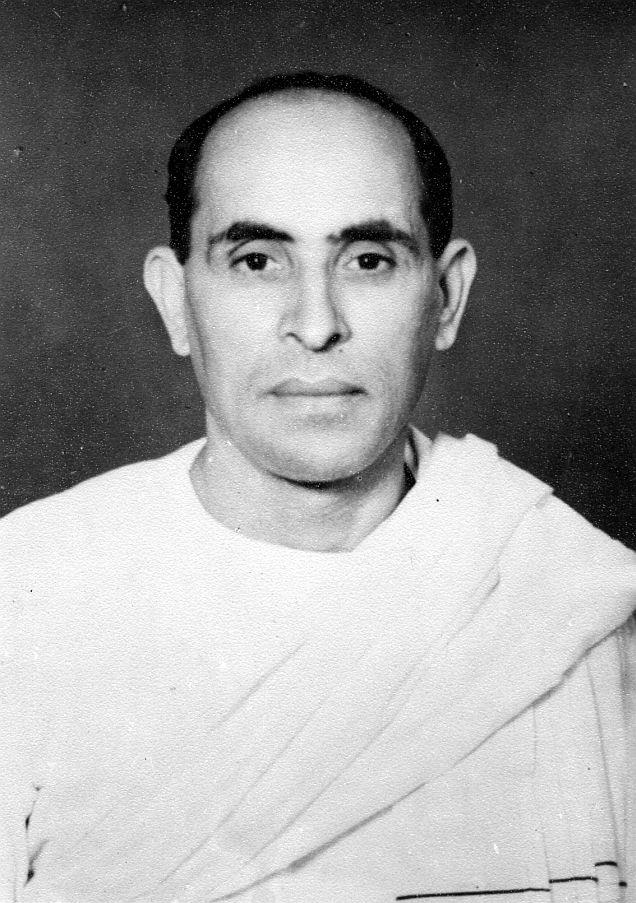
S. S. Cohen, a Jew from Iraq, was one of the keenest intellects who came to Bhagavan. At the age of eighteen, he came across an esoteric book that detailed miraculous happenings in the life of yogis. Determined to go in search of the truth, he felt he should sacrifice everything and his all to meet a life transforming spiritual sage.
The First World War took place at that time. It taught him the great lesson that peace can never be attained outside, only inside. Even though a teenager, this conviction born of the heart, told him that the key to the mystery of his life lay in India. As providence would have it, his close friend in Mumbai fell seriously ill. (We call it providence or coincidence when we have such experiences, but it is only the guru’s grace. In a seeker’s life nothing happens as coincidence.) This friend was a millionaire, until one day his stocks and shares crashed. All of a sudden, he was on the streets, a pauper, and deeply depressed. He wrote to the one true friend who could help. Cohen felt that this friend who was drowned in depression should read the same esoteric book which helped him so much. He also felt this was an opportunity to go to India though he belonged to a very poor family. He was the eldest of eleven children and his father was just a cleaner on a ship. The father loved his son very much. When he came to know of his son’s inward longing, he went to his boss and requested that he give his son a deck hand’s job on a ship that could take him to Mumbai. Cohen was soon on his way to India. Cohen’s father was so poor that he could give him only one coin for his journey. He put that one coin into his son’s pocket and lovingly blessed him, “Go, and may you be successful in your spiritual search.”
He went to meet his friend. The book helped his friend to come out of his depression. But both of them were utterly poor. Relatively rich, Cohen at least had that one coin. Cohen, who was always a hard worker, hunted and found a job as a shop assistant in Mumbai. With his keen intellect, he observed that there were two sets of people. One set was happy and comfortable while the other set was unhappy and always complaining. He figured out that the people who were happy had two qualifications. They had lots of money and knowledge. Those who were unhappy did not have money or knowledge. Cohen decided to be a man of knowledge and earn money. He wanted money only so that he could do spiritual sadhana, without the distraction of want. He got a job with a shopkeeper who was not a very wealthy man. He trained Cohen in accounting. Seeing that Cohen was brilliant, he entrusted all his accounts to him. He also recommended him to the other shops around. Cohen began keeping their accounts and became very well known among the shopkeepers of that neighborhood as a good accountant.
While this was going on, his friend who he helped save from depression, became a member of the Theosophical Society and started taking Cohen to some of the Society’s meetings in Mumbai. There, Cohen met its president Annie Besant. Her keen intellect, total dedication to work and perfect execution of it attracted him. Again, as providence would have it, Annie Besant was looking for somebody to help her with the accounts whenever she came to Mumbai. By that time, Cohen felt drawn to her. He already had had a few private meetings with Annie Besant. Consequently, she asked him to assist her with the accounts. She was so satisfied with his work that she took him to Chennai, the headquarters of the Theosophical Society. Cohen was there for five years and made full use of it. The library of the Theosophical Society in Chennai, is one of the biggest libraries in India. There he studied Vedanta and other branches of philosophy. This is how God guides us. The sages say, “If you take one step towards God, he will come nine steps towards you.” Cohen was almost in tears when he told me, “I was so near to Bhagavan for five years! Yet, I did not even hear about him.”
During this time, one of his other friends living thousands of miles away sent him a book by post. That was the turning point in Cohen’s life. The book he received was Paul Brunton’s A Search in Secret India. Reading it thrilled him because his life’s ambition to sacrifice everything to be with a life transforming sage was about to be fulfilled. On reading the book describing many masters, Cohen’s mind, like Major Chadwick’s, was attracted only to the three chapters on Ramana Maharshi. His inner voice told him that this was the sage he had been yearning for. He packed his bags and left for Tiruvannamalai with seven thousand rupees in savings. He came to Ramanasramam in February 1936, dressed in western attire. He was ushered into the dining hall where Bhagavan was finishing his breakfast. Bhagavan, without even lifting his head, invited the stranger in a most sweet voice, “Please come and have breakfast.” When Cohen later recounted this, he was literally in tears, “That was the beginning and the end of my spiritual journey.” When he went in and saw Bhagavan seated wearing a loin cloth, he immediately had the ecstatic feeling that he was in front of truth in human form. While Cohen was still in a state of ecstasy, Bhagavan went for his usual walk on the hill.
When Bhagavan came back to the Old Hall from his walk, Cohen entered and sat in front of his guru. He could not control his emotions which were welling up as spiritual ecstasy. This is what Cohen said, “I was alone in the hall with Bhagavan. Joy and peace suffused my being. Never before have I had such a feeling of purity and well being at the mere proximity of a person. My mind was already in deep contemplation of Bhagavan - Bhagavan not as flesh, although that was exquisitely formed and featured - but as an unsubstantial principle which could make itself so pronouncedly felt. After a while, I became aware of my environment and I saw Bhagavan looking at me with large penetrating eyes wreathed in smiles rendered divinely soothing by childlike innocence.” This is how Cohen was trapped!
Seated in front of Bhagavan, totally lost, he suddenly realized he still hadn’t changed his dress. He also remembered the fruits he had put into his suitcase to be offered to the master. But when he searched for his suitcase keys in his pocket, he couldn’t find them. It turned out to be a blessing in disguise. Resigned to the turn of events, he sat with his eyes closed when he suddenly felt the clinking of keys on his lap. One of the devotees, Ramaswami Pillai, had gone to the railway station on ashram work. The station master was waiting with the bunch of keys, expecting somebody from Ramanasramam, because a passenger had handed them to him saying, “Sir, these keys were found on an empty seat from which a westerner alighted. Perhaps, you will be able to hand them over to him.” The station master gave them to Ramaswami Pillai. When Ramaswami Pillai came back and told Bhagavan this, Bhagavan pointing to Cohen confirmed, “Whose keys are these? Indeed, they are his!” Ramaswami Pillai then dropped them in his lap. This was one of the series of ‘miracleless’ miracles that the master was going to perform. Cohen had embarked on his journey to India to find the key to the mystery of life. And now, he was sure that he would find it.
Cohen had also brought with him a letter for Paul Brunton who was staying in Ramanasramam at that time. As he went in search of Brunton to hand him the letter, he saw a westerner seated at a table reading a book in one of the rooms. Thinking this was Brunton, he greeted him, “Mr. Brunton, good morning!” The westerner replied, “I am not Paul Brunton. I am Major A. W. Chadwick.” Chadwick and Cohen became friends instantaneously. Chadwick continued, “Paul Brunton has gone away. He will return in two days.” When Paul Brunton came back, Cohen had a beautiful satsang with him and Chadwick, talking for hours about the master and trying to get some of their doubts clarified. Now, Paul Brunton, was also Jewish and an intellectual like Cohen. This, of course, resulted - as it usually does - in heated discussions. That day the topic was celibacy. Paul Brunton did not believe in celibacy. However, Cohen maintained that it was vital for a spiritual seeker. He was convinced that for seekers, practices like sattvic food, celibacy and satsang were all helpful. Brunton was unmoved. Then, Chadwick told them, “Why are you going on arguing? Let us go and ask Bhagavan.” They went to Bhagavan and Chadwick asked him, “Bhagavan, is brahmacharya, celibacy, necessary for spiritual seekers?” Bhagavan’s method of answering was never just to solve the problem. His answers were always focused on dissolving it. He replied, “To remain unmoved in Brahman is brahmacharya. The very word brahmacharya indicates that you should not move away from Brahman. So, staying unmoved in the ‘I AM’ is very essential for seekers.”
This answer of Bhagavan, which led to instantaneous dissolution of the problem, made Cohen feel that he must study all the works of Bhagavan. He stayed in the ashram, became a permanent resident and started studying all the books of Bhagavan. What he especially liked about Ramanasramam was that it was free from any form of control. Nobody was forced to attend meetings, classes, bhajans or rituals.
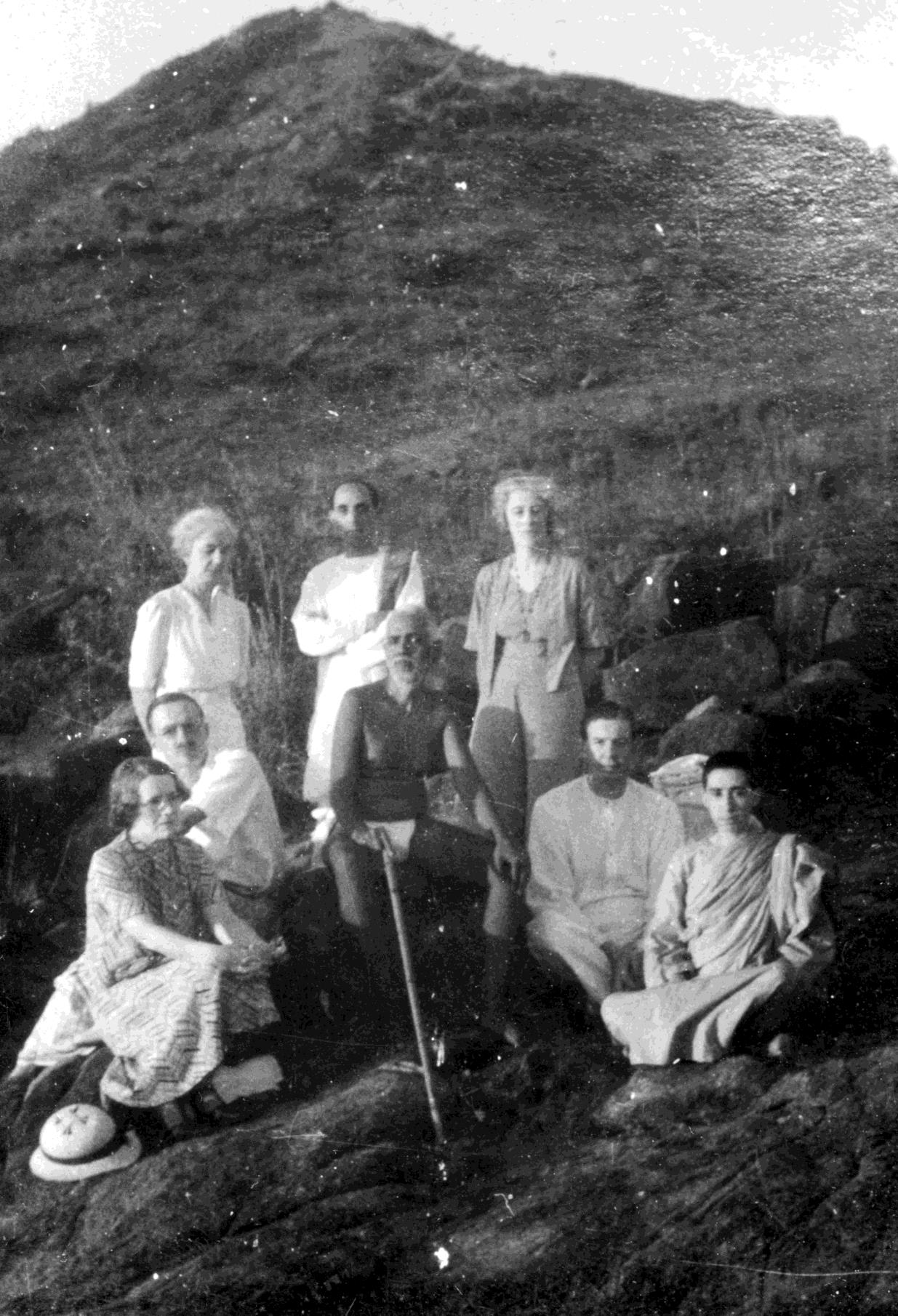
Western devotees on the Hill with Bhagavan (Cohen is standing behind Him)
The absolute freedom given to the seeker by the institution captivated Cohen’s heart. When he turned to Bhagavan, Bhagavan, too, gave absolute freedom. There were no instructions from Bhagavan such as, “This should be done! This should not be done! This is more important! This is less important!” There was none of that for the simple reason that Bhagavan knew that each person knows what is best for him and no one else could know it better. Cohen was very much attracted to the ashram, but even more to Bhagavan who was free from all forms of control. He has said, “Bhagavan was the most liberal of gurus. At no time did he feel the need to form rules and regulations to control the lives of his disciples. Neither did he believe in a common enforced discipline, because he himself had attained the highest without them and had discovered the self evident truth within himself. It was his experience that at the right time Self realization surges up from within by a free impulse, like the budding and blossoming of a flower.”
At that time, Cohen was staying in the ashram’s common guest room. As a serious seeker, he felt he needed solitude for his sadhana, which the crowded room could not offer. He went to Bhagavan and asked, “Bhagavan, may I stay in a hut outside the ashram to pursue my sadhana?” Getting an affirmative answer from Bhagavan, he had a hut built in Palaakothu. Since Cohen was a chronic asthma patient, Bhagavan took care that he should not go into a wet hut by advising him, “Wait for it to dry up.” Cohen told me, he often wondered how Bhagavan knew that he was an asthma patient. For the house warming ceremony of his hut, Cohen invited Bhagavan and the other devotees. When Bhagavan entered Cohen’s hut, he told him, “Do not put a chair for me or anything.” Then, he sat on a mat on the floor along with all the others. After the ceremony, when Bhagavan was leaving, Cohen followed him, and full of emotion prayed to him, “Bhagavan, you have given a home for this body. Will you please give me an eternal home for my soul also? It is only for this that I have come here severing all ties with family and worldly affairs.” Bhagavan kept walking and after a little time, turned to him and said, “Cohen, your firm conviction brought you here. Where is the room for doubt?”
Cohen’s only income was the meagre interest that he was getting from his savings of seven thousand rupees. While living in his hut at Palaakothu, he would cook a little rice and vegetable every morning after which he would go to the ashram to be with Bhagavan. He would come back only for his lunch. Cohen told me that all through his life, he had never been attracted to variety in food. He ate only to appease his hunger, not his palate. One day, a wealthy man happened to offer an extensive and huge feast in Ramanasramam. Cohen was not invited for that. When he went to his hut that day to have his meagre meal, for the first time in his life he was troubled about food. Cohen told me, “I never thought about food any time before or after. But on that day, I was suffering. They were all eating such rich food there, and here I was eating this meagre meal.” When Bhagavan passed by his hut that afternoon, he asked Cohen whether he had eaten his lunch - something he had never done before. Cohen replied that he had eaten just a little rice and vegetable. To which Bhagavan replied, “Rice and vegetable? That is very good. When I was in Virupaksha cave, for days there would not be any food. On some days, somebody would bring some rice. I would add water to the cooked rice and then eat it without salt. You have got rice, vegetables, salt and yogurt on top of it.” Cohen told me, “After that day, not even once was I distracted by any thought of food.” He added, “That is the advantage when you stay with the master - every defect is rooted out once and for all. Living with a master is itself a spiritual sadhana.”
He was with Bhagavan the whole day and sometimes in the nights, too. He would say, “When staying with the master, you have to imbibe his spiritual energy. In the night, when only a few of the serious seekers were around him, Bhagavan would tell us about the lives of ancient saints, sages and mythological stories. But, whether Bhagavan talked or was silent, his presence was surcharged with spiritual energy and we loved to look at him and soak in that spiritual energy.” He once said that such proximity to the master was very rewarding to him in that stage of his sadhana. When I asked him how this was so, he replied, “It healed those wounds I had from wasting energy on foolish expectations and upholding false values and hollow ideals. Bhagavan was pouring his grace on me. I was suddenly gripped by an overwhelming urge to surrender unreservedly to him to guide me in my spiritual hunger, abandoning all the methods I had previously followed and all the beliefs I had built my hopes on. That very moment, I passed on my fate and all that I was to the sacred hands of my master, Bhagavan Sri Ramana Maharshi.”
Three years of austere sadhana followed. He started going on the eight mile circuit of the hill every alternate day. On being asked why, he told me, “During those three hours of walking round the hill, there is no thought - only Self attention. There are no physical or mental distractions. The holy hill helps you focus attention on yourself without volition and with greatest ease.” This helped him strengthen his inner silence and solitude. When external activities started attracting and distracting him, he went to Bhagavan and said, “I want to intensify my sadhana. To do that, I want to go on a yatra, a pilgrimage.” Bhagavan asked him if he had made any arrangements for it. Cohen replied, “Bhagavan, I have not made any arrangements. I am going as a sadhu. I will dress like an Indian, eat vegetarian food, visit temples and sacred places, keep myself secluded, focusing my attention on myself.”
Cohen toured all over south India. He visited many temples. Cohen, like Maurice Frydman had a deeply questioning and logical approach to spiritual pursuit. Initially, Cohen was very intellectual. The intellect being the eye of the mind, can take a seeker to a state of perfect theoretical understanding of the Self. But it can never provide the seeker even an iota of the taste of it. At this stage, a true seeker gets frustrated and disappointed. He can at the most experience only a vacuum. This produces in him a ‘dry’ state. The sage recognizes this void and helps the seeker to move forward. One way is to guide the seeker to go on a pilgrimage. During such travels, the seeker gets ample opportunities to recognize within himself the actual movement from theory to practically experiencing the truth. Bhagavan helped Cohen to achieve this transcendence by approving his pilgrimage across South India. This brought about a tremendous change in his spiritual life. This is how Cohen interpreted to me his transformation from ‘dry’ saturation in theory, to his pulsating experience of the Self within as the Heart.
During his pilgrimage, he met Swami Ramdas at Anandashram in Kerala. Swami Ramdas was full of joy, always singing Ram’s name. In the presence of Ramdas, who had his realization in the presence of Ramana Maharshi, joy permeated the very air. For the first time, Cohen understood the real nature of bhakti - pure, inward joy. When he walked out of Anandashram, he walked out as a happy, joyful man still pursuing jnana marga. He went to Kanyakumari where he started feeling his separation from Bhagavan. Cohen told me, “That emotional pining for Bhagavan was the gift of Swami Ramdas to me.” Lying down on the sands by the ocean, he started crying, “Oh Bhagavan, how mighty you are and how sublime and all pervasive is your immaculate purity. With what tender emotions do we, your disciples, think of your incomparable qualities, your gentleness, your serene adorable countenance, your cool refreshing smile, the sweetness of the words that come out of your mouth, the radiance of your all pervasive love and your equal vision towards one and all - even towards diseased, stray animals!”
Thus pining for his guru, he came back to Ramanasramam. He started noting down the conversations and dialogues between Bhagavan and his devotees. Since taking notes in the hall was not permitted at that time, he would memorize whatever conversations took place there and then go to his room and write it all down in his notebook. It was this notebook that was later published as Guru Ramana. He was also the only person to note down, in his diaries, the last two years of Bhagavan’s illness. Being a homeopath, he was able to write accurately about the various treatments tried and the surgeries performed. Meanwhile, he was starting to see glimpses of the bliss which Bhagavan had said was the very nature of the Self. It had taken a long time for Cohen, but being an intellectual, he still had doubts. He had read in the scriptures that the ultimate realization is always instant and sudden. He went to Bhagavan and asked, “Bhagavan, the scriptures say that the final realization is a sudden and instant event.” Bhagavan smiled at Cohen and said, “Yes! But it should not be forgotten that before that there must be a maturing which is a slow process like the ripening of a fruit on a tree.”
He records as on April 12, 1950, two days before Bhagavan’s Mahanirvana : “It looks like we are on the eve of doomsday. The eve of the day on which we are destined to be deprived of everything we hold worth living for - our refuge, our love, our hope, the greatest treasure, the precious life of our great master. Maharshi is still conscious, and at times speaks. But, till the last, he asks for nothing, expresses no opinion on what should and should not be done for him, does not complain of any pain, except when lifted or touched on a painful spot. Then, and then only, as if to give a piece of information, he would remark, ‘There is not a spot that is not painful to the touch.’ Then, the attendant takes greater care in handling him - especially today, when the pain is so severe.”
After Bhagavan’s Mahanirvana, there were a lot of quarrels and feelings of enmity towards the management. Most of the old devotees had left. From 1950 to 1951, the situation was so precarious in the ashram that there was no breakfast, tea, or coffee, only lunch and dinner. Soon, the sarvadhikari, Niranjanananda Swami, also dropped the body. My father became the next president. He did not know English. Cohen supported my father by writing the many letters and defense affidavits required for the numerous legal cases against the ashram. Cohen was immensely helpful in getting the ashram back on its feet. Being the true renunciate that he was, when everything was almost settled, he passed on his small cottage to Mrs. Taleyarkhan, another devotee with whom he was sharing it. He also had a small piece of land next to my father’s land. He bequeathed it to my father without any condition. Not wanting to be a burden to the ashram, he went and settled in Vellore. When I asked him why he left Arunachala and settled in Vellore, he replied, “My asthma became worse. The weather in Vellore, though just fifty two miles from here, is more conducive.”
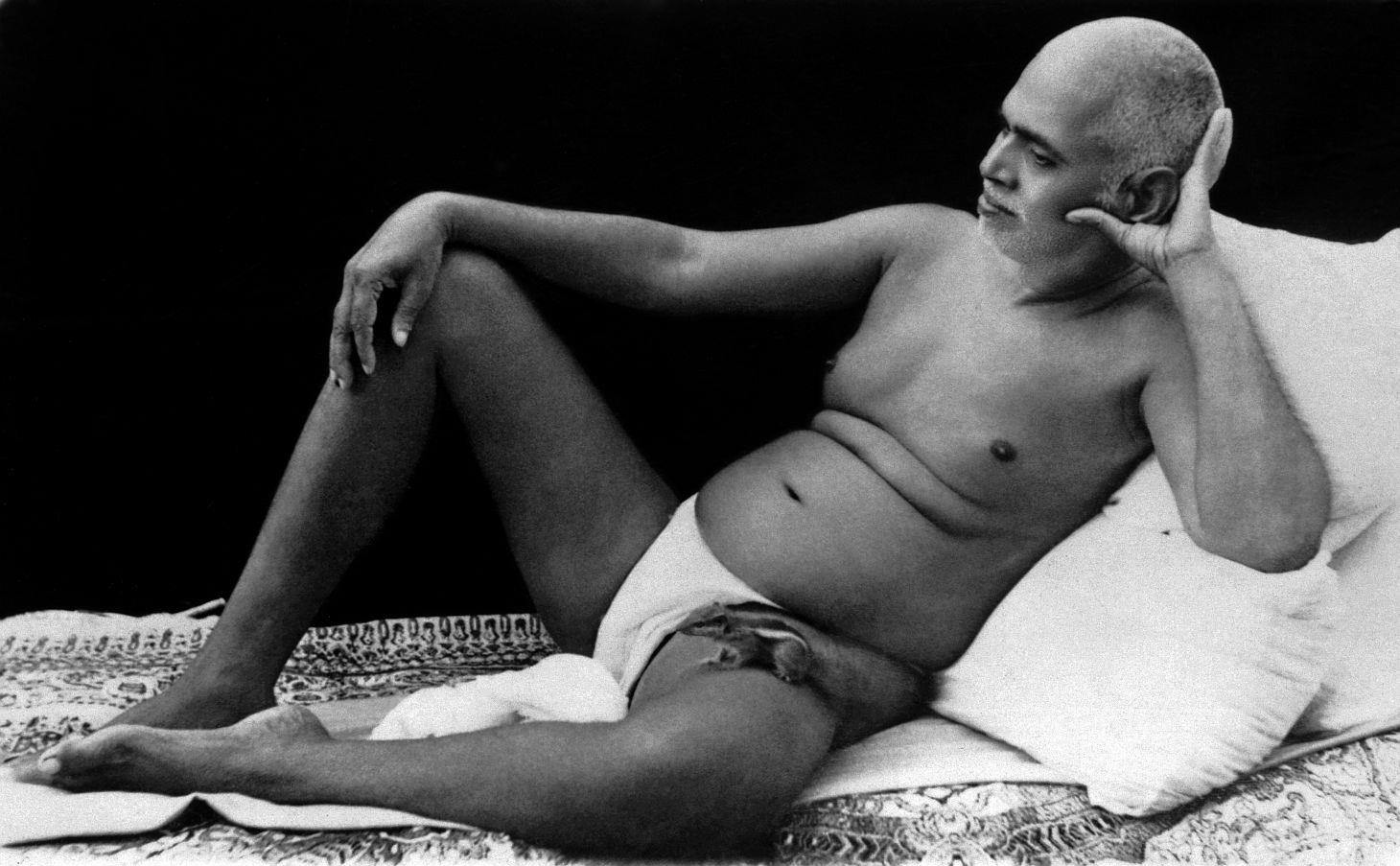
Notice the baby squirrel on Bhagavan’s lap
When his book Guru Ramana was ready, since Ramanasramam could not publish it for want of funds, he published it himself in 1952. I wanted to bring it out as an ashram publication. I went to Vellore and made a request for its publishing rights. He agreed. When in 1962 I brought out the second edition of Guru Ramana, for no known reason, I sent a copy to Dorab’s elder sister who was an equally staunch devotee of Bhagavan. At that time, she was having very serious family problems. She had a small room with Bhagavan’s picture which she used to worship. Her family and relatives objected and wanted to throw away the picture of Bhagavan. She told them, “You can do anything to me. Just give me half an hour to worship Bhagavan.” When she was denied even that, she decided to question Bhagavan and take him to task by locking herself in that small room. She prayed, “Bhagavan, prove to me that you are there, that you are my Guru.”
I have visited her in that big apartment. Between the front door and the floor, there was a gap of an inch or two. Her meditation room was in a straight line from the front door. The meditation room’s door too, had a similar gap. The postman whisked the parcel I had sent her through that gap. It went straight into her room and hit her forcefully. The parcel was also amazingly open in such a way that when she looked down, she could see the title, Guru Ramana! Even today, I do not know of all people what made me send the copy to that particular lady in Mumbai.
In Vellore too, Cohen led an independent life. He never asked for help or money from anyone and lived very frugally. When seekers visited his house, he would fill them up with stories about Bhagavan and his teachings. One of the devotees, Dorab Framji, visited him regularly. On one such visit, Cohen was not to be seen. Searching for him, he found Cohen lying down in his bathroom. He had been lying in the bathroom for seven hours as he could not get up. Dorab put him up in his house at Ramana Nagar opposite to the ashram with the request that I send him food. After a year, he again fell in the bathroom and was not discovered for many hours. Fortunately, Dorab came that day to Tiruvannamalai and found Cohen lying down in the bathroom. He came running to me saying, “We cannot leave him without assistance. Let him stay in the ashram.” In the ashram, he fell one night from his bed and thought that he had broken his legs. I brought both orthopedic and ayurvedic doctors to examine him. After checking him, they found that nothing was broken. But Cohen had convinced himself that his legs were broken and that he could not walk. I got him a wheel chair and appointed an assistant called Kannan to serve him till the end.
Cohen was very kind to me. If by five in the evening I was still in the ashram office engrossed in work, he would come by and urge me to stop for the day. If I protested, he would scold me, “What is all this work? You have come here for sadhana. We have come here for our master. All this service to the institution, to the master, these will all bring you name, fame, popularity and comfort, but you will be nowhere near emancipation. Wake up, Ganesan! Wake up as I did. I did enough service and then went into solitude. Go into solitude. Plunge into sadhana.” He told me repeatedly, “Do not be duped by all these imaginary convictions that you are serving the guru or helping the institution.”
Whenever I went to his room after my work at the office, he would tell me again and again, “Beware! Beware! Go back and do sadhana. All this work is of no use to you. I am interested in you, Ganesan. You have come for emancipation.” Cohen alternated between hallucination and normalcy towards his last days. Immediately after saying this, he would continue, “Your father has put me on the seventh floor. I have no legs, so how can I climb to the seventh floor?” The first time this happened, I was shocked: “Cohen, you are one of the greatest intellects that has come to our master. What are you talking about? There is not even a first floor in Ramanasramam!” Since he continued to blabber, I shook him to get him out of what I thought was his delirium. At this, his eyes brightened and he said, “Ganesan, just as in old age the body goes out of control, the mind also sometimes loses control. But, since we are neither the body nor the mind, it does not matter.” I asked him, “What state are you in?”.Cohen replied, “I am in bliss. I am in total bliss.” The next minute, he started blabbering again, “You appointed only one attendant, Kannan. But there are nine Kannans in my room. How can I sleep alone in the room?” When bewildered I shook him again, he looked at me steadily and said, “Why do you listen to my mind? These are all in my mind. I told you not to listen to my mind.” Since the intellectual aspect was very important in his life, his mind was now playing tricks. When some of the old devotees had to go through intense physical suffering in their last days, I have asked them, “Why should someone like you get such a disease?” They would invariably reply that it was because they had paid too much attention to the body and its comforts and now it was returning the favour! Cohen was the first devotee I saw who actually demonstrated the bliss that was beyond even the mind. When I asked him why he blabbered, Cohen answered, “When I turn my attention outwards, it blabbers. When I turn my attention inwards, it is bliss, Ganesan. I bless you that you should never have this affectation of the body and the mind. I bless you.”
And sometimes when he cried, I would console him, “Cohen, why do you cry? You will pass away smoothly, as peacefully as you slip into deep sleep.” A very humourous man, he would then give me a smile and say, “I know Ganesan, why you say this. You are saying this because after I die you can tell everyone else that Cohen died exactly as you predicted!” For some reason, Cohen was very particular that his body be buried in the ashram. My father and I assured him it would be done. Cohen even showed me the spot where he should be buried. Sometimes, when I was not at the ashram, he would take Kannan to that spot and instruct him, “Dig a pit here and drop my body into it, now. Then, fill it up with earth.” Frightened, Kannan would shout, “Oh, no, no! That is a sin!” Cohen would plead with him, “It is all right, Kannan! Don’t worry. This is the place where I will be buried when I am dead. I am only asking you to do it now when I am alive. That’s all! No sin will come to you!”
Sometime in 1980, I had to go away on ashram work. At that time, Cohen dropped the body. We don’t know why Cohen wanted his body to be buried in the ashram. Unfortunately, despite the assurance given to him, his body was taken outside and given a common burial. When I came back from my tour, I said, “Cohen was one of the greatest devotees of Bhagavan. He is a spark from Arunachala! Could we not fulfill this small wish of his?” I do not know how many will approve of it, but the fact is that I had his body exhumed and buried in the ashram where his samadhi now is. That night, I slept happily knowing that Cohen’s wish was fulfilled.
Cohen was no ordinary person. We should not waste our thoughts on why he asked to be buried in the ashram if he was beyond his body and mind. Instead, we should look at how it happened. When he was in Vellore, he had given money to a Christian institution to take care of him during his last days. What forced him to fall in the bathroom and then brought back to the ashram? It would have appealed to his sense of humour that though he wanted his body to be buried in the ashram, it was buried outside at first. Then, the higher power played another trick and brought his body back to be buried inside the ashram. This very bright spark had gone back to the ‘Hill of the Holy Fire’. Samuel Suleiman Cohen had been re-absorbed into Arunachala.
Cohen’s life is our life. It is like breathing. Breathing is common to all. But, it is individualized. In the same way, Cohen’s sadhana oriented life is every one’s life. Reading about him and absorbing it, awakens in us that pure awareness which Cohen aspired for and lived all his life.
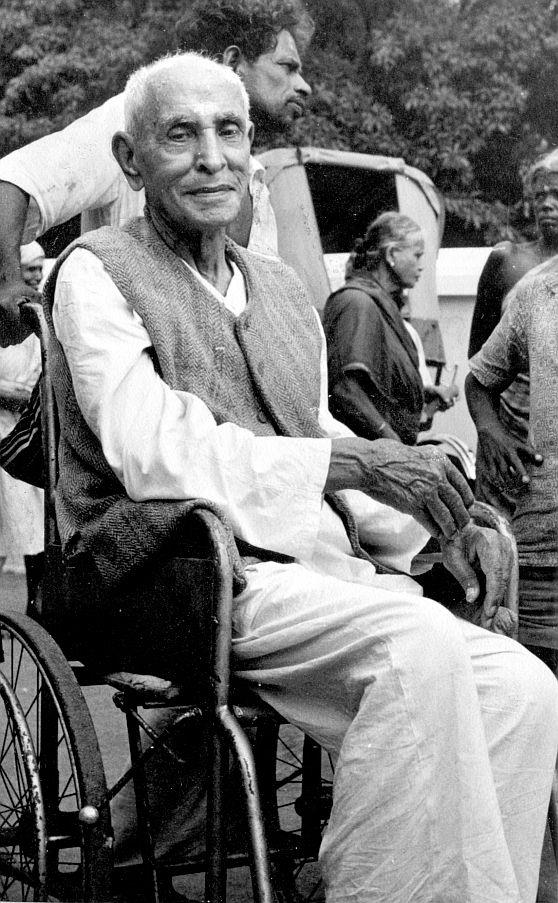
Cohen in his wheelchair