N. Balarama Reddiar
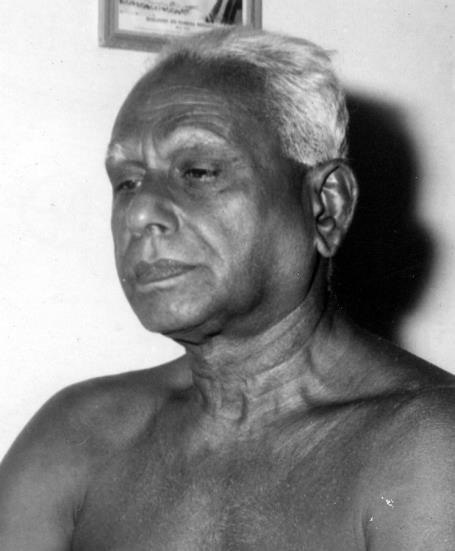
“Oh Lord. Oh guru! You are the reality who remaining as my innermost Self ruled me during all my countless births. Glory to you who put on this human form in order to redeem me through your upadesa. I do not see how I can repay your grace in helping to liberate me. Glory, glory and more glory to your sacred feet.” These lines from Kaivalya Navaneetam, quoted very often in Talks with Ramana Maharshi, are a reflection of Bhagavan’s teaching which states that when a person has not re-cognized his Self, then the Self takes the human form of the guru, who in turn leads that person on the path of Self realization.
N. Balarama Reddiar came to Ramanasramam in 1933. Unlike other people who came there in search of a guru, Balarama Reddiar had already found a master in Sri Aurobindo of Pondicherry and was a resident of his ashram for five years. The residents of the ashram in Pondicherry abide by strict rules and regulations. Balarama Reddiar did not find this an inconvenience since he had been raised by devout parents, and his father had been a particularly illustrious seeker. He had seen his father touring all over India and observing silence for a whole year. Since he wanted to do spiritual practice like his father, he volunteered to do gardening for two hours in the afternoon so that he could have time to himself. All the while, he was also reading extensively. He read about Ramana Maharshi for the first time in B. V. Narasimha Swami’s book Self Realization. The Sanskrit scholar Kapali Shastri, also a resident of Sri Aurobindo Ashram, paid frequent visits to Ramana Maharshi. Kapali Shastri’s accounts of Ramana both intrigued and fascinated Balarama Reddiar. So, when Kapali Shastri urged Balarama Reddiar to visit the great sage at least once, he made up his mind to go.
Balarama Reddiar arrived in Ramanasramam on an early morning in March 1933. Delicious idlis were being served for breakfast and he was invited to join. By the grace of a higher power he was seated not only next to the Maharshi but also to the right of him. Once food had been served, it was the Maharshi’s custom to give a nod to the person seated to his right. This was a signal for everyone to start eating. The Maharshi’s simple gesture of nodding made Balarama Reddiar feel elated. He found it to be a beautiful and pure experience because it enabled him to have a glimpse of the spiritual radiance within him. He was also overwhelmed by the pervasive freedom in the ashram.
Ramana Maharshi rarely asked anyone who came to the ashram questions such as, “Who are you? Where do you come from?” or “How long will you be staying?” As Balarama Reddiar had come only for one day, he went to Bhagavan in the evening to take leave of him. The feeling of awe and wonder had still not left him. Bhagavan asked him, “Where do you come from?” Balarama Reddiar was reminded of Adi Sankara’s famous question, “Kutha ayatha?” meaning, ‘where do you come from’. Balarama Reddiar was thrilled by the question. It pulled him inwards to the source of thought and he got a taste of spiritual bliss. This is an example of the Shakti, the higher power, bringing the seeker and the guru together.
On his return to Pondicherry, he once again started reading the book Self Realization, this time paying greater attention. He read that it was possible to change one’s guru; to Balarama Reddiar, this seemed a little contradictory. He decided to go to Ramanasramam once again. On his second visit, too, Balarama Reddiar was captivated by the spiritual presence and peace that permeated the ashram. Yogi Ramiah, ardent devotee of Bhagavan, received him, took him to Bhagavan and introduced him, “Bhagavan, I know his father. This is Balarama Reddiar.” Bhagavan looked at Balarama Reddiar and this encouraged him to clear his doubt. He asked, “Can a person change his guru?” Bhagavan responded with a beautiful reply. He said, “Yes, certainly! One can change his guru. What of that?” The question, “What of that?” implied that Bhagavan had already changed the guru in Balarama Reddiar’s case. Balarama Reddiar did not quite grasp what Bhagavan had said, yet he felt a sense of profound peace just sitting beside Bhagavan. He felt liberated at the ashram because it did not have the rules and regulations of Sri Aurobindo Ashram. There was a natural air about Ramanasramam that was elevating. He lost interest in everything, except the Maharshi and his presence. He felt that he was being guided even though there was no one to tell him what to do or where to go. Even years later, Balarama Reddiar would emphatically state, “The power of the presence of the Maharshi is the guiding force.” He was well aware that the guidance had come from within.
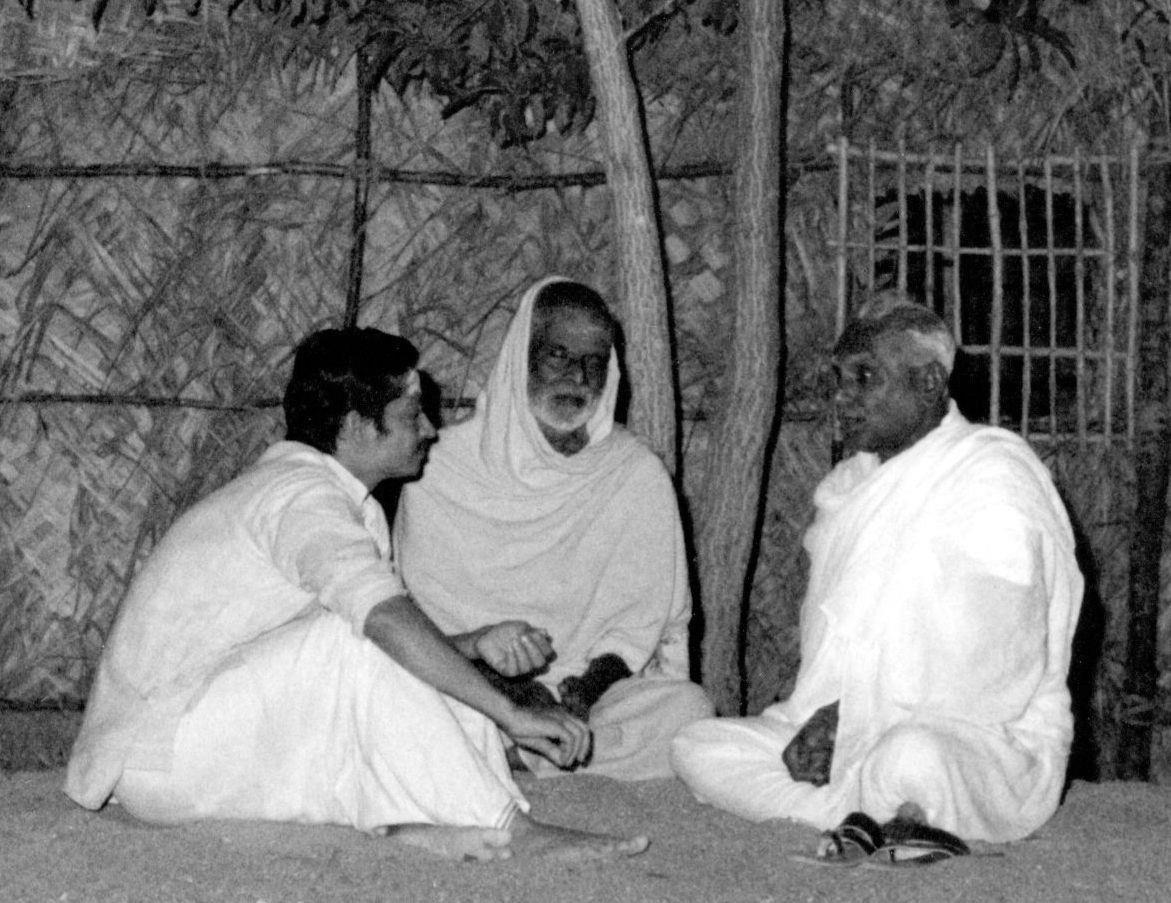
(l to r) Ganesan, Kunju Swami and Balarama Reddiar during Bhagavan’s Birth Centenary celebrations
Balarama Reddiar stayed at the ashram for three days and during this time, he was even more convinced that Bhagavan was his guru and Ramanasramam his home. On the third day, when he went to take leave of Bhagavan, he found Bhagavan alone. What happened next strengthened his conviction further. He said, “In order to take leave of the Maharshi, I approached him while he was sitting on his couch which was outside in the verandah. His feet rested softly on the ground. He had just returned from an afternoon stroll after the midday meal. I fell to my knees and prostrated before his holy feet. I was aware of the ashram rules which prohibited devotees from touching Bhagavan’s body. I kept myself at a slight distance, but just look at the beauty! As I lowered my head near his feet, in the twinkling of an eye, Bhagavan’s feet ever so gently rose and the big toe of each foot very lightly touched my closed eyelids. It all happened in an instant. I was thrilled!”
Balarama Reddiar went back to the Aurobindo Ashram. While there, he visited his village. Whenever he was back in his village, he would not stay in his house. Being a very austere man, he stayed in a small cottage on its grounds, continuing his practice and sustaining himself with whatever food was sent to him from his house. A year later, he came to Ramanasramam for the third time. This time, there were no rooms available. He had to stay with others in the common guest room which is still there. One day, he had the strong desire to go to the top of the hill. Without consulting anyone, he started climbing up. After some time, he found himself in a very precarious position on a very steep rock face with no way up or down. There was nothing to hold on to. He prayed to Bhagavan and suddenly found himself grasping at a root. He used it to pull himself up and to his surprise, found that he was on top of the hill. Bhagavan had saved him as soon as he thought of him. This strengthened his conviction that there is a divine power. The experience made him understand that Bhagavan was his master and his place was holy Arunachala. While sitting, in the Old Hall in front of Bhagavan, he told himself, “This is Sarveswara ! ” [“ Lord of the Universe.”]
Balarama Reddiar returned to Aurobindo Ashram, determined to take leave of Sri Aurobindo. At Aurobindo Ashram, the custom was for seekers to correspond daily with the master. Everyone had their doubts cleared by putting them in writing and depositing the slip of paper in a box. The next morning, Sri Aurobindo would have given the answer to the query. Balarama Reddiar wrote, “Master, you begin your teaching with Self realization; Ramana Maharshi dwells only in Self realization. Give me permission to go to Ramanasramam and attain Self realization.” Quick came Sri Aurobindo’s reply: “You can discover Self realization here. There is no need for you to go anywhere.” This response disappointed Balarama Reddiar. He was not ready to give up because he was drawn irresistibly to the presence of Ramana Maharshi. He wrote again to Sri Aurobindo. Sri Aurobindo replied, warning him, “If you go away, whatever work we have done on you until now will all be undone. So, we will not give you permission.” Balarama Reddiar knew that he could not argue or quarrel with such a towering personality like Sri Aurobindo, but the divine power was such that he was compelled to write for the third time. He was determined to leave, whatever the reply. Such was his resolve to go to Sri Bhagavan’s abode at Arunachala. The Mother and Sri Aurobindo understood Balarama Reddiar’s yearning and granted him permission, albeit with a lot of hesitation. The rule in Aurobindo Ashram is that all correspondence from Sri Aurobindo and the Mother to a seeker, once read, must be torn or burnt. Balarama Reddiar did this with all his letters but kept with him the last letter of permission. There was a divine reason for this, as we shall see later.
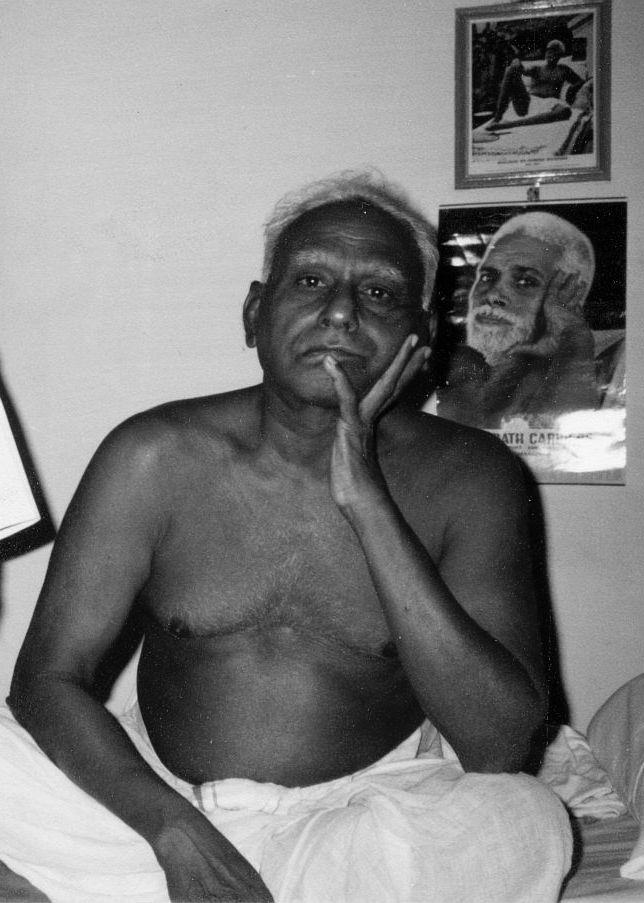
Balarama Reddiar attentively listening to visiting devotees questions
Balarama Reddiar came to Ramanasramam in 1937 on Ramana Maharshi’s fifty seventh birthday. It was a most auspicious occasion for this determined disciple and the guru to bond. Balarama Reddiar came with the intention of doing practice, and dedicating and surrendering himself to the master. The ashram had no private rooms at that time and Balarama Reddiar wanted privacy to pursue his practice. He was advised to take a room in town and come and meet Bhagavan every day. He would arrive at three in the morning, stay till eleven and then go back for lunch. He would again visit the ashram at three in the afternoon and stay on until eight at night. Meeting Bhagavan every day was vital for him. As he said, “The presence and proximity of the master is very important for the seeker.” This arrangement made it easier for Balarama Reddiar to spend the time just looking at the Maharshi. The Maharshi guided him through words, gestures, acts of kindness and the expression of love in silence.
Although he had given up Sri Aurobindo and had come to embrace Bhagavan as his master, there was still this gnawing doubt, “Have I done the right thing?” Sri Aurobindo’s physical, intellectual and psychic influence were so overpowering that he could not easily extricate himself. He felt that he had to get it clarified that Ramana Maharshi was his guru and that moving away from Sri Aurobindo had been the right decision. He intended to get the issue clarified by Bhagavan, but look at the master’s consideration for the devotee! While reading the newspaper, Bhagavan happened to read a review of Sri Aurobindo’s Light on Yoga. Someone seated in the hall said, “Balarama Reddiar has that book!” Since the Maharshi had not read about Aurobindo’s philosophy, he asked for the book and read it. Why? It was not for himself but for the sake of his devotee who was soaked in Sri Aurobindo’s philosophy.
One day, when Balarama Reddiar was alone with Bhagavan, he sought the answers to two questions: had he done the right thing by coming away and is it possible to attain physical immortality like Sri Aurobindo was proclaiming? Whenever this topic of physical immortality was discussed, Balarama Reddiar would argue for its possibility with Chadwick, Cohen and the others. However, he could never argue this topic with Bhagavan because he felt that the answers were coming straight from the Heart. The lingering doubt about physical immortality remained, until one day Bhagavan told him after reading the newspaper in the hall, “You know, in Kumbakonam, there was a C. V. V. Rao, a yogi. He professed the knowledge of an herbal elixir that would ensure physical immortality. He said he could help people attain physical immortality. Great personalities like Tilak and Annie Besant wanted to meet him. But C. V. V. Rao died at the age of thirty six!” Bhagavan showed Balarama Reddiar the newspaper announcement and put his mind to rest on this issue.
Balarama Reddiar showed Bhagavan the final letter that he got from Sri Aurobindo. Bhagavan found it difficult to read Sri Aurobindo’s handwriting and therefore requested Balarama Reddiar to read it. Sri Aurobindo had written, “You are determined to follow a path in which you can achieve only partial realization. We give you blessings; if you stayed on here and pursued your practice, both the Mother and I could have helped you.” When Balarama Reddiar came to the part about ‘partial realization’, Bhagavan interjected, “Partial realization! If it is partial, then it is not realization. If it is realization, then it is complete - there are no parts to it.” This settled all his doubts. He gave up all thoughts of continuing as Sri Aurobindo’s disciple and decided to follow Bhagavan’s path of Self Enquiry. He looked on Bhagavan’s devotees as his family and Bhagavan as his guru; a guru who was available all the time to guide and bless him.
It might seem to onlookers that Bhagavan was not interested in the affairs of others. But, according to Balarama Reddiar, “Bhagavan was keenly interested in sincere seekers, and this only the seeker would know.” When I asked him if Bhagavan had helped him, he said, “Bhagavan has helped me personally and also in strengthening the depth of my practice.” I asked him to share some of these experiences with me.
He shared with me the struggles he experienced. When Balarama Reddiar was in Sri Aurobindo ashram, there was a young Hindu girl who was in love with him. The girl’s parents came from the same state as Balarama Reddiar and they too wanted him to marry their daughter. The parents met the Mother at Sri Aurobindo Ashram and the Mother told him, “Yes, marry this girl. She is for you. It will be wonderful.” However, Balarama Reddiar’s mind was more drawn to spiritual practice. He liked the girl, but he felt marriage would be a distraction. The girl and her parents pursued him to Ramanasramam. In a weak moment, Balarama Reddiar wondered whether he should marry her, but he wanted permission from Bhagavan first. That was the remarkable thing about Balarama Reddiar. Before making a decision, he consulted his master who was available twenty four hours a day. He wrote a note to Bhagavan asking, “Should I marry this girl?” Bhagavan read the note, folded it and then put it under his pillow. Whenever Bhagavan agreed with something, he would nod his head and return the note. Otherwise, he would keep quiet. In this case, he kept quiet. A few months after this incident, as Balarama Reddiar entered the hall, Bhagavan gave that day’s newspaper to him. The newspaper mentioned the marriage of this girl to a politician. Balarama Reddiar’s question was answered. Bhagavan loved his disciples like a mother, protected them like a father, guided them like a teacher, and moved with them like a friend. He constantly guided them and loved them. It was possible to ask him anything. One only had to surrender the doubting mind to him and accept him as master.
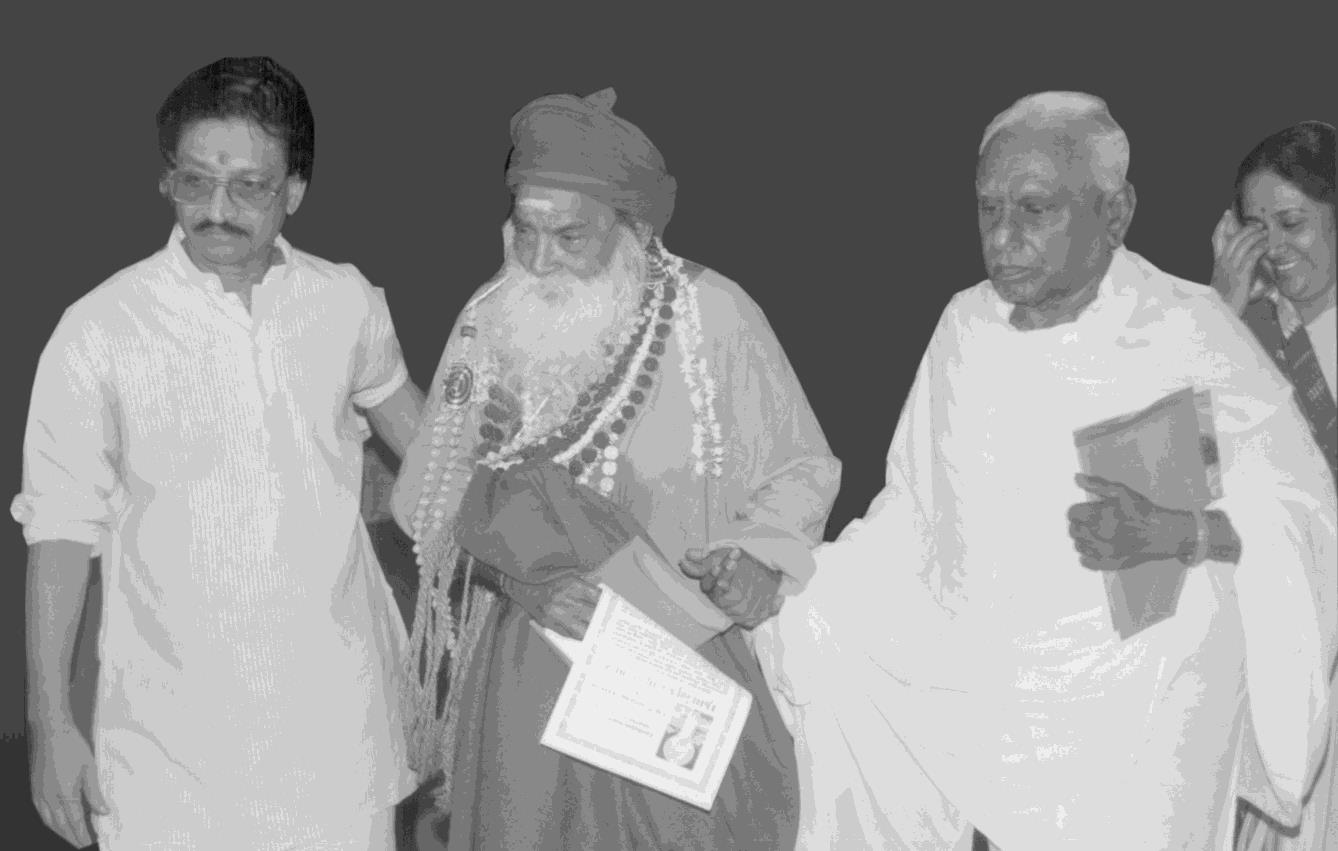
Balarama Reddiar and Ganesan receiving Yogi Ramsuratkumar and leading him to the Samadhi Shrine of Sri Bhagavan (Anuradha seen behind Reddiar)
Once, Balarama Reddiar went to Almora in the Himalayas. After coming back to Arunachala, he informed Bhagavan, “In Almora, it was so cool and pleasant! Here, it is so hot!” Bhagavan immediately said, “Real coolness lies within. If we have that coolness, it will be cool wherever we go.” That was the beauty of Bhagavan’s guidance. Bhagavan very rarely commented on the weather. This comment helped Balarama Reddiar to be unmindful of the weather. From then on, he too did not allow the weather to affect him.
Balarama Reddiar would come to the ashram in the morning, afternoon and evening to be with Bhagavan and sit before him. The ashram became crowded in the afternoons. Balarama Reddiar stopped coming at that time. Noticing this, Bhagavan gestured to Balarama Reddiar when he came in one evening and said, “Professor G. V. Subbaramayya asked me this afternoon whether Balarama Reddiar was here.” Balarama Reddiar understood this to be an indication for him to come in the afternoons also. However, the next afternoon too, he did not go to the ashram. The next day, as usual, Balarama Reddiar was at the ashram at three in the morning. At that time, Bhagavan would be just getting up from his couch. Normally, Balarama Reddiar would fold the shawl that Bhagavan covered himself at night with and then keep it in its right place. But that morning, Bhagavan folded the shawl himself and put it under his pillow, refusing to give it to Balarama Reddiar. Balarama Reddiar later wrote, “Bhagavan taught me to attend the afternoon session too, because being in the presence of the guru is absolutely important. Not even one minute should be wasted.” From that day on, Balarama Reddiar was with Bhagavan, his guru, all the time.
Once, when he was going around the hill, Balarama Reddiar suddenly felt like observing silence. Unknown to Bhagavan, he started observing silence the very next day. At the time, he was staying with S. S. Cohen in Palaakothu. Then, sometime later, Viswanatha Swami got a letter from Swami Ramdas saying, “I am very happy Balarama Reddiar is observing silence. It will do him good. Congratulate him on my behalf.” Viswanatha Swami handed over the letter to Bhagavan. Balarama Reddiar was also present at the time. When Bhagavan read out the line, “It will do him good,” he looked at Balarama Reddiar. Balarama Reddiar believed that this confirmed the fact he should continue to observe silence. Balarama Reddiar observed silence for one year. Towards the end of the year, Sadhu Vaswani, a saintly man, visited Ramanasramam. Not many people knew him, but Balarama Reddiar had met him in the Himalayas. Sadhu Vaswani sat next to Balarama Reddiar in the hall, but did not talk to him there. He thought he would talk to him outside. But Balarama Reddiar had to go somewhere urgently and by the time he came back, Sadhu Vaswani had already left. Bhagavan asked, “Did you know that Sadhu Vaswani had come?” Balarama Reddiar nodded his head. Bhagavan then said, “You should have spoken to him. He is your friend.” It dawned on Balarama Reddiar that the guiding hand of the master was instructing him to break his silence since it had served its purpose.
Balarama Reddiar was a very affluent man. He owned lands which his family looked after and his elder brother was sending him money. One day, he got a letter from his brother saying, “I can’t take care of your land any more. You have to come here and supervise your land.” Balarama Reddiar was downcast because this meant that he would have to leave the ashram and visit Bhagavan only once in a while like many others. He gave Bhagavan the letter and he read it, laid it aside and kept quiet. Balarama Reddiar refrained from asking him anything. Three days later, Balarama Reddiar got a letter from his mother, also a spiritual person, saying, “Do not come here. It is your good fortune that you are able to stay with such a holy person. I will take care of your land. I will send you money. Do not come away.” Bhagavan smiled at the letter indicating that he need not go back for the sake of money. The master does indeed protect his devotees in every respect!
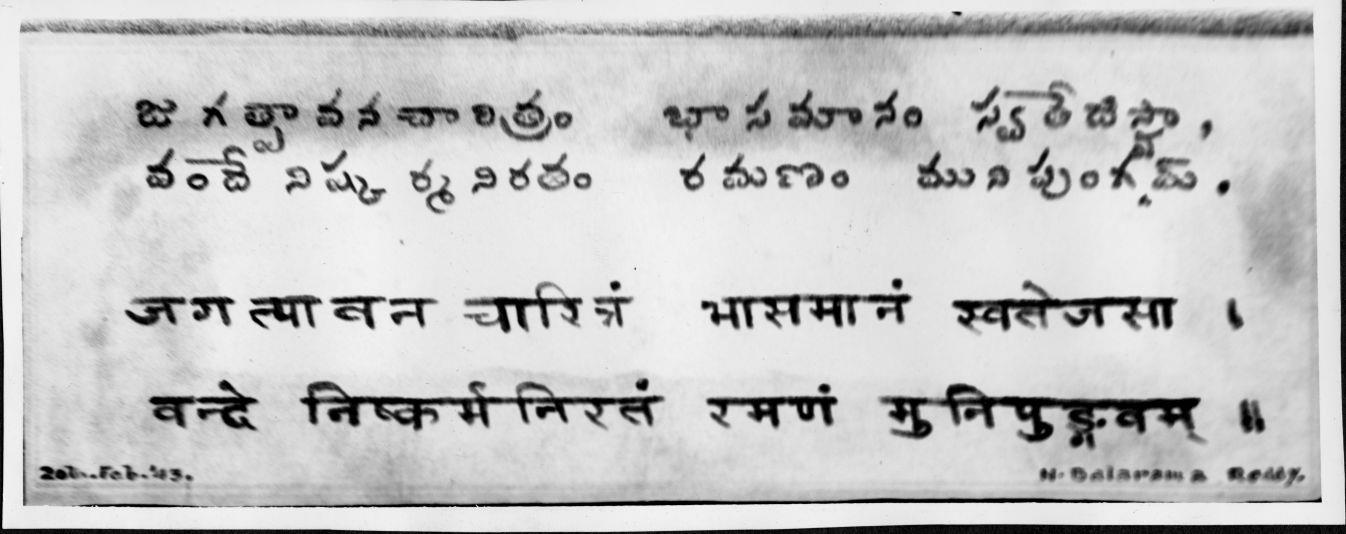
Sri Bhagavan’s handwriting from Balarama Reddiar’s notebook
During Bhagavan’s last days, devotees like Balarama Reddiar rarely visited him because they did not want to cause him any inconvenience. One day, accompanied by Balarama Reddiar, his friend, Sitarama Reddiar, a minister in the Madras government, called on Bhagavan in what is now called the Nirvana Room. Balarama Reddiar noticed a halo around Bhagavan which made him ecstatic and thrilled him to tears. He wondered whether it was his imagination playing tricks on him. But, when he came out of the room, the minister asked him, “Where did the brilliant glow in the room come from? There was no electric light in the room!” This was the exquisite spiritual aura that saturated Bhagavan’s presence in his last days.
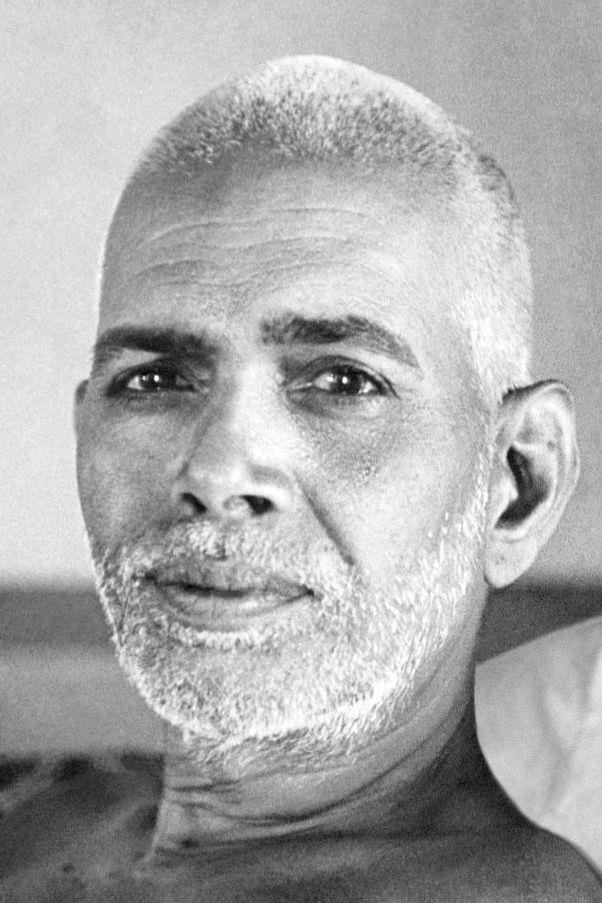
Once, Balarama Reddiar’s sister came to the ashram with her husband and their baby. The ashram gave permission to his sister and her baby to see Bhagavan, but her husband had to wait outside. Before prostrating, his sister happened to put the baby down on the floor on the left side of Bhagavan, the side that was excruciatingly painful for him to move due to the surgery on his left arm. The baby started to cry. Bhagavan, with visibly great difficulty, extended this hand to pat and console the baby.
The night that Bhagavan dropped the body, Balarama Reddiar, Viswanatha Swami and a few other senior devotees like Subba Rao went outside. They sat under the light of the moon. “Our master has gone,” they said and wondered, “Will we ever see the ocean of compassion in human form again?” Thousands of people had sat before Bhagavan and had their lives transformed. He had showered grace on them like the sun. No one will ever know how many lives he touched and how many hearts blossomed like a lotus on account of that grace. Bhagavan had given them everything they needed to rise to the supreme heights of spiritual awareness. Such were their feelings as they sat under the moon.
Balarama Reddiar returned to his village and continued his practice there. He would come to the ashram for Bhagavan’s Jayanthi and Aradhana, but would go back to his village. Many changes were taking place in the ashram. My father, who was then the president of the ashram, and I were asked to invite all the old devotees to stay in the ashram. We persuaded Balarama Reddiar to stay. He was given no work to do and no donation was taken from him either. Balarama Reddiar would lock himself up in his room and constantly pursue his spiritual practice. I had an attendant waiting on him and taking food to him so that he could focus on his goal. Some people in the ashram mistook his seclusion and deep meditation for arrogance and said, “Why can’t he participate in the functioning of the ashram like other people? Does he think he is supreme?”
Being in close contact with him, I once asked him, “Could you tell me about the uniqueness of Bhagavan?” Balarama Reddiar said, “Once, I asked Bhagavan if he would describe his state of jnana, the state of Self realization, in which he was rooted. He replied, ‘In this state, it is as difficult to think a thought, as it is in bondage to be without thoughts.’” Balarama Reddiar added, “The greatest features of Bhagavan were saameepya and sowlabhya. Saameepya is proximity, nearness, accessibility. Sowlabhya means not having any feeling of duality. Bhagavan was so close to us! There were so few rules and restrictions that it improved and encouraged our practice. We could do almost anything we wanted before Bhagavan. Sometimes, we would read the newspaper in his presence and at other times we would even discuss political matters. It was beautiful! Reddiar would say that Bhagavan was always in ‘Brahman’.
On another occasion, Balarama Reddiar wanted his doubt about Self realization clarified. He was well versed in the Bhagavad Gita. In the Gita, Lord Krishna says that it will happen ‘bahunaam janmanaam antey,’ (at the end of numerous births). When Reddiar mentioned this to Bhagavan, he got seemingly angry and declared, “What bahunaam janmanaam? I say it is here and now!” As he said the last sentence, he raised his voice and everyone assembled in the hall including Balarama Reddiar experienced the state of Self realization at that very moment. Reddiar said, “That is the beauty of a master being present - the experience is given directly and instantaneously. There is no demand for maturity.”
Balarama Reddiar too, played an important role in my life. Many years ago, my family and the people of Ramanasramam thought I was lost. There were reports in the newspaper of my disappearance. My father was naturally very concerned and turned to Balarama Reddiar for advice. Balarama Reddiar comforted my father and told him that they could perhaps consult Anandamayi Ma, a wonderful saint, whom Balarama Reddiar revered. Anandamayi Ma was then in Bangalore. My father, Mrs. Taleyarkhan and Balarama Reddiar went there. The saint smiled when she heard about why they had come. “Do not worry,” she said, “My Ganga Mata is protecting him.” My father was puzzled because he thought that he would get a specific answer. On returning to Ramanasramam, they found a telegram from one Dr. S. Nath of Benares: “Ganesan is here in Benares.”
When Ma Anandamayi Ma came to Chennai, Balarama Reddiar insisted I come for her darshan. I was a fervent devotee of Bhagavan and therefore hesitated, but he compelled me to go with him. There was a huge audience and it was impossible for me to have a personal meeting with her. Reddiar did not give up. He took me to the railway station and we met her on the train as she was leaving. She was alone in her compartment. Balarama Reddiar said, “Prostrate before her,” and I did so. He introduced me to her as Bhagavan’s brother’s grandson. She was delighted and blessed me profusely. She also gave me an orange as prasad.
Before his end came, he was involved in a car accident that injured his back. He was admitted to a hospital in Bangalore. I sent Natesan, his attendant at the ashram, to look after him. Reddiar was in the hospital for nearly two months. Before departing from the world, he called out, “Natesa! Natesa! Look, Bhagavan has come. Bring a chair!” Natesan said, “Swami, Bhagavan is not here. He is in Ramanasramam. Tomorrow, we are going there.” Balarama Reddiar retorted, “You fool ! Bhagavan is standing here. He is straining himself. Give him a chair.” These were Balarama Reddiar’s last words. The very next moment, he collapsed with a blissful smile on his face. Bhagavan had come for him! This unique rock of a devotee had gone back to Arunachala!
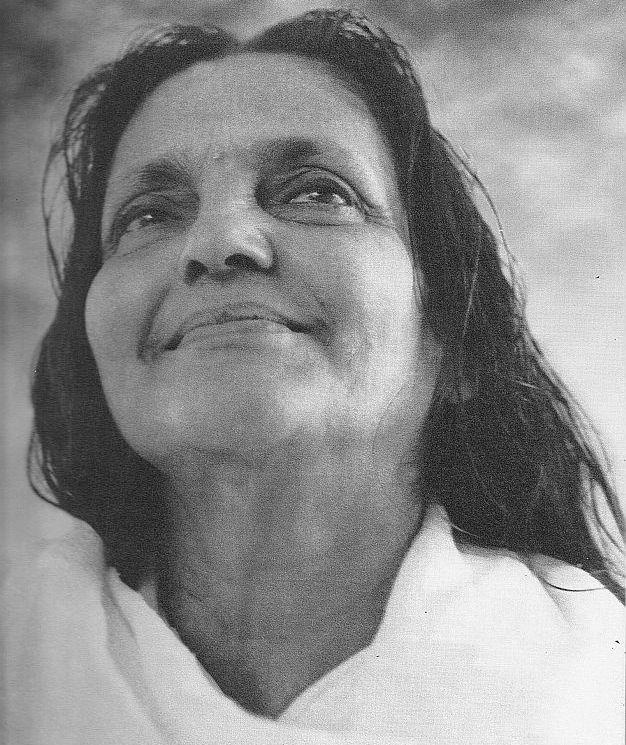
The Grace-filled Ma Anandamayi Ma
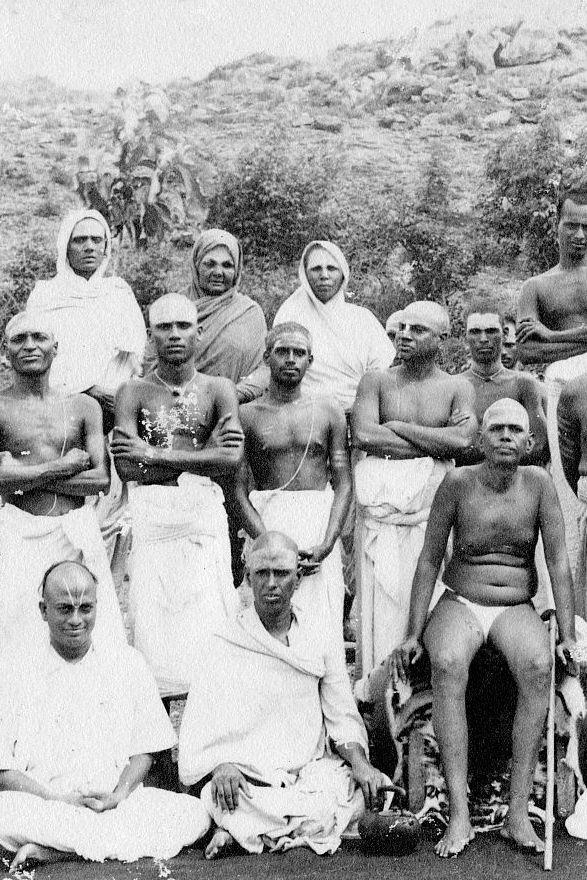
Ashram lady cooks along with Sri Bhagavan and ashram residents