Subbalakshmiammal
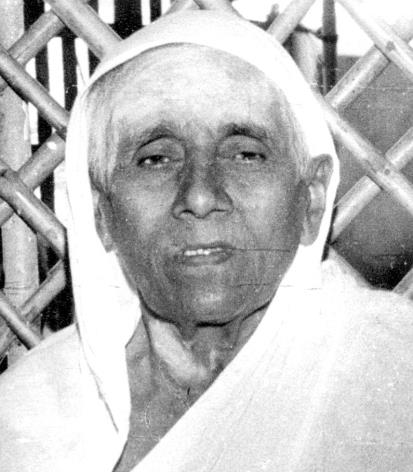
Bhagavan’s relationship with the cooks was unique. He interacted with them - mostly child widows - like a friend. It was a simple, warm relationship, but at the same time, he imparted to them the same high teaching that he shared with great scholars. He enabled them to experience the real depth of the teaching. This is a sure sign that the true guru has always been, is, and will forever be, impartial in imparting the highest teaching to one and all.
Varanasi Subbalakshmiammal became a widow at the age of sixteen. Her only support was her mother who was also a deeply spiritual person. They lived in a village near Nellore. They often went on pilgrimages to temples situated in other places. On one of their pilgrimages, they happened to come to Arunachala. When they heard of a young ascetic staying at Virupaksha cave, they paid a visit to the cave. As soon as Subbalakshmiammal saw Bhagavan, she had the conviction that Arunachala himself had come in human form. In her own words, “He was about thirty at that time; he was bright and shining like burnished gold; his eyes were blooming like the petals of a lotus. An immense peace surrounded the swami.”
When she was thirty one years old, she came again to Bhagavan. By now, he had come to the present ashram at the foot of the hill. She could spend only a very short time. A year passed. She longed to be in the presence of Bhagavan, and waited for the opportunity. One day, she had a dream in which a learned pundit, well known to her, told her, “Where is the need for you to search elsewhere? Entrust yourself to Bhagavan Ramana. He is God himself. He will lead you to salvation.” Along with her friend, Nellore Parvatamma, she reached the presence of Bhagavan. Both of them had planned to travel to Varanasi (Benares) and settle down permanently in that holy city. Before embarking on such a vital pilgrimage, she wanted spiritual guidance from Bhagavan. She asked Bhagavan, “What is atma, the Self? Is it the limitless ether of space or the awareness that cognizes everything?” Bhagavan looked at her intently and said, “Abide in the Self free from thoughts, instead of enquiring about the nature of the Self.” Subbalakshmiammal felt her mind melting away. No thought arose - only the feeling of immense peace pervaded her whole being.
Subbalakshmiammal forgot about the Varanasi pilgrimage, and instead stayed in town and came to the presence of Bhagavan every day, immersing herself in the silence and peace. Then, at the request of Bhagavan’s sister, Alamelu Ammal, she agreed to help with the cooking in the ashram. The presence of Bhagavan guiding them in the kitchen gave her a fillip to continue her services. Her attachment to the strict orthodox way of life and the heaviness of work demanding her whole attention, made her go back to her village. As time passed, she started feeling a vacuum in her meditation. The anguish caused by staying away from the guru made her come back to the ashram. She experienced peace and was even happier to learn that on that very morning of the day that she arrived, Bhagavan had told Santhammal to reserve some food for Subbalakshmiammal who was arriving that day. This deep love of Bhagavan and his paying special attention to her even in her absence, made her stay with Bhagavan and serve him the rest of her life.
Again, she started feeling that the load of work thrust on her in the kitchen was preventing her from meditating. The master understood her anguish and told her one day, “It looks as if you are still hankering after meditation.” She replied, “Yes, Bhagavan! But what have I got except endless work in the kitchen?” Bhagavan smiled at her and said, “Your hands may do the work but your mind can remain still. You are that which never moves. Realise that, and you will find that work is not a strain. As long as you think that you are the body and that you are doing the work, you will feel your life to be an endless toil. In fact, it is the mind that toils, not the body. Even if your body keeps quiet, will your mind keep quiet too? Even in sleep, the mind is busy with its dreams!” She asked, “Why can’t I always remember that I am not the body?” Bhagavan smiled and replied, “Because you haven’t had enough of it!”
Subbalakshmiammal used to fast very often, as she had read in one of the ancient texts, “He who wants to know himself and yet pays attention to his body, is like a man who trusts a crocodile to take him across a river.” She showed this passage to Bhagavan. He replied, “It does not mean that you should starve. You need not torture the body. It only means not giving the body more than what it needs. With your mind, hold on to the enquiry and just keep the body going so that it does not become a hindrance. For this, pure, fresh food simply prepared and taken in moderation is a great help.” On another occasion, when she asked Bhagavan’s permission to put on the sannyasin’s orange robes and beg for food, Bhagavan sternly told her, “Will coloured clothes give you renunciation? First learn what sannyasa means.”
One day, a group of people sat in front of Bhagavan and sang a hymn in praise of the guru. Bhagavan got up in the middle of the recitation and went away, saying, “Prayers and praises will not take one far. It is the merciful look of the guru that bestows true wisdom.” Subbalakshmiammal felt proud that she had received Bhagavan’s grace of glance fully, not once, but many a time. But, the next day, Bhagavan turned to her and spontaneously said, “Unless one becomes like a six month old baby, there is no hope for one in the realm of true wisdom.”
Subbalakshmiammal recalled, “Living in the presence of Bhagavan, by itself, was a true sadhana. It was ever like this with him. Whoever went to him, he would go down to their level; his words and gestures, even the intonation of his voice, would adapt themselves to the level of the people around him. With children, he was their playmate; to family people, a wise counselor; to pundits, a well of knowledge; to yogis, the god of victory. He saw himself in them and they saw themselves in him and their hearts would be bound to his feet in everlasting love. He radiated an overwhelming sense of unity by his mere presence - just as fire spreads light.” She added, “Bhagavan was the very embodiment of wisdom and kindness - though he did not mind our faults and mistakes, he made us follow his instructions to the letter. We had to do the same task again and again until it was done to his complete satisfaction. Did he do it for himself? Of what use was it to him? He wanted to prove to us that we could do things right and that only lack of patience and attention causes a mess. He sometimes seemed to be severe, even harsh, to make us do something correctly, for he knew what we did not know - that we can act correctly if we only try. With experience comes confidence and with confidence, the great peace of righteousness. What a noble teacher of work and wisdom Bhagavan was!”
To describe the depth of their relationship as guru and disciple, Subbalakshmiammal said, “In his presence, every moment, we felt that he was God. Even that feeling we owed to his grace, for he would from time to time let us see him as he really was - the Lord Almighty and not the human frame to which we were accustomed. It was our love for him, a reflection of his love, that chained us to his feet and made us stay. For him, we gave up hearth, home and all our earthly ties. We only knew we were safe with him, that in some miraculous way he would take us to our goal. He himself was our goal - our real home.”
I was fortunate to be very close to her. I was a chubby, two year old child at the time. Unlike my brothers who were shy, I was rather fearless and had no hesitation in approaching members outside the family. Hence, these cooks would play with me and fuss over me. One day, Subbalakshmiammal took me outside the kitchen, sat me on her lap and fed me my lunch. I was holding two mangoes tightly in my hands. Suddenly, a huge male monkey that had seen the mangoes made its way towards me. Out of fear, I turned my face towards Subbalakshmiammal. She came to my rescue. Wrapping her arms around me, she protected me from the monkey. She was fully aware of the danger she was exposing herself to, and sure enough, the monkey in his wrath bit off a chunk of flesh from her arm. Bleeding profusely, she handed me over to someone. All feared rabies, since there was no antidote for rabies at that time. But by god’s grace, nothing happened to her. She was hospitalized and bore a deep scar on her arm for the rest of her life. I, of course, forgot about the incident.
When I was older and I saw the scar on her arm, I asked her out of curiosity, “What is this scar on your arm?” I felt very disturbed when I was told that it had occurred when she was trying to protect me. However, Subbalakshmiammal comforted me by saying, “No! No! Do not feel sorry. I am very grateful to you because for many, many days after that, Bhagavan’s attention was always on me. He would constantly enquire, ‘How is your wound? Has it healed?’ His mere look saved me from rabies. So, I am grateful to you.” As I touched her holy feet, I said, “You acted like the protective mother principle. How can I express my gratitude?” Subbalakshmiammal was very moved because I had used the phrase, ‘mother principle’. She answered, “Bhagavan’s devotees are all protected by this mother principle.
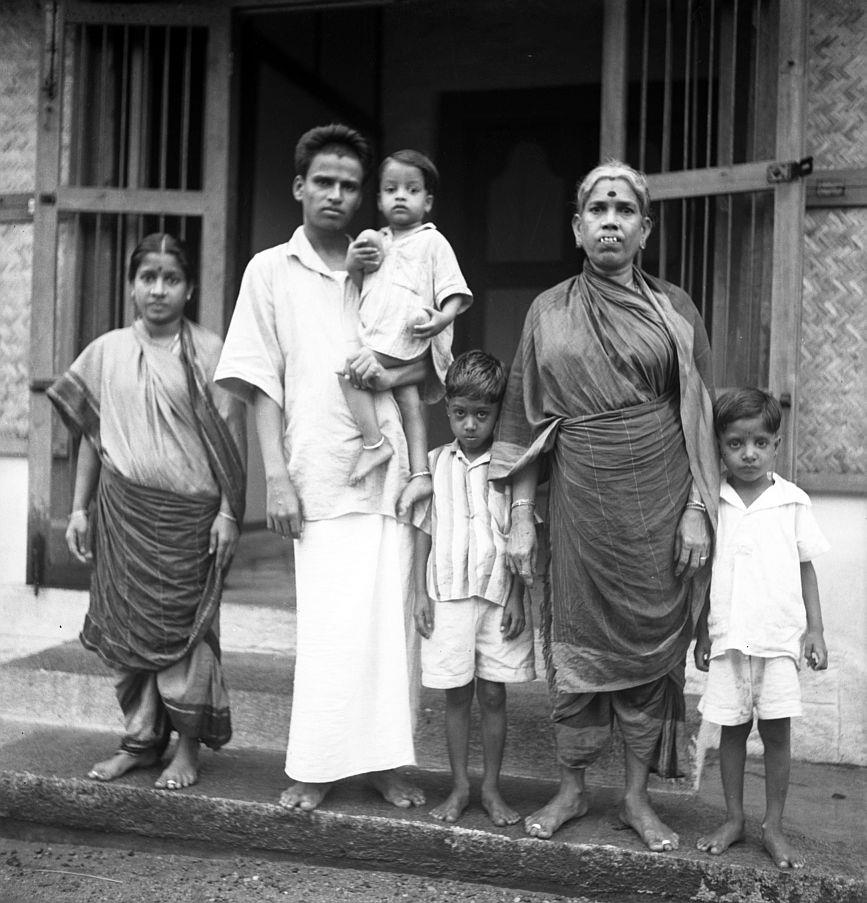
Child Ganesan holding mangoes ( l to r – Nagalakshmi, Venkataraman, Balu, Bhagavan’s sister Athai, Sundaram)
Even Bhagavan himself has referred to it quite a few times. However, the people who write about Bhagavan conveniently ignore this phenomenon because they cannot understand it. Bhagavan has referred two or three times to the mother principle operating in his life, and influencing it.”
She narrated to me what Santhammal had told her. Santhammal had a dream one day. She dreamt that Bhagavan was seated in the hall, and next to him was a beautiful female deity whose brilliant light was dazzling. At the same time, she also saw a similar female deity going round the ashram and discharging her duties. She was puzzled by the dream and therefore told Bhagavan the details. Bhagavan almost seemed to confirm her dream. He nodded and said, “Yes, even when I was up on the hill, it was a woman who used to come and give me food.” This person was of course Akhilandammal (Desurammal). Bhagavan said of her, “While serving food, she would place an extra leaf next to me. She would also serve food on the extra leaf. One day, I ventured to ask her, ‘For whom is the extra leaf?’ She replied, ‘It is for the Mother.’ Bhagavan paused and then added, “Akhilandammal had a dream similar to yours.” Subbalakshmiammal continued, “I have been a witness to another incident involving another devotee, Appu Shastri’s wife. In those days, coffee was a rare luxury and therefore many devotees who came to the ashram brought coffee with them, little realizing that Bhagavan did not particularly like coffee. Appu Shastri’s wife brought a big vessel of the choicest coffee to Bhagavan. Bhagavan said, ‘You know that I don’t like coffee.’ Appu Shastri’s wife said, ‘What am I to do? I had a dream wherein Mother Parvati stood in front of the temple and beckoned me. She said, ‘My son goes without drinking coffee. Make some coffee and take it to him.’ Do not blame me; these were Mother’s instructions.’ Bhagavan had no choice but to accept the brew. He however commented, ‘Mother has no other task than to interfere in my life and come in the way. This happened once even when I was up on the hill.’”
I asked Subbalakshmiammal to recount the incident, which of course now is recorded in the Ashram books: “Bhagavan was staying on the hill. There was no set routine. At eight in the morning, everyone gathered there would share the bhiksha food. The food would invariably be cold rice. Once this was done, they were all free to do what they wanted. Bhagavan would roam on the hill all day. So much so, he once commented, ‘There is not even an inch of space on the hill that remains untouched by my feet.’ On one such day, he found a rustic looking woodcutter woman blocking his path. The woman had her legs stretched across the path Bhagavan was walking on. Bhagavan stood there, hesitating. The woman did not pull back her legs; Bhagavan did not jump over the legs either since it is against the Hindu custom. As Bhagavan stood hesitating before her, the woman hurled accusations at him and asked, “Why are you roaming around relentlessly? Why do you not stay put in one place?” Bhagavan took her words to heart and thereafter never moved from Skandashram! Later, of course, he came down to Ramanasramam. Even there he never stirred from the place except to take his occasional walks.” Noticing my eagerness to query her further, Subbalakshmiammal added, “When we asked Bhagavan who that rustic woman was, Bhagavan said, ‘Who else is it except the mother principle?’”
Emotional devotion welling up in me, I humbly requested her to recount how she felt about Bhagavan. She remarked, “To me, Bhagavan is the mother. It is easier to hold on to him firmly if one approaches him as one would approach one’s mother. He was undoubtedly the most compassionate mother I have ever come across. Would there have been any hope of emancipation for me, an uneducated widow, cast aside by society? He saved me from my state of lowliness by lifting me up with his grace and thus emancipating me.” These outpourings of Subbalakshmiammal thrilled me, because even today this protective mother principle of Bhagavan is evident for the followers of Bhagavan. One only has to have ears to hear and eyes to see in order to understand this protective mother principle.
Once, alluding to Lord Krishna she told me, “Eons ago, the Lord came as a cowherd and liberated the simple milk maids. In a similar fashion, Bhagavan took to cooking in order to save us ignorant women.” I was moved by her approach to Bhagavan. I asked her how she was able to love Bhagavan with such devotion and totality. She said, “Do you know that even yogis and rishis of yore had to undergo severe austerities and penance in order to attain the state that Bhagavan would vouch us just by having us work near him in the kitchen? The small tasks that we did every day used to give us total bliss and light. We experienced ecstasy in mundane tasks such as grinding, cooking and serving the devotees in the dining hall. How was this possible? He blessed us with his proximity, and because of this blessing we reached the state where the mind merged in the Heart. Our hearts were with him and in him, and he was in all the work that we did. A person who has not had this ecstatic experience cannot possibly imagine how much bliss a human heart can contain.” She clapped her hands in complete adoration of her satguru Ramana and said, “Bhagavan himself was our true goal, our home. To us, he alone existed. His radiant form was enough for us. One had to live and work with him in order to know what a great teacher he was. He taught us Vedanta - the highest truth in life - through the trifles of daily life. We were changed to the very roots of our being, without being aware of the depth and extent of his influence. He led us to absolute wisdom through his infinite kindness.”
I prostrated before Subbalakshmiammal, who at that moment was a symbol of the mother principle. She saved this body, and because of all the sharing that she did, she gave me a glimpse into the realm of the kingdom of God.