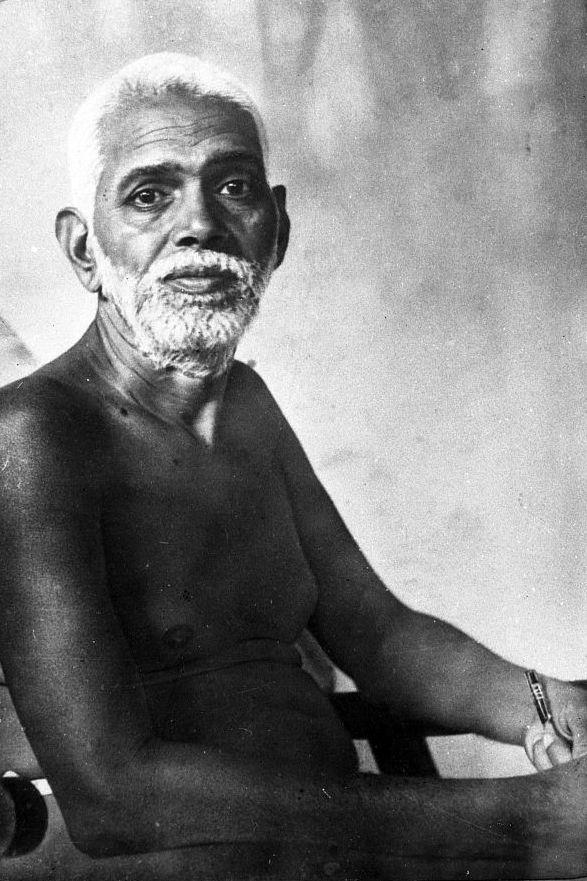
Sampurnammal
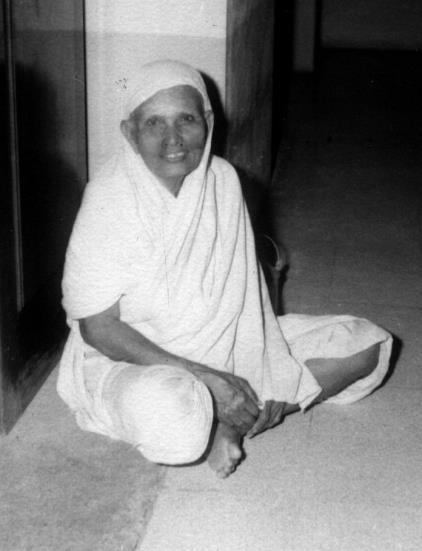
Bhagavan, who rarely drew any comparisons, said of Sampurnammal, “She is our best lady cook.” Sampurnam literally means ‘a sweet filling’. But its spiritual meaning is ‘complete bliss’. Sampurnammal was born in a village next to Tiruchuzhi, Bhagavan’s village. She had heard about young Ramana’s death experience, his departure to Tiruvannamalai and how he had come to be known as Bhagavan Sri Ramana Maharshi. Her family followed each occurrence with a great deal of excitement and wanted to have his darshan. The family invited Sampurnammal. She declined because she wanted to devote her time to her husband and relatives. After some time, Sampurnammal lost her husband. She was in inconsolable sorrow and pain. Her family wanted to help her out of this depression and invited her to visit Bhagavan as they strongly believed that only Bhagavan could help her regain normalcy. However, she only wanted to wallow in her grief and turned down the invitation once again.
Yet, look at Bhagavan’s grace! One day, while she was in the Meenakshi temple in Madurai offering prayers at the shrine, a bright young Brahmin boy interrupted her prayer. He asked rather firmly, “Will you not cook a meal for me?” This was a strange request! When asking for alms, mendicants only request for food. However, here was this strange and bright young man asking, “Will you not cook a meal for me?” Sampurnammal, who had almost finished her prayer, told herself, “Here is a good opportunity for me to feed a Brahmin. I am so happy!” But the young man suddenly vanished. She searched for him all over. Then it dawned on her that he might be none other than Bhagavan who had come in search of her.
So, in 1932, Sampurnammal went to Tiruvannamalai with her sister and brother-in-law, Dr. Narayana Iyer. She was still grieving. But one look from Bhagavan and she was transformed. The look was soothing. She continued to look at Bhagavan and Bhagavan too gazed at her. The result was magical. The three of them stayed on at the ashram for twenty days. Sampurnammal had been physically very active and therefore she had never known what it was to meditate. However, when she sat in the presence of Bhagavan, she was taken to the meditative state effortlessly. When she was in his presence, she had absolutely no thoughts; when she was away from him in the town, thoughts cramped her mind. The next day, when she was in the physical presence of Bhagavan, she again experienced a thought free state as he continued to look at her. Bhagavan wanted her to understand that this was a spiritual act and not a psychic one, and therefore gave her a copy of Who am I?
Twenty days later, Sampurnammal went back to her village and found that she was restless. She realized that the tranquility she had experienced in the ashram was because of Bhagavan’s presence. She made up her mind to go back. Her uncle understood her plight and escorted her to the ashram. Once there, she found that Santhammal, the cook, was leaving. She was thrilled when she was asked in the presence of Bhagavan, “Will you go and take up the cooking so that Santhammal can go?” As Bhagavan looked at her, she said to herself, “Oh, so this is your trick!” Thus, it fell on Sampurnammal’s shoulders to take on that responsibility. She cooked that day’s meal and as she was serving Bhagavan she realized that this indeed was the young Brahmin who had asked her in the temple whether she would cook a meal for him. By serving her very first meal, she not only began her spiritual quest but also ended it. She realized that she was not just feeding an individual Brahmin, but that she was feeding Brahman, the God in each one of us. She stayed on at the ashram, making food for Bhagavan.
Though Sampurnammal knew how to cook, it was Bhagavan who tutored her on the nuances and niceties of cooking. He taught her not only the variety of ways in which pulses, grains and vegetables could be cooked, but he also filled this time with stories. He began with stories of his boyhood and gradually went on to talk about Vedanta, leading finally to an emphasis on Self-Enquiry. He taught her that the supreme state of truth is the state of ‘I AM’. Bhagavan also gave Sampurnammal the Ribhu Gita and explained its significance. This was not the only thing Bhagavan taught. Sampurnammal said, “Bhagavan also taught us that work is love for others. By his very presence, he made us understand that all of us are in the presence of God, and that all the work we perform is in his service. He used cooking to teach us philosophy and spirituality. For instance, Bhagavan told me once, ‘You must cover the vegetables when you cook them. Only then, will they retain their flavour and be fit enough to eat. It is the same with the mind. You must put a lid over the mind and let it simmer quietly. Only then, will a man become food fit enough for God to swallow.’ These meticulous instructions given by Bhagavan about cooking could leave a stranger with the wrong impression that Bhagavan loved good food and ate heartily. On the contrary, when Bhagavan was served food, he would mix up the little food that he allowed us to serve him. He would mix the sweet, the sour and the spicy together and gulp it down indifferently, as if he didn’t consider the taste of the food at all! When we pointed this out to him sometimes, Bhagavan would smilingly say, ‘Enough of multiplicity! Let there be unity!’ On another occasion he said, ‘Why this separateness? Should not everything be one undistinguishable whole?’”
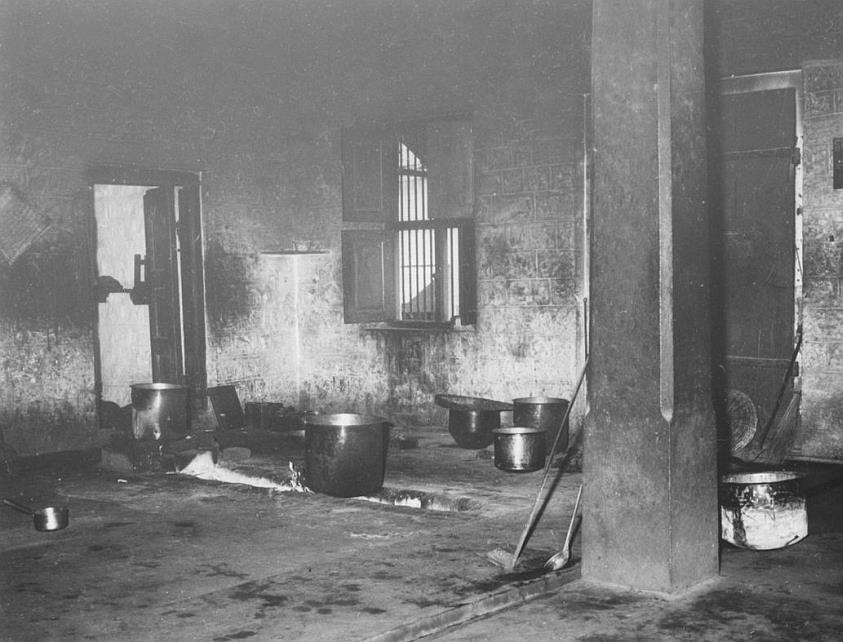
Inside the old Ashram Kitchen
Sampurnammal has given all of us a clue on how a spiritual seeker can mature quickly, easily and effortlessly. This is possible only because of the guru’s grace - as it has been vouchsafed in the Hindu scriptures. The higher state of inner felicity is possible because of the guru’s grace from which there is no escape. She said, “Bhagavan too, worked hard. He cooked diligently. He knew the exact proportion of the ingredients to be used. He was always correct and he would advise us do likewise. All we had to do was obey his instructions. If we thought of him as we cooked, our dishes would turn out to be delicious that day. In this manner, we learned to first think of him and then put in the necessary ingredients in order to make our dishes tasty. Gradually, we extended this process of thinking about him before the actual cooking to thinking of him before embarking upon any activity - no matter how mundane or trivial. We found that the end result was always successful. Hence, thinking of him became an integral part of our lives, and we learned to focus on Bhagavan. Whenever we were afraid, anxious, or in pain, we only had to think of him in order to feel his helping hand descend on us.” Quoting Bhagavan to affirm her statement, she added, “For coming to the ashram and also for returning home, I had to walk through a jungle path all alone. This was at the foot of the hill. I was sometimes a little afraid. When Bhagavan came to know of my fears, he said, ‘Why are you afraid? Am I not with you?’ He confirmed this fact once again when Chinna Swami asked me one day, ‘Why are you coming alone? Are you not afraid?’ To this, Bhagavan replied, ‘Is she alone? Am I not with her all the time?’” As Sampurnammal said, if we focus our attention on Bhagavan, he is with us all the time, guiding us, and making us more and more mature.
I would like to share three beautiful reminiscences given by Sampurnammal, wherein she revealed how Subbalakshmiammal was taken to the highest spiritual state just by experiencing mundane, every day events. Bhagavan had been advised by doctors to eat yoghurt rather than buttermilk. But there was not enough yoghurt for everyone and Bhagavan would not take something special for himself. One day, while Subbalakshmiammal was serving Bhagavan buttermilk, she did something that she thought was very clever. She secretively carried a ladle of yoghurt in the bucket of buttermilk and served Bhagavan. Bhagavan stared at her and said in an agonized tone, “Subbalakshmi! Do you know what you have done? You have served me poison! Showing any kind of discrimination between me and the devotees is sheer poison.” Subbalakshmiammal panicked so much that she had fever for three days. Shantammal went to Bhagavan and said, “Bhagavan, you are angry with Subbalakshmiammal. The poor lady has high fever. Will you please pardon her?” Bhagavan smilingly asked, “Did I get angry with her? I got angry only with her behaviour.” The fever started subsiding!
The second incident too is very beautiful. Sampurnammal said, “Once, I sought Bhagavan’s permission to go on a pilgrimage with some friends to Benares. Bhagavan made fun of me and asked me, ‘What do you expect to find in Benares that you cannot find here in Arunachala?’ He then continued, ‘Vishwanatha, the Lord of Benares is here. Why do you go in search of him when he is here with you?’ He was referring to himself, for he said, ‘Why go in search of him when he is here with you? He is with us, in every one of us here. He is here.’ I gave up the idea of the trip since Bhagavan did not grant me permission. But just look at the compassion of the master! The very next morning, Bhagavan told me, ‘Sampurnammal, I had a dream last night. I saw you worshipping in the temple of Lord Vishwanatha in Benares.’ I wondered whether it was just a dream. I felt he had taken me there and brought me back in order to give me a chance to worship in the temple.” Bhagavan was certainly very compassionate towards Sampurnammal. Those around her could only see the frailities in her character. But Bhagavan overlooked all this and paid singular attention to her so that she could be lifted out of these imperfections and be elevated to that state of spiritual perfection.
The third incident is extraordinarily unique in that it brings out Bhagavan’s incomparable love and care for human beings. In addition it reaffirms the ancient conviction that “in spirituality the human being comes first and that compassion is the supreme law”.
During their periods, women were not given Ashram food to eat or allowed to enter the Ashram. One month none of my relatives were there to help me, nor could I arrange for my food elsewhere, and I was starving. I sat in a stone shed in front of the Ashram where beggars usually spent the night. Bhagavan enquired about me and was told that I would not be coming for three days.
“Where is she?”.
“In the mantapam in front of the gate,” was the reply.
“Bring her in and feed her decently,” ordered Bhagavan.
Everybody was shocked, for it was a clear breach of all rules and customs. “But she is impure,” they protested.
“Who is pure and who is impure? All are one, all are the same!”
One need to know the South Indian Brahmin to understand what a crisis Bhagavan had created.. The rules about women in their periods were severe and rigidly enforced. To break them would mean to pollute the entire Ashram and face a public outcry.
It speaks a lot for the devotion of the inmates that they very reluctantly called me in. Bhagavan wanted to go to the kitchen to bring some food, but they asked him to wait. They brought some food and fed me in front of him. An ancient rule was broken and he sanctified the breach with his presence. He wanted to teach us the entire lesson that in spirituality the human being comes first and that compassion is the supreme law. Some understood, but many looked daggers at me or scolded me for polluting them all, by causing them to feed me.
Entering the Mother’s Temple one day, Sampurnammal, with her face beaming, exclaimed, ‘He has scattered so many diamonds before us! ’ Bhagavan had given her the eyes to see those diamonds!
Sampurnammal died at the ashram on Bhagavan’s Aradhana day. I had the privilege of taking her body to the cremation ground and seeing to it that her sister’s son lit the pyre . This is another blessing that Bhagavan bestowed on me.