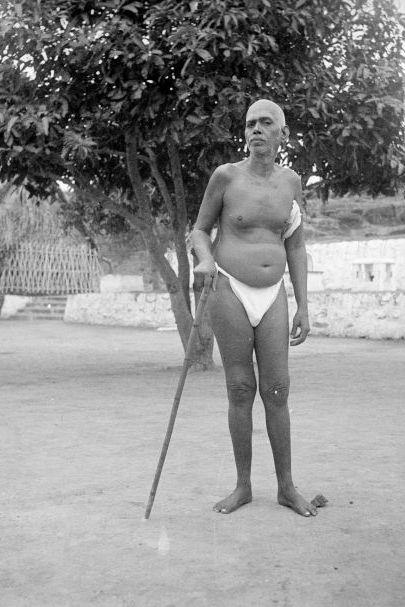
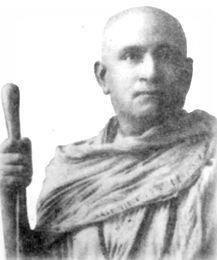
Swami Madhavtirtha
Of the next two devotees of Bhagavan, one was a skeptic and the other a scholar and philosopher. Bhagavan turned both these different metals into gold through the alchemy of compassion, love, attention and illumination. The process of transforming each of them may appear to differ, but the end result was the same: spiritual emancipation. When one reads with utmost attention about these devotees, about how the master descended to their level and removed their obstacles, thereby inspiring them to attain final emancipation, each one of us also receives the effect of that spiritual emancipation - whether one is conscious of it or not. It is like fire which will burn your finger if you touch it - whether you are aware or ignorant of the fact. Likewise, if one reads with one pointed attention, the transformation will take place within oneself, whether one is conscious of it or not.
Swami Madhavtirtha was a celebrated saint. From his childhood days, Motilal (Swami Madhavtirtha) used to ponder deeply over the mystery of death. He pestered everyone he met, especially wandering sadhus and sannyasins, “Please explain to me. What is this mystery called death?” He learnt Sanskrit and studied all the scriptural texts he could lay his hands on - his favorite being Srimad Bhagavatam. He was also very well read in modern science and was especially interested in the theory of relativity, as he found many parallels in it to Vedanta and Adi Shankara’s exposition of the theory of maya. He started giving talks in schools and colleges on the theory of relativity and its parallels in Vedanta. A very popular speaker, in the course of his tours, he was able to meet sages and saints like Anandamayi Ma. In the 1920’s, direct contact with Sri Aurobindo, the well known seer of Pondicherry, sent him on the true spiritual quest.
In 1939, he took sannyas. After this, he was called Swami Madhavtirtha. As a sannyasin, he travelled extensively. He was popular not only for his scholarship but also for the way he applied what he studied into his personal life. He was a prolific writer and had written over a hundred books. Yet, his quest for spiritual fulfillment continued unabated. This unquenchable thirst for the truth drew him to Arunachala and Bhagavan in 1944. He stayed for fourteen days - each day filled with study and experience. Also, since he was a scholar, he noted down his experiences, his questions to Bhagavan and the answers. The very first day, when Swami Madhavtirtha was introduced to Bhagavan in the dining hall, Bhagavan looked at him with a glance full of grace. About that first look, he wrote, “I found in the glance of the Maharshi, the sizzling brilliance of the sun. My breath seemed to stop and my mind was elevated into some spiritual realm of unutterable peace and happiness.” Whoever met Bhagavan, with his very first look, he graced them with his own highest state. It was darshan in its truest sense. Whether one was capable of receiving it or not, the master was always radiating his fullness. Fortunate were those like Swami Madhavtirtha who could receive it.
He made every minute of the fourteen days of his stay useful for himself, and thereby for all of us. Swami Madhavtirtha wrote, “While sitting in the hall, I observed the Maharshi silently resting on the couch, wholly unconcerned with what was taking place in his presence, and yet, I could easily discern in him, the attitude of oneness with all, abhinna bhava, through which he touched the inner being of the seeker who was thus able to feel within himself the presence of the Supreme transcending thoughts - just by a silent look.” He added, “I would venture to suggest that the reciprocal relationship with the Maharshi in his abhinna bhava and the seeker sitting in his presence is analogous to that of a radio transmitter and a receiver. Maharshi’s spiritual influence was transmitted unceasingly like the sun shining, as far as he was concerned, but from the point of view of the seeker such continued beneficial influence exercised by the sage would have no apparent effect until the seeker himself was prepared to receive it. The seeker’s preparedness to receive it is called operation of grace. How often has Bhagavan not assured us, ‘Grace is always there. Now receive it.’ ?”
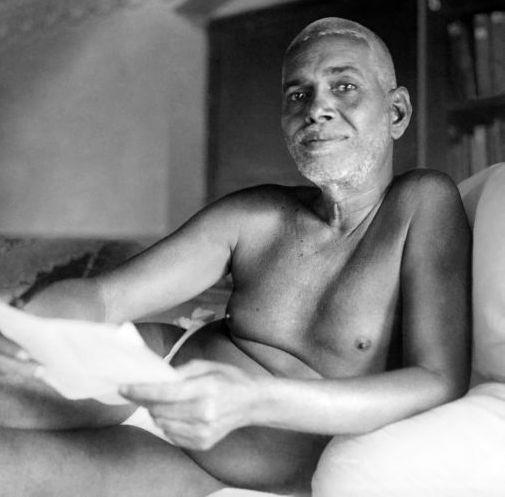
Swami Madhavtirtha had earlier sent his book called Maya to Bhagavan. In it, he had logically presented how Adi Shankara’s concept of maya was fully vindicated by modern science’s theory of relativity. When asked for Bhagavan’s views on the book, Bhagavan was gracious enough to point out a mistake in the Swami’s treatment of the subject and how he had based his arguments on a wrong presumption. The theory of relativity maintains that time and space are purely relative notions dependent entirely on the conditions governing the observer and the object under observation and that there is no such thing as objective time and space. It proves this by demonstrating how two observers in different points of space perceive the same event differently. The Maharshi pointed out to him that the very presumption of two observers being situated at two given points is in itself an unwarranted assumption and not true. Bhagavan says two observers put in different situations is itself a theoretical notion. In other words, the space between one observer and another being relative and unreal, there cannot be more than one observer. Swami Madhavtirtha at once recognized the error. It was a revelation to him that the Maharshi could judge off hand, as it were, such modern theories based entirely on his own experience of the supreme Advaitic Truth.
Swami Madhavtirtha put all questions based on his study of Vedanta: “If the world is nothing but the divine, why does the Isavasya Upanishad direct the seeker to renounce the world?” Bhagavan’s answers were, naturally, based on his own experience: “One is commanded to renounce only the wrong knowledge that the world exists as an objective thing other than the divine. One must give up the notion that there is duality and multiplicity, and whatever manifested existence that may appear to be true.” Swami Madhavtirtha persisted, “If the notion of duality is to be given up - no duality, no multiplicity - what place is there for the scriptural injunction to surrender to the divine?” Bhagavan answered, “The custom prevalent among some people in South India is to offer pooja to the idol of Lord Ganesa before their daily meal. Once, a poor traveller was carrying jaggery and flour as food to have on the way. He had to do pooja to Lord Ganesa before he could eat. He took out a portion of jaggery and moulded it into a lump, identifying it with the Lord. Now he had to offer food to that Lord. Not finding any jaggery left, he took a pinch from the same jaggery Ganesa and then offered it to him. By doing so, he defiled the image. Your idea of self surrender is nothing better than the offering made by the wayfarer. By presuming your existence apart from the Supreme Being, you have merely defiled it. Whether you have surrendered yourself or not, you have never been apart from that Supreme Being. Indeed, at this present moment, at this very moment, even as in the past or in the future, the divine alone exists. The divine alone is.” This story of the ‘jaggery Ganesa’, took place at the end of the fourteenth day of Swami’s stay. Before taking leave of Bhagavan, Swami Madhatvirtha put before Bhagavan a lot of fruits. Bhagavan smiled at him benignly and said, “So, you are offering jaggery to Lord Ganesa.” Swami Madhavtirtha later revealed that these words of blessing from Bhagavan instantly transformed him.
I would like to quote some of the important spiritual instructions that Swami Madhavtirtha elicited from Bhagavan during his short stay: “Do not reply to questions of the mind, like, ‘Should I say I am Siva ’, or, ‘I am not the mind’, ‘I am not the intellect’, etc., while pursuing Self Enquiry. Pursue the enquiry ‘Who am I?’ relentlessly and the Heart will reveal the answer by itself. The state of the silent ‘I’, behind the speaking ‘I’, is the greatest mantra. This ‘I’ state is the greatest mantra. Brihadaranyaka Upanishad says that the first name of God is ‘I’. Om, the primal sound and vibration, came into existence only later. There is no japa at all without the doer of the japa. All do the japa of ‘I’ only. How many times we say ‘I-I-I’ in our lives. Be as you are. Reality, pure awareness right now, is the real japa. Japa and God are one and the same. You are perfect. Abandon the idea of imperfection. There is nothing to be destroyed. Ego is not a real thing. Just as it is not necessary to kill the snake which one imagines to be a rope, there is no need to destroy the mind. Knowing the form of the mind benumbs the mind and makes it disappear. One cannot destroy what is eternally destroyed. Stability in the Self is the real posture. Be steady in that real posture.”
“You ask what book I should read. The Self is the real book; life, the written pages. You can glance anywhere in that book. Nobody will take away that book from you. Whenever you remember, turn towards the Self. This is true book reading. Keep your attention introverted. Keep the mind still. That is enough. When the mind becomes still, the power of the Self will be experienced. The aim of all practices is to give up all practices. The Self is all pervading. If the mind is in peace then one begins to experience the peace of the Self. Gaze at your own nature. One is everywhere. It is all the same whether you keep your eyes open or shut during meditation. Turn within and meditate on the I-ness, your true nature. Be as you are. The whole world is in you, not the other way around. Therein is all truth and happiness. Worries do not belong to you. Dive into the silent source of the mind where worries simply cease to exist. Seek the Self and all misery will come to an end. Introvert your mind and turn inside out. You will then come to know that a higher power is functioning everywhere. Know that one seer, your Self, and all will be well. Just as the sun has never seen darkness, the Self has never seen ignorance. The Self is unknowable, but it can be experienced by direct perception. The state of such experiencing is called Self illumination. Whatever is to be in the future is to be understood as impermanent. Learn to understand properly what you are now, what you have now, so that there will be no need of thinking about the future.”
Swami Madhavtirtha asked Bhagavan for personal advice, Bhagavan told him, “Reduce travelling and giving talks.” He obeyed it without question. He went back and founded the Vedanta Ashram on the banks of the Sabarmati River in Gujarat. All of Gujarat's elite, scholars and saints, knew him well and came to him for spiritual solace. He would relentlessly advise all the serious seekers, “Go to Ramanasramam. Be with Ramana Maharshi. Spend some time in his presence. Whatever you think I have got, is given to me by Ramana Maharshi.” These people started coming to Ramanasramam because of Swami Madhavtirtha. At times, because of this, Ramanasramam was filled with Gujaratis.
In 1956, Swami Madhavtirtha came to Ramanasramam with sixty devotees. He was already renowned as a saint. He stayed for a few weeks in the ashram, while his devotees stayed outside in the ashram guest house. At that time, I was managing the Ashram, as my father was away on a long journey. Senior devotees like T. K. Sundaresa Iyer were guiding me. These old devotees advised me, “Swami Madhavtirtha had his Self realization in the presence of Bhagavan. Spend some time with him.” On the day Swami Madhavtirtha was to leave along with his devotees, the duty of seeing them off fell on me. I arranged twenty horse carts for them to reach the railway station. The horse cart for Swami Madhavtirtha was waiting at the entrance of the ashram. When I entered his room, the Swami was in an ecstatic state with tears flowing from his eyes. His devotees handed over to him his sandals and an umbrella as it was raining heavily. I told him, “Swami, it is time for you to go to the train station. All the horse carts have come. Your devotees are waiting. Please come.” He followed me. But he refused to wear his sandals and also rejected the umbrella. Instead, he walked in the pouring rain unmindful that he was getting drenched. We reached Bhagavan’s shrine which was a thatched shed at that time.
For the first time in my life, I saw the thrilling sight of a radiant, six foot, elderly sannyasin, falling like a cut tree at the entrance to Bhagavan’s shrine and crying like a baby. He uttered the following prayer to Bhagavan, “I am like a suckling baby, Bhagavan. I cannot leave you. Yet, I have to go.” We had to literally pull him up and supportively drag him to the cart. He refused to get into his horse cart inside the premises of the ashram. We had to walk with him outside to where all his devotees and the other horse carts were waiting. All through, Swami Madhavtirtha was crying in ecstasy, submerged as he was in the state of surrendered devotion to the master. The devotees were about to help him into the cart. A pious and mature old devotee, B. M. S. Naidu, who was fully aware of the greatness of the Swami, advised me, “He is a saint. Place your head on his holy feet.” I obeyed. Swami Madhavtirtha put both his hands on my head and blessed me. I went into ecstasy! That was my very first spiritual experience - the experience of going beyond the limitations of one’s body and mind! I felt blessed. It was B. M. S. Naidu who helped me commence my true spiritual journey, though at that time, I was not aware of its true significance. It is all Bhagavan’s grace!
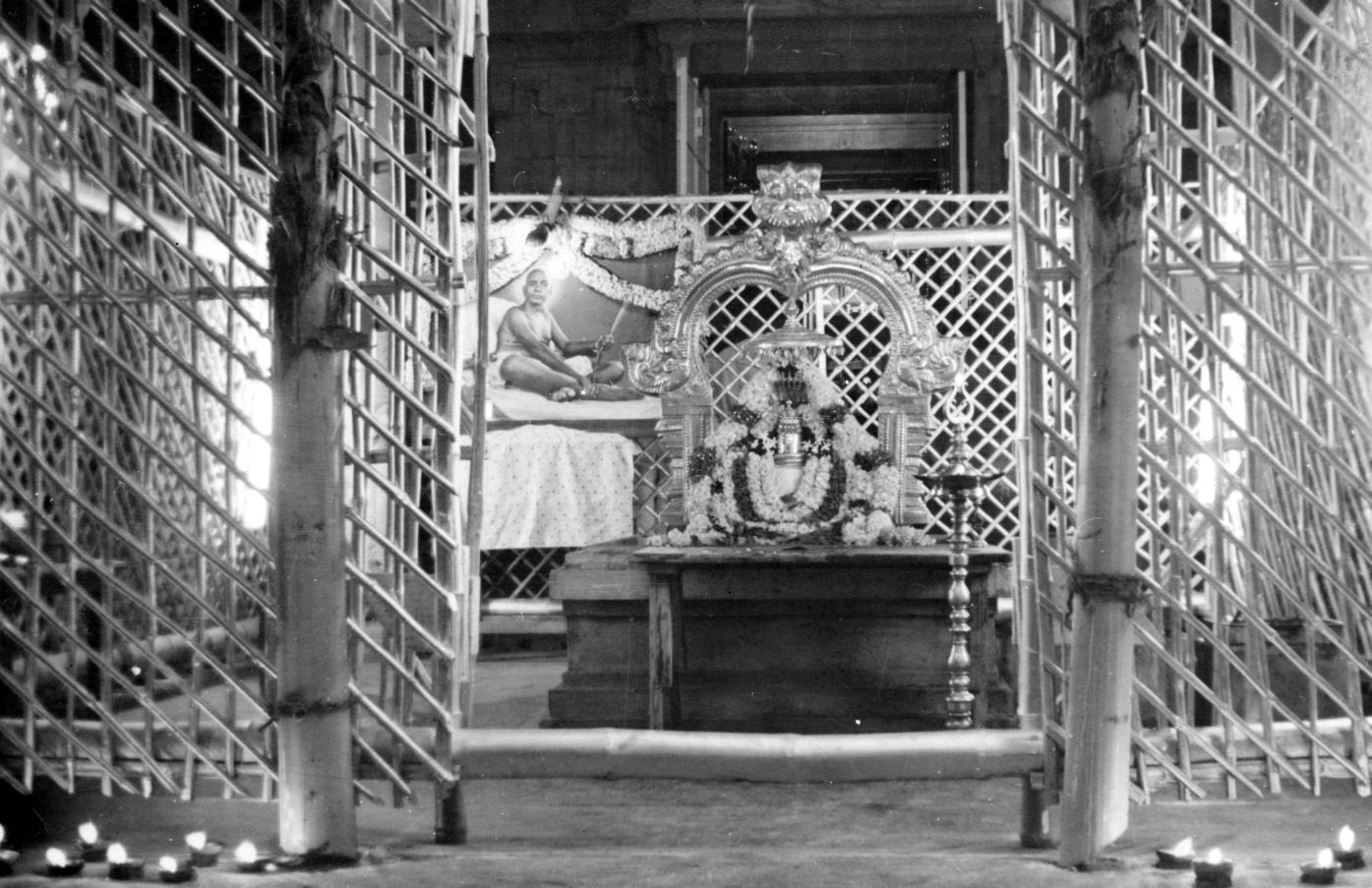
Sri Bhagavan’s Sacred Samadhi Shrine