T. P. Ramachandra Iyer
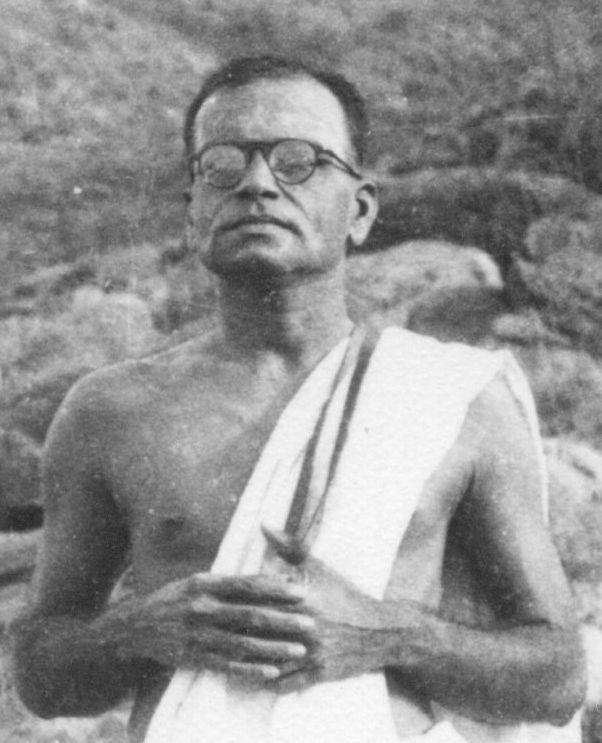
Santhammal was very helpful to seekers who wanted to have contact with Bhagavan in the kitchen. She came to the aid of many seekers who could not open up and speak in the hall in the presence of everyone else. Similarly, T. P. Ramachandra Iyer or TPR, who was one of the attendants of Bhagavan, was very helpful to seekers in the hall. He was congenial by nature, and understood the suffering of seekers who flocked to Arunachala in quest of solace and clarity in their spiritual struggle. When the ashram grew bigger in the 1940’s, a lot of people came thronging to see Bhagavan. Soon, rules and regulations naturally came into play to ensure that Bhagavan was not unduly disturbed. Genuine seekers who found it difficult to approach Bhagavan with their personal and spiritual problems would approach TPR for help. He was the bridge between these seekers and Bhagavan and helped them have contact with Bhagavan in some form or the other. Bhagavan sometimes allowed both Santhammal and TPR to flout the ashram rules because they were only trying to help seekers.
TPR was born in Tiruvannamalai and he grew up at the foot of holy Arunachala. His family had stayed there for generations and they were devoted to Arunachaleswara, the temple deity, and his shakti, Mother Apeethakuchambal. When TPR was a boy of six or seven, he had the darshan of Bhagavan many times in Virupaksha cave. He used to run to Virupaksha cave, but he was honest enough to admit, “I went to Bhagavan because he gave us sweets like sugar candy and raisins.” However, he also came under the imperceptible spiritual influence of Bhagavan and received his blessings. The impact of these experiences became obvious when he was a youth and went to school and college. He became passionate about the study of religion and philosophy, and in college he chose philosophy as his subject much against his family’s wishes. Perhaps he needed the theoretical knowledge of the scriptures of all religions for him to understand and put into practice Bhagavan’s direct teaching. In his later years, he became an affluent lawyer in Chennai.
In 1938, Ramanasramam had some litigation problems, all of which he attended to. His wife passed away in 1939. He was very fond of her. Her death shook him so deeply that he became like a rudderless boat. His only solace was the presence and proximity of Sri Bhagavan. Bhagavan guided TPR to come to him with the result that he took voluntary retirement in the 1940’s and settled down in Arunachala. After 1946, he became the personal attendant of Bhagavan. Imagine, such an intelligent and erudite scholar leaving his all to be with Bhagavan and attend on him!
I was very close to TPR during my childhood and even later on. In fact, I was fascinated by him. Now, looking back, I can very clearly see why I was attracted to him. On the last day when Bhagavan was to drop the body, family members, along with the doctors and other important people of the ashram, were inside the Nirvana Room. Bhagavan was lying down. During the last moments, doctors advised everyone to leave the room. We all got ready to leave. I too was going out, when TPR held on to my hand tightly and made me stand at the entrance. Had he not forced me to stay on, I would have missed the glorious opportunity of seeing the light that emerged after Bhagavan dropped his body. I did not see the light travel to Arunachala though. The Life magazine photographer, Henri Cartier Bresson, saw the light merging with the top of the hill. He was opposite the ashram at the time. It was he who marked the time as 8.47 p.m.
Bhagavan, through TPR, had granted me the darshan of this divine light. Now, I understand why I have always been drawn towards him. Even when studying in college, whenever I came to the ashram, I would seek him out. We would spend time together. In 1960, after I had worked in Mumbai for seven months, I gave up my job and returned to the ashram for good. Because of this, I was in close touch with all the old devotees, including TPR. All this happened on account of Bhagavan’s blessings. When a person is dedicated to the truth, God guides him through sages and saints. A lady saint gave me a duty to perform. She said, “Bring back all the old devotees who have left the ashram. Bring them back and serve them. Make them live comfortably inside the ashram.” This is how perhaps everyone, including TPR, came back.
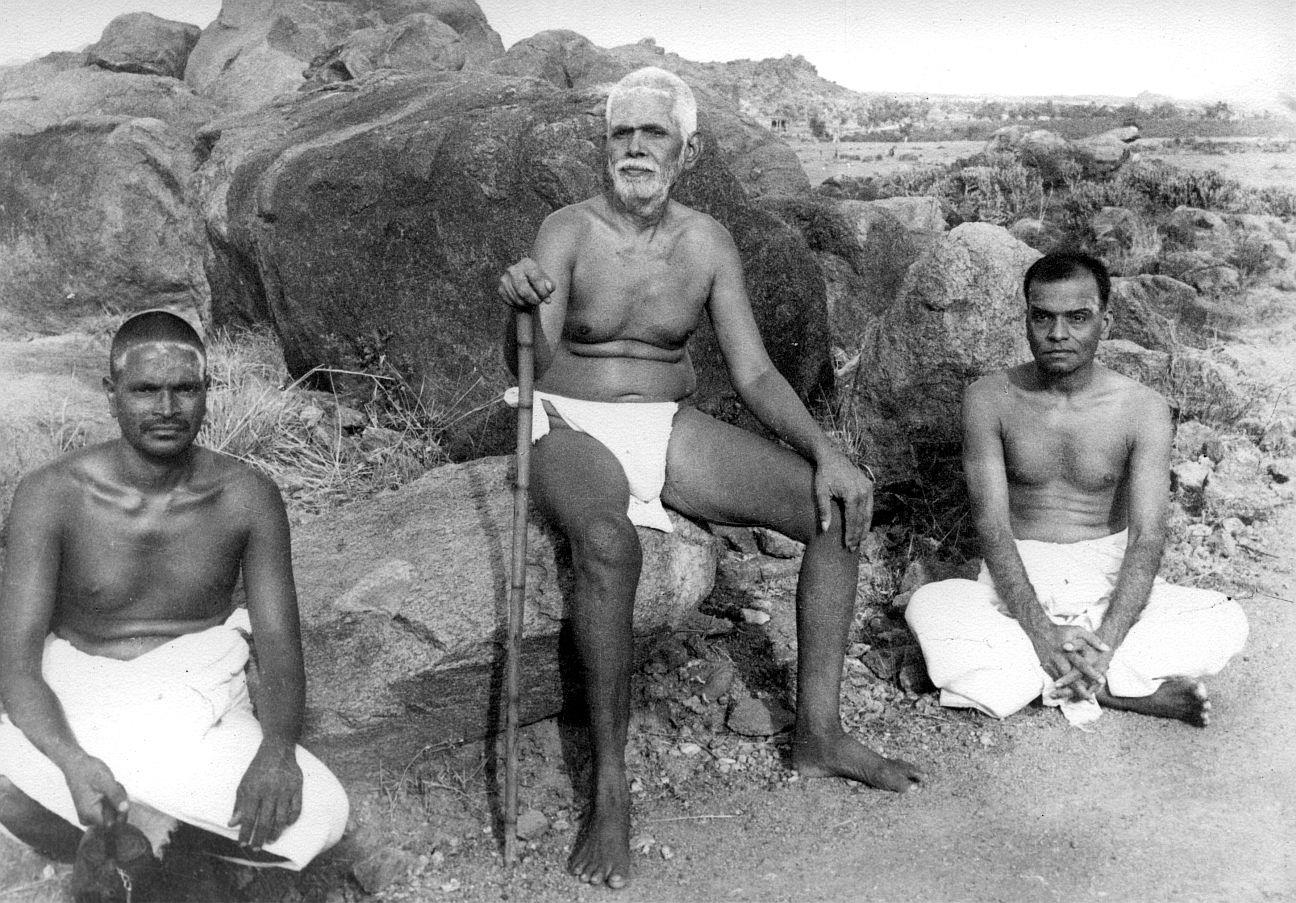
Vaikuntavasar, Sri Bhagavan and TPR
One day, when I was walking to the ashram, TPR tapped me on the back and said, “I too studied philosophy like you. I took philosophy as a special subject in college. I liked it immensely. When I had just become a lawyer, I came to the ashram on one of my frequent visits. Once, there was a discussion going on in the hall about the nature of the Self. Since my mind was still afresh with all the bookish knowledge that I had gathered, I freely gave vent to all that I had learnt. I talked about the various grades of consciousness that exist in the different systems of philosophy. I also used terms such as ‘super-consciousness’, ‘sub-consciousness’ and ‘unconsciousness’. I boasted before Bhagavan. He listened to my enthusiastic and elaborate explanations, and then reacted suddenly and sharply, ‘It is only with reference to something, that one can postulate a super, a sub or an unconscious state. Consciousness being the truth, any form of postulation of it is ignorance, even though it may be very appealing to the intellect. Truth is very simple and direct; it needs no variation. What exists is only consciousness. Call it by any name - Atma, Brahman, Awareness, Absolute, Arunachala. It is pure consciousness.’ These powerful words of Bhagavan made me instantly dive within, into that one and only consciousness. I was submerged in bliss for a long time.” What TPR said next was beautiful. “This is the advantage of living near the master. What takes one volumes to understand, takes just one knock from the master - it makes you go into that state to experience the truth instantaneously. This was not the only knock I got, because when you live close to the master, you get many knocks. Each knock takes you within, not without.”
TPR commented one day, “Even though I was closely associated with Bhagavan, there were doubts that assailed me. The cause of these doubts was centered on the misunderstanding of scriptural texts.” He had this problem because like me he too had studied philosophy. When one reads too much, contradictions and conflicts are bound to arise. I said, “Please be more explicit. This looks exactly like my problem too.” TPR explained, “There was always a confrontation within me between knowledge and wisdom. Is all knowledge of the scriptures really so useless that one can attain wisdom only by giving it up, or does one go beyond this framework? This was the dilemma I was in. I wondered whether learning the scriptures were a mere waste of time. I therefore put this question across to Bhagavan. Bhagavan then calmly explained, ‘Arunachala is the centre of unlearning. Everything that one has learnt has to be given up here for the final culmination of spiritual perfection. Unless one has learnt something, how can one unlearn it? The scriptures equip us with learning. Does unlearning denote denying or removing the scriptures from one’s memory? How is that possible? On the other hand, unlearning means releasing oneself from the mere intellectual knowledge of the scriptures and plunging oneself into the experience of the truth, i.e. making it one’s own and not keeping it outside as something other than one’s Self. What is conveyed in the scriptures should become one’s own experience.’ Arunachala makes one perfect by giving the cream of all the scriptures as one’s own experience in which theoretical knowledge is transcended. In short, the individual ‘I’ or the ego is the learning. This learning, this knowledge is in the head, while the throbbing of the ‘I-I’ is in one’s Heart. It is wisdom. Where is the contradiction then? Bhagavan has clearly stated, ‘Descending from the head to the Heart is the beginning of spiritual sadhana.’”
Very often, I would go to TPR’s room outside the ashram and wait for him. One day, as he came out of the room, he was murmuring, “The grandfather sowed; the grandson is reaping.” He kept muttering it repeatedly. I asked him, “What are you saying?” He then gave me a beautiful explanation, “One day, a devotee offered a huge bhiksha - a traditional feast given in honour of a saint - to Bhagavan in the ashram. While I was expressing joy to my friend over the feast, Bhagavan walked in. He had heard our exchange. He smiled and then turned in my direction and said, ‘Thinking about bhiksha? Your grandfather’s house was the only one I entered to eat after coming to Arunachala. Every day, your grandfather would regularly visit the temple. He was a staunch devotee of Lord Arunachaleswara. A tall and heavy built man, he adorned himself with a rudraksha garland and other beads. In those days, around 1896, I used to stay inside the big temple near the Gopuram Subramanya shrine at the entrance of the Arunachaleswara temple. Every day, your grandfather would sit in front of me for a while without saying anything. I was a young boy of sixteen. He was an elderly person, but he too kept silent when he was with me. He was a well known person in the town and a lot of important people used to be his guests. One day, a very important person came home and arrangements were made for a feast. Even on that day, after your grandfather came to the temple to have the darshan of the Lord, he came to me and sat down. After a while, he got up and then, abandoning his usual silence, said to me, ‘Get up! We will go to my house, have bhiksha and come back.’ I was not used to talking in those days. I made signs to indicate my unwillingness. He did not heed me. He was big and strong, while I was thin and weak. He repeated his request. I persisted in signalling ‘no’. Since I didn’t budge even a little, he bent down, linked my arms to his, forced me to get up and follow him. I was thus forced to enter his house. He made me occupy the most important place and spread in front of me a leaf much larger than the other ones. He himself served me. After I finished my meal, he ate. In those days, I never had a bath. My body would smell, and so nobody would come close to me. Yet, your grandfather used to come unfailingly and sit close in front of me. Many people in town came to see me and then went away. Your grandfather alone realized that though young, what was in this was fullness.’” TPR had tears in his eyes when he narrated this. He concluded, “Ganesan, it is solely my grandfather’s devotion to Bhagavan that is now enabling me to enjoy his holy presence and experience the inner felicity which Bhagavan is showering on me every day.”
Another day, I asked TPR, “Can you tell me about the compassion of Bhagavan? Many people talk about Bhagavan’s compassion as his greatest attribute.” He replied, “There are two sides to Bhagavan’s compassion. If someone is afflicted, he goes down to the level of that person to lift him up and bring him back to normalcy. In such cases, he will even break his strict adherence to his own teaching of Self Enquiry. The other side of his compassion goes even deeper. He will not just alleviate the person, but completely transform him.” I persisted, “Please explain with some anecdotes.” I was always eager for ‘Bhagavan stories’. TPR said, “Once, an important officer came to Ramanasramam when the post office inside the ashram compound was being opened. He came into the hall with tears in his eyes. He melted when he looked at Bhagavan. He said, ‘Bhagavan, I have lost my only son. My wife and I have neither been peaceful nor happy after the death of our son. We have been wandering around aimlessly in life since then.’ Bhagavan looked at him with great compassion. The man continued, ‘We have only one desire, Bhagavan. You have to fulfill this. We want to see our son in our next life.’”
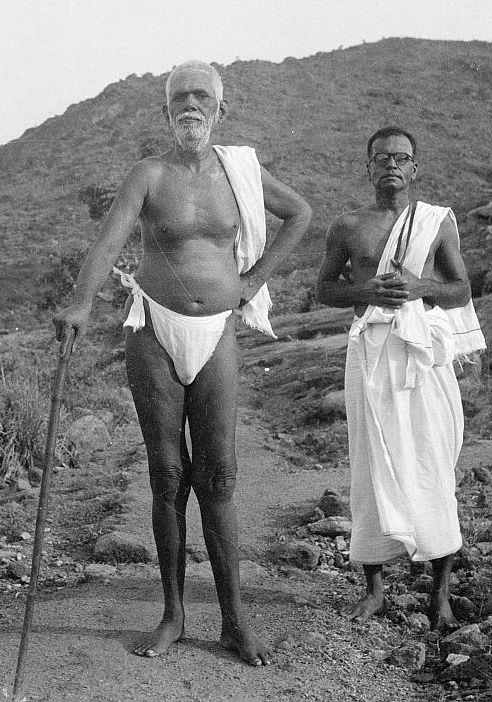
TPR continued, “We devotees in the hall knew what reply Bhagavan would give. Bhagavan indeed gave the very same answer. Bhagavan looked at the man very compassionately and posed a question, ‘Who is the father? Who is the son? What do you mean by relationship between father and son? What do you actually mean by rebirth? If you understand all this, you will understand the depth of what you are asking for.’ The man prostrated before Bhagavan and said, ‘I do not understand all this, Bhagavan. I only want one thing. I want to see my son.’ Bhagavan then did something remarkable and unusual. He got up from his seat, raised his hands and said, ‘Yes, I will give it to you. I will make you see your son. You will see your son in your next life, as clearly as you have seen him in this.’ The officer became extraordinarily happy and fell at Bhagavan’s feet several times. Feeling highly elated, he left the hall.”
The others in the hall, including TPR were concerned and worried. TPR asked, “Bhagavan, how could you give him such an answer? This is against your own teaching. Your teaching postulates that there is no birth and rebirth. When even this body is not born, where is the question of rebirth?” Bhagavan turned to TPR and said, “What am I to do? Had I not given him this answer, he would have been shattered.” TPR complained, “I am not happy because you should not have condescended like this.” Bhagavan, noticing their unhappiness and disappointment, suggested, “Go and get the Bhagavad Gita.” Bhagavan chose a passage from it and asked TPR to read it out aloud. In that passage, Lord Krishna says that knowledge should be given according to one’s ability to grasp it. If one teaches philosophy to those who are not ready to receive it, their faith will be totally shattered. TPR concluded by saying, “This is Bhagavan’s compassion.”
I then prodded him to tell me about the other kind of compassion - the transforming one. This is what TPR recounted: “Aravind Bose was an industrialist; he was also an intellectual and an ardent devotee of Bhagavan. He was drawn towards Bhagavan’s teaching of Self Enquiry. He began an industry in Bangalore which is well known even today. He came to visit Bhagavan every week and would also bring along some of his friends. Bose had a son who was around twenty years old at the time. He was a brilliant young man. Bose wanted to hand over the management of the factory to him and then settle down at the holy feet of Bhagavan. However, the boy suddenly died and Bose was inconsolable. Many of us went from Ramanasramam to console him. We talked about all the theoretical aspects of Bhagavan’s teaching but it was of no avail. We felt that he had to be brought before Bhagavan. Since, very rarely were there people in the hall between twelve and two in the afternoon, I brought Bose to Bhagavan then. Bhagavan instructed Bose to sit close to him and continued looking at him. Bose was in physical and mental anguish. He was very restless; he could not even open his eyes. Bhagavan focused on him and ultimately Bose opened his eyes. He managed to look at Bhagavan and Bhagavan continued looking at him. After some time, this shook him up and he shouted at the top of his voice, ‘Bhagavan, is there God?’ His voice was filled with the pain and agony of his loss. Bhagavan continued to look at him. Then, Bhagavan said, ‘Bose, your question itself has the answer.’ He had shouted, ‘Is there God?’ There is God. For five minutes, there was absolute silence. Bhagavan continued to look at Bose and Bose too looked at Bhagavan.” TPR observed all this from outside the window. He noticed a change in Bose. He became his normal self and prostrated before Bhagavan. Bose smiled for the first time, and said, “Thank you, Bhagavan.” TPR said, “This is the compassion of Bhagavan. We cannot understand what took place between Bhagavan and Bose. He asked the question, ‘Is there God?’ and Bhagavan answered, ‘Your question itself has the answer.’ The answer was intellectual, but the compassion was overwhelmingly healing and absolutely solid.” Bose remained a great devotee of Bhagavan. He had already built the Bose Compound which has many cottages for devotees to stay in. Even TPR stayed there during his last days until I brought him back into the ashram.
Bhagavan used to get up at three thirty in the morning. He would go up the hill around five or five thirty in the morning. He would take his bath around six. He would have his breakfast at six thirty. At eight, he would be in the hall. At eleven, he would go for lunch. He had a routine. So I used to tell TPR, “Our Bhagavan is very predictable, whereas all the other great masters like Sheshadri Swami and Ramakrishna Paramahamsa were not.” TPR said, “Do not talk like that. You can never predict a jnani.” He added, “I am going to narrate some incidents. I want you to analyze whether you have understood them or not. There was once a swami from North India. He was old and had stayed on for a few weeks. He must have been a very ripe soul because people could see an aura around him. On the day he was leaving, he stood before Bhagavan. I too was beside Bhagavan. The swami said, ‘I am very happy Bhagavan that I got all that I wanted after coming to Arunachala and to your ashram. But I need two more things to be fulfilled and they can be done only by you.’
All of us in the hall thought that the swami was going to get a very rude shock from Bhagavan. We waited with bated breath. Bhagavan, with a movement of his head, signalled the swami to continue. The swami, with folded hands, said, ‘My first request is that I want to place my head on your holy feet and melt. I want to wash your feet with my tears.’ Bhagavan waited, without uttering a word. ‘The second thing, Bhagavan,’ continued the swami, ‘you have to put your holy hands on me and declare that you have given me atma sakshatkar - liberation.’ We all laughed within ourselves because the swami had put forth such requests to Bhagavan. But a miracle took place. Bhagavan got up from the sofa and stood in front of him, pointing to his feet. The swami fell at Bhagavan’s feet. We saw his tears drenching the feet of Bhagavan. After a while, Bhagavan lifted him up, put his hands on his shoulders and declared, ‘I have given you atma sakshatkar.’ Though his eyes continued to shed tears, the swami’s face glowed with fulfillment as he took leave of Bhagavan!”
TPR continued, “An American came to the ashram. We did not know his name. The tall, handsome American entered without announcing his name. From the moment he entered, Bhagavan’s gaze was on him. He sat before Bhagavan for three hours. Some kind of communication was going on between them during this time. There was such deep silence; no words were exchanged. The American got up and left. He never came back. I asked Bhagavan, ‘How is it that this man came and was here only for three hours?’ Bhagavan replied, ‘He got what he wanted. His mission is over. Where is the need to stay on further? Everything ends in the now.’”
“Then there was an aristocratic lady from America who sent a telegram stating that she was coming to India just to be with Bhagavan. She said she was reaching Bombay by ship on a particular date and then taking the train to Madras. She had also written that she would be taking a special train and coming to Arunachala on a particular date. She sent a telegram from Bombay confirming her programme. She gave another telegram from Madras. She was disappointed that there was no one to receive her at the railway station when she arrived. At Ramanasramam too, there was no one to receive her. She came into the hall on her own. Bhagavan was holding up the newspaper and reading it - she couldn’t even see his face. Major Chadwick and Munagala Venkataramiah had been requested to look after her since she was coming from such a long distance and was making a special trip. She was fuming at the treatment she had received. She said, ‘I am a lady. What have I done wrong? I have taken all the correct steps and come here. Nobody gives me any respect here, and this Ramana Maharshi doesn’t even look at me.’ She was terribly angry. She told Chadwick and Munagala Venkataramiah, ‘Come to my railway car at four o’clock. I want to talk to you.’ She left the ashram abruptly. When they went to meet her, she demanded, ‘Why did Ramana Maharshi not even extend to me a common courtesy? What did I do wrong? I did everything perfectly but he does not know how to respect or even receive a lady.’ They said, ‘Do not talk ill about our master. We will go and report everything to him.’ She said, ‘That is the reason why I am saying it. Go and tell him. Let him learn something.’ The two fearfully reported the incident to Bhagavan. Bhagavan listened with great interest and coaxed them to give him a detailed account. Finally, he assumed his usual poise and said, ‘Did she say all this? Then, this itself will work.’ That night, the lady had a dream. In the dream, Bhagavan said, ‘Come back.’ The next day, she came to Ramanasramam, but this time unannounced. From eight onwards, Bhagavan’s eyes were looking at the entrance to the hall. She came at ten and Bhagavan showered her with his smile. She became a devotee of Bhagavan. Later, she said, ‘We can never judge a master or how he will act. From his action, you cannot decide anything.’”
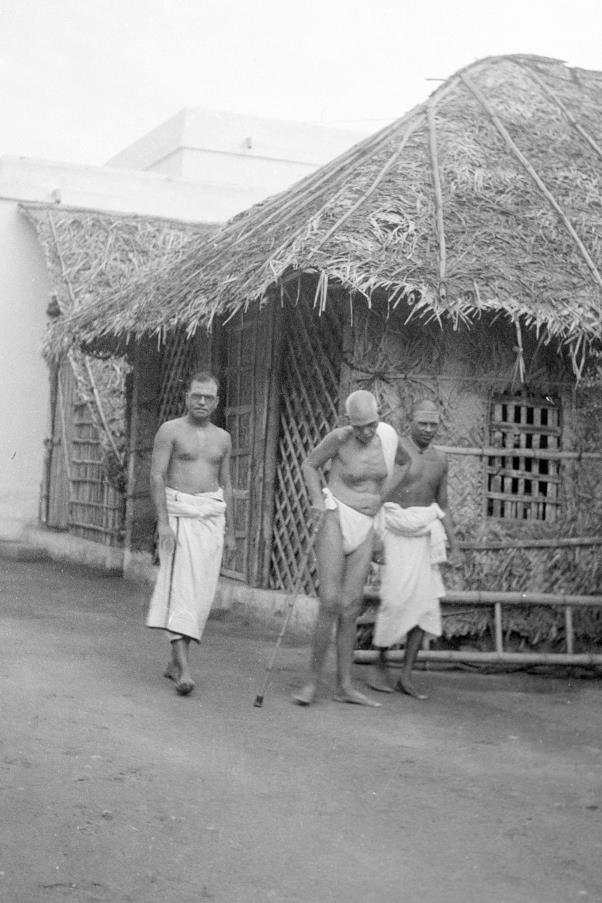
Sri Bhagavan walking towards goshala, TPR to his right
TPR gave not just an account of these incidents but also an insight into Bhagavan’s teachings. He once told Bhagavan, “Bhagavan, I came to you not because I adored your personal form. Your teaching ‘Who am I?’ was so logical that it attracted me to you. Although I am practicing it, I am still not getting anywhere. I am not able to experience it.” Bhagavan looked at him steadily and said, “The man who wants to catch a fish attaches a very tempting worm to the fishing rod. Does he want to feed the fish? He only wants to catch it.” The eleven page gem of a book, Who Am I? is only meant to catch us all and put us in the tiger’s mouth, once and for all !
I asked TPR, “Did you ever get any clarifications from Bhagavan on his texts?” TPR said that he once asked Bhagavan about the meaning of the Tamil words ‘aar oli’ which means ‘shining light’. The phrase appears in the first verse after the first two benedictory verses of the Forty Verses on Reality: “Since one actually sees the world, one has to accept there are varied forms of multiplicity. Yet, all that is seen, the names, the forms, the onlooker, the screen, the light that illumines all these - verily all are that one principle, the awareness ‘I AM’.” I asked Bhagavan, “What is this light that illumines? What does it refer to?” Bhagavan replied, ‘Aar oli means all pervasive brightness. It refers to that light of the mind in which we see the entire world.’ Only with a particular kind of mind are we able to see the world, both the known and the unknown. Even the psychic phenomenon is seen only through the mind. The known we see; the unknown is the vision of God that we long to have. The white light is what we call the Self and what Jesus Christ called fire. The white light is the light of the Self which transcends both light and darkness. No object can be seen in this light. Here, there is neither a seer nor the seen. Just as we do not see any objects in deep sleep, here too we do not see anything. However, the Self reflects a light, which is the light of the pure mind. This is the light which gives room for the existence of the entire world to be seen. What is seen cannot be actually seen in total light (as in enlightenment) or in total darkness (as in deep sleep). It can be seen only in this subdued or reflected light and this is the light that is being referred to in the verse.”
Once, I pleaded with TPR, “We seekers also have commitments, so how do we balance worldly responsibilities and spiritual aspirations? It seems like a contradiction.” TPR replied, “I can tell you what happened to me with Bhagavan. I pleaded with Bhagavan to save me from the grips of samsara as however much I turned my mind inward, the pull of commitments in the activities of life was still insurmountable. I wanted a way to tide over these involvements. Bhagavan turned around and said with great love, ‘Be like the tiniest chip of wood that is thrown into a river in spate.’ ” TPR then explained to me, “The external life of action and involvement of daily life is unavoidable, both for the spiritual seeker and others. Assuming that they are very important, men strive for name and fame, and hence they face a lot of problems and strife. One must understand that true spirituality is not the avoidance of action, but involving in action without giving importance to the doer. In other words, one should be like dust thrown into a floating flood while indulging in any kind of action. The sense of being the actor is to be given up, but not the action itself.” I questioned TPR further, “How can I give up the sense of being the actor? I am the actor!” TPR explained, “I too, asked Bhagavan this. Bhagavan showed two practical ways of erasing the importance given to the actor. One is by not ‘reacting’ to the action that takes place around you. One should ‘act’, but not ‘react’. The other is to understand totally and experientially that things and actions happen through you and not by you. It is being done by a higher power. Actions, whether good or bad, are being done through you and not by you. Reaction is mental work. The mind always binds us to the action. If you do not react to the action, then it dies.”
During his last days, I pleaded with him to come to the ashram. It was he who first occupied Chadwick’s room. No one other than Chadwick had occupied it before. Soon afterwards, he had a stroke. I took him to Pondicherry where Bhagavan’s devotee and my friend Dr. Bhaskaran attended on him. Within a few days, he was able to speak. I paid a visit to the hospital and said, “Please bless me.” He put his hands on my head and said, “Follow the direct teachings of Bhagavan; follow the direct teachings of silence and Self Enquiry. Do not swerve towards any other method. Be silent at times when you have nothing else to do; at times when you do something, always ask yourself, ‘Who is doing this?’ Raise this Self Enquiry constantly, and it will take you back to the state of ‘summa iru’.” (‘Summa iru’ in Tamil means ‘be still’. It does not mean being quiet physically.) TPR continued, “I did not understand that then, Ganesan. Being still is the link between the seeker and Bhagavan. Whenever you are silent and doing nothing, focus your attention on the inward silence, on the ‘I AM’. Then, you are always communing with the ultimate truth - Bhagavan, Arunachala, Jesus, God, - whatever name you want to ascribe to it. You are then established in that truth.” TPR passed away in Bangalore. His last words were reported to be, “Write to Ganesan that I am blessing him.” It was not a blessing for this individual alone. It is a blessing for all seekers. Let us pay homage to these devotees as they are the rocks and boulders of Arunachala, the ever living truth. By sharing their lives, we too are being established in the truth.
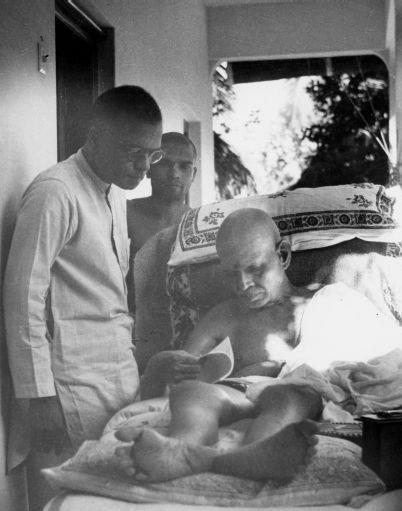
TPR with Sri Bhagavan outside ‘Nirvana Room’