Ramakrishna Swami

Ramakrishna Swami and Kunju Swami lived in neighbouring villages. In fact, it was Ramakrishna Swami who persuaded Kunju Swami to visit Bhagavan around 1920. Kunju Swami was serving Bhagavan, but when he decided to go to Palaakothu to do sadhana, he brought in Ramakrishna Swami to take his place. Ramakrishna Swami was a remarkably intelligent man; he was also innocent like Sivananda Swami. He served Bhagavan with such attention and alacrity that he pleased both Bhagavan and Niranjanananda Swami. Desperately needing help in running the stores and maintaining the ashram gardens, Niranjanananda Swami requested Ramakrishna Swami to assist him. With the permission of Bhagavan, Ramakrishna Swami served the ashram management with total dedication and devotion. Niranjanananda Swami remained ever grateful to this devotee and always spoke highly of him.
Ramakrishna Swami was very kind to me. He narrated many incidents relating to Bhagavan and himself. One day, while serving Bhagavan in the hall, Ramakrishna Swami approached Bhagavan and said, “Bhagavan, I want to devote myself solely to contemplation and meditation. May I go to Virupaksha cave for this?” Bhagavan looked very pleased and said, “Go and stay there.” Ramakrishna Swami found bliss within a week. One day, while he was in deep meditation, he found that he had, in his mind’s eye, travelled far away to the famous Nataraja temple in Chidambaram. He had a vision of the sanctum sanctorum; he also saw that the curtain next to the shrine was on the point of catching fire. The vision was so distinct that he woke up from his trance with a jolt. That evening, the entire town was talking about a fire accident that had taken place in the Chidambaram temple. Ramakrishna Swami was highly pleased with himself. Thinking he had spiritually evolved a lot in just one week, he ran to Bhagavan in order to narrate the incident. Having listened to him intently, Bhagavan burst out in annoyance, “Ramakrishna! Did you go to Virupaksha cave only to see a vision? Did you not go there to intensify your meditation? Seeing anything outside of oneself with either physical eyes or the psychic eye is a sure sign of interruption in the smooth flow of meditation. The attainment of any kind of siddhi or supernatural power is an obstruction to one’s spiritual journey. Enough of your isolation and meditation! Come down!” Bhagavan’s words came as an awakening to Ramakrishna Swami. He never indulged himself in visions from that day onwards. He fully understood that the proximity of the guru was necessary to activate the meditative current in his heart. So, he plunged into work, both in the garden and in the store. The ashram garden blossomed because of Ramakrishna Swami and Ramaswamy Pillai. The store too, became more efficient because of Ramakrishna Swami’s presence and hard work.
Ramakrishna Swami was subject to epileptic fits from childhood. Sometimes, while working in the store, he would be attacked by a fit that would leave him unconscious for hours. He would then be carried to the ashram dispensary for which they had to go through a narrow passage that passed by Bhagavan’s Old Hall. Once, Bhagavan happened to look at this sight through his window. When Ramakrishna Swami became all right, he went to Bhagavan and prostrated before him. Bhagavan enquired, “Hey, Ramakrishna! How did you feel?” What Bhagavan was actually asking about was how he had felt in the state when he had fits. Ramakrishna Swami replied, “Bhagavan, I did not know anything. I lost consciousness of the body and the surroundings. I knew nothing.” Bhagavan told him, “No, no; it should not be like that. You should hold on to the inner awareness all the time. Even if you lose pragnya (outward consciousness), you should never let go of gnyapti (inward awareness).” Ramakrishna Swami understood what Bhagavan meant. And what was the impact of the teaching? He never had epileptic fits again!
This was the explanation that Ramakrishna Swami gave me about gnyapti: “Pragnya refers to the consciousness that we have of the body and its surroundings. What we see or experience is pragnya; pragnya is outward awareness. Gnyapti refers to pure, inward awareness; it is one’s state of natural awareness. For instance, when a person wakes up, there is a state of alertness or awareness when he understands that he has woken up and is no longer asleep. This takes place in a short span of time. We all experience this state. Though it is a spiritual experience, since we do not pay pointed attention to it, it passes unnoticed every day . We do not allow the experience to last because of our compulsive urge to jump out of bed and get into our routine. This state of awareness when there is no movement or preoccupation, which is yet to descend to the level of consciousness, is the state of gnyapti. This is a state that can be experienced by anyone.” (Nisargadatta Maharaj made a clear cut distinction between the two by saying, “When awareness catches hold of an object, it becomes consciousness.”)
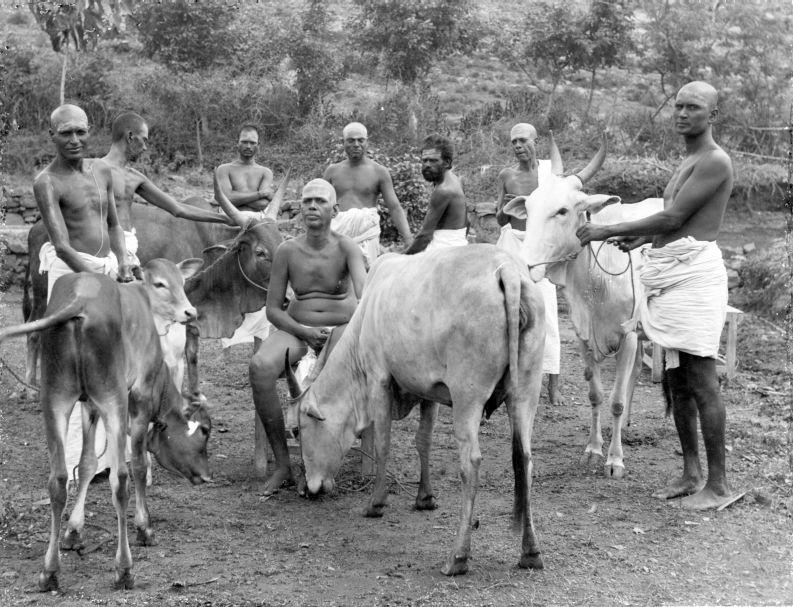
Sri Bhagavan showering His Love on Ashram cows. Cow Lakshmi is offering prostrations by surrendering herself at His feet. (Ramakrishna Swami is standing at extreme right).