Yogi Ramiah
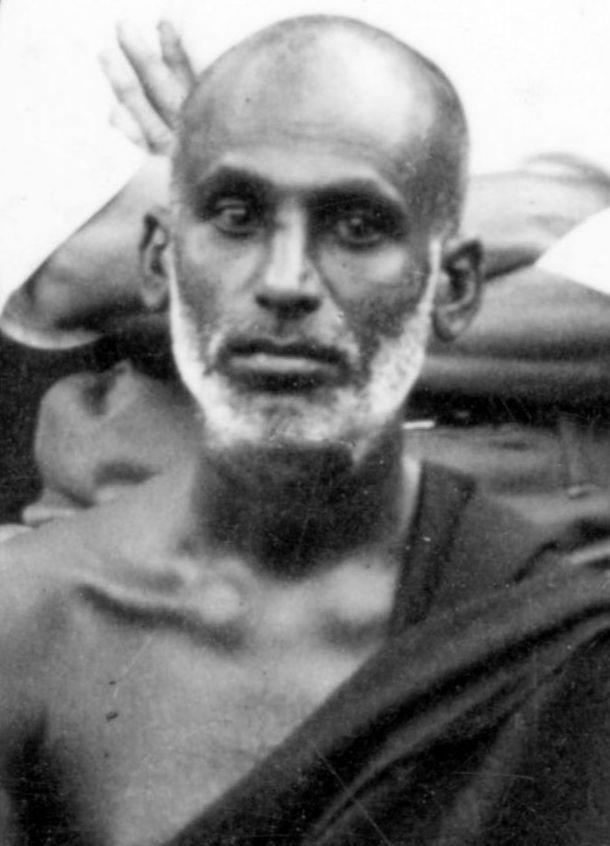
Paul Brunton’s dramatic introduction and subsequent high praise for Yogi Ramiah in his book, A Search in Secret India, made him very popular among Bhagavan’s devotees across the world. It was in the 1930’s. Paul Brunton was entering his hut when to his horror and loathing he saw a cobra with a raised hood inside. As he stood frozen and helpless outside the hut, a well built man, like a graven Buddha, came and took in the situation with a glance. Raising both his hands to calm the cobra, he entered the hut. In response, the cobra put down its raised hood near the man’s feet. The man then calmly bent down and stroked the cobra’s tail as it slithered out of the room. Surprised Paul Brunton asked, “Are you not afraid?” The man replied, “What have I to be afraid of? I approached it without hatred and with love in my heart for all beings.” Thrilled with the man’s actions and words, Brunton asked him for his name. “Yogi Ramiah,” was the reply.
Yogi Ramiah’s parents were devout and very wealthy. Consequently, he was more interested in enjoying the good things in life than paying attention to his studies. At the age of eighteen - this is how the divine operates - he happened to read a book on saint Kabir. On reading it, the unreality of the world exploded like a bomb in his face. He had been taking the world to be real. But, after reading about Kabir’s life and teachings, he was a changed man. Now, thirsting to know what the truth is, he started searching for a guru. One day, he met a guru who advised him to chant the name ‘Rama’, five thousand times every day if he wanted to know the truth. So intense was the young man’s thirst for truth that he countered, “What if I chant more?” The guru replied, “The benefit you reap will be greater.” Not letting up, Ramiah persisted, “What will happen if I chant it continuously?” Thrilled by the young man’s question, instead of replying, the guru embraced him and initiated him into the Rama mantra. From that moment onwards, whatever else he was doing, he was chanting the mantra without interruption. During this time, another guru initiated him into the breathing techniques of hatha yoga pranayama. The intense practice of these two further deepened his conviction that the world was unreal.
He now wanted to go to Benares and spend the rest of his life there. Look at the divine intervention: on the way, he happened to meet the same guru who had given him the mantra. On being told that he was going to Benares, the guru told Ramiah, “Go back to your village and pursue your sadhana continuously in your garden.” Without hesitation, Ramiah obeyed and returned home to do his sadhana. In due course, he had the vision of Lord Rama. On pursuing it even more intensely, he experienced the disappearance of the external Rama. Instead, he started feeling God within as the Self. Puzzled, he went and queried scholars, “Can the subject and the object be the same? Can they remain indistinct as one?” Their answer that the subject is different from the object did not satisfy him. So, he went on searching for someone who could solve his doubt. One of these searches led him in the thirties to the Old Hall in Ramanasramam. Obsessed with his doubt, he asked, “Can the subject and the object be one?” Kavyakantha Ganapati Muni, who was also in the hall, answered, “Of course not, the subject is different from object.” Pained, Ramiah looked at Bhagavan. Disagreeing with Kavyakantha, Bhagavan clarified, “The subject and object are distinct in the phenomenal world to the ordinary man. But in the experience of samadhi they merge and become one.”
This answer dissolved Ramiah’s doubt. He instantly took Bhagavan as his satguru and decided to stay on in Tiruvannamalai. Bhagavan gave him a lot of attention because Ramiah lived like a real yogi. At ten in the morning, he would have the only meal of his day - a limited amount of lentils that he himself cooked. Otherwise, he was either in a rock cave in Palaakothu pursuing his sadhana or spending hours together in front of Bhagavan. He was the only person who was freely permitted to be with Bhagavan anywhere and at any time. He loved Bhagavan’s direct teaching of Self Enquiry and Bhagavan loved him. Since Ramiah knew only his mother tongue, Telugu, Bhagavan of his own accord translated Upadesa Saram and Ulladu Narpadu into Telugu to help him pursue Self Enquiry.
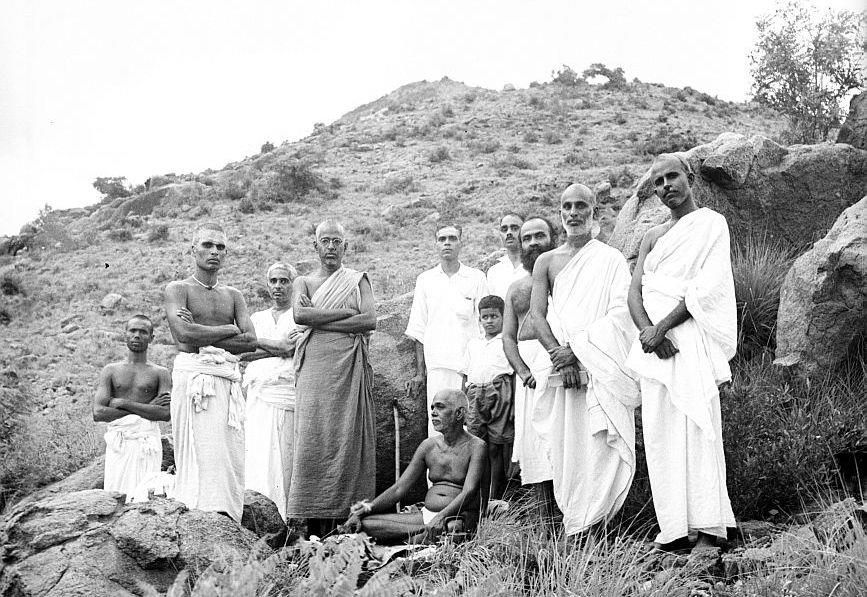
Group of devotees with Sri Bhagavan on the Hill. Yogi Ramiah is seen last but one from extreme right.
He had beautiful conversations with Bhagavan, some of which are printed in Talks with Ramana Maharshi.
Yogi Ramiah: A master is approached by a seeker for enlightenment. The master says Brahman has no qualities nor stain nor movement etc. Does he not speak as an individual? How can the seeker’s ignorance be wiped off unless the master speaks thus? Do the words of the master as an individual amount to the truth?
Bhagavan: “To whom should the master speak? Whom does he instruct? Does he see anything different from the Self?”
Yogi Ramiah: “But the disciple is asking the master for elucidation.”
Bhagavan: “True, but does the master see him as different? The ignorance of the disciple lies in not knowing all are Self realized. Can anyone exist apart from the Self? The master simply points out that the ignorance lies there and therefore does not stand apart as an individual. What is realization? Is it to seek God with four hands bearing conch, wheel, club etc? Even if God was to appear in that form, how is the disciple’s ignorance wiped off? The truth must be eternal realization. Direct perception is the ever present experience. God himself is known as directly perceived. It does not mean he appears before the devotee as said above. Unless the realization is eternal, it cannot serve any useful purpose. Can the appearance with four hands be eternal realization? It is phenomenal and illusory. There must be a seer. The seer alone is real and eternal.”
Bhagavan goes on to say, “Let God appear as the light of a million suns. Is it direct perception? To see it, the eyes, the mind, etc., are necessary. It is indirect knowledge whereas the seer is direct experience. The seer alone is pratyaksha - direct perception. All other perceptions are only secondary knowledge. The present superimposition of the body as ‘I’ is so deep rooted that the vision before the eyes is considered pratyaksha but not the seer himself. No one wants realization because there is no one who is not realized. Can anyone say that he is not already realized or that he is apart from the Self. No, evidently all are already realized. What makes him unhappy is the desire to exercise extraordinary powers. Man knows that he cannot have those powers so he wants God to appear before him, confer all his powers on the devotee and keep himself in the background. In short, God should abdicate his powers in favour of the man.”
Yogi Ramiah: “It is alright for great sages like Sri Bhagavan to speak out so plainly. Because the truth does not swerve from you, you consider it easy for all others. Nevertheless, the common folk have a real difficulty.”
Bhagavan: “Then, does anyone say that he is not the Self?”
Yogi Ramiah: “I meant to say that no one else has the courage to put things straight as Bhagavan has done.”
Bhagavan: “Where is the need for courage for saying things as they are?”
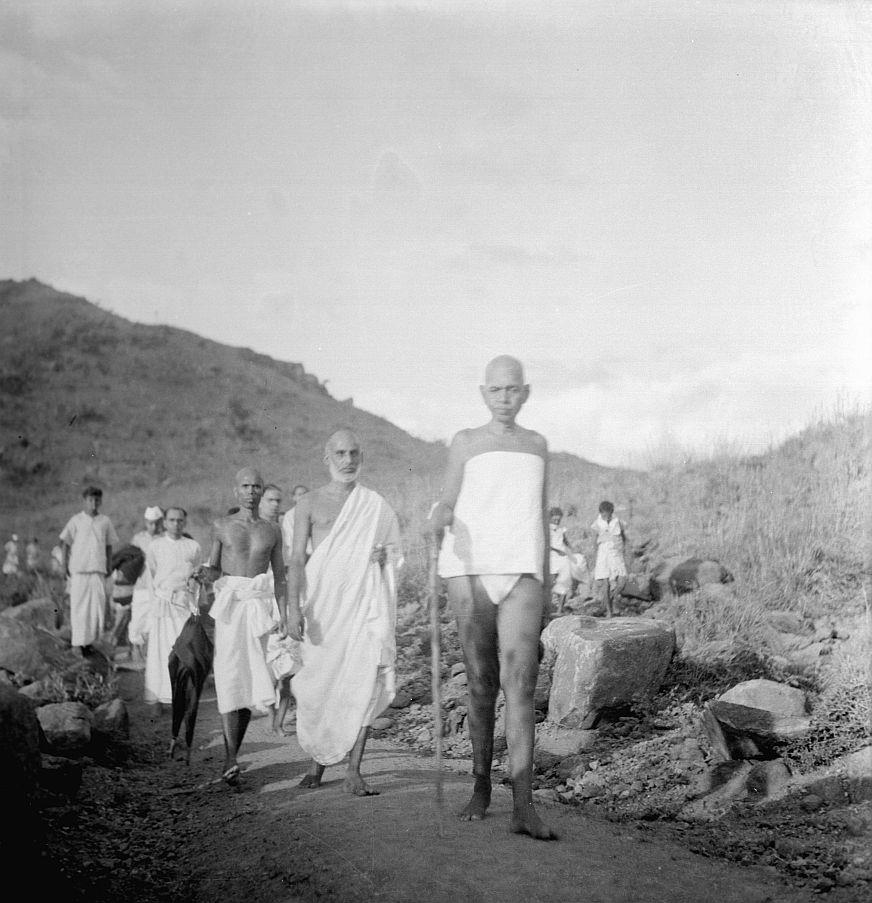
Once, I asked Yogi Ramiah, “Will you please tell me how you felt in the presence of Bhagavan?” He replied, “Sitting in the Maharshi’s presence brings peace of mind very easily and effortlessly. I used to sit in samadhi for three or four hours together. Occasionally, I felt my mind taking a form and coming out from within. But by constant practice and deep meditation, I made it re-enter the Heart until it merged there. When the mind is absorbed in the Heart, the Self is realized. The result is peace.”
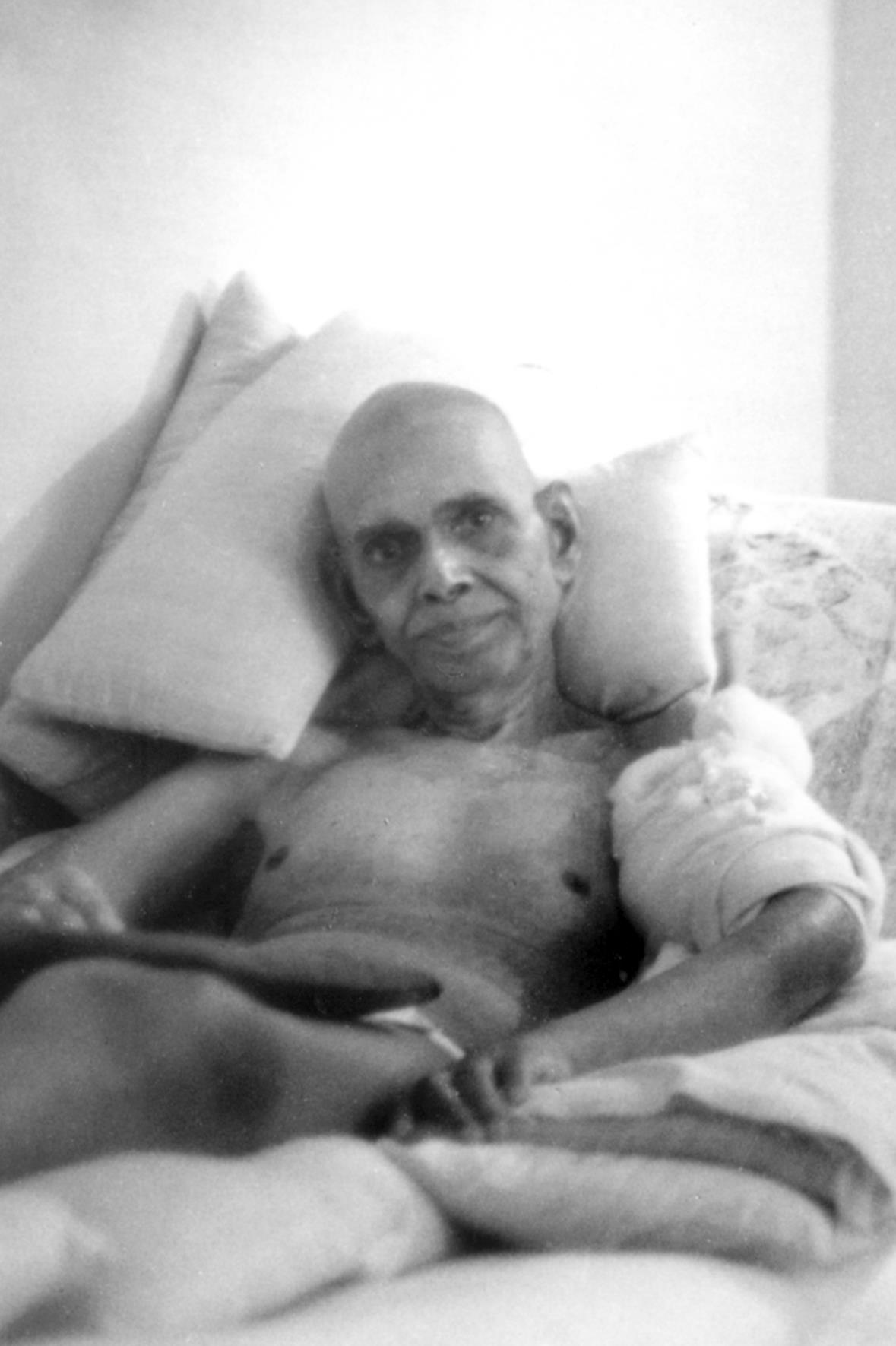
After Bhagavan’s passing away, Yogi Ramiah spent most of his time in tapas, yoga and mounam at his village – Annareddy Palam, near Nellore, A.P. Finding peace in his presence, many people used to spend time in his proximity. Those who stuck around were invariably taught Self Enquiry and advised to follow the path of Bhagavan. His last days were very peaceful. He was fully conscious till the last moment. Those who were with him then, told me that his face was suffused with yogic brilliance. His lips were constantly uttering the name of Bhagavan Ramana till he breathed his last. A samadhi shrine was built where his body was interred. Since then, this shrine has become a place of worship.
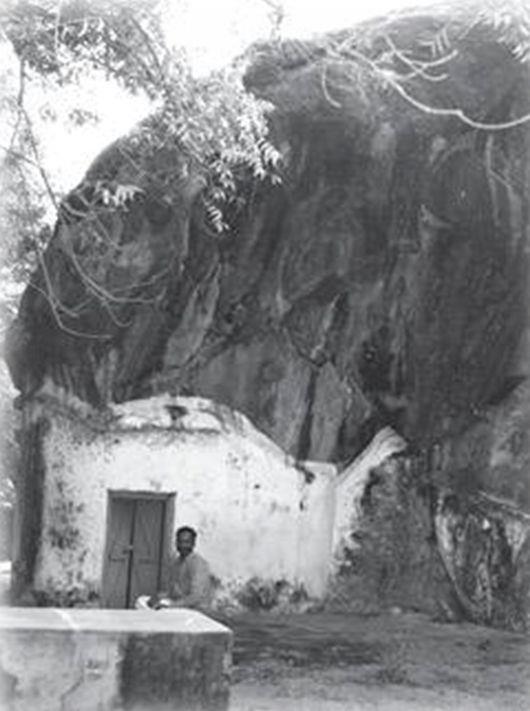
Yogi Ramiah stayed in this rock cave (built by B.V. Narasimha Swami)
“Glance of Grace”