Janaki Mata
Once, a staunch Christian from the west stood before Bhagavan, and in all earnestness entreated, “I want a living guru. Can you show me a living guru?” Bhagavan posed a counter question, “Is Jesus Christ dead? Is the Buddha dead?” He did not elaborate further because true masters merely hint at the answer. A true master does not get involved in complex answers because it is the questioner who has to be more involved in the process, since he himself is the answer. Moreover, the questioner has to experience the answer to the question rather than have it revealed by the scriptures or answered by someone else. In other words, if Ramana Maharshi is the truth, then the questioner too has to become the truth. Bhagavan’s counter-questioning, thus, is a perfect answer to the question.
Simply put, at first, Jesus Christ or the Buddha is merely a thought, a remembrance. Now, the inner quest must start. But, is any of the messiahs just a thought? Bhagavan Ramana once explicitly stated, “Everything else is a thought, but the guru is not a thought.” The relationship can be compared to the love a person has for his mother. If a person loves his mother very deeply, then is the mother just a thought? Can this love be compared to all the fleeting, short lived thoughts that one has in the course of a day? Similarly, when you think of your child, who may not be physically present at that moment, is it not a loving thought? Does the thought not take on another dimension of reality? This is the same dimension we are transported to when we think of our sages, saints and other spiritual luminaries. They continue to live in our midst, even though they have shed their physical presence. They are the incarnation of the deepest principles of love, eternally guiding us whenever we turn our attention to them. Bhagavan Ramana repeatedly said that there is only one guru and that guru dwells in one’s Heart.
What does the word saint mean? The dictionary defines a saint as ‘a very virtuous person of great holiness and one of God’s chosen people’. In the spiritual realm, we understand a saint to be a person who has no sense of ‘me’ or ‘mine’. They are also those who aid in destroying this sense in those with whom they come in contact. How do they do this? They do it with just a single look or darshan, which is also termed as ‘God seeing God’.
During my earlier days in Ramanasramam, I interviewed nearly four hundred devotees who had had the darshan of Bhagavan. My first question to these devotees invariably was, “How did you come to know of Ramana Maharshi?” This was followed by, “What happened to you when you first met the Maharshi?” The answers to the first question naturally varied from individual to individual. However, the answer to the second question was always the same - irrespective of their gender, creed, religion, the country they belonged to, education and social status. The response was always, “When I stood in the presence of the Maharshi for the first time, he looked at me and there was a peace which I had never experienced before.” Some devotees may have used words like repose, bliss, joy, quietude or happiness instead of peace, but they all meant the same thing. They also said, “I had never experienced it before.” ‘Never experienced’ means that there was no ‘me’ recalling such an experience. The ‘me’ is the recorder of experiences. In such a ‘God seeing God’ darshan, the ‘me’ of the person is totally erased. This obliteration can happen on account of a touch, a word or even a look from a saint. And, it is immediate.
Swami Sivananda of Rishikesh, a well known Indian saint who received blessings from Bhagavan, extols Janaki Mata of Tanjore in his book Women Saints from India: “Janaki Mata is one ever living in the remembrance of her satguru, Bhagavan Sri Ramana Maharshi.” Such was the glorious tribute that this great saint paid to this great Ramana devotee. Janaki Mata was already a majestic mystic by the time she came to Ramana Maharshi. She was a saint with many psychic experiences.
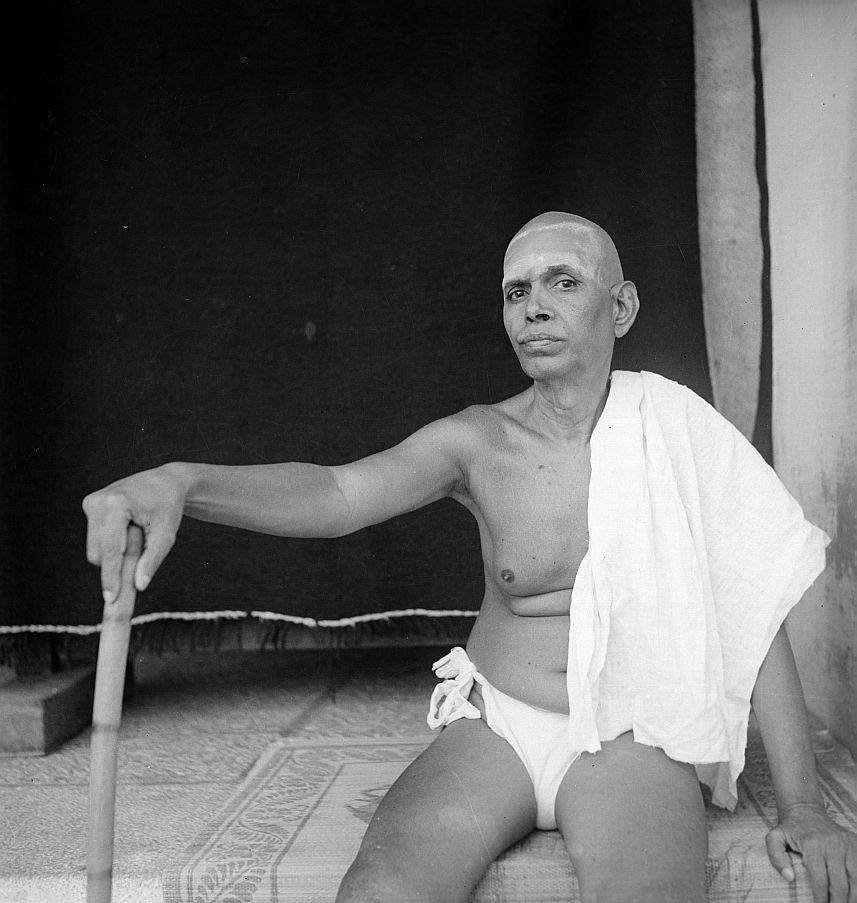
Sri Bhagavan seated at the entrance to the Goshala
Who was this remarkable woman? Janaki Mata came from an affluent family; she was the darling of the family. One day, as she was playing on the verandah of her father’s palatial house, she saw an emaciated old sadhu outside the house, crying, “Child! I am very hungry. Will you please give me some food?” Janaki Mata was such a generous child that she would give away whatever anyone asked for. However, her mother had once told her that she must never offer food until after the daily pooja was performed. At that moment, pooja was not yet over. Undeterred, the little girl went inside and brought out several plates of delicacies that had been prepared as offerings to God during the pooja. She was overjoyed to see the hungry sadhu eat it with relish. After he had eaten, the sadhu asked her to put out her tongue. Using his finger, he then wrote some sacred letters on her tongue. It instantly sent Janaki into a state of sheer joy and ecstasy. This experience impacted her in two different ways. On the one hand she became psychic, and on the other she became more spiritually inclined. While the former bestowed her with miraculous powers, the latter left the playful child a more withdrawn and introspective girl. No longer was the young girl interested in playing with other children. Instead, she longed to turn towards God.
Very soon, her generous outlook and saintly mystical qualities started attracting people around her. Janaki belonged to a typical Hindu family where the priority of the parents was to get their daughter married at an early age. Much to their concern and displeasure, they found that their daughter was moving more and more towards the spiritual realm, rebuffing any kind of physical relationship, and rejecting outright, all marriage proposals. At this juncture, the wife of a doctor with two children that the family knew, suddenly passed away. When Janaki was approached for an alliance with the widower, she had no hesitation in saying yes. When later asked what caused her to yield, she replied, “I loved the two children.” Isn’t this an instance of a spiritual woman soaked in motherhood?
Dr. Ganapathi Iyer, Janaki’s husband, was a doctor by profession and much older than her. He was frequently transferred from one town to another. By providence, he was transferred in 1935 to Tiruvannamalai. Janaki was by now yearning for the physical presence of a guru because she no longer found any fulfillment in the visions of gods and goddesses she was having. She recalled a verse in the Bhagavad Gita wherein Lord Krishna declares to Arjuna, “To him who worships me with loving devotion, and whose action is without desire or motive and is in tune with his swadharma (allotted position and duty in life), I reveal myself through the grace of a guru.”
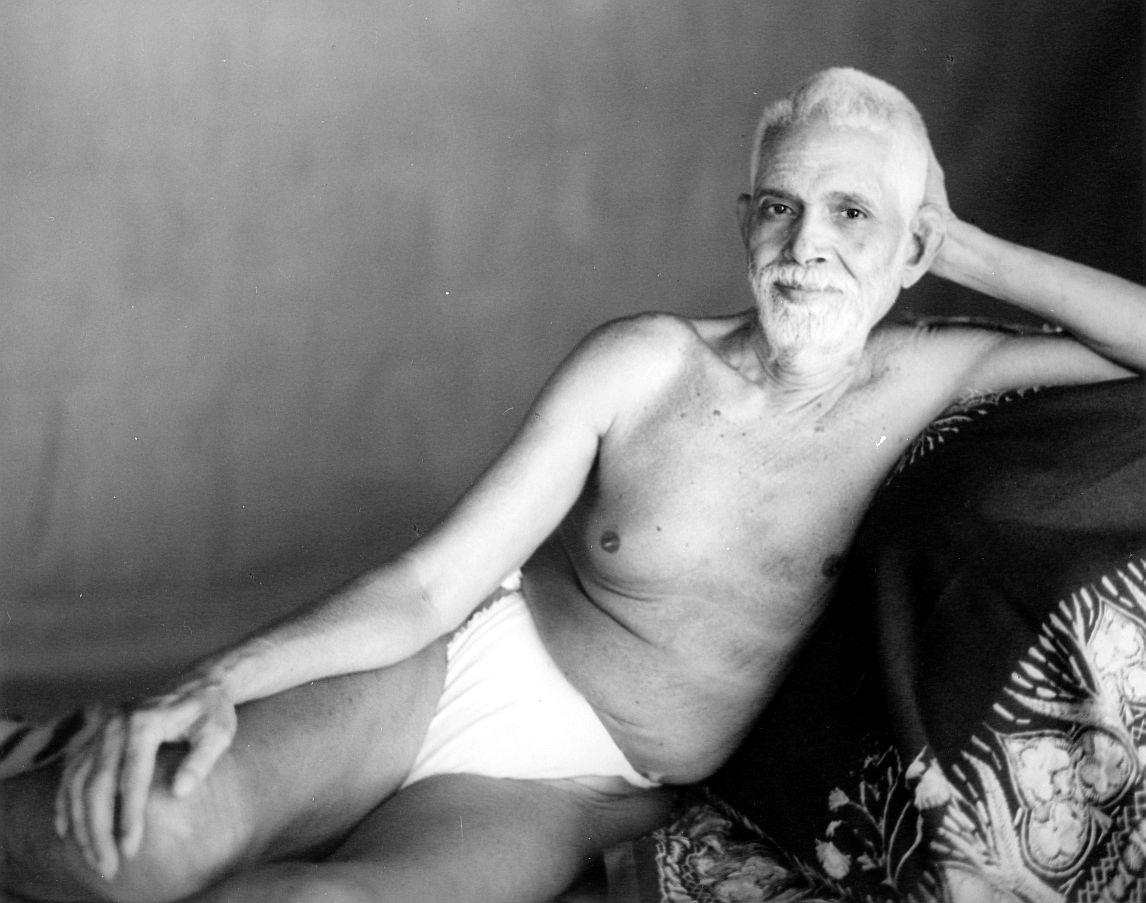
“ I am always with you ”
Her husband’s transfer to Tiruvannamalai brought to an end Janaki’s turmoil. With the darshan of Bhagavan Ramana, Janaki understood that she had found what she had been searching for. One morning, when Bhagavan was going for his routine morning walk, she followed him and spoke to him behind the cowshed at Ramanasramam. Here, she expressed her great inner anguish. Bhagavan looked at her with profound compassion and said, “You are a grihastha, a housewife. Fulfill all your obligations as a wife, especially those towards your husband. Leave the task of your spiritual fulfillment to me. There is nothing wrong with the body; it is only the dehatma buddhi, the ‘I-am-the-body’ notion, that has to be given up. You are ever the limitless Self. I am always with you.” She now felt the reassurance of receiving Bhagavan’s spiritual guidance. She knew that she had been blessed by him. Feeling immensely gratified, she plunged fervently into a life of spiritual sadhana. She started delving deep into the Heart all the time. After that life transforming experience, worldly life became a child’s play for her. Alas, soon the time came for Janaki Mata’s husband to be transferred again. She was loathe to part from Bhagavan and cried bitterly. Bhagavan looked at her compassionately and tenderly assured her, “I am always with you.”
Janaki Mata told me that worldly life and the fact she had many children, did not distract her in any way. She continued to lead a perfectly harmonious life, with peace within and without. Soon, she came to be known as Janaki Mata. Even before she came to Bhagavan, Janaki Mata used to have kundalini experiences; she also had other mystical powers. However, once Bhagavan told her, “You are the Self,” she shunned these and instead turned within. The thought of Bhagavan made her abide in the Heart and focused her on the Self. By this kind of focus, she overcame obstacles of every kind. She became a spiritual lighthouse for many seekers who had lost their moorings. She taught them how to surrender, how to make Self Enquiry their focus and eventually become the light themselves. There are many instances to substantiate that Bhagavan was forever with her. Bhagavan was totally supportive of those who were thus rooted in the Self. Even after his mahanirvana, his guiding presence steered spiritual seekers to recognize and adore those established in the Self. Janaki Mata is an example of such a person.
Repeated visits to Bhagavan hastened and perfected Janaki Mata’s progress. Janaki Mata herself shares why she always wanted to be in contact with Bhagavan: “Bhagavan’s presence made me experience the super conscious state wherein all the dualities welled up in the mind only to be absorbed in the great silence. The external world appeared to be a myth and an empty dream, the only reality being the silence within the all pervading Self. The successive waves of latent tendencies accrued in the chain of prior births were totally erased, and at last, all the diverse manifestations of the ONE sank into the void, and the transcendental Self alone shone.” It was this inner silence that she was established in. She would be immersed in samadhi for three or four hours in the presence of Bhagavan. She maintained constant contact with her guru. On one occasion, she sent a special walking stick with a silver handle; next she sent a pair of wooden sandals dressed in silver through her disciple Natarajan, who later became Sadhu Om. Bhagavan received both the articles. He held them, inspected them, and then said, “Give them back. Let Janaki Mata keep them in her pooja.” Janaki Mata worshipped the two articles daily with limitless devotion. The sacred feet of the guru were forever embedded in her Heart, the inner guru.
In 1966, which was the third year of the publication of The Mountain Path, Osborne wanted to bring out a special Jayanthi issue. He decided this issue would not carry articles on other saints, mystics and gurus. Instead, it would be dedicated entirely to Bhagavan. Being its managing editor, I was consulted and I agreed. However, it soon became obvious that Bhagavan had other plans - he wanted to confer recognition on Janaki Mata. One day, Osborne called me and insisted that we include an article on Janaki Mata in that particular issue. I was taken aback because I was not even aware that he knew her at all. I was pleasantly surprised when he wrote an apt and revealing introduction to the article. Osborne wrote: “It has become our custom to publish in each issue an article about some saint, mystic or guru. We had decided that in an issue entirely dedicated to Bhagavan this would not be quite appropriate, but just before it was time for the issue to go to the press, we received chapters of a still unpublished life history of the ecstatic woman mystic, Janaki Mata, who has a considerable following, and at the same time is a whole heartedly surrendered bhakta of Sri Bhagavan. So we decided to construct an article by stringing together extracts from it.”
The second incident, wherein Bhagavan apparently gave full recognition to Janaki Mata, took place in 1967 when Bhagavan’s shrine was consecrated. According to Hindu tradition, on such an occasion, a saint is invited to the ceremony in order to touch the shrine and sanctify it. The ashram had a committee of trustees to manage its affairs. My father was the president. The committee called me and instructed me to request Janaki Mata to consecrate the lingam on Bhagavan’s shrine. As Janaki Mata touched the lingam, she became ecstatic. She called out aloud, “Jai Ramanesa! Ramana Guru! Guru Ramana! Ramana appa! Ramana deva!” The entire audience of several hundred devotees and guests became ecstatic, being transported to a totally different realm ! When I met her during the consecration celebrations, I placed my head on her feet praying, “Oh Mata! Please bless me; please guide me.” Her words of guidance are sacred to me. She advised, “Hold on to the holy twin feet of satguru Ramana, the saviour of all suffering souls, and put his teaching into practice. Putting his teaching into daily practice is truly his two sacred feet. They should forever be embedded in your Heart, your hridaya. Heart is Ramana.”
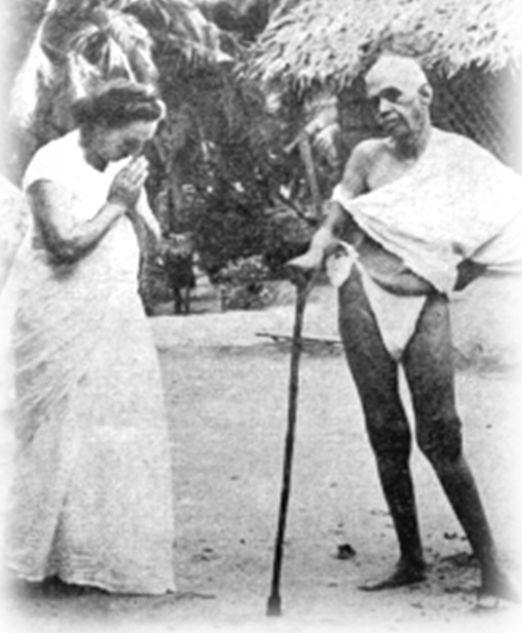
“ The atmosphere was filled with Sri Bhagavan’s purity and blessedness ”