Sivarama Reddiar
A flame needs no other light to make it visible. It has a presence and those who have eyes can see it. The flame keeps glowing brilliantly, unconcerned whether it is seen or not. Sivarama Reddiar was one such flame. He was in charge of the book depot that operated from a small room in the ashram. When I came in 1960 to Ramanasramam, my father told me, “You do not have any knowledge of worldly matters, especially money. So, go and work under Sivarama Reddiar.” Though I was just a spiritual novice, I was captivated by his aura of steady serenity and peace within just a few hours of working with him. And the beauty of this was that I wasn’t even trying to understand or gauge his spiritual stature. It happened as naturally and spontaneously as the blossoming of a flower.
Sivarama Reddiar hailed from Acharapakkam, a small town between Chennai and Tiruvannamalai. His parents were land owners and Sivarama Reddiar himself owned a rice mill. Their entire family was devoted to a sadhu called Achyuta Swami. A saint and a poet, his songs based on Advaita were very popular. Achyuta Swami’s first darshan of Bhagavan took place in the Arunachaleswara temple. On entering the temple with some of his devotees, he was drawn towards Bhagavan, then just a boy, sitting in deep samadhi under an illupai tree. An elderly sadhu, Achyuta Swami could see that though the body sitting under the tree was that of a boy, it was in timeless bliss. The very next year, he came again - this time with around two hundred of his devotees. Not finding Bhagavan under the illupai tree, they searched the entire temple but to no avail. On making enquiries, they found out that Bhagavan had been so immersed in samadhi that he had not even been sporting a loin cloth. Being the Karthikai Deepam festival, some kind souls had tied a loin cloth around his waist and taken him to Gurumurtam, a small shrine on the outskirts of the town, so that he could remain untroubled by the milling crowds that came for the festival.
Though Bhagavan was virtually unknown at that time, Achyuta Swami (better known as Achyuta Dasar) went there to see him along with his devotees. Achyuta Swami was the second person to recognize Bhagavan’s greatness, Seshadri Swami being the first. On reaching Gurumurtam, Achyuta Swami asked his devotees to stay outside while he went into the shrine. Seeing Bhagavan seated on a stool, fully immersed in the Self, Achyuta Swami held Bhagavan’s feet and prayed, “I have written poems on the Advaitic state of oneness. But I have not yet experienced it. Please bless me with that state.” When he came out, the words that he spoke to his devotees proved that he was blessed with that state: “What is seated there is a raging fire. Prostrate from a distance and pray for its blessings.”
Influenced by Achyuta Swami’s songs, Sivarama Reddiar was interested in Advaitic philosophy from his childhood. He used to regularly read Kaivalya Navaneetam and Yoga Vashista - two of the standard Tamil texts on Advaita which Bhagavan also used to refer to quite often. One of the disciples of Achyuta Swami initiated Sivarama Reddiar into the taraka mantra of Lord Rama and taught him how to chant it according to the shanmuki upasana tradition. Sivarama Reddiar practiced this rigorously for ten years at his home in Acharapakkam and also in a small forest nearby. As he progressed, he saw the brilliant light described in the shanmuki upasana. It filled him with exhilaration and excitement. However, in his heart of hearts he felt that what he had achieved was not the final goal. Consequently, he had no sense of fulfillment. Around this time, his twenty year old wife whom he loved very deeply, passed away. He told me, “When God took her away from me the world became a bleak and joyless place.” For Reddiar, this was not just the common kind of grief which fades away after some time. He just couldn’t get over it. According to certain traditions, one’s sorrow gets reduced and eventually disappears when one goes on pilgrimage. Believing this, he went walking around India and visiting holy places for three years. His sorrow didn’t abate even a little bit.
Then he remembered his uncle, a direct disciple of Achyuta Swami, who was staying in Tiruvannamalai in a place called Ramanasramam. So he came to Tiruvannamalai. Staying in the Arunachaleshwara temple, he started going around the hill every morning. While going around the hill, he used to pass through Ramanasramam, which in 1931 was not big. There, along with his uncle Krishna Reddiar who had raised a flower garden behind the Old Hall, he plucked flowers. One day, taking pity on Sivarama Reddiar, his uncle took him to Bhagavan and told him, “Bhagavan, this is my nephew. He is in deep sorrow ever since his wife died over three years ago.” Bhagavan focused his attention on him. Many devotees who have had darshan of Bhagavan have told me about his look piercing and soothing every atom of their body, mind and heart. Within a few moments of Bhagavan looking at him, Sivarama Reddiar’s sorrow disappeared. He still loved his wife. But the sorrow over her death faded away. He felt a great happiness in his heart and left to attend to his business at Acharapakkam. In 1934, he got a call from Ramanasramam, “Your uncle has passed away. Please come.” As Tiruvannamalai was just ninety kilometres from his village, he reached there that same night. On arrival, he was given all the details of his uncle’s demise by Kunju Swami. Sivarama Reddiar then performed his uncle’s last rites as per the instructions of Bhagavan. He now felt that he should serve Bhagavan all his life.
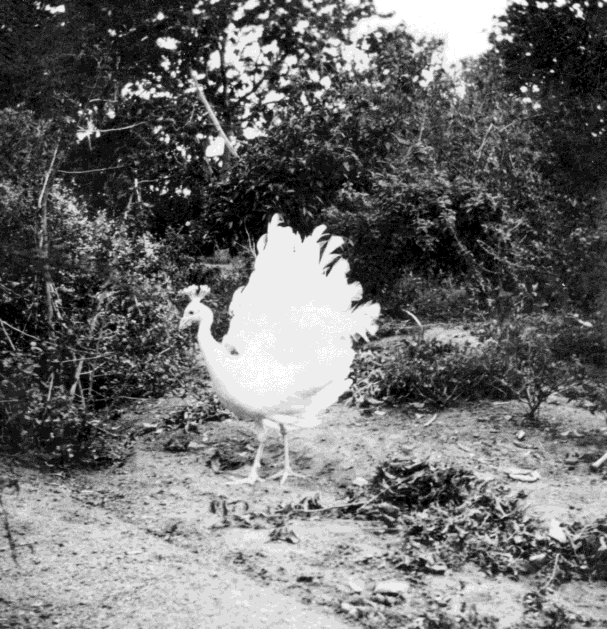
White peacock dancing in Ashram’s flower garden
I asked Sivarama Reddiar to tell me about his uncle. He replied that his uncle was one of those devotees who had come with Achyuta Swami and had darshan of Bhagavan in 1896. He used to serve Achyuta Swami. A few years later, when Achyuta Swami was going to drop his body, Krishna Reddiar held his guru’s feet and asked for guidance. Achyuta Swami told him, “Go to Ramanasramam and serve Ramana Maharshi. All that I have received spiritually, I have given you. You need more. So go to Ramana Maharshi.” That was how Sivarama Reddiar’s uncle came to Bhagavan. He had a sturdy body and was a very hard worker. He raised the ashram’s flower garden and ran errands for the ashram management. One day, his uncle told them, “I am going to my village and I will be back soon.” On reaching his village, he called all his relatives and told them, “Within a week, I will be giving up my body in Ramanasramam at the feet of my master. I have come to take leave of you.” Krishna Reddiar knew astrology well and knew when he was going to die. When he came back to Tiruvannamalai, he was still healthy - there was nothing wrong with him. But on the seventh day, he got a slight fever. By evening, this became so severe that he could not even stand up. Ramakrishna Swami and Kunju Swami advised him to stay in a cottage. At that time the ashram had a few thatched cottages. As he lay in a cottage, Ramakrishna Swami and Kunju Swami went and told Bhagavan about Krishna Reddiar. Bhagavan replied that Krishna Reddiar knew astrology and had gone home to take leave of his family and then come back to merge with Arunachala.
In 1914, when Bhagavan’s mother was seriously ill, Bhagavan wrote four verses to Arunachala, praying that she be absorbed. In the third verse he prays: “Arunachala, thou blazing fire of wisdom! Deign to wrap my mother in thy light and make her one with thee.” When the Mother dropped her body in 1922 at Skandashram, this is exactly what happened. With Sivarama Reddiar’s uncle too, Bhagavan was confirming the same thing when he declared, “He has come here to merge with Arunachala.” Later in the evening, after their dinner at seven, Bhagavan, B. V. Narasimha Swami and a few others went straight to Krishna Reddiar’s cottage. Bhagavan sat next to him touching him on his head. B. V. Narasimha Swami started doing bhajans while Ramakrishna Swami and Kunju Swami began meditating. Sometime later, Ramakrishna Swami and Kunju Swami begged Bhagavan and B. V. Narasimha Swami to leave as it was late. Bhagavan looked steadily at Krishna Reddiar and left. At four in the morning, Ramakrishna Swami and Kunju Swami informed Bhagavan of his death. Bhagavan’s specific directions as to how and where he should be buried were followed to the letter. Recounting all this, Sivarama Reddiar concluded, “It is because of the blessings of my uncle that I could stay permanently at Ramanasramam and serve Bhagavan.”
I asked Sivarama Reddiar, “You seem to be so poised in silence and so calm that I feel like sitting next to you all the time. But, at the same time, you look like a very ordinary person. What happened to you? Tell me.” He replied, “There is nothing. I am just as ordinary as anyone else.” I did not leave him. Day after day I pestered him, “There is something special in you. Please tell me what it is?” Since he did not relent, I altered the pattern of my questioning: “Have you never had any doubt in spiritual matters?” That worked. He disclosed, “Till 1931, I was studiously following the taraka mantra for twenty years and the shanmuki upasana for ten years. As a result, I experienced a light all around me and also a sense of exhilaration. Yet, deep within, I had a doubt about the reality of that state. In 1934, I reverentially placed this doubt of mine before Bhagavan. Bhagavan was gracious enough to reply, “Yes, that is the state of nididhyasana. You heard the guru instruct you, which is sravana. You assimilated his teaching, which is manana and now you experience it, which is nididhyasana. But, this is still on the level of triputi, the threefold illusion of seer, seen and sight. You have to go beyond that and find out who is the ‘I’ that experiences the light and exhilaration. Light and exhilaration exist to someone. Find out who that is.” Sivarama Reddiar continued, “Even before Bhagavan explained this to me, I knew about triputi and the need to transcend it. Only in the presence of the satguru did I grasp it as a practical reality, as a true, living experience. Lo! The experience of ‘I’ transcending the triputi descended on me and that supreme state of powerful silence enveloped me. That was my final initiation. That state of bliss continues without a gap.” For thirty years from 1934, he worked in the book depot as a manager with the limited work of packing and selling which he used to do himself. No ordinary candle, he lived in that inner state of light all the time. I assisted him for four happy years. For me, it was a deep and profound experience to work closely with a person who was living the ultimate reality, consciously, all the time. In that presence, I felt an even greater sense of reverence towards Sivarama Reddiar who was so profusely blessed by Bhagavan.
When I came to the ashram in 1960, I had taken three vows of my own accord. I thought they were essential for leading a spiritual life: “I will not touch money, I will not sign my name and I will not look at women.” Though, visitors used to come very rarely, if a woman or a family came to buy books, I would get up and go away. To close the accounts in the evening, I would assist Reddiar in writing the accounts, but he had to count the cash as I wouldn’t touch it. Moreover, when it came to signing invoices or receipts, I would fill in the details but give them to him to sign. What I didn’t know was that he was noticing all this. Realized people do not jump to conclusions and do not judge others - he observed me quietly for three or four months. I used to sleep in the open, in front of Bhagavan’s samadhi shrine and he used to sleep under a thatched shed in front of the book store. He used to address me affectionately as ‘Ganesu’. One night, around nine o clock, he called me, “Ganesu, come here.” He used to have terrible asthma attacks. Whenever he had one, he would call me and I would rush to him to help him in any small way I could. I thought he was having another such attack and hurried to his side. “Sit down next to me,” he told me. “I have been observing you all these months. You do not touch money, you do not sign in any invoice and whenever a woman of any age comes in to the book depot, you run away. What is the matter with you?”
I told him about the three vows I had taken to help me stay on the spiritual path. “Oh, that is good,” he replied, “But you have practiced it enough. Now, ponder over your actions. What is wrong with money? Touching money is not a sin, attachment to money is.” He didn’t say it as an argument or as an instruction - it was a sharing from the Heart and it naturally went straight into mine. He continued, “What is wrong in signing a name? Were you born with the name? Your parents gave you the name. You should not be attached to the body. By giving up the name you have not given up your attachment to the body. Give up the idea ‘I-am-the-body’. For you Ganesu, Bhagavan himself gave you the name. See, how holy that name is.” From that moment onwards, I stuck to my name. Regarding my third vow, Reddiar said, “Are you aware that when you ignore women, you are insulting the creator? It is the higher power that has created the dual appearances of male and female aspects - in animals, birds, creatures, trees, plants and even rocks. By not giving the importance due to the female aspect, you are denying one entire half of the principle of creation. Is this right? Is this necessary? To transcend this obstacle, love all women unconditionally as mothers. The more deeply you love them, the greater will be the devotion that wells up in you for the creator. Ignoring one half of the work of the creator will by itself become a very great impediment in your spiritual practice and progress.” Since then, I started truly loving all women as my own mothers, as my own sisters.
Sivarama Reddiar became very ill in 1965. Since he did not want to be a burden to the ashram, he decided to leave and called for his daughter. She came and took him to Uttaramerur, her native village. Before he left the ashram, I held his feet and appealed to him, “You are going away Reddiar, leaving me.” He smiled and said, “Arunachala is the truth. Truth alone is. Stay at Arunachala! All blessings will accrue to you.”
Blessings and grace are not personal properties. They are the only real things that one can share with everyone unequivocally. Everything outside has its limitations - a house can be given to one person; money can be given to a hundred people; but, blessings, grace, and love can always be shared with everyone, at any place and at all times.
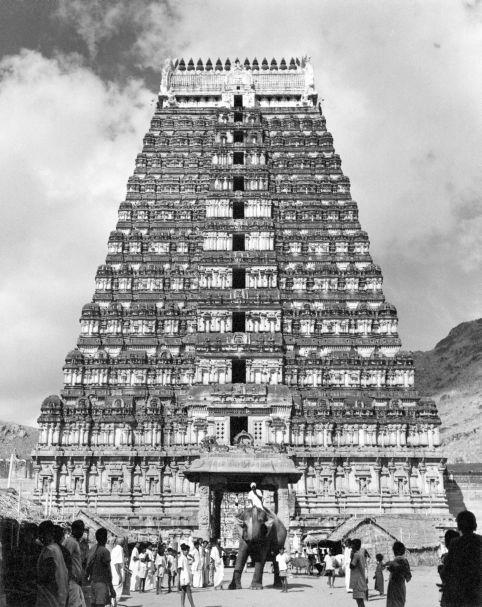
Eastern entrance to Sri Arunachaleswara Temple
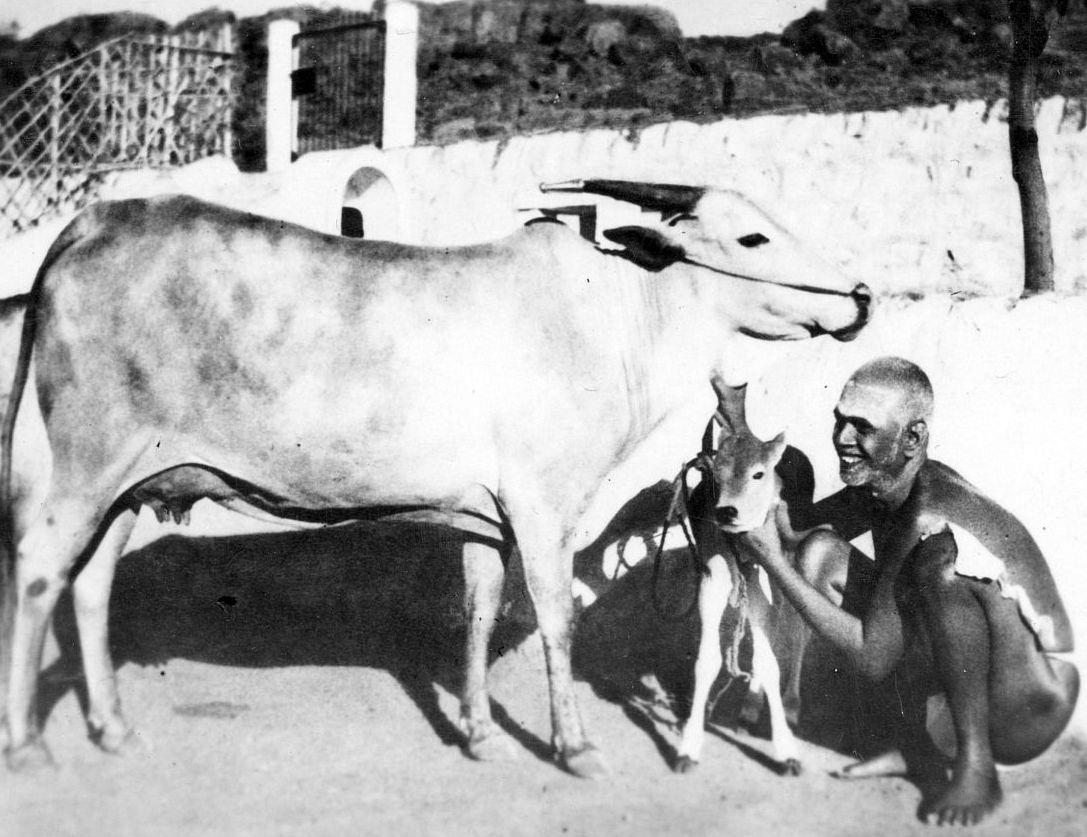
Sri Bhagavan with Cow Lakhsmi and her calf