Papaji
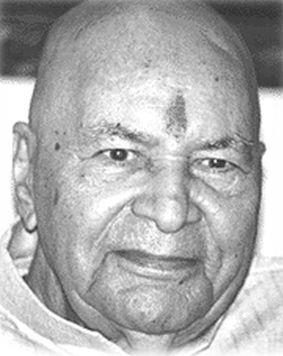
Everyone knows what a rose is. One doesn’t have to give an elaborate description of the rose in order to appreciate it. The rose is valued for its fragrance and freshness. In the same way, everyone knows about Papaji and what I am going to say about him is not anything new. Just as a rose never loses its freshness no matter how many times you look at it, similarly you can read about Papaji umpteen times without losing interest.
The truth about Arunachala and the truth of ‘I AM’ had to reach and spread all over the world. This was the commandment given by the father Arunachala to the son, Ramana Maharshi. Arunachala bound the son securely to his bosom from the very moment he arrived there on September 1, 1896. Bhagavan understood that the spiritual instruction given by Arunachala to him was to remain silent and not stir from his abode. So he remained there for fifty four years till he left his body on April 14, 1950. When this was the case, how could he spread the message all over the world?
The world came to him and his devotees took up the mission of spreading the truth of ‘I AM’ all over the world through their writings or through their physical presence. When Bhagavan dropped the body, three eminent devotees undertook this mission of sharing the truth with the entire world. With his scintillating articles, Arthur Osborne spread the truth about Self realization through Self Enquiry. Robert Adams and Papaji were two other devotees who spread the teachings of Bhagavan through their satsangs. These devotees imparted not just theoretical knowledge; they enabled others to practically experience the teachings of Bhagavan. Countless devotees have experienced the truth of ‘I AM’, the fact that they are the truth, in the presence of Papaji, Robert Adams and others.
Man is groping in the dark and needs a link to reach God, who is light itself. That link is the guru who takes the form of a sage or a saint and whose sole purpose is to help humanity taste divinity. God’s messiahs have come in many forms such as Jesus Christ, Ramakrishna Paramahamsa and Bhagavan Ramana, to name a few. They in turn had other messengers so that man reaches God more easily and forges a stronger link. Jesus Christ had, among others, St. Peter and St. John. Likewise, Bhagavan had many devotees who helped disseminate the truth of ‘I AM’ and established the fact that Bhagavan is the son of Arunachala. The Kathopanishad says, “He whom the Self chooses, by him the Self can be gained. To him, this atman reveals its true nature.” The Self has to select a person and reveal itself in him. Devotees such as Kavyakantha Ganapati Muni, Suri Nagamma and Arthur Osborne were all the chosen ones from a very early age.
One such person whom the Self chose and revealed itself to was H. W. L. Poonja. Also known as Papaji, he had a mystical experience at the age of eight. Here is what Papaji has to say about the experience: “One evening, I was sitting in the company of my mother and some relatives. I suddenly experienced something that made me supremely happy and peaceful. My eyes closed and the body became immobile. I was aware of what was going on around me and could hear everything that was taking place around me. People around me made attempts to bring me back to my normal state. It was such an overwhelming experience that I remained in a state of bliss for two days. I was totally conscious of my surroundings but was unable to communicate. There was total inward happiness.” Papaji’s mother realized the state her son was in and wanted to help him. She gave him a picture of Lord Krishna when he came out of that state of bliss. He fell in love with the picture of Lord Krishna at once. His mother encouraged him to worship Krishna and soon he became a devotee. His devotion was so ardent that he had visions of Krishna. He would often find himself playing with Krishna.
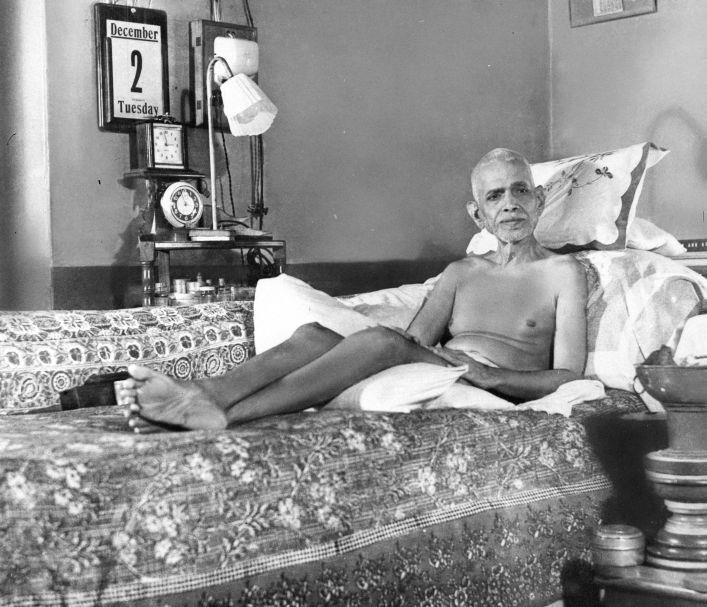
Sri Bhagavan in the Old Hall
Whenever Papaji desired, Krishna appeared in the same form as in the picture. The people of the house were a witness to his playing, but were never able to see who he was playing with.
At school, the picture of the Buddha held his fascination. It was a picture of a very emaciated Buddha after he had just attained Self realization. Papaji made a detailed study of the life of the Buddha. During his teens, he went on to have spiritual experiences because when the atma chooses, it knows exactly what to do. He had visions of gods which made him ecstatic. Yet, all the while, he yearned for the tranquility and peace that he had experienced when he was eight years old.
According to the practice then common in Hindu households, Papaji’s parents got him married when he was sixteen. With marriage came the responsibility of taking care of his family. Urged by his father to start earning, Papaji joined the military academy to be trained as an officer. However, he was many a time distracted from his studies by visions of Lord Krishna who charmed him to play with him and worship him. Papaji was not satisfied with this momentary happiness and wanted to be permanently one with God and always in bliss. This steady urge to be eternally with God became so compelling that he left his family with his father and went in search of someone who could show him the way to dwell with God permanently. He toured all over India, meeting sadhus and swamis in ashrams. His constant question was, “Have you seen God? Can you show me God?” The replies that he received hardly satisfied him.
Feeling disheartened, he returned home. But the fire within him was still burning. He fed sadhus who came home and posed to them these burning questions. One day, a sadhu knocked on his door. The sadhu was received with respect by Papaji and fed well. When asked the usual question, the sadhu smilingly replied, “I can show you a swami who can answer your questions.” Papaji immediately asked, “Where is he? What is his name?” The sadhu answered, “His name is Ramana Maharshi and he is in Arunachala in an ashram called Ramanasramam.” The sadhu gave him directions on how to reach the ashram. Papaji was elated that he was at last going to meet a swami who would show him the way to God. At that time, Papaji was very poor. One day, while scanning the newspaper, he saw an advertisement for the post of a manager in a military canteen in Chennai. Papaji was the right person for the post. When he went for the interview he was told, “You do not have to join immediately. We will pay you your travel expenses now. You can join after a month.” Just see how when the Self chooses, it makes way for everything!
Papaji was already thirty four years old when he reached Chennai in 1944. He was excited and eager to see the swami who would answer his burning questions and show him God. At Ramanasramam, he left his baggage in the dormitory and went to the Old Hall where they said the swami was seated. He peeped through the window and was totally disappointed and embittered by what he saw. He told himself, “The same sadhu who came to Punjab is seated here! He gave me his own name and address and is now seated on the sofa. He is a cheat; I will not stay here even for a minute.” Such was his anger! Fuming and frustrated, Papaji ran back to the dormitory and picked up his baggage hurriedly in order to leave. However, an old devotee, Framji Dorabji, told him, “You have not stayed even for an hour. Why are you going back when you have come from such a distance?” Papaji narrated what he had seen and concluded, “This swami is a cheat. He gave me his own name and address and said that he would show me God. I know he is a cheat. I know it!” Framji said in a troubled voice, “There is some mistake here. Bhagavan has not left Arunachala for forty eight years.” Papaji continued to fume, but Framji Dorabji induced him to have lunch in the ashram and partake of Bhagavan’s prasad. After having his lunch, Bhagavan used to retire to the Old Hall. People were told not to disturb the Maharshi between twelve and two. Papaji attempted to follow the Maharshi, but Krishnaswami, the attendant, stopped him. Bhagavan, who was already in the hall, told Krishnaswami, “Allow him to come inside.”
Papaji recounts what happened next: “I approached the swami in a belligerent manner. I asked him, ‘Aren’t you the man that came to see me in my house in Punjab?’ The Maharshi remained silent. I repeated, ‘Did you not come to my house and tell me to come here?’ Again the Maharshi made no answer. Since he was most unwilling to answer, I moved on to the main purpose of my visit. I asked him the questions that I had come to ask. ‘Have you seen God, and if you have, can you help me see God? I am willing to pay any price for the answer, even give my life. But your part of the bargain is that you must show me God.’ The swami answered, ‘No, I cannot show you God. I cannot help you see God because God is not an object that can be seen. God is the subject. He is the seer. Do not concern yourself with the objects that can be seen. Find out who the seer is.’ He then added, ‘You alone are God.’ He then told me to find out more about this ‘I’ that is so desirous of seeing God. After he concluded, he looked deep into my eyes in such a way that my entire body began to tremble. I felt a shiver running through every inch of my body. My hair stood on end, such was the intensity. Believe me, I became aware of the spiritual Heart. What I am referring to is not the physical heart, but the Heart that is the source and support of all that exists. This Heart opened up and blossomed in the Maharshi’s presence. I have never had such an extraordinary experience before. I had not come in looking for any kind of experience, so when it happened, it completely took me by surprise.”
However, even this experience did not convince Papaji for long. He still yearned to see God physically despite this spiritual experience. In his own words, “I did not want to be honey; I wanted to taste honey.” So he left Ramanasramam and went to Adi Annamalai on the other side of the hill. There, he played with Lord Krishna till he had to go back to Chennai to join duty. Out of respect for an elderly man, he went to Ramanasramam to take leave. Now, look at the beauty of the relationship between master and disciple. When Papaji went before Bhagavan, he was asked, “Where have you been? Where have you been staying?” It was very unusual for Bhagavan to ask such questions. Papaji replied, “On the other side of the mountain.” “And what were you doing there?” continued Bhagavan. “I was playing with my God, Krishna,” replied Papaji smugly. Papaji replied confidently, in a proud and superior manner because he was convinced that the man he was talking to, would never have had such an experience. “Is that so?” Bhagavan asked, looking both surprised and interested. “Very good,” he commented. “Do you see him now?” he questioned. “No sir, I do not,” replied Papaji. “I see him only when I have visions.” Papaji was still feeling pleased with himself because he was certain that the Maharshi would never have had such visions. “So, Sri Krishna comes and plays with you and then disappears,” observed the Maharshi. Then came the profound statement: “What is the use of a God who appears and disappears? If he is a real God, he should be with you all the time!” Even the profundity of this statement did not convince Papaji.
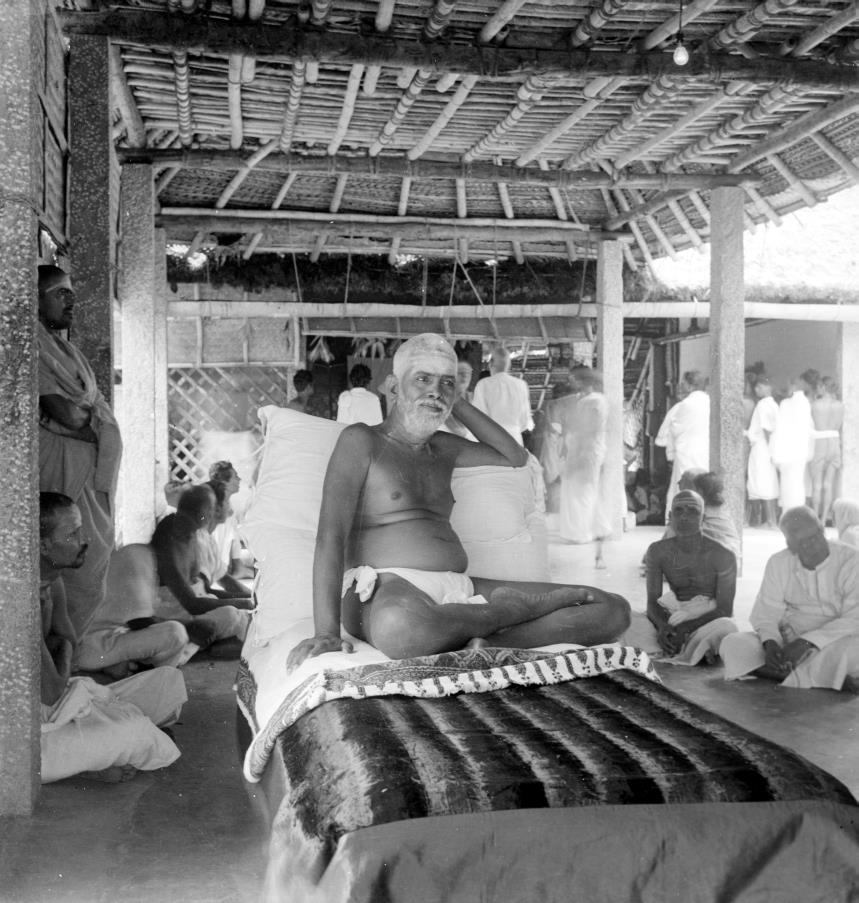
“I am with you wherever you are”
He returned to Chennai and joined duty. He was still attracted to an external God and continued playing with his Krishna. After his return from work, he would sit all alone every day and chant the name of Krishna twenty five thousand times. He then doubled this. Early in the morning one day, there was a knock on the door. Lord Rama, Sita, Lakshmana and Hanuman appeared and gave him darshan. Soon afterwards, they disappeared. He now found that he could not concentrate on the japa that he used to do every day. In fact, he could not even read his usual religious books because his mind had become free of thoughts. This thought free state puzzled him. A smiling Ramana Maharshi then appeared in his pooja room. He then remembered that this was exactly the state of quietude that he had experienced in the Maharshi’s presence. He told himself, “I will go and ask him what has happened to me. Everything has stopped; I cannot perform any of the religious practices that I was doing.”
He went to Arunachala and the same thing happened. After lunch, he tried to follow the Maharshi into the Old Hall. Krishnaswami stopped him again. Bhagavan told him to let Papaji in. This is what happened when he sat before Bhagavan: “I sat before the Maharshi and began to tell him the story of my life. ‘For twenty five years I have been doing sadhana. I have repeated the name of Lord Krishna up to fifty thousand times a day. I have been reading a lot of spiritual literature also. After Lord Rama, Sita, Lakshmana and Hanuman blessed me with their darshan I have not been able to carry on this practice. I can no longer meditate or even read books. I do feel calm deep inside; however there is no desire to seek God anymore. My mind refuses to engage itself in the thought of God. What has happened to me? What should I do?’ The Maharshi looked at me and asked, ‘How did you come here from Chennai?’ I saw no reason why he should ask me that question, but I answered politely, ‘By train.’ ‘What happened when you came to the station at Tiruvannamalai?’ he continued. ‘When I got off the train, I handed over my ticket and engaged a bullock cart to bring me to the ashram.’ ‘When you reached the ashram and paid the driver of the cart, what happened to the cart?’ asked the Maharshi. ‘I suppose it went back to town,’ I replied, still wondering where all these questions were leading. The Maharshi then explained what he was leading to. ‘The train brought you to your destination. You got off because you did not need it anymore. Likewise, with the bullock cart, you got off when it brought you to the ashram. You now need neither the train nor the cart since you are here. They were the means of bringing you here. That is what has happened to your sadhana, meditation and japa. You do not need them anymore. You yourself did not give them up. They have left you of their own accord because they have served their purpose. You have arrived.’”
“He looked at me very intently. I could feel that my entire body and mind were being washed and made pure. I could feel him looking intently into my Heart. I felt every atom of my body being purified by his spell-binding gaze. A transformation was taking place in the body. The old body was dying atom by atom and a new body was being created in its place. I then understood that this man who had spoken to me was in reality, what I already was and what I had always been. There was a sudden impact of recognition as I became aware of my Self. I use the word recognition intentionally, because as soon as the experience was revealed to me, I also knew that this was the same state of peace and happiness that I had been immersed in as an eight year old boy in Lahore, even though it may have occurred only by default. The silent waves sent out by the Maharshi re-established me in that primal state, but this time it was permanent.”
“The ‘I’ which had till now been looking for a God outside of itself because it wanted to go back to that original childhood state, perished in the direct knowledge and experience of the Self which the Maharshi had revealed to me. I cannot describe the precise experience, for as all books on the subject matter rightly say, no words can convey the experience. I can only talk about peripheral things. I can only say that every cell, every atom in my body, leapt to attention as they all recognized and experienced the Self that alleviated and supported them. I was aware that my spiritual quest had come to an end. However, the source of that knowledge will always remain indescribable.” This was the real and final awakening of Papaji. The Maharshi advised him in that experience to ignore the appearance of God, and to enquire instead into the nature and source of the one who had this desire to see God. This desire to hold on to an external God dropped off on its own accord.
Papaji has been kind enough to share with us seekers this experience. He observed, “With hindsight, I could now see that the question ‘Who am I?’ was the one question that I should have asked myself years before. I had had the direct experience of the Self when I was eight years old, and then spent the rest of my life trying to return to that state. My mother thought that my devotion to Lord Krishna would help bring back that experience, but it somehow brainwashed me into undertaking a quest for an external God whom she believed would give that one experience that I longed for so much. In the course of my spiritual quest, I have met hundreds of sadhus, swamis and gurus, but none of them revealed to me the simple truth in the way the Maharshi did. Not one of them had said, ‘God is within you. He is not separate from you. You alone are God. If you find the source of the mind by asking yourself, ‘Who am I?’ you will experience him in your Heart as the Self.’ If I had met the Maharshi earlier in my life, listened to his teachings and put them into practice, I could have probably saved myself years of fruitless external searching.” This applies to all of us.
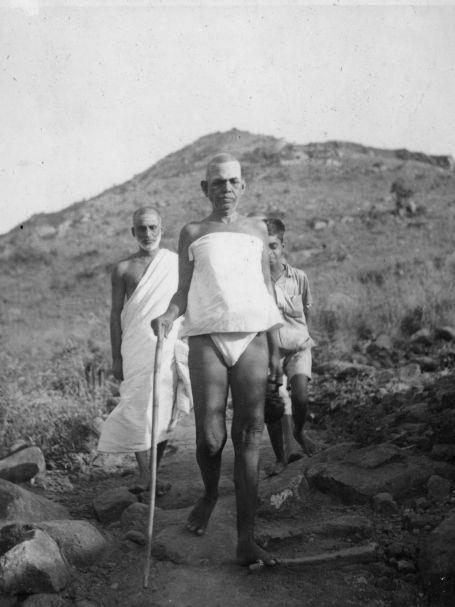
“…some of the dust from beneath his feet and put it in my pocket to keep as a sacred memento.”
We have to plunge right away into the quest of the Self within ourselves by asking the question, ‘Who am I?’
The Maharshi became Papaji’s satguru. Papaji continued working in Chennai and other places. During holidays, he would come to the ashram and reap the benefits of Bhagavan’s presence and proximity. He followed Bhagavan everywhere, to the cowshed and up the hill, because he now understood the significance of the satguru’s presence. Papaji narrated to me, how by listening to a dialogue that a devotee had with the Maharshi, he comprehended the importance of the satguru’s presence: “A devotee asked Bhagavan, ‘What are the different aids that one can turn to, for Self realization?’ Bhagavan replied, ‘The teachings of the scriptures and the teachings of realized souls.’ The devotee further asked, ‘Can such teachings be in the form of discussions, lectures and meditation?’ The Maharshi answered, ‘All these are only secondary aids; the essential aid is the master’s grace.’ I understood this fully and so I made full use of the Maharshi’s presence,” concluded Papaji.
In 1947, India became independent and the partition between India and Pakistan took place. A month before the partition, Papaji met his friend Devaraja Mudaliar at the ashram. He told Papaji that if the partition did take place as anticipated, the place where Papaji’s family was staying in Punjab would become a part of Pakistan and their lives could be in danger. He advised Papaji to bring back his family. Papaji replied, “My attachment to my family is like a dream. I will not go back and I will not go away from the Maharshi’s presence.” Devaraja Mudaliar, a lawyer by profession, was a persistent man and informed Bhagavan. Bhagavan called Papaji and spoke to him.
According to Papaji’s account: “In 1947, a month before the Indian Independence, Devaraja Mudaliar told me that the Punjab where my family was would soon become a part of Pakistan. ‘Why do you not go and fetch them?’ he asked me. ‘I am not going,’ I replied. ‘I cannot leave the company of the Maharshi, my satguru.’ Devaraja Mudaliar then told Bhagavan. The Maharshi called me and said, ‘There will be a lot of trouble in the area that you come from. Why do you not go there at once and bring your family?’ I replied with great confidence, ‘My old life was only a dream, Bhagavan. I dreamt that I had a wife and a family and when I met you, you ended my dream. I don’t have a family anymore. I only have you.’ The Maharshi opposed me by saying, ‘But if you know that your family is a dream, what difference does it make if you remain in that dream and do your duty? Why are you afraid of going if it is only a dream?’ I explained the real reason behind my reluctance to go. ‘Bhagavan, I am far too attached to your physical form; I cannot leave you. I love you so much that I cannot take my eyes off you. How can I leave you?’ The Maharshi gazed at me and then said, ‘I am with you wherever you are.’ From the way he spoke to me, I could see that he was determined that I should leave. This last statement was the blessing that I received for the trip I was going to make and also for my future in general. The ‘I’, which was my master’s real nature, was also my own inner reality. How could I ever be away from that ‘I’? I accepted my master’s decision and prostrated before him. For the first and the only time in my life, I touched my satguru’s holy feet as an act of veneration, love and respect. He did not normally allow anyone to touch his feet but this was a special occasion and he did not object. Before rising, I collected some of the dust from beneath his feet and put it in my pocket to keep as a sacred memento.”
Papaji went back to Peshawar It was a miraculous journey. He told me, “The prasad which was close to my heart saved me and gave me guidance at every instance.” Unrest and trouble were already brewing in Pakistan. The trains were full. Hindus and Muslims were segregated and packed into different carriages. Papaji sat in the carriage for Hindus. Bhagavan prompted him to sit in the carriage for Muslims. There were not many people in this particular carriage. On arrival at another station, all the people in the carriage for Hindus were butchered mercilessly. Papaji was safe; he reached his destination and brought back his family, thirty five of them women. Again another miracle took place and this he again attributed to the prasad. When he and his family members reached the Indian border, they learned that this would be the last train to leave Pakistan because the train tracks had been destroyed. Papaji went with his family to Lucknow. With the help of a friend, he found a house there, and worked hard till 1966 to support his family. He was firmly established in the Self, but outwardly he continued working day and night to support his family. The Hindu scriptures state that only a purna jnani, a fully realized man, can be a true karma yogi. Papaji felt that being in the Self was the only reality; everything else was a mere dream.
Papaji went on spiritual retreats to the Ganges; when at home, he had satsang. What started as a small group soon became a large circle. The Vedas say it is not through knowledge, austerities or spiritual practice that you can taste the Self. It can happen only through direct experience. Fortunate enough to gain this experience from Bhagavan, Papaji started imparting it to all those who came in contact with him. In other words, he gave to others what his master had given him. That is why he is a great master, even though he never declared himself to be one. He had no institution and never collected money. Instead, with his hard earned money, he fed poor people.
When I was the editor of The Mountain Path in 1993, I was eager to collect articles from those who had received realization directly from Bhagavan. Swami Ekatmananda of Ramakrishna Mission also encouraged me to collect articles and serialize them for the magazine. However, some people in the ashram were not too enthusiastic about the idea, especially in the case of an article on Papaji. In fact, even my friend Anuradha questioned me on my move. At that time, David Godman and Nadia Sutara were helping me with the work. Anuradha raised a question, “You can write about Kunju Swami and Annamalai Swami with whom you have had direct experience. Have you had any kind of experience with Papaji? Are you going to publish the article in the face of so much misgiving?”
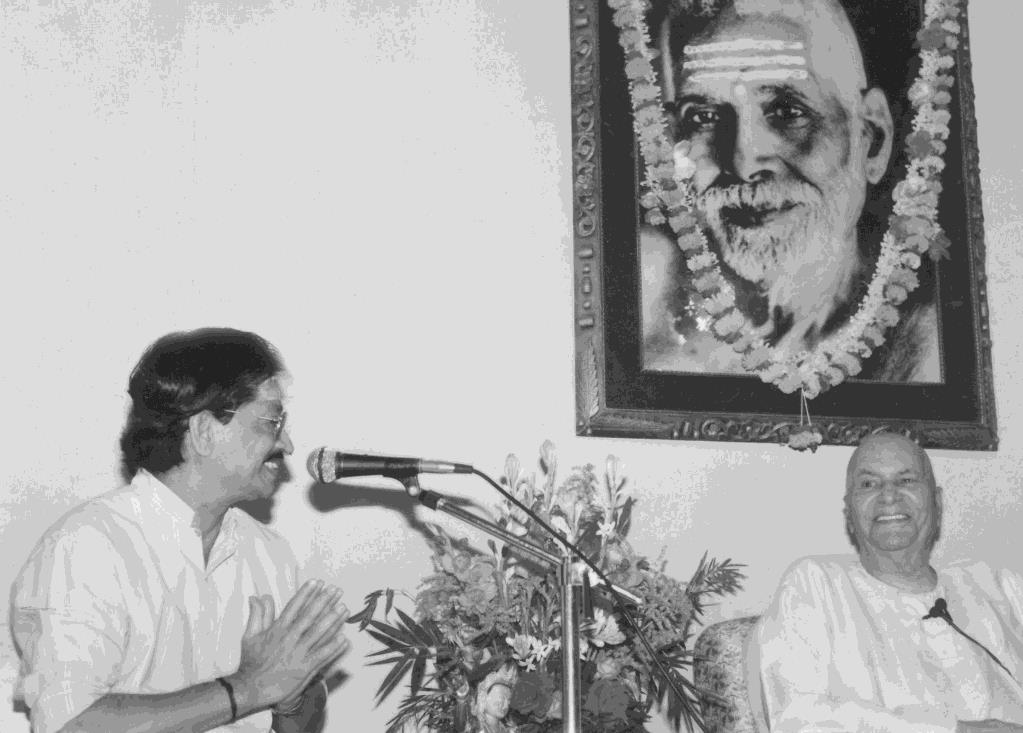
Papaji approvingly appreciates Ganesan’s talk
I replied, “Why don’t you yourself go and find out?” Anuradha, being a bold woman, went straight to Papaji. Planning to stay there for seven days, she booked her return ticket too. Although she enjoyed the dancing, the singing and the bhajans, she felt no connection with Papaji. The day of her departure dawned and yet she felt nothing. Before leaving, Anuradha met Almirah, Papaji’s Meera. Almirah was very affectionate towards Anuradha. When she heard what Anuradha had to say about Papaji, she said, “Unless you spend twenty one days with a sage you cannot understand him. Why don’t you stay longer?”
Anuradha left for the station. But look at the way the Lord works: The guard of the train refused to let her board the train even though she had a confirmed ticket! On her return to Papaji’s satsang house, she found that satsang was going on. She heard Papaji taking his singers to task: “Anuradha has been singing Ramana Satguru every day. I am very fond of it. Why has no one learnt it from her?” After singing Ramana Satguru, she prostrated before Papaji. Papaji then asked Anuradha to stay in the guest room. Later, Papaji and Dr. Yamuna came to her room. Papaji sat on the bed while Anuradha and Yamuna sat on the floor. Papaji looked at her compassionately and said, “Anuradha, what did Ramana Maharshi say about his dreams?” She answered, “Papaji, Bhagavan very rarely had dreams. It was in the form of going into some temple or entering Arunachala.” Papaji bent in her direction and patted her cheek, “Did he not say that everything you see and indulge in outside of you is a dream?” This drove her mind inwards into a state of quietude with absolutely no thoughts. Even after Papaji and Yamuna left, she continued to be in that state for three hours. When she returned to Ramanasramam later, she happily agreed with my decision to publish the article on Papaji.
1995 was a period of turmoil and restlessness. There was a lot of criticism and opposition. I decided to leave the ashram management and sought the advice of one old devotee after another. Every one of them - Annamalai Swami, Yogi Ramsuratkumar, Lakshmana Swami and others - encouraged me to leave my work at the ashram and take the inward spiritual journey. I wanted to consult Papaji too. I went to Lucknow which had by then become a haven for spiritual seekers. Papaji always exuded compassion. I must mention that this compassion also included reprimands and criticism because it was meant to awaken seekers. I prostrated to Papaji and exclaimed, “There is so much opposition.” Papaji looked at me very affectionately, but firmly, and said, “Even if the whole world opposes you, Ganesan, go ahead. You have been guided into this spiritual step. We are all with you.” He embraced me saying, “Dive deep within. Plunge into that state of silence and stay in that state of ‘I AM’.” At that very moment, the only great attachment that I had, the one to Ramanasramam management dropped like a cloak from the body. Now, I feel Arunachala wherever I go. No matter what country I am in, whatever state I am in - whether happy or unhappy - that state of inner silence is ever present. No kind of qualification or maturity is necessary for you to turn within. Go within and ask yourself, ‘Who am I?’ Then Arunachala will take you over completely.
When I started touring the world from 1990 onwards, I met and stayed with devotees whom I had never met at the ashram. In many of their homes, they had three pictures prominently displayed - that of Arunachala, Bhagavan and Papaji. Many of these devotees stated that Papaji had given them the experience of the inner ‘I AM’. Remember the commandment of Arunachala that his truth of ‘I AM’ should spread all over the world? Ramana Maharshi was the guru, the link between divinity and humanity. The link needed an extension and the extension appeared in the form of Papaji. He performed the role also played by Arthur Osborne and others - the link with divinity. It is an undeniable fact.
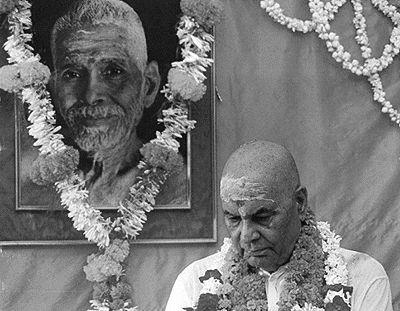
Papaji celebrating Sri Bhagavan’s Jayanthi
I would also like to share a few things about my friend, Lataji, who came to Papaji because her father’s friend influenced her to go to him. She had a tiff with her father because he wanted her to take up the medical profession against her will. She wrote a long letter to Papaji seeking his advice. In the satsang at Papaji’s house that day, Lataji’s letter was picked up by him. It was customary for the person whose letter has been chosen to sit in front of Papaji. Papaji’s satsang hall had many posters with sayings like ‘Be Still,’ because that is the essence of the teaching he wanted to impart. Lataji looked at Papaji expectantly assuming he would ask her about the matter. However, he put aside the letter and looked at her, saying, “Ask me something.” She felt cornered and was undecided. She looked around and the ‘Be Still’ poster caught her eye. Therefore, she asked, “How to be still?” She had not intended to ask the question, but Papaji’s look compelled her to ask it. Looking at her, Papaji replied “Drop the ‘how to’.” Lataji later said that this statement of Papaji’s, put her and many others in the audience into that state of stillness and inner silence, that too when they least expected it!
A very wealthy man once wanted to give Papaji a donation of one million dollars. With all sincerity, he approached Papaji and said, “I would like to give you a gift. Please accept it and bless me.” Papaji said, “Yes, I accept it.” Everyone laughed, because it was such an enormous amount. Papaji gleamed as he took the cheque and then tore it to pieces. He told the man, “This is my blessing.”
Papaji loved Chinna Swami and my father because they were Bhagavan’s descendents. Once, when my father was travelling and was at the Central Station in Chennai, Papaji ran into him. He prostrated before my father and put down at his feet an offering of two hundred rupees. He was such a humble man! When I went to Lucknow, he received me with much warmth. At the satsang, he said, “Now, Ganesan will speak.” Papaji was the personification of compassion and affection.
A poem written and published in the book titled Be Still, describes this big Heart of Arunachala well:
“In this play of Kali Yuga, Sri Ramana established Silence and Self Enquiry in the sattvic realm. For this, he is called the Maharshi. Sri Poonjaji tossed the flame of silence into the market place. He set the secret burning of non-abidance, loose in the land of activity. And the world is catching fire now. For this, he is called Papaji, Beloved father of all.”
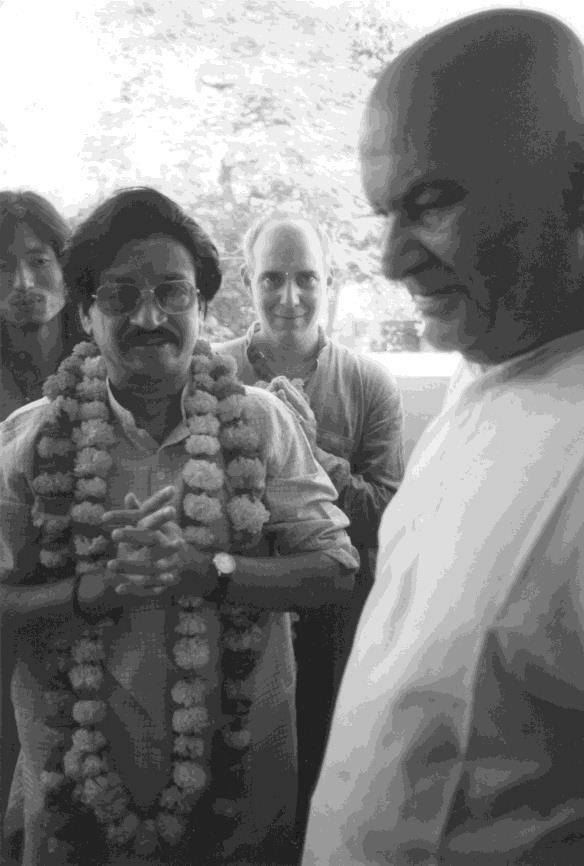
Papaji welcoming Ganesan with garlands
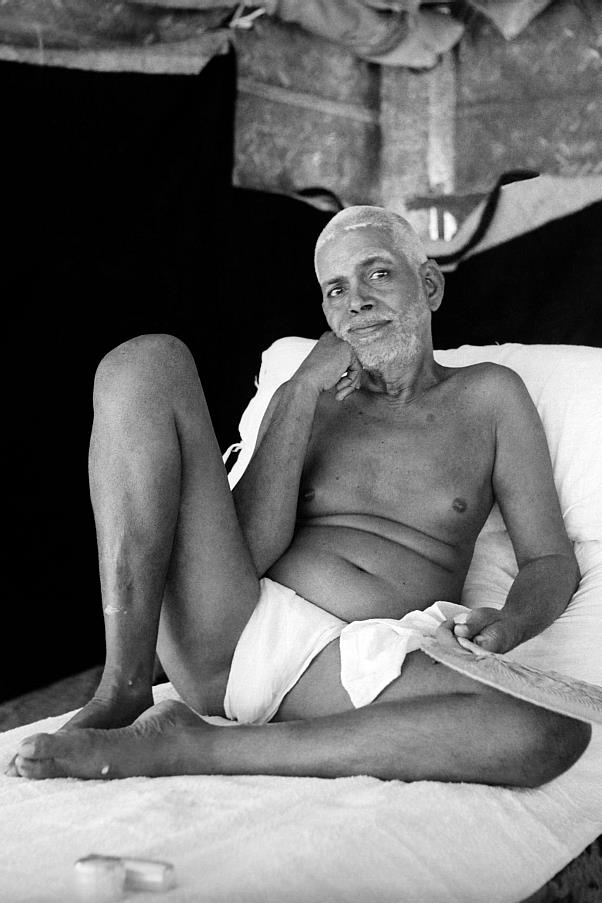
“ Has it taken you so long to come to me? ”