Sivananda: Biography of a Modern SageHis life, by Swami Venkatesananda
HERITAGE AND CHILDHOOD
Swami Sivananda was born at Pattamadai on the 8th of September 1887 at sunrise, when the star Bharani was in the ascendant. (There is a Tamil saying to the effect that ‘One born in Bharani will rule the universe’.) His parents named him Kuppuswami.
His father, Sri P.S. Vengu Iyer of Pattamadai, was very virtuous, a devotee of Lord Siva and a man of great wisdom. He was the Revenue Officer of the Ettiapuram Estate and was content with his position.
Parvati, Vengu Iyer’s wife, would read holy books during her leisure hours and sing the Lord’s name with intense faith and devotion.
With such parentage the child grew up in the most congenial atmosphere.
Kuppuswami was the third child in the family. He had two older brothers. He was a well-built, beautiful child with a radiant smile, and was the most beloved child of his parents, who delighted in everything that he did.
There were certain obvious religious and spiritual characteristics in the boy. He had a rare peace of spirit and perpetual cheerfulness, combined with a high degree of intelligence which astounded even his parents. He picked up new knowledge quickly and playfully, without any effort. The whole village adored him. Through his childish pranks he would often smother smouldering fire inside the hearts of the villagers —fire of bitterness and hatred which frequently plays one family against another in Indian villages. This mischievous boy would cleverly bring about a re-union of such embittered villagers by forcing them to mix with each other. He was a great peace-maker, even then, and he cast a spell of peace on those around him.
Pattamadai, Swami Sivananda’s native village, is a lovely place with green paddy fields and mango groves all around; it is ten miles away from Tirunelveli Junction. A beautiful canal from Tambraparni river, known as Kanadiankal, encircles the village like a garland. The water is very sweet and health-giving. Pattamadai is famous as the place where the finest silk-like grass mats are made. All the children of Pattamadai have a good ear for music and can sing well. Pattamadai has produced many eminent musicians.
Kuppuswami loved music. His father would often sing the hymn Ananda Lahiri composed by Sankaracharya. Kuppuswami would be happy listening to the recitation, and if his father stopped singing he would prod him on to continue, by nagging him with ‘hoom, hoom’. Kuppuswami did not often cry, but if on rare occasions he did his mother would sing Chandrasekhara Chandrasekhara Chandrasekhara pahi mam (‘Lord Siva protect me’) and he would stop crying and jump onto his mother’s lap.
The holy word ‘Siva’ had a special fascination for him, and he would repeat words in which these two syllables formed part, even if those words had no religious connotation; and when his mother sang hymns in praise of the Lord he would lisp the words too.
From the day he began to walk, he happily accompanied his mother to the local temple, and he loved the sound of the temple bells. Even at a tender age he used to help his father in his worship. His father would perform his sandhyavandana (a religious rite that a brahmin performs thrice a day) and the little boy would try to imitate his actions. When his father worshipped Lord Siva, he would bring the bael leaves and flowers, and would place a small stone in front of him and worship it in imitation of his father. He was all attention during the chanting of the mantras and hymns, and though otherwise a mischievous child, he kept still and silent during the worship. He would join his parents in prayers and kirtan, and loved to listen to them reading Bhagavatam and Ramayana.
In those days a dramatic troupe used to tour South India, headed by Sri Kalyanarama Iyer. This troupe would often stage religious plays like the Ramayana, Mahabharata and Bhagavatam. His father would take him to watch these plays. On returning home, he would happily imitate portions of what he had seen.
His parents would entertain him with spiritual stories. Even when he cried or refused to sleep they would never use the destructive method (commonly employed in many Indian households) of frightening the child into slumber. Instead they told him stories of the Lord’s incarnations when he went to bed.
Swamiji has himself revealed that he was a mischievous child. Through his mischief he would amuse and astonish others by the intelligence he displayed on such occasions.
Whenever sweets were prepared in the house the mother would divide them between the three brothers and sometimes a good quantity would be stocked in the family store-room for future distribution. Sturdy Kuppuswami, very active and energetic even in those days, would be the first to finish his. If his brothers had by this time not been able to finish theirs, he would take their share for himself. The stock-pots in the store-room would also rapidly get depleted of their contents, as he would distribute them to all his friends. In this boyhood mischief there was a glimpse, perhaps, of his future dictum of ‘Do it now’.
Kuppuswami was in Pattamadai till his fifth year. He then moved to Ettiapuram where his father was working. In those days Ettiapuram was a small ‘native state’, ruled by a rajah who enjoyed the favour of the British Government and so was able to lead an easy-going life. He was thus able to devote himself to the promotion of fine arts. Ettiapuram was therefore a centre of fine arts. There were many scholars, savants and musicians who flourished there.
It was in Ettiapuram that Kuppuswami came into contact with a renowned musician and devotee of the Lord, Subbarama Dikshitar, whose home was just a few blocks from the hostel where Kuppuswami’s parents had an apartment. Many were the evenings spent at Subbarama’s home, where often he would conduct akhanda kirtan (non-stop singing of the Lord’s names) for a whole night or days at a time. In this atmosphere of devotion and artistry Kuppuswami and his parents joined the other devotees in bhajan, ecstatically dancing around the lamp deep into the night. Subbarama taught music to Kuppuswami and under such an inspiring teacher Kuppuswami soon knew by heart all the bhajans and kirtans.
Sri Appaya Dikshitar, one of the great names in the annals of spiritual literature in India, was an ancestor of both Subbarama and Kuppuswami. He was born in Adaipalam, near Arni, North Arcot District, South India. He is reputed to have written 104 works in Sanskrit. His works on vedanta (a great and popular system of Indian philosophy) show his intellectual abilities. All the schools of vedanta have drawn inspiration from his unique work.
In almost all the branches of Sanskrit literature, poetry, rhetoric and philosophy he was peerless, not only among his contemporaries, but even among scholars of several decades before and after him. His Kuvalayananda is generally regarded as one of the best works on rhetoric. His poems on Lord Siva are great favourites of the worshippers of Siva.
Sri Appaya was considered by many to be an incarnation of Lord Siva. Legend has it that when he went to the Tirupati temple in South India, the Vaishnavas who were in charge of the temple refused him admission, as he was a devotee of Lord Siva. But in the morning the image of Lord Vishnu was found to have changed itself into the form of Siva. The Vaishnavas were astounded and, begging Dikshitar’s pardon, prayed to him to change the image again into the form of Vishnu which, the legend says, the great saint did.
Another great spiritual luminary was also born in the family of Appaya Dikshitar about half a century prior to Swami Sivananda, on the 3rd December 1831. He was Sundaresa Sivam. Though born of affluent parents, tragedy struck early in his life and he was orphaned. He was brought up by his maternal uncle who was a great devotee of Lord Siva, and a very learned man.
Sundaresa’s hobby in boyhood was the worship of the Lord. He listened to his uncle’s hymns and memorised them. Soon he mastered the Sanskrit language. He was forced into marriage but it did not last long, as his wife died. He left home and wandered as a sannyasi (monk). He helped several temples in South India and established a number of charities. He possessed miraculous powers. In 1878 he passed away. His ‘samadhi’ (tomb) is found even today in Arimalam near Pudukotai in South India. Swami Sivananda paid homage to this saintly ancestor during his All-India tour in 1950. (It is the belief of many that Swami Sivananda is a reincarnation of Sundara Swamigal — as Sundaresa Sivam came to be known after his renunciation).
During their time together, Kuppuswami and Subbarama Dikshitar shared many stories of their illustrious ancestors.
Next door to the house in which his parents lived was the house in which the renowned poet and patriot Shuddhananda Bharatiar lived. Thus in his boyhood Kuppuswami was literally surrounded by genius: great poets, composers, musicians and patriots.
One who knew the young Kuppuswami was Ganapathi Sastrigal. He related:
Kuppuswami was tall for his age, handsome and fair in complexion, neither lean nor stout, with a little bulging belly. He had a smiling countenance always and was attractive even at that age. His face was quite like his mother’s and his body was like his father’s. He was very majestic in appearance. He had a small rudraksha seed covered with silver and tied to his holy thread. He was free with young boys like me and would converse with us in short English verses with a musical tone. He had much humour in him which had a special attraction for us.
His special attention, even as a boy, was bestowed upon wandering monks. He took the greatest delight in entertaining them; they enjoyed special privileges at his hands. There was no beggar who called at his house who did not make the young boy run to him with love, wherever he might be at that time. He transcended all barriers and conventions by inviting beggars inside the house and feeding them or giving them plenty of rice and other victuals.
Once several youngsters were playing on the village street. An aged woman tripped and fell down. The youngsters giggled; the mischievous and happy Kuppuswami became suddenly stern and gave expression to wisdom far beyond his age: “Don’t laugh; we shall grow in age. Can you imagine what you would look like at her age? When someone is in distress we should help and not laugh.” One of the traits for which Kuppuswami had earned renown was his love of adventure. Without telling anyone he would go away from home, wander about for a few days, subsisting on almost no food on most occasions. He went away to Kazhugumalai once in this manner, without taking any money with him. At Kazhugumalai there was a temple dedicated to Lord Subramanya, where he worshipped the Lord. He did not have a morsel of food for over three days, but was sustained in full vigour by his enthusiasm for achievement. On the fourth day, as he was returning, a friend gave him some meagre fare which only had the effect of whetting Kuppuswami’s appetite, far from quenching it. Finally he returned home. Only then did he realise that he had completely exhausted himself in this adventure.
He had run away thus so often that his mother had almost begun to know that if he had not returned home before nightfall he would have gone to some nearby shrine or sacred place, or he would be found sitting underneath the neem-tree which was his favourite place of seclusion.
Kuppuswami had no fear at all. We can’t now guess what would have been his mental condition in those days; but death had no meaning for him. He would playfully dive into a well and get back unhurt and cheerful. This was one of his favourite ‘stunts’ with which to astound his friends, if not to frighten his family.
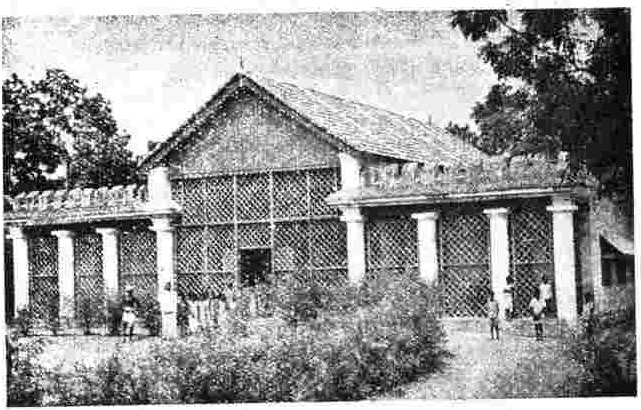
When Kuppuswami reached the school-going age his father had him admitted to the Rajah’s High School, Ettiapuram. Unlike other boys, he liked going to school and he could already read and recite the alphabet and the numbers in proper order. Ever-alert, he was quick to gather all the elementary knowledge at home while his elder brothers were struggling with their lessons. He did not like the idea of losing time.
Even as a boy he had been endowed with a keen intellect that could grasp anything without the least difficulty. He assimilated all the school lessons quite easily. He had never to be told a second time. This left him ample time and leisure at home.He would not spend time idly or in useless pastimes but, partly out of curiosity and partly out of an innate urge, he would go ahead with his lessons. This was especially the case during his college days, when he could with facility answer a problem which would perplex his seniors. He was thorough with his own class lessons and would compete with those four years senior to him.
In 1901 he was chosen to deliver an address on the occasion of the visit of Lord Amptill (the then Governor of Madras) to Kurumalai Hills; and he also sang a beautiful welcome song on the platform of Kumarapuram railway station. This was at the age of fourteen, when most of his companions would have perspired even at the sight of a European Governor, not to mention the huge crowd! He acquitted himself with credit.
Kuppuswami realised very early in life that a sickly body is a burden. Sambasiva Iyer, the physical training instructor in Rajah’s High School, lived in the same street, and Kuppuswami was his best pupil. During the All-India Tour in 1950 Sri Sambasiva Iyer went to see him in Tirunelveli, and said: “Swamiji was a very good gymnast and played well in parallel and horizontal bars in equal capacity to me.” In fact, his proficiency earned him such a place in his teacher’s heart that Sri Sambasiva Iyer would confidently ask him to take the class in his absence. (This good old man renewed his contact with the ‘old student’ later in life, and what is more remarkable, realising his divinity, became his disciple. Swamiji initiated him into the holy order of sannyasa with the name Swami Sadasivananda.)
As a gymnast of a superior order, Kuppuswami had a wonderful physique with well developed chest and strong arms. His orthodox parents did not view his gymnastics with any great favour, but the boy used to be up from bed as early as 3.00 or 3.30 a.m. and slip away before the rest of the household arose from slumber. “I have to confess,” he once said, “that many times I used to place a pillow on my bed and cover it up carefully with a blanket to give the appearance of my innocent self sleeping soundly.” He would at that time be in the gymnasium, absorbed in his vigorous pastimes.
From the Ettiapuram Rajah’s High School he passed in 1903 into the S.P.G. College, Trichinopoly. He was as humble and obedient as he was intelligent and studious, and very soon he attracted the attention of the principal himself (the Rev. H. Packenham Walsh). The teachers and the principal all loved him. He was hard working and gained distinctions in every examination, being especially proficient in Tamil literature. He passed very creditably in the Tamil examination held by the Tamil Sangham of Madurai in 1905 for students for First in Arts (F.A.) examination.
His taste for music, his bold deportment and obvious sincerity qualified him admirably for winning acclaim as an amateur actor, when he played the role of Helena in Shakespeare’s Midsummer Night’s Dream, staged in the college.
Kuppuswami always stood first in the class. He won many prizes and medals too. These prizes used to reach him in the form of valuable books and with them he built up a small library. Acquisition of books for his own study as well as for others was a habit which he developed at this stage.