Sivananda: Biography of a Modern SageHis life, by Swami Venkatesananda
MEDICAL CAREER
On completion of his studies there were three avenues open to Kuppuswami — arts, science and medicine. He had no problem in choosing medicine. Thus he came to embark on a career which was to train him for the path he was later to tread. He applied his one-pointed energies to the task on hand and out-shone his class-mates and even his seniors. Soon he acquired such a mastery over the subject that his professors were amazed. Even during the first year he had free access to the operation theatres, to assist the surgeons. This afforded him further opportunities of acquiring more and more knowledge.
Kuppuswami was fired with an inexplicable zeal and enthusiasm and he worked like one possessed. He would always have a small memoranda book with him in which he would jot down anything of importance that came to his notice. Occasionally he would draw lessons from occurences which must have influenced his future attitude towards life in general.
He showed signs of his future greatness even in his scholastic career. He would cover the subjects of two years’ study in one year itself. On the eve of his examination he would close his books and quietly sit. He would then score top marks in almost every subject. He could repeat word for word anything read out to him from any book; so much so that he was an object of envy and admiration in the eyes of his co-pupils and professors. His love, truth and honesty impressed all who came in contact with him.
Of this, perhaps the most eventful period in his early life, he himself says in his autobiography:
I was a tremendously industrious boy in school. During my studies at the Tanjore Medical Institute I never used to go home during the holidays. I would spend the entire period working in the hospital and learning many new lessons. I had free admission to the operating theatre. I would run here and there and acquire knowledge of surgery which only a senior student would possess. An old Assistant Surgeon had to appear for a departmental test; he used to make me read his textbooks for him. This enabled me to compete with the senior students in theoretical proficiency. I was first in all subjects.
I had heard of an enterprising assistant in the Mannargudi Hospital. I wanted to become like him. With all humility, I may mention that I possessed greater knowledge than many doctors with covetable degrees. At home my mother and brothers would try to persuade me to take up some work in some other line, but I was adamant in my resolve to stick to the medical line, as I had a great liking for it. All my leisure hours were spent in studying all kinds of medical books.
In the first years of my study in the medical school I could answer papers which the final year student could not. I topped the class in all subjects.
On emerging with brilliant colours from the medical college, Dr. Kuppuswami looked out for a channel to direct his surging passion to be of some substantial service to humanity at large, and to share the financial burden of the household which had fallen on his brothers at the death of his father. He joined a doctor in Trichinopoly, as his assistant.
Dr. Kuppuswami was ever dynamic and ever active. Though not ambitious enough to accumulate much money, he knew no contentment in the matter of service. He considered that day an utter failure if an opportunity to render service had been overlooked.
Even as a young man his child-like nature had a special power of its own for drawing out others. When the patients came to him they would at once sense his simple nature and pour out their hearts to him without the least reservation. This made his task all the more easy; because the freedom which they enjoyed with him enabled them to put before him a full and frank history of their complaints.
Rendering service to the suffering who are near at hand is, no doubt, a praiseworthy form of service, but other sick people needed help and what was more important, the masses had to be taught how not to fall ill!
In his autobiography he writes:
I hit upon a plan that I should start a medical journal. I soon worked out the details. I got from my mother one hundred rupees for the initial expenses. I used to approach ayurvedic physicians for articles on ayurveda, an ancient Indian medical system. I myself used to write articles on various themes and publish them in the ‘Ambrosia’ under different pseudonyms. The magazine quickly gained popularity soon after its inception in 1909, and many distinguished people started contributing to it. Once my mother wanted to celebrate some festival and was in need of about one hundred and fifty rupees to meet the expenses. I was ready with this sum.
The ‘Ambrosia’ journal was successfully run for four years until I sailed for Malaya. It was of demi-quarto size with thirty-two pages to each issue and was quite beautifully got up. The material that its contents presented to the reader every month was attractive and highly useful to all medical practitioners. A significant spiritual touch could be felt in the pages of the ‘Ambrosia’. Unlike other, medical journals, the entire outlook was based on the teachings of the sages of yore. Spirituality was ingrained in me even in my youth.
Extraordinarily, Dr. Kuppuswami was business-like in the conduct of the journal. He invited and accepted commercial advertisements, being paid Rs.3/- for a full page advertisement. Yet, as it grew in popularity, the income grew and the expenditure grew beyond the income. The method of conducting the journal was business-like, but the handling of the financial side was not quite so! Yet the primary object of the journal was dissemination of knowledge. That it did not bring him an income did not matter, but that it was eating away his scanty financial resources did matter. Dr. Kuppuswami was a great success with his patients; but an utter failure in money-making, He would ignore sending bills and give away medicines free of charge.
Besides editing the ‘Ambrosia’, the doctor found another delightful occupation for filling up whatever time he still had in his busy day. He would give medical advice by post. With the help of these, the budding doctor healed the sick; and by giving instructions on hygiene and rules of health he enabled people to ward off diseases and to maintain perfect health, full vigour and vitality.
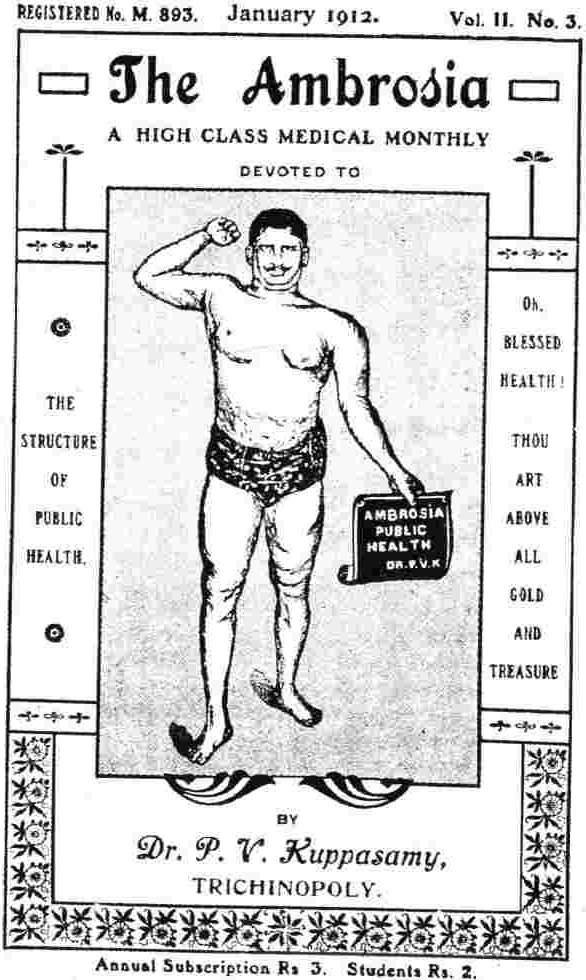
Cover page of ‘Ambrosia’
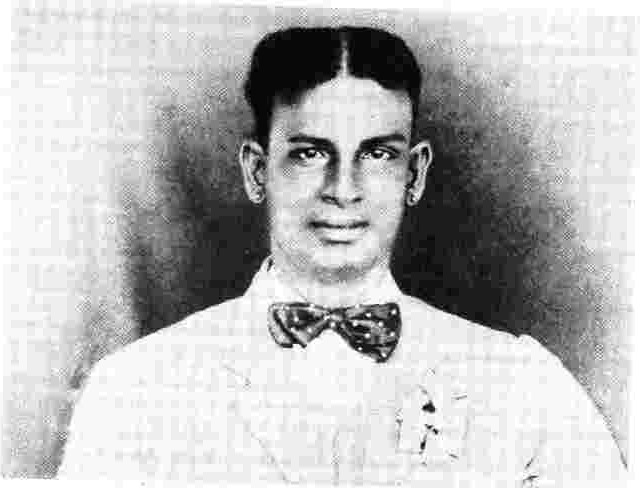
Young Doctor Kuppuswami
Dr. Kuppuswami was in search of a job to maintain himself and the journal. He went to Madras and joined Dr. Haller’s Pharmacy. He revealed this part of his life one day when a worker in the ashram neglected some service, feeling that it was not part of the duties allotted to him. Swamiji then referred to his work in Haller’s Pharmacy: “There I had to manage the accounts, dispense medicines, attend on patients: very hard work I had to do. I would finish all this and yet find time to continue my journal. From Madras I would send the journal free to various people who benefited by it.”
Kuppuswami felt more and more the need to widen his field of service and to come into direct contact with the needy. When Dr. Haller and his partner Dr. Damry decided to dissolve their partnership he saw his opportunity to make a radical change in his life. He wrote to a friend in Singapore, Dr Iyengar, that he was planning to go to Malaya as he knew that there was great need of his services there.
When he broached the subject in the household, the first impact was too severe for everybody and they burst into tears. An adept in handling delicate situations even at that age, he let the situation cool down. Then he brought home to them the lofty ideals he held before himself. He dexterously mixed philosophy with humour. Though a doctor of medicine he was an expert pleader; his sweet disposition made him a master of effective persuasion. The mother saw that beneath the cloak of a smiling countenance there lurked an iron will and an adamantine determination. She and his elder brother argued in many ways. “Crossing the seas is prohibited by the scriptures,” they said. But Dr. Kuppuswami was beyond the reach of superstition. He replied that those rules did not apply to the present day world, and that in search of fields of service, he should, if necessary, ignore all the conventional rules of conduct. To him the call of sick and suffering humanity was the call of the Lord Himself. Should he then hide himself behind conventions and refuse to respond? The very idea was preposterous to him. The mother and the brother were convinced. He got their blessing and approval.
With a cheerful face lit with a smile of contentment, he bade adieu to his friends and relatives, who struggled to check the tears that gathered in their eyes. They blessed him and wished him godspeed in his noble mission. He, on his part, felt that a heavy and oppressing burden had been lifted off his shoulders; with a light heart brimming with joy and thankfulness to God, he sent up a silent prayer to the Almighty to guide him in the path, as He willed.
On the eve of his departure from India, Dr. Kuppuswami (who had been nicknamed by his friends as Dr. Ambrosia) was given a farewell party by his friends. The renowned Maharishi Shuddhananda Bharatiar was present at this party in Madurai in 1913. He recalled how deeply the young doctor was imbued with altruistic principles of unselfish service to the sick and the suffering.
Malaya
Dr. Kuppuswami left Madras by the S.S. Tara in the year 1913. Even during the voyage he was ever alert, ever on the look out for opportunities for service. He had the stethoscope and the ‘Doctor’s Kit’ always by his side. He never stood on formalities. He would watch a man sneeze or groan, and he would immediately run to him and ask him what the matter was, and treat him. His transparent sincerity would break the reserve of even a reticent man and enslave him.
At other times he would be seen pacing the deck, deep in thought. He would often sit still like a statue, gazing at the sky, the vast expanse of water and the waves playing over it. The scorching sun, the rising vapour and the gathering clouds would all throw him into a contemplative mood. It was a bold adventure as he had no money to fall back on in case of a reverse in his expectations. However, he had tremendous hope, strength of will and fiery determination.
No easy-going prospect awaited Dr. Kuppuswami in the distant land of Malaya, as he was altogether unknown and friendless. He had to start from scratch and encounter disappointing setbacks in the beginning, but later events turned out much in his favour and he felt his position secure.
From his orthodox family of the brahmin caste, he inherited orthodox habits and ideas, one of which forbade him from eating in hotels and restaurants. Anticipating the trouble on board the ship which brought him to Malaya from South India, he had with him a small quantity of ‘laddu’, an Indian sweetmeat. He ate these laddus and drank water throughout the voyage. This was an extremely unsatisfactory state of affairs; and, judging by the ‘health’ of his appetite in his sixties, he would have enjoyed excellent appetite in those days. Thus, when he landed in Malaya (we believe that he landed in Penang) and almost immediately rushed to Seramban by train, he had almost reached the end of his physical endurance. Yet again, his will was so strong that he would not rest nor find food he could eat till he had found the person he sought —Dr. Iyengar, the doctor in charge of the Rubber Estates Medical Service. Dr. Iyengar gave him a letter of introduction to an acquaintance of his, Dr. Harold Parsons, a medical practitioner in Seramban, the capital of Negri Sembilan.
Dr. Kuppuswami went straight to the doctor’s office in the town. The doctor was away; his brother, Mr. Wilfred Parsons, told him that the doctor had gone to the estate, so he decided to move on to the Estate itself to meet the doctor. His strength gave way. But where could he find proper food to eat? He came across a person from Malabar (India) who was kind enough to direct him to a temple where an offering of curd and rice was available.
“The temple priests were not so hospitable, but somehow I managed to take some rice and curd; this greatly refreshed me,”Swamiji later told us with a grateful smile. This remote incident might have then and there kindled the spark of his principle never to refuse food to anybody, a principle that he dutifully maintained always.
Senawang Estate
When Kuppuswami finally arrived at the Senawang Estate he found that Dr. Parsons was not in need of an assistant, but the good doctor was so impressed by Kuppuswami that he took him to Mr. A.G. Robins, the manager of the Senawang Estate, which had its own hospital.
Fortunately Mr. Robins just then needed an assistant to work in the
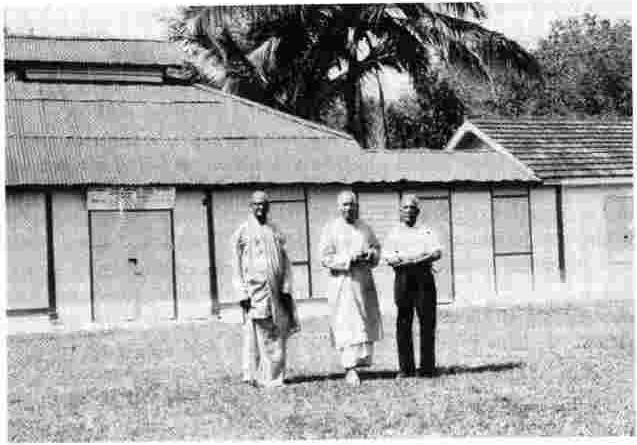
This was the Estate Hospital
Estate Hospital, as the previous one (who was incompetent) had just left. Mr. Robins was a man with a violent temper, a giant figure, tall and stout. He asked Dr. Kuppuswami “Can you manage a hospital all by yourself?” He replied, “Yes, I can manage even three hospitals.” He was appointed at once. He had been told by a local Indian resident that he ought not to accept, in accordance with their policy, anything less than a hundred dollars a month. Mr. Robins agreed to give him one hundred and fifty dollars to start with.
Malaria was common in those days, and even the manager of the Estate had an enlarged spleen and went about the Estate in a rickshaw. The establishment which supplied the Estate with medical care was known as ‘Dr. Parsons and Glenny’ and it had its central office in Seramban. In each estate there was a small hospital, with a hospital assistant in charge. Dr. E. Glenny visited these hospitals once a week.
Dr. Kuppuswami was put in charge of the hospital in Senawang. He quickly acquired a good knowledge of the hospital equipment and the stock of medicines, and was absorbed in the job. Here again, hard work awaited him. He had to dispense medicine, in addition to keeping accounts and personally attending to patients as he did for Dr. Haller in Madras. He was energetic and active. He would give free tuition and quickly train people for the post of hospital assistant.
The rubber estate was a small world in itself. It had its own post office, railway station, dispensary, shop, temple, etc. Rubber trees could be seen everywhere, with a small cup tied to each trunk to collect its juice. There were about one thousand trees per acre. The average estate might have anything from one thousand to three thousand acres. In those days the entire work force was composed of Tamilians from South India. Every estate employed a minimum of four to five thousand workers. This was to be Dr. Kuppuswami’s little world for the next seven years. It was his laboratory in which he conducted spiritual and altruistic experiments. It was his universe. It was the university in which he graduated to Self-realisation.
In 1967 Swami Venkatesananda, a disciple of Swami Sivananda, made a pilgrimage to the district and recorded his impressions:
About six miles from Seramban is the Senawang Estate. On the roadside we saw two buildings: these (or their simpler predecessors) had housed the young doctor from India and witnessed his self-transformation into a sage and mystic. It was here that the doctor came face to face with the vital problems of life and death, the extremes of pain and pleasure, and learnt the eternal Truth from life itself. Dr. Paramasivam explained that the house in which Kuppuswami lived was made of planks, as most of the ‘old’ houses in Malaya were; this had been pulled down and in its place stood a new house. Very near this house stood a large building; it was even larger in those days. Then it was the hospital; now it is a school. There were a few beds in the two (male and female) wards in the hospital, and critical cases were almost always kept in the doctor’s own house.
From the very start anyone and everyone found out the marked difference between Dr. Kuppuswami’s behaviour and that of other doctors. With him their behaviour, too, was different. Diplomacy was completely absent in him. He would deal with everyone with the same attitude of open-hearted straightforwardness. The staff in the hospital found in him a good champion of their cause; and they could repose their fullest confidence in him. So, too, felt the superior officers.
Dr. Kuppuswami’s service to the poor labourers was remembered for over half a century by them. Dr Paramasivam, who used to work in a neighbouring estate, recalled an extraordinary trait: “When he treated his patients he examined them thoroughly and gave medicines, no doubt, but he did something more. He gave each of his patients a tulasi (holy basil) leaf and a few drops of holy water. He had a tulasi plant in front of his house and he was regular in his daily worship. He kept the tulasi leaves and the holy water he used for the worship and gave them to the patients. He had remarkable success with them.”
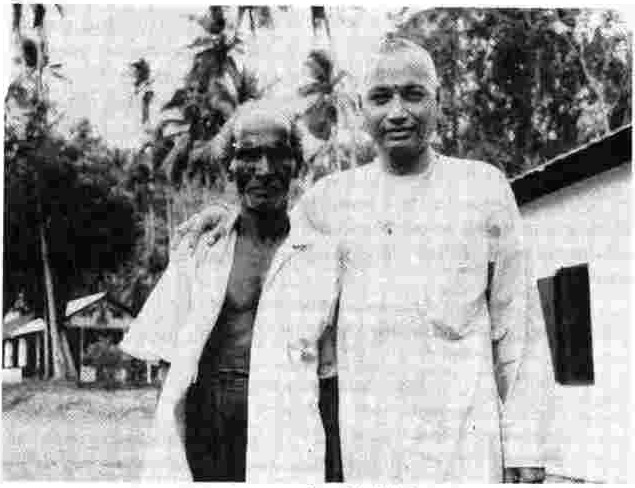
Swami Venkatesananda with Sri Arumugam
An aged labourer in the Estate, Sri Arumugam, recalled the young doctor’s services: “I remember him very well. There was something which distinguished him from everyone else. He would never address us discourteously but always used the respectful form of address. I have never heard him utter a harsh or angry word; he was kindness personified. He looked after poor labourers with special care. He would give us medicines, food and money too. He always prayed while attending to patients and gave them tulasi and holy water. Every Friday he held a prayer in the hospital. After the prayer he would distribute prasad. He would then go round the wards and give the prasad to those who could not leave their beds, and he himself put it in their mouths. He was a tall and handsome young man with an arresting personality not easy to forget.”
This old man’s emphasis was on the respect and courtesy with which the young doctor, in spite of his social status and birthcaste, treated the labourers, all of whom belonged to what was then an inferior caste and social status. It is a bit difficult for us to understand the significance of this in these days of social equality, but to this old man the doctor’s behaviour was already the dawn of a new era of equality and mutual respect.
Johore
Dr. Kuppuswami served in the Seramban Estate Hospital for nearly seven years, after which he joined the Johore Medical Office Ltd. at the request of Dr. Parsons, who had by then returned from overseas military service.
In Johore Medical Office, again his assistants used to take undue advantage of his kindness and leniency and were super-lethargic in their duties. He had to do all their work as well and he could not even complain of overwork lest his employers would be harsh towards the assistants. The problem of overwork was never solved in Malaya, or during his life-time.
Of this period, he said:
In Malaya I came into direct contact with hundreds of poor people, indentured labourers as well as the local citizens. I learned the Malayan language and conversed with the people in their own tongue. I served the workers of the Estate nicely and endeared myself to them all. I was always fond of service. One moment I would be in the hospital: and the very next moment in some poor patient’s house to attend on him and his family. Dr. Parsons, who was a visiting physician to the Estate hospital, loved me very much. I used to assist him in his private work also. Off and on I gave my earnings to help friends and the patients. I even went to the extent of pawning some of my own valuables for this purpose.
Dr. Kuppuswami was a friend of both the management and the labourers. Once there was a strike by the scavengers working in the hospital. The superintendent and other officials were fretting and fuming with rage. Coolly Dr. Kuppuswami called the ring leaders and persuaded them to resume work, assuring them of redress. He then acquainted himself with their demands and approached the higher authorities. There he began to plead the scavengers’ case so ably that they had to yield. They themselves could not explain how the doctor won the day. He was so sincere in the espousal of the cause, so straightforward and so sympathetic! In addition to all this he would help his assistants and train them for some time daily, and then send them to other hospitals with a recommendation letter, providing from his pocket their railway fare as well as some pocket money. He became well known in Seramban and Johore. The bank manager would oblige him at any time, even on holidays, by honouring his cheques. He became everybody’s friend through his sociable disposition and service. He got rapid promotions and with that his salary and private practice increased by leaps and bounds. All this was not achieved in a single day. It meant very hard work, unflagging tenacity, strenuous effort and undiminishing faith in the principles of goodness and virtue and their practical application.
He carefully attended on all patients, but never demanded fees from them. He felt happy when they were free from disease and trouble. To serve people and to share what he had was his inborn nature. He used to cheer people up with his wit and humour, and elevate the sick with loving and encouraging words. The sick persons at once felt a new health, hope, spirit, vigour and vitality. Everywhere people declared that he had a special gift from God for the miraculous cure effected in the patients, and acclaimed him as a very kind and sympathetic doctor with a charming and majestic personality. In serious cases he used to keep vigil at night by remaining at the patient’s bedside. In the company of the sick, he understood their feelings and endeavoured to relieve their sufferings.
Dr. Kuppuswami soon rose in the estimation of his fellow-doctors and superiors at the hospital — who loved, admired and respected him for his kindly nature, gentlemanly behaviour and spirit of selfless service. He was their ‘right hand’ and they soon found out that they could repose the fullest confidence in him. The entire management of the hospital thus gradually glided into his hands. He was given a bungalow inside the hospital compound itself, and this enabled him to devote as much time and attention as he wished to the hospital work. His own personal comforts he would attend to with quick despatch, only to rush to the hospital. There was no such thing as ‘off-duty’ for him. He was perpetually ‘on duty’; and excused himself only a few moments in the morning and at night for food and rest. This earned for him a fair name which spread like wild-fire throughout Malaya. His sincerity, thoroughness of attention, spirit of worshipful service and that ‘something’ that always emanated from him, brought about almost miraculous cures in some of his patients who were suffering from diseases pronounced incurable by able doctors. This drew to the hospital many people suffering from dire physical maladies, mostly from the poorer sections of the community. All this to him meant the fulfilment of his own desires: to serve, serve and serve till his physical frame withered away in service. He always kept up a cheerful face, and was ever ready to receive patients. For everyone he had a smile — particularly for the poor.
Dr. Kuppuswami recognised the poor as the very embodiment of God on earth. Poverty may be a curse or a blessing. A religious man may gladly embrace poverty for the sake of salvation, while a materialist would on the contrary employ all his genius and energy to get rid of it, and to adore Mammon as his god. But to Dr. Kuppuswami poverty presented a blessed opportunity to develop his heart. The poor needed his service more than the aristocrats who could do without his physical aid. If a poor man living in a slum fell a victim to a disease — the product of the conditions in which he was forced to live — Kuppuswami would take this patient up himself, provide for him a bed in his own home if need be, and treat him with all the care that a member of his own family could claim from him. He would employ a nurse to be in constant attendance and would himself run up to his bedside whenever he found a few moments’ leisure from the hospital duties. When the man got well, the doctor would give him some money and send him off.
During those days of medical service in Malaya the young doctor was the biblical Samaritan carried to the degree of perfection. He effaced himself. His energy, his talents and his body he did not consider as belonging to him — he belonged to any creature who was in distress and in need of him. He would not spare himself. It happened once that a humble woman of low caste, a pariah (untouchable) was about to give birth. She had no-one to call her own and to be of help. This young doctor, a brahmin of a most celebrated family, was at once by her side, all tenderness and sympathy, more solicitous than if she were his own sister. He looked to her comforts, eased her as best he could and, as the necessity arose, kept vigil that night, stretching himself down on the earth and passing the night thus outside the door of her lowly dwelling. Only when the task on hand was concluded did he return home and think of himself. It was this inherent thirst to befriend all, to relieve pain, to lessen sorrow, to console and comfort, that animated his life.
Once a patient suffering from a severe throat disease came to the doctor, who examined him. He found that the surgical resources at his disposal at the local hospital were inadequate to cure this man. At once he wrote a personal letter to one of his friends in the Singapore Hospital, gave the patient a ticket to Singapore with quite a decent amount of money, and sent him to the hospital with directions to present the letter to his friend. The doctors in the bigger and better equipped hospitals had so much high regard for Dr. Kuppuswami that they paid special attention to patients referred to them by him. The patient returned completely cured. He had had tracheotomy done and a button-hole fixed in front of the throat.
Dr. Kuppuswami was happy that the patient was cured; and happier to learn about the tracheotomy. He felt that the case was important enough to call for wide publicity. He wrote all the details of the case in the form of an informative article and had it published in several newspapers.
He also wrote other articles on diverse topics for the Malay Tribune. He used to purchase the newspaper, because by that other people were persuaded to buy it and this gave livelihood to a struggling news vendor. Though he was never interested in the daily news of the world, occasionally he used to go through the editorial and tried to strengthen his command of English. He was never interested in politics. Football, cricket and such games were then completely unknown to him.
Dr. Kuppuswami became a Member of the Royal Institute of Public Health (M.R.I.P.H.), London, and an Associate of Royal Sanitary Institute (A.R.San.I), London. During his stay in Malaya he published some medical books such as Household Remedies, Fruits and Health, Diseases and their Tamil Terms, Obstetric Ready-Reckoner, and Fourteen Lessons on Public Health.
Life With The Doctor
One of the eye-witnesses of the doctor’s life in Johore was Sri Narasimha Iyer, who served him as his cook in Malaya (and later in the Himalayas too).
This is what happened to Sri Narasimha Iyer on his first day of service with the doctor. In the evening when he arrived, the doctor put his bed on the floor and pointed to a cot placed in the same room and said to Sri Narasimha Iyer: “You lie down there.” That was too much for the cook! But his remonstrance was of no avail. “It is very unhealthy to lie down on the floor in these parts. I have become accustomed to this. But you should not take the risk.” He never gave the option to Narasimha Iyer to disobey him.
Next day, for the first meal, Narasimha Iyer very reverently and dutifully placed a wooden plank on the floor and a silver plate in front of it. He was ready to serve. But the master had a different idea. He said, “You also sit down now, along with me.” To Narasimha Iyer, it was strange sitting with his master and taking food.
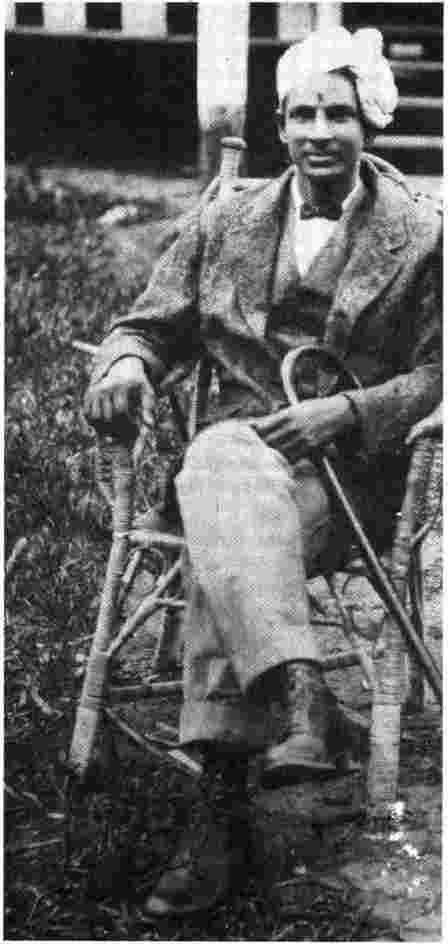
Dr Kuppuswami in Malaysia
“Sit on my left side. Place all the preparations in the middle. We will serve ourselves and eat together.” They began thus and the turn for ghee came. The doctor took a little out of a small cup of ghee placed on his left side, then emptied the rest of it in Narasimha Iyer’s plate with astonishing rapidity. The technique was repeated when the turn for serving curd came. Narasimha Iyer now understood why the doctor had asked him to sit on his left side. It would facilitate the doctor’s service of the cook!
“What is the difference between you and me? You earn a little less and I earn a little more, that is all. Both of us take the same food, we both have to sleep, and in every other aspect of life we both have the same characteristics. Why then should you wait for me to take food? Are you not feeling hungry at the same time? Why should you stand before me? Your legs are as much subject to pain as mine. Why should you go about in dirty clothes? You have as much self-respect as I have, and the same principles of health and hygiene apply to both of us. Foolish ideas of superiority and inferiority are entertained by some arrogant rich men. I know their habits. They will reserve spoilt food and stale bananas for their servants. I loathe even the thought. You shall be one of the members of my family. In future do not feel any reservation with me.” This was the doctor’s first sermon to his cook.
It was this that kindled the curiosity in the heart of Sri Narasimha Iyer to watch his master more closely. It was the feeling he had then that his master was out of the ordinary, that is responsible for what he was able to convey to us about Swamiji’s life in Malaya after more than twenty years.
Sri Narasimha Iyer completed his first month of service under the doctor. The salary that had been agreed upon was 25 dollars, ‘all found’. On the morning of the first of the next month the doctor ran into the kitchen and handed over an envelope containing 35 dollars to Narasimha Iyer. Narasimha Iyer could not make out the reason for the extra 10 dollars. Perhaps they were for some purchases to be made that day? He looked at the doctor. “That is your sambhavana,” clarified the doctor, and asked, “Is it enough?” (‘Sambhavana’ has a holy association and means an offering made with devotion and reverence.) Narasimha Iyer said that he never heard the words ‘salary’, ‘pay’ or ‘wages’ from the doctor when he paid the servants their dues. Even then he looked upon his servants as God. Whatever he gave them was an offering unto God by him.
Narasimha Iyer took to the study of religious books; during intervals from work, he would pore over some Tamil saint’s works. The doctor would suddenly peep into the kitchen. “What is that? Pattinathar’s life? Have you read this?” (In a sing-song voice he would repeat a verse or two, with friendly gestures, just as a child would run to its father and proudly recite a piece of poetry which he had learned from school that day). If the doctor noticed that Narasimha Iyer was still uneasy in his presence he would retreat, saying: “Read on, read on. It is a very good book.”
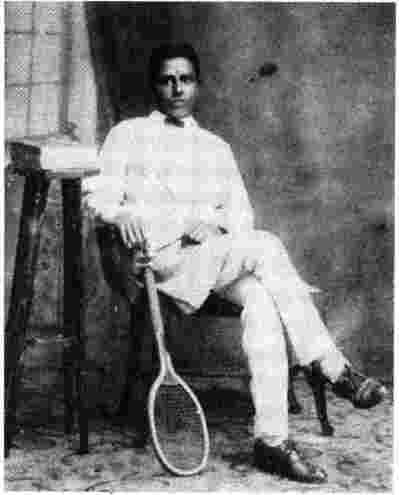
Swamiji’s cook, Narasimha Iyer
Towards the close of the period of his service with the doctor, Narasimha Iyer expressed the desire to be photographed with the master, as a memento. At once the doctor shot out of the house and came back within a few minutes with the information that the photographer was ready. He gave his own suit to Narasimha Iyer for him to wear and took him to the studio.
Narasimha Iyer had by this time reconciled himself to the pleasant but unusual nature of his master. The doctor himself arranged the chair, and other details.
When the shooting was over, he remarked smilingly: “You look like a lawyer in that dress,” and gave a hearty laugh. They both returned to the house. Narasimha Iyer was at his post of duty again, with a towel around his waist, busy making rice-paste for rice-cakes. The doctor hurried into the kitchen and (amidst laughter) said, “You are exceedingly charming now, Narasimha Iyer. Shall I call the photographer now?” He gave another hearty laugh and went away.
To make such friendly jokes was a habit with him, but even in the seeming fun there would always be a hidden lesson for the discerning. He could never bring himself to treat servants as servants. He loved them and played with them: to him they were his equals.
The basic urge in him to share what he had with others became irresistible when the object to be shared was something extraordinary. Narasimha Iyer gave us the following example:
One day the doctor entered the kitchen when Narasimha Iyer was preparing green-banana curry. Even when it was in the pan, the doctor took out a few pieces and started eating, all the time saying: “Oh, Narasimha Iyer! What do these rich people know of happiness? What happiness do these princes know and enjoy? Look at this! Is there anything equal to this in the world?” Soon the excellence of the preparation prompted him to exclaim that it was a first-rate curry. With a saucer and spoon in hand, he ran to the telephone. He had remembered his friend, Subramanya Iyer, to whom green-banana curry was as dear as life itself. “Oh Subramanya Iyer! You know what I am doing now? Eating a first-class green-banana curry. Yes, I shall send you immediately it is out of the oven. No, no, I tasted it even before it was taken out! My new cook, Narasimha Iyer, a stalwart figure with a towel round his waist, will bring it to your house just now. He does not know the place; so be on the lookout.” Cooking was over and Narasimha Iyer asked the doctor if he would take his food. “First take a plateful of the vegetable and give it to Subramanya Iyer. Do you know the house? No? Ask somebody on the road. Take it to him first and then we shall eat.” (This is Swamiji’s novel interpretation of the term ‘give and take’. First give a share of what you have to others and then take yours!).
Here are a few incidents illustrative (though not exhaustive) of Dr. Kuppuswami’s love, kindness and giving nature:
“Oh, noble Sir,” wailed a beggar in the street, “I am hungry and have had no food for the last two days. I am near death. I have cried at every door. Alas! Who can understand my suffering? Even God seems to be cruel, because He is bent on prolonging this miserable existence.” He was about to beat his head and fall down.
Though all this was not addressed to him, Dr. Kuppuswami patted the beggar on the back, and led him to his own compound. “Rest here for a few minutes. Oh, Narasimha Iyer, bring half the rice and other preparations. Take a good leaf, put it over the plate. Then arrange all the items nicely on it and bring them here at once. Quickly, quickly.” Narasimha Iyer went in and brought the food.
“Here you are, old man! Take this food and refresh yourself.” The beggar was unable to believe his own eyes. He rubbed them to make sure that he was not dreaming.
“Come on, why do you hesitate?” Moved with gratitude, the beggar began to eat his feast. Occasional tears escaped his eyes, though he tried to check them. Dinner finished, the beggar washed his hands as the tall doctor stood by his side and poured out the water. Before the doctor realised what the other man was doing, he fell flat before him and hugged his feet. The doctor sent him away with pocket money, enough to feed him for a couple of days, in case of need.
Narasimha Iyer, who was watching all this, was unable to make anything of it. The doctor turned to him and said: “Come on, let us take our food now.” What could poor Narasimha Iyer do? He had prepared food for only two. Half of that had been given to the beggar. “You may take your food. I shall prepare some again and eat later,” replied Narasimha Iyer. Quickly came the retort: “No, no. It does not matter. We shall share what there is between us. What does it matter if we have to take half the usual quantity one day? Hunger is the same in every person. By giving it to the beggar we have appeased hunger; whether it is his or ours it is all the same.” Immediately he sat down for lunch.
Narasimha Iyer recollected another incident similar to the above. A beggar came to the doctor’s bungalow and prayed for a few coppers to buy food. After ascertaining from Narasimha Iyer that food would not be ready soon, the doctor ran to the door and asked: “How much have you to pay for a meal?” The beggar casually replied: “Thirty cents, Sir.” The big hand at once dived into the coat pocket and brought out a fifty-cent piece. “Here you are! Take this and have a good meal. Is that enough?”
The beggar was wonderstruck. He rarely got such treatment. His lot had always been kicks and abuse. Here was one who would give a lot of money and would further ask him: “Is that enough?” Seeing him stand dumbfounded, the doctor repeated his question, jingling his pocket all the time, as if impatient at the man not asking for more. Out came another fifty-cent piece. “Here, take this. Don’t hesitate to come to me again if the money is insufficient for the meal.”
Narasimha Iyer told us the story of an educated young man, Subramania, aged twenty-four, who had come to Malaya in search of employment. He went to Singapore and met a prominent South Indian gentleman who at once directed him to Dr. Kuppuswami in Johore, with the remark, “Go to this doctor, he will do everything for you. He is the kindest and noblest gentleman you can find in these parts. If he cannot do anything for you, then I am afraid no-one else can.” The young man entered the doctor’s compound with mixed feelings in his heart: pessimism generated by past experience and an inexplicable hope and joy. The doctor had gone out for a walk with Narasimha Iyer. It was nightfall when he returned. Immediately he went to the young man and asked him what he could do for him. Subramania explained to the doctor the purpose of his visit and requested him to assist him in securing a job. The doctor’s response surprised him. “Oh yes,” replied the doctor, “surely I will see that you are fixed up. Now come in. You can stay with me for the present and make yourself quite at home. Come, let us take our food.” The young man’s feelings had better be imagined!
He stayed; and he was treated by the doctor as his own brother. One full month passed. Then the doctor took upon himself the task of getting him a job. By finding him a job immediately on arrival, he did not want to give the impression that he was eager to get rid of him. He asked one of his friends in the railways to fix him up and it was done in a few days. The young man joined the service on a salary of 40 dollars a month. He wondered if he would be asked to find his own lodging. At dinner time the doctor opened the topic of his own accord, and in his own inimitable way told the young man that he need never think of going. Subramania stayed for another month. He got his first month’s salary. Then he himself thought he must stand on his own feet. Guessing the mental condition of his guest, the doctor agreed.
The very next day the doctor found him a moderately rented and decent flat to live in. He arranged for his personal effects to be removed there, asked Narasimha Iyer to supply him foodstuffs for one month and all the cooking utensils necessary. He assured Subramania that he had himself told the shopkeeper to allow him any credit he wanted. On top of this came the assurance that in case of need he should not hesitate to call upon the doctor.
It was not that the other man ought to be grateful for the little help rendered, but always “Have I done all that I could and therefore should have done?”
He gave Subramania a grand parting feast and escorted him to the new house.
The doctor never forgot the difficulties he had encountered on his arrival in Malaya; anyone who found himself in a similar position found in him a ready and eager helper. He would always keep a lot of coins of all denominations in his pocket. While pacing the verandah of his house or as he walked along the road, his hands would be jingling the coins to remind him of their presence. He would be sorry if one morning he had not given out the usual quota.
Sri Seetharama Iyer, of Malaya, recalls: “His ways were strange. He was always bubbling with joy. He had a smile for all, a kind word for everyone. He could never entertain a thought of high or low; he treated everyone alike. If he met a labourer on the road he would stop and chat in a friendly manner for a couple of minutes and then pass on. We, who had different standards of behaviour, would often find fault with him. He would quickly brush aside our criticism, saying: ‘Imagine what a great joy he derives by my talking to him on equal terms! What do I lose by giving him that joy; on the contrary, I also get some delight.’ He would dress himself like a prince and talk to labourers on equal terms; this was truly the mark of a saint, though we did not understand it at that time.”
In business dealings, bargaining was unknown to him. Sometimes Narasimha Iyer would accompany his master to the bazaar. Whatever the shop-keeper demanded the doctor would pay without any word. Narasimha Iyer pointed out on the first occasion itself that the doctor ought not to do that. He explained that because the customers were bargaining, the vendors quoted a higher price than that which they themselves expected. The doctor retorted, “It does not matter. I cannot bargain. He is a poor man. Let him have a few cents more than what he deserves. Once he understands my nature, he will himself abandon the habit of quoting a higher price.”
Dr Kuppuswami always took the ‘other man’ at his word. He never questioned and never suspected. Once he wanted to purchase a car. Somebody took some money from him for this purpose, and the doctor found out much later that he did not mean to negotiate the purchase of a car for him! “It does not matter,” he said, “God willed it that way.” He was candid, straightforward, simple and open-hearted. Diplomacy and double-dealing were not known to him.
He had a great liking for high-class dress, and he had a collection of fancy articles of gold, silver and sandalwood. Sometimes he used to purchase various kinds of gold rings and necklaces and wear them all at a time. When he entered shops he never used to waste any time in selection, but gathered all that he saw. He paid the shopkeeper’s bill without scrutiny. He had many hats, but never wore them, though sometimes he used his felt cap and the silk turban like a Rajput prince.
A friend from Malaya, Sri Seetharama Iyer, on a visit to Rishikesh recalled: “He always wore costly clothes. His wardrobe consisted of silk clothes only, but he wore them with utter indifference. He would never give the silk the respect that was due to it. He would just throw them on as though they were rags.
“He had a great fancy for jewellery. He had a gold neck-chain; and he had at least ten rings for his ten fingers. One fine morning he would put them on and walk about; the next they would disappear into his box, to be forgotten for months together. He had his own varieties in turban-style.”
The boy Kuppuswami used to listen devoutly to recitations from the scriptures. As a youth, the small library of books on yoga that he then possessed grew with each visit to a book-stall. He took this treasure with him to Malaya.
In Malaya he methodically added to the wealth of the spiritual books he had. Narasimha Iyer related that the doctor would always keep with him a list of these books. He would take this list to a bookshop occasionally, leave it there and ask the bookseller to send him all the books available in the shop which were not on the list. Some of the books were in languages which were foreign to the doctor, but his reason for buying them was that others would be benefited. Whatever he could he read with great interest and delight. From the very first day Narasimha Iyer began to serve him, the master introduced him to the library and encouraged him to read religious and spiritual books. He would create a deep interest in everyone who came in contact with him, to read the books he had.
So, his library was open to everyone who claimed a love for those books. His amiable nature attracted to him a large circle of friends and they all became members of his library. This resulted in a two-fold satsang for the doctor. The books themselves formed a galaxy of saints who kept him company throughout his leisure moments. More important than even this: at home or at the hospital, in the bazaar or on the beach, he always had friends whose interest in common with him was spirituality. Very few minutes were spent in conversing on other topics. Everyone would greet him with “In that book by that yogi, it is said that ...” and a lively discussion would take place. These discussions would often throw the doctor into a deep reverie, when he would dive into the ocean of spiritual knowledge in quest of the pearl of Truth. Narasimha Iyer said that the doctor would spend the greater part of many nights in this fashion, either walking on the lawn around the house, or ‘reflecting’ in his own study. The transient nature of the world, the fleeting character of time, the endless succession of pleasure and pain and the attraction and repulsion that form the basis of life and all creation, were constantly uppermost in his mind. He found that suffering was everyone’s inevitable companion. The beggar on the roadside, the leper at the street-corner, the wailing patients in the hospital, the poverty-stricken people suffering in silence, constantly reminded him of human suffering.
As days passed by he turned more and more inwards, in search of that which would last, the enduring amidst the fleeting, the permanent amongst the transient. He was often lost to the world in such meditations.
He decided to practise yoga. For, as Thomas A. Kempis said: “Of what use is a cart-load of knowledge if even a particle of it is not going to be put to practical use?”
He took up the Gita and casually opened it. There it was! ‘Having been born in this transient and misery-laden world, worship Me’. He prayed “Oh Lord, Thou hast most graciously solved my problem for me!” Then and there he made up his mind to spend more and more of his time in singing the Lord’s names, in silently repeating the mantra, in formal and informal worship and in the study of the glorious lives of His devotees.
He started to hold prayer-meetings (satsang), in the hospital in Senawang Estate. In Johore Bahru it became a regular feature every night. He had been endowed with a sweet voice of which even the best musician could have been envious. He now thought that if he sang to the accompaniment of musical instruments it could be more pleasing to his dear Lord, and he himself could soar to greater heights of ecstasy. He thought of learning the harmonium. He found a musician and engaged his services for a few weeks. He fed him, provided him with all amenities, and learnt to play on the harmonium within a month.
He gave two hundred dollars to the musician as remuneration. The tutor was surprised; for twenty or twenty-five classes of half-an-hour’s duration each day, he had never expected such a large amount. This sort of lofty-minded generosity was a common affair in Dr. Kuppuswami’s life.
Every evening Dr. Kuppuswami would sit with Narasimha Iyer and a few selected friends in his puja room and pour forth, in melodious tunes, the healing names of the Lord. Tears of divine love would rain down his cheeks. Even after the others had dispersed the doctor would sit alone in the room and take to the silent repetition of the mantra till late in the night. Thus he passed his time in serving the Lord’s children from morning till night, and in repeating His name throughout a major part of the night, too, reducing the time spent in personal comforts and rest to the barest minimum.
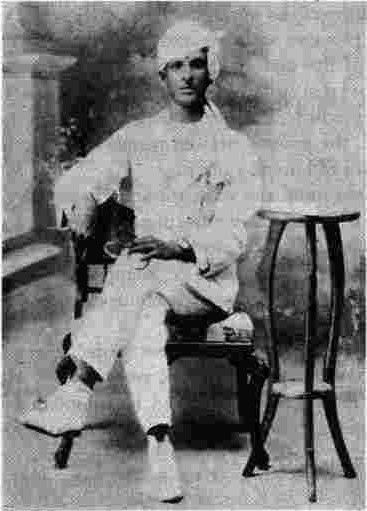
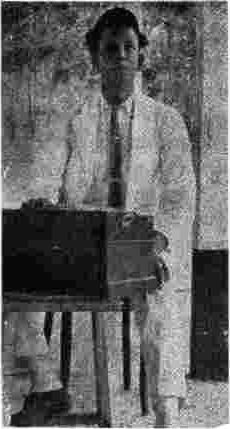
Dr Kuppuswami in Malaysia
He arranged for discourses on the Ramayana and Bhagavatam, and his house was a permanent abode for holy men, poor and helpless people. He had set apart a hall in the house and had decorated it and set up a stage. He would collect the neighbouring children and train them as actors. Many were the lives of holy saints that he thus staged through these child-actors. When he staged the drama of ‘Saint Nandanar’ in Malaya he made even European officials sing kirtans with him. He would himself often take part in these dramas. These inspired him a great deal and the high ideals of these saints were ever before his mental vision.
He attended all social and religious functions of the locality and the suburban towns too. Without the presence of the doctor there would be no joy. He pumped joy and power into them. He would play on the harmonium and make people laugh and laugh, by his jokes and comical songs.
If occasionally he missed getting invitations from any of his close friends, he used to straightaway go to the friend and say, “Have you forgotten me? Anyhow you are my friend and I am bound to attend the birthday celebration of your child!” And, in all his majestic boldness, Dr. Kuppuswami would begin sankirtan. No sanction, no introduction, no formality did he need. Everyone who came in contact with him was infected with his spirit. Many mocked at him at first, but joined him later.
He used to arrange for feeding brahmins and the poor on a large scale. He performed the anniversary (sraddha) ceremonies of his ancestors, with great faith and devotion, and invited priests for these ceremonies from hundreds of miles away. He used to feed untouchables and apply sandal paste to their foreheads. All these acts of kindness helped the doctor in his future life to realise the truth of ‘Sarvam khalvidam Brahman — All indeed is Brahman.’
With the aid of some books Dr. Kuppuswami started practising sirshasana (headstand) and a few other important yoga asanas. His enthusiasm was so infectious that Sri Narasimha Iyer also began practising asanas. At night the doctor called Narasimha Iyer to him just before going to bed and asked, “Oh, Narasimha Iyer! Do you know how to stand on your head? You help me first. Then I will help you.” He got ready. He placed his head on the pillow and threw his legs up on the wall, saying: “Oh, catch hold of my legs, they are shivering. Press them against the wall. That is right.” Then he resumed the normal pose, saying: “Now come on. You do it.” Though Narasimha had a nodding acquaintance with this exercise, he was far from being perfect. “Don’t worry; I will catch hold of your legs,” the doctor reassured him.
Narasimha Iyer started doing pranayama, tratak and such other hatha yoga exercises. He started wearing all sorts of dirty and torn clothes and imagined that by simply denying himself the necessities of life he could realise immortal bliss. He would not do his hair; he had removed the golden ear-rings and bangles that he used to wear. In short, he disfigured himself. Whenever he got leisure he would shut himself in the pantry and go on with his pranayama or stand upside down (in imperfect sirshasana) by the wall. With all the dietetic conveniences at his disposal he was yet unable to withstand the great strain of these exercises. The exercises performed in a haphazard manner produced some bad effects upon his system, and began to tell upon his health. Besides, hidden innate tendencies and desires harassed his heart.
The doctor noticed this change in Narasimha Iyer. He would never hastily upset anyone’s programme, however faulty it may be; but one morning, turning up unexpectedly in the pantry while Narasimha Iyer was doing his pranayama, he gave a mild discourse: “You ought not to take these things seriously into your head now. These authors simply write whatever comes to their mind, regardless of the difficulties that individual aspirants will have to undergo while following their instructions. Their writings are always one-sided. They do not preach the combined method. They often ignore the fundamentals and deal elaborately with advanced spiritual practices. They do not point out that it would be unwise to practise their precepts except under the direct guidance of an expert; for that hampers the sale of their books. These hatha yoga practices require an expert teacher. Take to the name of the Lord. Here you need no one to assist you. Give up these; just keep so much of these practices as are necessary for the maintenance of good health.” Narasimha Iyer was impressed; and he obeyed.
But the eagerness of Narasimha Iyer to pursue the spiritual path continued unabated. One day he expressed to the doctor his desire to abandon worldly life and rush to the Himalayas in search of some yogi at whose feet he could practise yoga for the realisation of God. Dr. Kuppuswami gave a hearty laugh at this suggestion. “Wait; do not all of a sudden give up family life. You ought to fulfil marital obligations once you have undertaken them. Otherwise you will get difficulties which will retard your spiritual endeavours. There is yet time. God will guide you aright. Let this desire to renounce be always with you; and He will decide when you ought to be relieved of your worldly ties. Then you will surely get, by His grace, the help of a yogi in the Himalayas to guide you onward.”
(Later, Narasimha Iyer rejoined his master — not as a servant, but as a disciple. As he met the monk Sivananda on the bank of the Ganges twenty-four years after he had left him in Malaya, his only feeling was one of amazement: “How true were your words, master. You could foresee and foretell the future with cent per cent precision!”)
Very few swamis were seen in a far-off town in Malaya. However one called on the doctor one fine morning, on his way to Singapore. He had learned much about the doctor during his travels in Malaya, and had just dropped in to see him. The doctor was beside himself with joy at the very sight of a swami. Self-forgetfully he ran about entertaining him. He washed his feet with his own hands, made him sit comfortably on a sofa and started fanning him, at the same time asking Narasimha Iyer to give him a glass of warm milk. The swami was extremely pleased at this hospitality. The doctor insisted on his staying with him for an indefinite period.
Stopping for a few days with the doctor, the swami fell ill. So carefully and tenderly did the doctor nurse him back to health that he became captivated by the loving treatment. He had with him certain very valuable books which he cherished zealously. He had been keeping them concealed and at first refused to part with them. Now he voluntarily gave Kuppuswami the book Jiva-Brahma-Aikya-Vedanta-Rahasyam by Swami Kadappai Satchidananda Yogeswarar. It acted as a spark to further ignite his spirituality and set his thoughts God-wards. It led him to the study of other books — the works of Swami Ram Tirtha, Swami Vivekananda and Theosophical literature, etc. The swami stayed for a few days and said that further stay was not possible on account of important engagements he had in Singapore. With a heavy heart the doctor reluctantly went to the station and bought a first class seat to Singapore for the swami. He then returned home, fed him sumptuously and, giving him some good South Indian preparations to be taken en route, took him to the station and saw him off with tears in his eyes and with an insistent request that the swami should write to him when he proposed to return to Johore. The swami himself was visibly moved at the parting, such was the pure, unselfish and divine love that he had seen in the doctor. He gave the promise asked for and was soon able to redeem it.
Doctor Kuppuswami encountered other types of ‘holy men’ too. During the course of a talk he once told his disciples:
In Malaya there were several tantriks. (Tantrik, in the popular mind, is one who possesses magical powers — who uses special formulae called mantras and geometrical designs called yantras). It was the time the Spanish flu took a heavy toll of life in Malaya. I too, had an attack, but somehow escaped. One tantrik had several mantras and yantras. That was a wonderful art. A special unguent was applied on the thumb-nail of the adept of the mantra. Through this unguent Lord Hanuman himself would appear there and answer any question. The tantrik could tell what was going on in such and such a place, or what a particular person was doing, where he was and so on. I even now remember the mantra.
I had great reverence for the man who taught me the mantra. I used to prostrate before him nicely and serve him whenever the occasion arose. Later I gave up the tantrik practice as I did not like the idea of subjugating devatas and getting things done through them. “Gods should be worshipped and adored, not made to serve us,” I said, and sent the yogi away with a small purse.