Sivananda: Biography of a Modern SageHis life, by Swami Venkatesananda
THE SECOND RENUNCIATION
Many earnest spiritual aspirants had come to Swamiji seeking spiritual training. Even in 1931 he used to warn them against juvenile enthusiasm by saying: “I am only a common monk. I may not be able to help you very much. Further, I do not make disciples. I can be your sincere friend till the end of my life. I do not keep persons at my side for a long time. I give lessons for a couple of months and ask my students to meditate in some solitary places in Kashmir or Uttarkashi.” In spite of all this, young aspirants did come. He himself says in his autobiography “From 1930... I also had a burning desire to serve the world. With a view to training a band of sannyasins and yogins on the right lines, I permitted some aspirants to live in the adjacent kutirs... and gave useful hints for the removal of their difficulties and obstacles in meditation. Thus more and more persons came to me; but the Swarg Ashram management could not maintain the increasing number of seekers after Truth.”
The Mahant of Swarg Ashram had died suddenly and his successor was a young man who had little reverence for the sadhus. As soon as he took charge of the ashram management he began to tease them in many ways. He imposed a number of restrictions on them. Swamiji could not tolerate the ‘ordinances’. He refused to obey them, saying that the sadhus had every liberty to live as they wished. All the sadhus echoed Swamiji’s views. They too refused to accept the mahant’s restrictions.
The mahant was arrogantly obstinate. He wanted to erase Swamiji’s influence among the sadhus. How was it possible? He began to ‘bribe’ some of the young, healthy, sturdy sadhus with ghee, butter and milk. He gave them good clothing. Such men joined hands with the mahant and worked against Swamiji, but many yogis were very genuine, and they were friendly and co-operative with Swamiji.
The mahant, with the help of some sturdy men, made secret arrangements to violently attack Swami Sivanandaji and his followers. The conspiracy was revealed to Swamiji by one of the mahant’s assistants. Swamiji rose up to the occasion. He directly went to the mahant and cautioned him in polite but firm language. Never before had the sadhus heard the thunder of Swamiji. They whispered: “He deserves the name Sivananda — the Rudra-spirit (the fierce aspect of Siva) is so much in him!” The mahant promised to govern the ashram properly and regretted his previous actions.
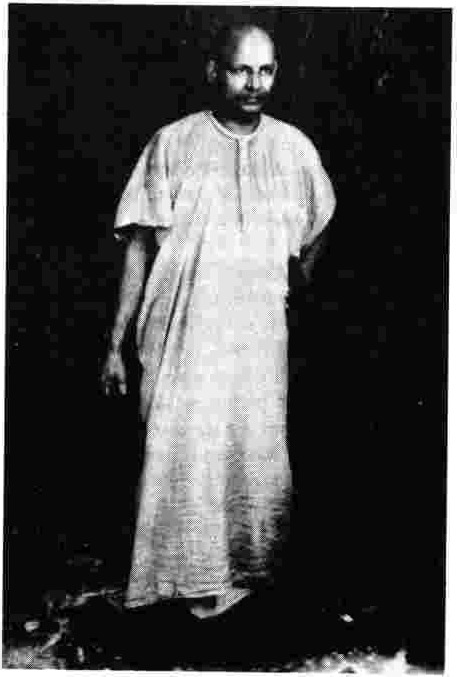
Swamiji could be stern
Swamiji did wonderful service through the Sangha. When the mahant refused to give bhiksha to the monks, Swamiji had to make numerous arrangements to feed nearly a hundred monks and support them for days on end in the lonely forests. Swamiji was truly an abode of courage and was absolutely fearless. The mahant, realising his powerlessness and foolishness, came to Swamiji and begged for pardon. As usual Swamiji blessed the man who cursed him.
On another occasion the same mahant had injured his leg. He hesitated to go to Swamiji for fear that he would not attend him. But Swamiji gave him special treatment and cured his leg in a few days, much to his surprise.
Once Swamiji had to attend a Kirtan Conference in Meerut, and in his absence the mahant again troubled the monks residing there. The ill-treated monks sought the help of the police, but in vain. They then informed Swamiji of the matter. Swamiji returned from Meerut and heard all the particulars of the situation. He reacted in the typical jivan-mukta way — without in the least losing the balance of his mind —taking everything calmly and cheerfully. Just before returning to Rishikesh he had written to Paramanandaji as follows: “11th January 1934. Rely on Him. Pray. Out of evil cometh good. ‘Thy will be done’. Om Shanti Shanti Shanti. May God bless you all with strength and peace.”
When he reached Swarg Ashram Swamiji was faced with two alternatives, either to give up Swarg Ashram or give up the disciples. Swamiji chose the former. He said: “It is not advisable to resist evil. Every now and then the mahant will give trouble and there will be no peace at all.” He thereupon advised all the monks to leave the place, but many sadhus hesitated. Even though he had performed austerities there for ten long years, Swamiji had no attachment for the place. He declared, “Wherever I go it is Swarg Ashram for me. Even if I go to Meerut, Lahore, Lucknow, etc., I find only Swarg Ashram there.” So saying, Swamiji crossed the Ganges and settled on the other shore.
When the mahant learnt about this he offered Swamiji many things to stay back, but in vain. Later on, Swamiji revealed, “I loved the place and enjoyed peace, but in the interests of the spiritual upliftment of a large number of educated seekers, I decided to leave Swarg Ashram.”
Thus on the 17th January 1934, when Swamiji returned from his tour, he went over to the Ram Ashram (adjacent to the present Sivananda Ashram), along with four disciples — Paramananda, Krishnananda Puri, Yogi Narayan and Swarna Giri. He occupied the room to the east of the library in the main building itself.
Once again, bhiksha had to be got from the Kalikambliwala Kshetra at Rishikesh, two miles away. The road to Rishikesh was not what it is now, and for nearly two months crossing the storm-water stream of Chandrabhaga was a risk to life. All this had to be undergone all over again for the sake of the Lord’s mission.
The First Step — Sivanandashram
Years later, during Swamiji’s birthday celebrations, it was almost a fashion for the holy men of Rishikesh and devotees of Swamiji who had come into contact with him before he had left Swarg Ashram, to exclaim, when referring to Sivanandashram, that that which had been a jungle but a few years ago had been converted into a colony of saints, a small township in which the devotees could take refuge and commune with the Lord. This was the fruit of Swamiji’s second renunciation. On leaving Swarg Ashram he had not only renounced a life of comparative ease, but also a life which afforded him the greatest scope for enjoying the bliss of samadhi, undisturbed by institutions and responsibilities. He had to renounce the previous ideology that he would not own an ashram and would not allow disciples to stay with him.
He was ready, willing and eager to serve humanity; but his favourite method in Swarg Ashram was the ‘lightning’ method. He would take some place or province by storm and immediately rush back to Rishikesh; but even this had to be given up in favour of a life of continuous work, responsibilities and management. That was the Lord’s will and Swamiji gladly submitted to it, saying: “I never dreamt that He would ordain matters thus. I left my all, cutting off ties finally, with a hazy idea of spending all my life in a quiet spot, absorbed in repeating the sweet name of Rama. But now God has given me a ‘family’ which so dotes upon me that, whether I want it or not, it will have me for itself. Who knows? Perhaps I am born for it. As long as anyone continues to derive one iota of benefit from this self, I am happy to be entirely theirs. I give myself over to whosoever claims me.”
Years later, when discussing the move with his disciples, Swamiji said: “Planning and scheming were not in my nature. I depended upon the grace of the Lord. I had decided to leave Swarg Ashram. Where was I to go? That was a great problem. For some days I stayed in a small room at the Ram Ashram Library. A few of my students lived in a small dharamsala (resthouse for pilgrims) nearby, and depended on the kshetra for their meals. For some days I too went to the kshetra for my food. To save time, later I received my food through an elderly monk from the kshetra.” Thus months passed.
Swamiji was in search of some accommodation where they could all live and work. All the inconveniences they had to endure were incapable of compelling them to leave the locality and go to Rishikesh town. Swamiji found a kutir of four rooms, dilapidated and disused, which looked like an abandoned cow-shed. To him it was more than a palace. He cleaned it thoroughly and occupied it. On the 28th March, 1934, he wrote: “Now I have occupied the small kutir with the four rooms. Sri Swami Advaitanandaji will stay with me.”
This was the nucleus of the great institution. One room he used as his kutir, office, living room, etc., another was used as a dispensary and the other two, as also the room on the hillock, were used by the disciples. Then the increasing number of disciples who came undaunted by the forbidding conditions of living, necessitated expansion. Construction meant money. Swamiji was unwilling to spend anything even on food; spending on building was out of the question: “I could have easily set up some thatched cottages in the jungle, but that was not suitable for dynamic work. Books and papers might get damaged by white-ants. I saw a row of rooms in a rest-house for pilgrims used by a shop keeper as a cow-shed. These rooms had no doors. Gradually one by one, all the rooms were converted into residential quarters for the students.” Again, he says in his autobiography:
They were improved a bit by fixing doors and windows. I occupied the place and lived there for a period of 8 years.
When devotees gave me some money for my personal use, I utilised it in printing leaflets like Twenty Important Spiritual Instructions, Way to Peace and Bliss, Forty Golden Precepts and other pamphlets, and gave them to visitors. I purchased some useful medicines for treatment of sick mahatmas and for postage to send articles to newspapers and letters to keen aspirants. The work grew at a steady pace. I did not go out in search of students.
True seekers of Truth came to me in large numbers seeking my help and guidance. They all received initiation from me and lived in the adjacent rooms of the dharamsala, and worked day and night. To meet the heavy rush of work I got a duplicator and typewriter. People evinced great interest in the divine service done for the spiritual upliftment of the world. I admired their devotion to me. In work they forgot the past and plunged themselves in attaining spiritual evolution through service and sadhana. Devotees gave me voluntary contributions for the noble cause. For the maintenance of the students I received dry rations for five persons from the Kalikambliwala Kshetra at Rishikesh. For the rest of the students and the visitors I utilised the meagre donations received from a few admirers. That enabled me to publish some books also, for sale.
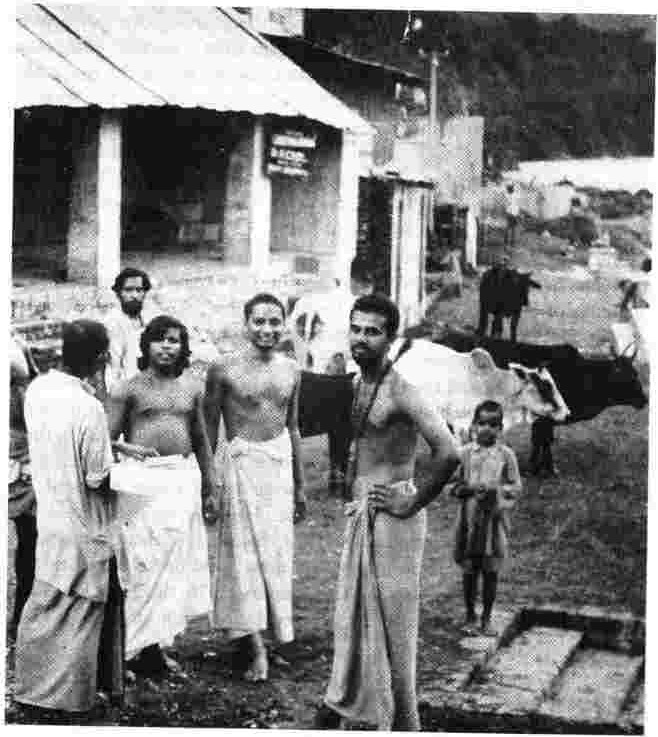
A general view of the early buildings. The steps on the right lead to Swamiji’s kutir.
Swamiji lost no time in applying to the Maharajah of Tehri Garhwal for the grant of some land for constructing an ashram. The farsighted ruler of the state quickly granted the land, and also an old disused hut nearby (just where the Mt. Kailas Kutirs stand now). This was a boon to Swamiji’s disciples, who used the kutirs for their living and working as well.
In the meantime they found some more vacant rooms, but uninhabitable and filthy. They were what later became the kitchen and adjacent rooms. In one room an old cowherd was living; the others were full of hay and dung. Swamiji first cleaned up what is the post office now, and occupied it. It housed a student, and also served as the first small kitchen. In about a year or so the old cowherd also vacated his ‘room’.
Swamiji had found that through an organisation great good could be done for humanity. The aim was dissemination of spiritual knowledge and training of spiritual aspirants in yoga and vedanta. The Swarg Ashram Sadhu Sangha had shown the way. (The Sadhu Sangha idea itself found its fulfilment in the All World Sadhus’ Federation and the Bharat Sadhu Samaj, founded later.)
The best way to achieve this noble aim was a matter that engaged the attention of Swamiji and his first disciples. The decision was taken up quickly and executed with his characteristic promptness. Whilst Swamiji and Swarupanandaji were returning to Rishikesh from a tour of the Punjab, they discussed the matter on the train. As the train was nearing Ambala they had come to a conclusion. On the railway station platform several of Swamiji’s disciples were waiting for his darshan. Among them was an advocate. Swamiji quickly conveyed to the advocate the decision to establish an institution, and the advocate immediately tendered the advice that Swamiji could create a trust. However, a Trust Deed was necessary for the registration of the trust. Swamiji, without a moment’s hesitation, said: “Let us do it here and now”, and broke the journey at Ambala. The very same day, the 13th January, 1936, the Trust Deed was drawn up by the advocate and registered by Swamiji at Ambala Cantonment.
The Divine Life Trust Society
The Aims and Objects stated in the Trust Deed, were as follows:
1. To disseminate spiritual knowledge:
(a) by publication of books, pamphlets and magazines dealing with ancient and oriental Hindu philosophy, religion and medicine in the modern scientific manner, and their distribution on such terms as may appear expedient to the Board of Trustees.
(b) by propagating Hari nam (the name of the Lord) and by holding and arranging religious discourses and conferences and frequent Hari nam sankirtans.
(c) by establishing centres or societies for yogic training and moral and spiritual sadhanas to enable practicants to achieve spiritual regeneration through puja (worship), bhakti, jnana, karma and hatha yoga with systematic training in asanas, pranayama, dharana, dhyana, samadhi, etc.
(d) and by doing all such acts and things as may be necessary and conducive to the spiritual upliftment of mankind in general and to the attainment of the above-mentioned objects in Bharatavarsha (India) in particular.
2. To establish and run schools, colleges and other institutions on modern lines and right basic principles and help deserving students by granting refundable or non-refundable scholarships for doing research in the various branches of Hindu shastras.
3. To help deserving widows, orphans or other destitute people by rendering them such assistance as the Society may deem proper to render, whether in any individual case or in any particular class of cases.
4. To establish and run medical dispensaries or any other medical institutions for free treatment of diseases and dispensing of medicines to the poor in particular, and to the other public in general, or on such terms as may be deemed expedient by the Board of Trustees.
These Aims and Objects were re-interpreted by the Board of Trustees by a resolution at their meeting on the 15th December, 1957, to give effect ‘to the vastly expanded de facto activities of the D.L.S. Trust’: and therefore, resolved that in clause 1 (a) the words ‘and other contemporary’ be inserted between the word ‘Hindu’ and the word ‘philosophy’ so that the phrase may read ‘Hindu and other contemporary philosophy’. Similarly in the case of clause (2) the phrase ‘Hindu shastras’ was amended to ‘Hindu and other contemporary shastras’.
The Divine Life Society
The Trust membership was limited. Many were the seekers after Truth who wanted to associate themselves with the glorious mission. Hence Swamiji founded ‘The Divine Life Society’, with four sections: ‘The Vedantic Society’, ‘The Divine Prem Society’, ‘The Yogic Society’ and ‘The League of Brahmacharis’. “There is no fee for membership,” says the First Annual Report of the D.L.S. “Anyone who is eager to have Self-realisation, who practises ahimsa, satyam and brahmacharya can become a member... Branches of these societies have already been formed in different places.”
The Divine Life Society was duly registered under the Societies Registration Act XXI of 1860, at Lahore, on the 16th April, 1939. One of the first concerns of the institution was to find ways and means of disseminating spiritual knowledge. Therefore in January 1938 the Trustees resolved to open a Permanent Fund (Capital Account) for this purpose. Devotees could donate Rs. 25 to this fund. This amount was invested in a bank and out of the interest a leaflet was printed periodically for free distribution. These pamphlets and leaflets were sent to anyone who sent stamps for postage. Often Swamiji would send them unasked for, to anyone who wrote to him.
Just before the Divine Life Society was actually registered at Lahore, the First Punjab Provincial D.L. Societies’ Conference was held there on April 8th, 9th and 10th. It has therefore a distinct place in the history of the inception of the Society. Moreover, this Conference was attended by Swamiji himself. It passed several significant resolutions which may be said to form the basic principles that Swamiji felt ought to govern the great institution.
The Conference was held in the Moolchand Temple, Naulakha, Lahore. Swamiji, who had on one or two previous occasions declined to move out of Ananda Kutir, surprised the organisers by arriving at Lahore on the 7th. The programme of the Conference followed the model of the Sadhana Week programme at Ananda Kutir. What is significant here is the budget of resolutions passed at the Conference, at the instance of Swami himself. Here they are:
1. That members of the Divine Life Societies, in particular, and all the sankirtan-loving aspirants and devotees in general, must make it a point to write at least one mala (108) of their guru mantra in a mantra notebook every day. In case they fail to do so, they must make up the deficiency the next day without fail.
2. That every member of the Society must make it a point to keep up the Spiritual Diary regularly.
3. That every member of the Society must make it a point to strictly follow the rules No. 1,3,7,9,12,14,15,17 and 19 laid down in the Twenty Spiritual Instructions without fail.
4. That every member of the Society must make it a point not to smoke, not to ‘drink’ and not to eat meat, at all costs.
5. That every member of the Society must make it a point to do at least one mala of mantra japa, as penance, whenever he fails to do his duty as far as his pledge to the observance of truth and non-violence and treading the path to God-realisation is concerned.
6. That every member of the Society must make it a point not to go to cinemas, talkies, etc., and abstain from ‘fashion’ at all costs.
7. That every member of the Society must try to serve the country and use as far as practicable country-made cloth and country-made goods only.
8. That every member of the Society all over India must make it a point to use Hindi only, as far as nationality is concerned.
9. That every branch centre of the Society must try to conduct daily morning class in brahma-muhurta as put forth in the ‘Routine for Branches’.
It is clear from the above that the sole aim with which Swamiji established the Divine Life Society was to lead everybody along the path of Divine Life, the path to God-realisation. He never minced words. He clearly stated the duties of the members and gave them cent-per-cent practical instructions to guide them to the goal. He demonstrated clearly that his was an institution that had no axe to grind but that it shared his burning desire to see that everybody benefited by his teachings and that everybody might be freed from the misery of birth and death.
The Ashram Grows
Earnest seekers after Truth who had accepted Swamiji as their guru and who regularly visited Rishikesh for his darshan volunteered to build some kutirs on the land granted by the Tehri Maharajah. First and foremost among them was Sri Hari Ganesh Ambekar (Sri Swami Hariomanandaji Maharaj). Then another devotee came forward with a donation, and with these the construction of the ‘Yoga Sadhana Kutirs’ was undertaken by Swamiji.
This idea appealed to many others. They, too, came forward to build kutirs expressly for their own stay whenever they visited the ashram. But there was this advantage; that when they left, the kutirs could be utilised by Swamiji’s sannyasin-disciples. Hence almost all the kutirs in the Sivananda Ashram were built by some devotees or other, mostly for his or her own use, the ashramites using the kutir in the absence of the donor.
When Swamiji noticed that the idea of building kutirs on the bank of the Ganges appealed to all, he began to encourage it. A notification published in the Society’s magazine The Divine Life calls the ashram “An ideal place for meditation with picturesque scenery and a view of the Ganges,” and says, “Some isolated kutirs, a lecture hall, a dhyana mandir (shrine for meditation) with sankirtan bhavan will gradually be constructed in the near future. This is an ideal place with perfect solitude and quietude for the practice of divine contemplation. Those who want to practise meditation at Ananda Kutir are welcome to build their kutirs here.”
The response was very good: quite a number of aspirants, particularly those who were to retire from active service, eagerly came forward to have kutirs built at the ashram. The question of retired people settling at the ashram gave rise to the necessity of accommodation suitable for those who might like to lead the life of a vanaprastha (one who leads the third stage of life) for some time.
Swamiji at once took up this idea and the result was the following announcement in The Divine Life magazine of April, 1942: “For the accommodation of retired people who come to Rishikesh for rigorous sadhana, a plot of land is reserved at Ananda Kutir for the construction of kutirs. These will be constructed with a room for silent meditation and rooms for kitchen, bath and other conveniences. The first kutir is under construction.”
At the same time the Bhajan Hall was taking shape. It was completed in 1942. All important functions, particularly the Sadhana Weeks, were conducted here.
It is said that even during Swamiji’s stay at Brahmananda Ashram he used to frequent the place where the Vishwanath Mandir now stands and, noticing the abundance of bael trees (sacred for the worship of Lord Siva) he ardently wished that there should be a Siva temple there. He would mentally offer all the bael leaves to the Siva enshrined in that imaginary temple. Therefore, building of a Siva temple was taken up as soon as the Bhajan Hall had been completed. Mizar Govinda Pai gave the beautiful idol of Lord Murali Manohar (Krishna), and Sri H.M. Mehta of Bombay sent the idols of Lord Rama, Lakshmana, Sita and Hanuman. Swamiji’s wish had materialised in the form of the imposing Vishwanath Mandir. The opening ceremony was performed on the 31st December, 1943.
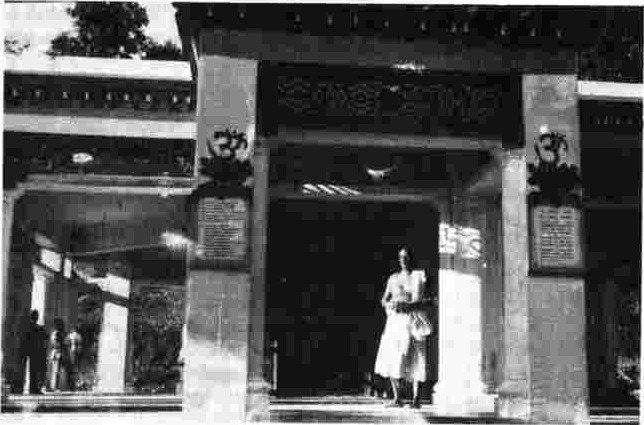
Swamiji outside the temple
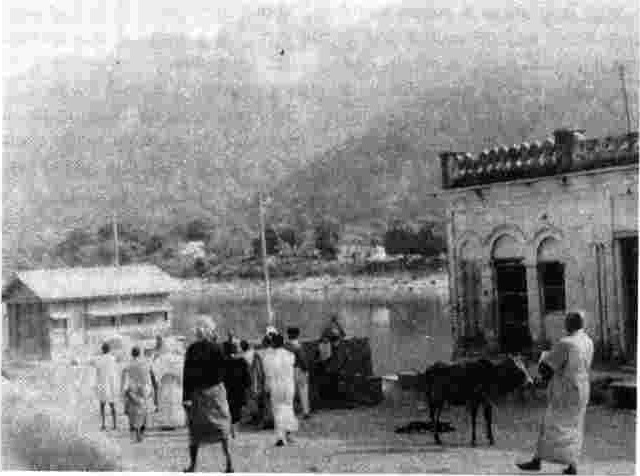
A general view
At about the same time Swamiji moved to the kutir on the bank of the Ganges. The ashram had grown, too. The number of inmates was steadily increasing.
The previous kitchen was transferred to a bigger room in the same block; and that room was given over to Swamiji to be used as an office. The almirahs contained his books; there were a few typists in front of him, ready to type his precious writings and letters. The secretary worked in the next room. When the post office came, it was accommodated in the last room in the same block.
It was wonderful to see Swamiji sitting on a small sofa, with a small table in front of him, absorbed in a letter from a seeker after Truth, and to see him walking briskly with a few letters to hand them over to the postmaster himself. Even in Malaya he himself insisted on posting every one of his letters. As he dropped them in the post box he felt that he had handed it over to the addressee. (Later, that was the feeling with which he looked over every packet of books and then placed them on the table.)
It was a grand and glorious sight to see him sitting on one of the cement benches flanking the kitchen verandah, discussing problems of world interest with his secretary and other inmates of the ashram, to see him go from room to room, enquiring about the welfare of the inmates, their needs and necessities and giving them, as a token of his supreme love for them, some almonds, curd, butter, fruits, etc.
The moment an aspirant or visitor expressed a wish to have a personal talk with him for spiritual enlightenment or for clearing some doubts in sadhana, Swamiji would at once take the aspirant to the open terrace over his old kutir and patiently hear what the aspirant had to say, and clear his doubts.
Before 1941, the ashram satsang (congregational prayer) used to be held on the verandah of the Rama Ashram. After Swamiji occupied the present kutir and the Bhajan Hall was built, in summer the satsang was held on the verandah (which also served as the dining hall during meal-times). In winter it was held in the Bhajan Hall. Swamiji was always the first to arrive and the last to leave. The evening satsang was extremely solemn, except when there were many visitors; and, after a period of study of scriptures (Gita, Upanishads, some Puranas and one of Swamiji’s own books), the entire gathering would meditate or sing kirtan. There were no lights, except for a small oil lamp at the temporary altar,and a hurricane lantern used only during the study-period. Swamiji’s radiant countenance as he emerged from his room to take part in the satsang, and as he re-entered it afterwards, was an object for meditation. Equally so was the great figure clad in an overcoat and turban, with a lantern in one hand and the inevitable bags in the other, walking majestically along the road towards the Bhajan Hall in winter. There was inexpressible grace in the long arms swinging rhythmically with each step.
The Bhajan Hall served Swamiji not only for the purpose of conducting his satsang and prayers, but also as a sportsfield, for soon after the morning class and after having attended the puja in the temple, he would run around in the Bhajan Hall for his morning exercise.
The Diamond Jubilee year (1947) saw a number of additions to the ashram. The Diamond Jubilee Hall was built to house the office which had by then grown enormously and, for want of accommodation, had been scattered all over the ashram. Swamiji’s office was also in the new hall. The post office was moved to where it is at present. During the Diamond Jubilee year in 1947 the Vishwanath Ghat was constructed on the bank of the Ganges, and a block of three more kutirs was added to the ashram. It would not be incorrect to say that this year in particular introduced a period of intense activity and unlimited expansion. Swamiji’s glory had spread to the four corners of the globe, and people came forward to carry out his wishes with great joy.
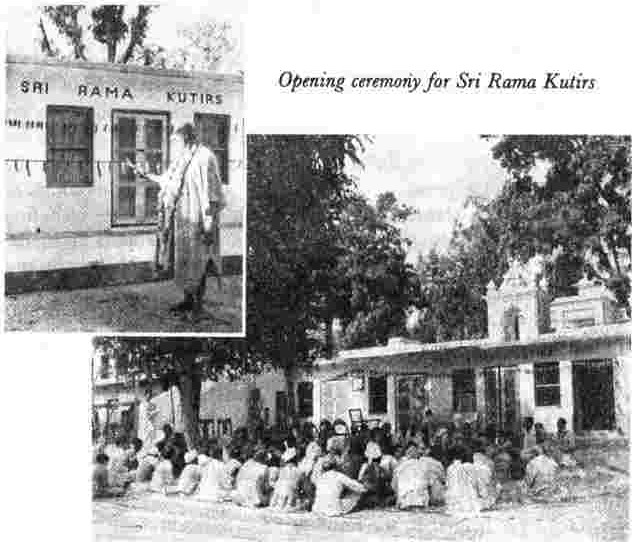
Opening ceremony for Sri Rama Kutirs
The All-India Tour in 1950 resulted in a continuous stream of visitors flowing into the ashram: more and more kutirs were needed. Rooms in the neighbourhood had to be rented. The ashram had grown into a nagar (township) — Sivananda Nagar.
(A miracle brought into existence the ‘Gyaneshwari Kutir’, near the temple. In 1948 Swamiji and a party of devotees went to the residence of Yogiraj Sri Gauri Prasadji, a retired judge, in Swarg Ashram, and conducted sankirtan there. Soon afterwards the departed soul of the yogi’s grand-daughter expressed to him the desire that she wished to ‘live close to Swamiji’. In deference to her wish he immediately donated the kutir.)
Supreme guru-bhakti (devotion to the guru) of Swamiji’s disciples took the shape of the beautiful marble temple known as Sivananda Mandir (wherein is enshrined the marble statue of Swamiji) and the grand Sivananda Pillar on which are inscribed his life-transforming teachings.
Whilst all this was taking place a two-storeyed building was being constructed which was to house the professors of the Yoga Vedanta Forest Academy as well as some of the students — especially foreign students. This building was completed in 1954, and the opening ceremony was performed on the 26th June, 1954. Even the construction work going on throughout the year could not keep pace with the donations received for the construction of kutirs. Thereafter another two-storeyed building known as ‘Parvati Kutir’ was built, as well as another group of rooms which were built over the old Yoga Sadhana Kutirs. And finally, when the government sanctioned the hillock adjacent to the ashram in 1958, the Mt. Kailas Kutirs were added to the ashram. These delightful kutirs, as also most of the well-planned blocks of rooms in the ashram — including the Eye Hospital building — were designed and constructed under the supervision of Sri Swami Madhavanandaji. Before him, Swami Vishnudevanandaji was in charge of construction, and the Sivananda Mandir was built in his time. Earlier Sri Swami Nityanandaji did this seva (selfless work) when the Siva Kutir and a number of other kutirs were constructed.
In 1944, the Divine Life Society acquired the ‘Vishwanath Bagh’ (Garden House) on the Hardwar Road at Rishikesh. Sri Swami Shraddhanandaji constructed a cave in it; and Sri Swami Shankaranandaji later on not only converted it into a vegetable and flower garden, but also remodelled all the rooms into concrete buildings.
Many have helped in the building of Sivananda Ashram, but the dynamic spirit behind every new construction, the inspirer and the one who, by his own unique methods would keep the flame of inspiration ever bright in the hearts of those who had the blessed good fortune to help him in this noble mission, was Swamiji himself. The ashram, therefore, reflects his personality, his dynamism and his untiring spirit of selfless service. In that sense it would be true to say that every brick of this grand structure has been laid by him. And apart from this, it is literally true in the case of the construction of the Vishwanath Mandir: Swamiji himself used to carry bricks on his head when the work was going on.
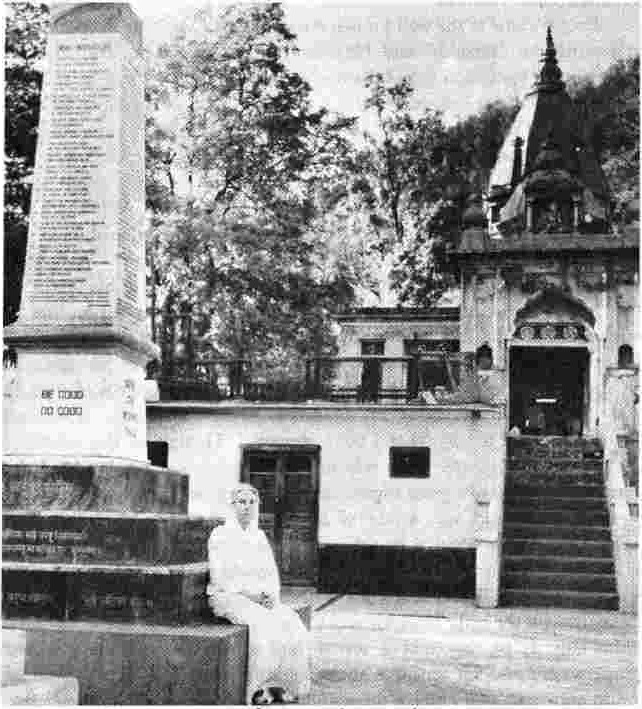
The Sivananda pillar with the temple in the background
(Since 1944 the growth of the ashram has gone on apace. The total number of rooms is in excess of 200.)
Treatment of Visitors
People came to the well-known Ananda Kutir with the devout desire of having the ‘darshan’ and blessing of this mahatma, and to their surprise and confusion found themselves confronted by a stately, stalwart sadhu (monk) who behaved as if it was he who had come eager for their darshan. For instance, a certain lady from South India came to have Swami Sivananda’s darshan. At that time Swamiji was in the office and she was shown in. After some time she came out and asked some ashramites standing there “Where is Swami Sivananda?” When she was told that it was from him she was coming, in great astonishment she gasped: “Oh! I thought he was the manager. Is he the saint?” With tears in her eyes she ran again to the manager-monk, and fell at his feet.
To see him cutting jokes with everyone gave the impression that he was a worldly man, but one who was perceptive could not but be dazzled by the exquisite lustre of his eyes which ever revealed his spiritual greatness. Yet, not withstanding the unmistakable atmosphere of serenity and dignity that pervaded his presence, every movement, word and action appeared to say, “I am your servant.” Though he was a seer of great repute, a teacher and reformer of nation-wide renown and the founder and head of a great organisation, Swamiji seemed quite oblivious of these facts, and was aware of himself as the cosmic servant and worshipper. Even when a dozen willing students of his were ready to hasten to serve him at a single word, one would find at times that before a cup of milk could be ready for a tired guest, Swamiji himself would come up with the milk from his room, and some fruits as well in his little white bag. If he saw that a visitor had a naturally shy or reserved temperament and felt sensitive about making known his needs, Swamiji would anticipate every one of them and an ashramite would be directed to attend to all his wants even before he asked for anything.
When he went for his evening walk Swamiji was always in the habit of carrying with him some fruit, some little tit-bit or perhaps an interesting book which he would take to the room of anyone to whom he could give it. Whilst on his way to his room at midday, happening to see some sadhu being served with bhiksha by an ashramite, at times Swamiji would stop there to drive away the monkeys and pour water for the sadhu to wash his hands. On such occasions remonstrances were of no avail. If his devotees had presented fruits and sweets to him as an offering, Swamiji would at once start giving them to every soul in sight. If the servant boys, the barber, the postman, a passing beggar or scavenger happened to be on the spot, they all got their share.
On the eve of periodical functions in particular, when feeding on a large scale was to take place, before the hired cook had begun to prepare the special sweet dish Swamiji’s childlike impatience would overcome him. Quickly offering a little to the Ganges he would heap up all that was ready and hasten to distribute it. He did not give with one hand, but would scoop with both hands from the plate and pour it into everyone’s hands. At times he forgot to distinguish between adults and infants in his fervour to give. Several times one would witness the comic terror of a suddenly wide-eyed child confronted by the extended palms of Swamiji, heaped with a quantity of sweets such as would hardly be possible for it even to hold, let alone carry.
He amazed the orthodox type of sannyasins by his manner of service to his devotees. A guest would feel that he was monopolising the entire time and attention of Swamiji and that the latter was bestowing the most exceptional care upon his comforts. The visitor would find that no sooner was a room allotted to him than he was besieged by a dozen kind enquiries as to his needs. Water would be placed in his room, a lantern provided immediately, a mosquito net if it was summer or an extra blanket or two if the season was cold, an easy chair if he happened to be old or an invalid. Then Swamiji would finally ask the librarian to issue any book that he desired to study.
Observing this extreme and meticulous manner of Swamiji’s care and attendance proved a revelation to many visitors who said frankly, “We are really put to shame by Swamiji. He teaches us householders the true method of treating and serving guests. Swamiji has perfected the art of hospitality and we feel that we must learn many points from him. We thought that as householders there was little that we did not already know about entertainment, but here is one who is a model to be copied, even by us.”
The manner of treatment of visitors and guests at this remote ashram was truly an eye-opener. The ashramites as well as anyone connected with them could well be proud of it. Swamiji was like a watchdog in this respect. His instruction to his beloved workers was never to be overbearing to any visitors. He would constantly say: “If you try to view everything as Atman you must express it in all your actions. It’s no good to have your head in the clouds while you keep your palms clenched in your pockets. It does not matter whether they derive any extraordinary spiritual gain or not, but people staying here for some time must at least enjoy real peace. Later, whenever they remember the love and kindness they received here they will also be reminded of the peace of the Ganges, the kirtans and other spiritual ideas associated with the place. Serve them, therefore, with bhava (feeling). Ashrams and maths must serve as examples to show what selfless service and disinterested love mean.”
By this loving attention and kindness Swamiji achieved his object of awakening each one in a manner suited to his capacities. Together with hospitality and service he managed, within the short period of their stay, to transform the ideas, opinions and conduct of people. He did this in a manner peculiarly his own, making them pick up some kirtan, learn a few asanas, do simple pranayama and lecture a couple of times before a small audience. He acquainted them with the practice of likhit japa (mantra writing) and taught them the method of maintaining a spiritual diary and how to draw up a rational daily routine. Visitors also got to know how to conduct meditation, prayer and study classes. In brief, by the time they departed each one virtually constituted a potential nucleus for the further propagation of divine ideas and spiritual practices. Within a short period of a week or ten days the visiting aspirant or devotee managed to learn many a thing in a concise but clear manner.
Swamiji said: “One has to follow the policy of ‘short and sweet’ in the world of today. The traditional piety is conspicuous by its absence and the people have very little time to spare nowadays. Everything has to be made to suit the nature of the occasion. Life is short and days and years pass away. So when people are with me I quickly give them whatever I have to give, according to their need and particular temperament.”
Swamiji’s concern did not end with the ashram visitors but embraced some less welcome ‘guests’. He would not even allow others to harm any being on earth. Once an ashramite had taken out the cot in which Swamiji used to sleep, and discovered that it was an abode of bugs. ‘Guru-bhakti’ (devotion to the preceptor) surged in his heart and he wanted to exterminate the little creatures that disturbed Swamiji’s sleep. He prepared a big swab and dipped it in kerosene oil and began to apply it to all the hideouts of the bugs. The bugs were lucky (and why not, they had enjoyed Swamiji’s holy company every night!). Swamiji appeared on the scene. A look of intense pain on his face halted the disciple’s destructive process. “Ohji, please don’t do this,” he said.
“But Swamiji, this cot is full of bugs and that is why Swamiji is unable to sleep,” replied the disciple.
“It does not matter. Take the cot and leave it in the jungle for a few days; and in the meantime give me another cot,” came Swamiji’s quick answer.
Similar was the protection that the rats that had taken refuge in Swamiji’s dwelling got from him. A few of them began to eat away the papers and to destroy the bedding and clothes. The disciples working there caught them and all that they could do was to give the rats a joy-ride in a cosy gunny-bag; but the rats invariably returned to the place that very evening. They even began to appeal to Swamiji’s mercy by nibbling his toes at night. For a diabetic this could be dangerous. An expert arrived at the ashram and he gave his expert advice on the elimination of the rat-nuisance. Of course, he had no solution simpler than poisoning the rats. Swamiji who always listened sympathetically to every kind of topic — pleasant or unpleasant, sacred or secular — for the first time refused to listen. “No, no.” He vigorously shook his head. “The rats should not be killed. On the contrary we should take care of the things that we wish the rats should not destroy. Manuscripts should remain in steel cabinets; bedding and clothes, too should be well protected against rats. They should never be killed!”
If the expert said anything more he would have earned regular food for the rats, as others had done who pleaded that the monkeys living in the ashram neighbourhood should be driven away. Swamiji quickly countered this suggestion by sanctioning a regular supply of gram for the monkeys!
In 1949 sometimes the evening satsang used to be held in Swamiji’s kutir. After the satsang was over Purushottamji used to spread Swamiji’s bedding. One day when he opened the almirah to take a bed sheet, he found one new and costly sheet completely torn into pieces by a rat, and inside it were its four new-born babies. They had hardly opened their eyes. Purushottamji took the sheet along with the little rats to show them to Swamiji. When Swamiji saw the tiny creatures his heart was filled with compassion and he felt greatly pained for having disturbed them from their place. He asked Purushottamji to put them back immediately in their original place in the same condition, lest their mother should miss them. In a day or two, however, the mother rat met her death at the hands of a cat. Soon afterwards the little rats also unfortunately died. When Swamiji saw the dead rats an expression of pain came into his eyes. He did maha mantra kirtan for the peace of the departed souls of the rats.
During the summer season scorpions are plentiful. On the verandah of Swamiji’s kutir, where the evening satsangs were previously held, a pair of tongs were kept for picking up the scorpions and throwing them away. One night a visitor saw a scorpion during kirtan time. He crushed it to death with his torch-light. Swamiji happened to see the incident, and immediately after the kirtan he called the visitor and asked him why he killed the scorpion. The man replied: “It is a cruel creature and stings people.” Swamiji retorted: “By killing one scorpion are you able to save people from the stings of scorpions of which there are millions in the country? To kill the creature it probably took you only a few seconds. But can you give its life back again? When you have no strength to give life back to the dead how could you take life?” The visitor was taken aback, prostrated before Swamiji and said that he was sorry for the incident and that he would never kill a creature in his life again.
Training in Self-Reliance
Swamiji trained his early disciples with great care and thoroughness and instilled into them the missionary spirit of service.
He always emphasised that they had been trained to face all eventualities. For instance, when the possibility of some litigation involved in the publication work was being discussed, he wrote in a letter dated 2nd July, 1935: “One should have every kind of experience. Then only fear and feeling of shame will disappear.”
Almost the same words were uttered by him in 1955 when the ashram authorities were hesitating to file a complaint against the absconding inmate who had been the ashram postmaster: “If that is the right thing to do, then do it! I am not afraid to go to court. We should welcome dishonour as well as honour.”
Swamiji’s disciples had to face a severe test in 1941. It was perhaps designed by Swamiji to test the devotion of the disciples to himself and to his cause, and to train them for all eventualities. On the 18th February, 1941, Swamiji left the ashram without the knowledge of anyone. He left a note which said: “I have nominated Swami Paramananda, my senior disciple, as the president of the Divine Life Society... as he is in close contact with me for several years... I have to retire immediately for reason of my poor health.”
The disciples started searching for their master, each in a different direction, while those who had specific duties stuck to their posts. They were put through the ‘fire test’ and proved worthy of the confidence that Swamiji had placed in them. They had matchless devotion for him, and were ready and eager to carry out his behests. They would carry on the mission without his personal stimulus, and worked as a team. This was what Swamiji wanted.
In a supplement to the March 1941 Divine Life magazine, Sri Swami Paramanandaji wrote:
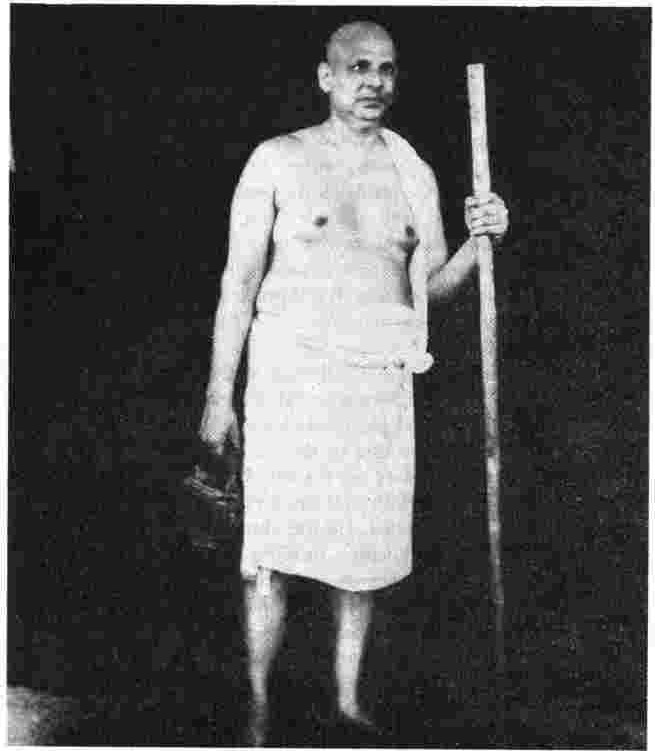
His holiness Sri Swami Sivananda Maharaj. Born in 1887. Served as a doctor for ten years in Singapore. Returned to India and entered the order of Sri Sankara in 1923. Settled down in Rishikesh for tapas and seclusion.
Sri Swamiji has a heart full of unlimited mercy and love. In order to serve humanity on a large scale in a systematic and organised manner, he established the Divine Life Society in 1936. He remained in a small hut on the bank of the Ganges, and for the benefit of the whole world he turned out tremendous work in various directions. He has initiated 200 sannyasins and brahmacharins. Every word of his writings is filled with power. Thousands have been given a new life, derived fresh energy and hope, inexpressible joy and peace through the grace, mercy and blessing of Sri Swamiji.
On the unforgettable day of Tuesday the 18th February, 1941, Swamiji retired from the active field of the D.L.S. work. He has again taken to seclusion, either in the deep forests of the Himalayas, or in the plains on the banks of the holy Ganges. He left Ananda Kutir with a single cloth, without any money and without taking leave of anyone, at about 2 p.m. If anyone is fortunate to meet this magnetic personality, we request him not to disturb Swamiji in any way. But if people happen to meet him they may have his darshan and take care of his body when the opportunity arises.
Swamiji has given us definite lines to work on in the spiritual path. He has guided us for a long period, and now he wants to see how we act our part. No doubt this is a severe test, especially when all his students are so young in the spiritual path. If we make an earnest attempt to carry out his will, by his grace we are sure to come out of this difficult trial successfully. Sri Swamiji Maharaj’s love for us is unbounded. He will always dwell with all of us. He cannot desert us and deprive us of his darshan. He cannot injure anyone in any way. When we give satisfaction to our master, we are sure that he will again give us darshan in the near future and guide us further in the spiritual path till we reach the goal. It is his duty. He will not fail in any way to do his duty, but we must carry out his instructions to the very letter.
Special prayers will be conducted in all places, by the members of the Divine Life Society and the disciples of Sri Swamiji and inmates of Ananda Kutir, for his good health and early return. At all Birthday Celebrations on the 8th September of every year we hope Sri Swamiji Maharaj will give darshan and bless all his devotees.
This announcement is dated 21st February.
This ‘Supplement’ also carried an ‘Open Letter’ to Swamiji signed by ‘Admirers, sannyasins, brahmacharins, disciples and members of the Divine Life Society.’ A few interesting extracts taken from it are given below:
The last letter from thy holy hand is a boon to the whole world because it contains your definite instructions for us to follow. We assure you that we will carry out all your instructions to the very letter. Thy will is strong and powerful. Thy grace and blessings will work wonders. We have strong faith in thy lotus feet... You have guided us all... Every moment of your life had something for us to learn... The wealth of the whole world is at thy feet. How very happy the world will feel, if we had made suitable arrangements for thy comfortable stay in seclusion!... The condition of the inmates of Ananda Kutir is now pitiable. Some have given up taking meals, some have stopped sleeping, some are wandering around in wild jungles like mad-men, in anxious expectation of thy darshan. A word from the master by way of a letter will bring peace and joy to millions.
Then follows a progress report on the item dearest to Swamiji’s heart:
Now the Gita: Part VI, Inspiring Songs, Philosophy of OM, Mandukya Upanishad, and Inspiring Messages for All, are all ready and the first copies wait at Ananda Kutir for thy blessings before release. We are certain to get help from all quarters for the quick publication of all your latest writings, and one by one all will be printed.
Blessed is the movie camera that was purchased from the donations given by your devotees for the 54th Birthday celebrations. Due to our ignorance and foolishness, we did not use the camera well. We have taken only 300 feet of your daily activities at Ananda Kutir. Whenever we yearn for thy darshan, at least we will have thy darshan through the films on the screen. For the sake of future generations, kindly have mercy and give us darshan — we will record some more of thy actions.
On the day Swamiji left he went to the post office in the morning and asked for two rupees. He had only a dhoti (a piece of cotton cloth which men in India wrap around their waists) and an upper cloth with him; he played with the two rupees for a short while like a young child. It was the custom in those days that no one would disturb Swamiji when he rested in his kutir in the afternoons, and it was during this period that he slipped out of the ashram. On the way near the Rishikesh toll gate Sri Swami Abhayanandaji and some other mahatmas met him and greeted him: but he would not be drawn into conversation. Perhaps he was observing the vow of silence. He passed through Hardwar where he spent a night on a public platform, and then continued his journey via Jwalapur, walking along the canal side. Near Kankhal in the village called Jagdispur he took rest under a tree. His wonderful personality attracted the attention of the villagers, one of whom served him. This man had a sugar-cane farm, and he served Swamiji with food and sugar-cane juice. He was so moved by Swamiji that, thinking that he must be a great mahatma, served him with devotion and faith.
In the meantime, everyone at Rishikesh, Hardwar and throughout the entire district knew that Swamiji was missing. One of the swamis who had gone in search of him found him at the home of the sugar-cane farmer and begged, “Please come back to the ashram.” It was only then that the farmer realised that he had been host to a very great sage. (This man became a great devotee of Swamiji and every year used to bring two big drums of sugar-cane juice in commemoration of the wonderful event!)
Accompanied by the disciple who had found him, Swamiji returned to the ashram in a car on the 24th February, at 10 a.m. On his return he wrote the following letter to Swami Paramanandaji, who by that time was at Lahore: “Your mighty will, plus that of others, has again dragged me. You will have to manage everything. I will be in name only. Mysterious are the ways of Lord Siva. May his blessings be upon you and all... We must always be prepared for anything and everything. Be cheerful and bold.”
The mission did not rest with the building up of a powerful central organisation, but needed independent, capable, well-trained saintly disciples of the sage who would be willing to work anywhere to further the noble cause. Their capacities had been tested, and their willingness to work. Would they sacrifice his close proximity, and even if they had to leave in unpleasant circumstances, would they continue the noble mission?
That test came in 1942. Paramanandaji had been asked to leave the ashram. When he left on the 3rd October 1942, Swamiji gave him a general letter of introduction: “Swami Paramananda is my disciple. He lived with me for a period of ten years. He considerably overworked himself during these years and so is taking rest.” This paved the way for the wider expansion of the Divine Life Mission.
Wherever he went, Paramanandaji spread the glory and the gospel of Swamiji. He also had several of Swamiji’s books translated and published in Urdu and paved the way for a later establishment of a dynamic Divine Life Centre in Madras. This example was followed by many other sannyasin disciples of Swamiji, who went to different centres and established ashrams and institutions both in India and later abroad, for the furtherance of Swamiji’s mission. (Paramanandaji also visited several branches of the Divine Life Society, and galvanised them. He won the appreciation of the public and also of Swamiji, who wrote on the 31st October, 1951: “I am receiving several letters from the branches you visited, where you exhibited the film. Countless appreciations. No one has done such work. It is unprecedented.”)
The question of finance did not worry Swamiji. He knew that once the workers were looked after, their enthusiasm kept up and their spirit of service preserved, the work would be done efficiently, and public support in the form of donations would be forthcoming in abundance. “Money or no money,” he said on the 2nd October, 1949, “you must take care of the body. If you are not looking after this instrument of the Lord, then you are not worshipping God properly. The best worship of God is to maintain this body in proper condition, to enable it to work out His will in the best manner possible.”
One of Swamiji’s most amazing characteristics was his supreme optimism. When there were only twelve inmates in the ashram and they used to take their meals inside the kitchen room itself, he would often come in and, with an indescribable light in his lustrous eyes, say: “A time will come when our diner’s line will extend from Rishikesh to Lakshmanjhula.” That was not in fun. Even by 1959 if all those who took their food in the ashram’s annakshetra (dining room) were seated in one row they would cover a considerable distance. The following remarks of Swamiji made on the 2nd October, 1949, echoes this spirit:
“Money will come; money must come; very soon there will be crores and crores. You won’t be able to count the money! Believe me: such a time must come. You can best help that if you all work hard.”
For two months during the All-India Tour in 1950 so much money poured into the Tourist Car and thence to the ashram, that it was difficult for two swamis to count it! His words never proved false.
The above quotation should not be taken to mean that Swamiji had wealth as his goal. No. His attitude is best explained in his own words:
I never thought of starting an ashram. When the great rush of students and devotees came to me for spiritual guidance, with a view to render help to them and to make them useful to the world, I created some fields of activity for their evolution and for the public good. I encouraged them much in their studies and their sadhana, and I arranged the necessary comforts and conveniences for their boarding and lodging, using the donations I received for my personal use from some admirers. Thus in course of time I found around me a huge ashram and an ideal institution with a congenial environment.
I did not work with big plans or schemes. I did not approach any great person or maharajah for getting money. The world appreciated the service done here on the right lines. A little help came from the divine source and I carefully utilised every cent of it for bringing maximum spiritual good to the world. Several new palatial buildings crop up every year and yet there is lack of accommodation for the inmates and the stream of visitors. At every stage, there was splendid development of work. On many occasions devotees pressed me to undertake propaganda tours for collecting money. That was impossible for me. I take delight in giving and serving all. In 1940 grand arrangements were made for an extensive tour in the Punjab. I cancelled the programme and sent the following telegram at once: “I do not care if the Divine Life Society flourishes or not. If it is the grace of the Lord and if we carry on our sadhana and service with the right attitude, inner feeling and faith, help is bound to come from the Divine Source. Let me do as much as possible by remaining in my own small kutir on the banks of the Ganges. When the honey is there, the bees will come by themselves. Shun ruthlessly the desire for money.”
In a short period the work grew. Regular classes are now conducted on yoga, bhakti, vedanta and health. Today over 300 students live by my side with all comforts and conveniences, treading the path of yoga, and serving the world in a variety of ways.
Blueprint for the Institution
On the 18th February, 1949, Swamiji gave a discourse upon the glory of sannyasa and duties and responsibilities of the sannyasin. His own remark that one of the main advantages of life in the ashram was the protection it gave the sannyasin from the onslaughts of worldly influences, led Swamiji into the topic of the conduct of the institution itself:
No one should feel estranged in the ashram. Everyone has got so many faculties. There is capacity also to do something grand. The will of the Lord also guides them. But the difficulty is that when a man leaves his hearth and home, his wife and children, his parents and relatives, his wealth and position, he feels that he is entitled to be independent and refuses to be bossed over. We should appreciate that, or at least recognise its existence. Each sadhaka, therefore, should personally take care that this independence does not grow into arrogance. Those who run the institution should not hurt the individual’s feelings, nor make him feel that he is being looked down upon. Each department, the moment you entrust it to a particular person, should be almost independent.
There is a difficulty in this. For instance, there is the Ayurvedic Pharmacy and the Publication League, etc., where saleable items are stocked. If those who handle these things are left to themselves, maya will spread her net over them and instigate them to pilfer, thus ruining themselves and the institution. The system should be fool-proof and there should be frequent checking also.
This should not lead us into a suspicion complex. If those who are responsible for the various departments feel that they are being watched with suspicion, their interest and zeal will be lost. Just once in a while have an eye open. It is not only good for the institution, but will prevent the individual from falling a prey to evil.
Earlier in the day Swamiji had said:
Sannyasa is not an easy thing. I think that in sannyas life, too, we shall see all the lilas that characterise worldly life: fights and quarrels, jealousy and hatred, passion and greed. Many sannyasis have gone back to the household life after having embraced sannyasa. They had all taken sannyasa perhaps before they were fit for it. Some of them have again come back to a life of renunciation and thenceforward have been very good sadhus. Evil is there inside; man has got to be vigilant and to exert always to annihilate it.
Every ashramite should be made to feel this is his own home. Especially those who do not belong to your caste, creed, community or group should be especially well looked after, lest they should feel, ‘Because I am a Punjabi, I am neglected by these Madrasis’. They should be made to feel that they are in fact looked after better here than they would be in an ashram where their own people predominate.
And there should be a sort of tribunal to settle grievances and to listen to complaints. This should meet once in a while and iron out the differences that may crop up between man and man.
Old workers (I mean both those who are aged and those who have served the institution for a long time) should be well looked after. If a sadhak has served well for three or four years and has been very useful to us, the Society should attend to his needs till the end of his life. What little service they can render to the Society they should voluntarily do. There should be no extraction of work from them. They should be allowed to meditate and progress in their sadhana. Nowadays we are not making any arrangement for people who would like to spend their days in meditation practice. Krishnanandaji, Achyutanandaji and others like them should immediately be provided with kutirs where they can carry on their meditation in seclusion. Premanandaji should also be given a room somewhere up the hill. He has greatly overworked. He needs immediate relief and rest. Food, milk, fruits, biscuits, coffee and tea; everything that they need should automatically reach their kutirs without their asking.
But this should not bring about an effeminacy in you. Some people have an intriguing nature. They will create parties, cliques and troubles. With them you should be polite but firm. Say “Om namo Narayanaya! Swamiji Maharaj, you can leave the ashram.” These vipers should not be allowed to poison the atmosphere, and create internal dissensions.
These are just some of the thoughts that occurred to me. Keep them in mind. The organisation has grown world-wide beyond our own expectations. It is better therefore that we adhere to certain principles. The whole world looks to us for guidance. It is essential that the main hub of the institution should be efficient and run on systematic lines.
I have a feeling that even if all of us disappear from the scene, the Lord’s will will work itself through other instruments. But that should not lead us into complacency. We should exert our utmost to do our bit.