Sivananda: Biography of a Modern SageHis life, by Swami Venkatesananda
DEVOTION
Satsang
One of the most important sadhanas is satsang. In 1924 when Swamiji entered Rishikesh he had only just become a swami and was still a mendicant and almost unknown. He was about forty and as such was fairly junior to the other great holy men in Swarg Ashram, but as a bold and practical idealist he discovered even then that satsang was the fan to keep alive the fire of God-love in the spiritual aspirant’s heart, so he worked to bring all these holy men together in satsang. He suggested: “Why don’t you all get together on the same platform so that all the people may see you and listen to you.” He fixed up a platform and spread the mats and cushions for the holy men to sit upon, but he kept in the background.
When he moved over to the present ashram site the first thing he did was to ensure that there was satsang every night in the ashram —summer, winter or monsoon. In winter it was held up on the hill where it was less cold, and in summer on the bank of the Ganges where it was cooler.
Swamiji was the ‘sat’ in the satsang, or, the divinity whose company was sought by those who gathered there. He was a holy man and he didn’t need anybody’s company; and yet, walking with the aid of a long stick, he used to go to the satsang every night. When the body didn’t allow even that he used to hold the shoulders of two people and walk to satsang. Nobody could prevent him. Later, when he was not quite sure whether the legs could even sustain his body, he said, “Oh, the legs are a bit wobbly. Bring me a wheelchair”. He who but a few years before was in wonderful health, was not at all reluctant to be wheeled to the satsang. When he could no longer sit on the floor he sat in an easy chair. When the body was ill and weak he couldn’t even sit, so he would lie down on the floor — but he would not miss satsang.
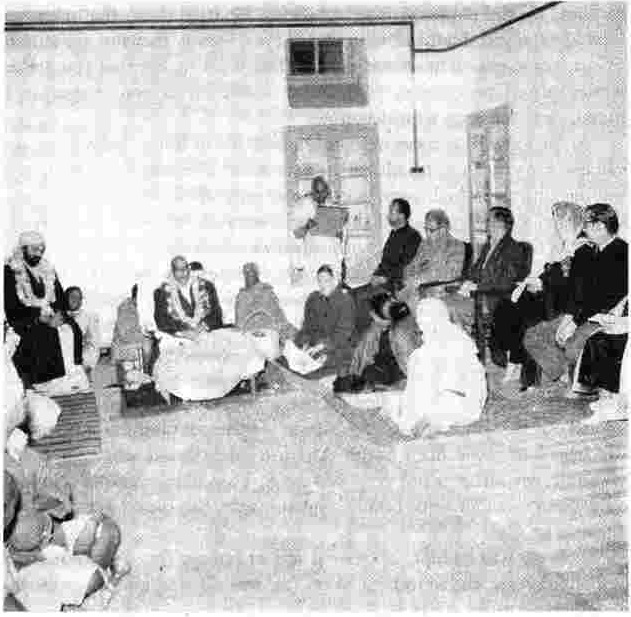
Once a visitor missed out on satsang on the second or third day. Swamiji noticed it and asked him next day why he hadn’t come to satsang. The visitor replied that he was not very well. Swamiji said, “That is the reason why you should come to satsang. If you are not well you must definitely come to satsang. You will get well there.”
Swamiji’s satsang was unique in many ways. It beautifully combined songs in praise of the Lord, chanting His names, music, study of scriptures and discourses, etc. In the beginning it was very austere, and even cymbals were not allowed. There were no electric lights and even other lamps were scarce. It was usually conducted in almost complete darkness, except for a little lamp at the altar and a hurricane lamp for reading purposes. Swamiji was always looking for a sincere expression of love and devotion. He did not encourage hypocrisy. He used to say that when you chant kirtans you should sit with closed eyes, feeling that you are singing to God, not to entertain an audience. When you sing like that you are not worried about your voice, your throat condition or your expertise in singing, but you sing with devotion.
In the early days there were only about ten or fifteen ashramites and perhaps ten visitors, who all sat in two rows. The satsang started with opening prayers (which were later greatly expanded) and then the lamp was passed to the first person sitting on Swamiji’s left, who would read a chapter of the Bhagavad Gita, with or without translation. As soon as that was finished that person would lead in chanting a kirtan and then the lantern would be pushed to the next person, who would read from some other scripture. This person would also lead the next kirtan and so it would go round.
Everyone had to lead in singing a kirtan, it was not enough to sing in chorus. Swamiji would not accept any excuse or explanation. He pointed out that shyness was an obstacle to spiritual progress. One young lady who had come from South Africa tried to avoid singing, saying: “Swamiji, my throat is not very well today. I am a little hoarse”. Swamiji immediately sent for some bitter cough mixture. She didn’t know whether to take it or not!
Nobody was exempt, because it was in satsang that one found one’s foothold in yoga, and found out where one was slipping and how to steady oneself.
When everyone had finished chanting Swamiji would conclude with the maha mrityunjaya mantra. The satsang concluded with arati and the following peace chants:
Om sarvesam svasti bhavatu, sarvesam santir bhavatu, Sarvesam purnam bhavatu, sarvesam mangalam bhavatu, Sarve bhavantu sukhinah, sarve santu niramayah, Sarve bhadrani pasyantu, ma kaschit duhkha-bhag-bhavet.
Asato ma sat gamaya, tamaso ma jyotir gamaya, Mrityor ma amrtam gamaya.
Om purnamadah purnamidam purnat purnamudacyate, Purnasya purnamadaya purnameva vasisyate, Om santih santih santih.
May all be blessed with well-being, auspiciousness, peace and fullness. May all be happy and free from illness. May all see only good: and may no ill befall anyone.
O Lord, lead me from the unreal to the Real, from darkness to Light and from death to Immortality.
The Lord is full; the creation is also full. The latter has come out of the Lord, and yet the Lord is ever full. Om Peace, peace, peace.
After this Swamiji would walk away very quietly to his kutir so that the profound thoughts and ideas from the scriptures would still be fresh and ringing in the hearts and minds of those who had attended, as they went to bed.
This was the basic structure of his satsang.
Swamiji also encouraged people to have satsang in their own homes, perhaps with a few neighbours, choosing their own scriptures.
Songs
Swamiji once said that when he went to Rishikesh all that he wanted to do was to sit under a tree, to sing God’s names and do japa. He was so fond of kirtan that there was not a single function which commenced without it. Every occasion demanded the singing of God’s names. If someone was sick, dying, born or married; for laying a foundation-stone or pulling a building down, he sang the mahamantra:
Hare Rama Hare Rama Rama Rama Hare Hare, Hare Krishna Hare Krishna Krishna Krishna Hare Hare.
which was his favourite. He was so fond of this mantra that he instituted the continuous chanting of it at the ashram on the 3rd December 1943, and this chanting has been going on continuously day and night ever since, generating an all-powerful spiritual current, invisibly helping all aspirants in their spiritual endeavour.
Swamiji encouraged all organisers of conferences and other functions and celebrations of importance to arrange for the continuous chanting of this mantra to synchronise with the event, and assured them of success in their venture.
Though the mahamantra is more or less a common feature at the ashram gatherings, he had his own special songs for invoking various deities each day of the week.
Swamiji wrote many songs which are philosophically inspiring. They contain the very essence of his teachings. Here is one of them:
Sunaja sunaja sunaja Krishna Tu-gita-wala jnana sunaja Krishna. Serve, love, give, purify, meditate, realise, Be good, do good, be kind, be compassionate. Enquire ‘Who am I?’, know the Self and be free. Adapt, adjust, accommodate, Bear insult, bear injury, (This is) highest sadhana. Be honest, be sincere, be truthful, Be patient, be obedient, be tolerant. Be gentle, be humble, be noble, Be bold, be pure, be wise, be virtuous. Be still, be quiet, know thy self. Seek, find, enter and rest, Enquire, discover and recover. This is the way, this is the truth, this is life divine.
A remarkable characteristic of Swamiji’s songs is that they are non-dualistic at base. They vividly portray his ultimate realisation of Godhead and his catholic understanding that the Lord is thought of and worshipped in an infinite variety of ways by people of different temperaments and spiritual equipment.
Prayer
Another form of service which Swamiji strongly recommended was prayer. Prayer was not so much praying for yourself (not even for your salvation) but it was recommended as a form of service, of charity. So to pray — not only for the peace of all in a general sense, but in a specific sense — was part of his life.
Swamiji always insisted on his disciples praying for all absolutely unselfishly. At satsang and other times he would often ask all to pray for someone who was sick, or for the peace of the departed soul of someone who had died, or for someone whose birthday it was. Then he himself would conduct the congregational chanting of the Lord’s names and conclude with a two minute silent meditation and prayer. This prayer has literally wrought miracles.
In the early days another service was performed by the ashram. Swamiji had great faith in the maha mrityunjaya mantra:
Om tryambakam yajamahe sugandhim pustivardhanam, urvarukamiva bandhanan mrityor muksiya mamritat.
We worship the Lord who promotes health and strength. May he liberate us from death.
This wards off all kinds of accidents, bestows health and long life and ultimately confers immortality. This prayer was not confined to human beings. An injured dog or monkey would invariably invoke from him the maha-mrityunjaya mantra. Even a dead lizard on Swamiji’s path would earn this mantra for the peace of the soul. To Swamiji all beings were equal and prayer was always universal.
Devotees used to write to him saying that they (or a member of their family) were sick and asking him to conduct mrityunjaya-mantra japa. The disciples were all made to participate in this. There were only about ten in those days, and each was allotted so many malas a day. The secretary kept an account of how many malas of the mantra were done while remembering this person. Even if the disciple had not seen him he had the name at the back of his mind, and thinking of the person and praying for his welfare he did japa of the mrityunjaya mantra on the Ganges bank.
This was another form of service that Swamiji used to encourage. In this all the vital elements of sadhana were immediately introduced. Doing japa, sitting on the Ganges bank for about one hour is sadhana, and at the same time it was a service to the other man, a service to humanity. The disciple gained nothing out of it and so was taught how to be unselfish. An unselfish service covering also one’s own sadhana is a beautiful blend.
This used to be very regularly performed. When the required number had been completed there used to be a havan (fire ceremony), feeding of the poor people and so on, and the ritual came to a conclusion. By that time someone else might have asked for the mantra-japa again; so it continued.
Swamiji said: “When you pray for the health, happiness and peace of others you become a channel for the flow of divine grace. The water that is collected in a pond may become dirty sometime or the other, but the water that flows along a pipeline never does, because it is flowing all the time. So, if one continues to be the channel for the flow of divine grace, one’s heart is always pure and filled with divine grace.”
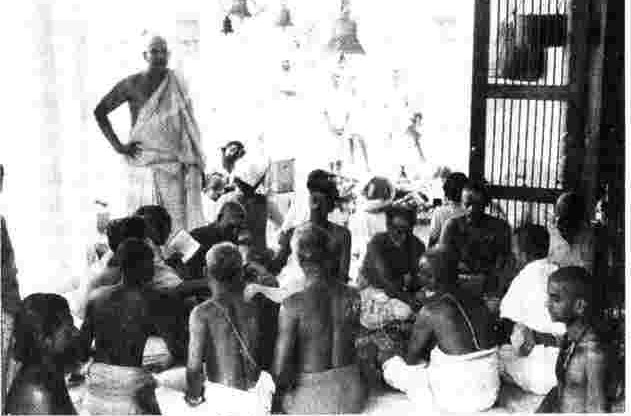
Concluding ceremonies
There is nothing new in this, people have offered prayers for thousands of years, but it is in this combination that Swamiji’s genius lay. In combining what is essentially regarded as a bhakti practice with a tremendous ideal of unselfish service, he performed a miracle. Japa and prayer were vitally important to him, not only for personal evolution but as an act of service of humanity.
Though as the natural ‘fruit’ of Swamiji’s bhakti yoga practices he enjoyed the visions of divinities and sages, though his prayers for the sick healed them and his prayers for the afflicted removed their afflictions and even altered the destinies of devotees, his utter egolessness was the supreme manifestation of bhakti.
Swamiji asked us to make our entire life one long prayer, by living for the realisation of God and for the service of humanity. Until prayer became habitual, he exhorted us to take the help of any prop available. Temples, idols, images, pictures, saints and sacred books etc., all should be made the best use of to keep up the constant current of prayer. Pictures of gods and goddesses were hung in the office and the prayer hall. He did not hang a picture up with the best of intentions and then forget all about it, as most of us do, but wove their existence into his daily life. As soon as he entered the office he would glance at them all. A moment’s silent prayer was offered before he commenced his work. When one task was completed and the next job was about to begin, or when one visitor left and the next was about to enter, he would lean back in his chair, close one eye and with the other just throw a glance at one of the pictures of God. Thus the contact with the Absolute was continuously kept up.
He was so serious about this practice that if one picture was disturbed or removed he would at once notice it and have it restored. What need had he, who was consciously rooted forever in Brahmic consciousness, to resort to these props of devotion? Only to set an example for others to follow.
This is the beautiful and soul-elevating Universal Prayer which he composed:
O adorable Lord of mercy and love Salutations and prostrations unto Thee. Thou art sat-chid-ananda (existence, knowledge, bliss absolute), Thou art omnipresent, omnipotent, omniscient; Thou art the Indweller of all beings. Grant us an understanding heart, equal vision, balanced mind, faith devotion and wisdom. Grant us inner spiritual strength to resist temptations and to control the mind. Free us from lust, greed, anger, hatred and jealousy, Fill our hearts with divine virtues. Let us behold Thee in all these names and forms, Let us serve Thee in all these names and forms, Let us ever remember Thee, Let us ever sing Thy glories, Let Thy name be ever on our lips. Let us abide in Thee for ever and ever. Om Santih Santih Santih.
Worship
Right from his Swarg Ashram days when he was a mendicant ascetic till the last moment of his physical life, Swamiji was not only a believer, but a firm practitioner of what is called idol worship. Sometimes he used a picture of Siva, but most often he used the picture of Lord Krishna with flute in hand.
Once Swamiji referred to this picture, saying, “The artist who painted it must have had a vision of Krishna. It is highly inspiring.” This picture was kept in his own puja (worship) room all the time, and there was not a single day when his body could move from the bed that the ritualistic worship of that picture was neglected. When he could not bend or sit on the floor, the altar was raised. Every day as soon as he had had his bath he would go and offer a flower at the feet of Krishna, take a lamp and do arati. He once said that he did not know very many mantras, but whatever few he knew he used in the worship.
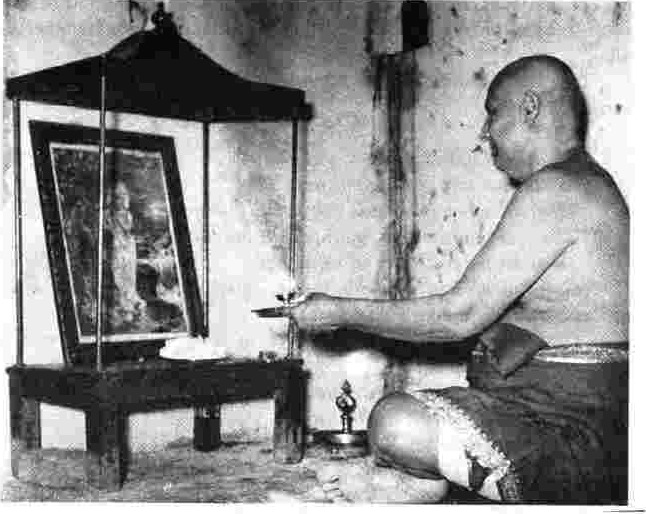
The teaching of the Bhagavad Gita was embodied in Swamiji’s life. There is one verse which has the following meaning: ‘Whatever My devotee offers to Me with love, even if it is only a leaf (patram), a flower (pushpam) or a little water, all that I accept with great relish.’ When Swamiji had some charity to perform, or some fruit, money or clothes to give to his own disciples, he would repeat the first two words of this verse (patram puspam), indicating “I am the devotee, you are my God, and I am offering this which is patram pushpam. Please accept it.”
Such worship can be performed to an image (murthi-puja), to the Lord seated in one’s heart (manasic puja), or to the omnipresent Being who dwells in all beings (para puja). Swamiji did not neglect any of these. The whole world was to him the manifestation of the Lord, and he lived every minute of his life in this consciousness. Greeting the sun in the morning, he would offer mental worship to it, repeating “Om suryaya namah,” (the mantra for propitiating the sun god) and mentally offer incense, lights, food and flowers in the order in which they would come to his heart. Sitting on the bank of the Ganges, gazing at the sparkling divine water, he would offer mental worship to the river with milk, flowers etc.
On no account would he take his afternoon meal without first offering formal and ceremonial worship to the Lord at the small shrine in his own cottage. In only this one item of his daily routine did he claim and insist upon privacy — perhaps only to illustrate his own precept that you should pray to the Lord in secret for the sake of obtaining His grace, and not ring the bells and sound the gong in order to attract public attention and earn appreciation for your ‘marvellous devotion’. He attached no value whatsoever to ostentation. Only once did one of his personal attendants by chance witness the moving spectacle of Swamiji lying down on the ground in full prostration before the deity. There was nothing mechanical in this worship or prostration. It was symbolic of total self-surrender, and in his case the symbolism was real and whole-hearted.
To Swamiji the deity whom he worshipped, either mentally or physically, was more real than the things that are solid realities to us. He often went to the ashram’s Vishwanath temple for the puja. When he offered some bael leaves and looked at the little bull and the Siva-lingam there, it was clear that he did not treat them as statues at all. When he looked at the beautiful Krishna statue the expression on his face was much the same as that on ours when we meet and greet a life-long beloved friend. You could see it in the eyes. It was a beautiful thing to watch, it was indescribable. He used to say that when you worship an idol (or picture) it remains an idol, but your devotion goes to God. To him the idols in the temple were not mere statues, but the living Presence.
On no account would Swamiji let us confine our devotional practices to the shrine only. Worship in a shrine is no doubt the necessary initial training ground, but the aim of this was to treat the entire universe as the abode of God and every being in it as the Lord Himself.
At Swamiji’s insistence, special varieties of worship were instituted at the ashram — like the worship of the virgins during Navaratri, worship of scavengers on Gandhi’s birthday; and sacred Guru Purnima day when worship is offered to Sri Vyasa, who commenced writing the Brahma Sutras on that day.
On the days when worship was offered to his own feet by some ardent disciple, he would himself go round, flowers in hand, individually worshipping all the devotees who had worshipped him. Those who intently observed the mood reflected on his face and the expression of devotion in his eyes would realise that to him every devotee standing before him was a veritable manifestation of God.
On Sivaratri (a day sacred to Lord Siva) he wouldn’t eat at all and would keep awake the whole night while worship in the temple was going on. He would sit next to the pillar on the left near the temple and while all the others were shouting he would chant very quietly, “Om namah Sivayah” with closed eyes and a deep voice. (Only he could do that —others would go off to sleep!) He was the only one who managed to sit there continuously, and he hardly ever got up from that seat from 9 p.m. to about 3 a.m. Devotees were engaged in the all-night worship of Lord Siva, which consists of pujas (worship) performed four times during the night, every three hours. On the temple verandah continuous chanting of the holy five-syllabled formula of Lord Siva (Om namah Sivayah) went on. After the last session flowers were offered to the Lord and the devotees filed into the sanctum sanctorum, devoutly placing the sacred bael leaves on the Siva-lingam (the symbol or idol of Lord Siva).
Some threw the bael leaves on the Lingam; some half sleepily allowed the leaves to slip from their hands. Last of all Swamiji, bael leaves in hand, his radiant face shining with an extraordinary light, would let a few leaves drop at the foot of the holy bull, Nandi — very softly, sweetly and devoutly seeking his permission to worship the Lord. Once when he gazed at the Lingam before offering the bael leaves he neither prayed, recited hymns, nor repeated the Lord’s name aloud, but his eyes spoke to the Lingam. For him it was a living presence; such tenderness and gentleness characterised every movement. Right then, in the twinkling of an eye and unnoticed by anyone else, he turned around and worshipped the worshippers with the flowers, as if to say, “God is not only there. He is everywhere.”
Swamiji was the greatest and perhaps the only recent exemplar of vibhuti yoga (the yoga dealing with the glories and the manifestations of the Lord) as described in the 10th Chapter of the Bhagavad Gita. Those who heard his inspiring lectures either during his All-India Tour or on important occasions at the ashram itself, could not have failed to notice how he laid the greatest emphasis on this practice. He exalted it, putting it on a par with raja, bhakti, karma and jnana yogas. It is a dynamic jnana-bhakti yoga. To the list of vibhutis (glories or manifestations) given by Lord Krishna in the Gita, Swamiji added quite a few of his own. He sang the Song of Vibhuti Yoga.
Soham soham soham soham Om om om om om om om om om om I am neither mind nor body, immortal self I am. I am witness of three states, I am knowledge absolute. I am fragrance in jasmine, beauty in flowers. I am coolness in the ice, flavour in coffee. I am greenness in leaf, hue in the rainbow, I am taste bud in the tongue, essence in orange. I am mind of all minds, prana of all pranas, I am soul of all souls, self of all selves. I am atman in all beings, apple of all eyes, I am sun of all suns, light of all lights, etc. I am that I am, I am that I am. I am that I am, I am that I am.
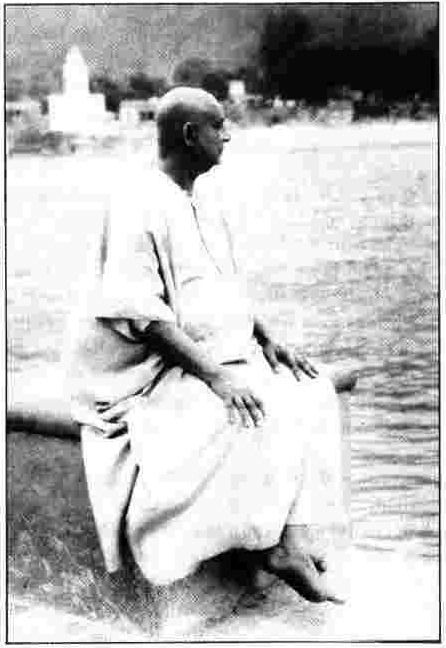
How did Swamiji practise vibhuti yoga? Everything reminded him of the manifestation of God. When he came out of his room and saw the Ganges he would remember Krishna, saying, “I am Ganga among rivers,” and while gazing at the Himalayas, “Among the immovables, I am the Himalayas.” The sun, the moon, the stars, the peepul tree, intelligent people and even robust wrestlers, boxers and gymnasts are manifestations of God. When you look at their strength you realise it is something divine. Often it looked as if Swamiji favoured brilliant and wealthy people, but to him a man’s affluence was just another vibhuti of God — that prosperity, or that brilliance of intellect is divine. Lord Krishna said, “I am the brilliance of the brilliant.” Swamiji saw the manifestation of the divine in all.
Sometimes Swamiji would peel an orange and keep throwing it into the Ganges for the fish, and if a monkey was sitting there he would also get his share. In those days fruit was scarce but he felt that if he could have it the monkey could have it too.
Even in his spectacle-case, shoes, or anything that he handled he saw the divine presence. It started with the Krishna in the temple and went right down to the shoes and the spectacle-case. He would close the spectacle-case very gently; and he handled fountain pens and glasses so sweetly and delicately that you would think he was handling a newborn baby. He never broke one little thing in his life. Even when he took up his shawl and put it round his neck it was done beautifully, delicately and artistically, as if he would hurt the god in that shawl if he were not so gentle; and when he came to the temple and offered the bael leaves on the Siva-lingam he would place them devoutly and gently at its base.
Even things which normally ‘feed the senses’ appeared in a different light to him. Delicious food not only tickled the nerves of his palate, but reminded him of God who is the deliciousness in all dishes. Music, rather than drawing his consciousness outwards and disturbing his mind, helped to preserve his natural and continuous superconscious state. The silence in the forest was no longer frightening. He saw only the power of the Lord.
To get the spiritual aspirant established in this habit of seeing God in all, Swamiji taught, “First see God in all the special manifestations of divinity. Look up. See the vast infinite blue sky. Doesn’t this remind you of God? Look at the resplendent sun and contemplate the self-luminous self. Gaze at the holy waters of the Ganges and see the Lord. Mentally prostrate to these manifestations. Gradually your vision will expand to behold the Lord in even asses and donkeys. Root out the idea of evil from your mind. When you see someone whom your mind regards as a wicked person, mentally repeat, ‘God is the gambling in the cheat’. See God in him and all contempt will vanish at once. You will neither hate nor dread the dacoit, for the Lord himself is the chief among them.”
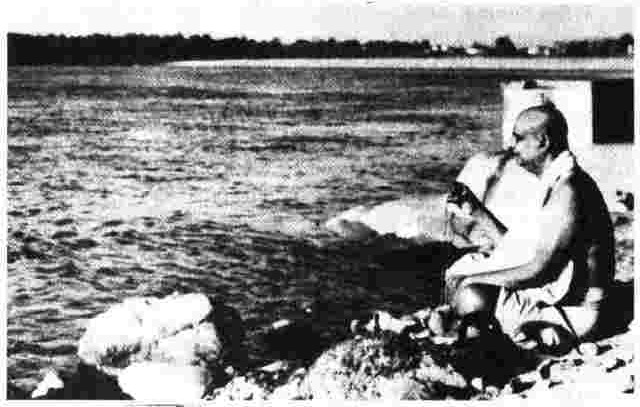
Doing japa on the Ganges bank
Japa: Mantra Repetition
Swamiji was tremendously fond of people repeating a mantra. Every day people, young and old, came to the ashram in Rishikesh and asked a very simple question: “I want to practise yoga; I want to lead a spiritual life. What must I do first?” Instead of beating about the bush with splendid theories about God and about Self and non-Self, Swamiji used to say, “Repeat Ram nam. Repeat God’s name”. The people who came asking to be his disciples were of varying temperaments and belonged to different religions, but the answer was always the same: “I’ll give you a mantra. Repeat it day and night. When you repeat it regularly it will automatically become your ‘background of thought’. “ This answer was very soon followed up with, “What would you like, tea or coffee?” No further questioning — “What is God? What is your conception of God?” — was encouraged.
Swamiji avoided all speculative questions. Once in 1947 a brilliant man appeared at the office at 8 a.m. and asked him to explain the difference between savikalpa samadhi and nirvikalpa samadhi. The disciples who were working in the office looked up expectantly, keen to hear the answer to a question they would never have dared to ask. Swamiji, who had been doing some work, suddenly put his pen down and looked at the visitor. There was total silence for a couple of minutes and then he asked, “Ohji, what would you like to have — some milk, tea, or coffee?”
When Swamiji asked a question you had to give the answer, so this professor replied, “I think I’ll have some coffee, Swamiji.”
“And some fruit, some idli?” (Idli is a South Indian breakfast dish).
“Yes, Swamiji,” the man replied.
Swamiji asked a disciple to get all these. Then he said to another man, “Bring me some books for the doctor.” About ten minutes passed in this way. In the meantime coffee and breakfast arrived. Swamiji went on instructing the attendant on how to serve the professor.
In the meantime the professor’s wife had been looking for him. A few minutes later she walked in, gave him one stern look and said, “How long are you going to stay here? Get up! Let us go”. Meekly the professor got up and left.
After he had gone Swamiji burst out laughing. He laughed and laughed with his whole abdomen trembling, and, wiping his eyes, he said, “He wants to know the difference between nirvikalpa and savikalpa samadhi; and the wife merely looks at him once and says, ‘Get up, get up,’ and he gets up, and walks quietly behind!”
Swamiji had no patience for vain discussion. His message was: “Repeat Ram nam. Take God’s name, do japa. You will discover the answer to all these questions within yourself.”
There was another incident which was highly revealing. A renowned political leader came to the ashram, sat down and presented Swamiji with a picture of India in the context of the present world situation, as he saw it. He spoke for forty-five minutes. The only audience he wanted was Swami Sivananda. One had to admire Swamiji’s patience. He had his elbows on the table, looking straight into the visitor’s eyes, listening. He never said a word. This politician gave a beautiful lucid synopsis of the world situation. When he had finished he looked at Swamiji as if to ask, “Well what is your advice? What is your solution to all this?” Then the ball was in Swamiji’s court. Poverty, hunger, over-population, oppression, suppression, depression and compression, the whole lot — what is the solution? His response was beautiful: “Only God’s name is the remedy. Repeat God’s name.” The poor politician felt that the floor was slipping from under his feet. He expected Swamiji to say, “You must become Prime Minister, or form a new party to reconstitute, change, destroy, and so on.”
Swamiji was so certain that the background of thought was so great in its psychological and spiritual effect that he recommended it for the solution of all problems in life.
When he said, “Repeat the mantra day and night,” he actually meant that the mantra should be repeated simultaneously, along with all life’s activities. He used to demonstrate it very nicely. In India chapatis (flat round unleavened pancakes) are made by the clapping movement of the hands. He used to say, “As you go on doing this, keep singing Sri Ram jaya Ram jaya jaya Ram — both jobs get done at the same time.”
When Swamiji gave a disciple a mantra and a mala (rosary), if the disciple said, “I am going to do japa for three hours in the morning, three hours in the afternoon and three hours in the evening without doing any other work,” Swamiji would say, “Throw your mala away and come and do some work. Someone who goes on endlessly turning the beads without caring even to give a cup of water to a thirsty man is a hypocrite and a pseudo-devotee. You don’t have to sit down and look at your nose to repeat your mantra. The mantra can go on throughout the day and night.”
Some of the disciples thought that by doing a lot of work they would please the master more. One day in 1946 Swamiji descended on one swami like a thunderbolt: “How much meditation did you do today? How much japa? Throw your typewriter into the Ganges; and all these other things too. Go and do some japa and meditation. ‘All work and no worship’ is not correct. ‘Work is worship’ is indeed the motto, but in practice it should mean ‘Work and worship’!” He excelled in working out a balance in which nothing was neglected at any time.
Swamiji called the ‘background of thought’ battlefield pratyahara — how to withdraw the mind and introvert the senses at will. He said: “If there is a temptation, threat, annoyance or irritability, if someone comes and argues with you and you realise that the next moment you are going to explode, the repetition of your mantra can defuse the situation.” He was a genius at that. Even when two ashramites started arguing in front of him he would seem to participate in it for a few moments, then say, “Om namah Sivayah,” and the whole thing wound up. It didn’t matter where the argument lay, how far it had developed or who was the winner or loser. He could cut it short at any point, even if someone was arguing with him. ‘Om namah Sivayah’ at that point meant ‘enough’.
Swamiji did not accept that meditation is possible only when we are not doing anything. He said: “You must be able to meditate even while you are fighting; but first learn to meditate while doing something like singing kirtan or doing japa, instead of feeling that there is a distraction or contradiction. Whatever the body may be doing, it is possible for the contemplative mood to be sustained. If while doing japa and chanting you can maintain the meditative mood, it is possible for you to find a way to sustain it whatever you are doing.”
To Swamiji japa itself was meditation, hence he never described meditation. He said that if you try to practise meditation you will invite distraction. You will not be meditating, you will only be trying. But when you go on with your japa you will slip into meditation without effort.