Sivananda: Biography of a Modern SageHis life, by Swami Venkatesananda
SIVANANDA’S DAILY LIFE
During Swami Sivananda’s All-India Tour, millions all over India and Sri Lanka heard him roar: “Get up at 4 a.m. and meditate. Brahma-muhurtha is the best period for meditation.” One person who invariably stuck to this principle was Swamiji himself. He generally got up at 3 a.m. The first prayers of the day were offered in bed immediately thereafter. Then a rapid wash, which was never allowed to take more than fifteen minutes, was at once regularly followed by a period of prolonged meditation. He strictly adhered to the necessary preliminaries to meditation —a few rounds of bhastrika pranayama, a few minutes of guru stotras and other hymns.
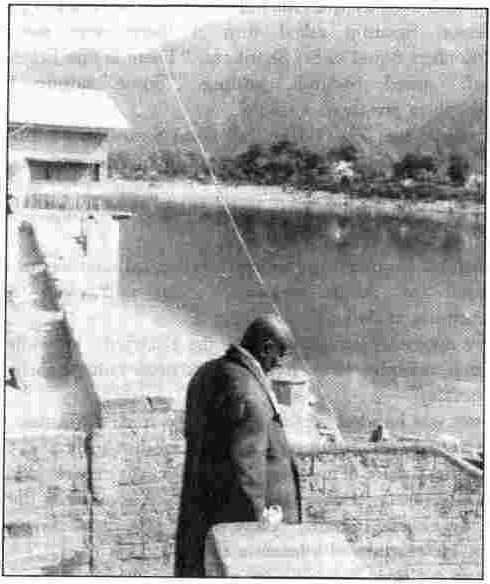
At first light Swamiji came out of his kutir. He bowed to the Ganges and the Himalayas. Standing ankle-deep in the Ganges he sprinkled the holy waters on himself. In summer this was followed by a few minutes of silent contemplation on the Ganges-bank itself. With the chanting of mantras in praise of Surya, the sun god, he greeted the sun.
Returning to his kutir, half an hour was spent in the practice of asanas and pranayama. “Whatever be the condition of the body, even if I have severe lumbago or rheumatic pains, cough, cold or fever, I cannot remain without practising asanas and pranayama. I do not know how you are able to live at all without doing asanas and pranayama,” he said once to a young aspirant who was not so keen on exercising the body. Over an hour was spent in pranayama alone. He did a few rounds of bhastrika in winter and a few rounds of sitali in summer. Before breakfast once again he practised pranayama for about half an hour, then again after returning from the office at noon. Evening found him at it again, and the final round was done before going to bed at night. Thus he devoted an average of four of the busiest hours of his eventful day to this important practice.
The next two hours of the morning were spent in writing. The thoughts that arose in his fresh mind were immediately transferred fast to notebooks. These notes became the literature that shaped the lives and destinies of millions of aspirants all over the world.
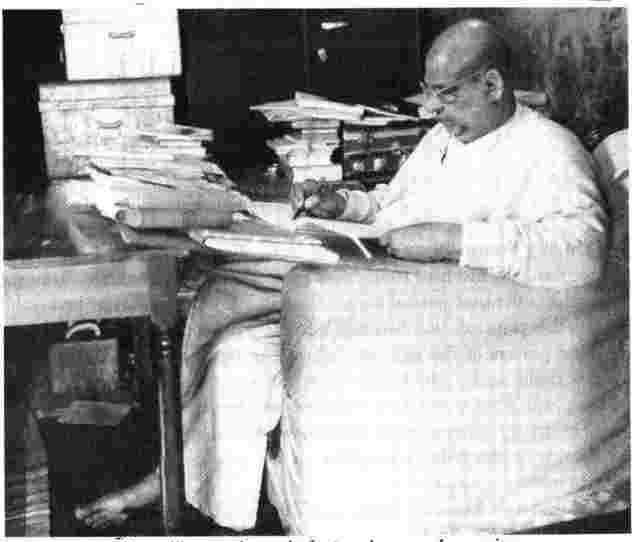
Swamiji wrote intensely for two hours each morning.
Swamiji so arranged the things about him that without rising from his seat he was able to record the thoughts on the various subjects that would arise in his mind at this most auspicious hour. Books of reference which he might need were kept by the side of his writing seat. Rapid and intense work and maximum production with minimum expenditure of energy were the keynotes of his work.
A dozen notebooks were always ready at hand, along with three fountain-pens and two pairs of spectacles, so that a pen running out of ink or even the remote chance of the spectacles breaking could not interfere with the flow of thoughts to the paper. Some notebooks were ear-marked for certain special notes: e.g., Spiritual Lessons and Medical Notes, and others were for General Notes.
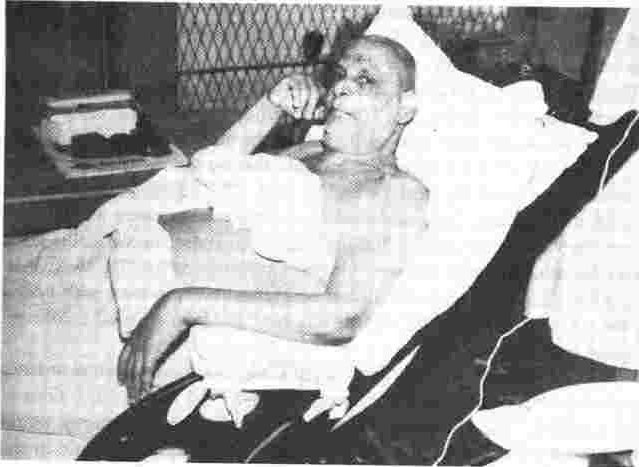
Notebooks and pens were always at hand.
At 9 a.m., after nearly three hours of work, he was ready for his breakfast, which consisted of a glass of milk with an occasional dish of light refreshment (tiffin). There were many who shared his repast. The fish in the Ganges were the first; then the monkeys of the locality were served even before Swamiji. If there was some tiffin it was first sent round to several ashramites by turn, and only then Swamiji had his.
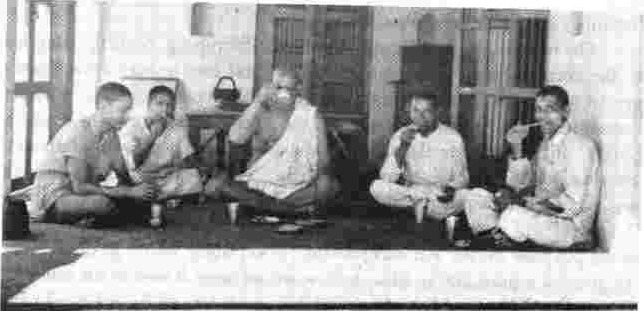
Tiffin with Swamiji.
Then there was a change of place; but the work went on. With numerous bags of all kinds of correspondence and articles, he left his kutir for the office premises, the Diamond Jubilee Hall. ‘Urgent letters’, ‘Ordinary letters’, ‘Articles’, ‘Journals’ — each category had its own bag; sweets and dried fruits, too, (for distribution to children, visitors and seekers who might meet him on the way to the office) had their own bags.
The face of every ashramite Swamiji met on the way drew from his pigeon-holed mind the work he had for him. The ashramite received his share of the prasad first; and then his instructions. Letters and articles were distributed at various ‘halting places’ en route. Between his kutir and the office Swamiji repeated ‘Om Namo Narayana’ or ‘Tat Twam Asi’ or other mantras at least 108 times; he greeted every person with folded palms. Greeting, courtesy, regard, kindness and japa were all combined in this exemplary practice.
At the post office Swamiji enquired if some particular parcel or letter had been despatched. At the ‘treasury’ he gave the day’s instructions to the treasurer. The kitchen manager knew that first thing Swamiji would enquire of him about attendance on visitors and the sick people in the ashram. Though he did more work than any man on earth, Swamiji attended to the minutest details of the work that engaged the whole time of a hundred selfless workers. The kitchen manager was often astonished at how Swamiji put his finger just at that spot where there had been a lapse. The doctor in charge of the Charitable Hospital also got his share of enquiries and instructions.
Swamiji’s entry into the office was the signal for the morning prayers to commence. All the sadhakas who worked in the office joined this prayer, as also visitors who were present. The kirtans were followed by Swamiji’s own Universal Prayer.
The morning’s ‘note-books’ were given for typing. Swamiji attended to the correspondence. A rack of leaflets and two bowls of the Lord’s prasad were at hand; every letter was invariably accompanied by a leaflet containing spiritual instructions and the Lord’s prasad, even if it was a purely ‘official’ letter. Seekers’ spiritual diaries gladdened Swamiji’s heart. He studied them closely and gave further guidance. Similar treatment was accorded to aspirants’ ‘Annual Resolves Form’. The Diary and the Resolves Form were his potent devices to keep the seeker constantly awake to the purpose of life. An exceptionally good diary would at once evoke the greatest admiration in him, and he would hand it over to the editor of The Divine Life to publish along with his comments on the extraordinary points in it, for the benefit of others all over the world.
On one day the accountant might bring the statement of the ashram’s income and expenditure for his perusal, the press manager might want money for paper or a new machine, or an aged swami in charge of the construction work might come to him with great joy to invite him to attend the opening ceremony of a new building. The cashier with his bundle of cheques and postal orders stood in the corner awaiting a chance to approach Swamiji for his signature. Each day the swami in charge of the Yoga Vedanta Forest Academy Press presented himself and brought to Swamiji’s notice the work that was in progress at the press. Articles for publication in other newspapers and journals all over the world; messages of blessings and instruction to individuals and institutions for all kinds of functions — both sacred and secular — were then signed by Swamiji. Once a month, reports from Divine Life Branches were scrutinised and certificates of affiliation with headquarters were signed, and advice on the development of the Branch along the right lines was offered by Swamiji. In the meantime Swamiji might ask a devotee to sing a song, and a professor from some university to deliver a short lecture. As in a busy market, people always ran here and there with papers in their hands, typewriters clattered non-stop in preparing articles for newspapers and journals, and young energetic brahmacharis moved about with tea, milk, biscuits and fruits for distribution to those present. To add to this, a large number of dogs, pups and monkeys at the entrance often fought and made a terrible noise.
After giving rapid instructions to various departments, Swamiji then commenced the important work of the day. A huge ‘Who-What-Where Register’ then ascended the table. It had spent the night under lock and key. It was Swamiji’s treasure. In this 10 lb. index book were noted the names and addresses of all those who were in touch with him —aspirants, disciples, donors, officials, Europeans, Americans, editors and newspapers, ministers, yogis, philosophers, maths and ashrams, ‘something-like-disciples’ and ‘first-class-misers’. A new address at once found its way into this great book. It was this register that enabled Swamiji to contact people all over the world, and to serve them effectively. He was extremely particular in maintaining it, for it was of the greatest assistance to him.
The swami in charge of the ‘Free Department’ would go over to Swamiji with a small consignment of perhaps a hundred assorted books. The ‘WWW Register’ and also the departmental ‘Free Register’ acted as reminders, and Swamiji autographed the books and inscribed the name of the devotee with his own hand, adding to it his blessings. This went on for an hour. Then he himself checked the addresses on parcels that had to go out. The ‘Free Department’ swami held up the parcel for Swamiji to read the address. Swamiji said: “Om Tat Sat” — the code which he used for signifying that he had satisfied himself with the address. As many ‘Om Tat Sat’ mantras were repeated as there were parcels. (There was no prosaic act which was not thus flavoured with this wonderful element of sadhana.)
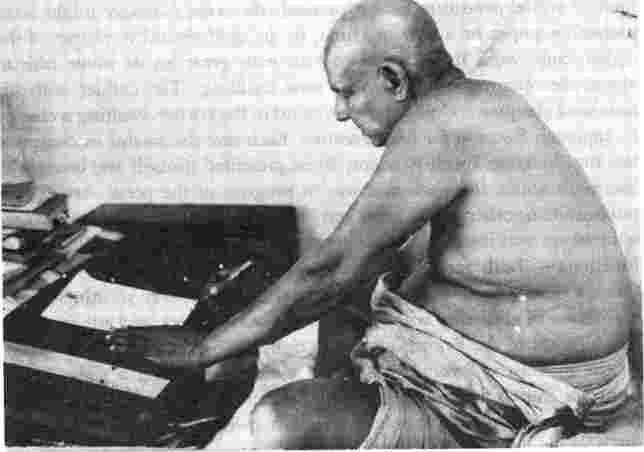
The ‘Who; what; where’ register
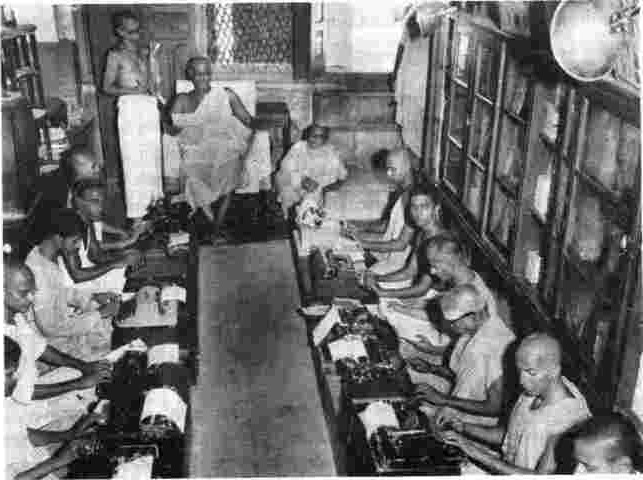
Typewriters clattered non-stop.
There were two rows of workers in the office. Swamiji sat at the end of the rows. He had a big chair, and once in a while he would merely relax back in it, put his spectacles up, and just look... There was something in that look which was bewitching. Just to look at him was an inspiration.
Swamiji was the most easily accessible person. He made himself available to everybody at large. The office was open, anyone could walk in. Children would even run in and ask, “Swamiji, what is the time now?” — and he answered them.
Invariably there were a few visitors. The moment a visitor stepped in Swamiji’s ‘hospitality machine’ was switched on. If the visitor brought fruit or other offerings they were at once distributed among those present. Even if he had overlooked this customary practice, Swamiji’s inevitable prasad of tea, or milk and fruits, came to him.
The visitor was not allowed to waste either his time or Swamiji’s, though Swamiji patiently listened to the account of his spiritual practices and problems. Answers were readily given; and silence was offered as the best answer where the enquirer’s vain or academic argumentations demanded it. One perhaps was initiated into the ishta mantra, another got a prescription to cure a disease, a third was instructed in bhakti or karma yoga, a fourth obtained an elucidation of a knotty point in sadhana, yet another got an opportunity to air his family worries and his grievances against the world. The ashramites themselves got an occasional dose of ‘spiritual mixtures’ during this session.
If there was sincerity of purpose Swamiji was all sympathy. Sincere but poor and illiterate seekers were known to have engaged Swamiji in conversation for over an hour; and vain pandits have equally been known to have found themselves incapable of drawing his gaze away from the letters on his table or of so much as getting even an indication that he had heard what they had said.
Swamiji returned to his kutir at about noon after ensuring that all the visitors had been properly attended to and that all of them had had their meals and had been shown round the ashram. Then there were a few minutes of silent relaxation, which was more for the purpose of flushing out of his mind the office, the Society and the world and everything else — a sadhana which he never failed to do every day and several times a day — than for actual rest.
In summer Swamiji had his bath before he took his breakfast in the morning, while in winter he had it before lunch. He first worshipped the Ganges with milk and flowers. Offering prayers, he entered the waters. He took a few dips, then performed ceremonies for all devas, the departed souls, etc. He repeated the maha vakyas and the paramahamsa mantra. Then again he took a few more dips — for the sake of those who long to have Ganges bath but are denied the privilege. Then came worship of the Lord at the small shrine in his room.
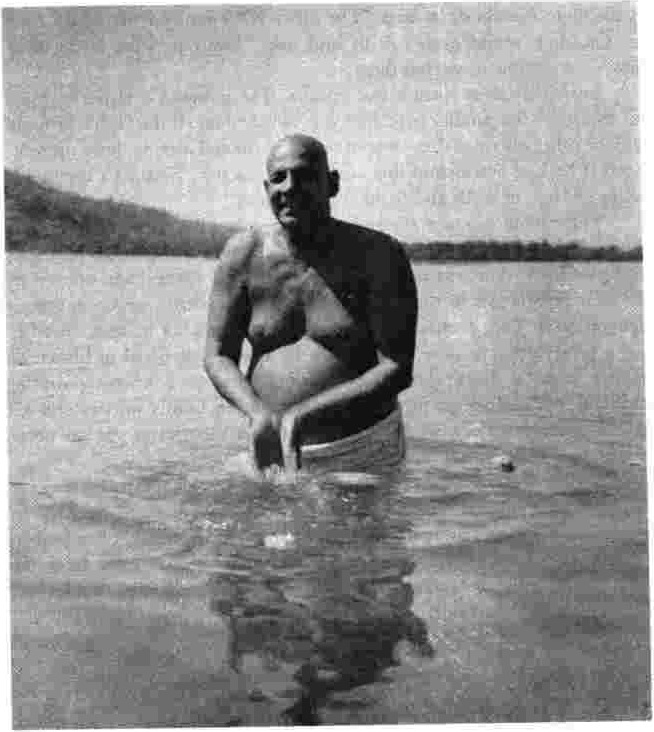
Swamiji took his food at about 2 p.m. in winter and 12 noon in summer — long after all ashramites and visitors had finished their meals. Before he would take anything, all the sharers should get their share. A few selected slokas from the Gita were chanted before taking food.
The first part of the afternoon was spent mostly in study; in summer, when the weather is unbearably hot, he took an hour’s rest.
Work began once again at 3.30 p.m. Urgent letters were attended to. Swamiji would leave his kutir after a glass of milk, and attend the Yoga Vedanta Forest Academy class (in summer this was held in the morning). The day’s inward mail was then placed on his table. Rapidly he would peruse all the letters, sort them out and fill his bags. Those that were not immediately distributed in the office to the departments concerned, accompanied him to his kutir.
Swamiji was meticulous in the matter of receiving and treating guests. If someone had an appointment with him at 5 p.m. he would be in the receiving lobby even at 4.45 p.m. His principle was that the guest should not be made to wait. There was generally a greater rush of visitors in the evening than in the morning. Sometimes Swamiji volunteered to show them round the ashram himself. He started with the various departments in the office, and then took the visitor to the hospital, the ayurvedic pharmacy, the post office, the kitchen; then up the hill to the studio (where often the visitor was shown the yoga movie-films), the yoga museum (where one of the professors of the academy explained the structure of the museum), the guha (cave), then the Bhajan Hall, temple, press, primary school, library, etc. It took a little over an hour — if the visitor was in a hurry. This ‘hour’ acted only as an appetizer and the visitor always left with a resolve to spend a few days at the ashram.
Towards evening Swamiji returned to his kutir.
A casual visitor to the ashram who happened to be sitting on the Ganges-bank might have been amused to witness Swamiji running about the verandah of his kutir. He started with pacing up and down the verandah with OM chanting. (One who approached him closer found a far-away look in his eyes which looked at the surrounding world with an ‘unseeing’ vacancy that refused to recognise any kind of objective existence.) Then he ran about the verandah — his evening exercise.
In summer Swamiji spent the evening-hour on the Ganges bank in silent contemplation; in winter within the kutir itself.
When the ashram lights came on, Swamiji saluted them, chanting a sloka of the Gita. This was his favourite method of giving the ‘divine touch’ to all phenomena around him.
A glass of milk and one piece of bread, and he was ready to go up to attend the night satsang. Study of Bhagavad Gita, recitation of Ramayana, chanting of kirtan and bhajan, and an occasional lecture formed the important items in this satsang, and the crowning feature was always Swamiji’s own songs.
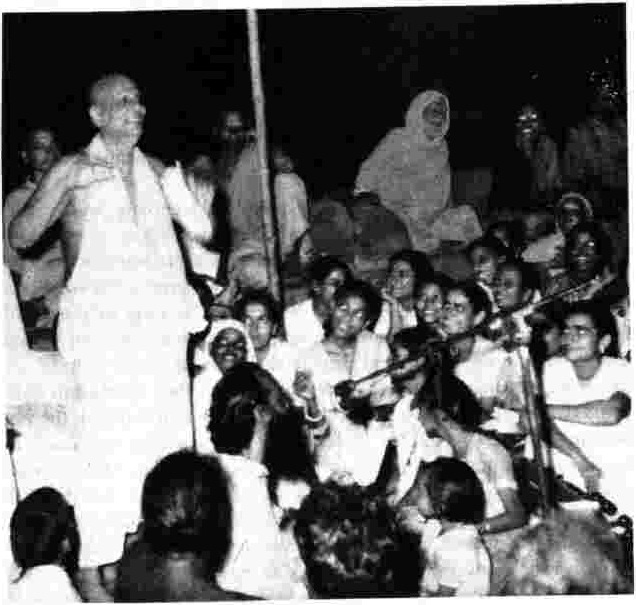
Sometimes Swamiji would sing and dance
Occasionally he would take part in a drama staged at the ashram satsang, and once, during the Diamond Jubilee, he played the part of a divine messenger — to the delight and amusement of all. On one occasion he narrated the story of Bhakta Nandanar, and, with kartal (a type of cymbal) in his hand, he sang several kirtan which were popular in the ‘twenties and ‘thirties. The audience was spellbound.
Eminent musicians came from all over India to visit Swamiji, especially during festivals and celebrations. They delighted all with their performances.
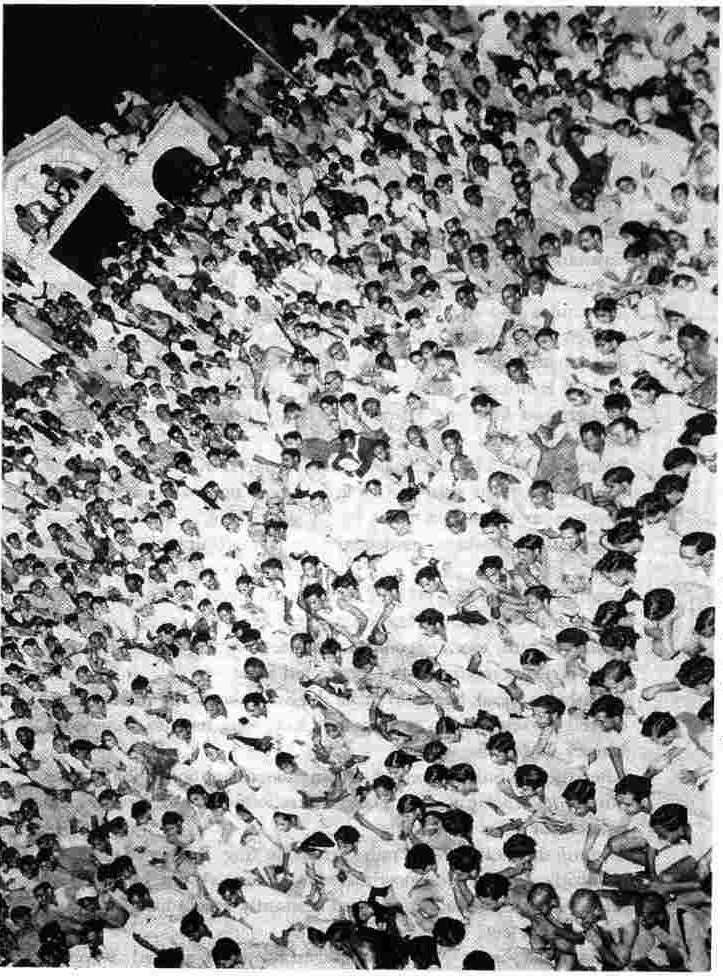
Swamiji, in the middle of the audience, enjoys a musical performance
The following is an excerpt from a visitor’s account of a typical satsang:
Wednesday, May 23rd, 1962. The sun had set. The moon had not yet risen. Sivananda, the simplest among men, emerged from his kutir to proceed to the night satsang. A loving smile lit his childlike face. A large group of devotees, gathered by the roadside, greeted him with folded palms. The devotees saw God in the guru. The guru, too, saw God in the devotees. The atmosphere was charged with devotion.
On the open terrace outside the Diamond Jubilee Hall of the Sivanandashram, kirtan with instrumental accompaniment was going on. The whole place was brightly illuminated. Visitors, ashramites and the locals filled the place — men on one side, women on the other. A myriad stars lighted the dark sky.
The placid waters of the Ganges flowed noiselessly, imperceptibly, in the Rishikesh valley. The river resembled a lake. In the background were the Himalayas, rising high, majestic, looking dark in the night.
Swami Sivananda, the splendour of Ananda Kutir, the muni of Muni-ki-Reti, the rishi of Rishikesh, gently moved in, greeting the devotees as he passed them by. A word here, a smile there, a benediction elsewhere, made many souls happy in the twinkling of an eye.
Swamiji took his seat on an easy chair in a corner, from where he had a full view of the audience. And everyone in the audience could see him, too. Diagonally opposite to him was the picture of Lord Krishna mounted on a decorated altar.
An ashram monk began to recite the Sri Suktam. Devotees came, offered currency notes at Swamiji’s feet, went back to their seats. Money flowed like water.
After the Sri Suktam recital, Sivananda called on Subba Rao, a blind Gita scholar, to give a talk. There followed an interesting exposition of a few Gita slokas.
Swamiji then asked Pal, a radio artiste, to sing. Pal began to render a Tulsidas bhajan in a most melodious voice. As the bhajan went on, a visitor came to Swamiji and hesitantly sought his permission to touch his feet.
A foreigner came. “Om Namo Narayanaya” greeted Swamiji.
“From where?”
“From Vienna,” replied the gentleman. “My name is George. I wrote three letters to you.”
Swamiji asked for books and magazines to be given to the visitor, and thanked him for coming.
Pal finished singing. Then followed kirtan, arati and distribution of prasad. Many devotees now flocked around Swamiji to receive the prasad directly from his hands. One of them was a philosophy professor. Swamiji asked him if there were not Western philosophers equal to Sri Shankara. “There is one Eckehart, isn’t there?” asked Swamiji, adding, “Some saintly Christian philosophers are there, I think.”
A visitor came. He said he had taken Swamiji’s blessings before going abroad at the outbreak of the Korean War and was happy to be able to see Swamiji again.
“You are also a philosophy student?” asked Swamiji.
“No, engineering.”
“What, all engineering studies? Mechanical engineer or chemical engineer or Atmic engineer?” he said with a smile. “Something to do with machinery.”
“Very necessary nowadays. See, the electricity just failed,” said Swamiji, referring to the frequent electricity failures earlier during the satsang.
A letter was handed over to him. It was from an inmate who had been served with a quit notice by the ashram secretary. The letter was in the nature of an appeal: ‘Thou art my refuge. Where can I go?’ Sivananda, usually very considerate, dismissed the petition with the caustic remark, “Lazy man!” (He had no sympathy for idlers. He considered idleness a sin.)
Next to get near Swamiji was a Sanskrit professor from Gwalior. He narrated how, as a student, he had gone through Swamiji’s book on brahmacharya and benefited much. He then referred to Swamiji’s Conquest of Mind, a recent release. Sivananda gave a copy to the professor who remarked that it would help him greatly in guiding a research student doing his doctorate thesis. Swamiji then asked, ‘You are my professor or student?”
“You are my professor. I am your student,” came the reply.
As he began to move slowly through the devotees lining his path, a visitor burst out with a few lines from a Tamil scripture, the meaning of which is: “Oh, Lord, give me that state where the mind melts, where acts cease... where all is quiet.”
“Yes, be still, be quiet,” said Swamiji, “but let the hands be working. Give the mind to God and the hands to work. Quiet within, active without.”
Slowly Swamiji wended his way back to his kutir, quietly repeating some mantras — in his own words ‘to compensate for the time spent in useless talk’.
At the entrance to his kutir he took leave of the devotees with folded palms and short prayers from different religions. Even as he went in one could see from the expression on his face that his mind was now completely taken away from the devotees, away from songs and lectures, away from puja and prasad, to be alone with the Infinite.