Sivananda: Biography of a Modern SageHis life, by Swami Venkatesananda
THE ASSAILANT
On the 8th January 1950 the night satsang was in progress. It was fairly dark inside the Bhajan Hall, as during kirtan even the lantern which was used for reading of Gita etc. was reduced and put aside. The two oil lamps that stood on either side of the altar shone as brightly as they could, but were only able to illumine a third of the hall, leaving the entrance dark.
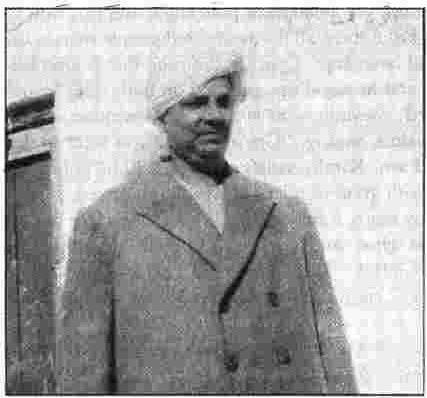
Govindan, a young man whom Swamiji had maintained in the ashram for months prior to this, approached Swamiji through this dark entrance, axe in hand. The axe was raised. As it fell it missed its mark and struck the door. Govindan, becoming more nervous, raised the axe to strike again at Swamiji. This time a picture on the wall received the blow. Only the wooden handle of the axe struck Swamiji’s turban. Generally as soon as Swamiji entered the Bhajan Hall he used to remove the cloth turban he wore when he left his kutir; but that day he forgot. Swamiji, thinking it was a stick with which he was struck, raised his hand, scratching it on the axe.
Swami Vishnudevananda’s attention was drawn to the assailant by one of the women sitting nearby. He got up and, hugging Govindan so tightly that he could not lift his hand again, drew him outside. The crowd in the Bhajan Hall immediately realised what had happened, and two of them held Govindan while his feet and hands were bound. Then one or two people started to beat him. Swamiji shouted at the top of his voice: “Don’t beat him, don’t beat him,” and Govindan was rescued and taken to a nearby room and locked in.
“Continue the kirtan,” said Swamiji; and the kirtan, arati and peace chants were duly conducted and the satsang came to a close. In the meantime one swami ran to the Diamond Jubilee Hall and, in broken sentences, informed the swamis there of what had happened. They ran to the police station, got a couple of policemen and ran with them up to the Bhajan Hall. From there all the assembled people went to the room where Govindan had been kept. Quickly the rope that bound his feet together was removed and he stood up, guarded on both sides by policemen. The crowd watched. Swamiji went straight to Govindan and bowed to him with folded palms, saying, “Govindan, do you want to deal some more blows? Here I am. Kindly satisfy yourself.” (The police inspector gazed at this scene with great wonder.) Govindan muttered: “No; I do not want to beat you any more. I am satisfied.” Everyone’s face indicated that these words poured ghee into the fire of wrath that they were somehow managing to control. “What harm did I do to you? Why did you get so angry with me?” enquired Swamiji in a loving manner. For this there was no reply.
After this, all left the Bhajan Hall and wended their way down the hill towards Swamiji’s kutir.
“What shall we do, Swamiji? Shall I lodge a complaint against this man?” asked the police inspector. “No, no, just send him away from Muni-ki-Reti. That is enough,” said Swamiji, and left for his kutir. Here he was greeted by an endless stream of visitors. Many of the men and women of the locality, on hearing of the incident, rushed to Swamiji’s kutir in tears, in spite of the late hour. Swamiji sat and received them all, smiling radiantly as if nothing had happened.
Surely Swamiji had had the protection of the Lord. It was later discovered that Govindan had been lying in wait for him in the morning; he knew that Swamiji always went alone all the way from his kutir to the Bhajan Hall. Swamiji would then have been entirely undefended. It would have been an easy job for the assailant. But Swamiji did not go to the Bhajan Hall for the early morning class. “I don’t know how I slept so soundly that I did not wake up at 3.30,” he said. Govindan had made a couple of circumambulations of the Bhajan Hall, impatiently waiting for Swamiji. Usually Govindan never used to stir out of his room before 9 a.m., but for one day in his life he attended the morning satsang and did kirtan also in the early morning hours. At night Swamiji always removed his turban on reaching the Bhajan Hall. He was not able to say why he did not remove it that day.
Govindan had calculated the distance between Swamiji and the door, and had adjusted the axe correctly in the first instance, but forgot to take into account the projection of the Bhajan Hall door. When the first blow was struck and missed its mark he became conscious of this factor; but when he went nearer to his mark he forgot to re-adjust the axe again.
On the next day it was decided that Govindan should be provided with two ashramite escorts and leave on the Grand Trunk Express with a ticket to Salem, his native place.
Swamiji would not countenance any suggestion that Govindan should be charged, saying: “No, no, we should not punish him. He only worked out my prarabdha (karma). Do you mean to say that anything could happen without the Lord’s will? No, the Lord only prompted Govindan to do what he did. Is dyutam chalayatam asmi (I am the gambling of the fraudulent: GitaX:36) mere words? Does not the same omnipresent Lord indwell the robber and the dacoit, the murderer and the burglar? No, I will not let the police charge Govindan. We should thank him for working out my karma so easily. The Lord has spared my life because there is some more service to be performed through this body. I must go on with that service. That is all the incident indicates to me.”
Swamiji went to the police station at about 11 a.m. with fruits, books, clothes, new blanket and japa-mala. With his own hand he applied kumkum and bhasma on Govindan’s forehead, and then prostrated before him. Those present were wonderstruck at this sight. Swamiji then gave the books with this autographed blessing: “May the Lord bless you with health, long life, peace, prosperity, devotion, wisdom and kaivalya!” He initiated Govindan into the ashtakshari mantra (Om Namo Narayanaya), gave him the clothes, etc. and also the following advice: “Kindly repeat the Lord’s name incessantly. Do regular and vigorous japa. Forget all that has happened. Only take care that the mind does not run into the old vicious grooves, and that you are not impelled to commit the same mistakes over again. Please read good spiritual books. Do not mix with bad characters. The latent spirituality will become patent through sadhana. Spirituality is latent in you now. If it was not there at all, you would not have come here. I have asked Saswat Swamiji and Purushottamji to accompany you as far as Agra and provide you with all comforts and conveniences during the journey. From Agra you will get a ticket to Salem. Kindly write to me frequently about your welfare and your sadhana. May God bless you!” He then repeated ‘Om Namo Narayanaya’ several times, and made Govindan also repeat that sacred mantra.
Special dishes were prepared and given to Govindan before his departure. Swamiji then sent a note to the Police Inspector that he did not want to proceed against Govindan in any manner, and that the police might drop the matter from their minds.
In the evening in the Bhajan Hall there was a thanksgiving service and prayer for the long life of Swamiji. The gathering sang the maha mantra in chorus; and the hall was filled with the vibrations of maha mrityunjaya mantra, which was chanted aloud by the entire gathering. Swamiji then distributed prasad with his own hands.
On the 19th February, Swamiji received a letter from Govindan, saying that he had reached Salem safely, he was grateful to Swamiji for what he had done, he prayed that any other pitfalls that may beset his path of life may also be removed by Swamiji’s grace, and that he regarded himself as Swamiji’s disciple. When Swamiji saw the letter he smiled and said: “Muruganandaji! Put Govindan’s name on the Magazine Free List. Include his address in the Prasad Register also. All free literature should be sent to him. I will send him books also. I will write to him to come again.”
There were many less dangerous incidents of which Swamiji says in his autobiography: “In the ashram, in the past, a few students with powerful senses and cravings criticised me and abused the ashram and the whole of the Himalayas, and left the place in anger. I blessed them and prayed for light, knowledge and proper understanding and inner spiritual strength for them. But they all go out only to come back to the ashram with a thorough change of heart. I welcome them with great love and affection. I forget the past quickly. Thus a man may go out a hundred times and come back. My love for the man is greater. It is not through compulsion or rules or regulations that men can be transformed into divine beings. They all must have convincing experiences of their own.”
In one of his earliest letters to Swami Paramananda he wrote, “I want around me a number of people who will abuse me, insult me, vilify and injure me. I want to serve them, educate them and transform them.” In a crowd he would seek out the bad characters first, whether they be in white or ochre robes, and greet them with folded palms. He would address them in the most respectful terms. About this he said, “Acclaim the rogue as a saint; publicly honour him and he will be ashamed to continue his evil doings. Persistently tell an ill-tempered man, ‘You are an embodiment of peace’ and he will be ashamed to lose his temper. Call a lazy man a dynamic worker and he will plunge himself into service. But the praise must come from the very bottom of your heart and you must pour your soul force into every word.”