Sivananda: Biography of a Modern SageHis life, by Swami Venkatesananda
MILESTONES
The All-India Tour
I heard a voice within: “Siva wake up, and fill the cup of your life with this nectar; share it with all. I shall give you strength, energy, power and wisdom.” I obeyed His command. He did fill the cup, and I shared it with all.
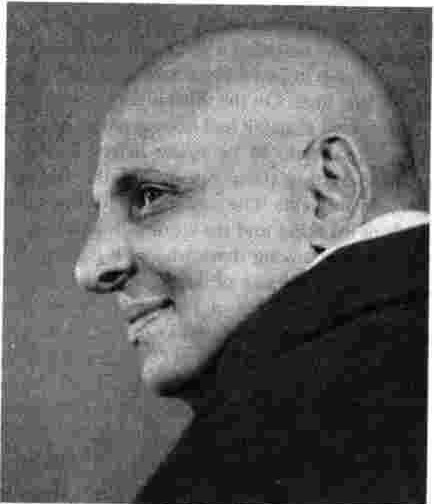
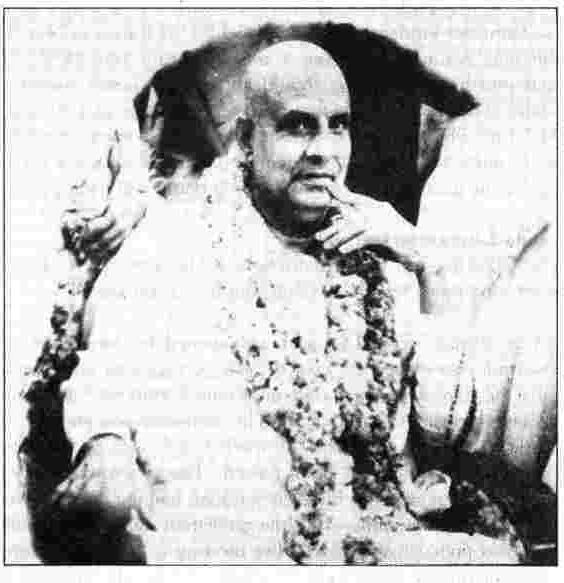
Swami Sivananda.
The All-India Tour was a direct result of the ‘Govindan-incident’. Swami Paramananda was then at Madras, and soon after the incident, in response to an urgent appeal, he returned to the ashram and decided to remain. Recalling the good old days when Swamiji thrilled the hearts of thousands with his lectures and sankirtan, creating a stir wherever he went, Swami Paramananda conceived the idea of an All India Tour to be undertaken by rail. He threw all his energies into organising it in great detail. He had at one time worked with a travelling circus, and the experience gained in regard to the Indian Railways was an invaluable help to him in the efficient organisation of this mammoth task. He wrote to the devotees at various centres and they all responded with great eagerness and enthusiasm.
A first class Tourist Car was hired, and the tour programme drawn up. On the 9th September 1950, just after the Birthday celebrations, Swamiji and a party of thirteen of his disciples left on the All-India Tour. The following members accompanied Swamiji: Swamis Paramananda, Chidananda, Narayananda, Poornabodhananda, Govindananda, Omkarananda, Satyananda, Saswathananda, Venkatesananda and Dayananda, and Sri Sivaprem, Sri Padmanabhan (later Swami Saradananda) and Sri Purushottham.
Just before the party left the ashram Swamiji outlined the coming mission: “At every railway station we should do kirtan. Millions should know the true significance and meaning of divine life. Wherever we go we should penetrate into the heart of the masses. Leaflets and pamphlets should be distributed in hundreds and thousands. We should disseminate the name of the Lord everywhere so that millions will know the glory of kirtan and Ram nam.”
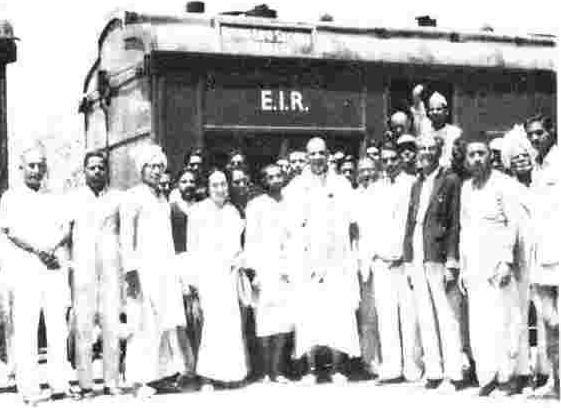
At Rishikesh station
The mission was emphasised further by Swamiji at Hardwar. Paramanandaji had thought of taking him for a car-ride along the Ganges-canal, accompanied by his disciples. On the way, when Swamiji found that they had not taken any books with them for free distribution, he said: “I do not know of a pleasure trip for me! Service gives me the greatest pleasure.”
This spirit was evident throughout the whole tour. For instance, Swamiji’s attendants were having tea in the compartment as the train wended its way to Lucknow, when suddenly Swamiji entered. He asked each of them if they had slept nicely, etc. Then Paramanandaji enquired of Swamiji if there had been any disturbance. The reply was surprising and revealing: “I slept hardly for fifteen minutes last night. I was anxious lest people who come to see me should be denied their wish.”
“Swamiji!” said Paramanandaji, “We shall send all people into your compartment throughout the day, but from 10 p.m. to 4 a.m. Swamiji must have some rest. Therefore we decided not to allow anybody at night to disturb you.”
“But I am anxious to see all people who want to see me!” Swamiji admonished. “Don’t they sacrifice their rest and come all the way to the station to meet me? Why should I deny them the pleasure?”
When the train came to a halt at Hardoi, people from the platform stampeded into the compartment. No one was able to control them. When Swamiji finally got out of the compartment they sprang forward and caught hold of his feet. Swamiji then gave a talk on discipline. Soon it was announced that the train was about to move. Swamiji got into his compartment, but he was not satisfied; he wanted to give the people something more. He peeped out of the window and said: “Hari Om! All of you repeat the Lord’s name with me. The Lord’s name contains infinite shakti. It will give you peace, prosperity and happiness.” Then he repeated “Ram, Ram, Ram, Ram.” The entire gathering responded vigorously. There was a second move for the train to leave. He said: “Do you know your essential nature? Now listen. Chidanand, Chidanand, Chidananda hum, har halme almastha satchidananda hum. This is your real nature. Your nature is knowledge and bliss. You are immortal Atman. Repeat this formula frequently and realise your essential nature.”
The train had already started; Swamiji roared through the window: “Om, Om, Om,” and the huge gathering that had assembled bowed with joined palms and tear-filled eyes.
At almost every railway station en route hundreds of people came to have his darshan, and wherever the train halted he conducted kirtan on the railway station platform. Even as the train entered the station the loudspeakers fitted on the Tourist Car filled the place with his recorded kirtans and songs and attracted a crowd. Leaflets and pamphlets were distributed.
At Lucknow Swamiji was joyously greeted by a large crowd at the railway station, and the platform itself had been converted into a satsang hall. He proceeded immediately to shower his welcomers with spiritual advice and then sang the Song of Instructions:
Bhajo Radhe Govind Radhe Govinda bhajo Radhe Govind, Radhe Govinda bhajo Sita Govind, Hari bolo, bolo bhai Radhe Govind, Hare Krishna Hare Ram Radhe Govind.
Get up at 4 a.m. Brahmamuhurta, Get up at 4 a.m. japo Ram Ram, Get up at 4 a.m. do Brahma vichar, Get up at 4 a.m. enquire ‘Who am I?’ Get up at 4 a.m. practise yogabhyas.
Observe mauna daily for two hours, Fast on ekadasi, take milk and fruits, Study daily one chapter of Gita, Do regular charity, one-tenth income, Rely on your own self, give up servants, Do kirtan at night, have satsang.
Speak the truth at all costs, preserve veerya, Satyam vada, dharmam cara, observe brahmacarya. Ahimsa paramo dharma, love one and all, Never hurt others’ feelings, be kind to all, Control anger by ksama, develop viswa prem. Keep daily spiritual diary, you will evolve quickly. (Hare Krishna Hare Ram...)
The audience repeated it enthusiastically. Then he said: “This song is not only for repetition. You have to practice the instructions. Then only will you realise the benefits.”
Many wished to garland him, but the crowds prevented some of them from reaching him. His loving hand reached out to them, took the garland from their hands, and he garlanded himself: he had become one with the devotees. The devotees rejoiced, and Swamiji shared their joy.
The first organised centre was Fyzabad. Here Swamiji addressed the public at the Town (Victoria) Hall, the students of the Boy’s High School and the Government Inter-College for women. At the high school he sang his Song of a Little:
Hare Rama Hare Rama Rama Rama Hare Hare Hare Krishna Hare Krishna Krishna Krishna Hare Hare Eat a little, drink a little, speak a little, sleep a little, Mix a little, move a little, serve a little, think a little, Help a little, give a little, study a little, worship a little, Do japa a little, do kirtan a little, write mantra a little, reflect a little, Do asana a little, pranayama a little, meditate a little, do vichara a little.
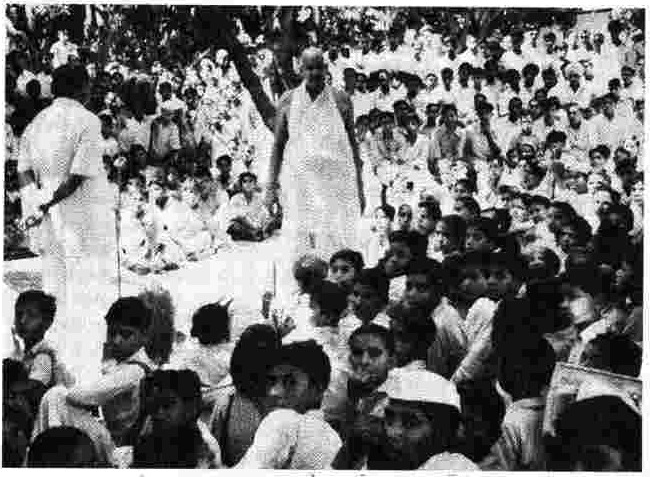
One of the boys later said: “Swami Sivananda says that we can drink a little. So we will only drink a little alcohol!” Then Swami amended it to ‘drink water a little’!
Swami also visited Ayodhya and the actual birth place of Lord Rama, where he addressed a huge gathering of devotees.
In the Town Hall Swamiji noticed the presence of a number of ladies in the gathering. He at once addressed himself to them: “When you do your housework let your hands do the work, but let the mind rest at the lotus feet of the Lord. As you make rotis, sing Jaya Sitaram jaya jaya Sitaram, jaya Sitaram jaya jaya Sitaram. This is an easy sadhana through which you will acquire eternal bliss and also make your home a real Vaikuntha (heaven). It is not necessary to awaken the kundalini through yoga. This is an easy sadhana for you all.”
On the way to attend a satsang Swamiji noticed several children standing a little away from the yard where the Tourist Car had been stationed. He went straight to them, taking a basket of bananas. He made them sing the Lord’s names in beautiful chorus and distributed the bananas to them.
At Benares Swamiji addressed the public at the Theosophical Society, the Theosophical Lodge, the students of the Benares Hindu University, the Central Hindu School and the Central Girls’ School. He also visited Sarnath Buddha Vihara and the most holy Viswanath Mandir, and conducted prayers there. The house in which he stayed (Dr. Kichlu’s) was a place of continuous satsang throughout Swamiji’s stay. (This was true of every centre during the tour.)
After Swamiji had finished a discourse there, an intelligent-looking college student approached Swamiji and asked: “Swamiji, are we not shirking our duty to the world if we take to the path of nivritti (renunciation) for realisation of the Self? Maybe it is an injustice to our kith and kin.”
Swamiji replied, “No. Those who think that they are doing an injustice to the world through their aspirations for Self-realisation have not yet gone above the credulity of childhood. They do not know that the Self which is absolute includes the whole universe, and is far beyond that. There is no shirking of duty here, for to a seeker his kith and kin are not excluded from his perception of Self in all and his service to that Self in all. What is wanted is a changed angle of vision — renunciation of mine-ness and attachment.”
At Benares Hindu University Swamiji imparted his wisdom to the students. He closed the proceedings in true Sivananda style:
Now I will sing some songs. You should also sing with me. You are all my brethren. You are my own Self. There is only one consciousness. These songs will create strong spiritual samskaras in you now. Only those who have strong religious samskaras will join with me:
Chidanand Chidanand Chidanand Hum Har Halme Almastha Satchidanand Hum
You may not wish to repeat this kirtan now, but I have sown the seed and created the samskara in you. When the time comes it will come out and you will start repeating the mantra. You may reject it now, but the impressions are formed in the photographic plate of your mind.
As Swamiji returned to the Tourist Car he was taken to a devotee’s house where a young man was lying gravely ill with a serious disease of the spine. Swamiji prescribed several naturopathic remedies as well as massage-treatment, and then said: “I shall now recite the maha mrityunjaya mantra for the health and long life of the boy. I shall also write the mantra and give it to you. Kindly do japa of this mantra. Ask the boy also to do japa of it. He will gain health and long life. It will bestow moksha (liberation) on him also.”
Then he said to the boy: “My child, do not be disheartened. You are in essence immortal diseaseless Atman. Assert this. Recognise this. Feel that you are all-healthy soul, not this diseased body. You will gain immense strength. Don’t be nervous. Be patient. You will be alright soon. Repeat Ram-nam incessantly in the mind. May God bless you with health, long life, peace, prosperity and eternal bliss.”
With the repetition of the maha mrityunjaya mantra Swamiji massaged the boy’s back with his own hands. The boy was visibly moved by this extraordinary kindness, and experienced a new upsurge of strength and power. The mother was in tears as Swamiji left the house.
At midnight, at the end of a very busy day, Swamiji and the disciples returned to the station. On the way Swamiji said:
“I do not feel tired in spite of this strenuous programme from three in the afternoon till midnight. When I sing the Lord’s name I get new energy. When I speak of God I feel an inflow of divine power. I never get tired at all. It gives me the greatest joy to propagate the Lord’s name.”
The following day Swamiji attended a Press Conference. One question was: “Do you think that Westerners can understand the message of vedanta? Do you think they are ready for yoga?”
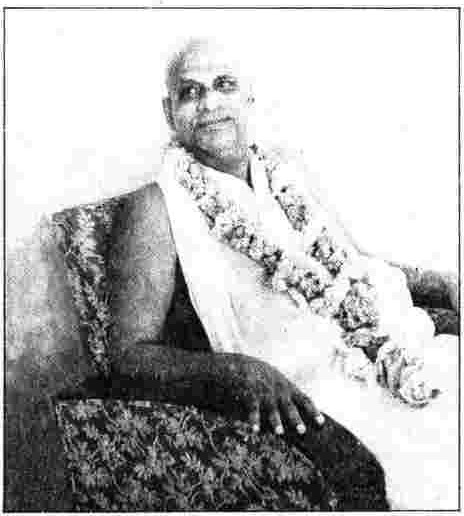
Swamiji was quick to reply, “Yes, yes. Not only are they ready, but they have already begun to appreciate our message. In fact, there are more yogis and jnanis in the West than in India today! They appreciate the message of India more than we ourselves do. They are more eager to know all about yoga and vedanta than we are. There are several people in Europe who are practising yoga and are advanced students. Harry Dickman of Latvia, Boris Sacharow of Russia, Louis Brinkfort of Denmark, G.C. Nixon of Britain and so many others are experts in yoga. Alexander and Nixon got such inspiration from yoga and vedanta that they have embraced sannyas and settled down in India. We are getting inspiration from them now to learn our own yoga and vedanta!”
To the question: “Is unity of the world possible? Will there be an end to wars?” Swamiji replied: “This is a world of duality. There will always be peace and war, good and evil, happiness and misery. You cannot have perfection in this imperfect world. All that you can do, all that the various avatars of the Lord and the many saints and sages have done is to increase the number of pure men. Only their percentage has changed from time to time. In satya yuga it was more, in kali yuga it is less. That is the only difference. Even in satya yuga there were asuric people, and there were quarrels. The only solution is for the individual to realise the Supreme, which gives supreme peace and perennial joy. Then you will realise that the world of duality does not exist in reality, and that it has only a relative existence.”
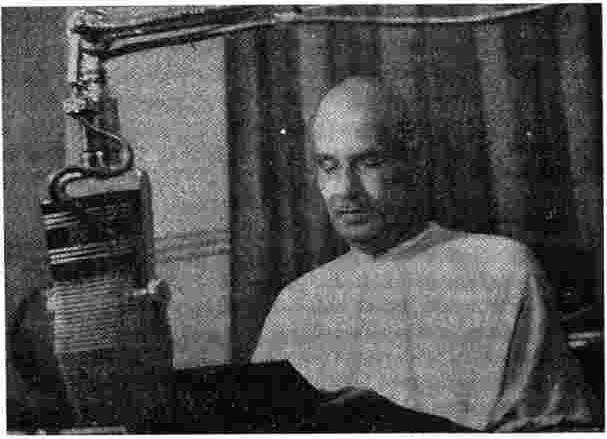
At Patna Swamiji addressed mammoth public meetings at the Bihar National College, at the Patna University’s Senate Hall and at several other places in the city. He gave the first radio talk of the tour from the Patna station of the All-India Radio. He performed an open miracle at the Senate Hall: while discoursing upon the glory of meditation, he roared OM and declared a two-minute mass meditation — twenty thousand people overcrowding the hall sat or stood in ‘pin-drop’ silence, thoroughly overwhelmed by Swamiji’s peace radiations.
While in Patna Swamiji spoke to a devout gathering of men, women and children. A blind business magnate had Swamiji’s darshan. Explaining his eye condition to Swamiji, he said: “I cannot see anything now, Swamiji. The sight has gone beyond repair.”
“It is all right” said Swamiji. “One-fifth of the world has been destroyed for you. You will soon get the spiritual inner vision. Repeat the Lord’s name, cling to His lotus feet. Don’t expect your prayers to be answered at once. Buddha did intense tapas for a number of years, but there was no sign of illumination. He became dejected. He was even about to give up sadhana; but in a few hours he attained Buddhahood. Like that, you should not give up your sadhana, japa, kirtan and prayers, whether or not there are indications of the descent of the Lord’s grace. Go on with your sadhana. Your prayers are bound to be heard by the Lord one day. God is not giving you little siddhis (major psychic powers) and riddhis (lesser psychic powers), because He wants to give you the supreme experience at once, at one stroke. So be happy and cheerful always. God will bless you.”
Early next morning a young devotee of Swamiji’s met him and asked: “Swamiji, I am not getting co-operation in my sadhana from the people at home. They always put obstacles in my path. What shall I do?”
Swamiji replied: “Behave like the most worldly of men. Do not reveal your piety, your spiritual bent of mind and your devotion to God. Pretend that you are thoroughly worldly. They should not know that you are spiritually-inclined. Then you will have no opposition from the parents. But internally you must long for God, you must be regular in your sadhana, you must weep in solitude over your separation from God. All difficulties will vanish quickly.”
From Patna Swamiji went over to Hajipur in a specially chartered steamer. More than twenty thousand people had crowded into the modest town to pay homage to him. The two-mile-long procession was led by five elephants and thousands of devotees. Swamiji addressed an enormous crowd of thousands in a specially erected pandal in the local school compound, besides declaring open a Divine Life Library.
At Gaya he addressed public meetings at the Sanskrit Vidyalaya, Ganga Mahal and Jawaharlal Hall; as also the students of the Gaya College. He visited Buddha Gaya (the holy spot where Lord Buddha attained illumination) and Vishnu Pad. He also consecrated a temple at the local Divine Life Society.
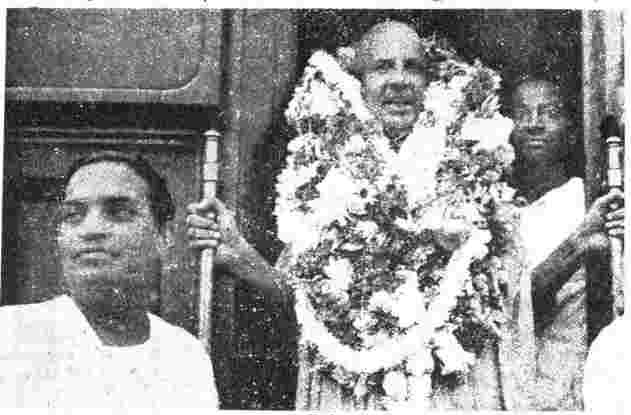
Arriving at Calcutta station
For the three days that Swamiji was at Calcutta the entire city reverberated with divine thoughts, and even the European millionaire-businessmen of the city felt happy that they were able to come into direct contact with a dynamic, practical, modern and authoritative interpreter of vedanta as a world religion. He created an indelible impression in the hearts of all who heard him.
During the meeting at the North Calcutta Branch of the Divine Life Society a child began to cry. There was confusion in the audience as some people tried to stop this disturbance by creating more. Gurudev quietened the adults by saying: “Let the child cry; it is also OM. Let him go on singing OM and we shall go on with our work.”
Swamiji addressed the public at the Calcutta University’s Ashutosh Hall, Vishuddhananda Sarasvati Vidyalaya, Sita Ram Mandir, Bharati Tamil Sangham and the Divine Life Society’s North Calcutta Branch. He also met His Holiness the Sankaracharya of Puri.
The Calcutta Station of All-India Radio broadcast Swamiji’s own vedantic hymns.
On the 25th September the train reached Waltair. On this one day Swamiji addressed the public at the Town Hall and the Prema Samajan, and the students of the Andhra University. After he had talked to the students he felt that they should witness a yoga asana demonstration and movie films from the ashram. The asana demonstration was in progress and someone had gone to the railway station to get the movie equipment, when it was suggested to Swamiji that he should proceed to the next engagement at the Town Hall. To everyone’s surprise he remarked: “I am not coming. The students and I have become friends. Let the Town Hall people wait.” This had a magic effect on the students; they would not forget him nor what he told them. All waited patiently and in an orderly manner till the movie equipment arrived.
At the next stop, Rajamundry, Swamiji addressed the public at the Government Arts College, Ramakrishna Seva Samiti, the Seva Sadan Sanskrit Girls’ School and the Rajahmundry Municipal Office (where a Civic Address — the first of the Tour — was presented to him). This was the first centre during the Tour where a grand ceremonial procession had been arranged. Swamiji bathed in the river Godavari. He also visited the Gotami Jivakarunya Ashram.
From Rajahmundry a specially chartered steam-launch bore Swamiji and party across the sacred Godavari river to Kovvur. Over 10,000 people from all over the district created a festive atmosphere at Kovvur. Standing on the rear seat of the flower-bedecked car, Swamiji gave darshan to the multitude. The crawling car took the longest route through the town, enabling the maximum number of people to have his darshan at their very doors. The crowning glory of the Kovvur programme was the spectacular pada-puja, when thousands of devotees offered flowers and fruits (symbolising the offering of their hearts and souls at the feet of the sage), sang the Lord’s names with him and received initiation from him. They then returned to their homes laden with rich blessings, a light heart, peaceful mind and blissful soul. The worship of a God-realised saint, one of the few remnants of India’s spiritual heritage, formed an inspiring spectacle at all the centres of the tour, bespeaking the Indian’s undying faith in God.
The twenty-four hour stay at Vijayawada was a demonstration of Swamiji’s supreme self-sacrificing service. His physical condition worried everyone but himself, but his mighty will silenced all pleadings for rest. Many people had his satsang at the house where he stayed; he addressed three public meetings at the local college, Kothakudi Temple and Ram Mohan Library; he broadcast a talk over the local radio station of the All India Radio and visited the Sanskrit Vidyapith.
It was impossible to estimate the impact that Swamiji’s memorable visit had on the people of Madras. It belied the popular fear that religion had disappeared from the cities of India. For the four days of Swamiji’s stay, on everyone’s lips was the name ‘Sivananda’ and in everyone’s heart was the divine life message. Every child was singing the popular ‘Eat a Little’ song. Even the poor and the down-trodden felt that they, too, had a friend and that they, too, were blessed.
Swamiji’s thundering exhortation — that man should respect man and forget all distinctions and pull down all barriers, that equal vision should be restored to all eyes — had a miraculous effect on the attitude of the citizens of Madras.
Swamiji arrived at the Central Railway Station in Madras at 7.30 a.m. He was greeted by the thunderous cheers of the thousands of disciples, devotees and admirers who had gathered there since early morning. After being garlanded profusely, he was taken in the magnificently decorated procession-car, to the accompaniment of nagaswaram and band music.
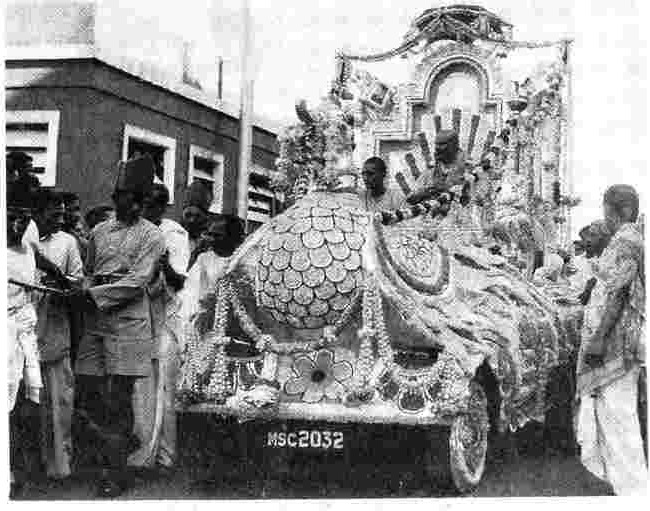
The four days were packed with engagements.
Swamiji’s first stop was the Parthasarathy temple where he offered worship. At 3.00 p.m. he visited the George Town branch of the Divine Life Society. Soon after this he went to the Ripon Buildings for the Civic Reception given in honour of his visit. The same evening he addressed the members of the Southern Indian Journalists’ Federation at its club premises.
During the morning and in the early afternoon thousands had his darshan. At the close of this very busy day, when he was asked to grace a benefit performance arranged in aid of the Kattupakkam Sivananda Sevashram, he did not hesitate to accept. They only asked for his presence, but Swamiji gave them the nectar of his wisdom too. Once the torrent of words commenced he himself found it difficult to stop. Referring to this he once remarked: “When I stand up to address a gathering I identify myself with all. I love every member of the audience. I feel that I must give them my heart — all of it — without reservation. Till I am satisfied that I have served them to my entire satisfaction, I cannot stop.”
On Sunday the 1st October the day began with a visit to the temples of Lord Kesavaperumal and Lord Kapalisvara at Mylapore, where he worshipped the deities. From there he visited the Triplicane branch of the Divine Life Society. From 9 a.m. to nearly 1.30 p.m. thousands performed pada puja to him. He then visited the Park Town branch of the Divine Life Society and also the Srinivasa-Gandhi Nilayam. From there he went to the Madras International Fellowship, where he addressed the members.
Two thermos flasks filled with apple juice and orange juice were always carried in the car when Swamiji’s programme meant that he had to go from place to place without returning to where he was staying, so that he could have some refreshment before and after the meetings. On the way to the next venue at the Museum Theatre it was found that both flasks were empty. It was after 8 p.m. The disciples travelling in the car with him suggested that they would have the flask filled when he reached the platform. Swamiji said: “No. Driver, please stop. Let us go and have something to drink. There must be a kiosk somewhere where we can get some soft drink. We will go there and get some lemonade or anything. The body must have some petrol.” The driver went to the nearest shop and bought lemonade. Swamiji drank two bottles and went to the meeting where, after the chairman had read the Welcome Address (and presented it to him enclosed in a silver casket) and a few of the hundreds of messages received from eminent men had been read out, Swamiji gave one of the most soul-stirring speeches ever heard since Mahatma Gandhi’s last visit to Madras. After this meeting Swamiji conducted sankirtan under the auspices of the All-India Sai Samaj at Mylapore until nearly 10.30 p.m.
Monday the 2nd October was also a day of crowded programmes. At 7.30 he addressed the members of the Shivaji Vyayam mandal, at 9.30 he paid a visit to the Hindu Theological College and at 11 a.m. the Divine Life Society branch at Purasawalkam was sanctified by his visit. He visited the National Girls’ School at Triplicane at 2.45 p.m. and at 4 p.m. he delivered Gandhiji’s birthday Address at George Town. At 6.00 p.m. thousands listened in rapt attention to the ‘Message of Vedanta to the Modern World,’ which was the subject of his speech delivered under the auspices of the Madras Philosophy Association. At 7.45 p.m. he presided over a discourse by Sri K.S. Ramaswami Sastri at Gandhinagar, Adyar.
On Tuesday, the last day at Madras, Swamiji visited the Kalakshetra at Adyar, where he spent a pleasant and peaceful two hours. From there he went to the Theosophical Society and then to Avvai Home, also at Adyar. In the afternoon he visited the office of My Magazine, where a Welcome Address on behalf of the editor and staff was presented to him. (Swamiji was connected with My Magazine from 1931, when his first article appeared in its pages, and continued without a break for over 20 years.)
The strain of continuous talking, lecturing and singing, which had already begun to tell on Swamiji’s health — particularly his ears, nose and throat — had reached its climax at Madras. By the last day talking had become almost impossible. Every ten minutes Swamiji suffered an extremely painful form of cough which frightened those who were sitting near him; but when news came that there was a huge gathering waiting his arrival at Vani Mahal he at once asked to be taken there. “After a little rest, Swamiji,” said someone. “No, no rest for me now. When people are waiting there for me, who can think of resting here?” he replied.
When Swamiji arrived at Vani Mahal there was a mammoth gathering to greet him outside the hall. The hall could only accommodate a few thousand, and the crowd outside was estimated as at least 10,000.
Many important people were on the platform. The organisers knew the state of Swamiji’s health, and were anxious to prevent further deterioration; they were therefore trying to dissuade him from exerting himself further. But once Swamiji saw that huge crowd gathered before him no one could check him. He poured forth his heart for 50 minutes. It was here for the first time that he needed the microphone. Even those sitting on the dias could scarcely hear him. He clung to the microphone, which not only amplified his voice, but helped him to stand. The organisers saw that even standing with this support was a strain on Swamiji, so they requested him to stop, or at least to sit down and speak. But Swamiji would not listen. “No, if I sit down and talk I will not be able to speak with as much feeling as I can standing up. Now I can see them and they can see me,” he said.
After the discourse a movie film of yoga asanas and the activities at Ananda Kutir was shown. Swamiji had a brief rest and then the entire party was taken to the Egmore railway station where, amidst the cheers of the thousands gathered there, he boarded the tourist saloon attached to the 10.25 p.m. train.
The amount of physical strain that Swamiji’s body had undergone in Madras was realised only when he reached Villapuram. Here the organiser, seeing the state of Swamiji’s health, provided ample rest for him; and the devotees contented themselves with his darshan as he was taken round the town in a grand procession from the railway station.
The next day Swamiji travelled to Chidambaram, where he addressed the students and staff of the Annamalai University and the public of Chidambaram at the Shanmuga Vilas. While there he met Maharishi Shuddhananda Bharatiar at the temple of Lord Nataraj.
From the 5th to 7th of October Swamiji visited Mayuram. H.H. Mahasannidhanam of the Dharmapuram Ashram showered Swamiji with loving attention, and Swamiji’s stay at Dharmapuram infused fresh energy, vigour and spirit into his ailing body, enabling it to be equal to his zeal for selfless service.
The procession from the Mayuram railway station to the ashram was a great marvel! It was like the procession of a deity.
Swamiji addressed the public of Mayuram at the Municipal Office (where he was accorded a Civic Reception) and at the Dharmapuram ashram. His speech was tape-recorded for the first time here, and played back before another gathering held the next day in honour of Yogi Shuddhananda Bharatiar, who had come again from Chidambaram to meet Swamiji. Swamiji also visited a number of temples, where he was received with great honour.
On the 7th October Swamiji reached Tanjore which, because of his ill-health and exhaustion, followed the example of Villapuram and contented itself with a spectacular procession along the main roads and a pada puja. The loving care which the organisers bestowed upon Swamiji was praiseworthy.
Swamiji gave darshan to devotees at the Shankara Ashram where the pada puja was performed: the Tanjore Municipality’s proposed Civic Reception had to be cancelled on account of Swamiji’s indisposition.
Leaving Tanjore after only a brief stay of two hours, Swamiji reached Trichinopoly a day earlier than planned, so few people knew that Swamiji was travelling by that train. But the devotees were clever. They were constantly in touch with the railway station staff and found out about the changes in programme. They were waiting to greet Swamiji at every station en route and at the railway station at Trichinopoly. It was at Trichinopoly that Swamiji had studied (at the S.P.G College). As he was driven to the house of his host, Swamiji recalled familiar sights and events of his youth. (His reminiscent mood continued until his birthplace was reached.)
Swamiji had complete rest here until the following morning at 4 a.m when the programme commenced. At 9 a.m. there was a two-mile-long procession along the main roads of Trichinopoly, with Swamiji in a decorated car. Three elephants headed the procession and there were nagaswaram, bands and singing parties on both sides of the car. At a hundred places the procession was stopped, and at a hundred places Swamiji was garlanded. When the procession reached the school where a reception had been arranged, thousands had Swamiji’s darshan. It became almost impossible to control the huge crowd that rushed towards him.
There were several huge public functions in Trichinopoly, but the numbers present at the National College dismayed all. There were about 50,000 people assembled to hear Swamiji in an open-air meeting. Because it was threatening to rain, when the organisers started to read the twelve Welcome Addresses from various organisations the crowd became restive, wanting to hear from Swamiji direct. As Swamiji started to speak the rain started, but the entire crowd stood still and there was perfect silence. They were so intent on listening to him that they did not even notice that they were getting drenched by the rain.
At Trichinopoly Swamiji was examined by some eminent doctors whose unanimous diagnosis was that Swamiji had an enlarged heart (cardiac hypertrophy): their prescription — complete rest — was unpalatable to him, however, and he therefore did not take it.
When leaving Trichinopoly the next day Swamiji and party had to be taken through the underground passage to the platform on which his train stood, otherwise it would have been impossible for him to reach his carriage through the crowd. When the train steamed out of the station the traffic inspector gave orders for the train to proceed slowly so that the thousands who were lining the platforms could have Swamiji’s darshan.
At Pudukkottai he was given a Civic Reception by the Municipality, and addressed the public there. More than 10,000 people had his darshan. On the way to Chettinad he halted at Arimalam to pay his homage to a sage-ancestor of his — Sri Sundara Swamigal — whose samadhi is situated at Arimalam.
At Chettinad Swamiji addressed the public and also held a Press Conference. From Chettinad he travelled to Rameswaram. The 11th October was the holy Mahalaya Amavasya day, so after a grand puja to Lord Ramalingeswara he offered the holy water of the Ganges in abhishekam. (This water had been brought all the way from Gangotri —2000 miles away — for this purpose.) Swamiji also addressed a public meeting in the temple.
Here there was an interesting duel between Swamiji’s humility and public devotion. A palanquin awaited to take him to the temple; but he would not ride on the shoulders of other human beings. The organisers pleaded, so to satisfy their devotion he rode the palanquin for a few yards; and then in obedience to his insistent demand they let him travel to the temple in a bullock cart. (Swami Paramananda had planned the tour in such a way that Swamiji would experience all modes of transport — the tourist saloon, boats, planes, cars — and this unexpected turn of events added the bullock cart to the list.)
During the few hours that he spent at Dhanushkodi on his way to Ceylon, Swamiji addressed a meeting of the Branch of the Divine Life Society before he boarded S.S. Goschen, the ship which took him to Ceylon. Sri Lanka accorded a royal reception to Swamiji. He was greeted with all the honour due to a foreign ruler; but quickly the people forgot all distinctions of nationality and man-made boundaries, enthroned him in their hearts and bowed to him in the supreme oneness of love.
A vast crowd had assembled at Talaimannar Pier to welcome Swamiji as he stepped onto the soil of Ceylon from the Dhanushkody steamer. Many of them had travelled from distant Trincomalie, Jaffna, Colombo etc., to join that first reception.
At 8.05 a.m. on October 12 1950 Swamiji arrived at Colombo Fort Railway Station, which was decorated like a temple. Thousands of devotees and admirers had collected from the early hours. ‘Haro Hara’ and guru namavali greeted him as he alighted from the train. He was received with traditional ceremonies and garlanded by the mayor of the city and the chairman of the reception committee. He stood for a few minutes on a specially-erected dais to enable the vast crowd to have his darshan, and later walked with them to the main entrance so that the thousands who had assembled there could see him. Outside Colombo Railway Station the mayor’s car was waiting and Swamiji boarded it. Mounted police kept the crowd from rushing at the car. (The entire reception was filmed by the Government of Ceylon.) In front was a police pilot car with a loudspeaker fitted to it to clear the road. In the mayor’s car was Swamiji and Sir Kanthiah Vaithianathan. Behind were two policemen on a motor-cycle. The mayor’s driver explained that this extraordinary privilege of police pilot escort was granted only to governors and high officials of foreign governments, and world leaders.
Swamiji addressed the public at the Town Hall, the Corporation, the University, the Ramakrishna Mission, Thambiah Mudalaar Chatram, Saiva Mangayar Kalagam and the Vivekananda Society.
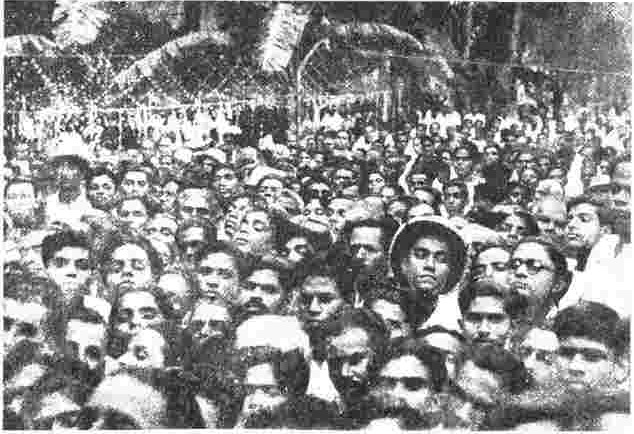
A section of one of the crowds in Ceylon
The Corporation gave him a Civic Reception, which was also attended by the Prime Minister of Ceylon, the Rt. Hon. D.S. Senanayake. Swamiji was presented with a novel Welcome Address on palm leaves and his Town Hall speech was relayed by Radio Ceylon. He visited the local shrine, as also the Kelaniya Buddha Vihara.
Later, at the home of Srimathi Sivanandam Tambyah, Swamiji granted interviews to many men and women. To one group he said:
There are four types of human beings: the active, the emotional, the mystic and the intellectual. The seers have therefore evolved four paths — karma yoga, bhakti yoga, raja yoga and jnana yoga — to enable the people of the four temperaments to reach the goal, Atma-jnana.
Everyone is endowed with all four, but one aspect is predominant in each. Therefore the yoga of synthesis, with a stress on one system, is the most suitable yoga for the present age. This yoga of synthesis develops you harmoniously...
The fruit of selfless service is jnana. Selfless service is most essential...
You should meditate regularly at a particular hour of the day. Then the meditative mood will come by itself at that hour. Besides, you should keep up the meditative mood throughout the day, by gradual extension. Then you will be tranquil, peaceful, happy and balanced. You will be able to turn out more work more efficiently. Have a concrete or abstract background of thought. This will help you to keep up the meditative mood throughout the day. You will soon attain the light of knowledge.
After satsang held at the Tambyah Chatiram Swamiji was taken to Dr. Kumaran’s private hospital, where he was examined by a specialist. Tests of urine revealed 2.5 per cent sugar. Dr. Kumaran and his brother were astonished how Swamiji, with such a high percentage of sugar, could withstand the strain of travel. In fact it was a matter of wonder to those who had been watching Swamiji while at Rishikesh. There he used to complain of giddiness even to go up the hill occasionally; once a week was an impossibility, and going up to the office twice a day from his kutir, hardly a hundred yards away, was getting more and more tiring. Swamiji, who had never before used a walking stick, had of late to use one, as while walking in the street he often felt giddy. Yet he had been able to stand the strain of a month’s tour with a crowded programme everywhere. When this was mentioned to him Swamiji quietly remarked: “It is all His grace.”
At every meeting students and statesmen, mayors and ministers, Hindus and Buddhists, gentry and peasantry listened to Swamiji spell-bound. Colombo was the apex of the tour. The people of Ceylon lost their hearts to Swamiji; and their devotion, piety and love of God and divine life left an indelible impression in Swamiji’s heart.
A big police force was at the railway station on Swamiji’s departure, holding back the crowds and providing a clear way for the car to go right up to the platform where Swamiji’s coach lay. The parting from the crowds gathered there was touching, as many began to weep as Swamiji stood at the open door as the train moved from the station.
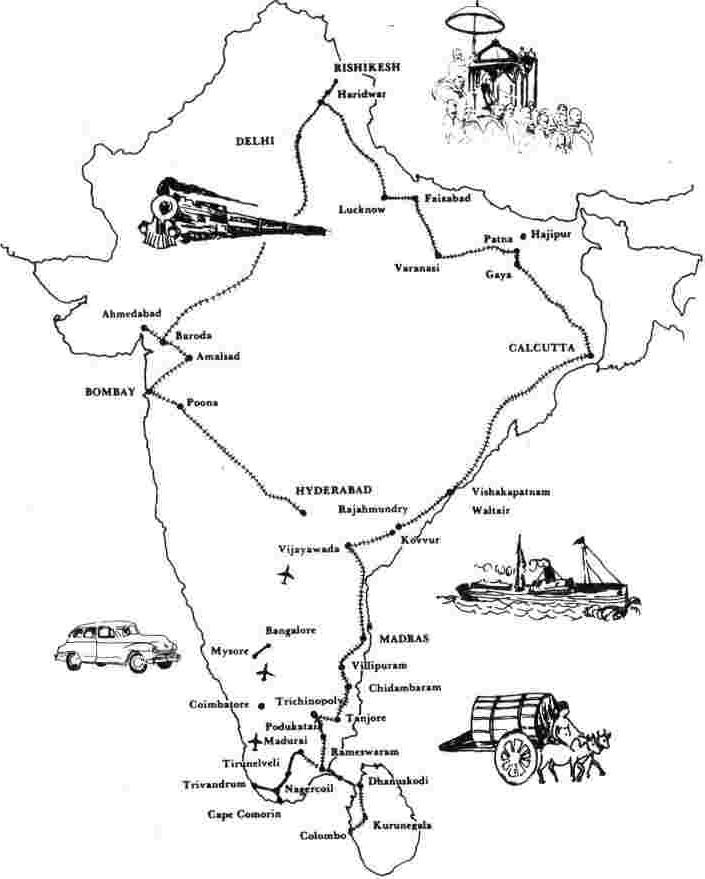
Route taken during the All India Tour
At 5 a.m. the next morning the train reached Kurunegala station. Some members of the tour group were fast asleep — tired out by the strenuous trip and the programme of the previous day. There was sweet kirtan and bhajan on the platform. Mrs. Nityalakshmi Tambiraj and her daughters were on the platform singing. Swamiji saluted the devotees and then, recognising Mrs. Tambiraja, said: “Nowadays you are not writing to me. Previously you used to write to me regularly about your sadhana and progress.” Mrs. Tambiraja promised to be more regular in future. She flooded the compartment with tea, biscuits, toast, milk and fruits for the entire party.
On his return to India Swamiji again addressed a public meeting, at Dhanushkodi. That night there was heavy rain — the first for four years.
At Madurai the procession was a marvel. There was a nagarswaran party, and Swamiji was taken in a four-wheeled coach accompanied by two baby elephants with golden headgear. Then there was an orderly darshan. For three hours Swamiji sat as the devotees filed past.
Swamiji addressed the public at Sourashtra secondary school hall, Sethupathy high school and the Meenakshi Temple. The crowd that listened to Swamiji at the Meenakshi Temple was estimated at fifty thousand.
At Virudhunagar Swamiji had time only to drive along the main streets, therefore a colourful procession had been arranged. His coach was stopped at twenty-five places, where a number of institutions presented him with Addresses of Welcome. He visited the local temple for a couple of minutes and addressed the public there.
After about thirty years, Swamiji visited his hometown —Tirunelveli — which he had left as a layman. Touching scenes of love and reverence marked the two eventful days he spent with his relations. Swamiji addressed the public at the Hindu College and the Centenary Hall (where he was presented with an address by a Muslim-devotee).
At Pattamadai, the place of his birth, Swamiji was received with great love and enthusiasm. He motored to Pattamadai from Tirunelveli en route to Nagercoil. He addressed the public at the Pattamadai High School.
Swamiji was taken round the streets of Nagercoil in an illuminated chariot, to the accompaniment of nagarswaran and kirtan parties. On the second morning he went to Cape Comorin, worshipped Kanya Kumari, had a bath in the sea (where three oceans meet), visited the Suchindram temple and Mahadanapuram. In the afternoon he returned to Nagercoil, where he addressed a large gathering. There was some confusion at the meeting, and the organiser declared: “If you are all well-behaved, Swamiji will be pleased.”
“Irrespective of how you behave,” said Swamiji, “I shall always be pleased, and take with me a wonderful impression of my visit to Nagercoil.”
This had an immediate magical effect on the crowd.
At Trivandrum those who witnessed the unforgettable sight of H.H. the Rajpramukh of Travancore-Cochin welcoming Sage Sivananda into his palace were transported into another era altogether. It was as though King Janaka himself was welcoming sage Yajnavalkya to his durbar. On the 18th Swamiji addressed the public meeting at the Town Hall. On the 19th he visited the famous Padmanabha Swami temple, lunched at the palace and conducted kirtan there. When he took leave of the royal family the palace was still resounding with Swamiji’s sankirtan and the tunes of his philosophical songs.
From Trivandrum Swamiji flew to Bangalore. There was a short but impressive reception at Coimbatore airport en route.
There was a big crowd at the Bangalore airport to receive Swamiji on the 19th October. He addressed a meeting of 8,000 devotees at the airport itself. From Bangalore airport he went to Mysore, where he was accommodated in the Sanskrit College. From there he went to the palace of the Maharajah of Mysore, and spent that evening and the next day there before returning to Bangalore, where he stayed at the Raja Bandhu palace. The people of Bangalore flocked to hear him in their tens of thousands, and in spite of the huge crowds the programmes were carried through smoothly and successfully, thanks to the hard working organisers at the R.B.A.N.M.’s High School; S.S. Sataka Mandali (who specially staged a drama on Ambarisha’s life in honour of Swamiji’s visit); Ram Mandir; E.M.E. Centre, Jalahalli; the Bangalore Corporation (where he was given a Civic Reception); and also several branches of the Divine Life Society.
At Jalahalli Swami addressed a huge gathering of officers and men of the armed services, arranged by Col. R.M. Newton-King. At the very outset of his inspiring ninety-minute address to the men, Swamiji appealed to their higher sentiments. He said: “You are all powerful, strong men, full of vim, vigour and vitality. Your OM-chanting also should be powerful and strong. OM is a great purifier. OM-chanting will infuse power into you and it will tranquilise your mind.” This had a marvellous effect. The OM that arose from the mammoth gathering rent the air. After maha mantra kirtan, Swamiji continued: “... The world cannot give you satisfaction. You are bound to it by strong bonds of desires. Desire is your real enemy. Desire has robbed you of real independence. Desire has enslaved you. You must arm yourself with the powerful weapons of discrimination and dispassion. Long for liberation, and fight this dire enemy within... Even a world-war may last only for a few years, but this inner warfare with ignorance, desire and other evils, might last several lives. By diligence and perseverance, as also by intense application, you can bring victory within easy reach and realise God this very moment. The inner enemy is the most powerful; you must adopt various methods to subdue him. Therefore one needs the combined method of japa, kirtan, meditation, study of religious books, satsang, introspection, selfless service — all these will help you to eradicate the vices that lurk in you and to cultivate virtuous qualities.”
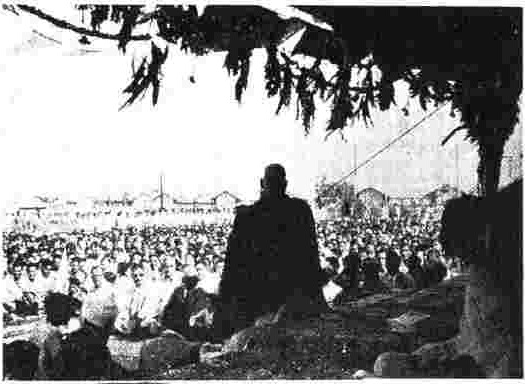
Addressing the armed services at Jalahalli E.M.E. Centre
Arriving at the Hyderabad airport on the 23rd Swamiji was welcomed by a crowd of over five thousand. In the afternoon he addressed the students of the Osmania University, the Mahbub College and the Nizam’s College. These meetings were also attended by the members of the public.
After the discourse at the College it was very difficult to rescue Swamiji from the crowd of enthusiastic people who thronged around him. However the gathering at the Siva temple, which was the next stop, was even more difficult. So many people pressed around the main entrance that Swamiji was taken by the organisers through a side entrance. When he left, because the crowd was becoming unmanageable, he was taken out quietly through a corridor. The public who ‘smelt’ this rushed to meet Swamiji half way. The joy of those who managed to touch his feet in spite of the rush could be measured by the tears which streamed down their faces. To them, touching his feet was the greatest blessing.
After this incredibly tight programme Swamiji and company returned to Pratapgiri Koti, which had been put at Swamiji’s disposal by the Raja of Pratapgiri. Completely exhausted and worn-out, he ascended the staircase; he was short of breath and had to take rest every few steps. All his physical energy had been poured out at various meetings that afternoon. No one who saw him dance on the various platforms could have believed that he could ever gasp while ascending a few steps. He turned to Paramanandaji and said: “I shall not be able to move an inch from here. Kindly take me back at once to Rishikesh. Please cancel further tour programme.”
And he went into the room upstairs.
After half an hour, as per the printed programme, the evening sankirtan started on the lawns of Pratapgiri Koti. Paramanandaji had requested Swamiji not to attend this function, but to take complete rest; and had assured him that the other members of the party would conduct the sankirtan. But, no, Swamiji was the first to go! The entire programme was his own sankirtan and discourse on sankirtan.
Those who had seen Swamiji as he went up the stairs a few minutes prior to this and who had heard him say that he wanted to return to Rishikesh at once, were astounded to see him at the meeting.
This was his own lila (divine play). Swamiji more often taught by example than by precept. By this supreme manifestation of his own gigantic will he demonstrated how a sadhaka should drill his mind to bring it under his perfect control. If the mind craves for rest and leisure, if it doesn’t want to take delight in the service of others, in singing kirtan, in swadhyaya or in sadhana, refuse to bow to it. Make it your obedient servant.
The next day, after barely four hours sleep, Swamiji broadcast a talk on the significance of Durga Puja over the Hyderabad station of All India Radio, and also visited the Gowlipura branch of the Divine Life Society where he declared open a charitable dispensary.
On the 25th October Swamiji’s party travelled to Poona by train. Poona was not on the original itinerary, and yet even at short notice a full programme was efficiently organised and a huge crowd had assembled at the railway station. Swamiji addressed several meetings here: at Saraswati Vidyalaya, the Malaria Institute, St. Mira’s High School, Dr. Viswanathan’s house, Kirkee Branch of the Divine Life Society, Tilak Mandir and Saidas Mandal. He also visited Jnanadev’s Samadhi at Alandi.
The party reached Bombay on the 26th. Besides the mammoth public meeting at Madhav Bagh Swamiji addressed the public at Lakshmi Bagh, South Indian Education Society, Astika Samaj, Vanita Vishram Girls’ School, Sunita Girls’ School, Bombay Spiritual Centre (Blavatsky Lodge), Sannyas Ashram, Daivik Jeevan Chaitanya Prabha Mandali, Sri P.G. Purohit’s house in Santa Cruz and Bharatiya Vidya Bhavan. He also broadcast a talk over the Bombay station of All-India Radio.
Justice Bhagavati’s introductory speech at the Bharatiya Bhavan was moving: “The vast audience I see here is proof positive that Swamiji is well known to you all. Who am I to say anything about him to you, when his fame has spread all over India and you have all come to listen to the words of wisdom he is going to address to you? In these days when we have gone to the very depths of demoralisation it is really like an oasis in the desert to find saints like Swamiji coming to us, to address to us words of wisdom. It is really necessary for us to hear him — not only to hear him, but also to shape our actions accordingly.”
One of the main events organised on Swamiji’s last day in Bombay was a pada puja. His attendants wanted Swamiji to take a few minutes rest before he went up to the terrace for the pada puja. As he was about to lie down he noticed that people from neighbouring balconies were watching him through the doors and windows of his room. He got up and stepped out of the room, and from the balcony gave darshan to the neighbours —or rather, had darshan of the neighbours. With folded palms he greeted them. They were delighted. He took a couple of fruits and showed them: “I am sending you this prasad. Kindly accept this.” At once a member of the group ran to the neighbouring house with the prasad.
Then Swamiji went up to the terrace. He proceeded straight to that side which was nearest the road, stood up on the platform which had been placed there (and from which Atmanandaji was doing kirtan) and began to address the gathering. There were about 1,000 people on the road, all standing in the sun eager to listen to Swamiji and to have his darshan.
“You see I am turning towards you all and doing kirtan. These people on the terrace are comfortably seated. But you are standing in the hot sun. You do not mind the inconvenience caused to you. You are full of devotion to the Lord and faith in Him. You are eager to listen to spiritual discourses, to do sankirtan of the Lord’s name. You are all very dear to me.”
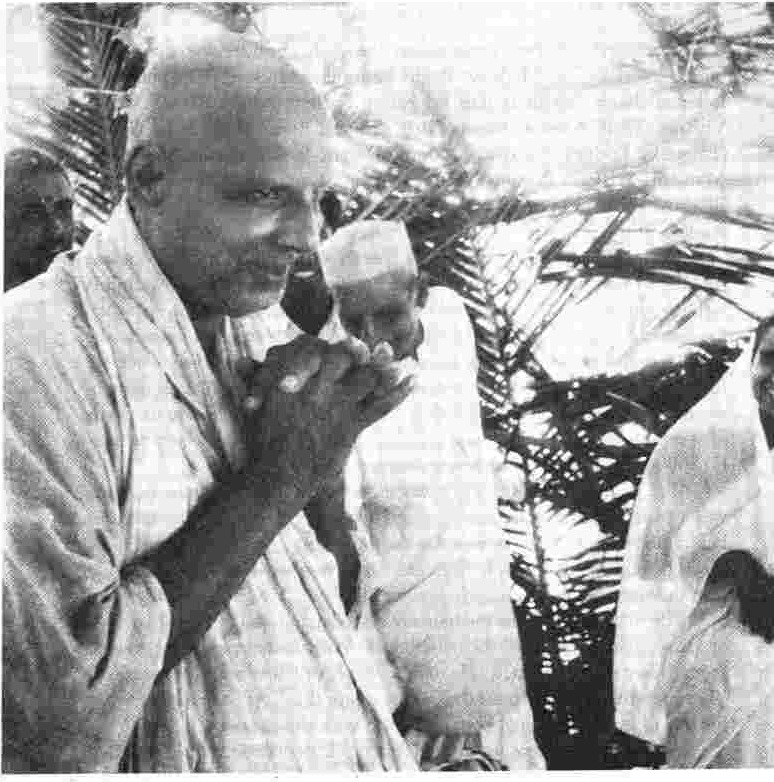
On the way to Baroda from Bombay fifteen thousand people from a radius of over fifty miles had gathered at Amalsad (a small town) to have Swamiji’s darshan and spiritual instruction. Special trains had to be run by the railways to deal with the situation. The public meeting was held in the school grounds. When Swamiji found that a crowd had collected at the railway station in the evening, he conducted a satsang there as well.
At Baroda Swamiji addressed the public at the Town Hall and also conducted satsang at the Vitthala Mandir. On the 1st November he inaugurated a branch of the Divine Life Society there, saying: “I declare open this branch of the Divine Life Society. The Divine Life Society is a universal institution. It has no pet dogma or secret doctrine. Anybody can join as a member of the Society. Throughout Europe and America there are also branches. Christians, Mohammedans, Parsis, Germans and Frenchmen are members of the Society... Some people show great interest and much enthusiasm in the beginning. Gradually they lose interest and the work they take up becomes almost extinct! You should not be like that... The Secretary and the President and other workers should develop adaptability. You must be able to adapt with everybody. Then only will the institution flourish and there will be whole-hearted co-operation from the public.”
Next stop was Ahmedabad, where Swamiji addressed a public meeting at Premabai Hall and held two satsangs at the Gita Mandir; he also visited the Sabarmati Ashram of Mahatma Gandhiji and addressed the inmates there. He gave an interview to the press reporters. After he had answered all the reporter’s questions he summed up his own teachings:
Serve, love, give, purify, meditate, realise, Be good, do good, be kind, be compassionate. Adapt, adjust, accommodate, Bear insult, bear injury — highest sadhana. Enquire ‘Who am I?’ know the Self, and be free.
Bear insult, bear injury; this is the highest sadhana. One harsh word upsets you, brings about blood-shot eyes and you at once react to it, saying; “Do you know who I am?” You are not able to control yourself in spite of your boasted intellect. You should learn to bear insult and injury with equanimity, thinking ‘these are only sound vibrations in the ether’. This demands perfect pulverisation of the ego. You should enquire ‘Who am I?’, ‘Who is abused by whom?’ and thus utilise every occasion when you are insulted as very good opportunities for introspection, enquiry and spiritual progress.
Just as in the Gita the Lord has enumerated certain fundamental virtues which an aspirant should possess in an abundant measure for quick spiritual progress, I have selected eighteen fundamental virtues and put them in English song-form for the benefit of students. You will like it immensely:
Serenity, regularity, absence of vanity, Sincerity, simplicity, veracity, Equanimity, fixity, non-irritability, Adaptability, humility, tenacity, Integrity, nobility, magnanimity, Charity, generosity, purity. Practise daily these eighteen ’ities, You will soon attain immortality. Brahman is the only real entity, Mr So-and-so is a false non-entity. You will abide in Infinity and Eternity, You will behold unity in diversity. You cannot attain this in the university, You will attain it in the forest-university.
Swamiji reached New Delhi on the 4th November. He was received at the ‘Victory Platform’ at the New Delhi railway station by a crowd which even a well-organised cordon of Scouts could not control. The public reception on the 5th was presided over by the Chief Justice of India, Sri Justice Patanjali Sastri, and addressed by several dignitaries. Besides this he lectured at Birla Mandir Hall, Sanathana Dharma Pratinidhi Sabha, Yoga Ashram, Delhi University, Lodi Colony, Salwan School and the Y.M.C.A. At the Birla Mandir and the Sanathana Dharma Prainidhi Sabha he addressed a meeting every day of his stay. He also gave a talk over the All-India Radio, Delhi station.
Swamiji visited the Rajghat Samadhi of Mahatma Gandiji and also Birla House where the Mahatma was assassinated. He offered prayers at both these places.
The great spiritual leader, Sri Goswami Ganesh Dutt, said: “What a miracle! This one sadhu, by his mere presence in the capital of India, has transformed the entire atmosphere of New Delhi.” Justice Patanjali Sastri said: “You have seen through intuitive insight where the need lay, and you have started this work of spiritual dissemination of knowledge. It is a gigantic task.”
A special feature of Swamiji’s stay in New Delhi was visits to the houses of devotees (including the Commander-in-Chief of the Indian Army, General K.J. Cariappa), where he conducted brief satsang. After one of these he remarked: “I do not think that the highly publicised and organised tour like the one we have had is as effective as these house-to-house visits and satsangs. We should have a station-wagon in which we should go from village to village and conduct house-to-house satsang. That is the most effective way of disseminating spiritual knowledge.”
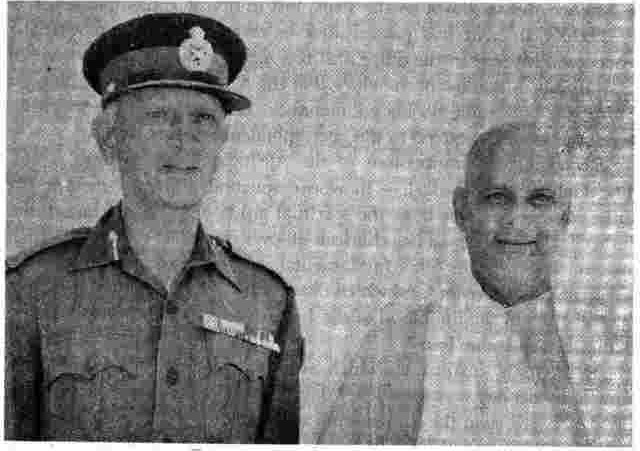
With General K.J. Cariappa
After two months of the most intense service, during the most extensive and exciting tour of India and Ceylon, and after effecting an unprecedented nation-wide spiritual awakening, Sri Swamiji returned to his abode on the bank of the Ganges. His countenance remained calm as the ocean-depths; the huge waves of spiritual currents that had emanated from him had flooded the country with wisdom but had not exhausted him — not even his physical frame! The mahatmas of Rishikesh read in his blissful face and sparkling eyes his eloquent message: “Service enables you to draw power, joy and strength from the inexhaustible Cosmic Source.”
The grandeur of the Rishikesh reception was equalled only by the loving anxiety with which the men, women and children of Rishikesh, who had made Swamiji their own during the past twenty-five years, welcomed him — proud of his superhuman achievements and happy at his safe return in perfect health. When they parted from him two months before, they wept; when he returned to them, they shed tears of joy.
At the ashram his disciples welcomed him back to his own abode. They rushed to greet him, to garland him and to touch his feet. A procession took him back to the ashram. After exactly two months Swamiji re-entered his kutir on the bank of the Ganges. Quickly he divested himself of his overcoat and rushed to the Ganges. He worshipped the Mother and sat down on the steps, lost in divine contemplation.
Hardly an hour had passed after he entered the ashram when he re-occupied his seat in the office and resumed his duties. Not a trace of the strain nor a shadow of the glory that the All-India Tour had brought to him was noticeable on his countenance. He conducted the morning prayer and began to attend to the correspondence on his table.
Recording his impressions of the All-India Tour, Swamiji wrote: “The Holy Bharat (India) — in whose spiritual affinity I include Sri Lanka also — has ever been the spiritual guide of the entire humanity. Mother India has nursed her children all over the world with the milk of wisdom. That wisdom, that fundamental spirituality, that aspiration for the Eternal, that love for God which characterised the peoples of the vedic era, still runs in the life-blood of the Indian today. That is what I found during the All-India Tour.”
To the many institutions which Swamiji had visited during the All-India Tour that day was a red-letter day: and they put it on their religious calendar. Every year, the day Swamiji visited their institution is observed by them as Sivananda Vijaya Jayanthi, the anniversary of Swamiji’s visit. Thus, the Tour had been made a source of permanent inspiration.
There is not the slightest doubt that Swamiji’s epoch-making tour not only brought about a very great spiritual awakening in the country but also helped the Divine Life Society’s establishment on a firmer foundation. The mission had a sudden fillip: all at once thousands of people came into Swamiji’s contact; the Society’s income increased, and with it work and debts! That was Swamiji’s miracle — the miracle of perpetual self-sacrificing service.
The Parliament of Religions
From the time that Swami Paramananda announced the intention of convening a Parliament of Religions, Swamiji enthusiastically supported him and encouraged him in every way, saying, “Kindly do not get discouraged when some obstacles crop up. Everything will be crowned with success.”
The Parliament met on the 3rd, 4th and 5th of April, 1953. It was an event of unprecedented magnitude, rejoicing and spiritual fervour. The ashram became a busy township, and there was a festive mood in the atmosphere from the 1st of April, 1953. The chairman of the reception committee (Sri N.C. Ghosh, M.A.) and Swami Paramanandaji, the prime mover, were busy giving final touches to the programme. On the evening of the 2nd all the delegates had arrived: the team of selfless workers of the ashram had been geared to the most intense service —receiving, accommodating and attending to the countless guests who kept on coming. It was on such rare occasions that the wonderful spirit that Swamiji infused into the workers of the ashram revealed itself. These swamis and sadhaks, accustomed to a quiet life devoted to their sadhana and guru-seva (service to the guru), instantly and spontaneously transformed themselves into human machines and plunged into service. Each took his place without any prompting, doing his duty flawlessly and shouldering any burden ungrudgingly. Swamiji trained by personal example, not by sermons (which are almost always ineffective). The following is the Press Trust of India report on the three-day session of the Parliament:
The three-day Parliament of Religions, attended by over 200 delegates representing all important religions, was inaugurated here (at Rishikesh) today by Sri C.P. Ramaswamy Aiyar at the Sivananda Ashram on the bank of the Ganges. Sixty-seven-year-old Swami Sivananda, who has organised the conference, stressed the unity of all religions and said that the underlying differences were in ‘non-essential’ and ritualistic aspects.
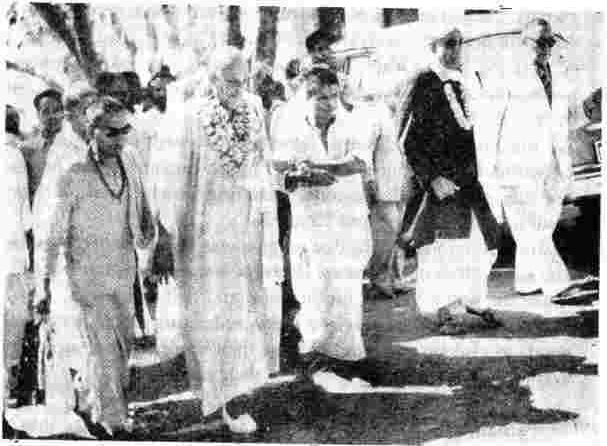
Swamiji arriving to inaugurate the proceedings
Sri Ramaswamy Aiyar said: “It is our function to emphasize unity in variety. The world is not made to a single pattern, and variety is as important as unity. Those who would like to have only dull uniformity are doing as great a disservice to religions as those who emphasize meaningless differences. The spirit that has animated the Indian races through centuries has been the common quest for the Ultimate. Our roads may diverge, but our goal is the same. Today when the world is gripped by fear, if India stands for anything she stands for liberation from fear. That is the contribution which India can make to world peace.”
Messages wishing the conference success were received from the Vice-President Dr. Radhakrishnan, Union Ministers, Governors, Rajpramukha, Mr. B.G. Kher, Indian High Commissioner in London, Mr. Chester Bowles, General Cariappa, and several overseas organisations.
Those participating in the conference included Maj. Gen. Yadunath Singh (who played a leading part in the Indian Army’s operations in Kashmir and is now Chief of the Military Mission in Nepal); Maj. Gen. A.N. Sharma, retired head of the Army’s Medical Service; sannyasins and many others. Just before the conference began the Guru Granth Sahib was taken out in a procession which was headed by an elephant and accompanied by a brass band.
At the conference Swami Sivananda recited verses from the Upanishads and sang a chant in English honouring the prophets and the seers of all religions, including Jesus Christ, Krishna, Buddha, Mohammed and Confucius.
Swami Sivananda denied that religion was the opiate of the masses, and said: “It is not a disease, born of fear, but it is our breath. It shows the way to peace, brotherhood and Self-realisation.”
Swami Sivananda improvised verses, exhorting the audience to be good, to give up smoking, to raise their voice against social evils and to work hard in the service of their nations.
The Parliament, which sat morning and evening and far into the night, was addressed by the representatives of all the main religions of the world. Swamiji himself was the first to reach the platform and the last to leave it, in spite of the fact that after a serious illness (lumbago) which had compelled him to remain in bed for over two months, he was moving out of his kutir for the first time. On the third night he conducted the session till everyone who wanted to speak had been given a chance: it was past 2 a.m. when he retired, only to be ready before 5 a.m. to meet Sri Ananthasayanam Ayyangar (later Speaker of the Indian Parliament) before his departure for Delhi. The condition of his body never interfered with the strength of his mind and the spirit of his service.
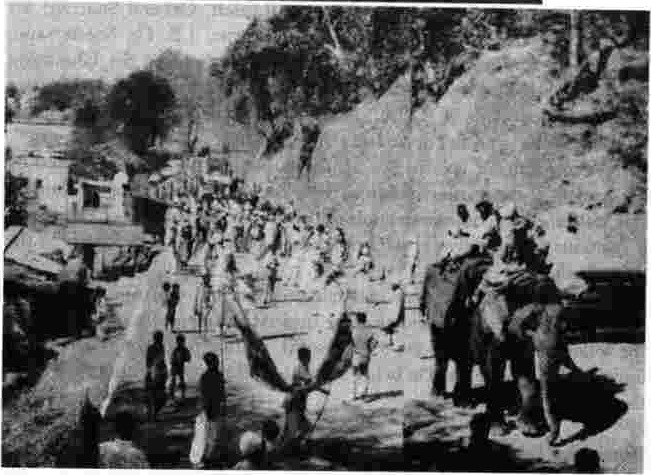
The Guru Granth Sahib is taken in procession
The following were among those who took part in the Parliament: Dr. M.H. Syed, retired Professor of the Allahabad University; Dr. B.L. Atreya, Head of the Department of Philosophy in the Benares Hindu University; Rev. St. John Catchpool of the Quaker Movement; Sri Swami Nirmalji, a great vedantic leader; Sri N.C. Chatterjee, President of the Hindu Mahasabha; Sri Swami Atmananda of the Yogoda Satsang, Calcutta; Sardar Bahadur Balwant Singh, Puri; Sri Kumaraswami of the Nav Kalyan Mutt, Dharwar; Sri Vyasji Maharaj; Sri H.J. Hablutzel of Switzerland; the Brahmakumaris of Mt. Abu; Sri Jayadayal Goenka of the Gita Press; Maharishi Shuddhananda Bharatiar; Dewan Bahadur Sri K.S. Ramaswami Sastriar; Dr. Thomas Ransch; General Sharma; Sri Samimi of Iran; Sri Ananthasayanam Ayyangar; J.E. Dr. Soedarsano, Indonesian Ambassador in India; Mahamandaleshwar Sri Chaitanya Giri of Kailash Ashram; Mahamandaleshwar Sri Swami Gangeswaranandaji of Delhi; Sri Swami Purushotthamanandaji of Vasishta Guha and Sri Sivananda-Vijayalakshmi of Madurai.
A magnificent volume containing numerous papers contributed by the leaders of the various religions who could not attend the parliament was published in commemoration of this World Parliament of Religions; it contains authoritative articles of learned persons, each a master of the topic dealt with.
The World Parliament of Religions was the crowning feature of Swamiji’s ceaseless efforts to promote understanding and goodwill among the followers of all religions of the world, so that their combined moral force could be harnessed to bring about a world-wide spiritual revival —the need of the hour.
Platinum Jubilee
The 70th Birthday of Swamiji was a decided landmark in his life. His spiritual influence had covered the entire globe; and within his own life-time he saw the great mission of his life bear fruit and thousands all over the world marching Godward. Hardly 32 years after he entered Rishikesh as a mendicant, with nothing but a cloth and a water-pot to call his own, he was taken in procession along the roads of Rishikesh with all honour and reverence. At the ashram itself, which had grown during these years from a ‘cow-shed’ into a township, the devout disciples had erected a temple where, in his own life-time, Swamiji was worshipped. The Platinum Jubilee witnessed this glory.
On the 7th September a grand procession, the grandest in the annals of the history of Rishikesh — grander than even the procession that was arranged on the day that Swamiji left Rishikesh on the epochal All-India Tour — had been organised by Sri Swami Paramananda (who had a natural flair for doing big things in a big way!) A motorcade with buses carrying devotees, sankirtanists and songsters; batches of devout disciples of Swamiji — some singing the maha mantra, some dancing in joy, some reciting the veda mantras; a small divine army of ardent followers of Swamiji, who had come to the ashram to take part in the Platinum Jubilee Celebrations; also a band-party and an acrobat — it was a mile-long series of arresting features.
The entire township of Rishikesh wore a festive appearance. There were flags and festoons everywhere and arches saying ‘Long Live Sivananda’ had been put up at a hundred places along the route for the first time in the history of the town. The procession went round the whole town so that everyone could have the blessing of Swamiji’s darshan.
While passing through the main bazaar of Rishikesh, suddenly the procession came to a halt; several ladies who were walking along just ahead of Swamiji’s car (decorated like a moving throne) had, even as they were singing the names of the Lord, begun to dance! Highly educated modern ladies, who belonged to the upper strata of Indian society, were singing the Lord’s names and dancing along the road. They had not the slightest feeling that it was a public thoroughfare; to them it was Swamiji’s divine presence. They gazed at his radiant countenance and lost themselves in ecstatic joy.
There were several shops in the town at which Swamiji’s car was stopped and the proprietors offered devout worship to him. The Divine Life Society owed them large sums of money for provisions, etc. which it had purchased from them. As they garlanded him, worshipped his divine feet with flowers and waved camphor before him, the thought did not occur to them that the Society, of which he was the head, owed them money. They knew that though business had to be carried on and money accepted in return for goods supplied, what was really conducive to their prosperity were his blessings and his grace. How happy and blessed they felt when Swamiji turned to them and enquired: “Oh, this is Sevaramji’s shop? Which is Ayaramji’s shop?” etc., and then turned his full gaze on the fortunate owners.
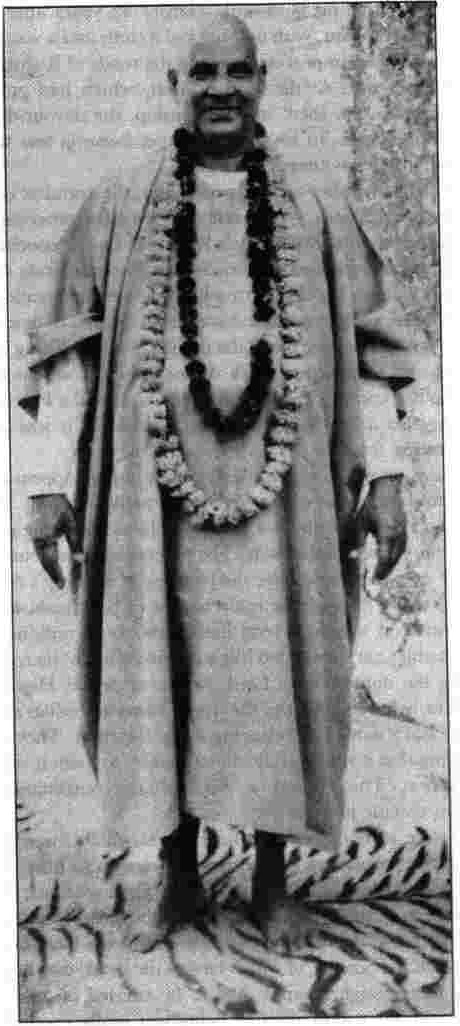
Swamiji garlanded on his birthday.
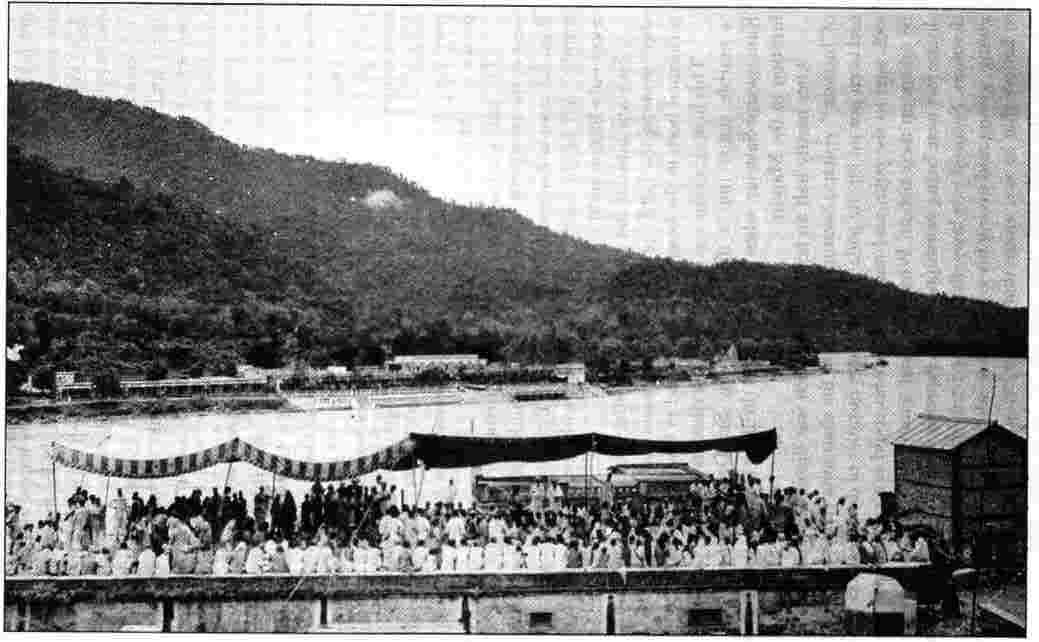
Some of the visitors who thronged to the ashram.
Everywhere fruits and sweets were offered to him, sanctified by his touch and distributed to devotees. Even while the procession was in progress he gave to those who sang and danced, and to several others who were taking an active part in the procession.
When he returned to the ashram, as he was entering his kutir he called all those who were accompanying him and invited them to dine with him. “You must all be very tired, walking all the way, singing and dancing; please forgive us for the trouble. May God bless you!” he said.
The next day (the 8th) Sivananda Nagar was astir with activity as early as 3 a.m., though most of the devotees were awake till midnight discussing the procession. Individual and group meditation was done and prayers were offered; many took bath in the Ganges; others were busy preparing for the celebrations. In all hearts was but one universal prayer — “May Swamiji live long!”
The car was ready at 6 a.m. Swamiji emerged from his kutir and went to the newly-constructed Sivananda Mandir(temple). Then Srimati Rani Sivananda-Kumudini Devi performed the opening ceremony of the temple, and at the same time the entire gathering shouted “Satguru Sivananda Bhagavan-ki-jai”.
Swamiji himself did the pranaprathishtha (installation of a murthi after invoking the Lord’s presence with special mantras). Then arati was performed both to the beautiful murthi and to Swamiji himself.
This historic event was beautifully described as the transformation of ‘a marble statue into a divine being’ by Sri Dewan Bahadur K.S. Ramaswami Sastriar, when he delivered a thrilling lecture soon after the function in the Mandir.
After hardly half an hour’s rest (which was disturbed by the arrival of ‘birthday’ visitors) Swamiji went up to the shamiana (large tent) which had been put up for the pada-puja. A large number of devotees personally took part in the puja; and many others who could not come had it done by others on their behalf. What was most remarkable was that while his divine feet were being worshipped with supreme faith, intense feeling and devotion, Swamiji was busy distributing fruits and sweets to devotees —giving, giving and giving his grace, his wisdom, his love. It was difficult to believe that he was aware that he was being worshipped.
After the pada-puja there was music by visiting musicians from Delhi, Dehra Dun, etc. Sri Sadhu Murugadas wanted Swamiji to go over to the musician’s dais; and it was past 12 noon. A senior inmate of the ashram peeped in, feeling that it was time to wind up the satsang, but Swamiji went on singing his English philosophical song, adding: “Oh Swamiji! I am not afraid of you! You cannot stop the satsang now!” in a humorous vein.
Finally Swamiji went to his kutir at 1 p.m. Surprisingly enough he was the first to reach the shamiana to commence the afternoon session. (The surprise was only because of Swamiji’s poor health: otherwise, he had always been the first to come and the last to leave any satsang.) It was a few minutes before 3 p.m. Even the ashram-workers, who were well acquainted with Swamiji’s extraordinary traits, were taken by surprise. Swamiji himself had the dais put up, carpets spread and the whole place prepared for the satsang. (It was towards the close of this session that Srimati Sivananda-Zepporah of Australia formally presented Swamiji with a platinum wrist watch, studded with diamonds, to signify the Platinum Jubilee celebrations.)
The night satsang went on till after 4 a.m. on the morning of the 9th. People who could not keep awake left earlier; people who could not resist sleep, slept wherever they were; but Swamiji and a few devoted disciples who surrounded him had not had a wink of sleep. Musician after musician, sankirtanist after sankirtanist, sang the Lord’s names and glories; Sri Sivananda-Vani of the All India Radio staged a drama; Sri Sudarshan Sarin conducted a variety entertainment programme by small children from her kindergarten school; while Sri Balam of New Delhi sang bhajans ecstatically. After 3 a.m. Swamiji remarked: “It is brahmamuhurtha now; so, we should all sing the Lord’s names more vigorously.” The satsang came to a glorious conclusion at 4.30 a.m.
At 7 a.m. when Swamiji came out of his kutir to attend the morning satsang no one could find on his radiant countenance a trace of tiredness, or a sign of the great strain that his physical being had been put to.
Sivananda Literature Festival
The following was a common sight at the ashram. It often went unnoticed, and much less understood, but it was unique:
A gentleman stepped in and was greeted by Swamiji with the warmth that melted the coat of reserve, suspicion and scepticism that he may have been clad in. Swamiji evinced interest in his achievements, ideas and ideals. The gentleman was pleased. What little reserve was left was easily washed away with sweetmeats and coffee. Almost half an hour passed. The renowned yogi of the Himalayas, reputed for his great wisdom, had not offered a word of advice or admonition — but the gentleman was not disappointed. He was preparing to leave, after meeting a ‘lovable’ personality. Swamiji quietly slipped a few books into his hands. The taste of the sweetmeats and coffee had gone, but the sweetness and the majesty of the face lingered. Later, memory tempted him to thumb through a book. A word, a line jumped out of the book. His eyes were glued to a paragraph. He was won, in spite of himself.
Such was the miracle worked by this ceaseless free gift of books, freely bestowed on all by Swamiji. So fond was he of this ‘free department’ that he never even enquired if copies were made available to the sales section. The reason was sound — the aspirant who asked for a book was obviously on the right path; if it was not available, he would derive inspiration from some other book. But that book might have served a better purpose if it was given to someone who did not ask for it, perhaps did not even want it (and accepted it out of courtesy thinking — “How can I refuse it when this loving, good man offers it free?”).
Swamiji’s books are not just printed paper. They are the manifestations of God’s grace, of God Himself. They are full of shakti. People have used them for innumerable purposes besides the acquisition of knowledge and spiritual enlightenment. Some have used them as a talisman to ward off evil; some have used them as the silent voice of God — when they have a doubt or difficulty they open a page and God speaks to them through a paragraph or a sentence on that page. Some have used the books as a good friend, a perfect companion, to keep away grief, gloom and depression; while others keep the books for the sake of the inspiring pictures of Swamiji that they carry. If the language is alien to them, Swamiji himself is all the more near. To one and all, Swamiji’s books are Truth made manifest, even as the Vedas, the Guru Granth Sahib, the Bible and the Koran are.
This was the idea underlying the Sivananda Literature Festival, which was celebrated on the Guru Purnima day — 20th July, 1958. The manifest Truth — Sivananda Literature — was looked upon not as just printed books, but as God manifest, ready and eager to bless, to guide and to enlighten.