Sivananda: Biography of a Modern SageHis life, by Swami Venkatesananda
COMMUNICATION AND EDUCATION
Photographic Studio
The guru’s portrait represents the highest spiritual ideal in the eyes of the seeker after Truth, just as to the patriot the national flag stands for his beloved motherland. Realising this the publishers of even the earliest of Swamiji’s writings had asked for and obtained his photographs for publication in the books. They themselves used to pay the studio bills. When Swamiji was in Swarg Ashram he had to go to Hardwar frequently to have a photograph taken.
The publishers had their own specifications. They had to keep an eye on the market, and satisfy the prospective reader. The South Indian publisher wanted a photograph of Swamiji with rudraksha-mala, lines of sacred ash on the forehead and arms, and the sannyasin’s staff, etc., but the North Indian publisher had quite a different idea. Moreover, they demanded an ‘appropriate’ pose for each book. That was their idea of what the public would expect: and they were right. Every time, Swamiji had to carry all the ‘props’ all the way to Hardwar. He would bundle up a tiger skin, a gown, a yoga dandam (a piece of wood fashioned into an arm rest for use in practise of pranayama), etc., and walk from Swarg Ashram to Rishikesh railway station with a kamandalu (water pot) in his hand. Once he had to have a photograph taken at short notice, and therefore resorted to a cheap roadside ‘studio’.
What mattered to Swamiji was publication of his book, the dissemination of spiritual knowledge, not his reputation. Once he was returning from a tour of Meerut, and en route he received a demand for a photograph. He promptly went back to Lucknow. He had not had a shave. The photographer immortalised the bearded form.
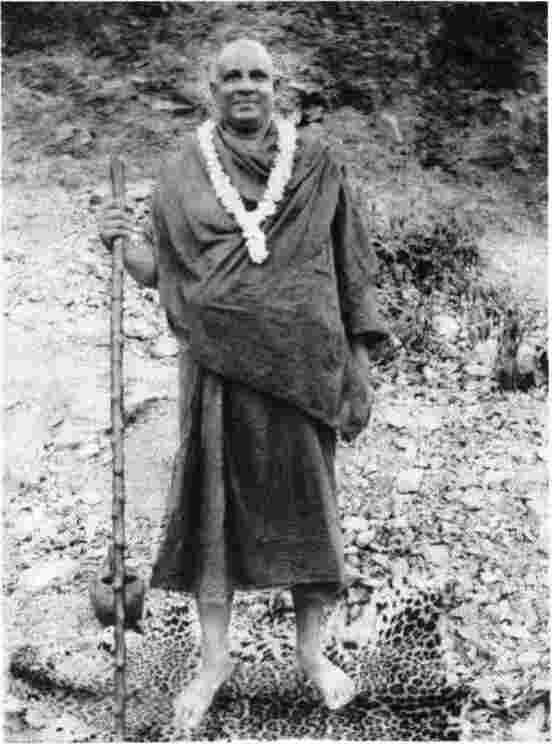
Photo taken by a ‘roadside photographer’
It was in 1932 that P.C. Mull of Lucknow took the first good studio portraits of Swamiji; they adorn the first publications of Swamiji’s earliest works.
In 1934 Swami Paramanandaji purchased a ‘Brownie 620’ box camera for Rs.3. “I struggled hard to purchase an 8 mm movie camera,” said Paramanandaji, “but Swamiji would not allow any money to be spent on it.” Somehow, out of the donations received for the Birthday in 1939, the 8mm movie camera was purchased. Once this was done everyone realised its importance. How much more inspiring to ‘see Swamiji in action’! A devotee might derive inspiration from a portrait; but a devout disciple wants to see his guru in action. To him it is a living scripture.
A couple of years later the Rajah of Atgarh presented the ashram with a 16mm movie camera and also a projector. This was a boon.
Then Swami Saradanandaji joined the ashram, and took a keen interest in the cameras. Swamiji found in him the zeal and enthusiasm that deserved promotion. A small ‘hole’ beneath the Bhajan Hall was converted into the photographic dark room. Mrs. Lilian Shamash of California gave the first major impetus to the studio by presenting the Speedographic camera. Swamiji’s photographs and the photographs that visitors obtained standing by his side were all taken and processed in the ashram itself.
At the same time a row of rooms was being constructed, with several rooms on the ground floor. One of these, because of its size, was good only as the photographic dark room. Swami Saradanandaji occupied it and transformed it into what was universally acclaimed as one of the best studios in India. His utterly selfless and intense devotion and his unbounded enthusiasm won Swamiji’s heart, and Swamiji also equally enthusiastically encouraged him in the acquisition of the best equipment for the studio.
The Sivananda Art Studio was formally opened by Swamiji on the Mahasivaratri day, 25th February 1949. Its contribution to the divine cause of the Society is inestimable. It won the admiration and gratitude of the aspirant-world by making available movie films of Swamiji’s life and activities, and of yoga asanas, kriyas and pranayamas demonstrated by the hatha yogi disciples of Swamiji. Yoga schools in London, Australia and Germany possessed copies of these films. The Studio maintained a pictorial, factual record of the sage’s actions, so that viewers could see Swamiji bouncing like a boy, singing, dancing, greeting, sweeping, swimming and conversing with distinguished visitors. During one of Paramanandaji’s tours of South India he exhibited these films at all branches of the Society; and similarly, during his tours to Gujerat Sri Swami Chidanandaji also exhibited them for the benefit of those who had a longing to have Swamiji’s darshan but were unable to go to Rishikesh.
The photographs have been of immeasurable value to spiritual aspirants and particularly to the disciples of Swamiji. It has been the unique experience of many seekers — both in India and abroad — that the photograph of Swamiji ‘talks’ to them. When they have a problem to solve they pray in front of the photograph and get the answer.
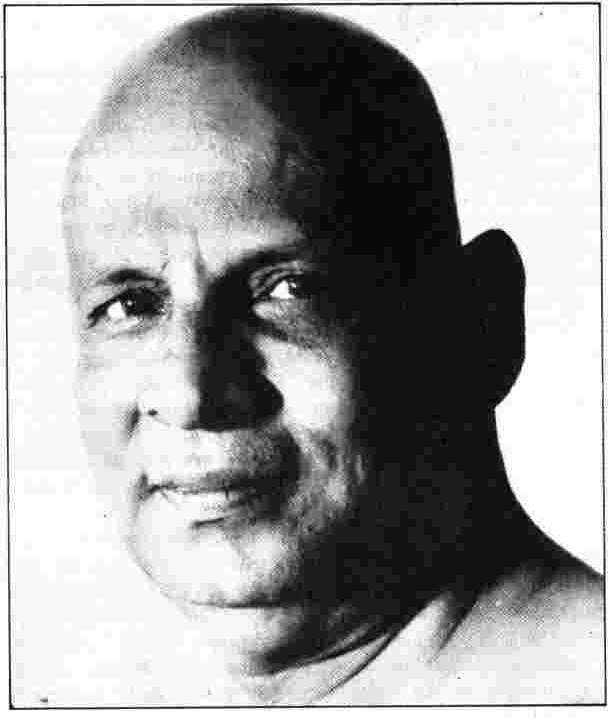
The photographs have been a life-saver to many. For instance one kept the company of Sri Rani Sivananda-Kumudini of Hyderabad when she was operated on: and sure enough, the pain became endurable. She had adorned all the walls of her room with Swamiji’s portraits so that she could have his darshan whichever way she turned. The beautiful picture of Swamiji on a locket saved the life of Sri Mohini Giri when she was ailing. To none of them has it been a mere picture. To every disciple of Swamiji, to every spiritual aspirant, the picture has been a living reality, a divine presence.
Under the able management of Sri Swami Saradanandaji the Studio grew by leaps and bounds, both in equipment and utility. His achievements evoked the unqualified admiration of even professional photographers of great reputation and standing. A distinguished visitor to the ashram was wonderstruck when Saradanandaji presented him with an enlarged print of a picture taken a few minutes earlier, when the visitor had entered the ashram. More-than-life-size enlargements of Swamiji’s pictures adorned the Regalia and the Eye Hospital. Saradanandaji would humbly confess the secret behind all these: “It is all due to Swamiji’s grace. Who but he would take such interest in our betterment in every way? Even my own father would not have so readily granted everything I asked for.”
The Post Office
Three departments at Ananda Kutir may be said to represent the heart of Swamiji — the Sivananda Publication League, the Annapurna Annakshetra (kitchen and dining room) and the post office. These three together enabled him to give himself to entire mankind. Paramanandaji bears witness to the care with which Swamiji used to allocate the few rupees he would get as donations during the early years of his life in Rishikesh. The first share would go to the printing press. The next would go to the post office: the printed gift should reach the aspirants all over the world. Swamiji and his workers could, of course, go to the alms-houses for their food! It is said that in order to prevent even these noble austere seekers from acquiring a love of luxury Swamiji would always maintain a good debt level with the grocers and milkmen who supplied the ashram. Whatever money was received would immediately go to the press and the post office.
The following account of the growth of the post office is an adaptation of the excellent ‘Story of Ananda Kutir Post Office’ given by Sri Swami Chidanandaji on the occasion of its twelfth anniversary:
Before the Ananda Kutir Post Office was established the sadhak inmates who gathered round Swamiji’s feet to lead a life of earnest spiritual sadhana and service to guru, themselves constituted the inmates, the workers, the servants and everything. The question of getting work done by others and paying them wages did not even enter their minds. A part of the most laborious work they had to perform was the carrying of the daily mail to Rishikesh Post Office. The mail rode on Swami Visveswaranandaji’s head or on Saswat Swamiji’s or Poornabodhji’s. Whether there was sun, rain or cold, this duty had to be done. When the load had become too much for one man to carry, a bicycle was added to the properties of the ashram.
When the volume of work increased so much that the big bundle of letters and book packets could not all be despatched for want of sufficient postal stamps at the Rishikesh Post Office, the need for a post office at the ashram itself was felt. On the 1st May 1940 an extra departmental Branch Post Office was opened at the ashram, and was called ‘Ananda Kutir’. Since then the jnana ananda (bliss of wisdom) has continued to be distributed the world over from the ashram directly. It was housed in the last room in the kitchen block, which is now used as the store room. Swami Vishuddhananda, ably assisted by Poornabodhji — who was the postmaster —managed this department. When the latter had to go to South India the work was taken over by Sri Atmaramji. By then the work had grown to such an extent that the previous practice of letting it be handled part-time by an inmate had to be given up, and Atmaramji had to be given over to this department. The expansion, especially after the Diamond Jubilee, was such that this postmaster had to be given two others to assist him.
The postal officials at the district headquarters (Dehra Dun) were watching with amazement the rapid growth of their income from their branch office at Ananda Kutir. Rishikesh Post Office, too, felt it burdensome to re-handle the Ananda Kutir mail bags before onward transmission. At last they decided that the time had come to upgrade Ananda Kutir into a sub post office. Sri Swami Chaitanyanandaji was selected to work as the postmaster.
The formal ceremony was held on the 11th November, 1949. The Inspector of Post Offices requested Swamiji to be the first to put the date stamp on. Uttering the sacred pranava (OM), Swamiji took all the stamps one by one, and franked the registers with his own hands. Thus came into being the largest extra-departmental post office in the whole state.
That same afternoon the driver of the mail van came to the ashram and wanted to take the bags to the van, which he had stationed a couple of furlongs away. He thought that the ashram’s post office would only send a small bag. When he was shown what awaited him he ran back to get the van and parked it right at the door of the ashram!
During the period that Swami Chaitanyanandaji was the postmaster the post office received efficiency certificates and the unstinted praise of the postal authorities.
Swami Kesavanandaji became the postmaster immediately after Swami Chaitanyanandaji. This dynamic swami was very keen to do everything himself — he was the cashier of the ashram and had the powers of a secretary, and he was in charge of typing and sending out Swamiji’s articles to various newspapers, compiling books, etc. A year or so after he took over as the postmaster he found that the work was beyond his capacity, which resulted in confusion entering into the accounts of both the Postal Department and the Divine Life Society. He suddenly left the ashram. By this time the post office had grown into an institution. It was considered inadvisable for the Society to continue to undertake responsibility of running it as an extra-departmental post office: hence it was handed over to the government to be conducted as a departmental post office. It was during Kesavanandaji’s tenure of office that Ananda Kutir post office was re-christened ‘Shivananda Nagar’ post office.
Swamiji treated even the departmental staff of the post office as disciples and inmates of the ashram, and he continued to take a keen interest in the post office. With his grace the government sanctioned a telephone which would also transmit the Society’s telegrams. This service was inaugurated on the 14th June 1955, with Swamiji himself sending the first message to Sri Pannalal of Amritsar.
On the 14th August 1956 the Government installed a telegraph apparatus at the post office, facilitating quick transmission of messages. The telephone remained as the ashram’s private connection.
It was the unique trait of Swamiji that every facility added to the ashram opened up for him yet another avenue for his message to be conveyed to thirsting aspirants, another channel for his service to flow through to the seekers after Truth. “I will make the very best use of the telegraph apparatus,” he said, and began to send telegraphic instructions to his foremost disciples. The first telegrams were sent to the Director-General, Post and Telegraphs, New Delhi and the Postmaster General, Lucknow. Every day he would send one or two telegrams to chosen disciples, national leaders and even foreign disciples and seekers after Truth.
This went on for a couple of months, till there was material enough for the book Telegraphic Teaching, and the telegraph office had been established. This was obviously unique and unprecedented. We read a telegram with greater attention than we do a letter. Swamiji made use of this psychological factor to impress upon his disciples the instruction he wanted to convey to them. To us a telegram implies urgency. By resorting to telegrams as one of the media of imparting spiritual instructions Swamiji taught us that spiritual practice is as urgent as any other aspect of our life here. The replies that were received from the recipients of the telegrams amply justified Swamiji’s expectations. It made everyone meditate deeply over the purpose and purport of the telegram. It created an indelible impression on the mind of the recipient.
Sivananda Primary School
Swamiji noticed many young boys and girls in the locality living without proper education facilities. He therefore opened a primary school for their benefit. Thus the Sivananda Primary School was established on Vijayadasami Day, 15th October 1943. It was a boon to the children of the locality. More than education in the three R’s, they received instructions in ethics, morality and the fundamentals of a truly spiritual life from Swamiji himself, from sadhak inmates who sometimes took the classes and from the pious teachers employed by the ashram. This was yet another field of selfless service for the ashramites with teaching ability.
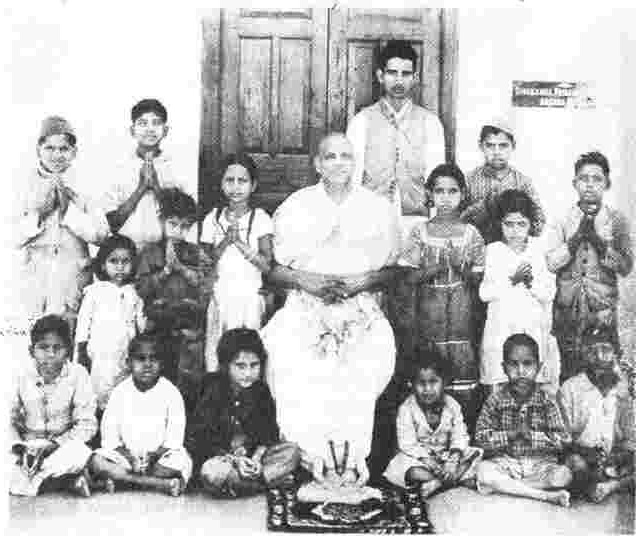
Sivananda Primary School pupils
The primary school earned the recognition of the government, which paid for the fees of the teacher. The children of the school always distinguished themselves in all fields of activity. Swamiji himself trained them in singing kirtans, delivering short lectures and taking part in spiritual dramas. They always did well in all their examinations. In society they conducted themselves in an exemplary manner, and thus brought credit and glory to their families, the ashram, Swamiji himself and to the unique system of education adopted by him.
The March 1950 number of The Divine Life magazine gives us the following report:
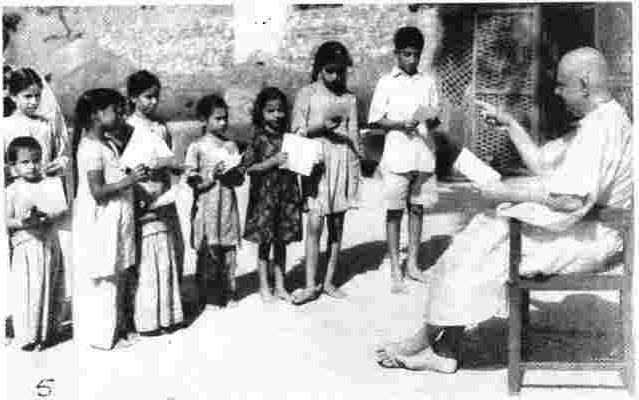
Swamiji trained the children to sing kirtans
To help poor students to continue their studies is one of the aims of the Divine Life Society. Already at the headquarters a primary school with free boarding and lodging is being run very efficiently by the Society for the past nine years. Yet, other students in various provinces should also be helped. With this in view, a ‘Scholarship Scheme’ for granting financial aid to poor students was instituted by Sri Swami Sivanandaji Maharaj on the Diamond Jubilee Day, in September 1947. Besides such aid, these students are provided with rich spiritual literature and guidance. (And the report goes on to give a list of names of those who had till then been benefited under this scheme.)
Sanskrit
In 1944 Swamiji established another institution — the Saraswathi Sanskrit Vidyalaya — in order to popularise the learning of Sanskrit, the language of the gods. Swamiji had always exhorted all spiritual aspirants to learn Sanskrit in order to be able to read and understand the scriptures (Bhagavad Gita, Upanishads, etc.) in the original. An ashramite who was well versed in the language took the class and instructed the students. Sri Swami Krishnanandaji, Sri Swami Chaitanyanandaji and Sri Swami Jnananandaji were successively the Sanskrit acharyas (teachers). It is an eloquent tribute to this institution that even foreigners learnt Sanskrit under these able teachers.
Sivananda Music School
To Swamiji the Fine Arts were just so many fine roads to the goal of life — God-realisation. He had not only a genuine taste for music and dance, but from his boyhood he had taken a keen interest in them. Sri P.R. Subbier (a close relative of Swamiji in his youth and a college-mate, who met Swamiji after half a century of separation, in November 1959) was thrilled when he heard Swamiji’s ringing voice: “How wonderful,” he said. “In spite of age and ailments he has preserved the vibrant tone of his powerful voice. He used to thrill us in those days, and we used to love to listen to him.”
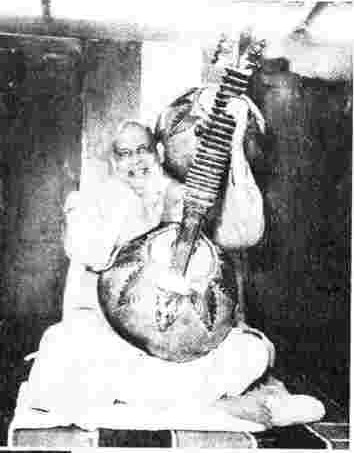
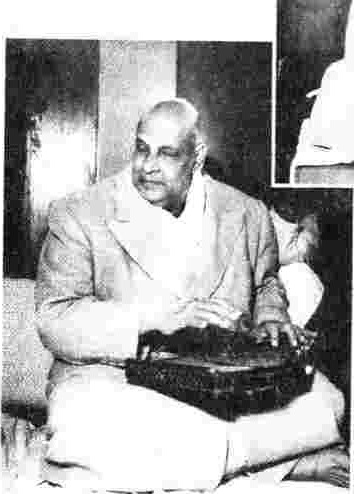
Whenever an aspirant with musical talent joined the ashram Swamiji would inspire him to teach music to some of the inmates. Sri Raghavia (who conducted a music school in Swamiji’s name at New Delhi), Sri Swami Sivaswaroopji and Sri Swami Nadabrahmanandaji were given all facilities to conduct music classes during their stay in the ashram. Sri Swami Vidyanandaji taught veena music and many visitors — especially foreign seekers — kept him busy throughout the day. He taught them to sing the Lord’s name to the accompaniment of the veena. Even visiting music teachers were made by Swamiji to give music tuition to ashramites. No opportunity would be overlooked!
‘Ananda Nada Mandir’, as the music school was called, was given a proper shape (and a constitution ) on the 6th December, 1955.
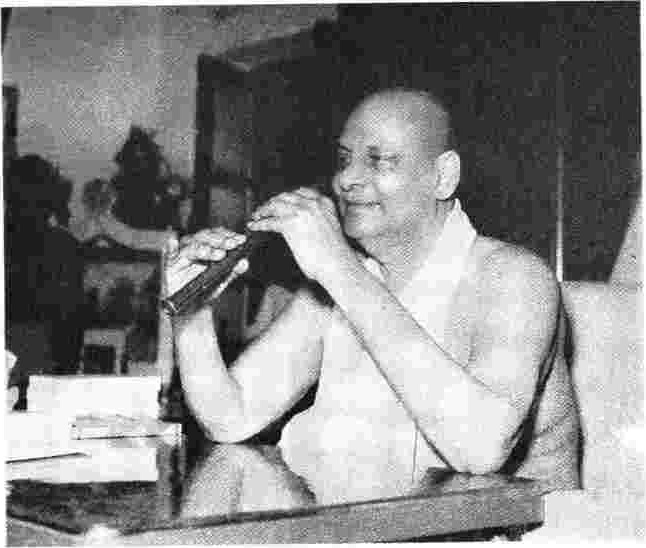
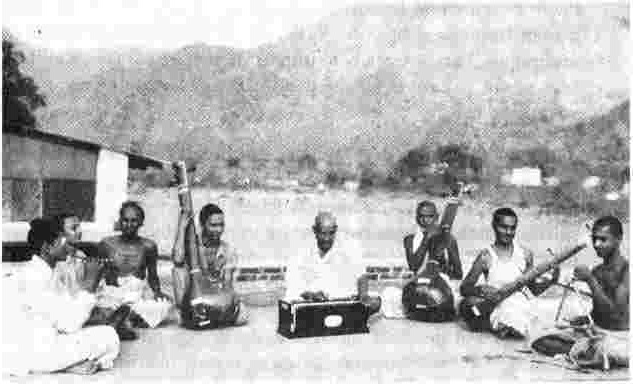
Enjoying music by the Ganges
The College of Yoga and Vedanta
Swamiji had had a pre-vision of the world-wide revival of interest in yoga and vedanta that we are witnessing today: and he used to call the Sivananda Ashram itself the ‘Ananda Kutir Forest University’. He had seen the urgent need of giving systematic training to seekers after Truth and more particularly to those who might be called upon to deliver the message of yoga and vedanta to the people of not only awakened and liberated India, but of the whole world at large. The following detailed scheme published in the May 1947 issue of The Divine Life gives us a glimpse of what he felt:
The world is now in the grip of evil forces. Blinded by greed and power, nations have destroyed one another. They still retain hatred in their hearts and are but awaiting the time for a further display of brute force. The thinker asks in despair: “Will there be lasting peace? Will civilisation survive?” The answer is “Yes, if the wise and the good all over the world will join hands.”
No good was ever done in the past without the exercise of spiritual power. The development of that power is an art which can and must be learnt. Brute force can be overcome by spiritual force. Now is the time to acquire that power. That is why the College of Yoga and Vedanta is going to be started in Rishikesh. Advanced souls content in normal times to enjoy inner happiness in solitary meditation are now bestirred into activity in the outer world. They cannot bear the sight of the suffering and the distress existing all around us. They are ready to impart their spiritual power to those who desire to have it for the good cause of stemming the tide of advancing evil.
The College of Yoga and Vedanta will be established at Rishikesh on the banks of the Holy Ganges with the sole object of making mankind spiritually vibrant. It will be a centre for the generation of spiritual energy, whose currents are to reach kindred souls all over the globe. Eligible trainees will be admitted from the four corners of the earth, to receive this spiritual force. They will be initiated in all the processes of Self-realisation by a combination of the teachings and practices of all schools of yoga and vedanta. After training they will become the most potent instruments of good wherever they go. They will carry spiritual power with them and revitalise society. All those who come in contact with them will become immune to the pernicious propaganda of the destroyers of true happiness. It is the aim of the College to make its trainees competent to establish similar spiritual centres in different parts of the world so that the teaching received from the parent institution may permeate everywhere. These centres will purify the world, purge it of its present evils, and make it the abode of true bliss.
The workings of the College will be in three departments or branches:
1. Sastra-jnana Branch (theoretical studies).
2. Sadhana Branch (practice).
3. Abhyasa yoga Branch (research and intensive meditation).
Besides work in the above-mentioned branches, combined work will be done every day by all the residents in the College (except the abhyasa yoga branch members) according to long-established and well-founded methods for the creation of spiritual vibrations.
At fixed hours of the day there will be conducted (1) common prayer, (2) nama-sankirtan and (3) silent meditation for invoking the aid of the Higher Powers for the enlightenment and purification of humanity. It is well-known to men of Self-realisation that these practices are most effective in the generation of spiritual electricity.
(Though the College did not materialise as such, Swamiji’s detailed planning was amazing.)
The Yoga Vedanta Forest Academy
Out of the idea of the college grew the Yoga Vedanta Forest Academy (called University at its inception — the word ‘University’ was altered to ‘Academy’ by the Divine Life Trust in September 1958.)
As though in response to the wish of the sage, scholars well versed in the philosophy and the scriptures of India joined the ashram. Foremost among them were Prof. Nanda Kishore Srivastava, M.A., L.L.B., and Prof. C.V. Narayana Iyer, M.A., L.T., (who later became Swami Sadananda). Regular classes were started with their aid and with the help of Swami Chidanandaji, Swami Krishnanandaji and Swami Harisharanandaji, the senior swamis of the ashram.
The syllabus was drawn up and a list of the texts that the students were expected to master was given. We shall only note here the practical side of the syllabus, under the headings ‘Karma Yoga’ and ‘Bhakti Yoga’:
KARMA YOGA (Practical): Doctoring and nursing the sick; spinning and weaving to provide clothing for the poor; helping villagers in agriculture and gardening; helping the coolies in their work; supplying water to wayfarers; service for the well-being of society; service of the country through peace missions; dissemination of spiritual knowledge; distribution of leaflets and pamphlets on spiritual education; propaganda and lecturing; training school students in the spiritual path; and writing articles on spiritual renaissance.
BHAKTI YOGA (Practical): japa, kirtan, bhajan and parayana; formal puja and prayer; service in the temple; service of saints; satsang; performance of ceremonies; fasting; vigil and akhanda kirtan.
Needless to say Swamiji always laid greater emphasis on the practical aspects of yoga and vedanta than the theoretical aspect.
Distinguished visiting scholars were invited to take the classes during the period of their stay. Foremost among them were Prof. Burtt of America, Dr. Graham Howe of London, Dr. Maryse Choisy of Paris, Dr. Kameswara Sarma of Pudukkotai, Sri Satchidanandam Pillay of the Annamalai University and Sri R.A. Shastri.
In answer to the question by a visiting professor, Swamiji gave the difference between the Yoga Vedanta Forest University and other universities: “Other universities prepare students for bread-winning, but the university here prepares students to become sadhus and saints. In the world, students try to become paid professors after finishing their studies, but the students from here go in for preaching; they do not want a salary. They have no connection with their families. They study kundalini yoga, vedanta and the six schools of philosophy. Some specialise in hatha yoga, some in vedanta. They have no desire for name and fame.”
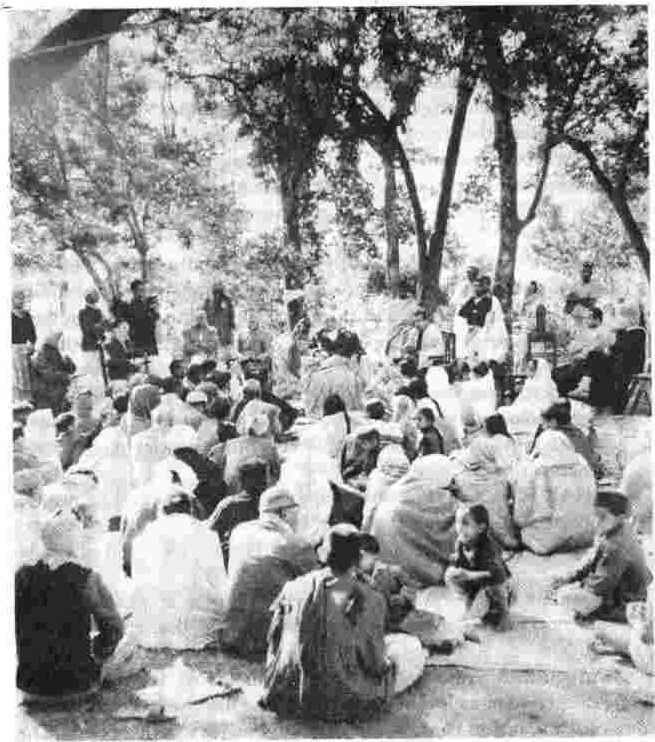
Swami Chidananda (seated on Swamiji’s left) lectures at the Forest University
Those who felt that the university had few students and fewer buildings of its own and expressed their feelings to Swamiji, got a nice answer, as did one visitor to the ashram on the 21st January 1949. Swamiji said:
This is not a university like the others in the world. People are not trained here to become clerks, advocates and scientists. Humanity has nowadays so demeaned itself that people everywhere want only sense-pleasures: they have no idea of yoga and vedanta, or the supreme bliss that they will enjoy from Atma-jnana. In such a topsy-turvy world it is a great thing to have even one good sadhaka bent on renouncing worldly pleasures and striving to attain God-realisation — the goal of life — through the practices of yoga. That there are even a dozen students earnestly endeavouring to realise the Truth in the Yoga Vedanta Forest University is a great achievement: that qualifies it to be called the greatest university in the world.
We should develop this Forest University nicely by concentrating all our attention on it. The University has a great future. Indian culture was born in such universities (or ashrams as they were called in those days.)
The hours of the University classes are a little inconvenient for worldly people. Sannyasin-sadhaks who have made it their sole end and aim to aspire for God-realisation would love to attend classes in brahmamuhurta (4 a.m. — 6 a.m.), for that is the most favourable hour for filling the mind with spiritual ideas.
For the sake of the visitors and laymen-sadhaks we should hold regular classes in the morning between 9 and 11 a.m. and in the evening between 3 and 5 p.m. Continuous classes should be conducted so that the visitors who come to the ashram in the morning and evening and who do not, in the first instance, have the opportunity to stay on in the early morning next day too, can attend the meditation and asana classes.
The seed has been sown. The Lord will look to its success. We should also in course of time construct big school buildings and professors’ quarters with a good library for each professor, and other conveniences. More and more professors will come. The message of sannyasa will spread. The glory of Divine Life will spread far and wide; ministers and governors will come and get initiated into sannyasa. To them, too, the message should go that they are simply wasting their life uselessly in worldly pursuits. The world is false; Brahman alone is real. It is useless to reform the world. The only duty of man is to realise his own Self. Only this can solve the problem of life and death.
Students from all over the world will come. There should be a big hostel to house foreign students. There should be many professors delivering lectures to these students. The whole world will be represented at the University. True sadhaks will come from America and Europe. It is all His work!
These words proved to be prophetic! Within a decade the University attracted students from America and Europe, and there has been a continuous stream of visiting students coming from all over the world to stay for some time to study vedanta and practice yoga.
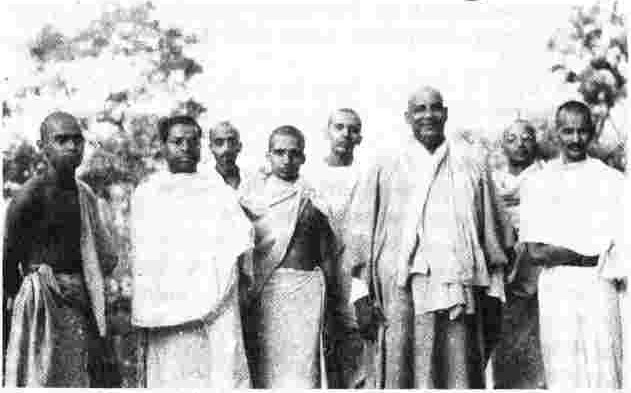
Swamiji with the professors of the Yoga-Vedanta Forest Academy. Left to right: Swami Vishnudevananda, Swami Saswatananda, Swami Chinmayananda, Swami Krishnananda, Swami Chidananda, Swamiji, Swami Raghavananda, Swami Sivanarayana.
The Sivananda Regalia
Above the post office was the Sivananda Regalia. On the day it was formally opened (9th January, 1956), Swamiji paid the following tribute to Paramanandaji, who brought it into being:
“Swami Paramananda has got original ideas. It was he who built the Bhajan Hall, collecting donations from people; it was he who started the Publication League; it was he who organised my All-India Tour. He was responsible for bringing out German and French translations of my books. He wrote to the publishers and induced them to take up the translations. He has spread my knowledge throughout foreign countries. He is a very hard worker. He works the whole night.”
For the Sivananda Regalia Sri Swami Paramanandaji gathered together all the inspiring articles associated with Swamiji’s life in Rishikesh — from the earliest days to the present day — from the begging bowl that he carried for getting bhiksha (alms) from the alms-house, to the silver caskets in which the people of Madras presented him a Welcome Address during the All-India Tour. Within the four walls of the Regalia were packed the living memories of Swamiji’s dynamic service. It gave a visual picture of the history of the Divine Life Society.
The Yoga Museum
The Yoga Museum was one of the unique creations of Swamiji. It was a vital part of the Academy. Every section contained a few well-chosen illustrations which gave a succinct, clear and comprehensive idea of the fundamentals of yoga. The nature of the Absolute and the nature of phenomena; the transcendental Being and the immanent Godhead; the path of inward contemplation (jnana yoga); the path of mystic communion (raja yoga); the path of devotion (bhakti yoga) as well as the path of divine dynamism (karma yoga) were all ‘shown’ in the Museum through such pleasing pictures that one assimilated the great ideas framed in them without irksome toil. It was a boon especially to Western aspirants who were new to Eastern philosophical thought.
Yet another novelty was the Sivananda Vani (Broadcasting Centre) which Swami Sivananda inaugurated at Ananda Kutir on 29th March 1950. An interesting daily programme was broadcast through a loudspeaker which had been installed on the top of the Viswanath hillock overlooking the Muni-ki-Reti valley. Every morning at 4 a.m. the programme commenced with the chanting of Om, kirtan, recitation from the Bhagavad Gita, etc. During the day, from 1 p.m. to 2 p.m. and 6 p.m. to 7 p.m., discourses in Hindi and Garhwali on socio-spiritual topics, bhajan and sankirtans of talented musicians, and gramophone records by Sri Swamiji Maharaj and others, were broadcast. News of the day-to-day ashram activities and announcements were also broadcast.