Treasure Trove of Sri Bhagavan’s Grace
In this chapter
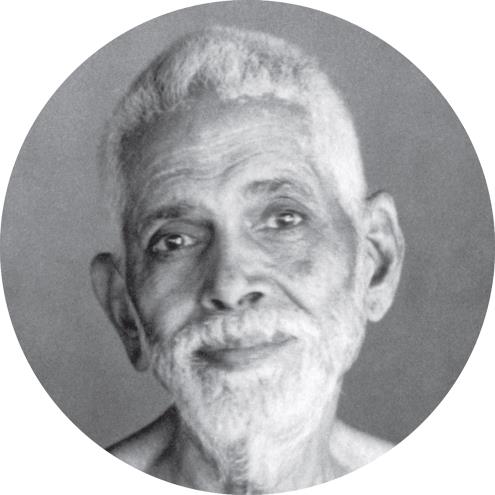
The Practice Of Self-Enquiry ‒ The Ramana Way2
அதுநீஎன்று அம்மறைகள் ஆர்த்திடவும் தன்னை எதுஎன்று தான்தேர்ந்து இராது - அதுநான் இதுஅன்றுஎன்று எண்ணல்உரன் இன்மையினால் என்றும் அதுவே தானாய் அமர்வதால்.
– உள்ளது நாற்பது, 32
–
“Although the scriptures proclaim ‘You are That’, it is a sign of weakness to meditate: ‘I am not this but That’, instead of enquiring what one IS and remaining so; for one is always THAT.”
– Reality in Forty Verses, v. 32
* * *
I have divided it into three parts for the sake of convenience.
(1) Overall Perspective; (2) The ‘How’ of Self-Enquiry and (3) The Uniqueness of the Ramana Way.
(1) OVERALL PERSPECTIVE
It is said in the Old Testament, ‘God made man in His own Image’. Man is thus a product of the Divine Will only. He partakes of the Holiness of God and he can commune with the Creator, the Perfect One. When man realises his Perfect Nature, he is fully Divine. Man is now steeped in ignorance, oblivious of this Divine Essence in him. The Divine Nature in man is ineradicable; it may be covered up for a time being, but it must shine forth again.
2 Be the Self
As the Upanishads point out, man’s movements are generally directed only outwards and not inwards to his Self, which is Divine, since all the senses in his body are turned outwards and tuned to absorb things only from outside. When his attention is one-pointedly turned within, he becomes aware of an entirely different Nature of himself. He recognizes the Divine Nature in him revealing Itself in all splendour. Anyone thus turning within is bound to realise this Eternal Truth within him; man turning his attention outward by the very act excludes himself from consciously experiencing it, though every man, even in his ignorance, is not devoid of this Divine Consciousness in him. In his song of ‘Self Knowledge’, Sri Bhagavan says “True, strong, fresh forever stands the Self. From it in truth springs forth the phantom body and phantom World. When this delusion is destroyed, and not a speck remaining, the Sun of Self shines bright and real with vast Heart expanse.” Whether he knows it or not he is nothing but Pure Consciousness, Pure Awareness — the Self.
That which clouds such awareness from his conscious experience is his habits to cling to externalities which are expressed in his discontent, frailties, darkness and fear. Let him look within deeper and longer and without fail he will notice this so-called ‘hidden and mysterious’ Self inhabiting his Centre, the Source of his Being. Turning within from the externalities and paying full attention to this Source, brings about a tremendous change in a man’s life, since for the first time he recognises that he possesses this Divine Essence within him. He understands the declaration: “You are That” to mean “You are Brahman, the Supreme Reality, the Truth, the Self.
In verse 34 of Ulladu Narpadu, Sri Bhagavan says “The natural and true Reality for ever resides in the Heart”, and in the next verse he affirms “To discern and abide with the ever present Reality is true attainment”. The marks of the Reality are that it always exists and it shines by its own light. The Awareness in man exists always, by and in itself. Each man has therefore within his grasp this opening to this Eternal Light within.
When he has a glimpse of experience of this — his true Being within — which glows totally independently not needing his effort or support for its existence, it is a sacred experience of a transcendental and immanent State. This is an experience which is beyond the senses, the mind, the five sheaths which cover the Self. It is a state of Being oneself, being everything and one with Eternity. Whoever engages in such inward exploration becomes an Awakened One, a Buddha. ‘He merely antedates today what the multitude of men will have perforce to do tomorrow.’ Man, therefore, is a spiritual being having this capacity to become the timeless Wisdom. He breathes this Truth every moment. He thus contains the Divine Infinitude within him. This Infinite Awareness is experienced as a perennial feeling of absolute happiness – the Ananda which is also Sat (Being) and Chit (Awareness).
One might say, ‘All right, there is something marvellous, limitless, blissful, sacred within us all and that is, as realised beings like Bhagavan Ramana say, is one’s own true identity’. What about the World of appearances in which we live, work, have mutual relationships? Is that to be ignored? In any case, it does not ignore us, rather it has us in its grip. Time too rushes onward like a roaring stream carrying the human race along with it and drowning it in its flux. In such a struggle – all the time forced to run outward and forward, both physically and mentally – if a man is asked to take a leap backwards, to dive within, perhaps never to surface again, is it not too tall an order? Won’t it daunt the doughtiest of men? Won’t he fear the leap in the dark, into the unknown? And, even if he is ready to go inward, how does one do it?
When the Sat-Guru says ‘Turn your attention inward, see yourself,’ he only asks us to be our own Self, and not this or that, which is nothing but an imagination, whereas being ourselves is Reality. Is it not ironical that we grasp everything that is suggested to us on the World of appearances but look askance when we are asked by the Awakened One, the Sat-Guru, not to dream but to wake up?
(2) THE ‘HOW’ OF SELF-ENQUIRY
Self-inquiry is the art and science of inquiring into and knowing by being one’s own true Self. A man who knows himself is a Buddha. Bhagavan Ramana — in his infinite compassion — put at the disposal of everyone — no matter what his intellectual or other status may be — a simple, direct method of knowing who he or she is. In his own words, “Atma Vidya, Self-Knowledge is easy, indeed the easiest”. So much so, in trying to explain or expound his way, we may end up, albeit unwittingly, complicating it. As Dr. Mees (Sadhu Ekarasa), the Dutch philosopher-devotee said, Bhagavan’s words are enough, no commentaries are necessary.
Keeping this in mind, we may proceed with our Sat-Sangh. Verbal communication, spoken or written, is indeed a Sat-Sangh in which the speaker and listener or writer and reader are equally involved ( 50% + 50% ).
Though everyone says ‘I’, ‘I’ only, yet strangely not many make effort to know what exactly this ‘I’ is or what it means. By ‘I’ usually primarily we mean only the body, but on deeper analysis we mean by it the faculties of thinking, feeling and willing. We can easily arrive at the conclusion that the body is not the ‘I’ since it is insentient. By insentience, we mean that the body is always the known one and never the knowing principle. Said the great Hindu sage, Allama Prabhu: “Know yourself without losing your Awareness. If the body be yourself, why do you say: ‘my body’. Everybody speaks of his possessions as ‘my clothes, my gold’ only. Tell me if anyone ever identifies himself saying ‘I am the clothes or I am the gold’? You are mistaking a superimposition for a fact when you take your body to be your Self”.
Then, what is this ‘I’?
In the body, which is insentient, there arises a ‘sense of alertness’, a sensation of ‘I’. It is termed as ‘mind’. Bhagavan Ramana says that if one investigates the mind, it is seen to be a bundle of thoughts. The ‘I’ functions as the basis of all thoughts. All thoughts are related to you. Every thought is either about you or connected with you as individuals, objects, things, events or opinions. All these are rooted in your ‘I’; thus the ‘I’ in you is only an ‘I’-thought — the ground for the entire gamut of countless thoughts. Let us look at it still closer.
Every day the first thought on waking from our sleep is this ‘I’-thought. In sleep you do not know anything, including the ‘I’ with which you refer to yourself. This ‘I’ or ‘I’-thought is completely subsided in deep sleep, along with its chain of other thoughts. If we observe further carefully it will be seen that the last thought to ‘set’ before sleep is this ‘I’-thought, which is also the first to ‘rise’ when you wake up the next morning! Where does this ‘I’ set and where from does this ‘I’ arise? We should seek the source of this ‘I’ which ‘dies’ every night in our sleep and again takes birth the next morning. In this quest we have the assured help of Sri Bhagavan who leads us further on by saying that there is an Eternal ‘I’ behind the known ‘I’, into which this ‘I’ or ‘I’-thought merges and again comes out daily, since it is the Source. Scriptures declare that the first Name of God is ‘I’. It should definitely refer to the Eternal ‘I’ — the source of Being — and not to the ‘I’ of our everyday knowledge. Moses got a verbal answer from God when he questioned God what His Name was: ‘I AM That I AM’. Sri Bhagavan says that this is the best definition of God.
The word for God in the Hebrew language is ‘Yahweh’ (Jehova) which means ‘I AM’. So, both from sages’ statements and scriptural declarations and from our own common experience we can easily arrive at the conclusion that there is an Eternal ‘I’ behind the ‘I’ by which we refer to ourselves in our daily lives. We forget the infinite ‘I’ which is our true identity and are content to be with the limited, phantom ‘I’.
Let us observe closely the ‘I’-thought which is the link between the insentient body and the Eternal ‘I’ which is Pure Consciousness, which the Scriptures say lies hidden and shrouded within us. Let us trace the ‘I’-thought to its source.
When other thoughts arise, we should focus our attention on the ‘I’-thought. All the time our attention should be unflinchingly focused on the feeling of ‘I’ or ‘I’-thought. When we are filled with thoughts, how do we bring back our attention to the ‘I’-thought? When we have other thoughts, Bhagavan says we should ask ourselves ‘For whom is this thought?’. He added, the answer will come, ‘To me’. Then ask, ‘Who am I?’. When we do that, our attention is drawn back to the ‘I’ or ‘I’-thought and this attention leads us to the Source. Thus, focusing one’s attention on oneself is the sole effort one has to put in to find one’s true identity.
When one is probing into oneself, persistently questioning ‘Who am I?’, one gets in direct touch with the inner Reality, the Eternal ‘I’. The greater our seriousness and one-pointedness in delving within ourselves, the sooner will be the success. Self-enquiry is not only the straight path but it is also the easiest since no outer aid is required nor are you seeking anything but yourself. As taught by Sri Bhagavan, any act which directs the outgoing mind inward to its Source, the Eternal ‘I’, is spiritual and that anything that drags the mind outward, doping it in any activity, is unspiritual.
Bhagavan Ramana has offered a Direct Path to wake us all up to this Truth of Inner Bliss. Anyone can follow this silent, inward path of Sri Ramana wherever they may be and in whatever walk of life they may be placed, regardless of the challenges of perplexed environments. Thus, this path of introspective Self-Enquiry is an ever open path and hence anyone can tread it. This path, is for the learned and unlearned, rich and poor, for the recluse and the householder, for all who wish to renounce the World.
What makes Sri Bhagavan’s method unique is that it is based on ‘intuition’ checked by ‘reason’; also, this pure reasoning is employed in the enquiry into the Self only by ‘illuminated intuition’. So, to summarise, quoting Sri Bhagavan’s own words: “The state of non-emergence of ‘I’ is the state of Pure Being, Pure Awareness. (‘Heart’ is the word used by Sri Bhagavan for this Pure Reality, within us). This could be achieved only through enquiring ‘Who am I?’ Just as a man would dive in order to retrieve something that has fallen in water, so would one dive into oneself with a keen one-pointedness and find the place whence the ‘I’ originates. The only enquiry leading to Self-Knowledge is seeking the Source of the feeling ‘I’. If one enquires ‘Who am I?’ within, the individual ‘I’, the limited ‘I’, falls down abashed as soon as one reaches the Heart. Immediately the Reality manifests itself spontaneously as ‘I’. Although It reveals Itself as ‘I’, it is not the limited ‘I’ known to us, but the Perfect Being, the Eternal ‘I’, the Divine Essence in us. The Self, the Truth that you seek to know is thus verily yourself”. When once Sri Muruganar asked Sri Bhagavan what he should do to attain the ultimate Truth, Sri Bhagavan answered: “Be as you ARE!”
He was even terser to Ramaswamy who became later ‘Thinnai Swami’: ‘Iru’ (Be).
What an immediate and total transformation this one word brought in Ramaswamy!
(3) THE UNIQUENESS OF THE RAMANA WAY
The term Atma-Vichara or Self-enquiry is found in many of the ancient Scriptures of India. In his great work Vivekachudamani Sri Adi Sankara says that Liberation cannot be attained by any amount of action but only by Self-enquiry.
In Jnana Vasishta, Sage Vasistha proclaims: “Shining in everybody as ‘I’-’I’ is nothing but the Self, on which one has to meditate... With the stick of enquiry strike the fierce-looking mind and snake-like senses and make them abide in the Heart”.
Kaivalya Navaneeta declares: “Enquiry alone can lead to the Knowledge revealed in the Vedas. Knowledge of Self cannot be gained by study”.
Srimad Bhagavad Gita declares: “Fix the mind firmly in the Self”. It may be asked ‘When Self-enquiry is already mentioned in Scriptures, what new revelation has been made by Sri Bhagavan?’ The uniqueness of Sri Bhagavan’s teaching is that it is not within the framework of the ‘mind’. In fact, Sri Bhagavan is the Great Master who has exclusively dealt with the realm, scope and ultimate futility of trying to rid of the shackles of the mind through mental methods. “When questioned, it will merge in its Source and a new dimension of functioning will come about,” He said.
In the first benedictory verse of Ulladu Narpadu, Sri Bhagavan points out the futility of thought. He asks “Since void of thoughts, the Reality exists in the bottom of the Heart, how does one know the Reality, which is called the Heart?” That is to say, if meditation is understood in its usual sense, namely a process of thinking, no amount of meditation can enable one to know or realise the Reality which is beyond thought. For, how can any amount of thought enable one to realise that which is beyond the range of thought? How then is the Reality to be realised? The answer is given by Bhagavan Himself in the remaining portion of the same verse: “To abide in the Heart as it IS, is truly meditating upon it”. In other words, since the Reality is beyond thought, to abide without thought as that Reality is the only way to meditate upon it and to realise it as it IS. But how to abide thus without thought?
What is it that now prevents us from abiding without thought as the Reality? The Reality or Self ever shines in the Heart, beyond thought, as the pure adjunct-less ‘I AM’. But instead of abiding as that ‘I AM’, there rises an ‘ego’, a separate individual who feels ‘I am this body’, ‘I am so and so’. This ego is the root thought, the ‘I’-thought; without it no other thought can exist, as we already saw. Therefore, it is this individual ‘I’ which assumes the thought-forms as ‘body’, ‘World’, etc. that obstructs our natural abidance as ‘I AM’. Hence, if we want to abide without thought as the Self and thereby realise the Reality as it IS, we need only remove this obstruction, the first ‘I-thought’ or ‘ego’. That is why so many of the verses of ‘Ulladu Narpadu’ analyse and describe the nature of the ‘ego’ and its by-products – the body and World – for only when we understand their nature will we know how to be free from them.
What is the nature of this ‘ego’, and how are we to prevent its rising? The answer to this question is the uniqueness of Sri Bhagavan’s teaching. In verse 24 of ‘Ulladu Narpadu’, He tells us that the insentient body cannot of its own accord say ‘I’, that the real Eternal ‘I’ does not rise or set, but that between these two rises a false ‘I’ which is limited to the body; this is the ‘ego’, otherwise known as the ‘chit-jada-granthi’ – the knot between the sentient Self and the insentient body – bondage, the individual soul, mind and so on”. In the next verse, Sri Bhagavan tells us: “This formless and ghostly ego comes into existence by grasping a form (a body); grasping a form it endures; feeding upon forms which it grasps, it waxes more; leaving one form, it grasps another form...”
How then are we to remove this sole obstruction which prevents us from peacefully and happily abiding as the Self? The answer is given by Sri Bhagavan in the same verse (v. 25), “When sought for, it takes to flight”! He illustrates it with a story. A man posed himself as a friend of both the bride’s and the bridegroom’s party. So long as everyone believed him, he got on very happily, bossing over both the parties and feasting sumptuously. But, as soon as people got suspicious and an enquiry was started about him he made himself scarce. Such is the case with the ‘ego’ which, likewise, poses both as Self and as the body; it is endowed with consciousness and shines as ‘I’, which are the properties of Self, and, at the same time, it is limited to a form and it rises and sets, which are the properties of the body. So long as we do not enquire who it is, this ‘ego’ will boss over us and will feast on the knowledge of objects gained through the five senses. But, as soon as we start Self-enquiry, as soon as we try to know who this ‘ego’ is, it will take to flight and disappear.
Why, some may wonder, does the ‘ego’ thus disappear when it is scrutinised or attended to? As Sri Bhagavan explains, the ‘ego’ comes into existence only by grasping a form, also it endures by grasping forms, and it feeds itself and waxes strong by grasping forms. Without a form to grasp, the ‘ego’ cannot stand. All thoughts, objects, knowledge of second and third persons are only forms. Therefore, so long as the ‘ego’ attends to objects, to second and third persons, it waxes and grows strong. But, the ‘ego’ itself has no form; so, if it tries to attend to itself, the first person or subject, it will lose its strength, subside and disappear, since, there, the ‘ego’ falls back into its Source, in the Heart. So long as it attends to second and third persons, it appears to exist, but when it tries to attend to itself, when enquired ‘Who am I?’ it is found to be non-existent. This truth is clearly stated by Sri Bhagavan in verse 17 of ‘Upadesa Saram’: “If one enquires without inadvertence into the form of the mind (or ‘ego’), it will be found that there is no such thing as ‘mind’ at all! This is the Direct Path for anyone and everyone!” When the ‘ego’ thus disappears, being found to be non-existent, what remains? Only Self, the Reality! This, therefore, is the Direct Path which enables us to “abide in the Heart as it IS” as Sri Bhagavan says in the first benedictory verse of ‘Ulladu Narpadu’.
Sri Bhagavan clearly teaches us that there are no two ‘I’s, one the ‘ego’ and another the Self – duality during ‘sadhana’ or practice and non-duality on ‘sadhyam’ or attainment – and that Self is the only Real ‘I’. Only on this ocean of ‘I AM’, arise all emotions, feelings and thoughts, the adjuncts of the individual, the ‘ego’ making us feel that it is the real ‘I’. Therefore, if we closely attend to this ‘I’, we will find that it is not the ‘ego’ but only the Real Self. That is why, while teaching the practice of Self-enquiry, Sri Bhagavan does not distinguish two ‘I’ s — the ‘ego’ and the Self. He merely says: “Enquire ‘Who am I?’”; in other words, attend to what you feel as ‘I’. If what we feel as ‘I’ is the Self, by our attending to it, we will know it as it IS. If what we feel as ‘I’ is the ‘ego’, by our attending to it, it will disappear, and Self alone will then be known. Thus, whether the ‘I’ which we try to attend to is the ‘ego’ or the Self, the result will be the same; only the Self, the Eternal ‘I’ — the Substance and Ground of the false ‘I’ will remain shining.
Another uniqueness in the teaching of Sri Bhagavan is that He revealed the importance of paying ‘attention’. We can thus boldly say that the correct technique of Self-enquiry as taught by Sri Bhagavan is paying full attention to the mere feeling ‘I’. As soon as we try to attend to the feeling ‘I’, all sorts of thoughts arise and distract our attention. However, it is interesting to observe that thoughts do not rise of their own accord, they rise only because we ‘think’ them. Moreover, thoughts do not have any power of their own, they gain power only by our attending to them. If we do not attend to the ‘thoughts’ that rise, they will subside of their own accord. Sri Bhagavan says: “If you deny the ‘ego’ and scorch it by ignoring it, you would become free. If you accept the ‘ego’, it will impose limitations on you and throw you into a vain struggle to transcend them”. We have, thus, to set aside thought-attention and regain Self-attention. This method of ‘attention’ is clearly taught by Sri Bhagavan in his seminal booklet WHO AM I? where He says: “If other thoughts rise, one should, without attempting to complete them, enquiry ‘To whom did they rise?’. What does it matter however many thoughts rise? At the very moment, that each thought rises, if one vigilantly enquires ‘Who am I?’, the mind (our power of attention) will turn back (from the thought) to its Source, Self; (then, since no one is there to attend to it) the ‘thought’ which had risen will also subside. By repeatedly practising thus, the power of the ‘mind’ to abide in its Source increases”. This is a great clue for aspirants so long as our ‘attention’ clings to this feeling ‘I’, we cannot know or attend to anything else.
The sole purpose of the quest is to divert our ‘attention’ back towards this ‘I’. Therefore, Self can be known only by means of Self-enquiry and Self-enquiry is not an activity of the ‘mind’ but the state of stillness of mind. As Sri Bhagavan says in verse 26 of ‘Upadesa Saram’. “Being the Self is itself knowing the Self, because Self is not two. This is Self-abidance”. In verse 27 of ‘Ulladu Narpadu’, Sri Bhagavan declares that unless we attend to Self we cannot attain the state of egolessness in which ‘I’ does not rise, and unless we attain that egolessness, we cannot abide in our True State of Oneness with the Reality. Why should this be so? Why should not other sadhanas also enable us to realise the Self? The reason is lucidly explained by Sri Bhagavan in ‘Maharshi’s Gospel’ (Book-I, Ch. 1): “Self-enquiry alone is the direct means to realise the Self, because every other kind of sadhana presupposes the retention of the ‘mind’ as the instrument for carrying on the sadhana, and without the ‘mind’ it cannot be practised. Therefore, the attempt to destroy the ‘ego’ or ‘mind’ by sadhanas other than Self-enquiry, is just like a thief posing as a policeman and pretending to try to catch the thief. Self-enquiry alone can reveal the Truth that neither the ‘ego’ nor ‘mind‘ really exists, and thus it alone can enable one to realise the Self”. Sri Bhagavan has also employed another analogy. He explains that trying to kill the ‘mind’ by other sadhanas is like trying to bury one’s own shadow. If the ‘mind’ were real, it could perhaps kill itself. But, the truth is that the ‘mind’ is non-existent and hence it can no more kill itself than a man can bury his own shadow!
Sri Bhagavan has categorically stressed in ‘Atma Vidya’ that Self-enquiry is the easiest of all paths. Let us see why Sri Bhagavan has said ‘easiest’. What do the terms ‘easy’ and ‘difficult’ mean? In the words of Sri Sadhu Om: “What we do not like, what we cannot do and what we do not know, we call ‘difficult’, whereas what we already like, what we have already done and what we already know, we call ‘easy’.” That is, if something is within our power of ‘loving’, our power of ‘doing’ and our power of ‘knowing’ we feel it to be easy; but, if it is not within our power of loving, doing or knowing, we feel it to be ‘difficult’.
With this simple definition, let us see whether Self-enquiry is easy or difficult. Is there anyone who can say that he does not love himself? No, among all the things we hold dear, it is our-self that we love most. Is there anyone who can say that he does not know himself? No, because before we know any other thing, we must first know our-self; when we say: “I know so-and-so’” does it not prove that we know the feeling ‘I’? And is there anyone who can say that he is not able to remove all his adjuncts such as the body and mind, and to abide as himself? No, because every day in deep sleep, we effortlessly and naturally remove these adjuncts and remain in our true nature. Thus, it is clear that we all love our Self, we all know our Self, and we are all able to abide as our Self. In other words, the ichha-sakti (power of ‘loving’), kriya-sakti (power of ‘doing’) and jnana-sakti (power of ‘knowing’) necessary for Self-enquiry are already inherent in us! Therefore, Self-enquiry is easiest. All Sri Bhagavan asks us to do is: “Love yourself, know yourself and be yourself”. How can this be called difficult?
When Sri Bhagavan assures that Self-enquiry is the easiest, He has also subtly left us a clue there. His reassurance is that we are not alone in this endeavour, but that His Grace is always there to help us. When His Grace has brought us all to His Lotus Feet, will He not help us to achieve success with this noble and worthiest endeavour viz., Self-enquiry taught by Himself.
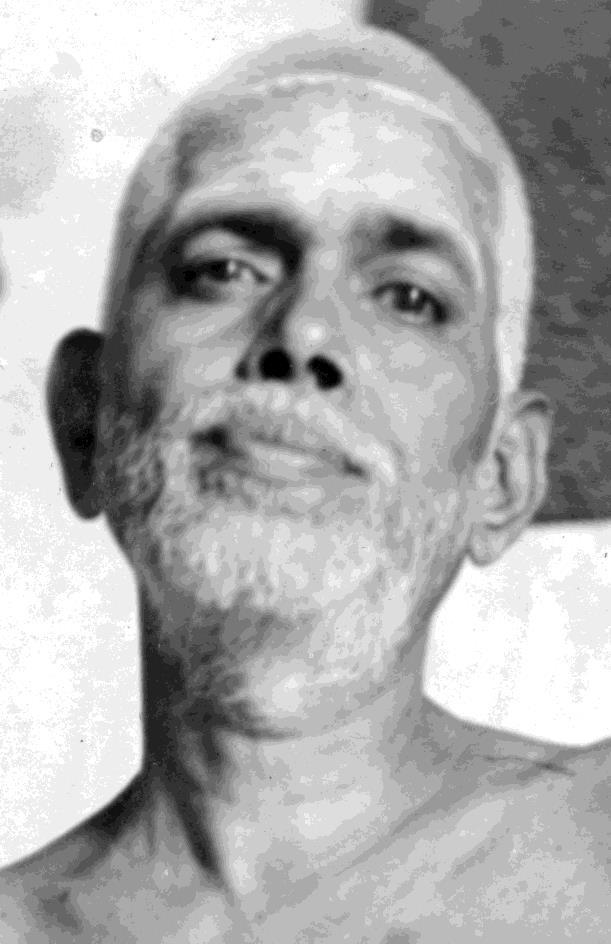
Sri Bhagavan’s “Glance of Grace” !