Treasure Trove of Sri Bhagavan’s Grace
In this chapter
Be The Bliss
இழிவு உடல் யான் என்னல் இகந்திடுக என்றும் ஒழிவு இல் இன்பாம் தன்னை ஓர்க – அழியும் உடல் ஓம்ப லோடு தனை ஒர உனல் யாறு கடக்கக் கராப்புணை கொண்டு அற்று.
– உள்ளது நாற்பது அனுபந்தம், 12
“Give up the idea that this loathsome ‘body’ is the Self. Realise the eternally Blissful Self. To seek to Know the Self while cherishing the ephemeral body is like mistaking a crocodile for a log and trying to cross the river on it.”
– Supplement to Forty Verses, v. 12
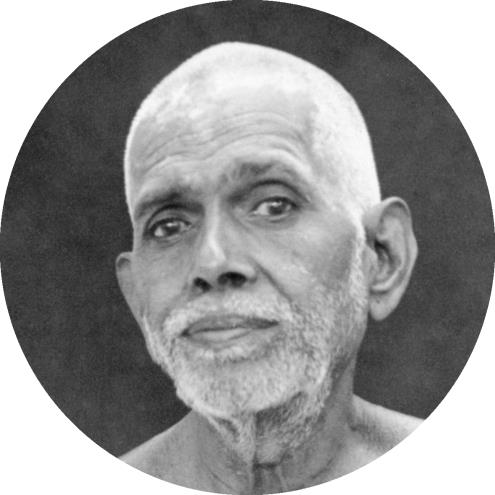
Paul Brunton, Arthur Osborne and other writers on Sri Ramana Maharshi were wonder-struck by the way He confronted and overcame ‘Death’ at the tender age of 16 years. The wonder deepened their study of His teaching of ‘Who Am I?’ and dragged them to His Presence at Arunachala. The great change in His life was brought about by the ‘Death Experience’. What resulted became the essence of His teachings. The Life of the Sage and His teachings are thus inseparable.
The first two lines of verse 12 of ‘Supplement to Forty Verses’ contain the essence of His teachings:
“Give up the idea that this contemptible ‘body’ is the Self. Know and be the eternally Blissful Self.”
THE CAUSE
The attachment to the ‘body’ is the source and ground of all other attachments. Taking the ‘body’ to be the Self is the sole cause of bondage, say the Scriptures. Sri Bhagavan has given, at various places, the many difficulties faced by one who takes the ‘body’ for the Self. The seeker should beware of being swallowed by this dehatma-buddhi.
What happens when one is caught in ‘I-am-the-body-idea’ (dehatma-buddhi)? Sri Bhagavan deals with this in the following passages:
“Forgetful of the Self, mistaking the physical ‘body’ for it, one goes through innumerable births…”
– Five Verses on Self, v. 1
“… to fall into the deep sea called jaganmaya and get drowned in the universal illusion…”
– Necklet of Nine Gems, v. 9
“Save me from falling once again…or else I cannot cross the grim illusion, the cycle of births and deaths…”
– Ibid, v. 5
“…rescue me from being drowned in the void…”
– Eleven Verses, v. 4
“…it wanders aimlessly in various ways…”
– Ashtakam, v. 8
Thus, we are sufficiently warned not to identify ourselves with the ‘body’.
What exactly, then, is the ‘body’?
“The ‘body’ is inert like a pot.”
– Supplement to Forty Verses, v. 10
“... mistaking the earthlike ‘body’ to be the Self.”
– Navamanimala, v. 4
“The ’body’ is of the form of the five sheaths...”
– Forty Verses, v. 5
“... the perishable ‘body’ which is insentient like a stone.”
– Supplement to Forty Verses, v. 23
“If we take ourselves to be the ‘body’, we are caught in the net of time and space.”
– Forty Verses, v. 16
It is therefore clear that dehatma buddhi has to be given up. If we give it up, what results?
THE CONSEQUENCE
It dawns on us that “we are eternally the blissful Self alone and nothing else”. What is this state of Blissful Being? Sri Bhagavan describes it clearly in many places.
“…it is the Wholeness, Fullness (poondram)…”
– Forty Verses, v. 7
“... it is the experiential knowledge of all…”
– Ibid, v. 33
“…ever the One state for all…”
– Ibid, v. 34
“…it is always present and to remain as it is, is the real attainment…”
– Ibid, v. 35
“… this state is essential…”
– Ibid, v. 38
“The One Self, the Sole Reality, alone exists eternally…”
– Five Verses on the Self, v. 5
The eternal state of Bliss, ever shining within each one of us, Sri Bhagavan asserts, it is common to all, irrespective of one’s spiritual maturity. It is repeatedly stated that this Ultimate State of Perfection, being common to all, one has only to open up oneself to this ever-existing Truth. He says:
“Liberation is for all.”
– Devikalottara, v. 1
“…everyone is in that State of Perfection...”
– Ibid, v. 12
Sri Bhagavan’s reiteration has great significance. The Truth has to be repeated any number of times so that the anxious ‘mind’ grasps it afresh and makes it its own.
‘Dehatma buddhi’ and the ‘Perfect Blissful State’, though widely different, exist in oneself only, like the two sides of one coin. The yearning seeker steeped in dehatma buddhi, also longs for the attainment of the Blissful State, which Sri Bhagavan says “exists always”. How can one transcend the sense of identity with the ‘body’ and abide in the Self?
THE CONNECTION
Let us begin again at the beginning.
Is the problem really with the ‘body’? ‘No’, says Sri Bhagavan, the ‘body’ is inert, insentient.
Sri Bhagavan says:
“The ‘body’, which is matter, says not ‘I’. Eternal Awareness neither arises (nor disappears). Between the two, bound by the ‘body’, arises the thought of ‘I’. This is the knot of matter and Awareness. This is bondage. This is jiva, the subtle body or ‘ego’. This is samsara. This is the ‘mind’.”
– Forty Verses, v. 24.
Sri Bhagavan says in verse 23, ibid.: “Since it is insentient, the ‘body’ does not say ‘I”. None says in sleep ‘I am not’. Once the ‘I’ arises everything arises. Enquire with a keen mind wherefrom this ‘I’ arises.”
In the state of waking, we are well aware of the ‘body’, but the ‘body’ does not say ‘I’. In the absence of body-consciousness, in sleep, no one says ‘I do not exist’. It follows then that there is an ‘I’ which is independent of the ‘body’. This knowledge is a very important clue in our Quest of the Self. Once we know intellectually that the ‘body’ is not ‘I’, we should then proceed to find what is this ‘I’ and wherefrom it emerges. It is the greatest quest, most adventurous hunt, the hunting for the ‘I’.
“Enquiry into the source of the ‘I’, declares Sri Bhagavan “is the Direct Path”. Relentless enquiry reveals that the birth-place of the ‘I’ is where the ‘I’ dissolves in sleep and emerges from sleep. It, therefore, becomes clear that the egoless state is the state of Reality. To remain in this state is the Goal of Self-enquiry. It was the supremely Blissful state of jagrat–sushupti, Wakeful Awareness.
Sri Bhagavan says:
“The state in which the ‘I’ does not arise is the state of ‘THAT’ Which is Self. Realise this as your experience through keen investigation.”
– Forty Verses, v. 27
Self-enquiry is the sure way to get rid of ‘ego’, the dehatma bhava, known as ‘I-am-the-body-idea’ and to be the Self. This is the Royal Path. Diving deep within, and like a hunter tracking silently the quarry, one reaches the Source. This state, beyond ‘thought’, is the Ultimate Reality. To remain in that alert state of tranquility and perfect equilibrium, is the Goal and Aim of all sadhana. Through the Royal Path of Enquiry, Sri Bhagavan has made it absolutely easy for seekers to abide as the Self.
In verse 20 of Supplement to Forty Verses, He says: “By remaining as ‘THAT’ through continued effort (of Self-enquiry) the ignorance in the form of ‘I-am-the-perishable-body’ will disappear, like darkness at Sunrise.” In verse 30 of Forty Verses, Sri Bhagavan declares: “When the mind, turning inward enquires Who Am I? and reaches its Source, that which is ‘I’ (ego) sinks crestfallen and the one (Self) appears — of its own accord — as ‘I’-’I’. Though it appears as ‘I’ it is not the ‘ego’; it is the ‘Whole’. It is the Real Self.”
Sri Bhagavan shows the root of all problems, when He says: “With the rise of the ‘ego’ (‘mind’), all things rise. If the ‘ego’ is not, nothing else is.” (Forty Verses, v. 26.) “Liberation is the destruction of the ‘ego’”.
– Ibid, v. 40.
So, the seeker has to let the ego ‘die’ and thus be ‘reborn’ in the Source and shine in It, as It.
“... as a result of enquiring who is the doer (karta) one knows oneself, the kartrtvam (the sense of being the doer) is lost, and one is set free from the three kinds of karma (sanchita, agami and prarabdha). The (resulting) State of Liberation is Eternal”. (Ibid, v. 38) Such a one stands out amidst mortals, for, “He alone is born, who, after enquiring ‘Who Am I?’ is born in his source as ‘THAT’. Know that he is ever-born and ever-fresh. He is the Supreme Sage”.
– Supplement to Forty Verses, v. 11
To be born in the Self, which means to realise the Self and to remain as ‘IT IS’ is the Supreme Truth taught by Sri Bhagavan.
Sri Bhagavan has shown us the way to Reality, to the Self, to ourselves. It is for us to walk the way. It is an inward way. In verse 44 of his ‘Arunachala Aksharamanamalai’, Sri Bhagavan says, “’Look within, ever-seeking the Self with the inner eye. Only then will (It) be found.’ Thus did’st Thou direct me, O beloved Arunachala!” The word ‘ever’ is important. Similarly, in verse 17 of his ‘Upadesa Undiyar’, Sri Bhagavan says: “When unceasingly the ‘mind’ scrutinizes its own form; (it will see that) there is no such thing as the ‘mind’. This is the Direct Path open to all.”
To the earnest seeker after Truth, a firm grasp of the theory underlying both the problem and the approach to its solution is essential. But the job has hardly begun even then. It is vital to put into practice honestly, fearlessly and unremittingly what one understands to be the way to the Goal3. Humble study of a Jnani’s life stirs from our depths the current of mumukshutva, the yearning for Liberation. The wonder and longing kindled by contemplation on the various aspects of a Sage’s life, will reinforce our sattvic nature and enable us to proceed with Self-enquiry without remiss.
“He who sees himself by the eye of Wisdom (Jnana) to be without ‘body’ gives up that very instant all desires and thereby acquires the Poise of Bliss.”
– Devikalottara, v.52.
3 At the end of the book the practical method to do ‘Self-Enquiry’ is given