Treasure Trove of Sri Bhagavan’s Grace
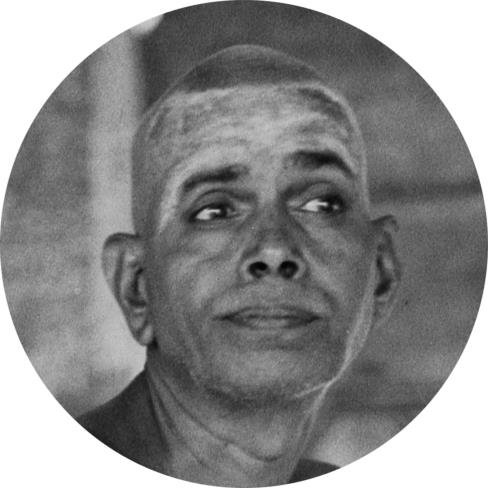
Sri Bhagavan And Grace
பற்றிமால் விடம்தலை யுற்றிறு முனும் அருள் பற்றிட அருள்புரி அருணாசலா!
– அருணாசல அக்ஷரமணமாலை, 64
“Grant me your Grace before the poison of delusion (ignorance) grips me and, rising to my head, kills me, Oh Arunachala!”
– The Marital Garland of Letters, v. 64
Going beyond thinking by jnana, beyond feeling by bhakti, beyond self-willed action by karma marga means going beyond that which arrogated to itself — from the very beginning — the ‘thinking’, ‘feeling’, ‘acting’ and in short the ‘doership’ – a ‘false I’. It means more and no less than returning to the Source of Pure Consciousness.
Thereafter:
“Your efforts can extend only that far, then the Beyond will take care of Itself. You are helpless there. No effort can reach It!” (Talk 197).
Here we meet the Great Experience of Sri Ramana, the Maharshi, in its second aspect, as the pure Power of the Beyond, Sakti: “Some force, call it atmic power or anything else, rose within me and took possession of me. I became a new man.” (Day by Day with Bhagavan, 22-11-1945)
This ‘power of the Beyond’ Sri Bhagavan calls elsewhere ‘Grace’ – among hundreds of other names for it. “Grace is ever-existing, ever-flowing “, says Sri Bhagavan. While adoring Arunachala, He says: “Ocean of Nectar, full of Grace”. “Grace is the Self. You are never out of its operation. Grace is always there”. “You are neck-deep in It and yet you cry for Grace. It is as if one neck-deep in water should feel thirsty!” That which exists is ‘Grace’, it is always there, it is available to all and it fills the entire Universe since it is Existence Itself. That which eternally IS the I AM and it is the inmost nature of all and so is available to all, at all times. This pure I AM in every one of us is ‘Grace’. Sri Bhagavan identifies ‘Grace’ with Guru. ‘Grace’ as Guru within, pulls you, while ‘Grace’ as Guru without, pushes you within into the Self. The transformation of the seeker into an adept is done by this operation of ‘Grace’ – both from within and from without.
The confluence takes place in the human Heart, which Sri Bhagavan calls both ‘உள்ளது ’ and ‘உள்ளம்’, ‘That which is’ and ‘What is within’. This Being is the Awareness ever there to embrace you into a Silence and Stillness which transcends all duality. “The highest form of ‘Grace’ is Silence. It is also the highest upadesa”, says Sri Bhagavan.
This assertion of Sri Bhagavan is a great change from the age-old, common belief that ‘Grace’ is to be obtained after strenuous efforts, that it has to come from somewhere above and beyond, that one has to deserve it, that it has to “choose” one. And so on.
Sri Bhagavan asserts: “’Grace’ is within every human being. It is the state of True Being, True Awareness, devoid of otherness. It is the Self.”
Sri Bhagavan says that to make an effort to know one’s real existence is due only to ‘Grace’: “Your very desire for ‘Grace’ is due to ‘Grace’ that is already within you”. “’Grace’ is that which always exists”. The true ‘I-I’ is Pure Being, Pure Awareness and Pure Bliss. The sat-chit-ananda in one is nothing but ‘Grace’ itself. The Aham sphurana is ‘Grace’; the Aham swarupa is ‘Grace’; the Hridayam itself is ‘Grace’!
Let us see how Sri Bhagavan deals with this ‘Grace’ in His written works.
In ‘Five Hymns to Arunachala’, Sri Bhagavan uses profusely the word ‘Grace’, ‘அருள்’, and describes it in twenty different ways: “All-kindness, Love, Saving, Moon of Grace, Benign Treasure, Adornment, Mercy, Blessings, Divine Life, Grace-warfare, Grace-Love-Arrow, Grace-partner, net of Grace, cords of Grace, light of Grace, ocean of Grace, effulgence of Grace.” Particularly in ‘Aksharamanamalai’ He has used the word ‘அருள்’, ‘Grace’ 59 times! In ‘Navamanimala’ thrice, in ‘Padhikam’ 5 times, in ‘Ashtakam’ twice and in ‘Arunachala Pancharatna’ and ‘Arunachala Mahatmiyam’ once each. ‘Grace’ is obviously everything for Him in the devotional hymns spontaneously written by Him, while up on the Hill, Arunachala.
Strangely, when we come to His philosophic treatises, like ‘Upadesa Undiyar’ and ‘Ulladu Narpadu’, He has not used the word ‘அருள்’ even once! His magnum opus — as far as His teachings are concerned — are ‘Upadesa Undiyar’ and ‘Ulladu Narpadu’, and imagine Bhagavan conveying His essential teaching in them without using this word ‘அருள்’, ‘Grace’, so pervasive in His devotional outpouring, ‘Five Hymns to Arunachala’!
Does it mean that there is any conflict between the Bhakti of the ‘Five Hymns to Arunachala’ and the Jnana of ‘Upadesa Undiyar’ and ‘Ulladu Narpadu’?
What are the key words in these two seemingly variant texts? In the Bhakti granta, it is ‘அன்பு’, ‘அருள்’ (Love and Grace) and in the Jnana granta it is ‘உள்ளது’, ‘உணர்வு’ (Being and Awareness). What do these four words mean? Love and Grace seem to belong to the warm realm of emotion and duality, while Being and Awareness belong to the bright realm of non-duality. At the superficial level the two worlds seem to differ.
The bhakta, like the blue lotus, basks in the cool moonlight of ‘Grace’, while the jnani, like the red lotus, rejoices in the fierce fire of non-duality. ‘Grace’ comes from surrender; jnana demands the effort of self-enquiry. Even ‘Grace’ seems hidden to the common man. Why? Sri Bhagavan says: “Grace is not manifest because of ignorance prevailing. With sraddha (perseverance) it will become manifest. Sraddha, Grace, Light, Spirit are all synonymous with the Self.” (Talk 381).
Grace or Self appears in outer form as the Guru. For us Sri Bhagavan is the Sat-Guru, manifested in a human body for our sake; to guide and strengthen us and awake us to the Being that lives eternally in us as the Self. The Guru is like a mother. “Guru’s Grace is like a hand extended to help you out of water, or it makes your way easier for the removal of ignorance.” (Talk 398).
Sri Bhagavan explains clearly. “’Grace’ is necessary for the removal of ignorance. But ‘Grace’ is all along there. ‘Grace’ is the Self. It is not something to be acquired. All that is necessary is to know its existence. For example, the Sun is brightness only. He does not see darkness. Whereas others speak of darkness fleeing away on the Sun approaching. Similarly, ignorance also is a ‘phantom’ and not real. Because of its unreality, its unreal nature being found, it is said to be removed. Again, the Sun is there and also bright. You are surrounded by Sunlight. Still if you would know the Sun you must turn your eyes in his direction and look at him. So also, ‘Grace’ is found by practice alone although it is here and now.” (Talk 354).
Sri Bhagavan gives the master-key to obtain ‘Grace’. “Surrender”, “Self-surrender” – is that key. The sense of duality which doubts and demands proofs is stilled. The doubter, the mischief-maker, slowly disappears. In surrender, the mind which doubts is dissolved, as in its mother’s lap; the mind which fears is lost in surrender!
Devotee : Is ‘Grace’ necessary for knowing the Truth?
Bhagavan: Yes.
D.: How to gain Divine Grace?
B.: By surrender.
D.: Still I do not feel ‘Grace’.
B.: Sincerity is wanting. Surrender should not be verbal or conditional... Prayer is not verbal. It is from the Heart. To merge into the Heart is prayer. That is also ‘Grace’.” (Talk 318).
In another place, Sri Bhagavan emphasises: “Surrender will make one understand the Grace.” (Talk 317). “That which is – is only ‘Grace’; there is nothing else.” (Talk 287). “’Grace’ is both the beginning and the end. Introversion is due to ‘Grace’; Perseverance is ‘Grace’; Realisation is ‘Grace’.” (Talk 319). Sri Bhagavan quotes Sri Bhagavad Gita: “mamekam saranam vraja”, “only surrender to Me”. If one has entirely surrendered oneself is there any part left to ask for ‘Grace’? He is swallowed up by ‘Grace’!” (Talk 320).
A devotee appealed to Sri Bhagavan that when he remembered His form his ‘mind’ should be strengthened and that response should come from His side; and that he should not be left to his individual efforts which he knew to be very weak. Sri Bhagavan graciously replied: “’Grace’ is the Self. I have already said: ‘If you remember Bhagavan, you are prompted to do so by the Self (‘Grace’)’. Is not ‘Grace’ already there? Is there a moment when ‘Grace’ is not operating in you? Your remembrance is the forerunner of ‘Grace’. That is the response, that is the stimulus, that is the Self and that is ‘Grace’.” (Talk 251). The very doubt “Will I have ‘Grace’” is to be eschewed. Sri Bhagavan says this very doubt ‘Can I have it’ or the feeling ‘I have not got it’ are the obstacles. “Be free from these also,” encourages Sri Bhagavan!
One may need further assurance to take the plunge of final surrender. And here it is: “The Guru is both within and without. So, he creates conditions to drive you inward and prepares the interior to drag you to the Centre. Thus, He gives a push from without and exerts a pull from within so that you may be fixed at the Centre. This is the Grace of the Guru.” He further asserts: “God, Guru and Grace are really one and identical. He who has earned the Grace of the Guru shall undoubtedly be saved and never forsaken, just as the prey that has fallen into the jaws of a tiger will never be allowed to escape. Nevertheless, the disciple, for his part, must unswervingly follow the path shown by the Master.”
Are surrender and Self-enquiry inconsistent with each other? “No”, says Sri Bhagavan. “What the bhakta calls surrender, the man who does vichara calls Jnana. Both are trying to take the ‘ego’ back to the Source from which it sprang and make it merge there.” Both surrender or Bhakti and strenuous Self-enquiry help to dissolve one’s ‘ego’. So, both by bhakti and jnana the final result of destroying the mischief-maker, the ‘mind’, the ‘ego’, is realised.
A devotee, even after much discussion and Sri Bhagavan’s ample clarifications, had doubts about the grant of His Grace. Sri Bhagavan patiently but emphatically replied: “Are you asking this question without ‘Grace’? ‘Grace’ is the beginning, middle and end. ‘Grace’ is the Self. Because of false identification of the Self with the body, the Guru is considered to be with ‘body’. But from the Guru’s outlook, the Guru is only the Self. The Self is One only. He tells that the Self alone IS. Is not then the Self your Guru? Where else will ‘Grace’ come from? It is from the Self alone. Manifestation of the Self is manifestation of ‘Grace’. All doubts arise because of the wrong outlook and consequent expectation of things external to oneself. Nothing is external to the Self.” (Talk 157).
Then, what is meant by Sri Bhagavan’s ‘Grace’? The answer is the counter-question: Is not Sri Bhagavan ‘Grace‘ itself? Every word He spoke, every word He wrote, was ‘Grace’. He was Himself “Ocean of Grace, Nectar Supreme”! His Light eternal guides His devotees from within, from His seat of Sovereignty, the Heart. “Arunachala Ramana is the Supreme Being sporting within the Lotus – Hearts of all beings.”
An elderly devotee wanted to express gratitude to Sat-Guru Ramana for having revealed to him the realm of the Self, by quoting a verse from ‘Kaivalya Navaneeta’: “Lord, you are the Reality abiding as my inmost Self, ruling me during all my countless births! Glory to you who have put on this human form in order to redeem me through your upadesa, I do not see how I can repay your ‘Grace’ for having liberated me. Glory! Glory to your Holy Feet!” Sri Bhagavan claimed and took the repayment, by Himself quoting the next verse from the same text: “To stay fixed thus in the Self, without the three clouds (ignorance, uncertainty and wrong knowledge) obscuring your experience, is the highest recompense you can render to me!”
Oh Bhagavan! Thy Name is ‘Grace’; Shower Thy Grace on us all !!
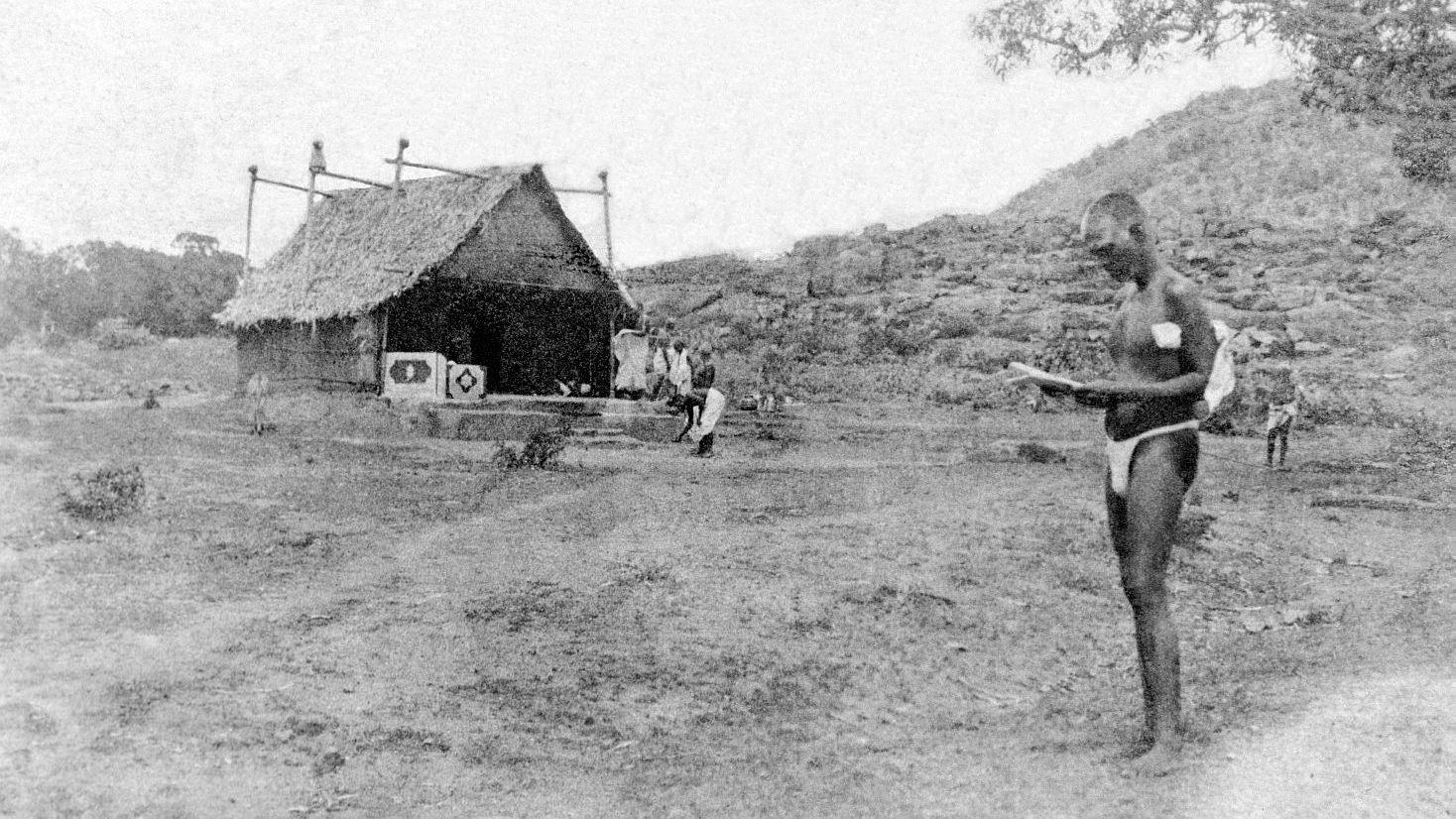
“Sri Ramanasramam” in 1922 — a thatched shed over the Samadhi of Mother Alagammal. Sri Bhagavan examining given to Him by a devotee
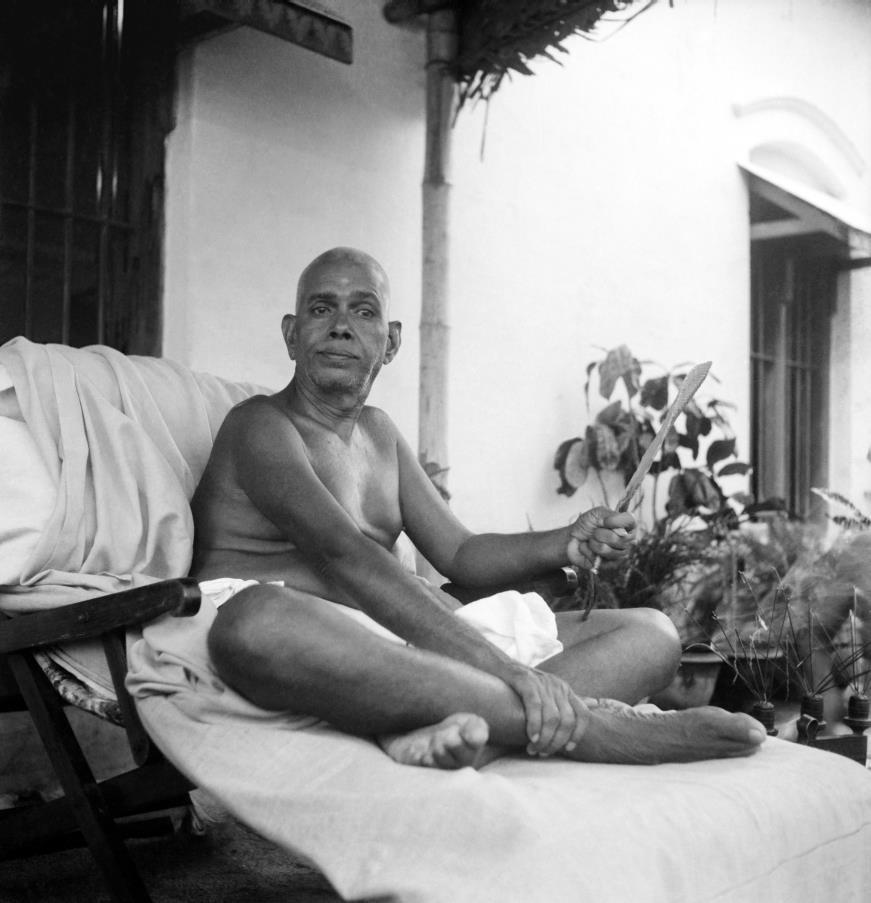
Outside the Old hall near the Well — Very popular photo among Old Devotees in the earlier days