Treasure Trove of Sri Bhagavan’s Grace
In this chapter
- Thirumoolar’s “Thirumandiram”
- 1910 Do not Consign Siva-Jnani's1 Body to Fire; Nor Neglect it
- 1911 Disasters Follow if Jnani's Body is Consigned To Fire
- 1912 Bury Jnani's Body in Proper Way
- 1913 Bury Jnani's Body in an Underground Sepulchre
- 1914 Samadhi Rituals
- 1915 Samadhi Cave Locations
- 1916 Dimension For the Sepulchre Cave
- 1917 Samadhi Rituals
- 1918 Samadhi Rituals (Cont.)
- 1919 Samadhi Rituals (Cont.)
- 1920 Samadhi Rituals (Cont.)
- 1921 Samadhi Rituals (Cont.)
- 1922 Samadhi Pujas
Jnani’s Samadhi Rituals
On the day of Mother Alagammal passing away, from early in the morning, Sri Bhagavan sat next to her with His left hand on her head and His right hand on the right side of her chest. He remained like that for nearly eight hours. The devotees who had gathered there knew that her end had come. They observed the beauty and sanctity of a son elevating his mother’s soul to the Infinite. Kunju Swami who was present later said that the devotees observing this felt it was a physical demonstration of the soul’s journey to the Absolute — it was like heat and light spreading from a flame. When He was sure that the ‘soul’ and ‘mind’ had merged in the “Self”, Sri Bhagavan took His hands off and then said, “When the soul merges with the Self and is completely annihilated, a soft ring like sound — like that of a bell — can be felt.”
It was a common practice that after witnessing a death, all those present must bathe. However, Sri Bhagavan said that in this case there was no need as there was no pollution. “She did not die. She is ‘Absorbed in Arunachala’,” He stated. Later, the devotees who were there enquired, “Bhagavan, what did you do by keeping your hands on her head and her chest? What exactly took place?” Sri Bhagavan explained, “‘Innate tendencies’ and ‘subtle memories’ of past experiences that lead to future possibilities became very active when my hands were placed on her. Scene after scene rolled before her in her subtle consciousness. The outer senses had already gone. The ‘soul’ was passing through a series of experiences, thus avoiding the need for rebirth and making possible the ‘union’ of the ‘mind’ with the “Self” or the “Heart”. The soul was at last disrobed of all subtleties before it reached its Final Destination, the Supreme Peace of Liberation, from which there is no return to ignorance.”
My teacher, Pundit T. K. Sundaresa Iyer, Kavyakantha Ganapati Muni, Manavasi Ramaswami Iyer, Vedic pundits and a great number of devotees were at Skandashram. The question arose as to how the Mother’s body should be cremated. Nayana made TKS go and ask Sri Bhagavan. Sri Bhagavan referred him to Thirumoolar’s Thirumandiram, especially to the pages specifying as to how a Jnani’s body be treated after its death. Kavyakantha stood firm that with Sri Bhagavan affirming the state of Videha Mukti to Mother Alagammal, all arguments that she was a ‘woman’ and that too a ‘widow’ and that tradition insisted on such a body should be burnt after death, did not have any value. He suggested that the body be carried down to the land at the foot of the hill where Sri Ramanasramam now stands, and be given a ceremonial burial. He later even gave the name ‘Mathrubutheswara Maha Lingam’ to the Shivalingam which was placed over the spot Mother’s body was interred.
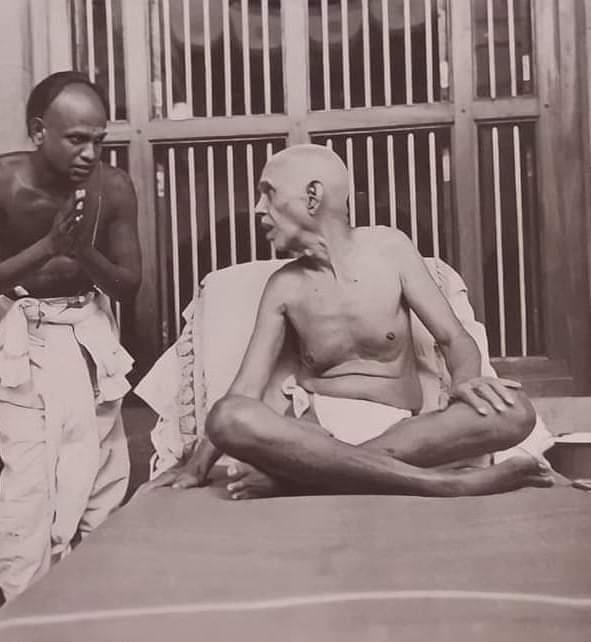
Vaidhyanatha Sthapati is receiving guidance from SRI BHAGAVAN on the construction of Sri Mathrubuteswara Temple – Mother Alagammal’s Shrine!
Years later, it was TKS who got the confirmation about the structure of the Samadhi to be built for the sacred body of Sri Seshadri Swami after he dropped it. Sri Bhagavan Himself stood there and made sure that Thirumandiram's specifications were meticulously followed as the body of Sri Seshadri Swami was interred.
Further, following Sri Bhagavan’s instructions, Thirumandiram’s specifications were followed not only for constructing the Samadhis of Natesa Swami — the head of the Kovilur Mutt — Masthan Swami, Sivaprakasam Pillai and Mudaliar Patti, but also for Cow Lakshmi, Valli, the deer, Jacky, the dog, and the anonymous but fortunate crow.
After Sri Bhagavan’s Brahma Nirvana, the Samadhis of Tanjore Janaki Mata, Tirukoilur Jnanananda Swami and others were also built according to Thirumandiram on the suggestion of TKS. Years later, when I came for good to stay in the Ashram, following the footsteps of my teacher TKS, I had the good fortune of having the Samadhis of Old Devotees - beginning with Major Chadwick, Muruganar, Viswanatha Swami, Kunju Swami, S.S.Cohen, and others in strict accordance with Thirumandiram. Also,when Yogi Ramsuratkumar dropped the body in 2001, at the request of Justice Arunachalam and Devaki Ma, I helped in seeing to it that Yogiji’s Samadhi too followed the same specifications. Finally, for Sadhu Natananda’s Samadhi, Sadhu Om, Dorab Framji and I had the same thing done inside the compound of Dorab’s house.
* * *
Please read the Sacred Text of this incomparable Guidance Book:
Thirumoolar’s “Thirumandiram”
1910 Do not Consign Siva-Jnani's1 Body to Fire; Nor Neglect it
If the body of Siva-Jnani is to fire consigned, The people entire will in burning fever suffer; If his body a prey to dogs and jackals left, Tumultous war the land will see, And the people a prey to dogs and jackals be.
1911 Disasters Follow if Jnani's Body is Consigned To Fire
If to fire the Jnani's body is consigned That will be unto fire the Lord's temple consigned; No more will rains fall on the land, Famine shall ravish the world, Countless kings will their kingdoms lose.
1 A Self-Realised Jnani is reverentially addressed as “Siva-Jnani”
1912 Bury Jnani's Body in Proper Way
Proper indeed is to bury them; If to fire they are consigned Destruction dogs the land; If left to perish, uncared for, The world its prosperity loses, A fell prey to devastating fire falls.
1913 Bury Jnani's Body in an Underground Sepulchre
Let the body of Jnani, When Lord's Grace receives, Be in a cave seated, Appropriate in earth's bowel dug; Then stately rulers and people in land Receive blessings, Of Grace infinite.
1914 Samadhi Rituals
Well dig the sepulchre, Heap the earth five cubits around, Shape it into a triangle Three cubits on sides; And there in Padmasana, Seat the body.
1915 Samadhi Cave Locations
One's own homestead, roadside, tank bund, riverbed, Flowery grove, city's common Forest dense, and mountain valley high --These the sites appropriate, For the sepulchre to shape.
1916 Dimension For the Sepulchre Cave
Five feet on four sides all, Nine feet straight deep, Three feet each on the triangle's sides --These the dimensions Appropriate for the sepulchre to shape.
1917 Samadhi Rituals
In abundance spread the five metals precious And the nine gems rare; Upon them place the seat, Scatter the Kusha grass, And shower the holy ashes white; Above that scatter Turmeric powder that is of color gold And incenses richly mixed.
1918 Samadhi Rituals (Cont.)
Shape the cave inside into a square, Upon that lay garlands of honey-dew flowers; Sandal, musk, civet, and unguents diverse; And pouring rose's water Light the ritual lamp, in devotion ecstatic.
1919 Samadhi Rituals (Cont.)
Smear the body entire with ashes white and holy To form a shroud protective; Place the body on an Asana (seat) appropriate, Spangle bright with incenses several and ashes holy; And thus seated, cover the cave with earth.
1920 Samadhi Rituals (Cont.)
Having covered thus, level the four sides; Place his sandals and ear rings, And an image with face and eyes Decked in dress appropriate; Offer parched rice, food, and tender coconut.
1921 Samadhi Rituals (Cont.)
Then pour the ashes white and powdered incense, Shower flowers diverse, Kusha grass and Bilva leaves, Sprinkle water holy, And raise a platform three feet by three.
1922 Samadhi Pujas
Upon the platform plant The sapling of peepal tree, or a Lingam holy, Arrange the Sannidhi (face) toward north or east And perform pujas with rituals sixteen, In devotion endearing.
— from “Tirumular Thirumandiram – English translation of the Tamil Spiritual Classic by Dr. B.Natarajan”
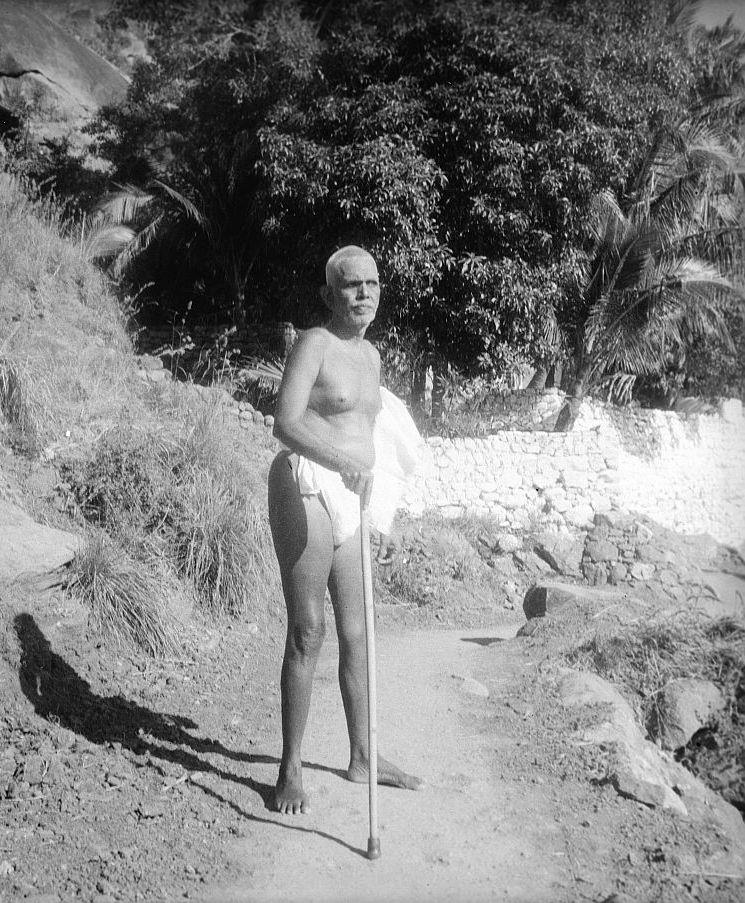
Going from Sri Ramanasramam to Skandashram in 1945 (before entering it)