Treasure Trove of Sri Bhagavan’s Grace
Ribhu Gita (Chapter 26)
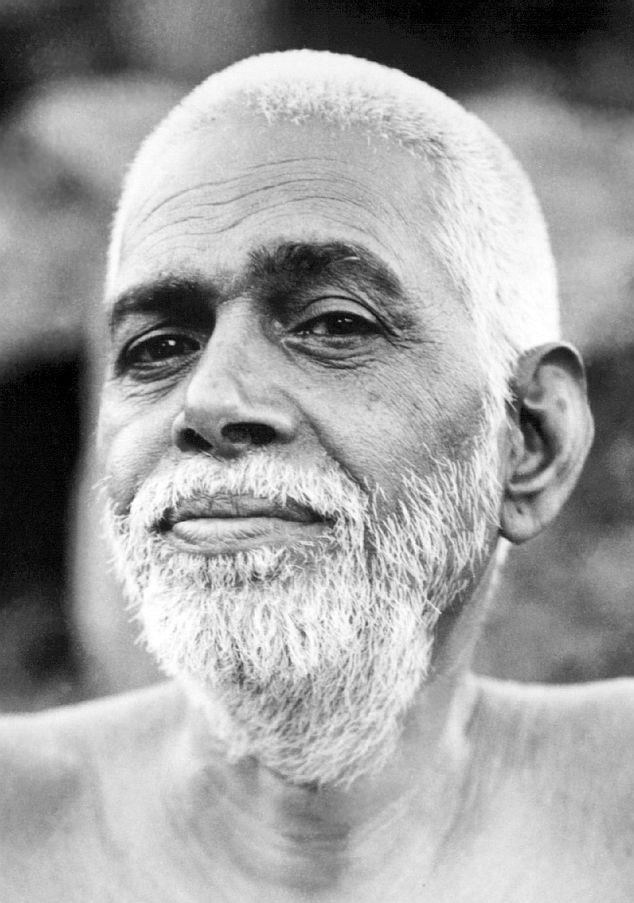
One of Sri Bhagavan's favourite traditional spiritual works was the Ribhu Gita. The Ribhu Gita forms the sixth section of the Sanskrit work known as Siva Rahasya. It is the teachings of Lord Siva in Mount Kailas to His devotee Ribhu, from whom the Gita derives its name.
Sri Bhagavan often referred to the Ribhu Gita in his talks with devotees and seekers, and he is reported to have said that if one repeatedly read Chapter 26 of the Ribhu Gita one could pass spontaneously into Samadhi, or the natural state of Self-realisation.
Sri Bhagavan’s first attendant, Palaniswami had brought a copy of Ribhu Gita to Sri Bhagavan's attention. Later in life Sri Bhagavan related how surprised he was at the time to hear an exact description of his own state recited in the Ribhu Gita and that it had been experienced by others and was the Bliss of the Self sought after by all true seekers.
* * *
Although Ribhu taught his disciple the Supreme Truth of the One Brahman without a second, Nidagha, in spite of his erudition and understanding, did not get sufficient conviction to adopt and follow the path of jnana, but settled down in his native town to lead a life devoted to the observance of ceremonial religion.
But the Sage loved his disciple as deeply as the latter venerated his Master. In spite of his age, Ribhu would himself go to his disciple in the town, just to see how far the latter had outgrown his ritualism. At times the sage went in disguise, so that he might observe how Nidagha would act when he did not know that he was being observed by his Master.
On one such occasion Ribhu, who had put on the disguise of a village rustic, found Nidagha intently watching a royal procession. Unrecognized by the iowndweller Nidagha, the village rustic enquired what the bustle was all about, and was told that the king was going in procession.
"Oh ! it is the king. He goes in procession ! But where is he ?" asked the rustic.
"There, on the elephant" said Nidagha.
"You say the king is on the elephant. Yes, I see the two" said the rustic, "but which is the king and which is the elephant?”
"What!" exclaimed Nidagha, "you see the two, but do not know that the man above is the king and the animal below is the elephant? Where is the use of talking to a man like you?"
"Pray, be not impatient with an ignorant man like me" begged the rustic. "But you said ‘above' and 'below', what do they mean?"
Nidagha could stand it no more. "You see the king and the elephant, the one above and the other below. Yet you want to know what is meant by 'above' and 'below'?" burst out Nidagha. "If things seen and words spoken can convey so little to you, action alone can teach you. Bend forward, and you will know it all too well."
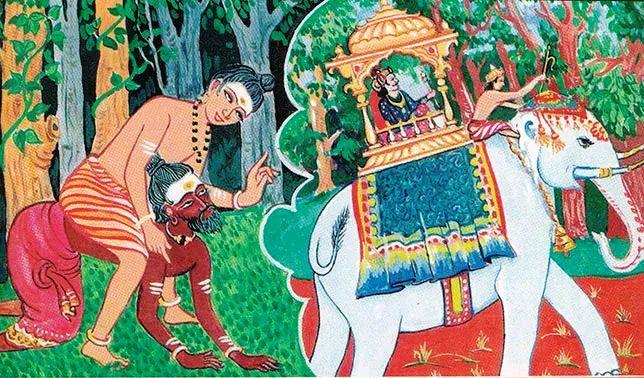
The rustic did as he was told. Nidagha got on his shoulders and said "Know it now. I am above as the king, you are below as the elephant. Is that clear enough ?"
"No, not yet", was the rustic's quiet reply.
"You say you are above like the king, and I am below like the elephant. The ‘king', the 'elephant', 'above' and 'below', so far it is clear. But pray, tell me what you mean by ‘I’ and ‘you’ ?" When Nidagha was thus confronted all of a sudden with the mighty problem of defining the ‘you' apart from the 'I' light dawned on his mind.
At once he jumped down and fell at his Master's feet saying :
"Who else but my venerable Master, Ribhu, could have thus drawn my mind from the superficialities of physical existence to the true Being of the Self ? Oh ! Benign Master, I crave thy blessings."
* * *
Ribhu Gita (Chapter 26)
Inhering in the Undifferentiated and Non-dual Reality
1. I shall now expound to you the method of inhering in the All-inclusive and undifferentiated Reality. This teaching is secret and difficult to understand without the help of the Vedas and other scriptures. Even divas and yogis who hold it dear acquire it only with great difficulty. Follow what I say and, inhering in Reality, be happy.
2. My son! Realised Sages say that absolute inherence in Reality means becoming one with the immutable, tranquil and non-dual Brahman which is Existence-Consciousness-Bliss and the Self of all, and making the wandering mind one with it like the proverbial milk and water, absolutely free from all concepts.
3. When one scrutinises this variety of manifestation one realizes that it does not really exist and that everything is the undifferentiated Supreme Brahman which is not different from the Atman and oneself. Let this knowledge become firm with you by constant practice. Then, discarding everything, become one with the Supreme Brahman and, remaining as that, be happy.
4. Abide as That which does not, when scrutinized, show any duality in the form of these various objects or the least trace of cause and effect ; that in which, when the mind is absorbed in it, there is no fear of duality at all — and be always happy, unshakable and free from the fear arising from duality.
5. Abide as That in which there are neither thoughts nor fancies, neither peace nor self-control, neither the mind nor the intellect, neither confusion nor certainty, neither being nor non-being and no perception of duality — and be always happy, unshakable and absolutely free from the fear arising from duality.
6. Abide as That in which there is neither any defect nor good quality, neither pleasure nor pain, neither thought nor silence, neither misery nor austerities,1 no 'I am the body' idea, no objects of perception whatsoever — and be always happy, free from all traces of thought.
7. Abide as That in which there is no work, physical, mental, verbal or of any other kind, neither sin nor virtue, neither attachment nor its consequences — and be always happy, free from all traces of thought.
8. Abide as That in which there are neither thoughts nor a thinker, neither the arising nor the preservation nor the dissolution of the world, nothing whatsoever at any time — and be always happy, free from all traces of thought.
1 which are practised for getting rid of misery.
9. Abide as That in which there is neither maya nor its effects, neither knowledge, nor ignorance, neither jiva nor Isvara, neither being nor non-being, neither world nor God — and be always happy, free from all traces of thought.
10. Abide as That in which there are no gods and their worship, none of the three gods2 or meditation on them, no Supreme Siva nor meditation on Him — and be always happy, without the least trace of thought.
11. Abide as That in which there is neither maturing karma nor bhakti nor jnana, no fruit of action to be enjoyed, no supreme state separate from it, no means of attainment or object to be attained — and be always happy, free from all traces of thought.
12. Abide as That in which there is neither body nor senses nor vital forces, neither mind nor intellect nor fancy, neither ego nor ignorance, nor anyone who identifies himself with them, neither the macrocosm nor the microcosm — and be always happy, free from all traces of thought.
13. Abide as That in which there is neither desire nor anger, neither greed nor delusion, neither ill-will nor pride, no impurities of mind and no false notions of bondage and liberation — and be always happy, free from all traces of thought.
14. Abide as That in which there is no beginning or end, no top or bottom or middle, no holy place or god, no gifts or pious acts, no time or space, no objects of perception — and be always happy, free from all traces of thought.
15. Abide as That in which there are none of the four spiritual qualifications,3 no competent guru or disciple, no steady knowledge, no realized stage, no liberation of either kind,4 nothing whatsoever at any time — and be always happy, free from all traces of thought.
16. Abide as That in which there are no Vedas or other scriptures, no one who thinks, no objection or answer to it, no theory to be established, no theory to be rejected, nothing other than one Self — and be always happy, free from (without) the least trace of thought.
17. Abide as That in which there is no debate, no success or failure, no word or its meaning, no speech, no difference between the jiva and the Supreme Being, none of the manifold adjuncts — and be always happy, without the least trace of thought.
18. Abide as That in which there is no need for hearing, etc.,5 no samadhi to be practised, no differences of the same kind (sajatiya) or of a different kind (vijatiya) or within itself (pragata) no words or their meanings — and be always happy, free from the least trace of thought.
2 Brahma the Creator, Vishnu the Preserver and Siva the Destroyer.
3 (a) Discrimination between the real and the unreal, (b) Absence of desire for the joys of this world as well as the next, (c) Possession of the six virtues like sense-control, mind-control etc., (d) Yearning for liberation.
4 Liberation while still alive and liberation after death.
5 Hearing (sravana), reflecting (manana) and practising (nididhyasana).
19. Abide as That in which there is no fear of hell (naraka), no joys of heaven (svarga), no worlds of Brahma or the other Gods, nor any object to be gained from them, no other world, no universe of any kind — and be always happy, without the least trace of thought.
20. Abide as That in which there is nothing of the elements nor even an iota of their derivatives, no sense of 'I' or 'mine' no fantasies of the mind, no blemish of attachment, no concept whatsoever — and be always happy, without the least trace of thought.
21. Abide as That in which there are none of the three kinds of bodies,6 none of the three kinds of states,7 none of the three kinds of jivas,8 none of the three kinds of afflictions,9 none of the five kinds of sheaths,10 no one to identify himself with them — and be always happy, without the least trace of thought.
22. Abide as That in which there is no sentient object, no power to hide Reality,11 no difference of any kind, no power of projecting unreal objects,12 no power of any other kind, no false notion about the world — and be always happy, without the least trace of thought.
23. Abide as That in which there are no sense organs or anyone to use them, that in which transcendent bliss is experienced, that which is absolutely immediate, that by realizing and attaining which one becomes immortal, that by becoming which one does not return to this cycle of births and deaths — and be always happy, without the least trace of thought.
24. Abide as That, on realizing which and experiencing the bliss of which, all joys appear to be the joys of That, that, on clearly knowing which to be oneself, there is nothing apart from oneself, and all kinds of jivas become liberated — and be always happy, without the least trace of thought.
25. Abide as That, on realizing which to be oneself, there is nothing else to be known, everything becomes already known and every purpose accomplished — and be always happy, without the least trace of thought.
6 The physical, the mental and the causal.
7 Waking, dreaming and sleeping.
8Those who are fully eligible to advance spiritually, those who are not so eligible and those who are not at all eligible.
9Afflictions of the body, afflictions caused by the gods and afflictions caused by the elements.
10 The physical, the vital, the mental, the intellectual and the blissful.
11 Avarana Sakti.
12 Vikshepa Sakti,
26. Abide as That which is attained easily when one is convinced that one is Brahman, that which results, when that conviction becomes firm, in the experience of the supreme bliss of Brahman, that which produces a sense of incomparable and complete satisfaction when the mind is absorbed in it — and be always happy without the least trace of thought.
27. Abide as That which leads to the complete cessation of misery when the mind is absorbed in it, and the extinction of all ideas of 'I', 'you' and 'he' and the disappearance of all differences — and be always happy, without the least trace of thought.
28. Abide as That in which, when the mind is absorbed in It, one remains without a second, nothing other than oneself is seen to exist and incomparable bliss is experienced — and be always happy, without the least trace of thought.
29. Abide as That which is undifferentiated Existence, undifferentiated Consciousness, undifferentiated Bliss, absolutely non-dual, the undifferentiated Brahman and with the firm conviction that you are That, be always happy.
30. Abide as That which is 'I' as well as 'you' as well as everyone else, is the basis of all, is one without anything else whatsoever, is extremely pure, the undifferentiated Whole and with the firm conviction that you are That, be always happy.
31. Abide as That in which there are no concepts or anything else whatsoever, the ego ceases to exist, all desires disappear, the mind becomes extinct and all confusions come to an end and with the firm conviction that you are That, be always happy.
32. Abide as That in which there is no awareness of the body etc. and no perception of objects, that in which the mind is dead, the jiva become one with the Reality, thoughts dissolved and even one's convictions no longer hold and with the firm conviction that you are That, be always happy.
33. Abide as That in which there is no longer any dhyana or yoga or ignorance or knowledge or activities of any kind, that which is the Supreme Reality and with the firm conviction that you are That, be always happy.
34. Abide as That in which, when one is completely merged with it, one experiences pure bliss, never experiences misery, sees nothing, does not take birth again, never thinks oneself to be a separate individual, becomes the Supreme Being and with the conviction that you are That, be always happy.
35. Abide as That which is truly the Supreme Brahman, the Supreme Siva, the absolutely pure Being, the Supreme State, absolute consciousness, the Supreme Truth and with the conviction that you are That, be always happy.
36. Abide as That which is the absolutely pure Supreme Being, absolute bliss, the supremely subtle Being, the Self-Effulgent, non-dual and undifferentiated one and with the conviction that you are That, be always happy.
37. Abide as That which is absolute truth, supreme tranquility, eternal being, absolutely attributeless, the Self, the absolutely undifferentiated supreme being and with the conviction that you are That, be always happy.
38. Abide as That which is everything from the empirical point of view and nothing from the absolute point of view, Existence-Consciousness-Bliss, always tranquil, with nothing separate from it, the self-existent being and with the conviction that you are That, be always happy.
39. I have thus, O Nidagha, clearly explained to you the state of being one with the Supreme Being. By constantly thinking that you are the undifferentiated Supreme Being you can attain that state and enjoy constant bliss. Thereafter, having become Brahman, you will never experience the misery of samsara.
40. "Everything is the Supreme Being which is Existence-Consciousness-Bliss and I am That." By constantly cultivating this pure thought, get rid of impure thoughts. Then, my son, discarding even that thought and always inhering in the State of Fullness, you will become the non-dual and undifferentiated Supreme Being and attain liberation.
41. Pure and impure thoughts are a feature of the mind. There are no wandering thoughts in the Supreme Being. Therefore abide as That and, free from the pure and impure thoughts of the mind, remain still like a stone or a log of wood. You will then be always happy.
42. By constantly thinking of the undifferentiated Supreme Being and forgetting thereby all thoughts including the thought of the Supreme Being, you will become the all-comprehensive Supreme Brahman. Even a great sinner who hears and understands this teaching will get rid of all his sins and become the undifferentiated Supreme Being.
43. The endless Vedas have already prescribed meditation for attaining purity of mind. In order that those who have become pure in mind may easily attain liberation and, realizing that they are absolute and boundless bliss, remain still like a stone in the undifferentiated and all-comprehensive Supreme Siva, the nature of this immaculate state has been expounded by me.
44. Therefore, attaining purity of mind by constantly thinking that everything that is known is Siva and that, that Siva is oneself, and thereafter abiding in the state of complete identity with Brahman, liberation can be attained here and now. I have spoken the truth. In this manner, Sage Ribhu expounded the state of being all to Nidagha.
45. When one is convinced that one is always that which is Existence-Consciousness-Bliss and abides as that in a state of complete identity, one casts off the unreal bondage of samsara and attains liberation. This is the significance of the highly blissful dance of our Supreme and undifferentiated Lord.